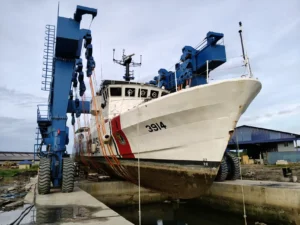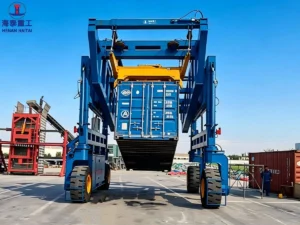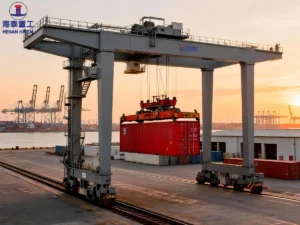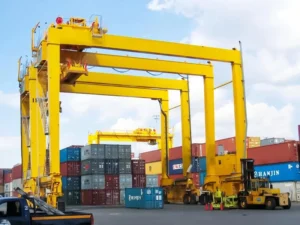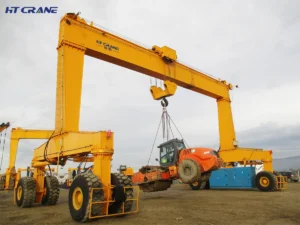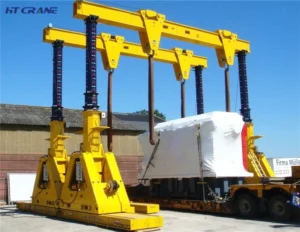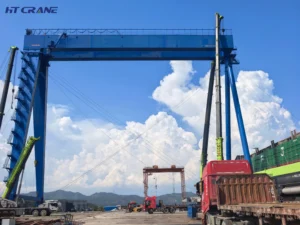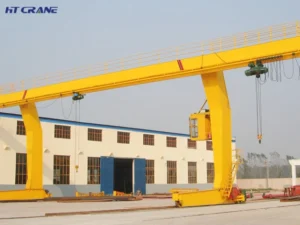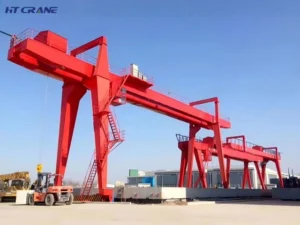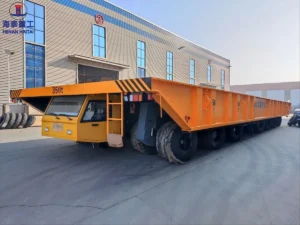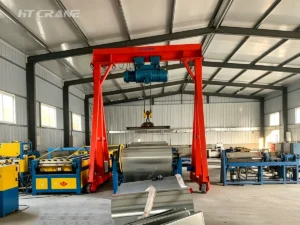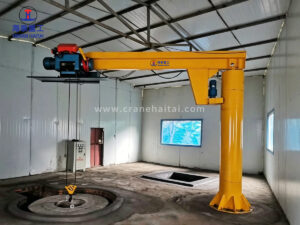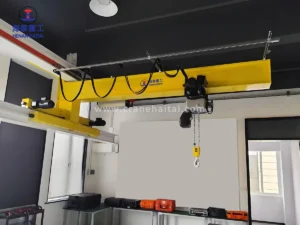

If you manage a marina, boatyard, or naval facility, you already know the pain: vessels stuck in the water waiting for maintenance, slipways that damage hulls, and cranes that simply weren’t built for boats. A marine travel lift solves all three problems in a single machine. It lifts, moves, and launches vessels safely — without fixed rails, without hull damage, and without slowing down your yard. This page covers everything you need to evaluate a marine travel lift: what it does, where it works, what makes ours different, and the full technical specs. If you are ready to specify a unit, our engineering team responds to enquiries within 24 hours. Product Description A marine travel lift — also called a boat travel lift, mobile boat hoist, or self-propelled boat hoist — is a rubber-tyred gantry crane designed specifically for vessel handling. The portal frame straddles the boat in the water. Polyester slings are positioned under the hull. The vessel is then lifted clear and driven anywhere on land. No rail tracks. No fixed infrastructure. Just one machine that handles haul-out,…
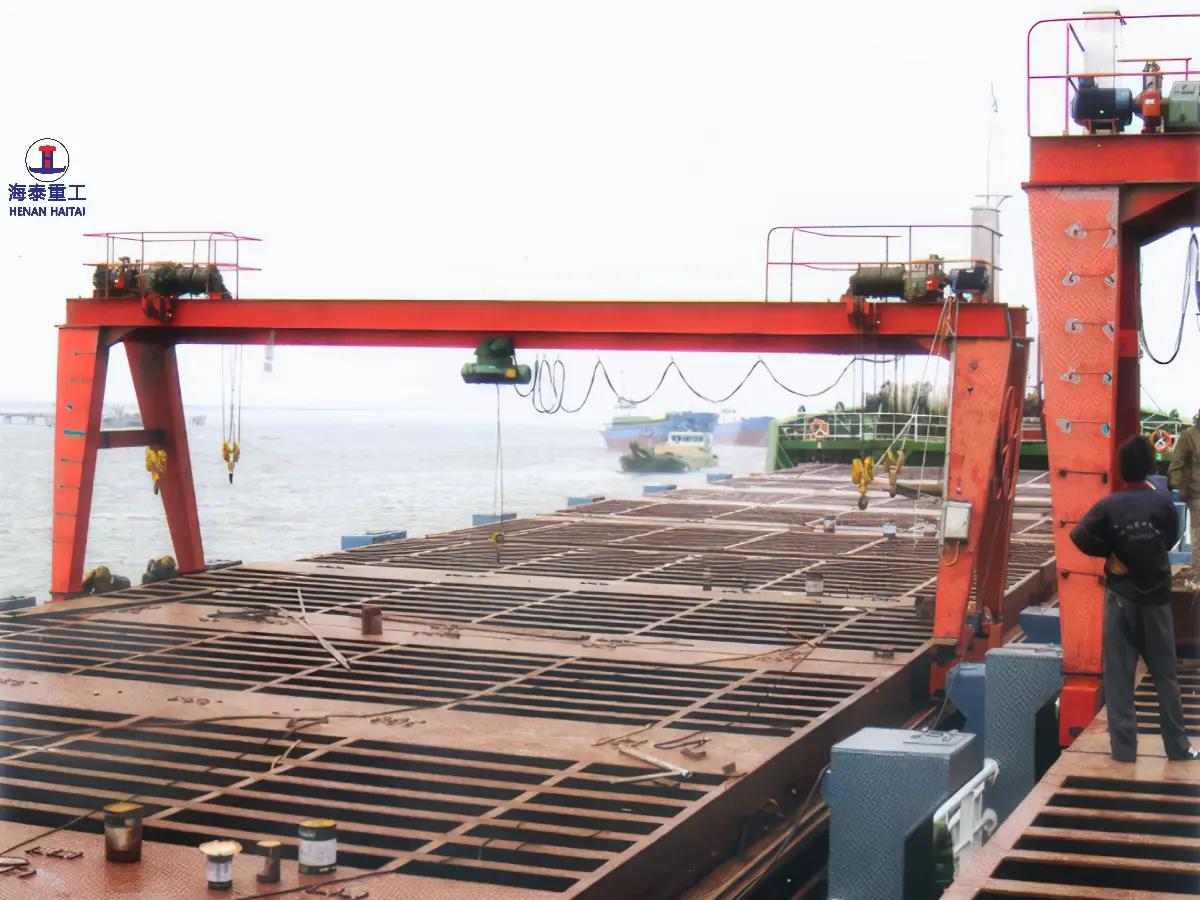
The hatch cover gantry crane is a rail-travelling box-leg gantry structure along bulk carriers’ and general cargo vessels’ hatch coaming, used to lift, shift and stack lift-away hatch covers. It is built as single or twin-girder frame with one or two independent electric hoists, runs on flanged wheels along coaming-top rails, driven by variable-frequency motors for smooth positioning in sea-state working conditions. Capacities range 5 to 40 tons, with single-hook or twin-hook (e.g. 2×12.5T), and CCS, BV, ABS or RINA classification is available on request. What Is a Hatch Cover Gantry Crane? A hatch cover gantry crane is dedicated marine deck-handling equipment, designed for opening, closing, hoisting, and maintenance of ship hatches, this compact structure is suitable for decks with limited space and frequent operation. Unlike a shore-based gantry, it is a marine deck crane: it must run on the ship’s own coaming rails, tolerate roll and pitch, resist salt-spray corrosion, and be light enough not to overload the deck structure while still handling covers that can weigh 5–40 tons apiece. The frame is either a single-girder gantry with one enveloping trolley/hoist, or a twin-girder gantry carrying two independently-driven electric hoists…

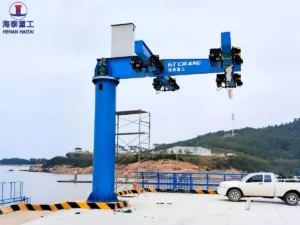
A boat jib crane is a marine-grade lifting solution designed specifically for docks, marinas, shipyards, and offshore platforms — where saltwater corrosion, confined space, and dynamic loads demand equipment built to a different standard. HaiTai Crane’s boat jib cranes deliver 0.5 to 20 tons lifting capacity, 180° to 360° rotation, and full C4–C5 marine corrosion protection from structural steel to electrical enclosures. Quick Reference: Boat Jib Crane Specifications Parameter Standard Range Custom Available Lifting Capacity 0.5 t – 20 t Up to 50 t on request Jib (Boom) Length 3 m – 10 m Up to 15 m Rotation Angle 180° / 270° / 360° Configurable Lifting Height 3 m – 12 m Customizable Hoist Type Electric chain / Wire rope Manual available Control Mode Push-button / Radio remote Cabin option Corrosion Protection Hot-dip galvanized + marine paint C4/C5 ISO 12944 Mounting Type Column / Wall / Dock-embedded Floating dock option Certification CE, ISO 9001:2015 CCS / BV on request Power Supply 380V / 50Hz (customizable) Global voltage supported What Is a Boat Jib Crane Structure and Operating Principle A…

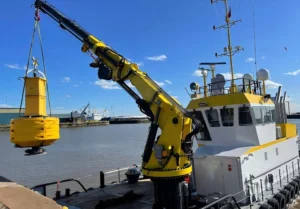
A marine arm crane is one of the most versatile pieces of deck equipment a vessel can carry. Unlike a straight-boom deck crane, a knuckle boom or articulated arm crane folds compactly when not in use, reaches over obstacles, and positions loads with precision that a fixed boom simply cannot match. For ship owners and procurement teams evaluating deck crane options, the choice between a straight boom and an articulated arm crane often comes down to one question: does your operation require the crane to work in confined spaces, reach below deck level, or handle irregular load positions? If yes, a marine arm crane is almost certainly the right choice. This page covers what marine arm cranes are, where they are used, what the key specifications mean, and how to evaluate suppliers before committing to a purchase. What Is a Marine Arm Crane? The Core Design Concept A marine arm crane — also called a knuckle boom crane or articulated marine crane — uses two or more boom sections connected by hydraulic-powered knuckle joints. This articulation allows the crane to…
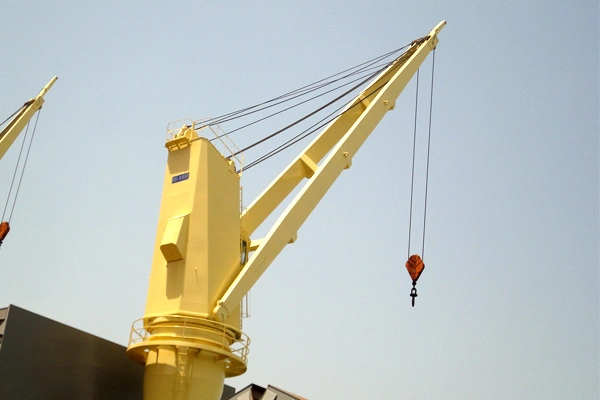
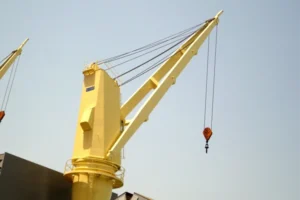
Selecting the wrong ship deck crane creates problems that follow you for the vessel’s entire operational life. Inadequate lift capacity, poor outreach, or a crane not certified by your classification society — any of these can delay port clearance, increase operating cost, or create liability exposure in the event of an incident. This page gives procurement managers, ship owners, and shipyard purchasing teams a clear, practical overview of what to look for when sourcing a ship deck crane. We cover equipment types, key technical parameters, certification requirements, and what distinguishes a reliable supplier from a risky one. HT crane manufacture and export ship deck cranes across a full capacity range — and we back every unit with classification society certification, factory load testing, and long-term spare parts support. What Is a Ship Deck Crane? The Basic Function A ship deck crane is a rotating lifting device permanently mounted on a vessel’s deck. It handles cargo loading and unloading at ports where shore-based equipment is unavailable or insufficient. It also supports deck operations, equipment transfers, and maintenance lifts during voyage. Vessel…