

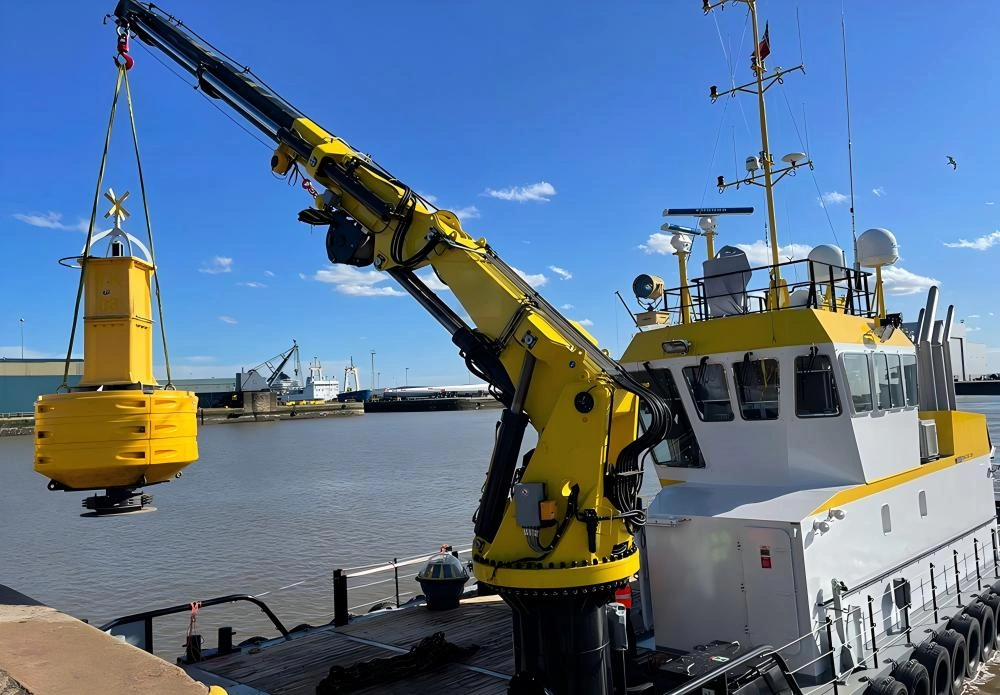
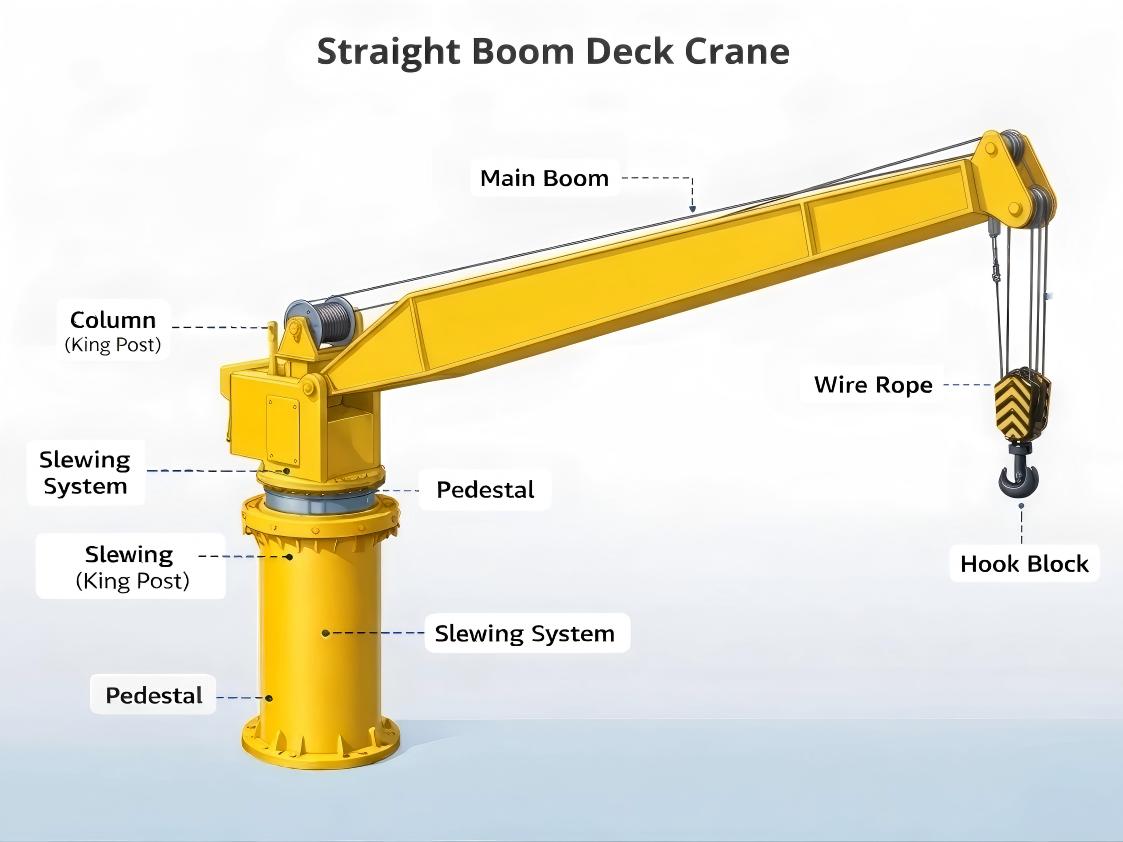
A marine arm crane is one of the most versatile pieces of deck equipment a vessel can carry. Unlike a straight-boom deck crane, a knuckle boom or articulated arm crane folds compactly when not in use, reaches over obstacles, and positions loads with precision that a fixed boom simply cannot match.
For ship owners and procurement teams evaluating deck crane options, the choice between a straight boom and an articulated arm crane often comes down to one question: does your operation require the crane to work in confined spaces, reach below deck level, or handle irregular load positions? If yes, a marine arm crane is almost certainly the right choice.
This page covers what marine arm cranes are, where they are used, what the key specifications mean, and how to evaluate suppliers before committing to a purchase.
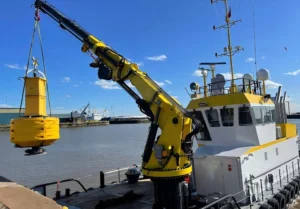
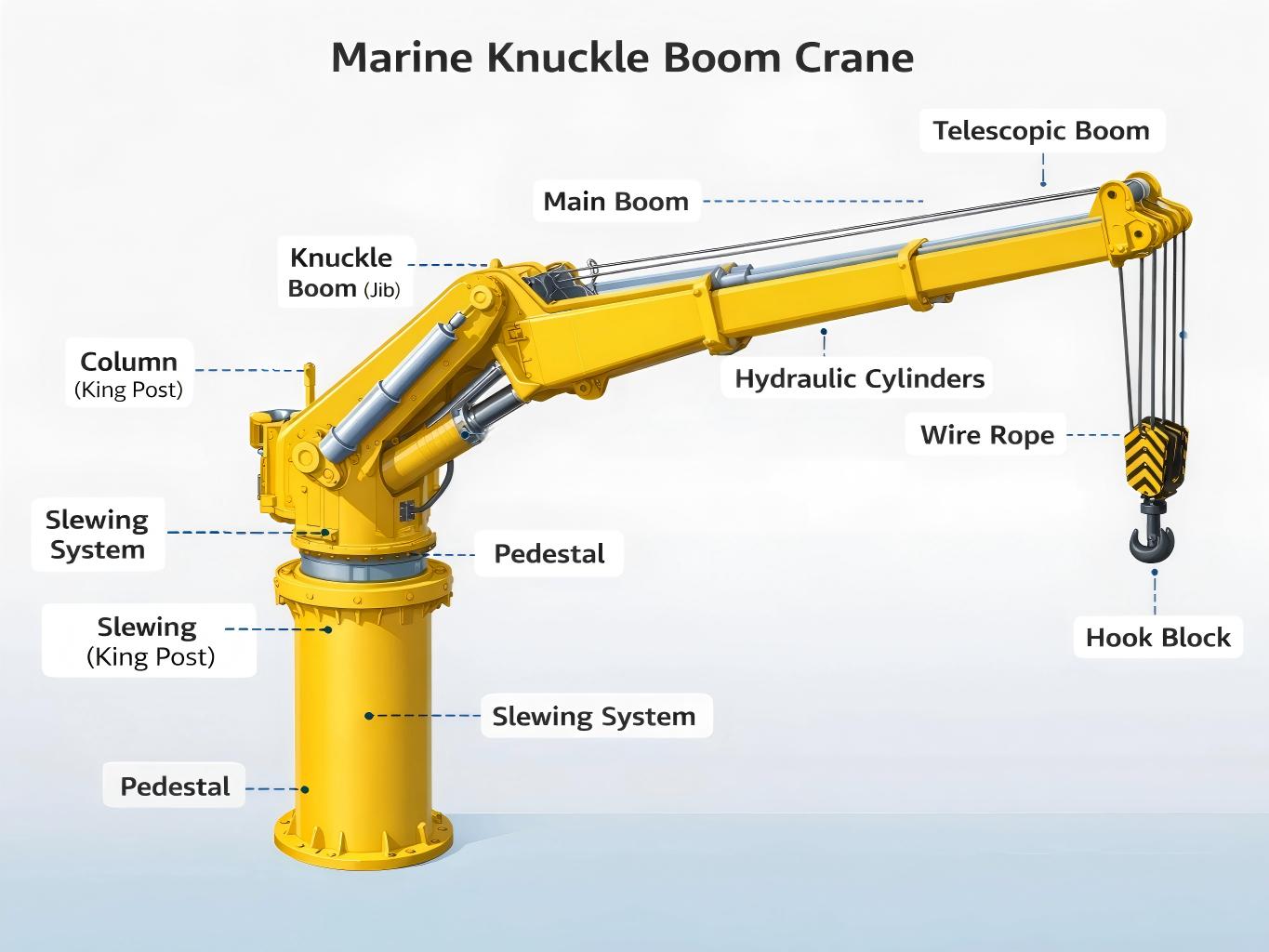
A marine arm crane — also called a knuckle boom crane or articulated marine crane — uses two or more boom sections connected by hydraulic-powered knuckle joints. This articulation allows the crane to fold, extend, and position the hook with much greater reach flexibility than a single fixed boom.
The result is a crane that can reach outboard over the vessel’s side, work in a downward arc below deck level, retract compactly against the superstructure when not in use, and handle loads in positions that a straight-boom crane would require repositioning the vessel to reach.
| Feature | Marine Arm Crane | Straight Boom Deck Crane |
|---|---|---|
| Boom Configuration | Articulated / knuckle joint | Fixed single boom |
| Reach Flexibility | High — works above and below datum | Limited to boom arc |
| Stowed Profile | Compact, folds flat | Requires vertical clearance |
| Precision Positioning | Very high | Moderate |
| Typical SWL Range | 1T – 50T | 5T – 100T+ |
| Best Application | OSV, fishing, research, patrol | General cargo, bulk carriers |
| Deck Space Required | Low | Moderate to high |
| Model Class | SWL at Max Outreach | Max Outreach | Typical Vessel Type |
|---|---|---|---|
| Light Series | 1T – 5T | 6m – 12m | Fishing, patrol, small research |
| Medium Series | 6T – 15T | 10m – 18m | OSV, general cargo, coastguard |
| Heavy Series | 16T – 30T | 14m – 24m | Platform supply, cable-lay |
| Custom Heavy | 31T – 50T | 18m – 30m | Offshore construction, naval |
SWL is rated at maximum outreach. At reduced radius, capacity increases per the load chart. Always request the full load curve — not just the headline SWL figure — when comparing models.
| Parameter | Specification Range |
|---|---|
| Safe Working Load (SWL) | 1T – 50T (standard); higher on request |
| Boom Outreach | 6m – 30m |
| Hook Height Above Deck | Up to 20m (model dependent) |
| Below-Deck Reach | Up to -8m (double knuckle models) |
| Slewing Range | 360° continuous |
| Slewing Speed | 0 – 2.5 rpm |
| Hoisting Speed | 8 – 40 m/min (full load) |
| Drive System | Fully hydraulic (electro-hydraulic HPU) |
| Control Options | Cabin, pendant, or radio remote control |
| Pedestal Type | Fixed or deck-mounted rotating pedestal |
| Classification Standards | DNV ST-0378, ABS, BV, LR, CCS |
| Marine Coating System | Sa 2.5 blast + 250-micron DFT epoxy |
| Operating Temperature | -30°C to +55°C |
Three control configurations are available, and the right choice depends on how the crane is operated:
Fixed cabin control — for cranes above 20T SWL where the operator needs full visibility and enclosed protection. Standard on heavy offshore models.
Pendant control — a wired handheld unit that allows the operator to move around the deck while controlling the crane. Widely used on fishing and small OSV applications where the operator needs direct line of sight to the load.
Radio remote control — wireless pendant, typically with a safety dead-man switch. Increasingly specified on research and survey vessels where operator positioning is unpredictable. Requires a certified radio control system per IEC 60945 marine electronics standard.
Marine arm cranes on offshore supply vessels handle cargo transfer between the vessel and fixed or floating platforms. This is among the most demanding crane operating environments: the vessel is in motion, the platform is fixed, and the load swings unpredictably in the gap between them.
For this application, cranes are designed and certified to DNV ST-0378 (the primary offshore crane standard). Active heave compensation (AHC) — a system that automatically counteracts vertical vessel motion during the lift — is available on models above 15T SWL for OSV applications. This significantly reduces dynamic load peaks and improves safety during personnel and equipment transfers.
Fishing vessel cranes are among the highest duty-cycle marine crane applications. They operate repeatedly throughout every working day — net handling, catch transfer, cage management in aquaculture, and supply boat transfers.
Compact knuckle boom cranes in the 2T–10T range are the standard for this sector. Key selection criteria are: duty cycle rating (FEM 1.001 class A5 or higher), corrosion resistance of all exposed components, and simplicity of maintenance — fishing operations frequently take place far from service infrastructure.
Research vessel cranes handle scientific equipment, sampling devices, ROV deployment frames, and instrumentation — often at significant water depth. The defining requirement is precision: equipment worth millions of dollars must be lowered through the water column with controlled speed and minimal swing.
Double-knuckle marine arm cranes with variable-speed hoisting and radio remote control are standard for research vessel applications. Winch integration — coordinating crane hoisting speed with a separate oceanographic winch — is a common custom requirement for this sector.
Naval applications introduce requirements beyond commercial standards: shock resistance to MIL-S-901 or equivalent, reduced acoustic signature, corrosion protection to the highest marine grade, and in some cases explosion-proof electrical systems. We design and manufacture naval-specification marine arm cranes with full documentation support for naval procurement processes.
Not all marine arm crane applications are offshore. River workboats, dredgers, environmental response vessels, and port service craft all use compact arm cranes for equipment handling, anchor work, and supply transfers. For these applications, the key drivers are compact stowed dimensions, low weight, and maintainability by non-specialist crews.
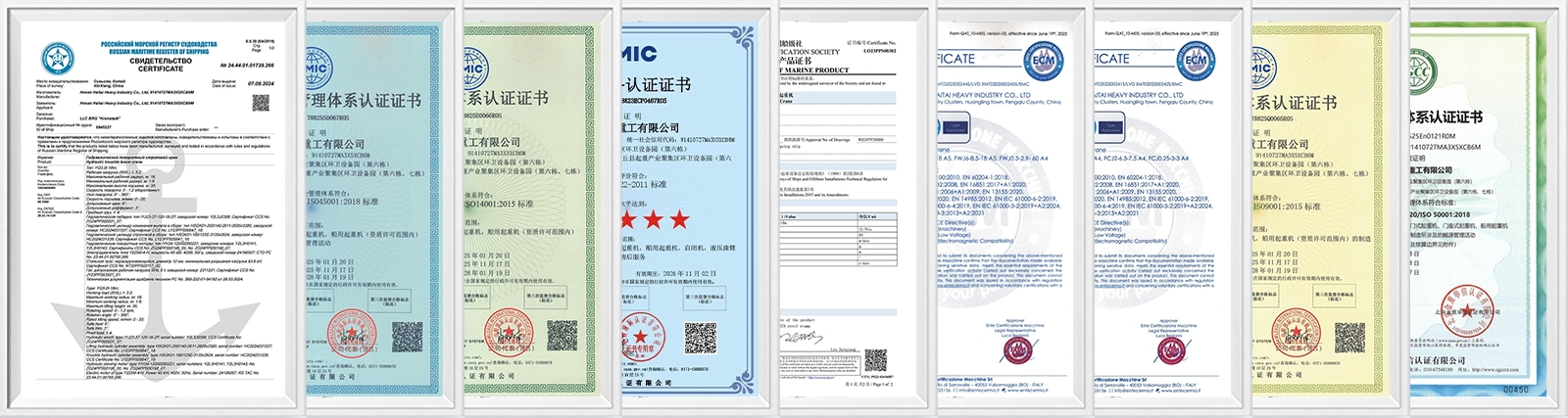
A marine arm crane installed on a commercial vessel requires certification by the vessel’s classification society. This is a mandatory condition of the vessel’s class certificate. The classification society reviews the crane’s structural design, manufacturing process, and load test results before issuing the crane certificate.
HT crane manufacture to the requirements of all major classification societies:
Classification certificates are issued by the independent surveyor — not by the manufacturer. The surveyor witnesses load testing at our factory and signs off on the certificate. Buyers should always verify that the certificate is issued by the classification society directly, not by a third-party testing company acting on the society’s behalf.
Before committing to a marine arm crane purchase, verify these five points with any supplier:
1. Does the crane have type approval from the required classification society? Ask for the type approval certificate number and verify it directly with the classification society. Type approval means the design has been independently reviewed — not just tested in isolation.
2. Is factory load testing witnessed by the classification surveyor? Witnessed testing is the standard. A certificate issued on documentation alone is not equivalent and may not be accepted by your flag state authority.
3. What is the hydraulic system specification? Marine hydraulic systems should use marine-grade fluid, stainless steel fittings in salt-water exposure zones, and corrosion-resistant cylinder rod materials. Ask for the hydraulic system specification in writing.
4. What coating system is applied? The industry standard for offshore marine environments is Sa 2.5 abrasive blast preparation followed by a three-coat epoxy system with minimum 250 microns dry film thickness. Cranes with inadequate coating degrade rapidly in salt-water service.
5. What spare parts are stocked and where? For vessels operating internationally, spare parts lead time is critical. Confirm which components are stocked at the manufacturer’s facility and what the maximum lead time is for critical hydraulic components.
A marine arm crane is a long-life investment that shapes your vessel’s operational capability for 20 years or more. The knuckle boom configuration offers reach flexibility, compact stowage, and precision load placement that fixed-boom cranes cannot match — and for the vessel types and operations described in this article, it is the more practical and capable choice.
Specification clarity and supplier verification are the two things that most directly determine whether the investment pays off. Define your SWL, outreach, duty cycle, and classification requirement clearly. Then verify your supplier’s credentials with the same rigor you would apply to any critical marine equipment purchase.
Our engineering team is available to review vessel drawings, confirm load charts, and provide classification-ready specifications for your project. Contact us to start the technical review.












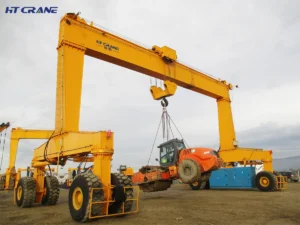
If you manage a marina, boatyard, or naval facility, you already know the pain: vessels stuck in the water waiting for maintenance, slipways that damage hulls, and cranes that simply weren’t built for boats. A marine travel lift solves all three problems in a single machine. It lifts, moves, and launches vessels safely — without fixed rails, without hull damage, and without slowing down your yard. This page covers everything you need to evaluate a marine travel lift: what it does, where it works, what makes ours different, and the full technical specs. If you are ready to specify a unit, our engineering team responds to enquiries within 24 hours. Product Description A marine travel lift — also called a boat travel lift, mobile boat hoist, or self-propelled boat hoist — is a rubber-tyred gantry crane designed specifically for vessel handling. The portal frame straddles the boat in the water. Polyester slings are positioned under the hull. The vessel is then lifted clear and driven anywhere on land. No rail tracks. No fixed infrastructure. Just one machine that handles haul-out,…
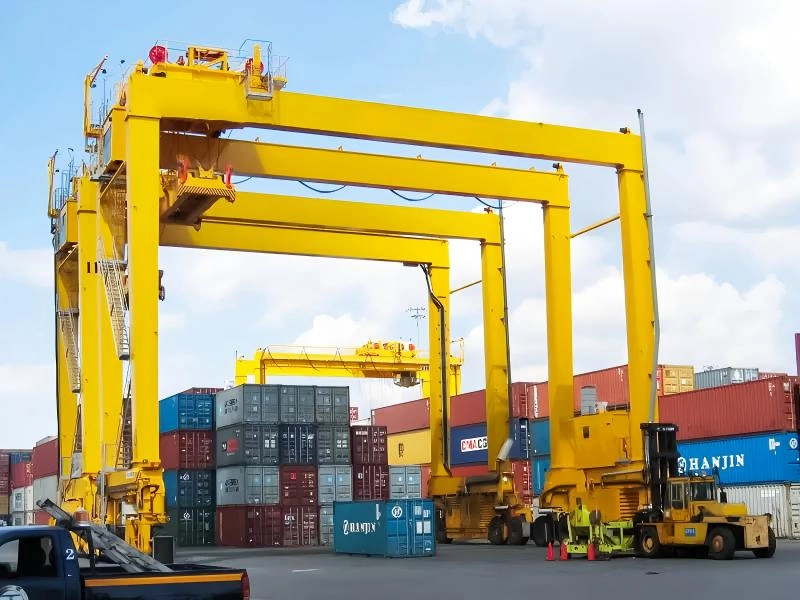
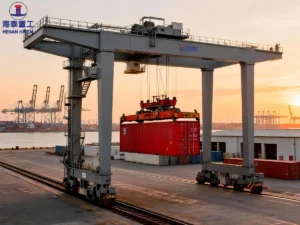
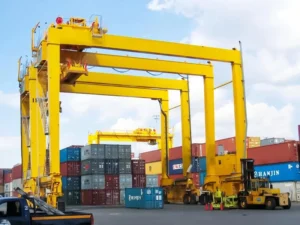
Choosing the right RTG crane supplier impacts your entire port or yard operation. A wrong choice means delays, downtime, and costly repairs. We help you avoid that. As a certified RTG crane manufacturer and exporter, we supply high-performance rubber tyred gantry cranes built for container terminals, intermodal yards, and logistics hubs worldwide. Product Description An RTG crane (Rubber Tyred Gantry Crane) is a mobile overhead crane designed to stack and move ISO containers in port container yards and inland depots. Unlike rail-mounted cranes(RMG Container Gantry Crane), RTG cranes run on rubber tyres — giving them full mobility across the yard without fixed infrastructure. 👉View Professional Buying Guide: RTG Crane vs RMG Crane: Which One Actually Fits Your Project? RTG cranes are the backbone of modern container terminal operations. They bridge the gap between ship-to-shore cranes and horizontal transport, enabling efficient container stacking, retrieval, and yard organization. Why Buy From Us? HT Cranes is a professional manufacturer of RTG cranes with over 15 years of lifting experience. Our cranes are exported to ports and logistics yards across Southeast Asia, the Middle…
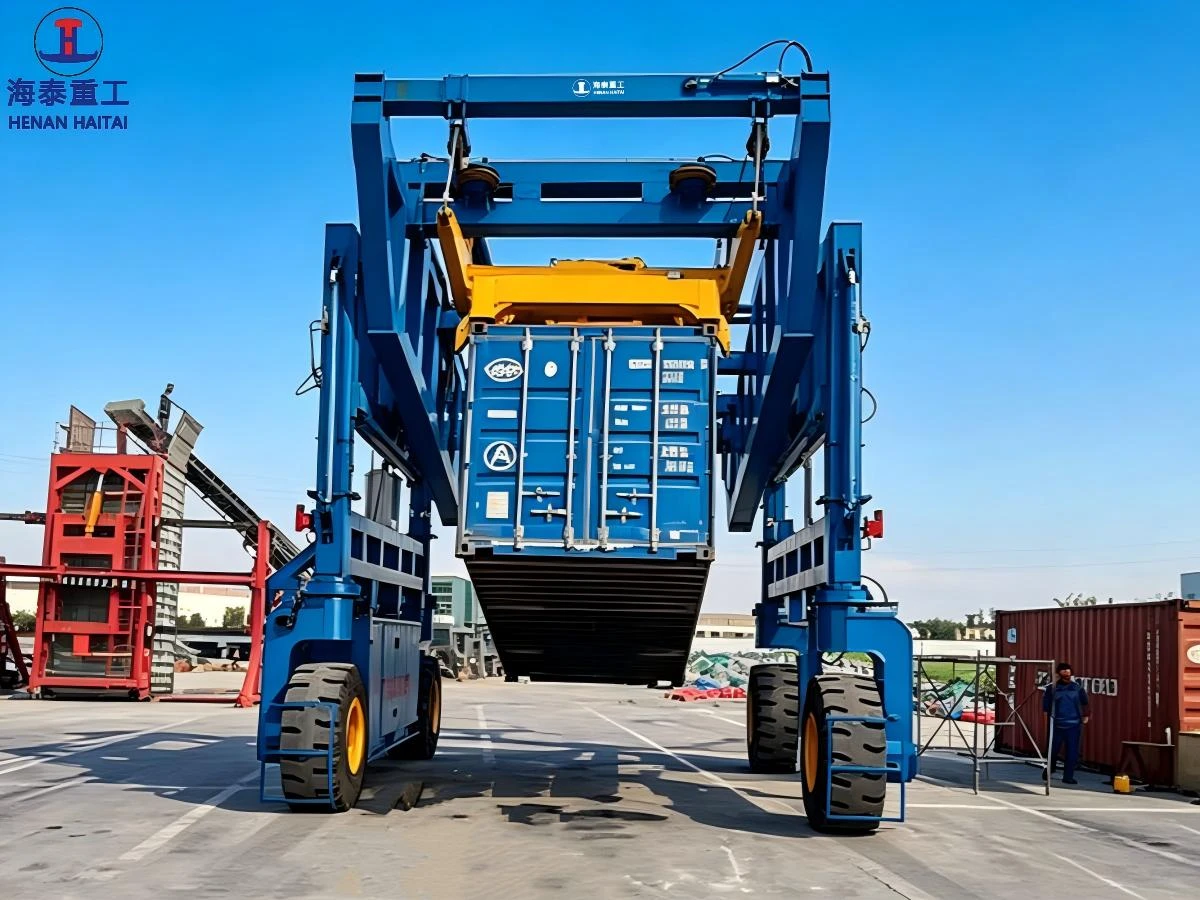
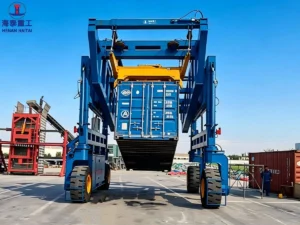
If you handle heavy containers, steel structures, or oversized industrial cargo — and your site lacks fixed power infrastructure — a hydraulic straddle carrier is likely the most practical solution available. It lifts, travels, and places loads without needing overhead structures, rails, or high-voltage power supply. One machine. Full mobility. Minimal civil works. What Is a Hydraulic Straddle Carrier? The Core Concept A hydraulic straddle carrier is a self-propelled heavy lift vehicle. It straddles a load — lifting from below using a hydraulic spreader or lifting beam — and moves freely across the yard on rubber tyres. The entire lift-and-travel cycle is powered by an onboard diesel-hydraulic system. Unlike electric or cable-reel powered cranes, the hydraulic straddle carrier carries its own power source. This makes it fully independent of yard infrastructure. You can deploy it anywhere your surface can support the wheel loads — no fixed installation required. How the Hydraulic System Works The engine drives hydraulic pumps that supply pressurized fluid to the lift cylinders, drive motors, and steering actuators. All motion — lifting, lowering, travelling, and steering —…