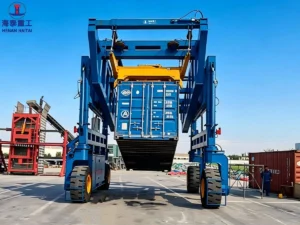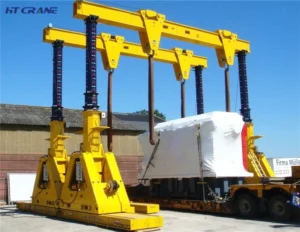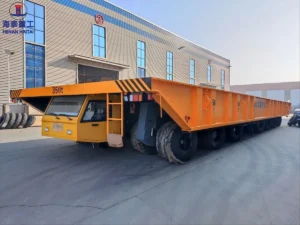

Moving a 200-ton reactor vessel across a refinery yard, or a 500-ton bridge segment onto its piers, is not a job for a standard truck or trailer. It calls for an equipment that can spread enormous concentrated weight across dozens of wheels, steer with millimeter precision in tight spaces, and keep the cargo level even when the ground underneath it isn’t. Available across a 50 to 1,000 ton capacity range, the Haitai hydraulic platform transporter is a heavy-duty multi-axle trailer solution for oversize and overweight cargo handling. Whether transporting a prefabricated building module across a jobsite, loading a transformer onto a barge, or shifting a ship segment within a dry dock, the Haitai transporter is designed to allow cargo—typically requiring cranes, gantries, or custom rigging—to simply roll into position. What Is Haitai Hydraulic Platform Transporter? Haitai hydraulic platform transporter is commonly known in the industry as Hydraulic Platform Transporter (HPT). It covers capacities from 50 to 1,000 tons and features a modular multi-axle design, depending on its setup. Every axle line is equipped with its own hydraulic suspension, independent steering,…

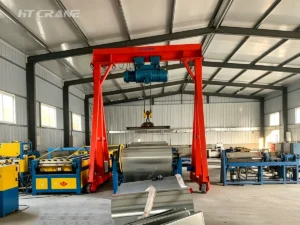
Haitai Crane’s portable gantry crane delivers 1-10 ton full overhead lifting capability without permanent infrastructure. Designed for workshops, maintenance bays, construction sites, and field service operations, the crane assembles without special tools, relocates on caster wheels, and adjusts to match the exact span and height your job requires. From a 1-ton lightweight steel frame to a 10-ton heavy-duty gantry, the range covers the full spectrum of light-to-medium industrial lifting. What Is a Portable Gantry Crane? A portable gantry crane is a mobile lifting system built around a steel frame supported by four detachable legs. These four legs can be bolted together without tools, allowing quick assembly, relocation, and disassembly. Therefore, this flexible portable gantry crane is ideal for workshops, warehouses, and temporary job sites where a fixed crane would be impractical. The overhead bridge runs on rails or rollers, allowing smooth horizontal travel. A hoist (electric hoist, hydraulic hoist, or manual hoist available) raises and lowers loads up to 10 tons with a usable span of 2‑16 m and a lift height of 2‑12 m. Configurations allow users to adjust leg length, spread, and accessories…

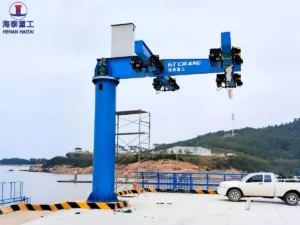
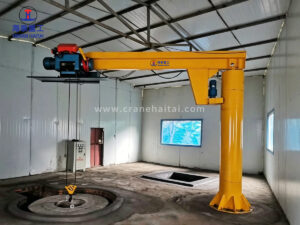
What Is A Floor Mounted Jib Crane? Haitai floor mounted jib crane is a free-standing pillar jib crane anchored directly to the workshop floor via a reinforced concrete foundation. Fitted with an electric chain hoist or wire rope hoist on a motorized trolley, it provides 360° or 270° slewing coverage across a working radius of up to 8m. Its special structure and flexible rotation makes it the standard lifting solution for dedicated workstations, assembly cells, production lines, and maintenance bays where a full overhead crane is either unavailable or impractical. Unlike wall-mounted or column-mounted jib cranes, the floor-mounted pillar design imposes no load on building structure. We install it independently of the building frame, so we can position it anywhere on the factory floor and relocate it when the production layout changes. We can position floor-mounted jib cranes at a production machine, a loading dock, a welding bay, and a material transfer point. Structural Design & Engineering Details Column and Base Flange The main column is a structural steel circular hollow section (CHS) manufactured from Q345B plate, rolled and seam-welded…

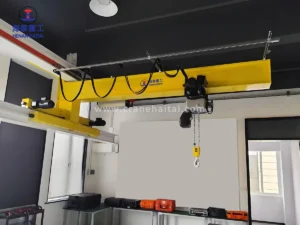
What Is A Wall Traveling Jib Crane? Haitai wall traveling jib crane is a wall-mounted, slewing-boom crane that mounts directly to a structural wall or building column. It consumes no floor space and imposes no foundation requirement on the workshop floor. The jib crane’s truss-section horizontal boom carries an electric chain hoist on a motorized trolley. It ensures operators’ precise three-axis load control across a working radius of up to 12 meters and a slewing arc of up to 360°. Working grade A5 classifies this cantilever jib crane for sustained, moderate-to-high duty operation. For example, it suits to production lines, fabrication workshops, assembly bays, and loading zones where lifting frequency is regular and consistent throughout the shift. With a lighter structural profile than a floor mounted jib crane of equivalent radius, the wall traveling jib crane is the correct choice where floor space is at a premium, where multiple cranes must share a wall-line, or where the building structure provides a suitable and cost-effective mounting point. Structural Design: Engineering Details Truss Boom The boom (cantilever arm) uses a welded steel…