


A boat jib crane is a marine-grade lifting solution designed specifically for docks, marinas, shipyards, and offshore platforms — where saltwater corrosion, confined space, and dynamic loads demand equipment built to a different standard. HaiTai Crane’s boat jib cranes deliver 0.5 to 20 tons lifting capacity, 180° to 360° rotation, and full C4–C5 marine corrosion protection from structural steel to electrical enclosures.
| Parameter | Standard Range | Custom Available |
|---|---|---|
| Lifting Capacity | 0.5 t – 20 t | Up to 50 t on request |
| Jib (Boom) Length | 3 m – 10 m | Up to 15 m |
| Rotation Angle | 180° / 270° / 360° | Configurable |
| Lifting Height | 3 m – 12 m | Customizable |
| Hoist Type | Electric chain / Wire rope | Manual available |
| Control Mode | Push-button / Radio remote | Cabin option |
| Corrosion Protection | Hot-dip galvanized + marine paint | C4/C5 ISO 12944 |
| Mounting Type | Column / Wall / Dock-embedded | Floating dock option |
| Certification | CE, ISO 9001:2015 | CCS / BV on request |
| Power Supply | 380V / 50Hz (customizable) | Global voltage supported |
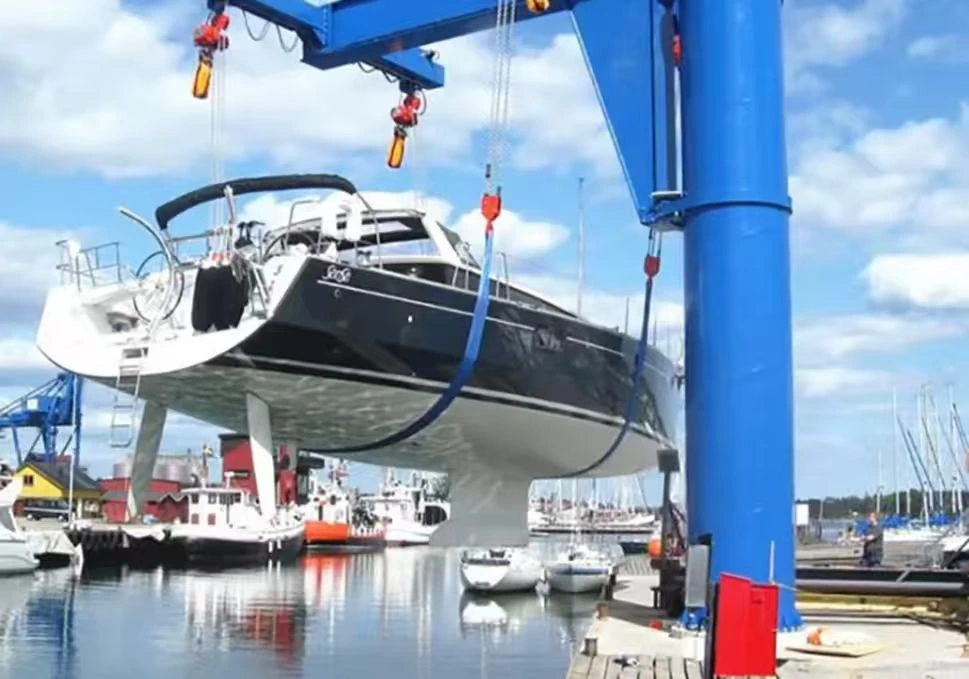
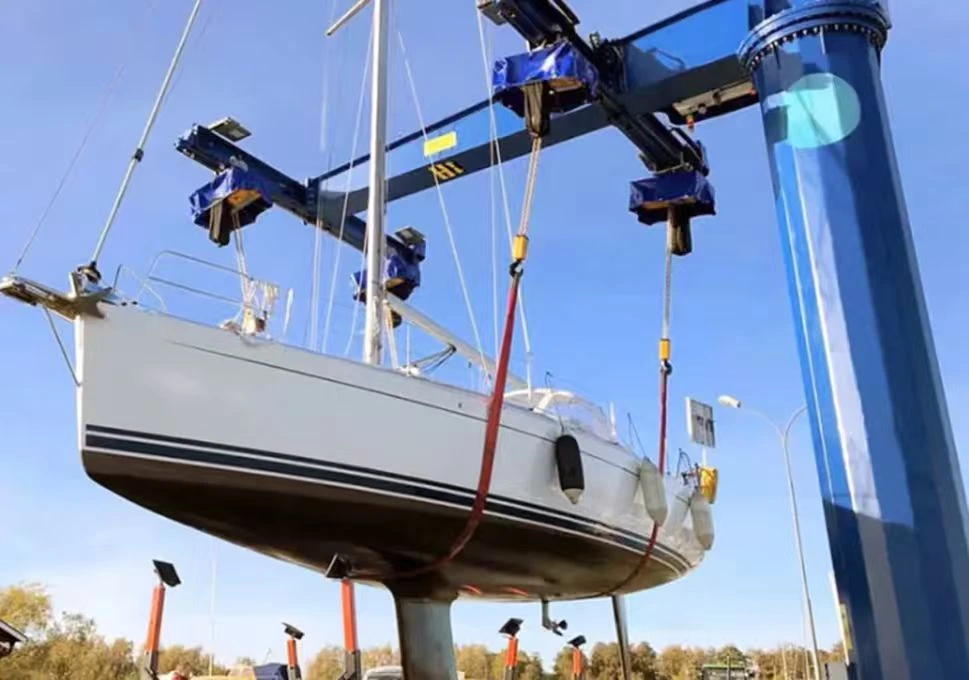
A boat jib crane consists of four core components: a vertical mast (column), a horizontal jib arm (boom), a rotation mechanism, and a hoisting unit. The mast is anchored to a concrete dock foundation or structural wall; the jib arm extends horizontally over the water or work area and rotates through a defined arc — 180°, 270°, or a full 360° depending on the mounting configuration and site geometry.
The hoist — either an electric chain hoist or wire rope hoist — travels along the jib arm, allowing the operator to position the hook precisely over the load before lifting. This combination of rotation and trolley travel gives a boat jib crane full coverage of its working radius without requiring the crane to move along a track or rail, which makes it particularly effective in space-restricted dock and marina environments.
Boat jib cranes and boat lift gantry cranes serve different operational profiles. A gantry crane straddles the vessel on two portal legs and requires significant apron width and a prepared rail or runway surface. A jib crane occupies a single column footprint and needs no ground-level rail infrastructure — making it substantially lower in both civil works cost and installation time.
For marinas, yacht clubs, and small shipyards handling vessels up to 20 t, a jib crane typically offers the better cost-to-capability ratio. For commercial shipyards handling vessels above 50 t with multi-point lifting requirements, a gantry configuration is generally more appropriate.
Salt spray is the primary structural threat in any coastal installation. HaiTai boat jib cranes are finished to C4–C5 corrosion category per ISO 12944, using a three-layer system: hot-dip galvanizing on structural steel, epoxy intermediate coat, and marine-grade topcoat. Electrical enclosures are rated IP65 minimum to prevent moisture ingress. Core mechanical components — bearings, gearboxes, hoist motors — are specified for marine environmental exposure, not adapted from standard industrial product lines.
This is the specification difference that determines whether a crane lasts 3 years or 15 years on a working dock.
All motorized rotation models are equipped with variable frequency drive (VFD) control on both the slewing mechanism and hoist. VFD control eliminates the mechanical shock loads that occur with direct-on-line motor starting — a critical feature when handling boats, where sudden load movement can cause vessel damage or operator safety incidents. Rotation speed is adjustable; load positioning is smooth and controllable from full-radius swing down to fine-increment adjustment.
HaiTai boat jib cranes are available in four mounting configurations to match different site conditions:
Every HaiTai boat jib crane is supplied with a standard safety package compliant with EN 15011 and FEM 1.001:
For facilities handling recreational vessels in the 0.5–10 t range, a column-mounted boat jib crane with 180°–270° rotation covers the standard dock-side lifting requirement: boat launching, retrieval, mast removal, and outboard engine servicing. A 5 t unit with a 6 m jib covers most vessels up to 40 ft LOA. Radio remote control allows single-operator handling, reducing labor cost on every launch cycle.
Shipyard applications demand heavier capacity and higher duty cycles. A 10–20 t boat jib crane positioned at a dry dock entrance handles small vessel placement and removal, equipment transfer, and component lifting during repair cycles. For shipyards processing multiple vessels per day, HaiTai recommends FEM 3m duty class specification and wire rope hoist over chain hoist for extended service life under high-frequency operation.
Port installations handling workboats, patrol vessels, and small cargo craft benefit from 360° rotation — allowing the crane to serve both the waterside and landside of a dock without repositioning. A 15–20 t unit with a 8–10 m boom covers most workboat handling requirements and can be equipped with an optional boat lifting frame and sling set for vessels without dedicated lifting points.
Deck-mounted boat jib cranes serve offshore vessels, naval platforms, and large yachts for handling tenders, rescue craft, and deck cargo. These installations require compliance with class society certification — CCS, ABS, BV, DNV, or LR depending on vessel flag state — and are supplied with classification society survey documentation on request.
Apply a minimum 25% margin above the heaviest vessel you will handle. A 4 t vessel requires a 5 t crane. This margin absorbs dynamic load factors during water-to-land transfer — the load does not lift clean in marine conditions; wind, wave action, and water drainage all add momentary overload. Specifying at exactly your vessel weight is an underspecification.
Jib length must clear the dock edge and reach the centerline of the vessel’s lifting point — typically the keel or dedicated lifting eyes. Measure from the column centerline to the vessel’s furthest lifting point, add 0.5–1 m clearance, and that is your minimum jib length. For dock edges with fender systems or safety rails, add fender projection to this measurement.
If the crane serves only one side of a dock (waterside lifting only), 180° rotation is sufficient and mechanically simpler. If the crane needs to transfer loads from water to a land-side staging area, 270° or 360° rotation is required. Confirm this against your site plan before specifying — adding rotation range after manufacture is not feasible.
| Operation Type | Daily Lift Cycles | Recommended FEM Class |
|---|---|---|
| Seasonal marina, low frequency | 1–5 | 1Am |
| Active marina, regular use | 5–15 | 2m |
| Shipyard, production use | 15–30 | 3m |
| Commercial port, intensive | 30+ | 3m–4m |
Coastal saltwater environments require C4–C5 corrosion specification as a minimum. Tropical or offshore environments with continuous salt spray exposure should specify C5-M (marine) per ISO 12944. Confirm also the available power supply (voltage, frequency, available amperage) before equipment order — HaiTai supports global voltage standards but needs confirmed site supply data for motor specification.
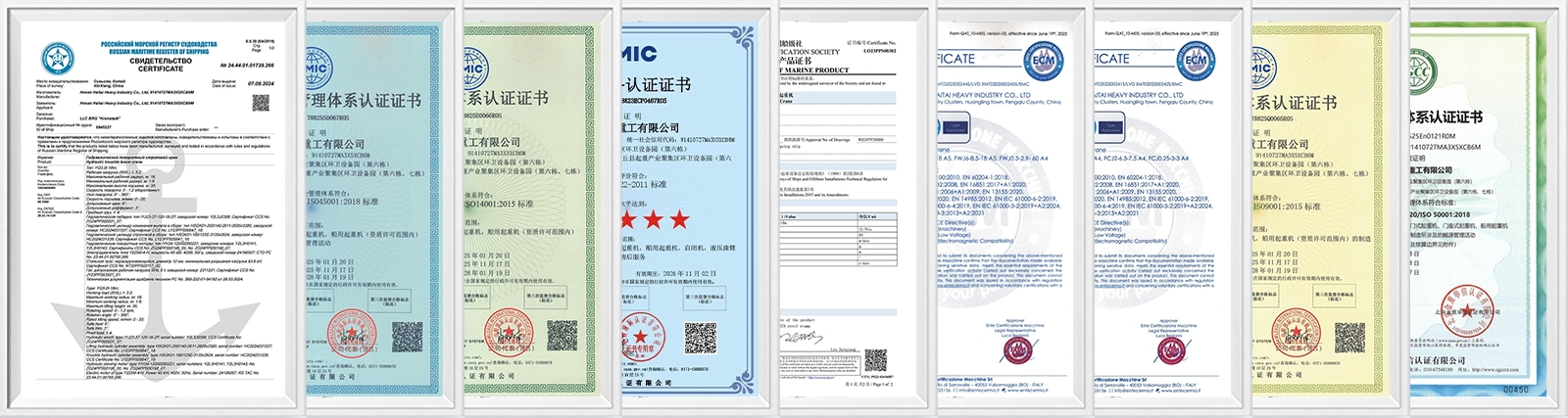
Backed by 20+ years of manufacturing experience and exports to 80+ countries, HaiTai Crane delivers CE and ISO 9001:2015 certified lifting solutions to ports, shipyards, and marinas worldwide. From standard configurations to fully engineered custom builds, our technical team tailors every crane to your site conditions and operational requirements.












If you manage a marina, boatyard, or naval facility, you already know the pain: vessels stuck in the water waiting for maintenance, slipways that damage hulls, and cranes that simply weren’t built for boats. A marine travel lift solves all three problems in a single machine. It lifts, moves, and launches vessels safely — without fixed rails, without hull damage, and without slowing down your yard. This page covers everything you need to evaluate a marine travel lift: what it does, where it works, what makes ours different, and the full technical specs. If you are ready to specify a unit, our engineering team responds to enquiries within 24 hours. Product Description A marine travel lift — also called a boat travel lift, mobile boat hoist, or self-propelled boat hoist — is a rubber-tyred gantry crane designed specifically for vessel handling. The portal frame straddles the boat in the water. Polyester slings are positioned under the hull. The vessel is then lifted clear and driven anywhere on land. No rail tracks. No fixed infrastructure. Just one machine that handles haul-out,…

Choosing the right RTG crane supplier impacts your entire port or yard operation. A wrong choice means delays, downtime, and costly repairs. We help you avoid that. As a certified RTG crane manufacturer and exporter, we supply high-performance rubber tyred gantry cranes built for container terminals, intermodal yards, and logistics hubs worldwide. Product Description An RTG crane (Rubber Tyred Gantry Crane) is a mobile overhead crane designed to stack and move ISO containers in port container yards and inland depots. Unlike rail-mounted cranes(RMG Container Gantry Crane), RTG cranes run on rubber tyres — giving them full mobility across the yard without fixed infrastructure. 👉View Professional Buying Guide: RTG Crane vs RMG Crane: Which One Actually Fits Your Project? RTG cranes are the backbone of modern container terminal operations. They bridge the gap between ship-to-shore cranes and horizontal transport, enabling efficient container stacking, retrieval, and yard organization. Why Buy From Us? HT Cranes is a professional manufacturer of RTG cranes with over 15 years of lifting experience. Our cranes are exported to ports and logistics yards across Southeast Asia, the Middle…
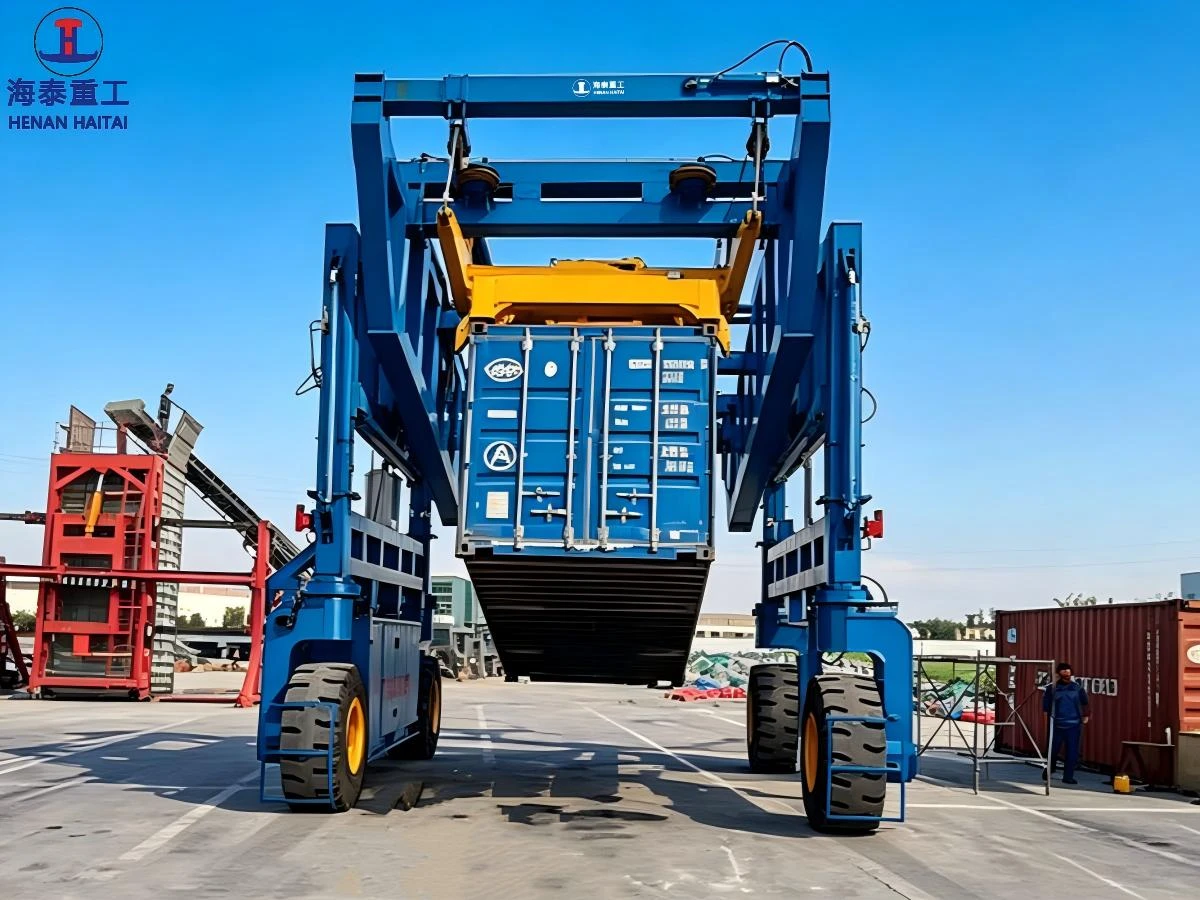
If you handle heavy containers, steel structures, or oversized industrial cargo — and your site lacks fixed power infrastructure — a hydraulic straddle carrier is likely the most practical solution available. It lifts, travels, and places loads without needing overhead structures, rails, or high-voltage power supply. One machine. Full mobility. Minimal civil works. What Is a Hydraulic Straddle Carrier? The Core Concept A hydraulic straddle carrier is a self-propelled heavy lift vehicle. It straddles a load — lifting from below using a hydraulic spreader or lifting beam — and moves freely across the yard on rubber tyres. The entire lift-and-travel cycle is powered by an onboard diesel-hydraulic system. Unlike electric or cable-reel powered cranes, the hydraulic straddle carrier carries its own power source. This makes it fully independent of yard infrastructure. You can deploy it anywhere your surface can support the wheel loads — no fixed installation required. How the Hydraulic System Works The engine drives hydraulic pumps that supply pressurized fluid to the lift cylinders, drive motors, and steering actuators. All motion — lifting, lowering, travelling, and steering —…


























