

Picking the wrong crane structure does not just waste budget. It creates daily friction — wrong span, insufficient lift height, or a beam type that cannot handle your load cycle. If you are sourcing a single girder gantry crane for a warehouse, construction yard, port facility, or manufacturing plant, the right configuration depends on more than tonnage alone.
This page breaks down all four single girder gantry crane types available from haitai Crane. You will find full specifications, clear application guidance, a direct type comparison, and a pre-order checklist. No unnecessary complexity. Just the information procurement teams need to make a confident decision.
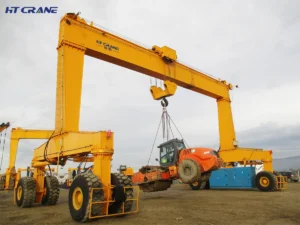
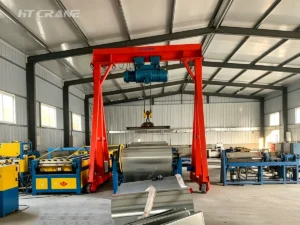
A single girder gantry crane uses one main beam supported by two legs that travel along ground rails. An electric hoist runs along the underside of the beam. This design is simpler and lighter than double-girder configurations. It costs less to build, install, and maintain.
Single girder gantry cranes are the standard choice for operations in the 2–32 ton range. They suit sites where lifting height does not exceed 24 meters and where budget efficiency matters alongside reliability. Logistics centers, precast concrete yards, light manufacturing lines, and small-to- mid port facilities all use this type routinely.
The single girder design also requires less headroom above the hook. In facilities with height constraints, that matters. Where double-girder cranes would sit too high for the building structure, a single girder crane fits.
Every single girder gantry crane shares the same core structure:
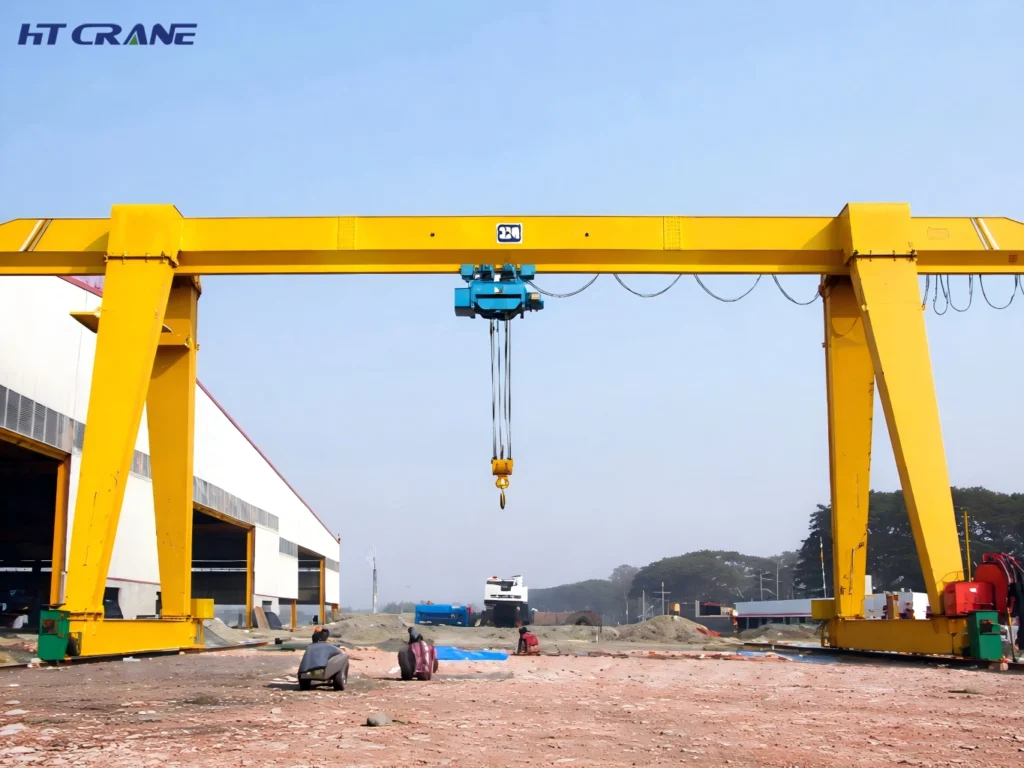
Haitai crane offers four distinct single girder configurations. Each addresses a different combination of load weight, span, environment, and structural need.
Product Overview
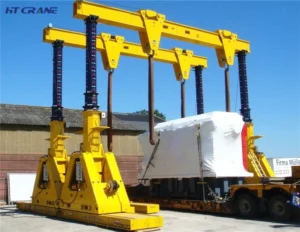
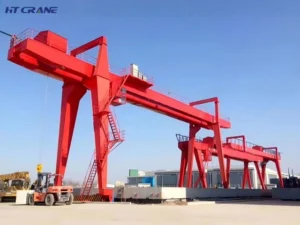
The MH Box type uses a closed rectangular steel box section as the main beam. Steel plates are welded together to form this profile. The result is a beam with high bending stiffness and strong torsional resistance. This matters when the hoist carries loads close to the rated capacity over long spans.
Box beams maintain consistent deflection behavior across the full span range. In high-temperature environments — steel plants, foundries, or facilities near heat-generating processes — the box section retains structural integrity better than open-truss alternatives. Its sealed profile also resists dust ingress, which reduces long-term wear on internal surfaces.
This is the most structurally capable variant in the single girder range. It suits high-load, long-span applications where structural margin and safety reliability are the primary selection criteria.
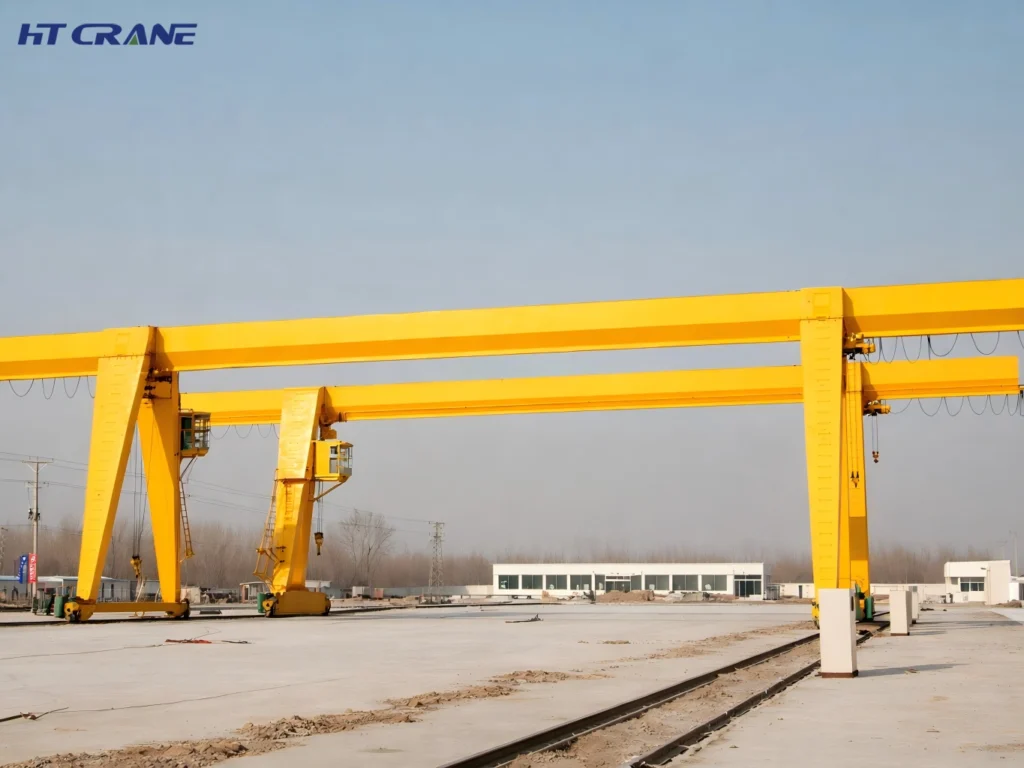
Application: Manufacturing plants, steel facilities, logistics and warehouses, power and energy industry where load capacity and operational safety requirements are high.
Key Features: High load capacity, strong structural rigidity, resistance to high-temperature environments, strong anti-bending and anti-torsion performance. Suitable for large lifting weights and wide-span operations.
| Parameter | Specification |
|---|---|
| Load Capacity | 3.2–32 ton |
| Span | 7.5–35 m |
| Lifting Height | 6–12 m |
| Lifting Speed | 0.8 / 5 m/min |
| Hoist Running Speed | 3–8 m/min |
| Crane Running Speed | 20–30 m/min |
| Work Duty Class | A5 |
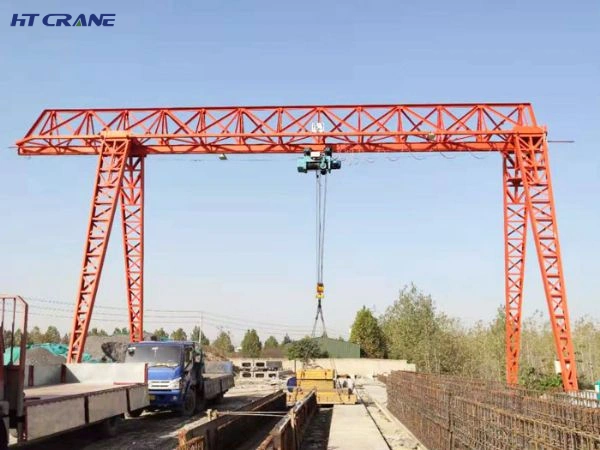
Product Overview
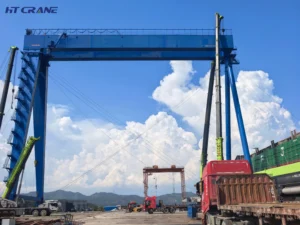
The MH Truss type replaces the solid box beam with a steel tube lattice truss structure. Members are arranged in triangulated patterns, creating a strong frame with significantly less material and lower self-weight. This reduces the load transferred to the ground rails and lowers foundation requirements.
The open truss profile offers natural wind resistance. Wind passes through the lattice rather than pushing against a solid surface. For outdoor sites or open-sided facilities exposed to prevailing winds, this structural behavior is a meaningful safety advantage. Corrosion protection is applied to all truss members to extend service life in humid or coastal environments.
The truss type also travels across the widest span range in the single girder lineup — up to 31.5 meters. For yards handling bundled steel, prefabricated concrete panels, or large engineering components, this combination of span and low dead weight makes the truss type a practical and cost-efficient choice.
Application: Construction sites, warehousing, machinery manufacturing, ports and harbor operations. Common loads include steel plates, structural profiles, large components, containers, bundled goods, prefabricated panels, and general engineering materials.
Key Features: Steel tube truss main structure, lightweight design, strong wind resistance, large operating range, good visual aesthetics for client-facing facilities.
| Parameter | Specification |
|---|---|
| Load Capacity | 3–20 ton |
| Span | 7.5–31.5 m |
| Lifting Height | 6–24 m |
| Lifting Speed | 20 m/min |
| Hoist Running Speed | 3–8 m/min |
| Crane Running Speed | 20–30 m/min |
| Work Duty Class | A5 |
Product Overview
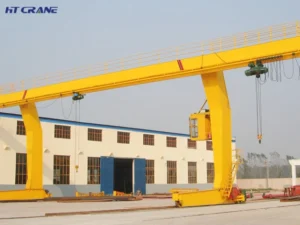
The L-type single beam gantry crane uses an asymmetric leg configuration. One leg is taller and vertical. The other is shorter and angled, forming an “L”-shaped profile when viewed from the side. This geometry creates a wide, stable footprint without requiring equal-height legs on both sides.
The asymmetric leg design is particularly effective where one side of the crane’s working zone is constrained — near a wall, an existing structure, or a road edge. The shorter L-leg can sit closer to an obstacle while the taller leg maintains full working clearance on the open side. This makes the L-type useful in logistics yards where trucks load and unload from one side only.
High-performance electric hoists provide precise vertical positioning. The crane travel speed of 20–40 m/min supports efficient throughput in active loading zones. It handles loads from 5 to 10 tons across spans of 16 to 30 meters — well suited for truck loading bays and railway wagon operations.
Application: Construction, logistics, manufacturing, and steel facilities. Typical tasks include lifting raw materials, semi-finished goods, bricks, steel bars, and construction materials; loading and unloading from trucks and railway wagons.
Key Features: L-shaped frame provides strong stability and high space utilization. High-performance electric hoists enable accurate positioning and efficient goods handling.
| Parameter | Specification |
|---|---|
| Load Capacity | 5–10 ton |
| Span | 16–30 m |
| Lifting Height | 9 m |
| Lifting Speed | 20 m/min |
| Hoist Running Speed | 20 m/min |
| Crane Running Speed | 20–40 m/min |
| Work Duty Class | A5 |
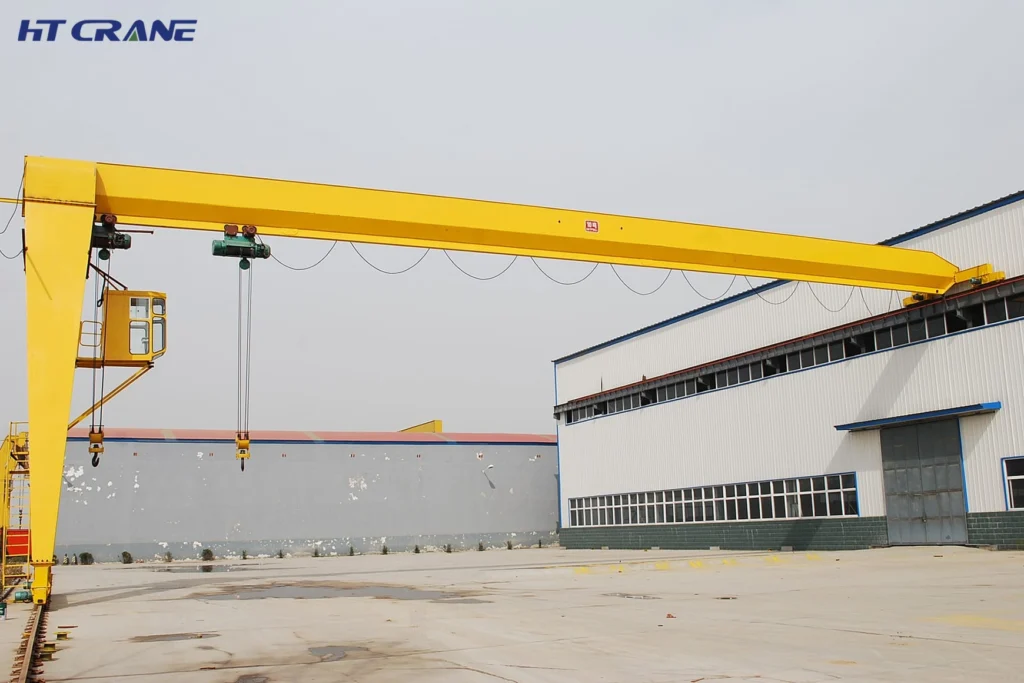
Product Overview
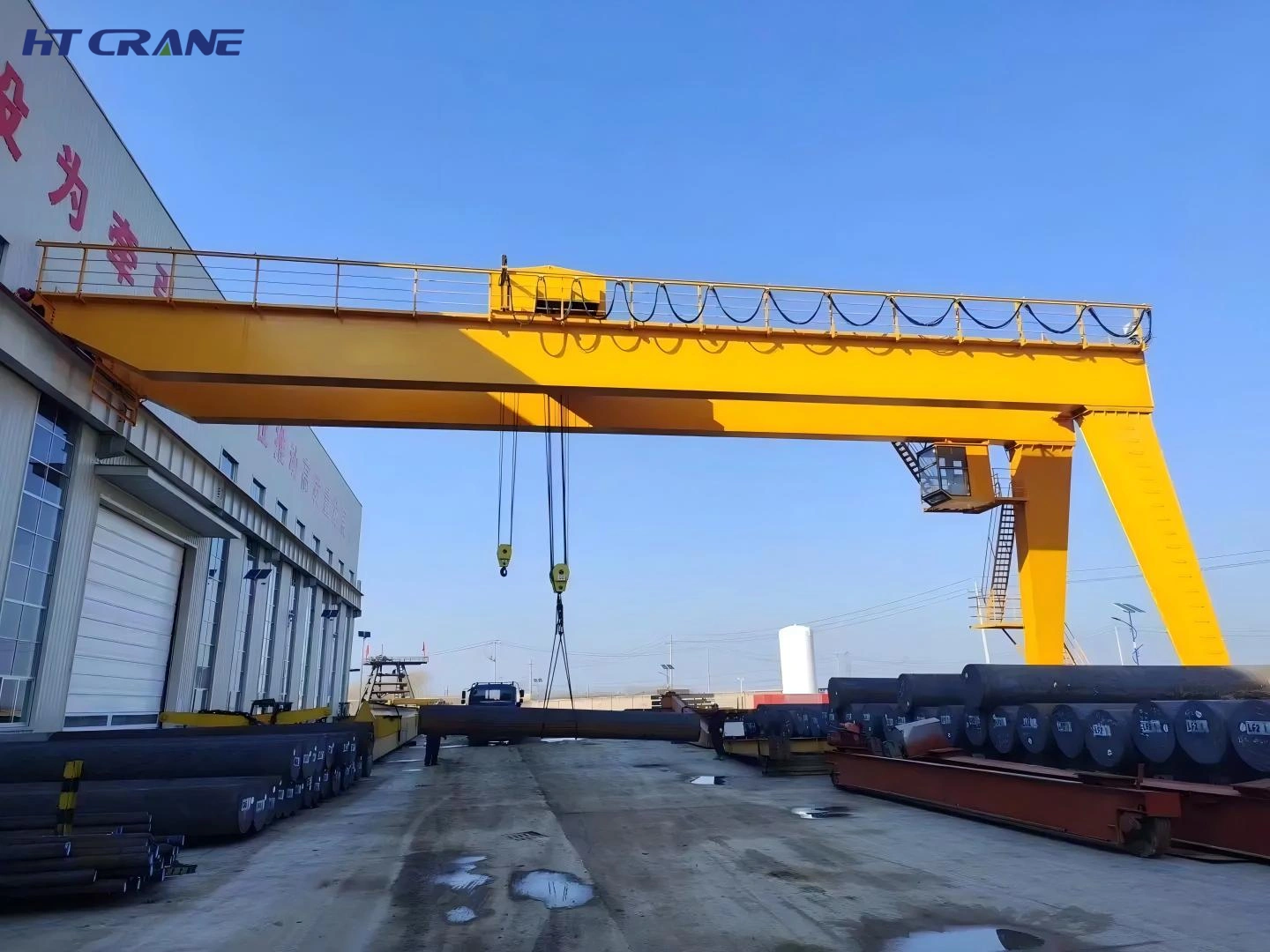
The BMH Semi Gantry Crane is a hybrid structure. One side of the crane runs on a ground rail like a standard gantry crane. The other side runs on an elevated runway rail mounted to an existing wall or column. This removes the need for a second freestanding leg entirely.
The semi-gantry configuration maximizes floor space utilization. In workshop production lines where every meter of floor width contributes to throughput, eliminating one ground rail and its supporting structure creates usable working area. Civil construction costs drop compared to full gantry installations. Installation time is shorter.
The BMH Semi is rated at A4 work duty class — appropriate for light-to- moderate use cycles, typically in single-shift operations. It handles loads from 2 to 16 tons and suits facilities processing molds, glass, prefabricated panels, agricultural materials, and light manufacturing components. Anti-corrosion and anti-dust custom coatings are available for food-adjacent or chemical environments.
Application: Small and medium warehousing, logistics facilities, workshop production lines, light industry, automobile manufacturing, and agricultural operations. Typical loads include molds, raw materials, stone, glass, prefabricated concrete panels, and construction materials.
Key Features: High space utilization, low maintenance cost, high positioning accuracy. Customizable anti-corrosion and anti-dust protection. Ideal for facilities with existing wall or column runway infrastructure.
| Parameter | Specification |
|---|---|
| Load Capacity | 2–16 ton |
| Span | 5–20 m |
| Lifting Height | 6 m |
| Lifting Speed | 8 m/min |
| Hoist Running Speed | 2–20 m/min |
| Crane Running Speed | 3–30 m/min |
| Work Duty Class | A4 |
| Feature | MH Box | MH Truss | L-Type | BMH Semi |
|---|---|---|---|---|
| Capacity Range | 3.2–32 t | 3–20 t | 5–10 t | 2–16 t |
| Max Span | 35 m | 31.5 m | 30 m | 20 m |
| Max Lift Height | 12 m | 24 m | 9 m | 6 m |
| Work Duty | A5 | A5 | A5 | A4 |
| Wind Resistance | Medium | High | Medium | Medium |
| Self Weight | Heavier | Lighter | Medium | Lightest |
| Leg Structure | Full gantry | Full gantry | L-asymmetric | Semi (1 wall) |
| Best Environment | Indoor/Heavy | Outdoor/Open | Logistics yard | Workshop/Factory |
The single girder gantry crane handles pallet loads, bundled goods, and general freight efficiently. Spans of 7.5–35 meters cover most warehouse bay widths. The MH Box type suits high-cycle, high-capacity zones. The BMH Semi suits space-constrained workshop areas where ground rail count must be minimized.
Prefabricated beams, concrete panels, and structural steel all require reliable outdoor crane coverage. The MH Truss type performs well here. Its wind-resistant structure and lifting height up to 24 meters make it the preferred choice for open-air precast operations. Sites in coastal or high-wind regions benefit from the truss profile’s reduced wind load exposure.
Steel plants require cranes that tolerate heat, dust, and high-frequency use. The MH Box type is rated for these conditions. Its anti-bending and anti-torsion performance handles asymmetric loads common in coil and billet handling. At A5 duty class, it supports two-shift operations with regular loads near rated capacity.
For truck and wagon loading bays, the L-type crane provides efficient coverage at spans of 16–30 meters. Its asymmetric leg layout works with the uneven access patterns typical of logistics terminals. The MH Truss type handles container and bulk material work where wider spans and outdoor exposure are both factors.
Standard configurations cover most applications. When site conditions fall outside standard ranges, Haitai Crane offers full custom engineering:
Custom orders require a full site specification. Lead time is longer than standard configurations. Submit requirements early in the procurement cycle to avoid project delays.
The single girder gantry crane covers the 2–32 ton working range across logistics, manufacturing, construction, and port environments. The four available types — MH Box, MH Truss, L-type, and BMH Semi — address different structural, environmental, and operational needs. No single type fits every site. The right choice depends on your actual span, lift height, load frequency, and facility layout.
Haitai Crane has supplied gantry crane solutions to infrastructure and industrial projects across Brazil, Pakistan, Indonesia, Malaysia, Egypt, and other markets. Each unit ships with 100% pre-delivery load and safety testing. Warranty coverage runs 3–5 years with 24/7 online support and on-site assistance available when needed.













Choosing the wrong gantry crane costs more than money. It costs downtime, structural risk, and rework. If you’re sourcing a heavy duty trolley gantry crane for a port, steel mill, rail yard, or large factory, the MG series is one of the most proven options on the market today. This page covers everything procurement teams need: how each MG type differs, what specs apply to your load and environment, and how to match the right configuration to your site conditions. No guesswork. Just practical guidance. What Is the MG Heavy Duty Trolley Gantry Crane? The MG gantry crane is a double-beam, trolley-type outdoor crane built for heavy industrial lifting. Its structure uses a box-type welded double beam with π-shaped legs. This design increases torsional rigidity significantly. The crane handles loads from 5 tons up to 500 tons. It runs on ground rails and supports spans from 18 to 40 meters. Core Engineering Advantages Unlike single-beam gantry cranes, the MG series uses two parallel main beams. This distributes the load more evenly. The trolley travels between the beams, allowing precise positioning…
Not every facility has the floor space for a full gantry crane. Not every building has the roof structure to support an overhead travelling crane. A semi gantry crane solves both problems at once — and for a significant number of industrial buyers, it is the most practical and cost-effective crane configuration available. The semi gantry crane uses one leg on the ground and one side supported by an existing building column or runway rail on the wall. This hybrid design reduces the crane’s footprint, eliminates one set of floor rail foundations, and integrates with the building structure in a way that a full gantry crane cannot. The result is maximum coverage in minimum space — at a lower civil works cost than either alternative. What Is a Semi Gantry Crane? The Defining Structure A semi gantry crane — also called a half gantry crane — has an asymmetric support structure. One end of the main girder rests on a standard leg that runs on a ground-level rail. The other end is supported by a trolley or bracket that runs…

When the load is heavy, the span is wide, or the hook height requirement exceeds what a single girder crane can deliver — a double girder gantry crane is the answer. It is the structural choice for heavy industry, and for good reason: two main girders share the load, allow a higher-positioned hoist, and provide the structural rigidity needed for large spans and demanding duty cycles. Buyers often reach the double girder decision after outgrowing a lighter crane or after realizing that a single girder model cannot meet their hook height or span requirements. The challenge then becomes specification: double girder cranes involve more variables, more civil infrastructure, and larger capital commitment than their lighter counterparts. This page walks you through what defines a double girder gantry crane, what to specify, where it fits, and how to evaluate a supplier for a purchase of this significance. What Is a Double Girder Gantry Crane? A double girder gantry crane uses two parallel horizontal girders — the main beams — supported at each end by leg structures that run on ground-level rails.…