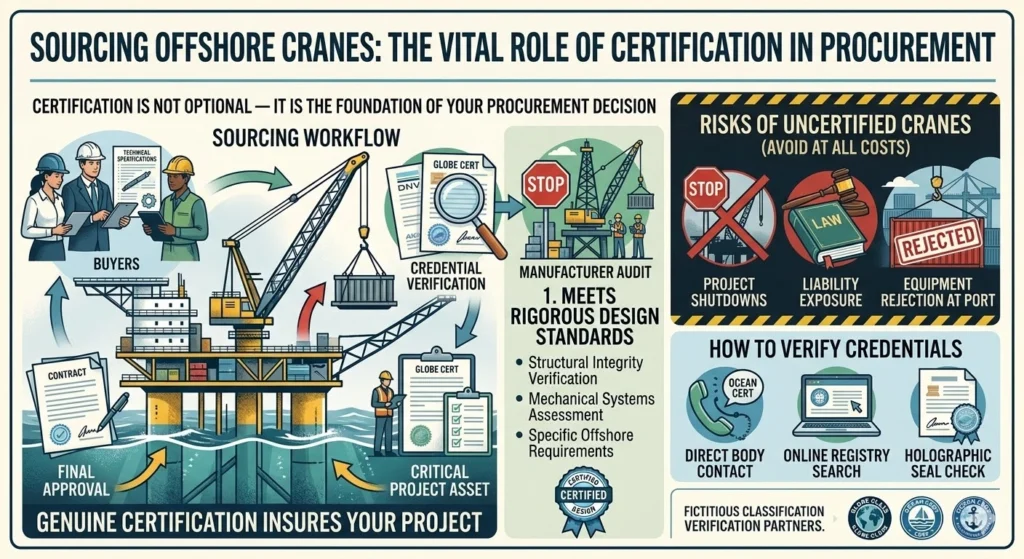
If you are sourcing an offshore crane for a marine or oil & gas project, certification is not optional — it is the foundation of your procurement decision. Buying an uncertified or improperly certified crane can lead to project shutdowns, liability exposure, and equipment rejection at port. This article walks you through the exact certification requirements you need to verify, which international bodies matter most, and how to confirm a manufacturer genuinely holds these credentials.
Why Offshore Crane Certification Is Non-Negotiable
Offshore cranes operate in some of the harshest environments on earth. Salt spray, extreme loads, dynamic vessel motion, and remote deployment create risks that standard industrial cranes are simply not designed for. That is why international classification societies and standards bodies have established strict certification frameworks specifically for offshore lifting equipment.
Certification serves three critical functions. First, it confirms the equipment meets defined structural and mechanical design standards. Second, it provides a paper trail for insurance, regulatory compliance, and contract fulfillment. Third, it gives your engineering and HSE teams confidence that the crane has been independently verified — not just self-declared by the manufacturer.
The Three Major Classification Society Certifications for Offshore Cranes
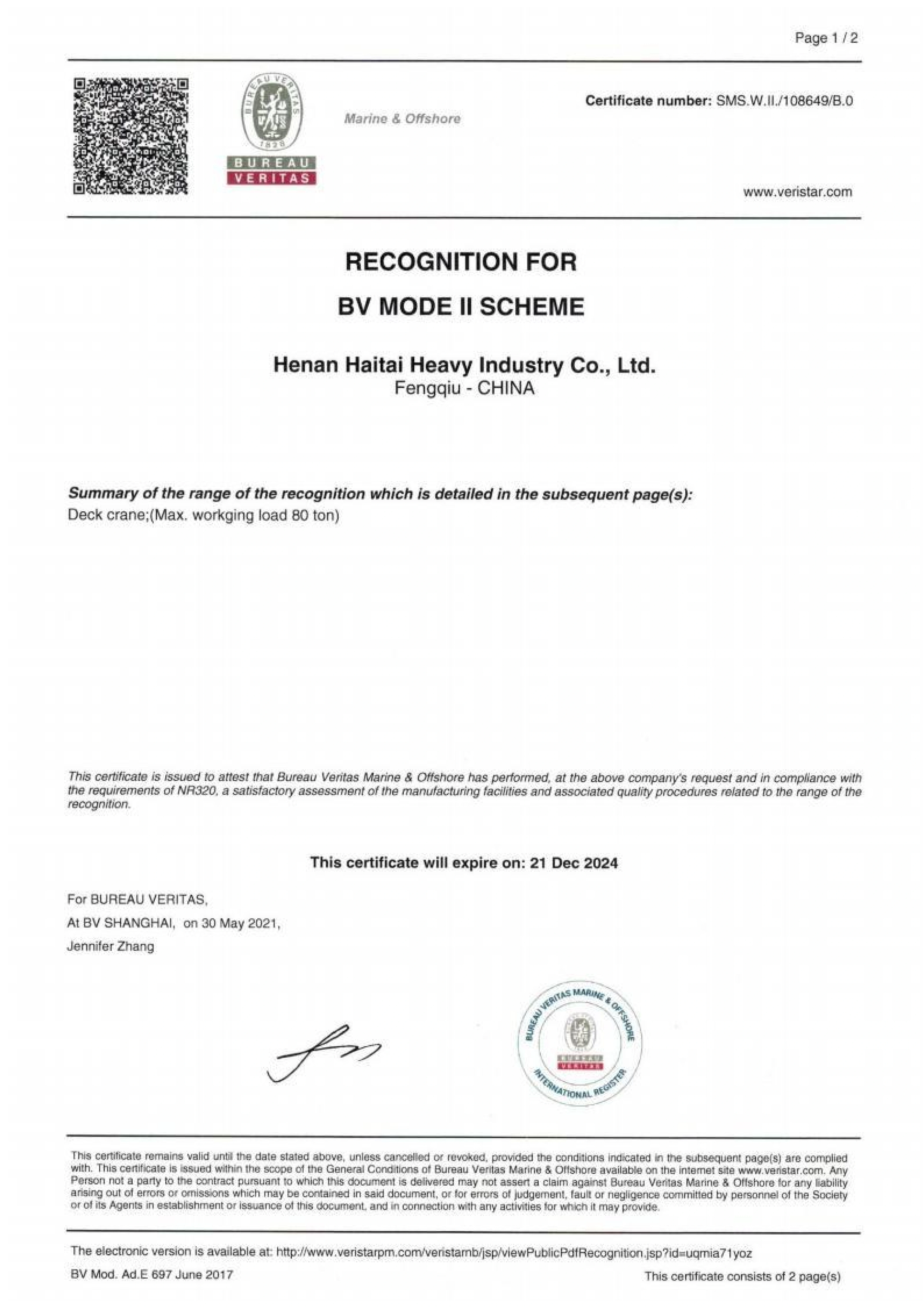
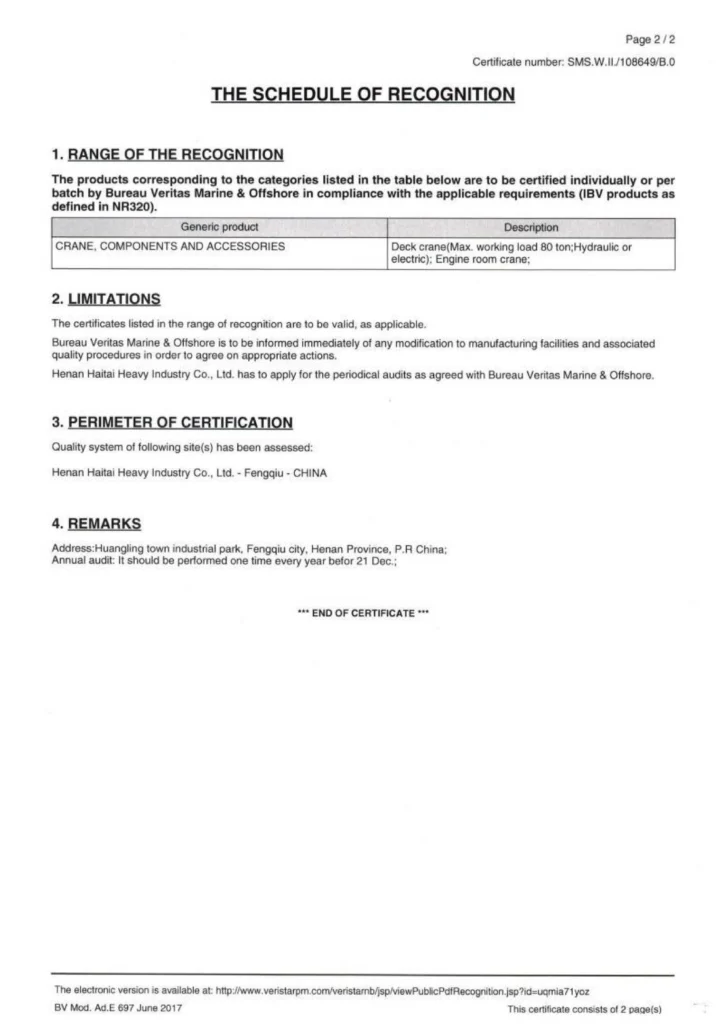
Bureau Veritas (BV) Certification
Bureau Veritas is one of the most widely recognized classification societies in the offshore industry. BV-certified offshore cranes have been assessed against strict standards covering structural integrity, load ratings, safety devices, and manufacturing quality control.
BV certification is commonly required for projects in Europe, West Africa, Southeast Asia, and global FPSO deployments. When a manufacturer holds BV approval, it means an independent BV surveyor has reviewed and approved the design drawings, witnessed production milestones, and verified final testing. This is not a self-certification — it requires physical audit and documentation review at the factory.
For buyers, requesting the BV Type Approval Certificate and the specific product certificate number allows you to verify authenticity directly through the BV online registry.
China Classification Society (CCS) Certification
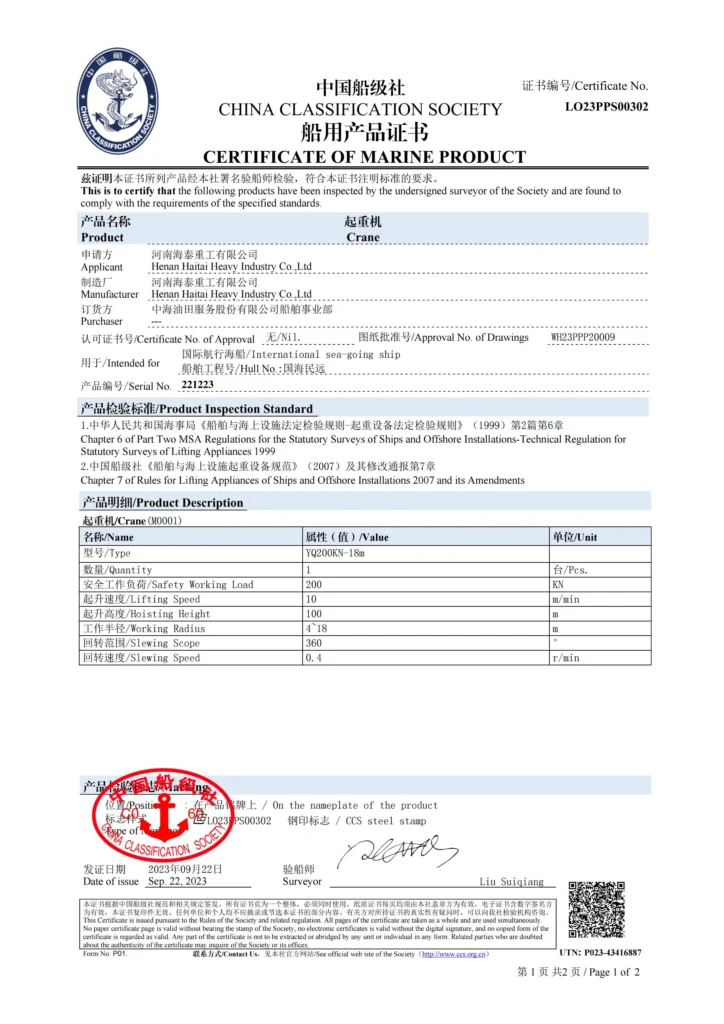
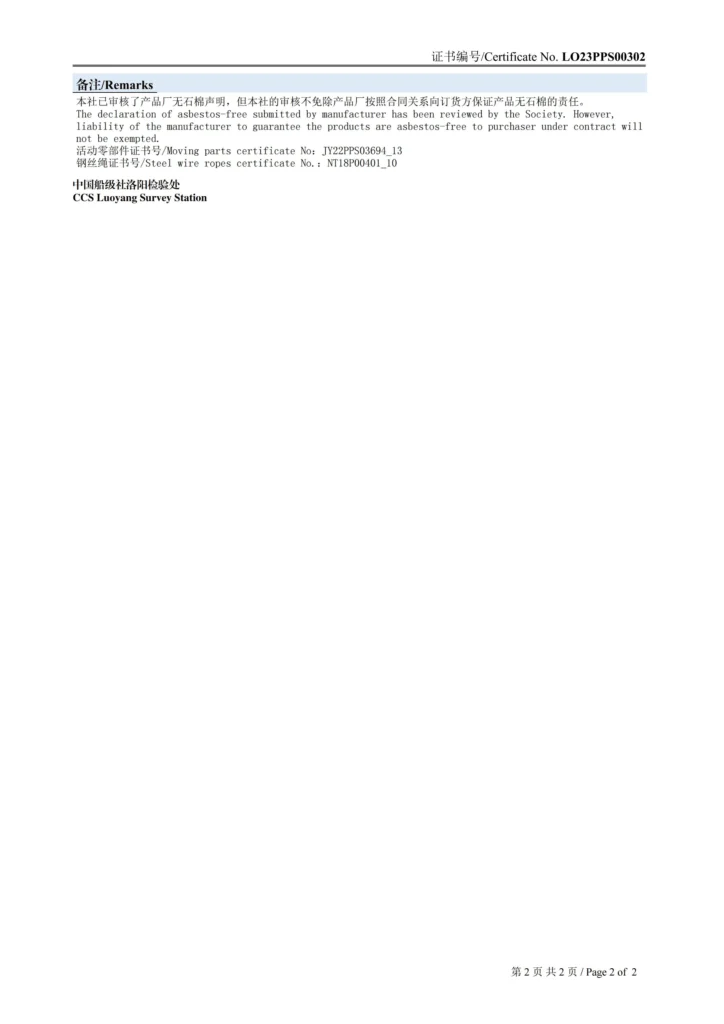
CCS certification is the primary requirement for offshore cranes deployed on vessels registered in China, as well as for projects tendered by Chinese state-owned energy companies such as CNOOC, CNOOC Energy, and Sinopec offshore divisions.
CCS follows its own published rules for lifting appliances on ships and offshore installations, which align closely with international conventions. For manufacturers based in China, CCS certification signals that the product has passed factory audits and type approval by a credentialed Chinese maritime authority.
If your project operates within Chinese territorial waters or involves a Chinese-flagged vessel, CCS certification is typically a contractual requirement — not a preference.
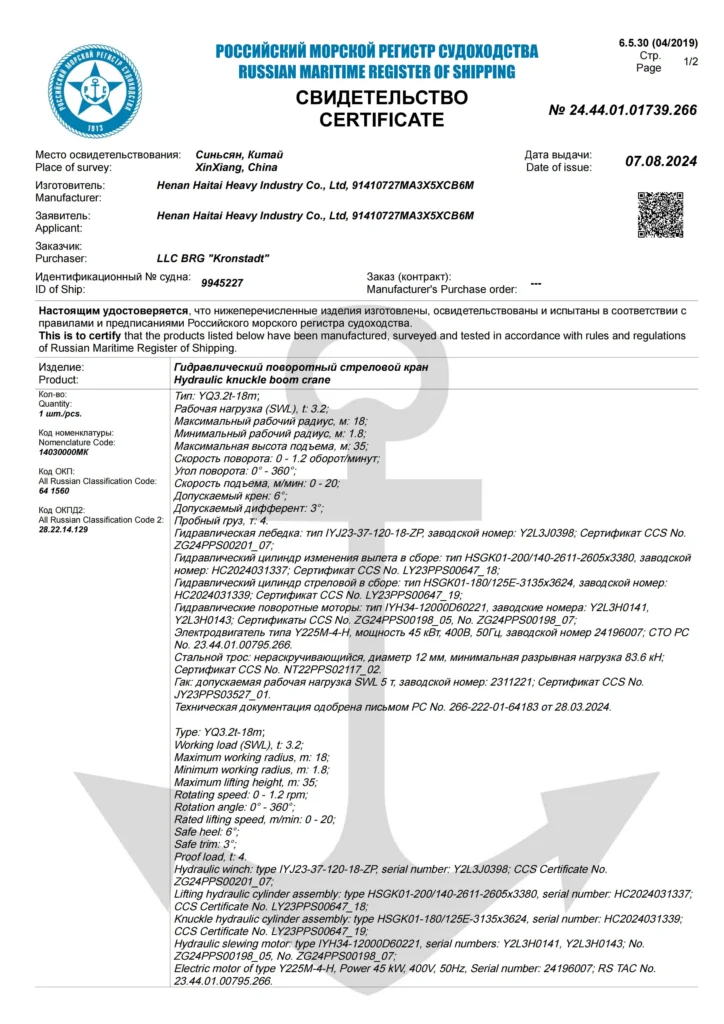
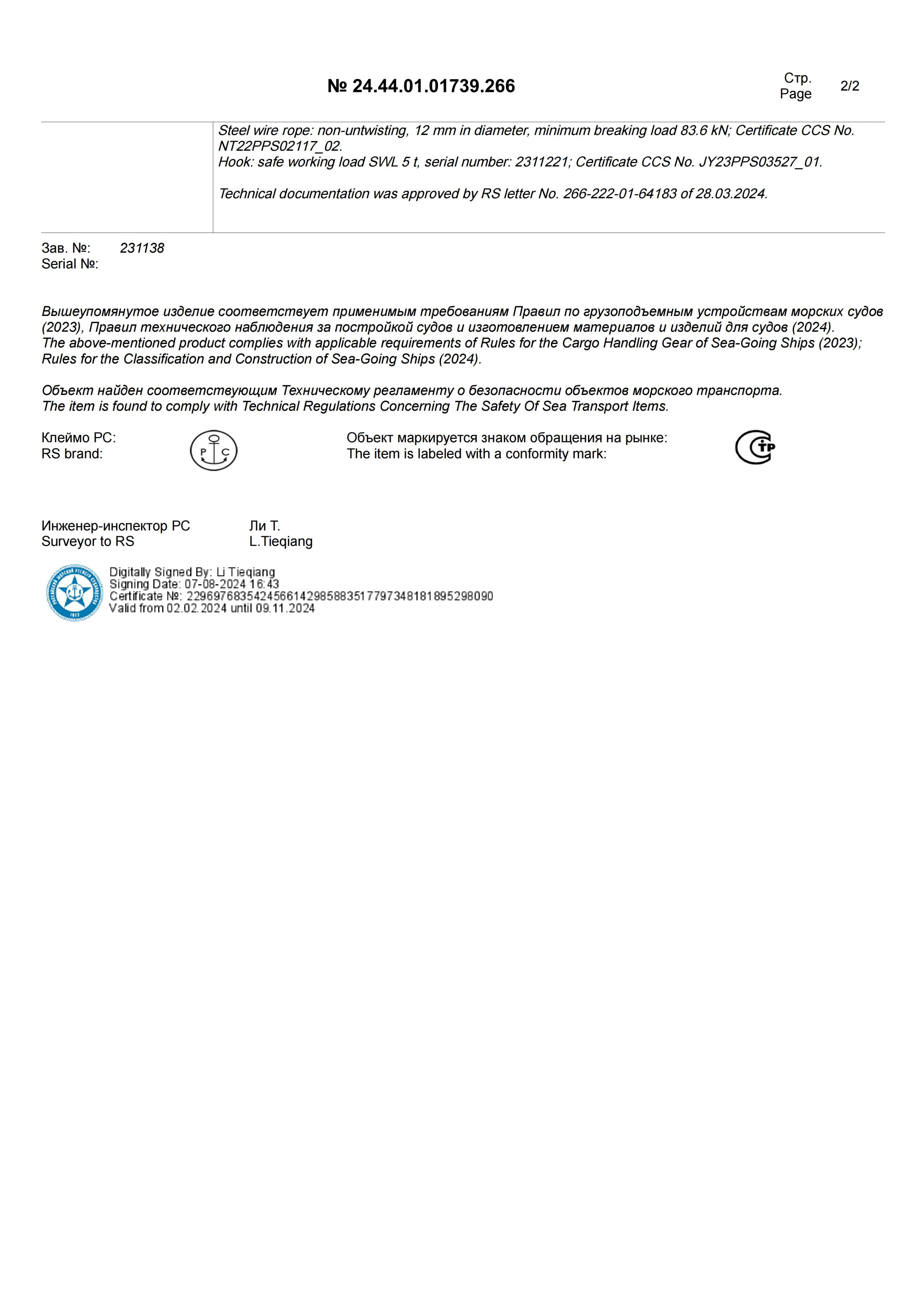
Russian Maritime Register of Shipping (RMRS) Certification
RMRS certification is the standard requirement for offshore and marine projects operating in Russian waters, Arctic regions, and across CIS (Commonwealth of Independent States) countries. Projects tied to Gazprom, Rosneft, Lukoil, or other Russian energy operators will almost always specify RMRS approval in their equipment procurement requirements.
RMRS has its own rules for the construction and classification of ships and offshore units, and their certification process involves design review, material traceability, and factory inspection. Holding RMRS certification significantly reduces the risk of customs rejection or project compliance delays when delivering equipment to Russian ports.
ISO Management System Certifications: The Operational Baseline
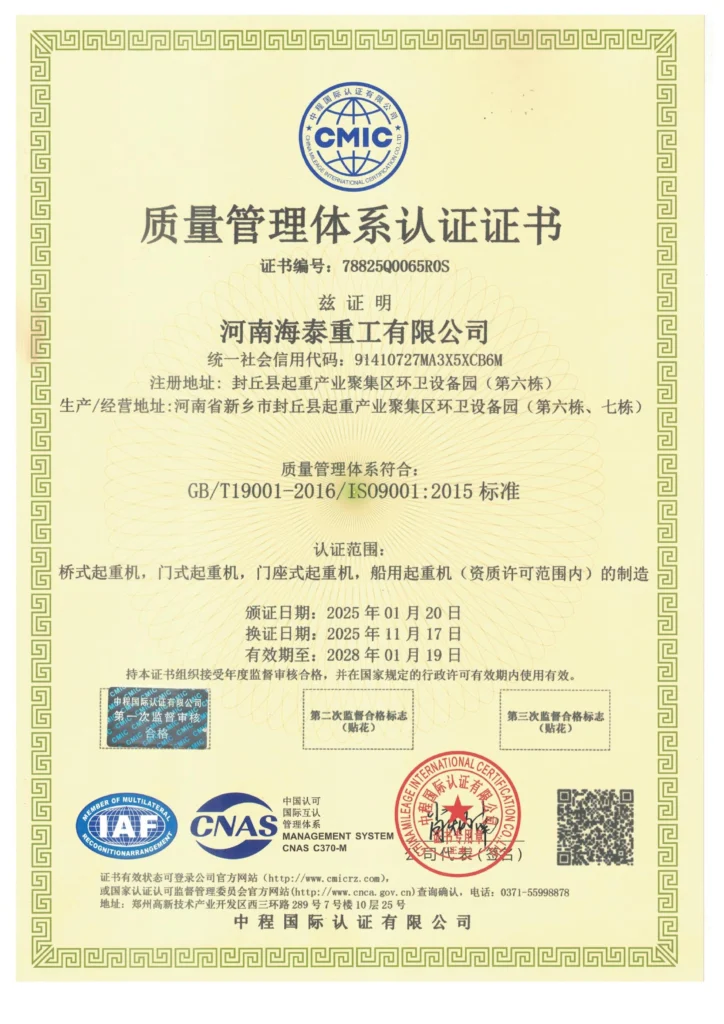
ISO 9001 — Quality Management System
ISO 9001 is the globally recognized standard for quality management. For offshore crane manufacturers, ISO 9001 certification means the entire production process — from raw material procurement to final assembly and inspection — is governed by a documented and audited quality system.
This matters to buyers because it directly affects product consistency. A manufacturer with ISO 9001 certification is less likely to deliver equipment with dimensional variances, weld defects, or undocumented substitutions. Before issuing a purchase order, always request a copy of the current ISO 9001 certificate and verify it covers the manufacturing scope relevant to your order.
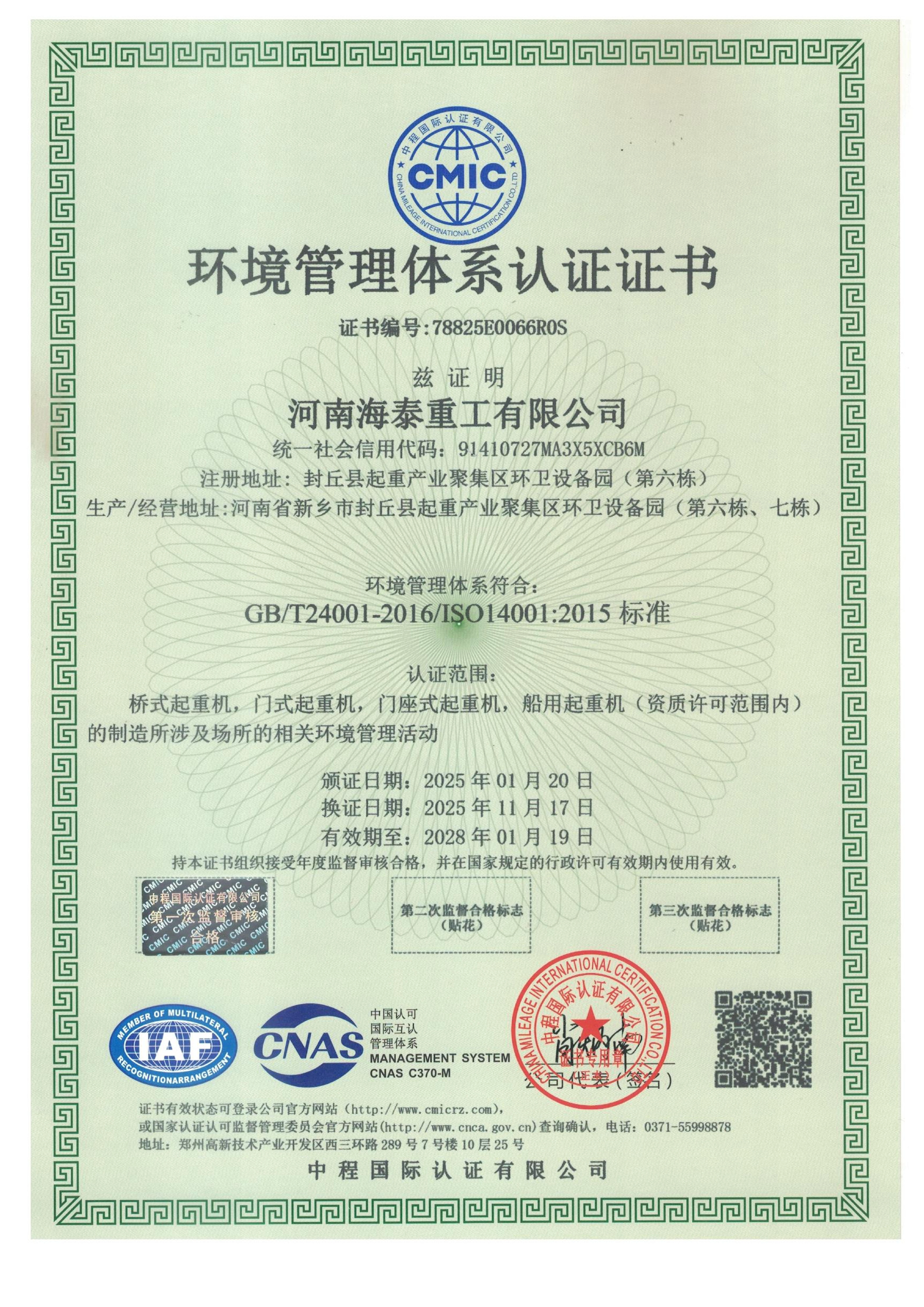
ISO 14001 — Environmental Management System
ISO 14001 demonstrates that a manufacturer manages its environmental impact in a systematic and audited way. For offshore projects tied to international energy majors or government-backed infrastructure programs, environmental compliance from the supply chain is increasingly required at the bid stage.
This certification also signals organizational maturity. Companies that maintain ISO 14001 tend to have stronger internal governance and documentation practices — both of which benefit buyers during factory acceptance testing and post-delivery support.
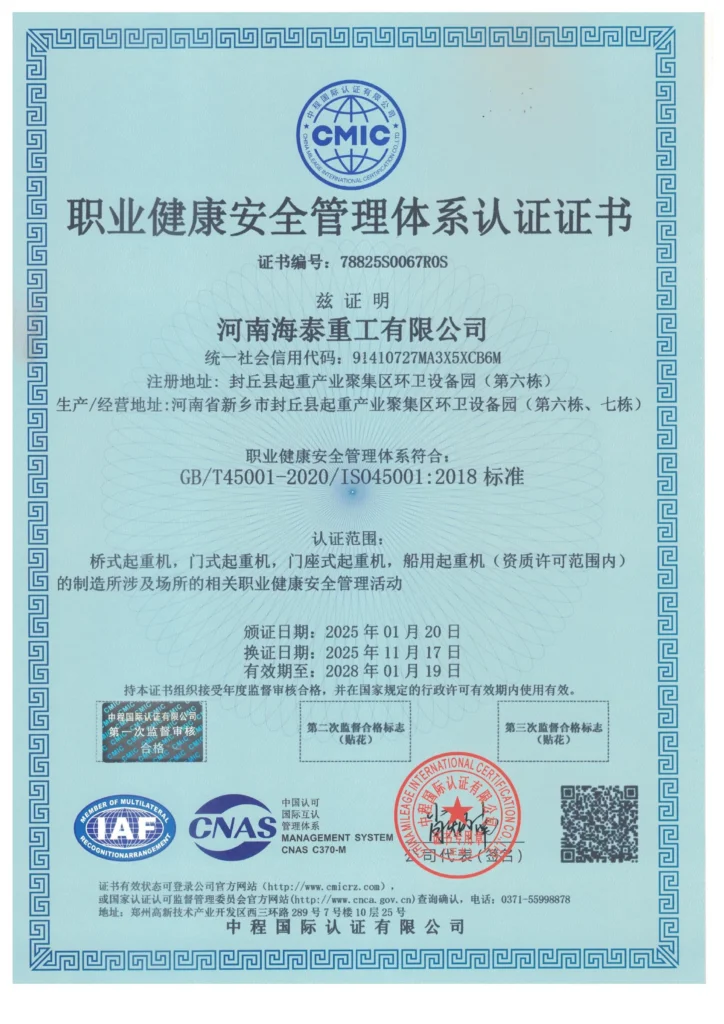
ISO 45001 — Occupational Health & Safety Management System
ISO 45001 replaced OHSAS 18001 as the international benchmark for workplace safety management. For an offshore crane manufacturer, this certification indicates that the production environment, worker procedures, and safety protocols are independently verified.
From a buyer’s perspective, this has direct implications for equipment quality. Factories with strong safety cultures typically have lower incident rates, better-maintained tooling, and more disciplined production workflows — all of which reduce the risk of hidden defects in the finished product.
Management System
How to Verify Certification Claims Before You Buy
Holding certificates and holding valid, current certificates are two different things. Here is a practical verification checklist for procurement teams:
Step 1 — Request original certificate copies. Ask the manufacturer to provide scanned originals of all certificates, including issue date, expiry date, scope of certification, and the certifying body’s stamp or digital signature.
Step 2 — Cross-check against the issuing body’s registry. BV, CCS, and RMRS all maintain online or request-based verification systems. A legitimate certificate can be confirmed by the certificate number and manufacturer name.
Step 3 — Confirm the certificate scope matches your product. Some manufacturers hold certificates for one product category but market them across a broader range. Ensure the certified product type — pedestal-mounted offshore crane, knuckle boom crane, deck crane — matches what you are purchasing.
Step 4 — Check ISO certificate validity.ISO certificates are issued by accredited certification bodies and typically have 3-year validity with annual surveillance audits. Confirm the certificate is current and the scope covers the relevant manufacturing site.
Step 5 — Request factory audit reports if available. For high-value orders, requesting the most recent classification society factory survey report adds an additional layer of confidence.
Matching Certifications to Your Project Region
Not every project requires every certification. Here is a practical guide to matching certification requirements to deployment region:
For North Sea, West Africa, and global FPSO projects — BV certification is the primary requirement, supported by ISO 9001.
For China and Asia-Pacific projects — CCS certification is typically mandatory for Chinese-flagged vessels and state-owned operator tenders.
For Russia, Arctic, and CIS projects — RMRS certification is the baseline requirement and often specified directly in the tender documents.
Haitai Cranes holds certifications from Bureau Veritas (BV), China Classification Society (CCS), and Russian Maritime Register of Shipping (RMRS), effectively reducing buyer risk and ensuring compliance in international projects.
Buying Recommendation
Offshore crane certification is not a formality — it is the technical and legal foundation of a safe and compliant procurement. When evaluating suppliers, prioritize manufacturers that hold recognized classification society approvals from BV, CCS, or RMRS depending on your deployment region, and confirm that their ISO 9001, 14001, and 45001 certifications are current and cover the relevant production scope.
A manufacturer that holds all three classification society certifications plus a complete ISO management system has demonstrated a sustained commitment to international standards — and that is a meaningful differentiator in a market where documentation gaps can delay entire projects.
Before issuing any purchase order for offshore lifting equipment, verify every certificate independently.

FAQ
Q1: Is BV certification the same as CE marking for offshore cranes?
No. CE marking applies to equipment placed on the EU market and covers machinery directive compliance. BV certification is issued by Bureau Veritas as a classification society and relates specifically to marine and offshore design and construction standards. For offshore cranes deployed on vessels or platforms, BV or equivalent classification society approval is typically more relevant than CE marking alone. Some projects require both.
Q2: Can a manufacturer hold BV, CCS, and RMRS certifications at the same time?
Yes, and it is a strong positive signal. Each classification society conducts its own independent factory audits and design reviews. Holding all three means the manufacturer’s product and production process has been verified by three separate international bodies — significantly reducing procurement risk for buyers working across multiple regions.
Q3: How often do offshore crane certifications need to be renewed?
Classification society type approvals typically require periodic renewal or revalidation, often every 3 to 5 years, along with ongoing factory surveillance. ISO management system certificates are issued for 3-year cycles with annual surveillance audits. Always confirm the renewal status before contract award, especially for long lead-time orders.
Q4: What is the difference between a type approval certificate and a product certificate for an offshore crane?
A type approval certificate covers a specific crane design or model range and confirms the design meets the classification society’s rules. A product certificate is issued for an individual unit after factory inspection and testing. For procurement purposes, you need to confirm both — that the design is approved and that the specific unit you are purchasing has also been individually surveyed and certified.
Q5: If a manufacturer holds ISO 9001 but not a classification society certificate, is that sufficient for offshore projects?
Generally no. ISO 9001 confirms the quality management system is in place, but it does not verify that the crane design meets offshore structural and safety standards. Classification society certification (BV, CCS, or RMRS) is specifically designed to validate the product against marine and offshore requirements. For any crane intended for use on a vessel, platform, or offshore installation, classification society approval is the non-negotiable baseline.