Specifying a shipyard gantry crane involves more interdependent variables than most procurement teams initially expect. Capacity, span, lifting height, and duty class all influence each other — and getting any one of them wrong creates problems that cannot be fixed without significant cost after the machine is commissioned.
This guide works through each specification dimension in order, explains how they interact, and maps them to the operational scenarios most commonly encountered in shipbuilding and dock facilities. The goal is to give procurement teams and engineers enough clarity to build a precise specification before approaching any supplier.
What a Shipyard Gantry Crane Is — and What Sets It Apart
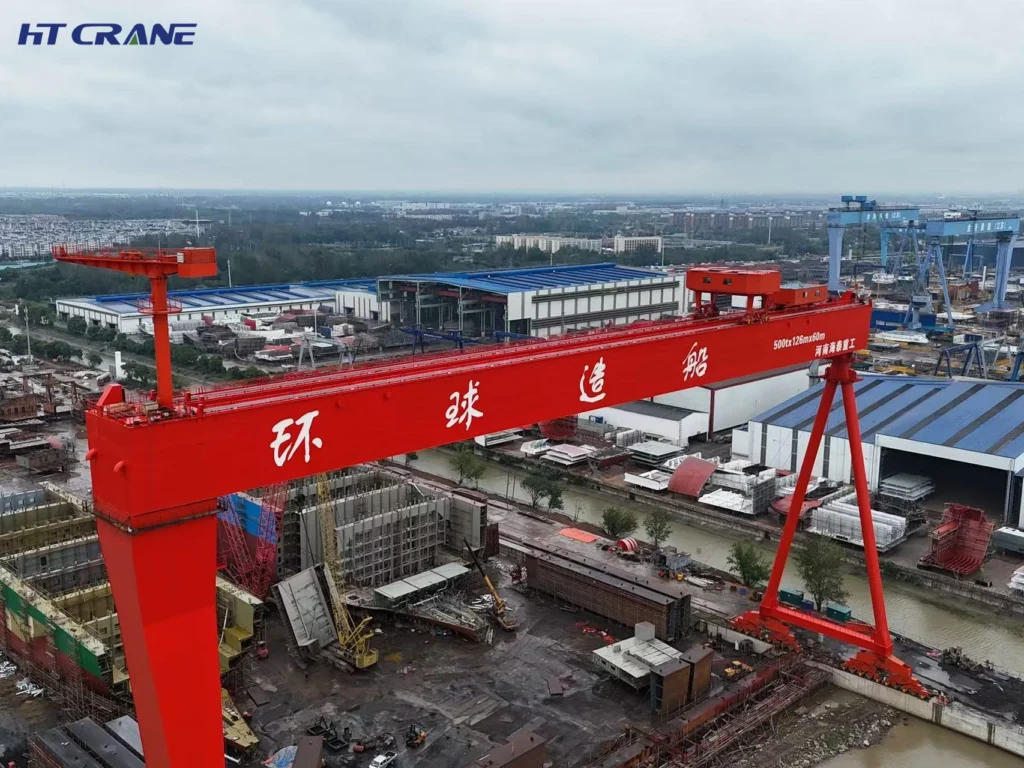
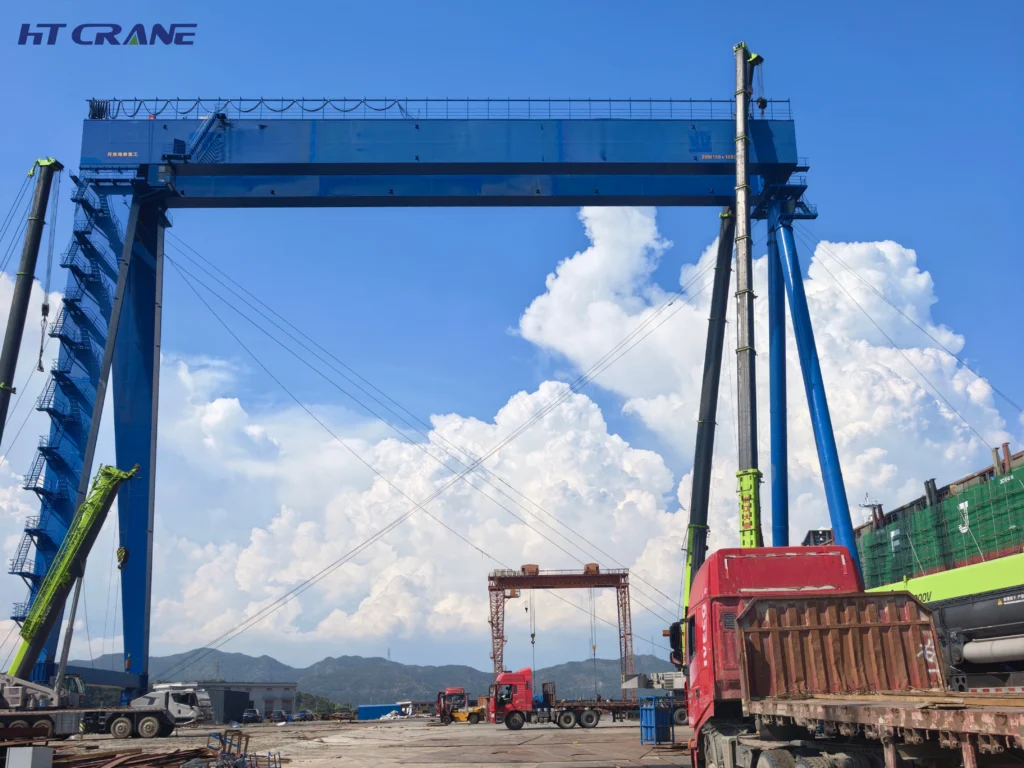
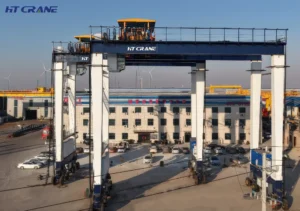
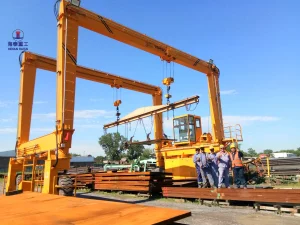
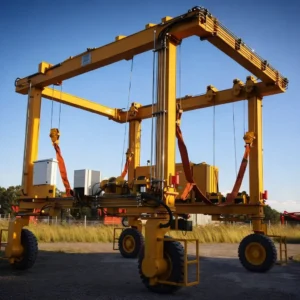
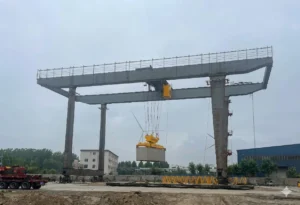
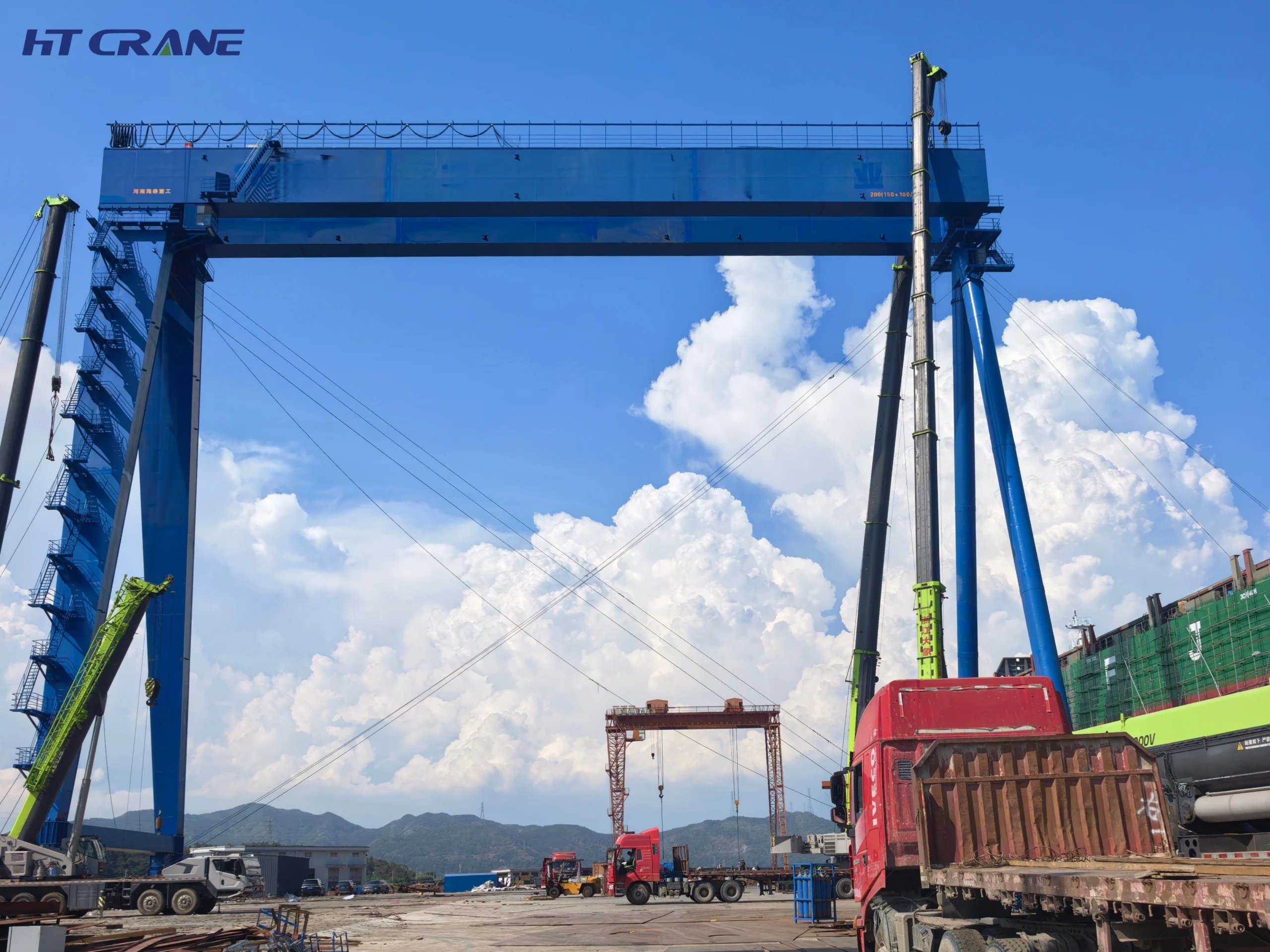
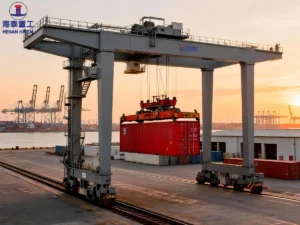
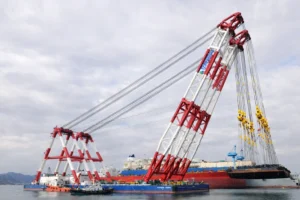
A shipyard gantry crane is a large portal crane designed specifically for the assembly, transportation, and positional adjustment of ship hull sections on a dock or slipway. It is not a standard industrial gantry crane scaled up.
The distinction matters because shipyard operations require capabilities that general-purpose gantry cranes are not designed to provide. The key ones are:
Tandem lifting — two cranes or two trolleys working in coordinated synchrony to lift a single oversized hull section. The upper and lower trolleys on a shipyard gantry crane are specifically designed to operate independently or together, allowing the load to be tilted, rotated slightly, or positioned to the exact welding angle required.
Mid-air turning — hull sections frequently need to be flipped or rotated in the air to reach their correct assembly orientation. This requires precise multi-point control that general industrial cranes cannot achieve.
Large-span dock coverage — the crane must span the full width of the dry dock or slipway, often including cantilever extensions beyond the dock edge. This is why span requirements for shipyard gantry cranes start where most industrial cranes end.
These operational demands drive every specification decision that follows.
Capacity: How to Determine the Right Rated SWL
What Rated Capacity Actually Means
Rated capacity — the Safe Working Load (SWL) — is the maximum load the crane can lift under specified conditions. This figure covers the combined weight of the load, the hook block, the sling or lifting attachment, and any other rigging equipment. Capacity is determined through structural analysis and testing against ISO, FEM, and applicable national standards such as GB/T3811.
A critical point that is often missed: rated capacity is a static value measured at specific trolley positions under controlled conditions. Dynamic loading during acceleration, deceleration, travel, and wind load adds to the effective load on the structure. For shipyard applications, applying a minimum safety margin of 10–20% above the heaviest anticipated lift is standard practice per ISO 4301 and FEM duty class requirements.
Capacity Ranges by Shipyard Type
Shipyard gantry crane capacities span an extremely wide range:
| Shipyard Type | Typical Crane Capacity | Primary Application |
|---|---|---|
| Small craft and yacht yards | 5T – 50T | Boat handling, light components |
| Commercial vessel repair yards | 50T – 200T | Hull sections, engine installation |
| Medium shipbuilding facilities | 100T – 450T | Hull assembly, large section lifting |
| Large and ultra-large shipyards | 500T – 2,000T+ | Full hull blocks, FPSO modules |
At the upper extreme, the world’s largest shipyard gantry crane — Taisun, installed at Yantai Raffles Shipyard in China — has a rated capacity of 20,000 tonnes and achieved the Guinness World Record for heaviest crane lift in 2008, hoisting a ballasted barge weighing 20,133 metric tonnes. While this represents the absolute ceiling of the technology, it illustrates how the shipyard gantry crane scales with operational demand.
How Span Affects Rated Capacity
Span and capacity are not independent. As span increases, the structural load on the main girder increases with it — bending moment grows with the square of the span. For a given structural design, a longer span reduces the maximum rated capacity the crane can safely deliver at midspan. Engineers compensate through heavier main girder sections, box girder construction, and in very long spans, variable cross-section design that concentrates material where stress is highest.
This relationship means buyers cannot simply specify maximum capacity and maximum span independently. The two must be engineered together. When approaching suppliers, always provide both figures as a combined requirement.
Span: Coverage, Dock Width, and Cantilever Design
Defining Span for a Shipyard Application
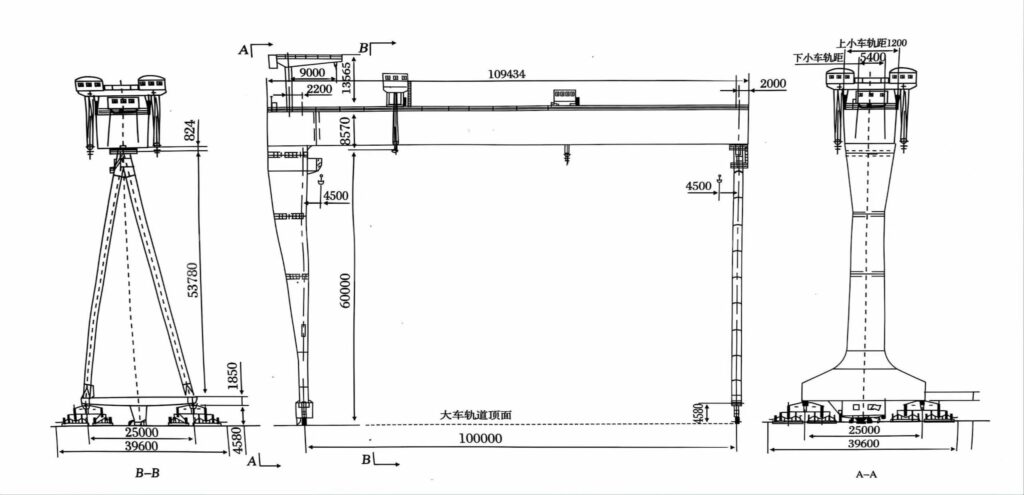
Span in a gantry crane refers to the centre-to-centre distance between the crane’s rail tracks. For shipyard applications, span is determined primarily by the width of the dry dock or slipway the crane must cover, plus any cantilever extensions required for laydown or staging areas alongside the dock.
Industry parameters for shipyard gantry crane spans run from 20 metres for smaller repair facilities to 120 metres for large construction docks. The Samson and Goliath cranes at Harland and Wolff’s Belfast shipyard — among the most recognised shipyard gantry cranes in the world — each span 140 metres.
Rigid Leg and Flexible Leg Design
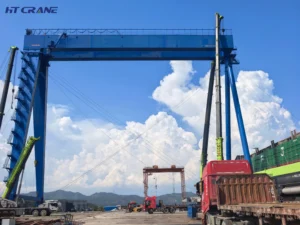
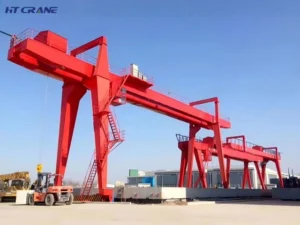
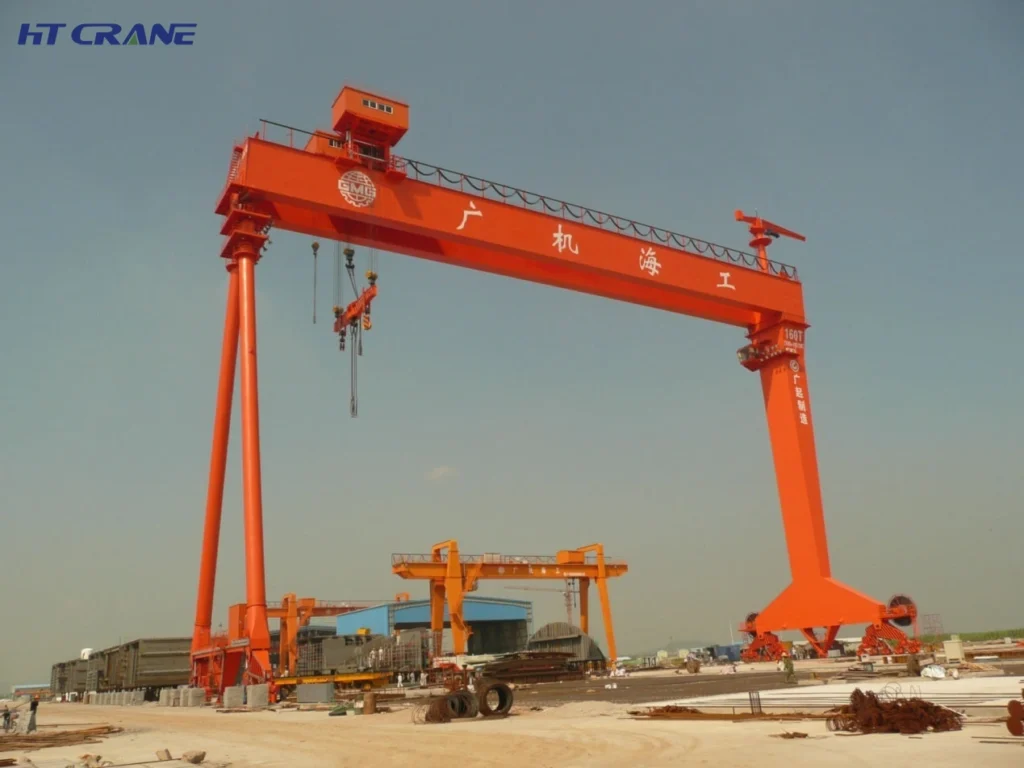
A distinctive structural feature of shipyard gantry cranes is the combination of one rigid leg and one flexible leg. This design is required because large spans produce significant thermal expansion and structural deflection under load. If both legs were rigidly connected to the main girder, differential movement would induce damaging stresses into the structure.
The rigid leg connects the main girder to the end carriage through a fixed joint, providing the primary structural reference. The flexible leg connects through a hinged or pin joint, allowing controlled lateral movement to absorb deflection and thermal change without transmitting those forces into the main girder. For very large spans, a deviation rectifying system is also fitted to correct crane travel alignment.
Single Girder vs Double Girder for Long Spans
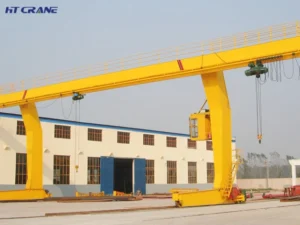
For spans above approximately 60 metres and capacities above 100 tonnes, the double girder configuration is the standard choice. Two parallel main girders distribute load across a wider base, reduce deflection at midspan, and allow upper and lower trolleys to operate independently on their respective tracks without interference.
Single girder configurations are more material-efficient and cost-effective at shorter spans and lighter capacities. They remain practical for many repair yard applications. For large-scale shipbuilding docks where tandem lifting and mid-air turning are routine operations, double girder design is the baseline.
Lifting Height: Hook Height and Working Clearance
Standard Parameters
Shipyard gantry crane lifting heights — measured from rail level to maximum hook height — typically range from 15 to 50 metres depending on the facility and the size of ship being built. This range reflects two distinct needs: sufficient height to lift hull sections clear of adjacent structures during horizontal transport, and adequate clearance for mid-air rotation.
For hull section flipping operations specifically, the minimum safe lifting height must account for the diagonal dimension of the section being turned — not just its height in the resting position. A hull section that is 8 metres tall and 12 metres wide requires at least 14–15 metres of hook height to rotate safely without ground contact.
Speed Parameters That Affect Workflow
Lifting speed and travel speed directly affect how quickly hull sections move through the assembly sequence. Shipyard gantry cranes use variable frequency drives (VFDs) on all mechanisms, allowing operators to control speed proportionally rather than switching between fixed speed steps. Typical parameters:
- Lifting speed: 0.5 to 10 m/min (variable, with very slow speeds available for precise positioning)
- Crane travel speed: 5 to 30 m/min along the dock
- Trolley travel speed: 3 to 20 m/min across the span
Slow lifting speeds at the lower end of the range are critical for tandem lifts and mid-air positioning. Operators need fine control when aligning a 200-tonne hull section to a welding position measured in millimetres.
Working Class and Duty Classification
Why Duty Class Matters as Much as Capacity
A crane’s working class — its duty classification — defines how intensively it can operate over its design life. Two cranes with identical rated capacity but different duty classes are fundamentally different investments.
Shipyard gantry cranes are classified under FEM 1.001 and ISO standards, with working classes ranging from A6 to A8 for heavy and very heavy shipbuilding applications. The working class is determined by three factors: the total number of working cycles over the crane’s design life, the load spectrum (how often the crane operates at or near its rated capacity), and the daily operating hours.
| FEM Working Class | Typical Application in Shipyards | Operating Intensity |
|---|---|---|
| A5 | Light repair yards, occasional heavy lifts | Moderate duty |
| A6 | Standard shipbuilding facilities | Regular heavy use |
| A7 | Large shipbuilders, continuous operations | Intensive use |
| A8 | Ultra-heavy, continuous heavy shipbuilding | Maximum intensity |
Specifying a crane at a lower working class than the actual operating intensity is one of the most common and costly errors in shipyard crane procurement. The structural and mechanical components are sized for the duty class — underspecifying duty class means the crane reaches the end of its calculated design life years before its expected retirement date.
Environmental Classification and Marine Corrosion
Shipyard environments present specific corrosion challenges that standard industrial cranes are not designed for. Salt air, sea spray, and condensation attack structural steel and electrical components continuously. Shipyard gantry cranes require:
- Structural steelwork with marine-grade protective coating systems applied to a specification agreed with the operator
- Electrical equipment housed to minimum IP54 protection class, with IP65 available for exposed locations
- Wind load design accounting for operational conditions up to 25 m/s and non-operational (storm) conditions up to 60 m/s, with rail clamps and ground anchors as standard storm protection
- Bearings and lubrication systems designed for marine humidity and temperature ranges
These requirements are not optional upgrades. In a coastal shipyard environment, an inadequately protected crane will begin deteriorating structurally within its first years of operation.
Application Scenarios: Matching the Crane to the Operation
New-Build Hull Assembly
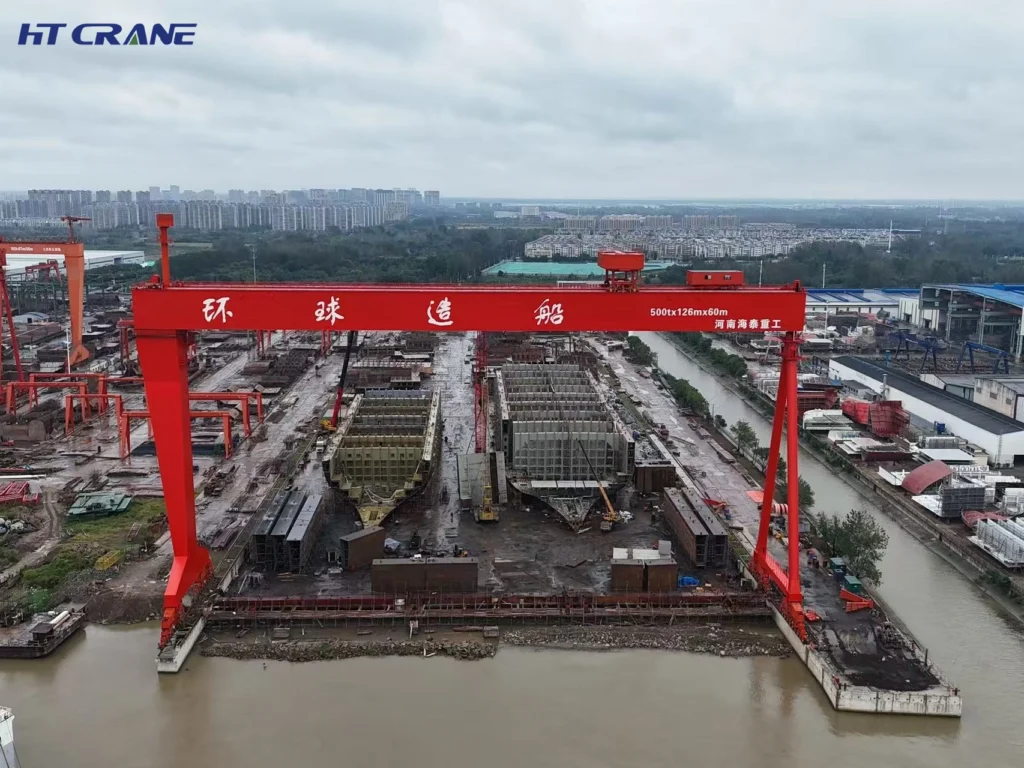
This is the primary application driving the design of the shipyard gantry crane as a product category. Hull sections — typically fabricated in workshops or on open ground adjacent to the dock — are lifted by the gantry crane, transported along the dock to the assembly position, and lowered onto the growing hull structure with millimetre-level precision.
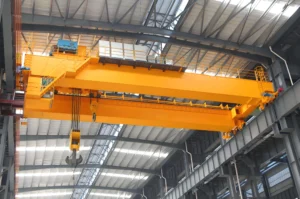
The upper and lower trolley arrangement is central to this process. Upper trolleys carry the main load. The lower trolley provides supplementary lifting and lateral positioning. Both can traverse the span independently and pass each other during operation, which allows a single crane to manage complex multi-point lifts without requiring a second crane on the same rail track.
Ship Repair and Maintenance Docks
Repair facilities have different requirements from new-build yards. Lift cycles are less frequent but equally demanding in terms of load weight and positioning precision. Engine removal and reinstallation, stern tube and propeller handling, and superstructure removal for major refits all require high capacity at precise hook positions.
For repair yards, the practical emphasis shifts toward flexibility — the ability to reach any point in the dock regardless of what vessel is currently in the berth — and toward service life, since repair yard cranes may operate for decades with minimal structural changes to the facility around them.
Offshore and Module Fabrication Yards
Yards building offshore platforms, FPSO vessels, and semi-submersible rigs use shipyard gantry cranes for module and topsides assembly. These applications typically involve the largest capacities and the most demanding tandem lift requirements. A single module can weigh several hundred tonnes and require simultaneous lifting at six or more attachment points to maintain structural integrity during the lift.
Specification Checklist: Before You Approach a Supplier
Seven parameters must be defined before a meaningful conversation with any supplier is possible:
Maximum lift weight — the heaviest single load, including rigging, at the most demanding lift point. Apply a 10–20% safety margin above this figure.
Span — the dock or slipway width plus any required cantilever. Confirm with your site survey, not with a design drawing.
Lifting height — the maximum hook height required, accounting for the diagonal dimension of any section that will be turned mid-air.
Duty class — based on your actual daily operating hours and load spectrum, not an optimistic estimate. If in doubt, go up one class.
Environmental specification — coastal marine, offshore spray zone, or sheltered inland. This determines coating specification and electrical protection rating.
Trolley configuration — single trolley for straightforward lifting, upper/lower trolley arrangement for tandem lifting and mid-air rotation.
Rail track gauge and civil foundation design — the crane’s rail spacing and rail loads must be coordinated with the civil engineering design of the dock structure. This is not a crane supplier decision alone — it requires input from the structural engineer responsible for the dock.

Conclusion
A shipyard gantry crane is a long-lived, high-capital asset that must perform reliably for 20 to 30 years in a corrosive and demanding environment. The specification decisions made before purchase determine whether it achieves that life comfortably or requires major intervention within the first decade.
Capacity and span must be specified together, not independently. Duty class must reflect actual operating intensity. Environmental protection must match the installation site. And the trolley configuration must be matched to the most demanding lift operation the crane will be asked to perform — not the average one.
Getting these decisions right at specification stage costs nothing. Getting them wrong after commissioning costs significantly more than the price difference between a correctly specified crane and an underspecified one.