If you’re planning a new terminal or expanding an existing one, choosing between STS and RTG cranes is one of the first decisions you’ll face — and one with consequences that last 20 to 30 years.
Here’s the direct answer: STS cranes handle vessel loading and unloading at the berth. RTG cranes manage container stacking inside the yard. Most terminals need both. But the critical decisions are about scale, configuration, cost model, and how these two systems work together.
This guide covers what procurement and planning teams actually need to know — technical specs, real cost figures, decision thresholds, automation options, and the scenarios where each crane type is the right call.
What Each Crane Does — and How They Differ Structurally
STS Cranes: Built for the Berth

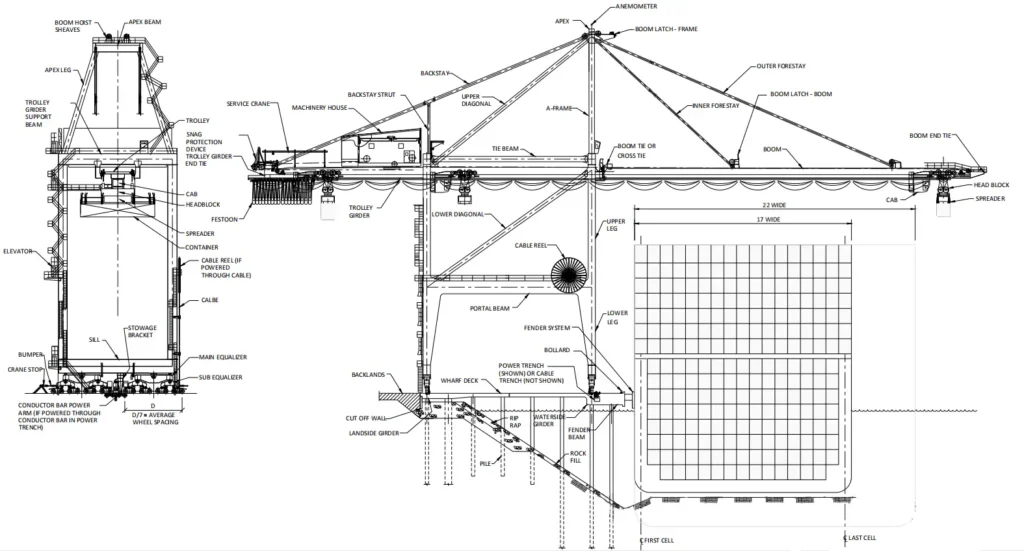
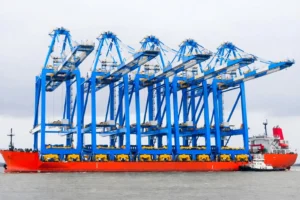
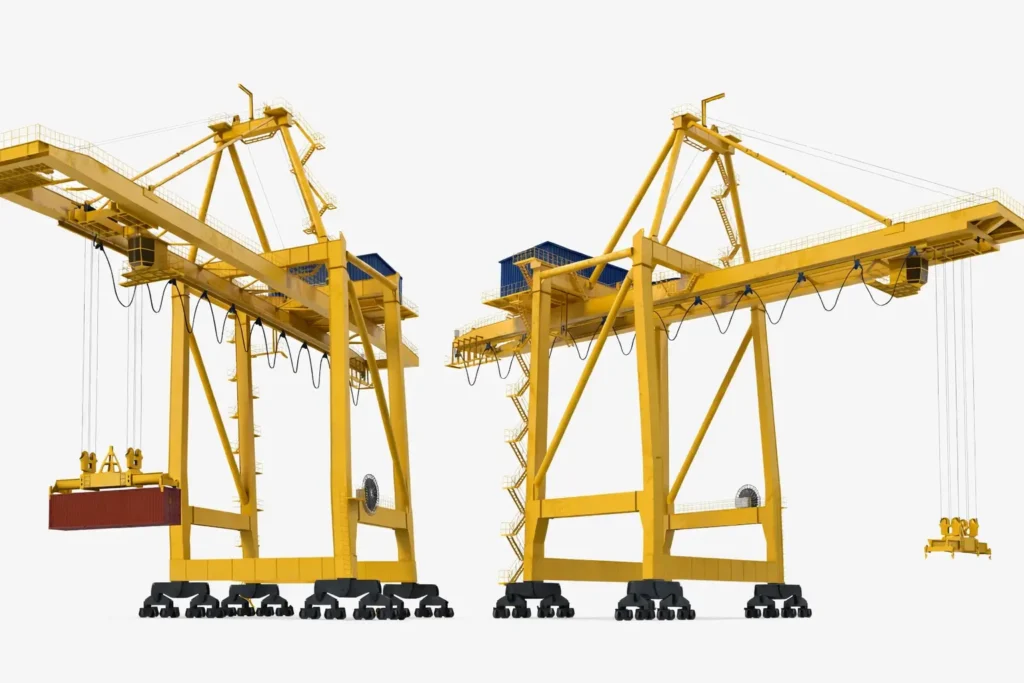
Ship-to-Shore cranes are fixed rail-mounted gantry structures positioned along the quayside. They exist to do one thing well: move containers between vessels and the dock as fast as possible.
Their physical scale reflects that purpose. Modern STS cranes stand 80–120 meters tall (boom raised) with outreach ranging from 50–70 meters — enough to span the full beam of today’s Ultra Large Container Vessels carrying 24+ rows. Backreach typically extends 15–25 meters to the landside buffer zone.
Key performance specs:
- Lifting capacity: 40–65 tonnes under spreader (some heavy-lift models reach 100 tonnes)
- Lifting height: 30–50 meters above quay level
- Cycle speed: 25–40 moves per hour under optimal conditions
- Power: Fully electric, via port grid, cable reel, or busbar
STS cranes are classified under ISO 8686 for design load principles. European market installations must comply with EN 13001 for structural safety. Regenerative braking systems on modern units recover 15–25% of operating energy — a meaningful figure given typical consumption of 150–400 kWh per operating hour.
RTG Cranes: The Yard’s Mobile Workforce
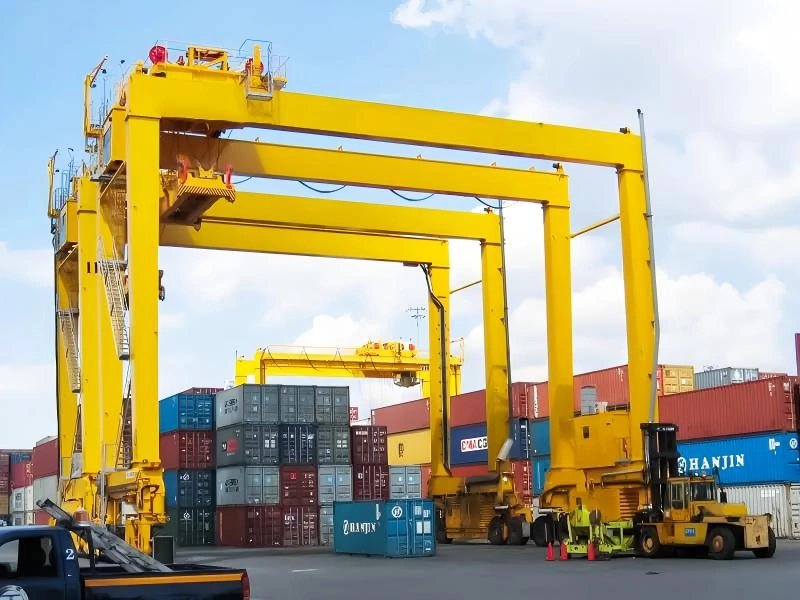
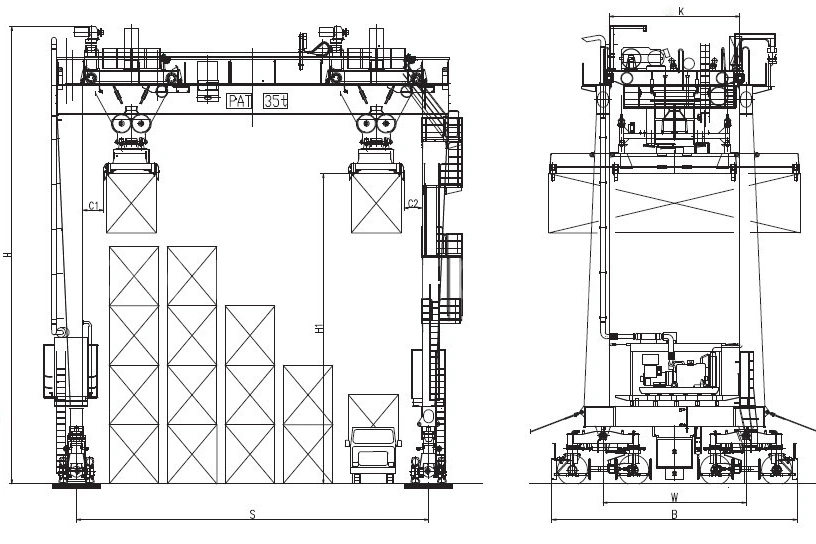
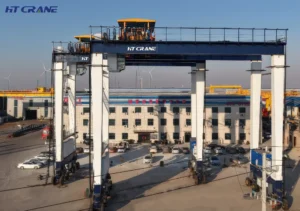
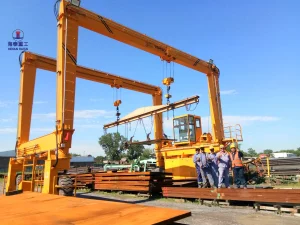
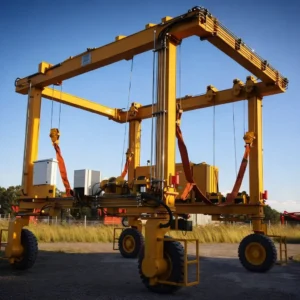
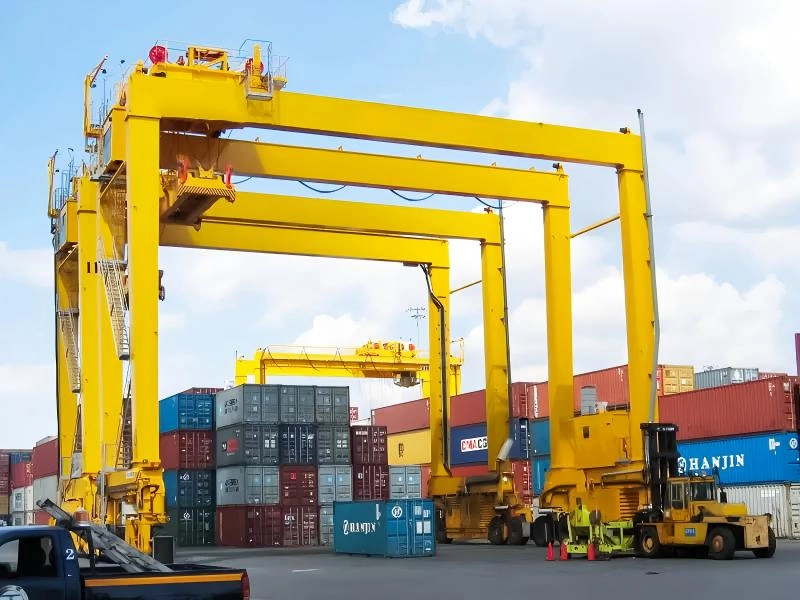
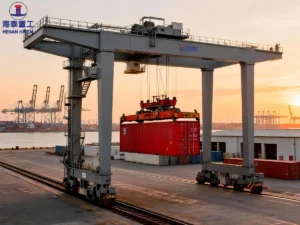
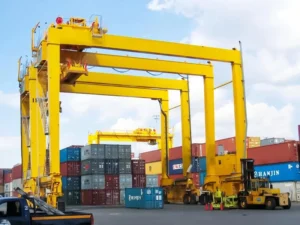
Rubber-Tyred Gantry cranes operate in the container yard. They stack incoming boxes, retrieve specific containers on demand, and connect the berth flow to the outbound transport network — trucks, rail, or AGVs.
The defining characteristic is mobility. RTGs move on rubber tires between storage lanes, which means yard blocks can be reconfigured without major civil reconstruction. That flexibility is a significant operational advantage as terminal footprints evolve.
Key performance specs:
- Stacking configurations: 1-over-4, 1-over-5, 1-over-6, and in some high-density terminals, 1-over-7
- Span width: 18–35 meters, typically covering 6–7 container rows plus a truck lane
- Lifting capacity: 40–50 tonnes
- Travel speed: 50–100 meters per minute when repositioning between lanes
- Cycle speed: 18–28 moves per hour
Wheel configurations range from 8-wheel (standard) to 16-wheel designs for enhanced stability in taller stacking operations.
Side-by-Side Comparison
| Feature | STS Crane | RTG Crane |
|---|---|---|
| Primary role | Vessel load/unload | Yard stacking & retrieval |
| Mobility | Fixed rail (quayside) | Rubber-tired, mobile |
| Typical outreach | 50–70 m | N/A |
| Max lifting capacity | 40–100 t | 40–50 t |
| Cycle speed | 25–40 moves/hour | 18–28 moves/hour |
| Power source | Electric (shore grid) | Diesel-electric / hybrid / full electric |
| Stacking height | N/A | Up to 1-over-7 |
| Typical lifespan | 25–35 years | 15–25 years |
| Containers/lifetime | 1.8–2.4 million | 600,000–900,000 |
| Automation readiness | High | High (ARTG commercially mature) |
Real Cost Figures: Capital and Operations
Cost is usually where procurement decisions get made. Here are realistic 2025 figures based on current market data.
Capital Expenditure
STS Cranes:
- Standard STS crane: $8–12 million
- Automated STS crane: $12–18 million
- Mega-sized STS (for 24,000+ TEU vessels): $15–25 million
RTG Cranes:
- Diesel RTG: $1.2–1.8 million
- Electric RTG (cable reel): $1.5–2.2 million
- Battery-electric RTG: $1.8–2.5 million
- Automated RTG (ARTG): $2.5–3.5 million
The capital gap is significant. One STS crane costs more than a full fleet of standard RTGs. That doesn’t mean RTGs are the better value — it depends entirely on throughput volume and operational model.
Lifetime Operational Costs
STS Crane (25-year lifespan):
| Cost Category | Estimated Total |
|---|---|
| Energy | $6–10 million |
| Maintenance | $3–5 million |
| Labor (semi-automated) | $4–6 million |
| Total | $13–21 million |
RTG Crane (15-year lifespan):
| Cost Category | Estimated Total |
|---|---|
| Energy / Fuel | $1.5–3 million |
| Maintenance | $1–2 million |
| Tires (replaced every 2–3 years) | ~$600,000 |
| Labor | $2–4 million |
| Total | $5–9 million |
One cost that catches many operators off-guard: RTG tire replacement. A full set of tires for a large RTG runs $150,000–$200,000, and with replacement cycles of 2–3 years, this becomes a recurring operational budget item that belongs in any TCO calculation from day one.
Cost Per Move
| Metric | STS Crane | RTG Crane |
|---|---|---|
| Cost per move | $2.50–$3.80 | $3.20–$5.00 |
| Payback period | 8–12 years | 5–8 years |
Despite higher upfront cost, STS cranes achieve lower cost per move at scale — driven by higher cycle speeds and longer operational lifespan. RTGs recover capital faster due to lower entry cost, but per-move economics favor STS at volumes above roughly 500,000 TEU annually.
Application Scenarios: Which Crane Fits Which Terminal
When STS Cranes Are Necessary
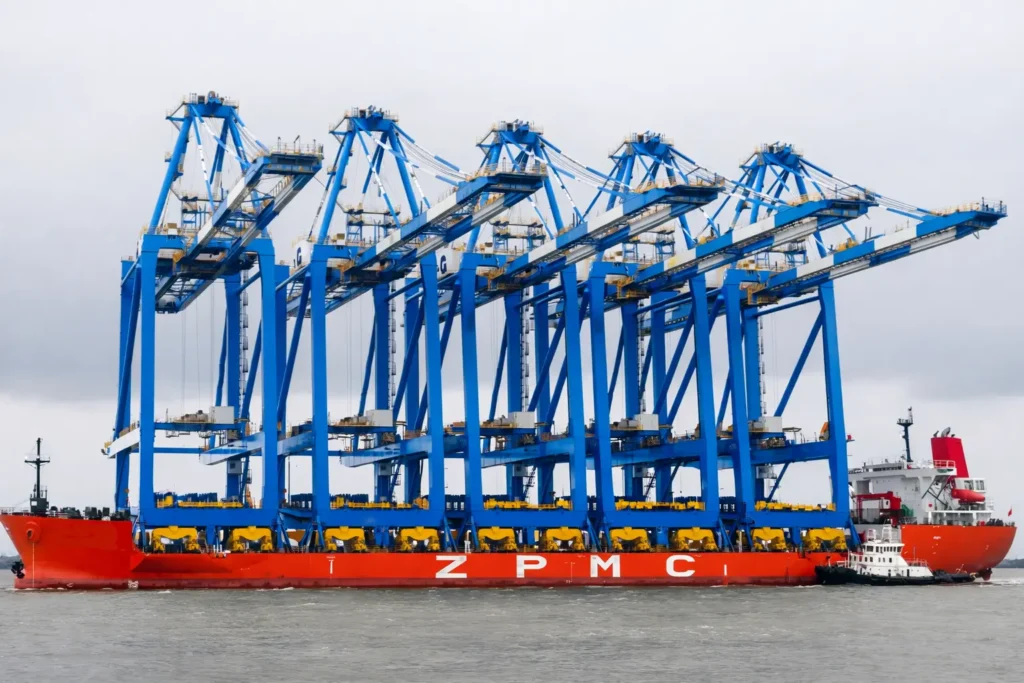
Deep-water, high-volume berths: If your terminal serves Post-Panamax or Ultra Large Container Vessels, STS cranes are not optional. Modern ULCVs require minimum 22-row outreach — no other crane type handles vessel-side operations at this scale.
Ports like Singapore PSA operate 80+ STS cranes across their terminals. Shanghai Yangshan Phase IV runs 26 automated STS cranes as part of the world’s largest automated terminal. These aren’t outliers — they represent the direction the industry is heading for hub ports.
Volume thresholds: The practical benchmark is 800,000 TEU annually and above. Below that, a well-configured RTG fleet with mobile harbor cranes may serve vessel operations adequately at smaller berths.
When RTG Cranes Make the Better Choice

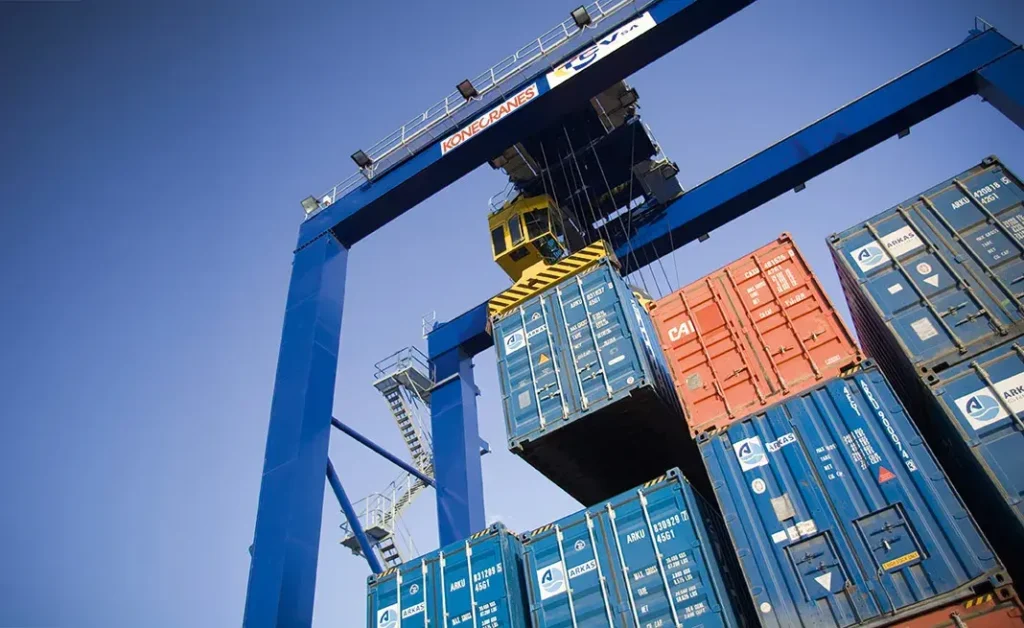
Multi-purpose and intermodal terminals: RTGs can service ships, trucks, and rail operations from the same equipment. Hamburg’s Altenwerder terminal runs 70+ RTGs in an integrated intermodal operation. That flexibility is hard to replicate with fixed-rail equipment.
Space-constrained or evolving terminals: Because RTGs run on rubber tires, yard blocks can be repositioned without infrastructure changes. For terminals with irregular land parcels or phased expansion plans, this matters significantly.
Volume thresholds: Under 300,000 TEU annually, RTG-based operations are typically sufficient. Between 300,000 and 800,000 TEU, a hybrid configuration — RTGs for the yard, mobile harbor cranes or a small STS fleet for the berth — is worth modeling carefully.
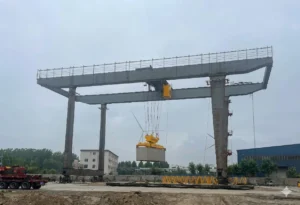
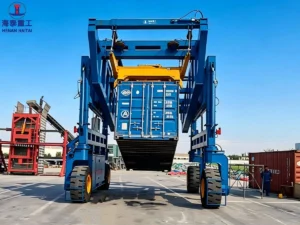
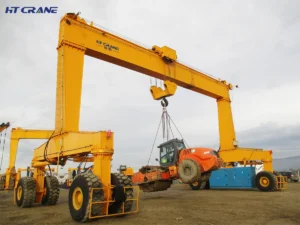
90-Ton Rubber Tyred Gantry Crane YTL90t-8m Successfully Exported to Mexico
The Third Option: Automated Stacking Cranes (ASCs)
Many comparisons focus only on STS vs RTG, but Automated Stacking Cranes (ASCs) — rail-mounted, fully automated yard cranes — are an increasingly common alternative to RTGs in greenfield projects.
ASCs offer higher stacking density than RTGs and are better suited to fully automated terminal designs. The trade-off is less operational flexibility and higher civil engineering requirements (fixed rail infrastructure). Rotterdam’s Maasvlakte II and Singapore’s Tuas Terminal both use ASC-based yard systems.
If you’re planning a greenfield terminal above 500,000 TEU with a full automation strategy, ASCs deserve a place in your evaluation alongside RTGs.
Automation: Where STS and RTG Technology Is Heading
STS Automation
Modern automated STS cranes incorporate several technologies that meaningfully change operational economics:
- Machine vision and AI recognition: Automated container identification and positioning, reducing misplacement rates to below 0.01%
- Auto-spreader systems: Automatic twistlock handling, saving 3–5 seconds per move — at 30 moves per hour, that compounds significantly across a vessel call
- Predictive motion control: Systems that anticipate vessel movement from swell and wave action, maintaining safe and efficient operation without operator intervention
- Remote operation centers: Operators supervise multiple cranes from a centralized location, changing the labor model fundamentally
RTG Automation
Automated RTGs (ARTGs) are now commercially mature, with deployments across terminals in Asia, Europe, and the Americas.
Key technologies include:
- Auto-steering with GPS/RFID guidance: ±2 cm positioning accuracy during lane travel
- Battery management systems: Fast-charge lithium-ion packs supporting 4-hour operation cycles with 10-minute recharging
- Tire pressure monitoring: Real-time sensors reducing unplanned tire wear by up to 30%
- Predictive maintenance integration: Vibration and load sensors feeding maintenance scheduling systems, reducing unplanned downtime by approximately 40%
Semi-automation — remote-controlled RTGs where an operator manages multiple cranes from a control room — is a practical middle ground for terminals below 300,000 TEU where full automation investment is difficult to justify.
Sustainability and Power Systems
STS Cranes: Already Electric
STS cranes run on shore power by design. Energy recovery through regenerative braking (15–25% of operating energy) is standard on modern units. Emerging developments include:
- Hydrogen fuel cell prototypes: ZPMC tested a hydrogen-powered STS unit in 2024
- Solar panel integration: Crane house rooftop panels contributing to auxiliary power
- Shore power connection standardization aligns with port emission regulations in Los Angeles, Rotterdam, and other major ports with 2030 diesel phase-out targets
RTG Cranes: Transitioning Fast
Diesel RTGs are being phased out across major ports under emissions regulation. The technology options are mature:
- Cable-reel electric RTGs (eRTGs): Commercially proven, in full operation at multiple major terminals
- Battery-electric RTGs: Viable for terminals with charging infrastructure; some Chinese ports have implemented 5-minute battery-swap stations for maximum uptime
- Supercapacitor energy recovery: Captures up to 90% of energy from container lowering operations
- HVO / biodiesel compatibility: Existing diesel RTG fleets can cut CO₂ by up to 80% with HVO fuel — a lower-cost transition option while full electrification infrastructure is built
If your terminal has sustainability commitments, specify electric or hybrid from the outset. Retrofitting diesel RTGs adds cost and complexity that outweighs the apparent savings of the lower initial purchase price.
Decision Framework: Five Questions That Determine Your Configuration
Work through these questions in order. Each one narrows the choice considerably.
1. What is your annual TEU forecast for years 1, 5, and 15?
- Above 800,000 TEU: STS cranes are required
- Below 300,000 TEU: RTG-based operation is typically sufficient
- 300,000–800,000 TEU: Model hybrid configurations
2. What vessel sizes will you be serving?
- Post-Panamax and ULCV: STS mandatory, minimum 22-row outreach
- Panamax and below: RTG or mobile harbor cranes may be sufficient at the berth
3. Is this a greenfield or brownfield project?
- Greenfield above 500,000 TEU: Evaluate STS + ASC vs STS + RTG
- Brownfield upgrade: RTG fleet optimization and electrification often delivers better ROI than new STS investment unless vessel mix is changing
4. What is your automation strategy?
- Full terminal automation: STS + ASC combination (see Rotterdam, Tuas)
- Semi-automation: RTGs with auto-steering and remote operation
- Manual with efficiency improvements: Standard RTG fleet with TOS integration
5. What are your sustainability commitments and regulatory constraints?
- Phase-out requirements by 2030 in many ports make diesel RTG procurement a liability
- Specify electric from the outset; the incremental cost is recoverable through fuel and maintenance savings within 4–6 years in most operating models

Common Planning Mistakes to Avoid
Underestimating RTG fleet size at project launch. RTG procurement lead times run 12–18 months. Terminals that open with a lean RTG fleet rarely catch up quickly when demand exceeds projections. Build in headroom.
Specifying STS outreach based on today’s vessel calls. ULCV deployment has grown steadily for a decade and shows no sign of stopping. A 55-meter outreach crane may be insufficient within 10 years if your port attracts larger alliances. Specify for where the market is heading, not where it is today.
Ignoring ground bearing capacity for RTGs. RTG axle loads are substantial. Yard pavement must be engineered for the specific model and load distribution — this is a civil engineering input that affects total project cost and gets missed in early budgeting more often than it should.
Omitting tire costs from TCO calculations. RTG tire replacement is a recurring $150,000–$200,000 cost item every 2–3 years. Exclude it from your lifecycle model and your operational budget projections will be consistently understated.
Treating automation as a future upgrade. Retrofitting automation onto cranes designed for manual operation costs significantly more than specifying automation-ready systems at procurement. If automation is in your 5-year plan, build the infrastructure now.
Summary: Making the Right Call
STS and RTG cranes serve fundamentally different roles, and most terminals of meaningful scale need both. The decision isn’t which one — it’s what configuration, what capacity, what power system, and what automation level.
The clearest guidance: match your equipment specification to your TEU forecast, vessel mix, and sustainability requirements — not your current situation alone. Both crane types will be in service for 15–30 years. The decisions made at procurement define your operational envelope for the entire period.
For greenfield projects targeting significant volume, automated STS cranes paired with ASCs or ARTGs represent the direction the industry’s most advanced terminals are moving. For regional and brownfield operations, electric RTG fleets with phased automation offer better capital efficiency and operational flexibility.
Engage OEMs early — not for pricing, but to validate technical parameters that feed your civil and electrical design. The cost of getting this right is a few months of planning. The cost of getting it wrong follows you for three decades.
FAQ
Q1: What is the minimum annual volume that justifies investing in STS cranes?
Most industry planners use 800,000 TEU annually as the threshold where STS crane investment becomes clearly justified on operational and financial grounds. Below 300,000 TEU, RTG-based operations with mobile harbor cranes or small semi-portal cranes can handle vessel operations adequately at lower capital cost. The 300,000–800,000 TEU range is a genuine gray zone — detailed financial modeling of hybrid configurations is advisable, and the answer often depends on the size of vessels you’re serving and the depth of your berth.
Q2: Can RTG cranes be converted from diesel to electric after purchase?
Yes, diesel-to-electric retrofits are technically feasible and have been completed at terminals globally. Common approaches include adding cable reel systems or converting to battery-electric operation. The challenge is cost: a full retrofit typically runs $400,000–$700,000 per crane, depending on the model and the target configuration. For terminals planning electrification, specifying electric at procurement is almost always more cost-effective than a later retrofit. For existing fleets, HVO or biodiesel fuel compatibility offers a lower-cost intermediate step that significantly reduces emissions while electrification infrastructure is developed.
Q3: How does the STS-to-RTG fleet ratio work in practice?
The commonly cited planning benchmark is 3–5 RTGs per STS crane, but this is a starting point, not a fixed rule. The right ratio depends on container dwell time (longer dwell = more yard congestion = more RTGs needed), yard configuration, automation level, and the mix of import versus export volumes. Terminals with average dwell times above 5 days will trend toward the higher end of this range. Detailed simulation modeling — running realistic vessel arrival schedules, dwell time distributions, and yard density scenarios — is the appropriate tool for terminals above 300,000 TEU. The benchmark ratio is useful for early budget scoping; it shouldn’t drive final fleet sizing.
Q4: What is the procurement lead time for STS and RTG cranes, and how should it affect project planning?
STS cranes carry lead times of 24–36 months from order to delivery, driven by custom fabrication complexity and the limited number of manufacturers capable of producing full-scale units (ZPMC, Konecranes, and Liebherr are the primary global suppliers). RTG cranes typically require 12–18 months. Both timelines extend further if significant customization is required or if the manufacturer’s production schedule is congested. The practical implication: crane procurement must be initiated well before terminal opening, and delays in equipment specification or contract award flow directly into commissioning delays. Early OEM engagement — even before final design — is advisable for terminals with fixed opening deadlines.
Q5: What international standards should procurement teams verify for STS and RTG cranes?
Core standards applicable to both types: ISO 8686 (crane design load principles) and EN 13001 (structural safety, primarily European markets). RTG-specific: ISO 22986 covers rubber-tyred gantry crane safety. For European procurements, EU Machinery Directive 2006/42/EC compliance is a mandatory requirement and should be explicitly confirmed during the tender process. Terminals in North American markets should additionally reference ASME B30.2 for overhead and gantry crane safety. Confirming standards compliance at the specification and tender stage avoids costly retrofitting requirements during commissioning or regulatory inspection. For automated systems, cybersecurity and software safety standards (IEC 62443, EN ISO 13849) are increasingly relevant and worth including in technical specifications.