

Manual rigging slows bulk material operations down and ties up labor that could be better used elsewhere. An overhead grab crane eliminates that problem entirely. The crane lifts, moves, and releases bulk material — coal, scrap metal, ore, sand, grain — without any manual load attachment. One operator handles the full cycle from the cabin.
For facilities handling bulk materials repeatedly across a large floor area, an overhead grab crane is not just a convenience. It is the right tool for the job — designed from the structural level up for the high-cycle, high-wear demands of continuous bulk handling. A standard overhead crane running grab operations will reach the end of its structural fatigue life years ahead of schedule. A purpose-built grab crane is designed to last.
This page gives you the full picture: what an overhead grab crane is, how the different grab types compare, what the key specifications mean, and what to verify before you commit to a purchase.
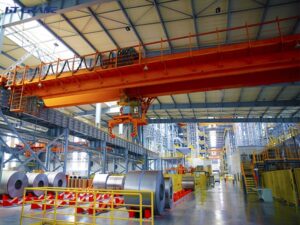
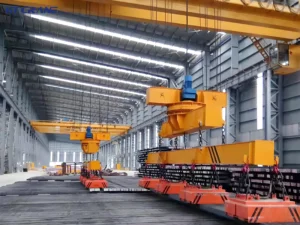
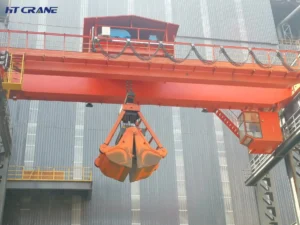
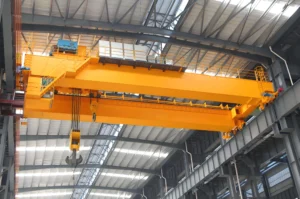
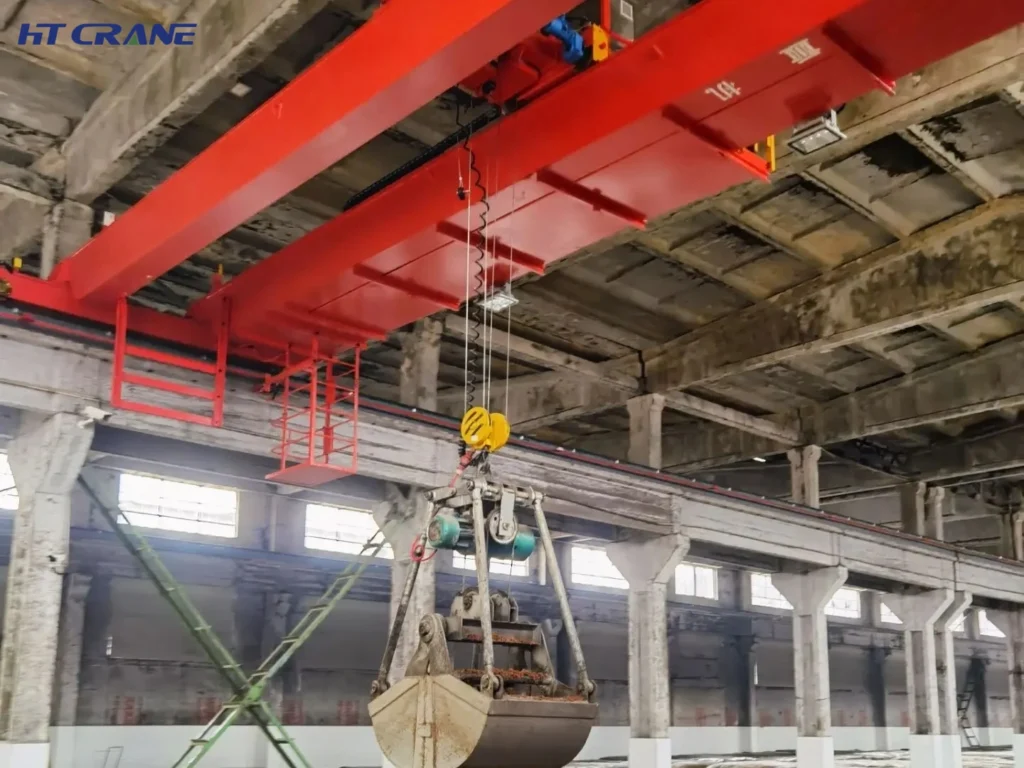
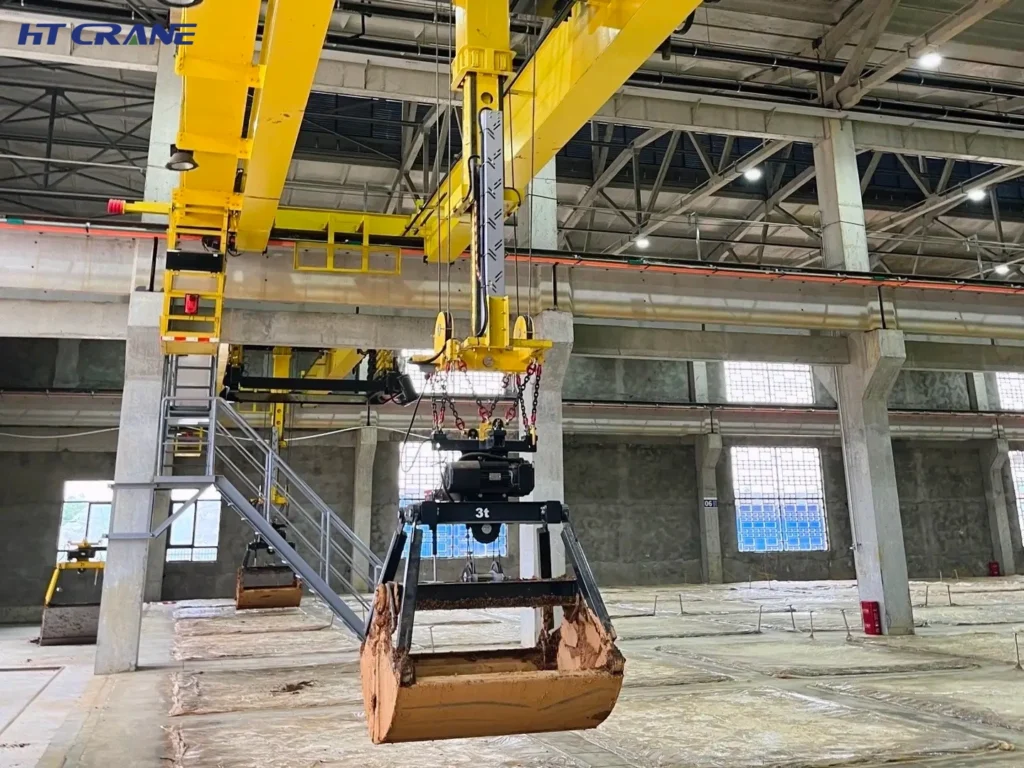
An overhead grab crane is a double girder overhead crane fitted with an integrated grab bucket drive system. The crane travels on runway rails above the working area. The grab bucket — suspended from the trolley — opens, descends into the material pile, closes to pick up a load, hoists, travels to the discharge point, and opens again to release the material.
The key structural difference from a standard hook crane is the grab drive system on the trolley. A rope-operated grab requires four rope reeving — two for hoisting and two for opening and closing the grab. A hydraulic grab requires a hydraulic power unit mounted on the trolley. Both configurations add weight and mechanical complexity to the trolley, and both require a crane structure designed for the higher duty cycle of grab operation.
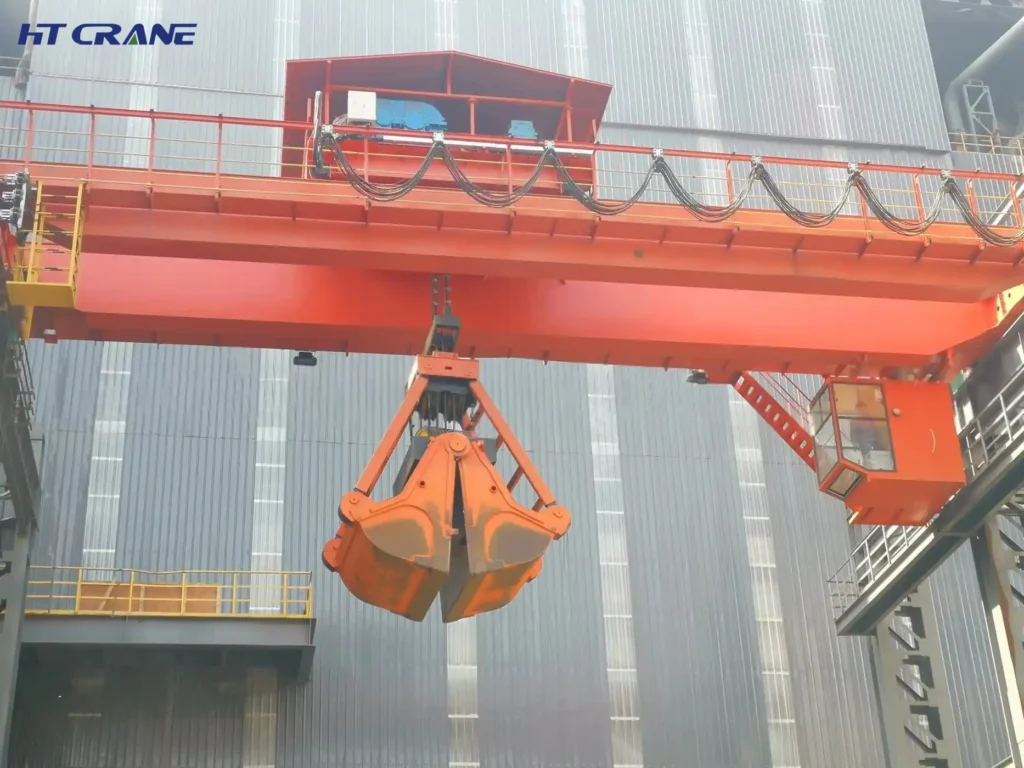
Bulk material handling is one of the highest duty cycle applications in the overhead crane world. A scrap yard overhead grab crane may complete 200–400 grab cycles per shift. Each cycle subjects the hoist mechanism, wire ropes, structural joints, and runway system to repeated loading and unloading. The cumulative fatigue over a year of continuous operation is enormous.
Standard overhead cranes are typically designed to work duty class A3–A5. Overhead grab cranes are designed for A6–A8 — the highest classifications in the GB/T and ISO 4301 systems. This difference is not just a number. It changes the design of the girder, the hoist drum, the wire rope diameter and fleet angle, the runway rail fastening system, and the service life calculations for every rotating component.
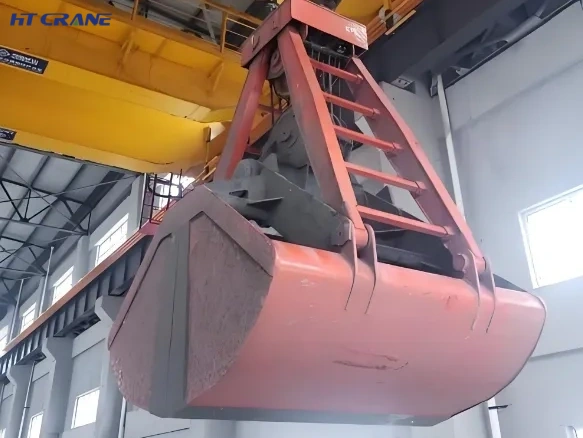
The clamshell grab uses two hinged bucket halves that open and close on a vertical axis. When the bucket is lowered onto a material pile, the two halves open; as the closing rope or hydraulic cylinder acts, the halves close and scoop material from the pile. The loaded bucket is then hoisted to the discharge point and the halves open to release.
Clamshell grabs are the standard for loose, free-flowing bulk materials:
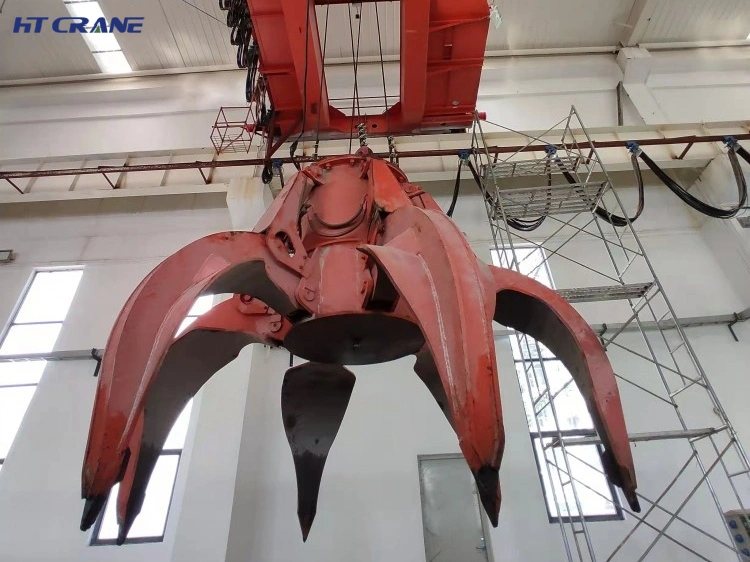
The orange-peel grab uses three to six curved tines that close around the material from multiple directions, like fingers closing on an object. This configuration handles irregular, interlocking material that a clamshell cannot reliably pick up — scrap metal pieces, demolition debris, mixed industrial waste, and similar materials that a clamshell would push aside rather than scoop.
Orange-peel grabs are the standard in:
| Factor | Rope-Operated Grab | Hydraulic Grab |
|---|---|---|
| Drive Mechanism | Closing rope on hoist drum | Hydraulic cylinder on trolley HPU |
| Cycle Speed | Moderate | Fast |
| Maintenance | Simpler — rope and drum | More complex — HPU, cylinders, seals |
| Reliability | High — fewer failure modes | Good — but more service points |
| Best Application | Coal, grain, moderate cycle rate | Scrap, high-cycle intensive operations |
| Trolley Weight | Lower | Higher (HPU adds weight) |
For moderate-cycle applications like power plant coal unloading and grain terminals, rope-operated grabs are the reliable and cost-effective choice. For high-cycle scrap yard operations where maximizing throughput per shift is the priority, hydraulic grabs deliver faster cycle times and better performance on dense, irregular material.
| Parameter | Specification Range |
|---|---|
| Lifting Capacity | 5T – 100T (grab + payload) |
| Span | 10.5m – 35.5m |
| Lifting Height | 6m – 25m |
| Work Duty | A6 – A8 |
| Grab Type | Clamshell or orange-peel (specify at order) |
| Grab Drive | Rope-operated or hydraulic |
| Hoist Reeving | 4-rope system (rope grab) |
| Trolley Configuration | Crab trolley with grab drive system |
| Gantry Speed | 60 – 120 m/min |
| Trolley Speed | 30 – 60 m/min |
| Hoisting Speed | 20 – 60 m/min (unladen); 10 – 30 m/min (laden) |
| Power Supply | Standard three-phase or conductor rail |
| Control | Cabin (standard), radio remote (optional) |
| Design Standard | GB/T 14406, EN 13001, FEM 1.001 |
| Certification | CE (EU Machinery Directive 2006/42/EC), ISO 9001 |
Grab bucket selection depends on material bulk density and required capacity per cycle:
| Material | Bulk Density (t/m³) | Typical Grab Capacity | Grab Type |
|---|---|---|---|
| Coal | 0.7 – 0.9 | 1.5 – 4.0 m³ | Clamshell |
| Iron ore | 1.8 – 2.2 | 0.8 – 2.0 m³ | Clamshell |
| Sand / Gravel | 1.4 – 1.6 | 1.0 – 2.5 m³ | Clamshell |
| Light scrap metal | 0.3 – 0.6 | 2.0 – 5.0 m³ | Orange-peel |
| Heavy scrap / HMS | 0.8 – 1.2 | 1.5 – 3.0 m³ | Orange-peel |
| Grain | 0.7 – 0.8 | 1.5 – 3.5 m³ | Clamshell |
Always provide your material’s bulk density and target throughput per hour when requesting a grab specification. Incorrect bucket sizing — either too large or too small for the rated SWL — creates either underloading or overloading on every cycle.
Scrap handling is among the most demanding overhead grab crane environments. The material is heavy, irregular, and abrasive. The crane operates in high-cycle mode throughout every working shift. The grab impacts the scrap pile on every descent — generating shock loads that a standard hook crane is not designed to absorb.
A scrap yard overhead grab crane is specified at A7 or A8 duty with an orange-peel hydraulic grab for maximum throughput. The structural design includes reinforced end truck frames, hardened wheel flanges, and a trolley built to absorb the dynamic grab impact loads on every cycle. Wire rope inspection intervals are shorter than in standard applications — rope wear in scrap service is significantly faster than in clean industrial environments.
(Application description based on standard scrap yard operating conditions.)
Power plant coal yards and ore processing facilities operate on a different profile: high volume, consistent material, and regular operating schedules. The clamshell grab handles coal efficiently, and the crane duty class reflects the sustained daily cycle rates typical of power generation support operations.
For these applications, a rope-operated clamshell grab at A6 duty is typically the appropriate specification. The rope system is simpler to maintain than hydraulics, and coal is a cooperative material for clamshell operation — consistent particle size, free-flowing, and low abrasiveness compared to ore or scrap.
At bulk terminals handling commodity imports and exports — fertilizer, grain, minerals — overhead grab cranes handle ship-to-warehouse or barge-to-storage transfer. The crane must cover the full warehouse or storage shed width and provide sufficient hook height to work within the building structure while handling material at different pile heights.
For enclosed warehouses with overhead structural constraints, the hook height specification and runway height must be coordinated carefully. The grab’s open height — the distance from the top of the grab to the hook — consumes lift height on every cycle and must be accounted for in the specification.
Municipal solid waste and industrial waste processing facilities use overhead grab cranes to feed material into shredders, sorting systems, and waste-to-energy furnaces. The grab handles mixed, irregular, and sometimes wet material — conditions that favor the orange-peel configuration over clamshell.
For waste facilities, the crane often operates in a partially enclosed pit or tipping hall, where dusty, humid, and corrosive conditions affect the crane’s electrical and mechanical systems. IP-rated electrical enclosures and additional corrosion protection on exposed structural components should be specified for this environment.
HT crane overhead grab crane bridges are designed to GB/T 14406 and EN 13001 for A6–A8 duty class. Box girder construction with full-penetration structural welds and non-destructive testing at critical joints is standard. The girder camber is pre-set during fabrication to compensate for deflection under rated load. End truck frames are reinforced for the impact and fatigue loads specific to grab operation.
Rope-operated grab cranes use a four-rope reeving arrangement: two holding ropes carry the grab load, and two closing ropes open and close the bucket. The rope drum is divided into holding and closing sections with independent spooling. This system is mechanically straightforward and fully maintainable by a standard maintenance team with wire rope experience.
Grab crane operators need clear downward visibility to position the grab accurately over the material pile. Our standard cabin includes a full-height forward window and an angled floor window providing direct vertical view to the grab and working area below. This visibility is operationally significant — a poorly positioned grab on a dense scrap pile wastes cycle time and increases mechanical wear.
Overhead grab cranes operate in dusty, often humid environments. Our standard specification for grab cranes includes Sa 2.5 blast preparation and a three-coat epoxy system with minimum 260-micron DFT. All cable conduits and electrical enclosures are rated to IP54 or higher. Trolley frame wear plates on high-contact surfaces are replaceable — this extends trolley service life significantly in abrasive environments.











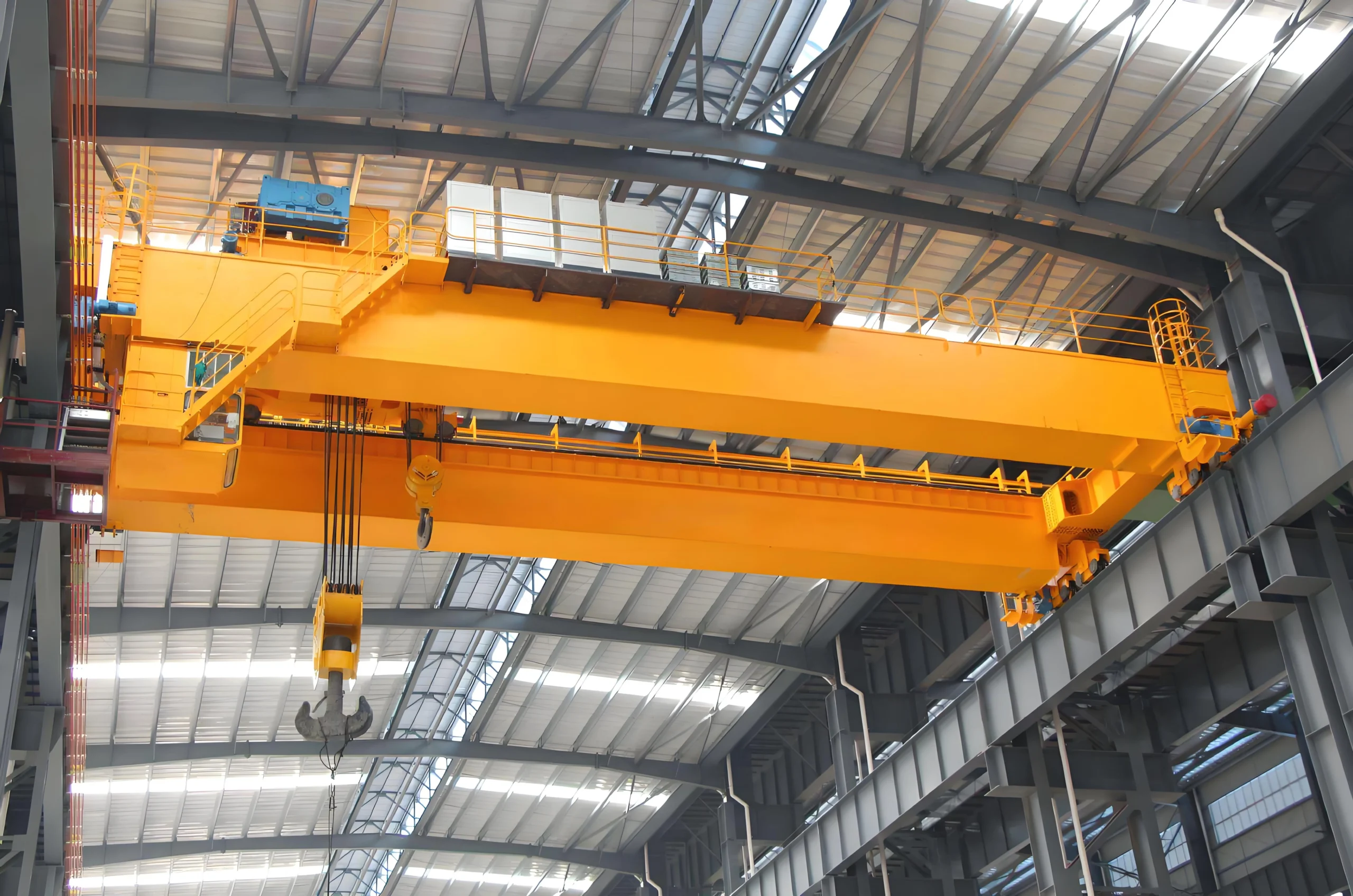
Because the load is too heavy, the span too wide, or the operating environment too demanding — a double girder overhead crane is the answer. Two main girders share the structural load, allow a top-running hoist trolley, and deliver the hook height, capacity, and duty cycle performance that heavy industrial operations require. The challenge for buyers is that “double girder overhead crane” covers multiple very different machine types. each is designed for a specific operating environment or load type. Specifying the wrong type creates safety risk, regulatory non-compliance, or a crane that fails prematurely because it was not built for the conditions it faces. This page covers six types in a single reference. By the end, you will know what distinguishes each model, where it belongs, and which one matches your operation — before you speak to any supplier. What Is a Double Girder Overhead Crane? The Structural Foundation A double girder overhead crane uses two parallel main girders spanning the building width. End trucks at each end run on elevated runway rails attached to the building structure. The hoist…