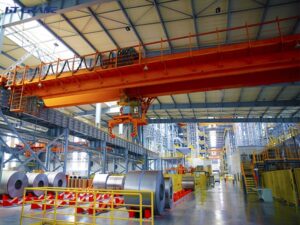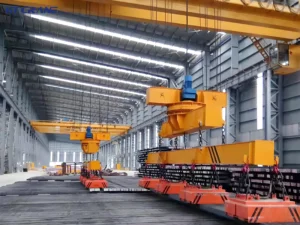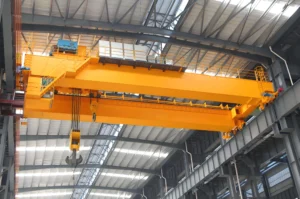


Because the load is too heavy, the span too wide, or the operating environment too demanding — a double girder overhead crane is the answer. Two main girders share the structural load, allow a top-running hoist trolley, and deliver the hook height, capacity, and duty cycle performance that heavy industrial operations require.
The challenge for buyers is that “double girder overhead crane” covers multiple very different machine types. each is designed for a specific operating environment or load type. Specifying the wrong type creates safety risk, regulatory non-compliance, or a crane that fails prematurely because it was not built for the conditions it faces.
This page covers six types in a single reference. By the end, you will know what distinguishes each model, where it belongs, and which one matches your operation — before you speak to any supplier.
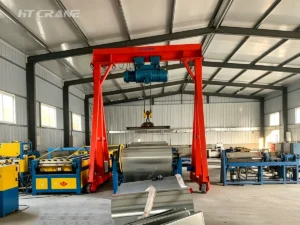
A double girder overhead crane uses two parallel main girders spanning the building width. End trucks at each end run on elevated runway rails attached to the building structure. The hoist trolley — carrying the lifting mechanism — travels on rails mounted on top of the two girders. This top-running arrangement delivers higher hook height than a single girder design for the same bay height, and it supports much heavier loads and larger spans.
All six model types share the double girder structure. What differentiates them is the operating environment they are built for and the specialized systems they carry. A QD general crane running in a foundry will fail faster than designed and may create safety risk. A QDY metallurgical crane installed in a standard warehouse is an unnecessary capital expense. Matching the model to the environment is not optional — it is the most important specification decision you will make.
Double girder cranes are the standard for loads above 20 tonnes, spans above 30 metres, and operations with high duty cycles. They are the infrastructure of steel mills, foundries, chemical plants, shipyards, and any facility where heavy loads move frequently across large areas.
The QD crane is the standard double girder overhead crane for general industrial use, manufactured to Chinese national standard GB/T 14405. It covers the broadest range of capacity and span of any type in this family — from 5 tonnes to 500 tonnes, with spans from 10.5 metres to 35.5 metres in standard increments.
The QD crane uses a standard wire rope hoist trolley and is designed for work duty classes A3 to A6, covering everything from light warehousing to intensive production use. It is the baseline from which all specialized variants are derived.
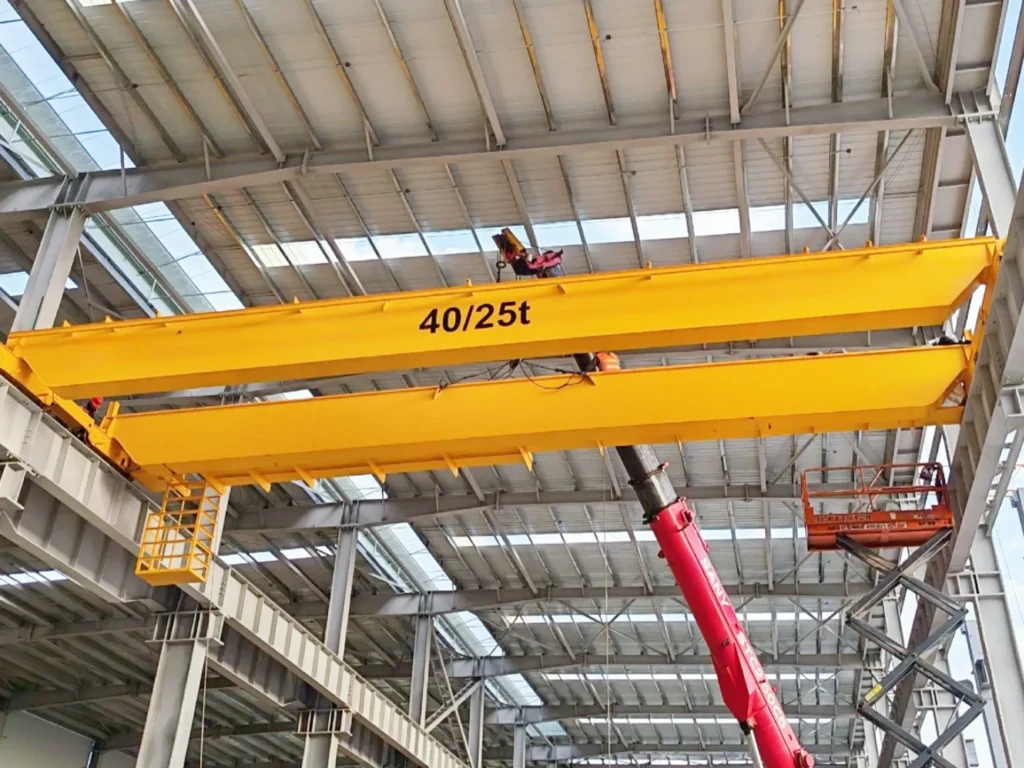
The QD is the right choice for standard industrial environments with no special hazards:
| Parameter | QD Standard Range |
|---|---|
| Capacity | 5T – 500T |
| Span | 10.5m – 35.5m (standard increments) |
| Lifting Height | 6m – 30m |
| Work Duty | A3 – A6 |
| Hoist Type | Wire rope hoist trolley (CD/MD or crab) |
| Power Supply | Standard three-phase |
| Certification | GB/T 14405, CE available for export |
The QB crane is a double girder overhead crane with full explosion-proof specification across all electrical components. Every motor, brake, control panel, limit switch, and electrical enclosure is certified to ATEX (EU Directive 2014/34/EU) or IECEx international standards for use in potentially explosive atmospheres.
The explosion-proof specification is not a coating or add-on — it is a fundamental design requirement that affects the selection of every electrical component in the crane. ATEX categories Ex d (flameproof), Ex e (increased safety), and Ex n (non-sparking) are applied to different components depending on their function and the zone classification of the operating environment.
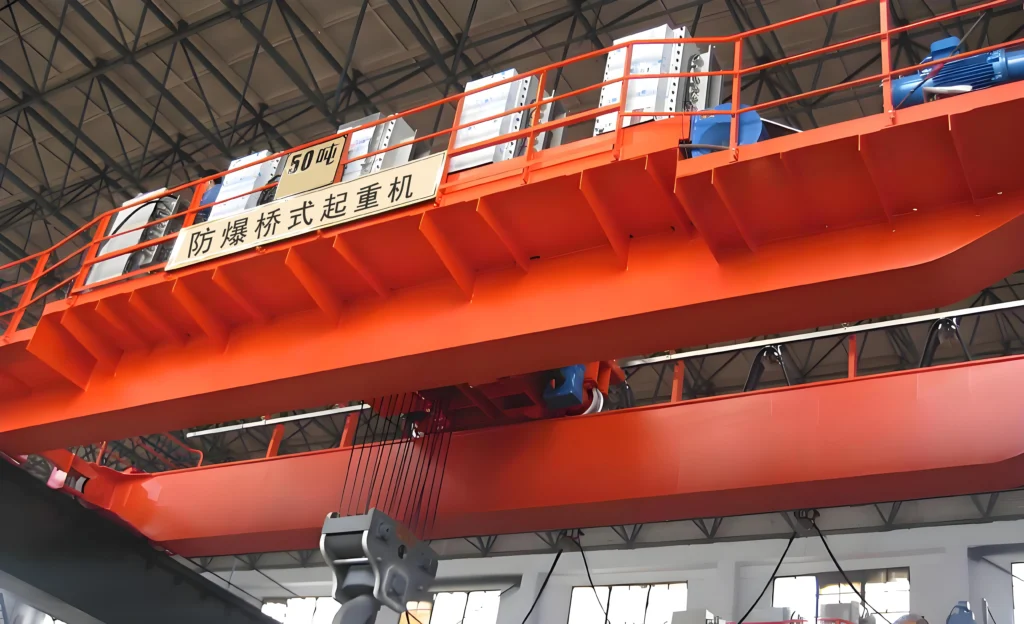
QB cranes are mandatory in any facility where explosive gas, vapour, or dust may be present in the working atmosphere:
Critical compliance note: Installing a standard QD crane in an ATEX-classified zone is a regulatory violation and a serious safety risk. The ATEX or IECEx certification of the crane’s electrical components must match the zone classification of the facility. Verify zone classification with your safety engineer before specifying the crane.
| Parameter | QB Explosion-Proof Range |
|---|---|
| Capacity | 5T – 100T |
| Span | 10.5m – 31.5m |
| Lifting Height | 6m – 20m |
| Work Duty | A3 – A5 |
| Explosion-Proof Standard | ATEX 2014/34/EU or IECEx |
| Ex Category | Zone 1 (Ex d/e) or Zone 2 (Ex n) — specify at order |
| Certification | GB/T + ATEX/IECEx certificate |
The QDY crane is a double girder overhead crane engineered specifically for metallurgical environments — steel mills, foundries, casting shops, and facilities where molten metal, extreme heat, and continuous high-intensity operation are daily conditions. The “Y” designates the metallurgical (冶金) specification.
Every aspect of the QDY differs from a standard QD crane. The structural steel is selected for elevated temperature performance. All electrical components have thermal protection ratings suited to ambient temperatures that can reach 60°C or higher near furnaces and casting lines. Hoist mechanisms use heavy-duty metallurgical-grade designs with larger drum diameters and higher safety factors on wire ropes, because the consequences of a hoist failure above molten metal are catastrophic.
The QDY crane is designed for work duty A6, A7, or A8 — the highest duty classes — because metallurgical operations run continuously, at or near rated load, with minimal downtime. A standard crane’s design life would be exhausted in a fraction of the time in this environment.
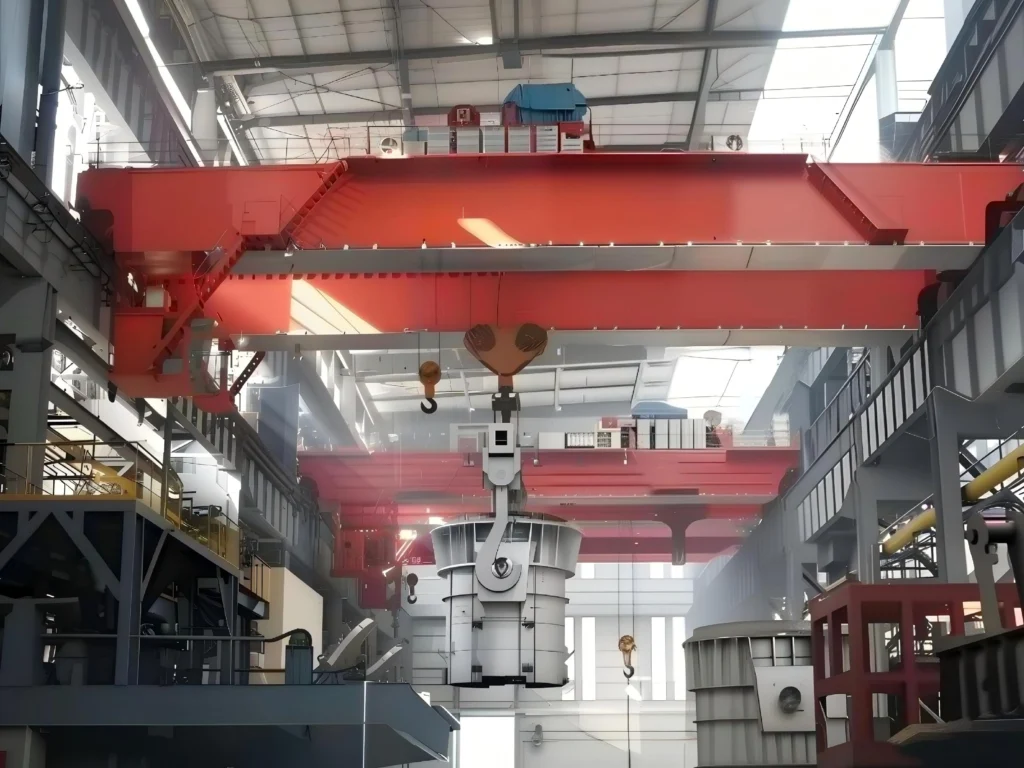
QDY cranes are the mandatory choice for:
| Parameter | QDY Metallurgical Range |
|---|---|
| Capacity | 10T – 500T |
| Span | 10.5m – 35.5m |
| Lifting Height | 6m – 30m |
| Work Duty | A6 – A8 (continuous heavy duty) |
| Structural Spec | Heat-resistant steel, thermal shielding |
| Hoist Spec | Metallurgical-grade drum, increased rope safety factor |
| Ambient Temperature | Up to 60°C+ with radiant heat shielding |
| Certification | GB/T 14406, CE for export |
The QY crane is a double girder overhead crane with full electrical insulation throughout the hook path — from the crane bridge down through the end truck, trolley, hoist, and hook block. The insulation system prevents any electrical current from passing through the crane structure to the load or operator.
This specification is required when the crane handles live electrical components, high-voltage equipment, or loads that may carry residual electrical charge. Without insulation, the crane provides a conductive path between the load and the building structure — creating electrocution risk and potential equipment damage.
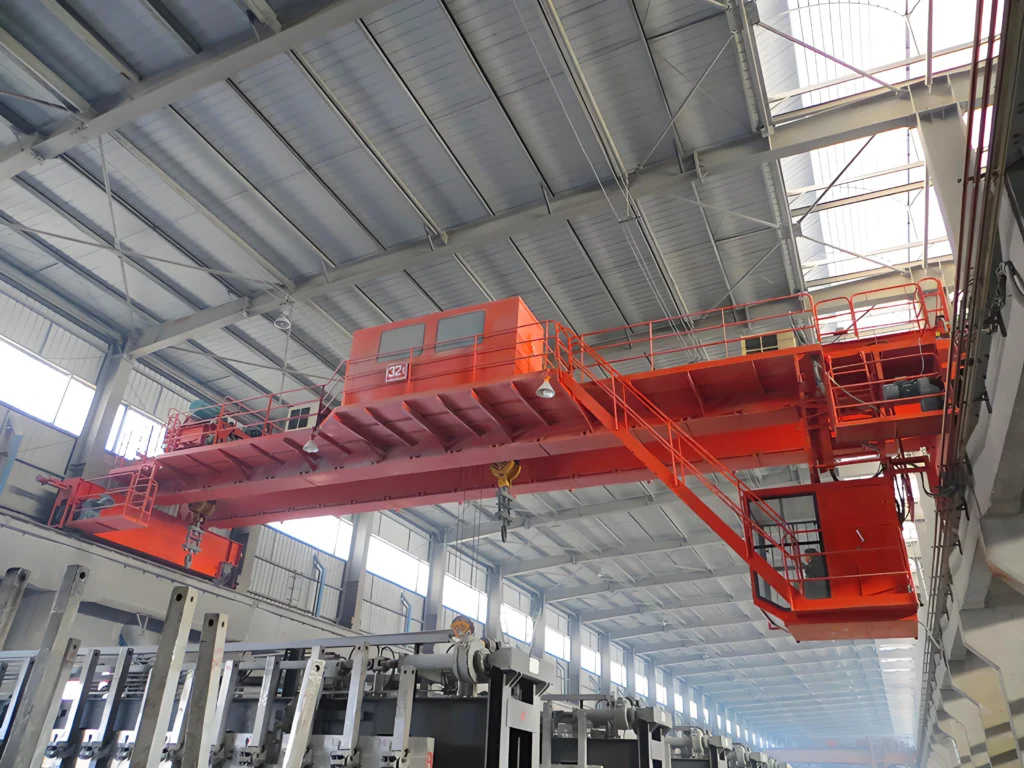
QY insulated cranes are used in:
| Parameter | QY Insulated Range |
|---|---|
| Capacity | 5T – 100T |
| Span | 10.5m – 31.5m |
| Lifting Height | 6m – 20m |
| Work Duty | A3 – A5 |
| Insulation Class | Full hook path insulation — verified by electrical test |
| Insulation Voltage | Specified per project requirements |
| Certification | GB/T + insulation test certificate |
The QE crane is a double girder overhead crane carrying two independent hoist trolleys on the same bridge. Each trolley has its own hoist, motor, controls, and hook. The two trolleys can operate independently or in coordinated tandem — lifting opposite ends of a long, heavy object simultaneously.
Tandem lifting with a single crane eliminates the need for two separate cranes, two separate operators, and the coordination risk of operating two independent cranes in close proximity. Both trolleys are controlled from a single operator station, with synchronization logic preventing differential lifting that could twist or overload the suspended load.
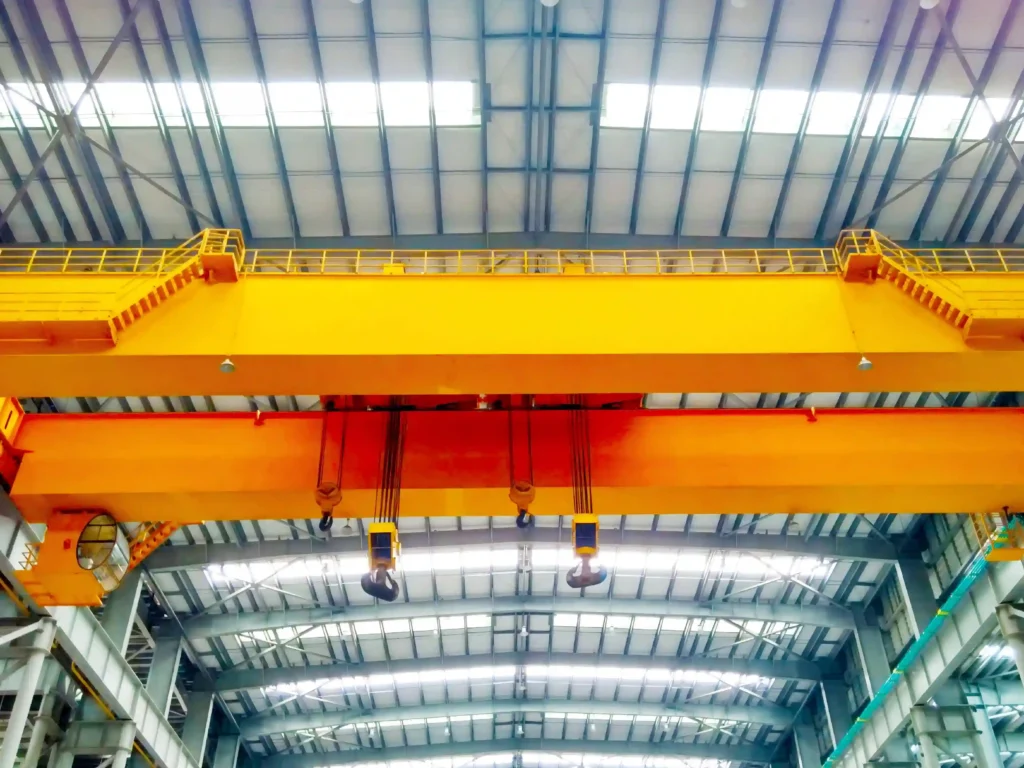
QE Type Double Trolley Overhead Crane:
| Parameter | QE Twin-Hook Range |
|---|---|
| Capacity | 10T + 10T to 100T + 100T (each hook) |
| Span | 14m – 35.5m |
| Lifting Height | 6m – 30m |
| Work Duty | A4 – A6 |
| Trolley Configuration | Two independent trolleys — synchronized or independent |
| Control | Single operator station with tandem control logic |
| Certification | GB/T 14405, CE for export |
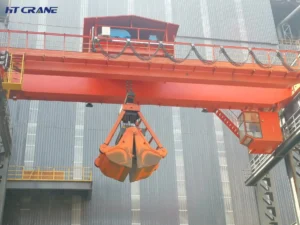
The QZ crane is a double girder overhead crane fitted with an integrated grab bucket drive system rather than a standard hook. The crane carries a dedicated grab bucket — hydraulic or rope-operated clamshell or orange-peel — for handling bulk materials directly, without slings, hooks, or manual load attachment.
The QZ crane has a separate drive system for the grab — opening and closing the bucket is powered independently from the hoisting motion. The crane structure and hoist are designed for the higher duty cycle of continuous bulk handling, where the grab operates repeatedly throughout every working shift.
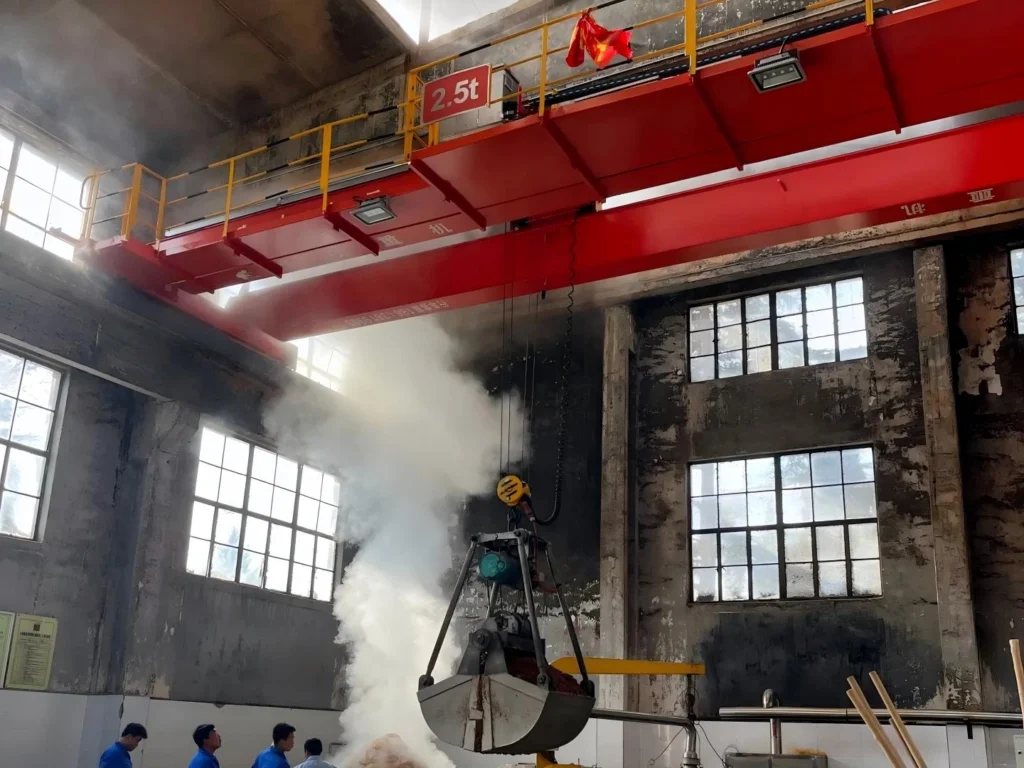
QZ grab cranes are the operational standard in:
| Parameter | QZ Grab Crane Range |
|---|---|
| Capacity | 5T – 100T (grab + payload) |
| Span | 10.5m – 35.5m |
| Lifting Height | 6m – 25m |
| Work Duty | A6 – A8 (continuous bulk handling) |
| Grab Type | Clamshell (bulk dry material) or orange-peel (scrap) |
| Grab Drive | Rope-operated (standard) or hydraulic (high-cycle) |
| Certification | GB/T 14406, CE for export |
Step 1: Identify your hazard environment. If your facility is ATEX-classified — explosive gas or dust — QB overhead crane is mandatory. If you handle molten metal above the crane’s operating area — QDY overhead crane is mandatory. If your loads may be electrically live — QY overhead crane is mandatory. These are not optional upgrades. They are safety and regulatory requirements.
Step 2: Confirm duty cycle. All specialized types typically require higher duty class ratings than a standard QD. Confirm your lift frequency and load spectrum with your supplier before finalizing the specification.
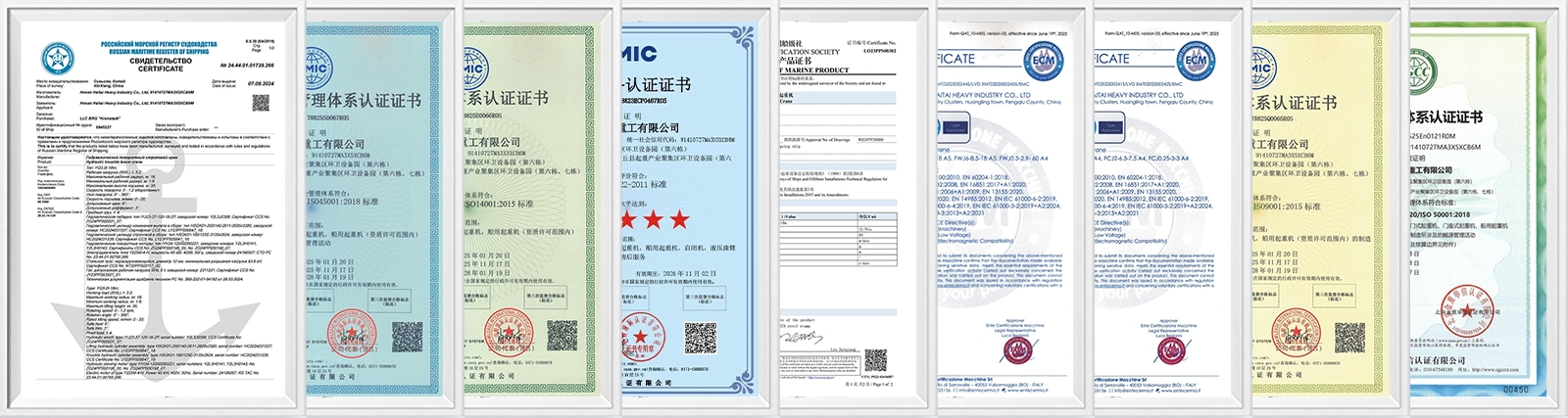
Step 3: Confirm compliance documentation. For QB overhead crane , confirm ATEX zone classification. For QY overhead crane , confirm insulation voltage requirement. For export projects, confirm CE documentation standard (EN 13001 vs GB/T).
Here is how the six types compare at a glance:
| Model | Type | Key Specialization | Typical Environment |
|---|---|---|---|
| QD Overhead Crane | General Purpose | Standard industrial lifting | Warehouses, workshops, manufacturing |
| QB Overhead Crane | Explosion-Proof | ATEX/IECEx certified components | Chemical, petroleum, grain, paint facilities |
| QDY Overhead Crane | Metallurgical | Heat resistance, continuous duty | Steel mills, foundries, casting shops |
| QY Overhead Crane | Insulated | Electrical isolation on hook path | Power generation, transformer assembly |
| QE Overhead Crane | Twin Hook | Two independent hoists on one bridge | Shipyards, heavy steel fabrication |
| QZ Overhead Crane | Grab | Integrated grab bucket drive system | Bulk material handling, scrap yards |
Double girder overhead cranes are not one product. They are a family of multiple engineered solutions, each built for a specific operating environment and load type.Getting the type right is the most important decision in this procurement. Get the type wrong, and no amount of correct specification on capacity or span will fix it.
HT crane manufacturer reviews your operating environment, hazard classification, load type, and duty cycle before recommending a model. Contact us with your facility details and we will provide a type recommendation, full technical specification, and CE documentation plan at no cost.










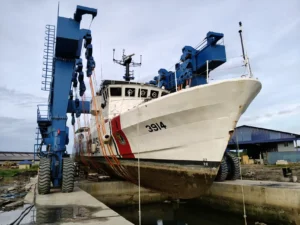
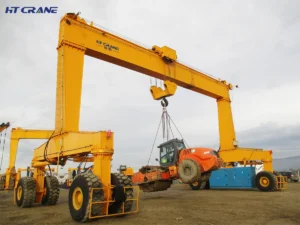
If you manage a marina, boatyard, or naval facility, you already know the pain: vessels stuck in the water waiting for maintenance, slipways that damage hulls, and cranes that simply weren’t built for boats. A marine travel lift solves all three problems in a single machine. It lifts, moves, and launches vessels safely — without fixed rails, without hull damage, and without slowing down your yard. This page covers everything you need to evaluate a marine travel lift: what it does, where it works, what makes ours different, and the full technical specs. If you are ready to specify a unit, our engineering team responds to enquiries within 24 hours. Product Description A marine travel lift — also called a boat travel lift, mobile boat hoist, or self-propelled boat hoist — is a rubber-tyred gantry crane designed specifically for vessel handling. The portal frame straddles the boat in the water. Polyester slings are positioned under the hull. The vessel is then lifted clear and driven anywhere on land. No rail tracks. No fixed infrastructure. Just one machine that handles haul-out,…
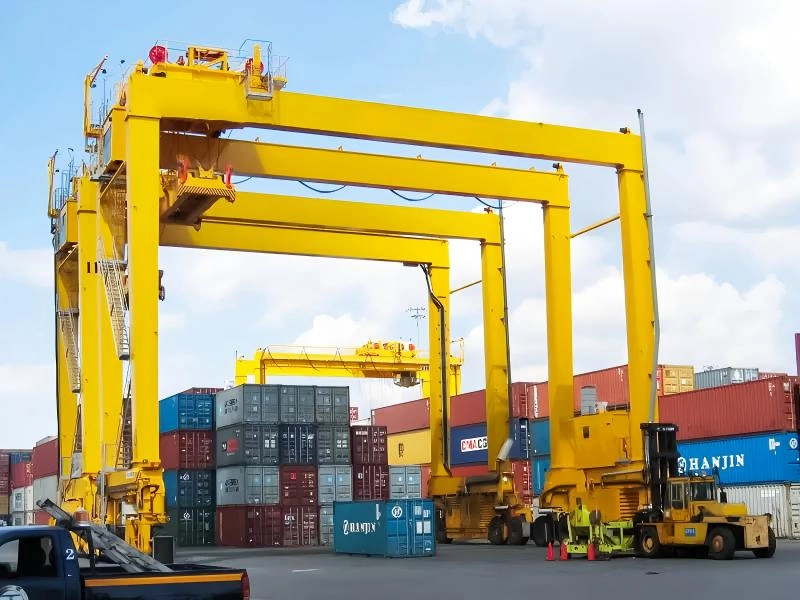
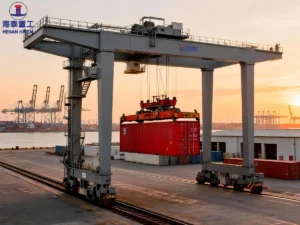
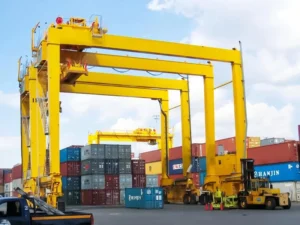
Choosing the right RTG crane supplier impacts your entire port or yard operation. A wrong choice means delays, downtime, and costly repairs. We help you avoid that. As a certified RTG crane manufacturer and exporter, we supply high-performance rubber tyred gantry cranes built for container terminals, intermodal yards, and logistics hubs worldwide. Product Description An RTG crane (Rubber Tyred Gantry Crane) is a mobile overhead crane designed to stack and move ISO containers in port container yards and inland depots. Unlike rail-mounted cranes(RMG Container Gantry Crane), RTG cranes run on rubber tyres — giving them full mobility across the yard without fixed infrastructure. 👉View Professional Buying Guide: RTG Crane vs RMG Crane: Which One Actually Fits Your Project? RTG cranes are the backbone of modern container terminal operations. They bridge the gap between ship-to-shore cranes and horizontal transport, enabling efficient container stacking, retrieval, and yard organization. Why Buy From Us? HT Cranes is a professional manufacturer of RTG cranes with over 15 years of lifting experience. Our cranes are exported to ports and logistics yards across Southeast Asia, the Middle…
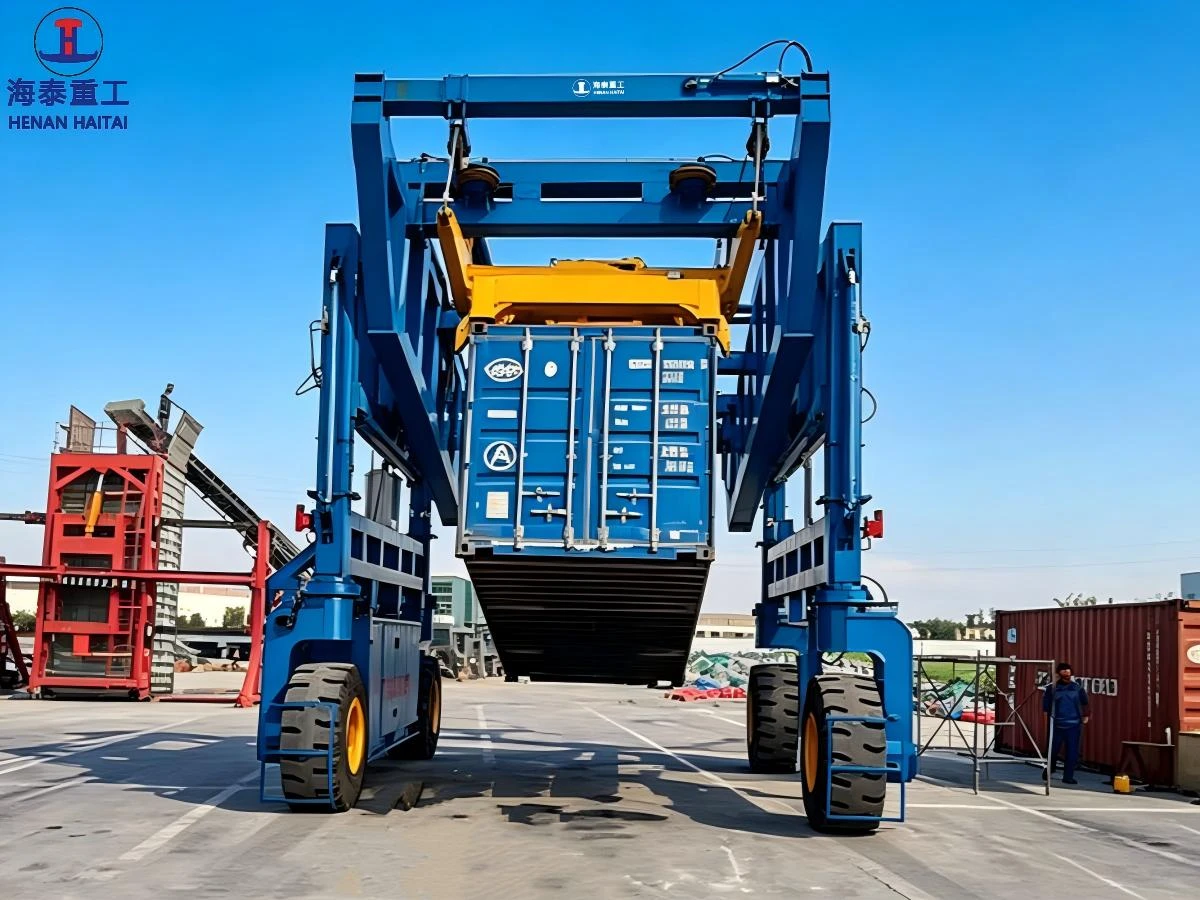
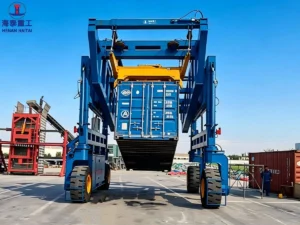
If you handle heavy containers, steel structures, or oversized industrial cargo — and your site lacks fixed power infrastructure — a hydraulic straddle carrier is likely the most practical solution available. It lifts, travels, and places loads without needing overhead structures, rails, or high-voltage power supply. One machine. Full mobility. Minimal civil works. What Is a Hydraulic Straddle Carrier? The Core Concept A hydraulic straddle carrier is a self-propelled heavy lift vehicle. It straddles a load — lifting from below using a hydraulic spreader or lifting beam — and moves freely across the yard on rubber tyres. The entire lift-and-travel cycle is powered by an onboard diesel-hydraulic system. Unlike electric or cable-reel powered cranes, the hydraulic straddle carrier carries its own power source. This makes it fully independent of yard infrastructure. You can deploy it anywhere your surface can support the wheel loads — no fixed installation required. How the Hydraulic System Works The engine drives hydraulic pumps that supply pressurized fluid to the lift cylinders, drive motors, and steering actuators. All motion — lifting, lowering, travelling, and steering —…