


If you operate a container terminal, port facility, or industrial yard, you know the challenges: containers stuck on the ground, yard operations slowed by inefficient equipment, and cranes that weren’t designed for modern logistics. A Single Girder Rubber Tyred Gantry Crane solves all these problems in one machine. It lifts, moves, and stacks containers safely — without fixed rails, without bottlenecks, and without compromising operational efficiency.
This page covers everything you need to evaluate a Single Girder RTG Crane: how it works, where it excels, what makes ours different, and the full technical specifications. Ready to specify a unit? Our engineering team responds to enquiries within 24 hours, ensuring you get the right solution for your port or yard.
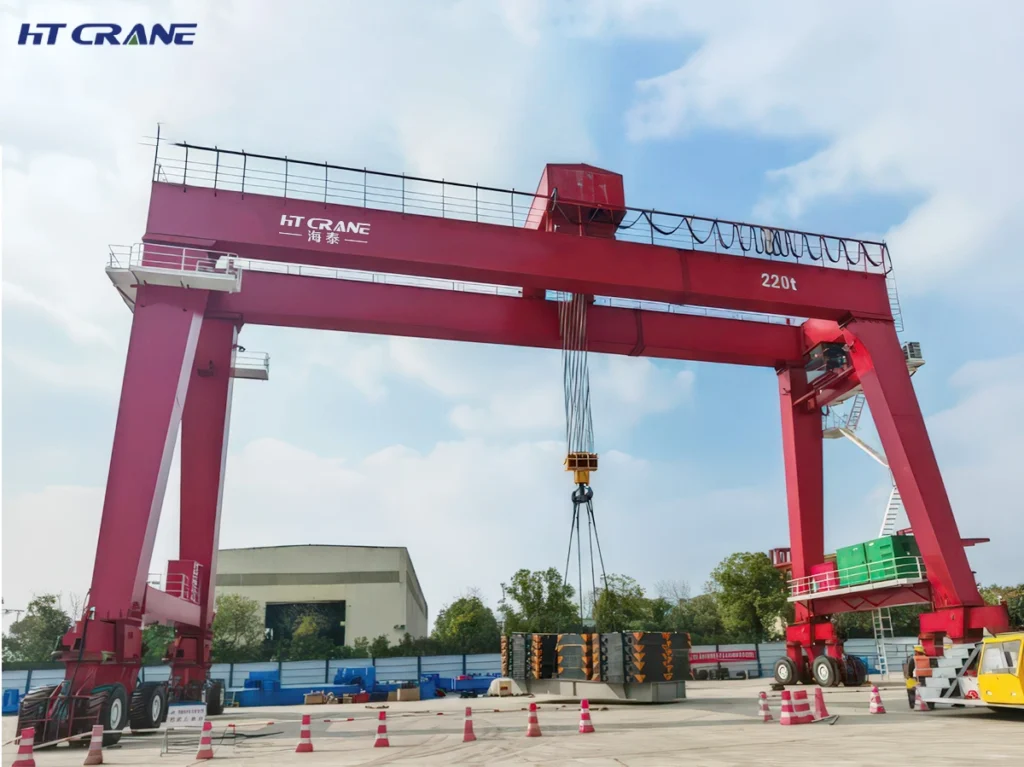
The Single Girder Rubber Tired Gantry Crane is a self-propelled, mobile gantry lifting system mounted on rubber tyres. It operates without fixed rails, tracks, or permanent ground infrastructure — making it one of the most flexible solutions available for container handling, industrial yard lifting, and logistics operations where site conditions or operational flexibility make rail-mounted systems impractical.
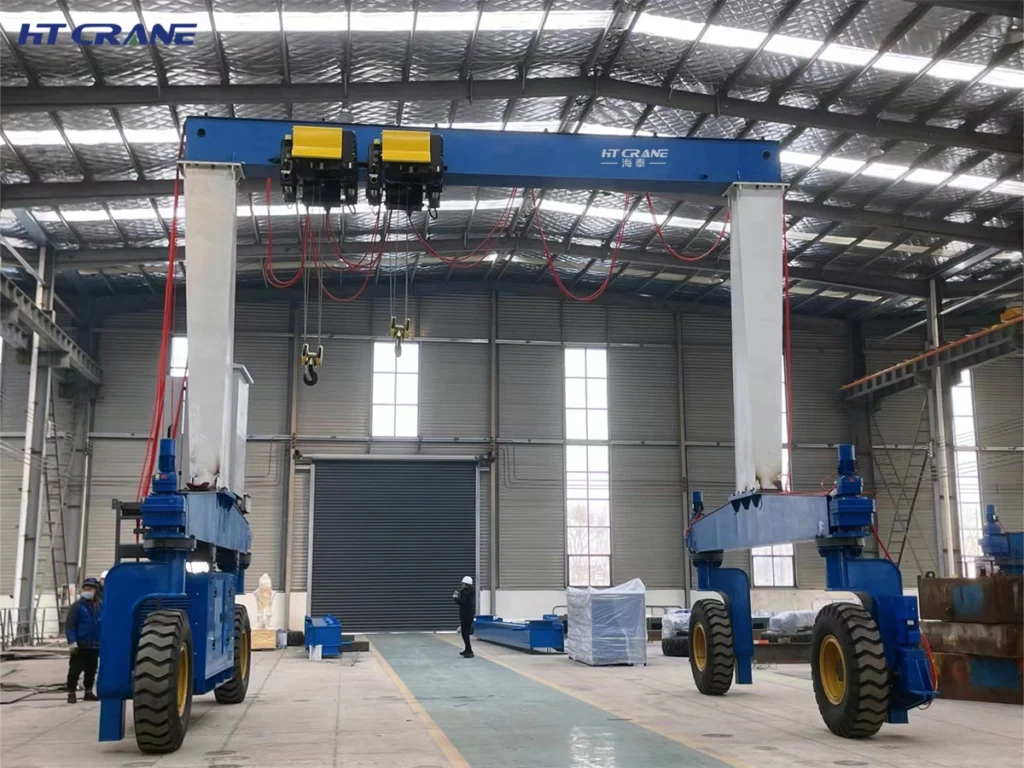
The crane’s single box girder bridge is supported on two rubber-tyred leg assemblies. The trolley and hoist travel along the bridge to position loads horizontally. The full crane assembly travels longitudinally through the yard on rubber tyres. Multi-mode steering — including crab steering and 90-degree transverse travel — allows precise maneuvering in confined spaces and quick repositioning between rows.
This configuration is particularly well suited to small and medium container depots, precast concrete production yards, steel storage areas, logistics distribution centers, and light port terminal operations where throughput does not justify a full double girder RTG installation.
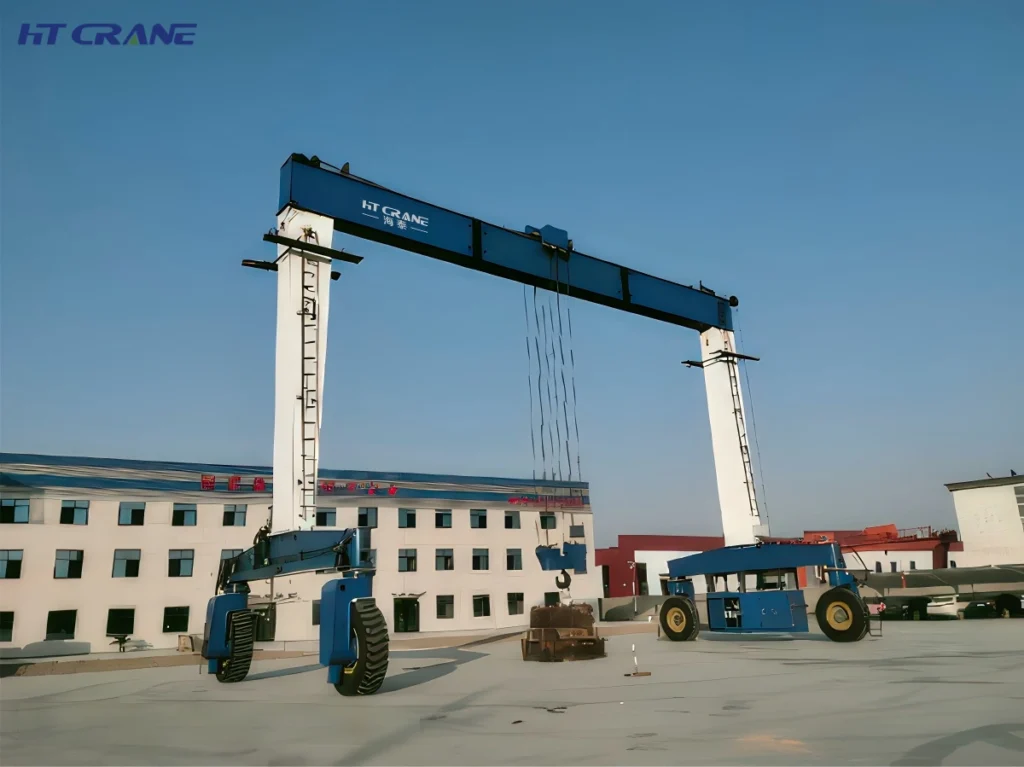
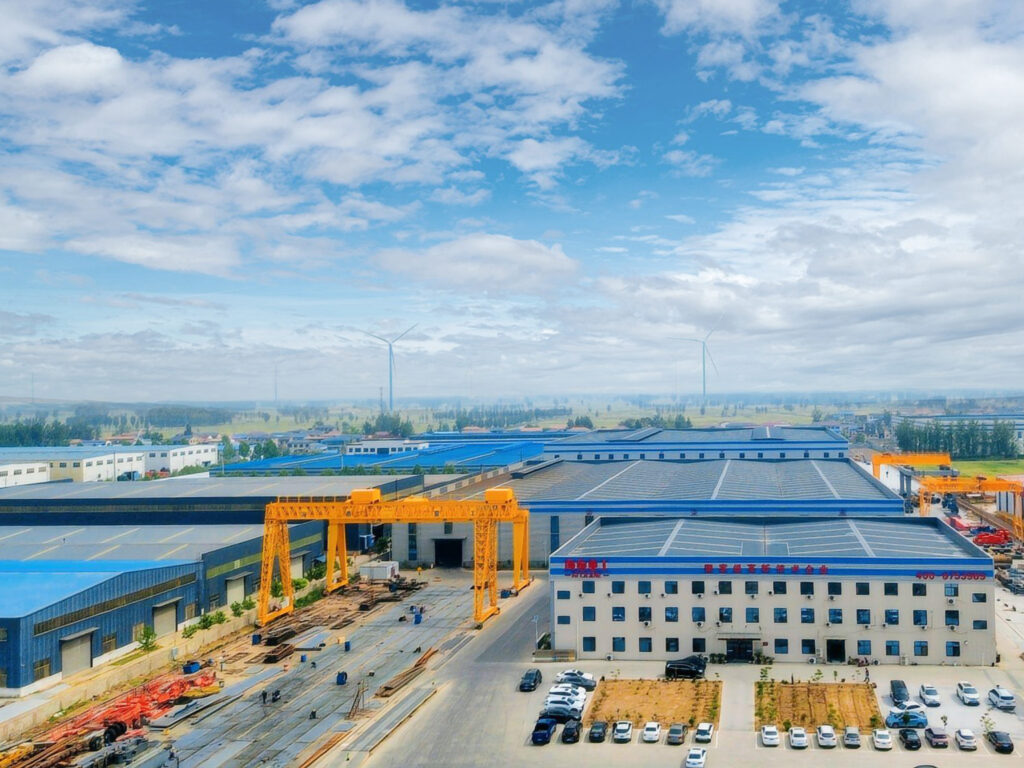
HT Cranes is a professional manufacturer of RTG cranes with over 15 years of lifting experience. Our cranes are exported to ports and logistics yards across Southeast Asia, the Middle East, Africa, and South America. Every unit is factory-tested before shipment and backed by full documentation including CE Declaration of Conformity and ISO 9001 certification records.
We do not resell third-party equipment. Every crane we supply is built, assembled, and tested in-house — giving you full quality traceability from steel fabrication to final commissioning.
90-Ton Rubber Tyred Gantry Crane Exported to Mexico
Client: Port Logistics Operator | Destination:
Manzanillo, Mexico Capacity: 90t | Span: 8m | Delivered in 14 Weeks
| Parameter | Standard Range | Notes |
|---|---|---|
| Lifting Capacity | 5 t – 50 t | Higher capacities on request |
| Span | 10 m – 35 m | Single to multi-row coverage |
| Lifting Height | 3 m – 30 m | Application-specific |
| Gantry Travel Speed | 0 – 25 m/min | VFD controlled |
| Hoisting Speed | 0 – 8 m/min | VFD controlled |
| Trolley Travel Speed | 0 – 20 m/min | — |
| Drive System | Electric / Diesel-Electric | Grid or independent power |
| Steering Modes | Straight / Crab / 90° Transverse | Multi-mode standard |
| Control Method | Radio Remote / Pendant / Cab | Configurable |
| Power Supply | 380V – 480V / 50Hz – 60Hz | Region-configurable |
| Duty Class | M4 – M6 | Per ISO 4301 |
| Working Temperature | -20°C to +45°C | Cold-weather package available |
| Certification | CE / ISO 9001 / FEM | Standard for export |
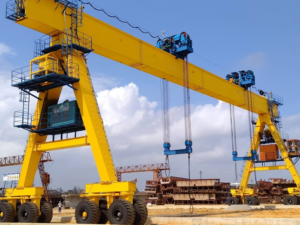
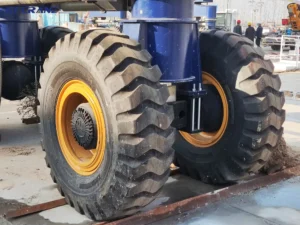
The rubber tyre travel system eliminates crane rails, rail foundations, and the civil engineering work that fixed gantry and rail-mounted systems require. The crane can be operational on a prepared concrete yard surface without structural modification to the ground.
Straight travel covers primary yard lanes. Crab steering allows diagonal repositioning. 90-degree transverse travel moves the crane sideways between adjacent rows without a wide turning arc. This combination handles the maneuvering requirements of compact container depots and industrial yards.
VFD-controlled travel, hoisting, and trolley traverse provide smooth acceleration and deceleration — reducing mechanical shock on the structure and load, improving positioning precision, and extending drive component service life.
Electronic load stabilization detects and corrects spreader or hook swing during travel and placement. Reduces cycle time, improves stack accuracy, and lowers the skill threshold required for consistent operation.
Multi-layer coating system for outdoor and coastal environments:
Single Girder Rubber Tired Gantry Crane handle 20-foot and 40-foot ISO containers in inland depots, intermodal yards, and small container terminals. Rubber tyre mobility allows repositioning as yard layout and utilization patterns change — without the civil works commitment of a fixed rail system.
Precast manufacturers use Single Girder Rubber Tired Gantry Crane to lift, move, and stack concrete panels, beams, and bridge elements within open-air production yards. The self-supporting structure eliminates any requirement for a building-mounted runway.
Outdoor steel storage and fabrication sites use RTG cranes to move steel plate, sections, coils, and fabricated assemblies between storage, processing, and dispatch areas. The rubber tyre system handles imperfect yard surfaces better than rail-mounted alternatives.
General cargo handling facilities use Single Girder Rubber Tired Gantry Cranes for loads exceeding forklift capacity — large machinery components, packaged equipment, oversized palletized cargo, and fabricated assemblies.
In smaller port facilities and shipyard storage zones where a full double girder RTG is not warranted, a single girder configuration provides practical container and component handling without fixed infrastructure investment.
Vehicle maintenance facilities, heavy equipment service workshops, and industrial repair bays use single girder RTG cranes for engine lifts, component positioning, and equipment transfer across large workshop floors.
| Factor | Single Girder RTG | Double Girder RTG |
|---|---|---|
| Lifting capacity | 5 t – 50 t | 32 t – 75 t+ |
| Self-weight | Lower | Higher |
| Ground pressure | Lower | Higher |
| Hook height for span | Standard | Higher (hoist between girders) |
| Ground / foundation requirements | Minimal — concrete yard surface | Moderate — higher wheel loads |
| Manufacturing cost | Lower | Higher |
| Duty class range | M4 – M6 | M5 – M8 |
| Best suited for | Depots, industrial yards, light terminals | Heavy container terminals, port operations |
A single girder configuration is appropriate when lifting capacity, duty cycle, and ground loading all fall within its rated range. For higher capacity, higher throughput port operations, a double girder RTG is the more suitable starting point.
| Option | Description |
|---|---|
| Anti-sway system | Electronic load stabilization for precision placement |
| Operator cab | Enclosed, climate-controlled cab for extended shift operation |
| Diesel-electric drive | Independent power for sites without grid connection |
| Cold-weather package | Cold-resistant hydraulics, heated cab, insulated electrics; -40°C capability |
| Explosion-proof system | ATEX-rated electrical components for hazardous area classification |
| Telescopic spreader | Adjustable 20ft / 40ft for container handling applications |
| Radio remote control | Full crane operation from ground level; eliminates cab requirement for lighter-duty applications |
| GPS / Telematics | Real-time location tracking, operational data logging, remote fault monitoring |
| Extended corrosion package | Additional coating layers or alternative paint systems for aggressive chemical or marine environments |
| Custom span and height | Configurations beyond standard range confirmed during engineering review |
| Dual hoist system | Two independent hoists on a single bridge for tandem lift capability |
| Automated positioning | Encoder-based position memory for repeat pick-and-place operations |
Backed by 20+ years of manufacturing experience and exports to 80+ countries, HaiTai Crane delivers CE and ISO 9001:2015 certified lifting solutions to ports, shipyards, and marinas worldwide. From standard configurations to fully engineered custom builds, our technical team tailors every crane to your site conditions and operational requirements.












If you operate a container terminal, port facility, or industrial yard, you know the challenges: containers stuck on the ground, yard operations slowed by inefficient equipment, and cranes that weren’t designed for modern logistics. A Single Girder Rubber Tyred Gantry Crane solves all these problems in one machine. It lifts, moves, and stacks containers safely — without fixed rails, without bottlenecks, and without compromising operational efficiency. This page covers everything you need to evaluate a Single Girder RTG Crane: how it works, where it excels, what makes ours different, and the full technical specifications. Ready to specify a unit? Our engineering team responds to enquiries within 24 hours, ensuring you get the right solution for your port or yard. Product Introduction The Single Girder Rubber Tired Gantry Crane is a self-propelled, mobile gantry lifting system mounted on rubber tyres. It operates without fixed rails, tracks, or permanent ground infrastructure — making it one of the most flexible solutions available for container handling, industrial yard lifting, and logistics operations where site conditions or operational flexibility make rail-mounted systems impractical. The crane’s…

When the load is heavy, the span is wide, or the hook height requirement exceeds what a single girder crane can deliver — a double girder gantry crane is the answer. It is the structural choice for heavy industry, and for good reason: two main girders share the load, allow a higher-positioned hoist, and provide the structural rigidity needed for large spans and demanding duty cycles. Buyers often reach the double girder decision after outgrowing a lighter crane or after realizing that a single girder model cannot meet their hook height or span requirements. The challenge then becomes specification: double girder cranes involve more variables, more civil infrastructure, and larger capital commitment than their lighter counterparts. This page walks you through what defines a double girder gantry crane, what to specify, where it fits, and how to evaluate a supplier for a purchase of this significance. What Is a Double Girder Gantry Crane? A double girder gantry crane uses two parallel horizontal girders — the main beams — supported at each end by leg structures that run on ground-level rails.…

Picking the wrong crane structure does not just waste budget. It creates daily friction — wrong span, insufficient lift height, or a beam type that cannot handle your load cycle. If you are sourcing a single girder gantry crane for a warehouse, construction yard, port facility, or manufacturing plant, the right configuration depends on more than tonnage alone. This page breaks down all four single girder gantry crane types available from haitai Crane. You will find full specifications, clear application guidance, a direct type comparison, and a pre-order checklist. No unnecessary complexity. Just the information procurement teams need to make a confident decision. What Is a Single Girder Gantry Crane? A single girder gantry crane uses one main beam supported by two legs that travel along ground rails. An electric hoist runs along the underside of the beam. This design is simpler and lighter than double-girder configurations. It costs less to build, install, and maintain. Where Single Girder Works Best Single girder gantry cranes are the standard choice for operations in the 2–32 ton range. They suit sites where lifting…


























