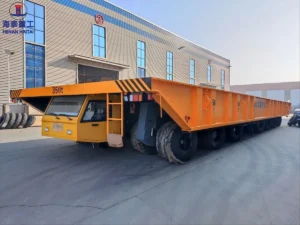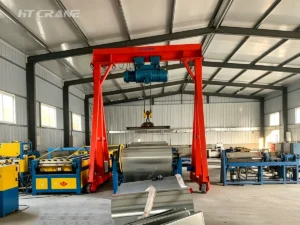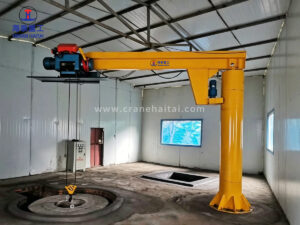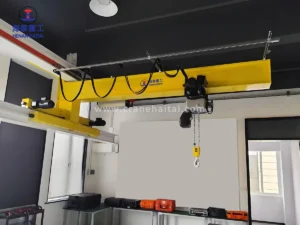


Choosing the wrong gantry crane costs more than money. It costs downtime, structural risk, and rework. If you’re sourcing a heavy duty trolley gantry crane for a port, steel mill, rail yard, or large factory, the MG series is one of the most proven options on the market today.
This page covers everything procurement teams need: how each MG type differs, what specs apply to your load and environment, and how to match the right configuration to your site conditions. No guesswork. Just practical guidance.
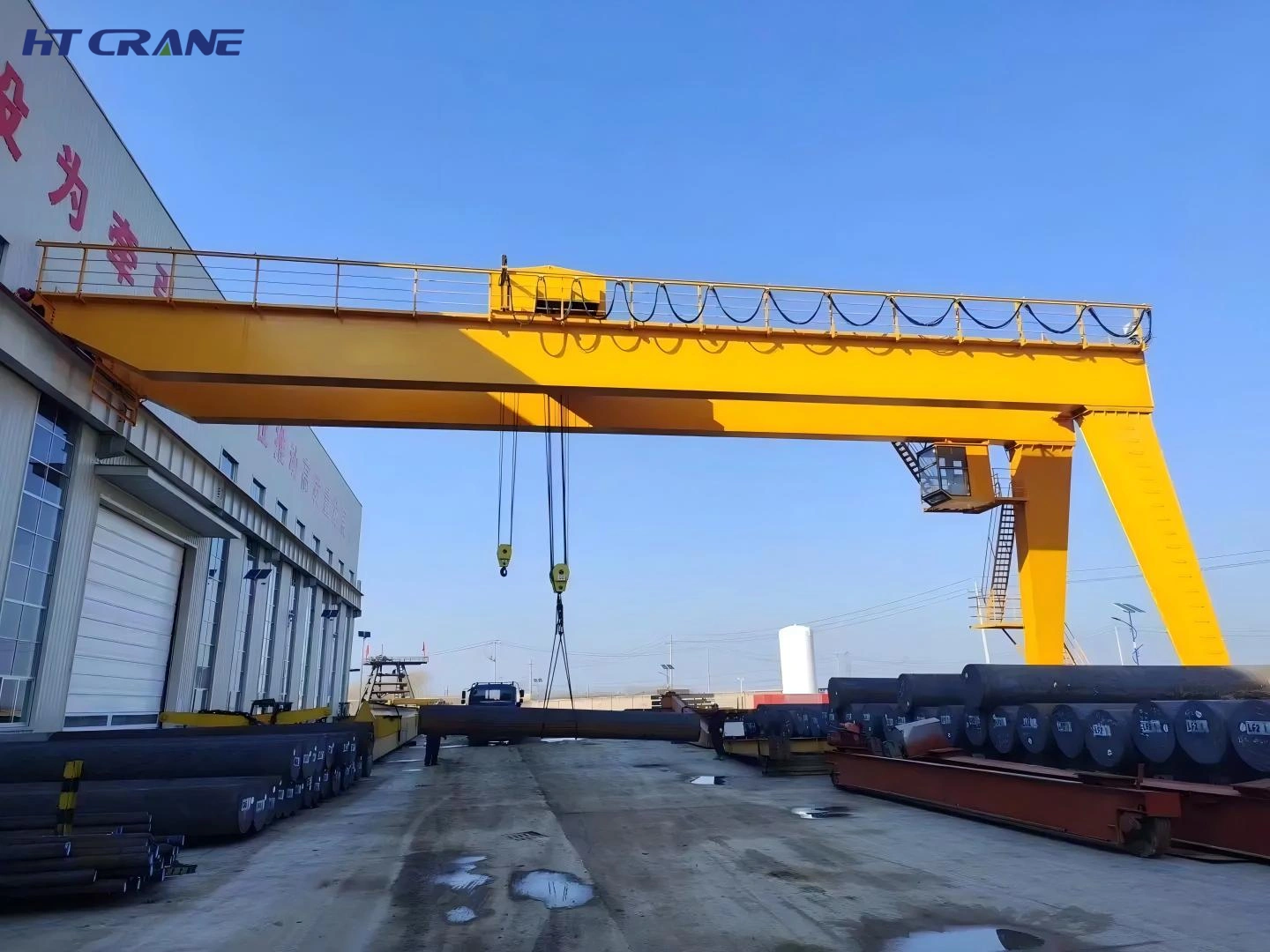
The MG gantry crane is a double-beam, trolley-type outdoor crane built for heavy industrial lifting. Its structure uses a box-type welded double beam with π-shaped legs. This design increases torsional rigidity significantly. The crane handles loads from 5 tons up to 500 tons. It runs on ground rails and supports spans from 18 to 40 meters.
Unlike single-beam gantry cranes, the MG series uses two parallel main beams. This distributes the load more evenly. The trolley travels between the beams, allowing precise positioning over wide spans. The π-leg design keeps the center of gravity low. That matters when handling asymmetric loads or working near site edges.
The full variable frequency drive (VFD) system adjusts power output automatically based on load. Compared to traditional fixed-speed drives, this reduces energy consumption by 20–30%. Over a 10-year service cycle, that’s a meaningful operating cost difference.
Every MG heavy duty trolley gantry crane ships with multiple protection layers. These include:
The hardened gear reducer and three-in-one transmission system reduce mechanical wear. That means longer service intervals and lower maintenance frequency in demanding environments.
The MG series comes in four structural configurations. Each serves a different use case. Understanding the differences prevents costly over-specification or under-specification.
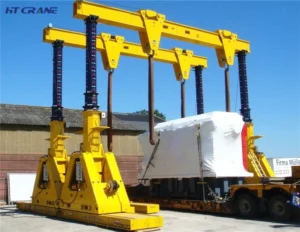
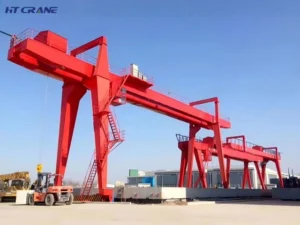
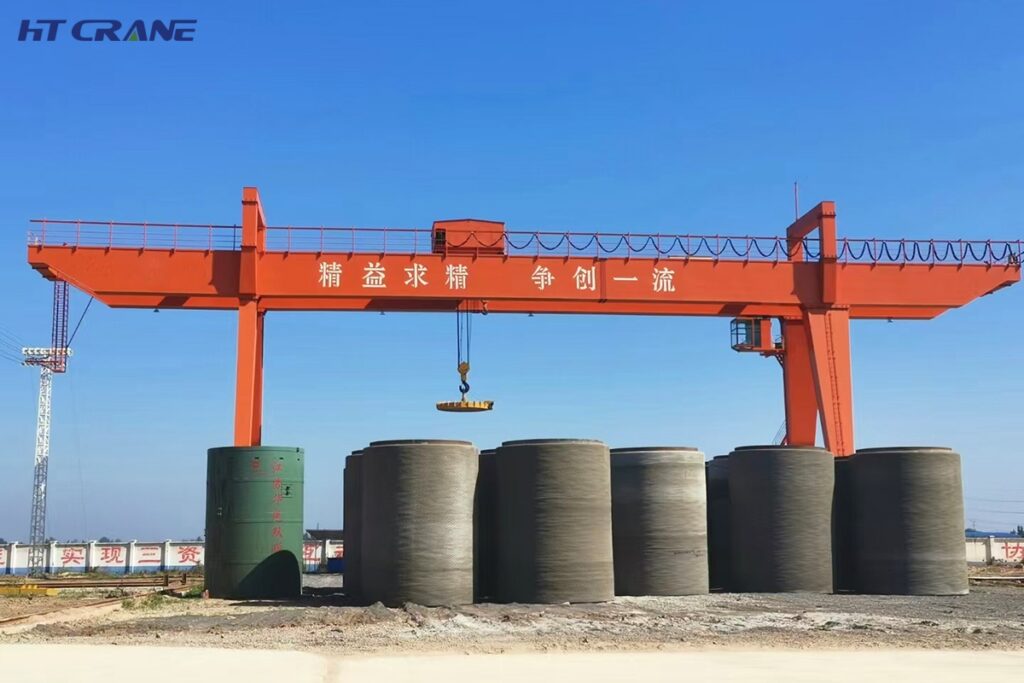
The A-Frame Double Girder Gantry Crane is a heavy-duty outdoor lifting solution built for large-tonnage operations. Its signature “A”-shaped legs form a wide, triangulated support base. This geometry distributes lateral forces efficiently. The result is a crane that stays stable under wind load, uneven ground conditions, and asymmetric lifts.
The double-girder main beam sits across the top of the A-legs. The electric trolley travels along the full span between beams. This allows precise load positioning anywhere across the working zone. Main and auxiliary hooks can be fitted simultaneously. Dual-trolley configurations support synchronized lifts of long or oddly shaped components.
Structurally, the A-frame variant is the go-to choice when lift weights exceed 50 tons and the site is exposed to outdoor conditions. It meets the rigidity demands of steel mill crane duty while maintaining the span range needed for port berth coverage.
| Parameter | Specification |
|---|---|
| Load Capacity | 50–120 ton |
| Span | 18–35 m |
| Lifting Height | 10–13 m |
| Lifting Speed | 3.9 / 7.2 m/min |
| Trolley Speed | 3.8–38 m/min |
| Crane Travel Speed | 3–30 m/min |
| Work Duty Class | A5 |
| Power Supply | 3-phase AC, 380V 50Hz |
Best for: Steel billet and coil handling in steel mills. Container loading at small-to-mid ports. Wind turbine blade and tower installation. Heavy equipment assembly in nuclear or power plants. Where complex lifts need dual trolleys or main-and-auxiliary hook configurations, the A-frame handles it.
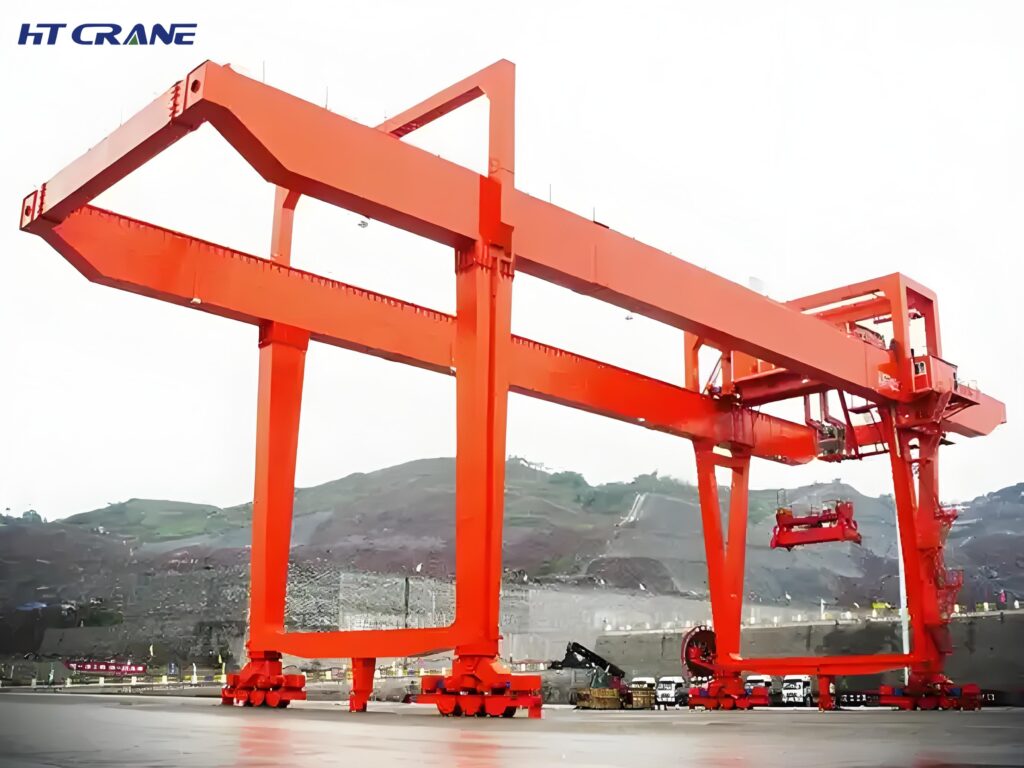
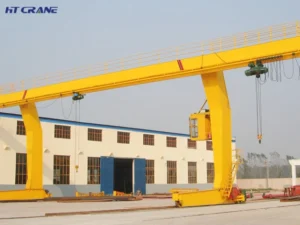
The U-Frame Double Beam Trolley Gantry Crane takes a different structural approach. Instead of angled A-legs, it uses vertical or near-vertical U-shaped outriggers. The space between the legs is wider and more open. Long materials — steel plates, vehicle frames, pre-cut profiles — can pass under the crane body without obstruction.
This clearance is the defining advantage of the U-frame design. In automotive plants, it allows full vehicle frames to move laterally through the crane’s working zone. In metal processing facilities, steel sheets up to several meters in length travel freely beneath the structure. This removes the need for secondary repositioning equipment.
The double-beam construction gives the U-frame solid rigidity for loads up to 50 tons. It handles impact loads well. Dusty, humid, and high-vibration factory environments do not degrade its structural performance over time. The U-frame suits indoor and semi-indoor sites where medium tonnage and material geometry are both key selection factors.
| Parameter | Specification |
|---|---|
| Load Capacity | 5–50 ton |
| Span | 18–35 m |
| Lifting Height | 10–13 m |
| Lifting Speed | 5.4–7.5 m/min |
| Hoist Running Speed | 5.9–13.3 m/min |
| Crane Travel Speed | 30–45 m/min |
| Work Duty Class | A5 |
Best for: Machine part handling in heavy machinery factories. Vehicle frame transport in automotive plants. Cross-zone warehouse movement. New energy battery component logistics. The U-frame resists impact well and performs reliably in dusty or humid environments.
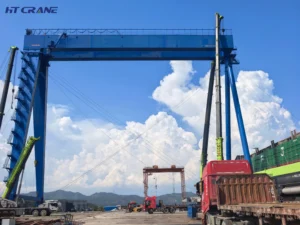
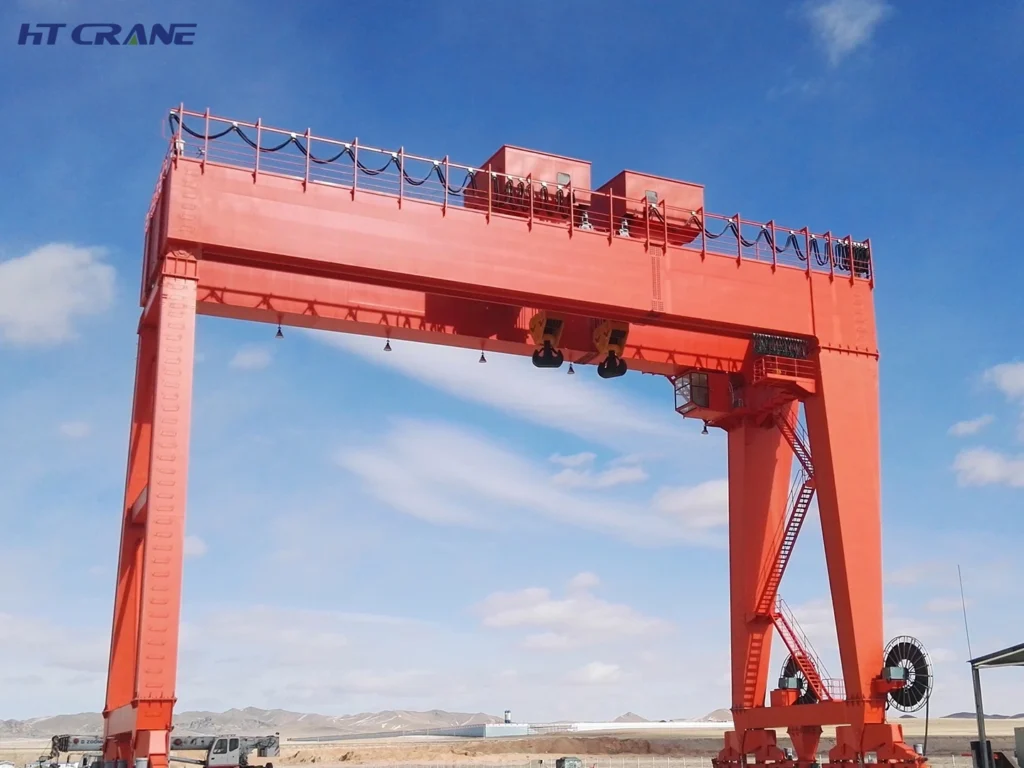
The MG Box Type Double Beam Gantry Crane is the highest-capacity variant in the MG series. It handles loads from 5 tons up to 500 tons. The main beams are fabricated from thick steel plates welded into a closed box cross-section. This profile achieves maximum bending and torsional stiffness for a given beam weight.
The box beam’s rigid geometry is critical for high-tonnage precision work. When a 300-ton load hangs mid-span, beam deflection must remain within tight tolerances. The box structure keeps deflection predictable and within ISO 22986 crane stiffness standards. That matters in applications like prefabricated bridge beam placement, where millimeter-level accuracy affects structural alignment.
The outriggers connect rigidly to the main beams — not with pins or bolted flanges, but through full-penetration welds. This lowers the whole-machine center of gravity. The crane resists overturning moments even under eccentric loads. For the most demanding industrial lifting environments — metallurgical plants, heavy machinery assembly halls, and large logistics centers — the Box type delivers the structural performance that lighter configurations cannot match. Double hooks are available for complex lift sequences.
| Parameter | Specification |
|---|---|
| Load Capacity | 5–500 ton |
| Span | 18–36 m |
| Lifting Height | 10–22 m |
| Lifting Speed | 0.1–1 / 7 m/min |
| Hoist Running Speed | 0.5–5 m/min |
| Crane Travel Speed | 1–10 m/min |
| Work Duty Class | A5 |
Best for: Iron and steel metallurgy. Metal processing plants. Heavy machinery manufacturing and assembly lines. Large-scale warehouse and 3D logistics facilities. When tonnage is high and precision matters, the Box type is the standard choice. Double hooks are available on request.
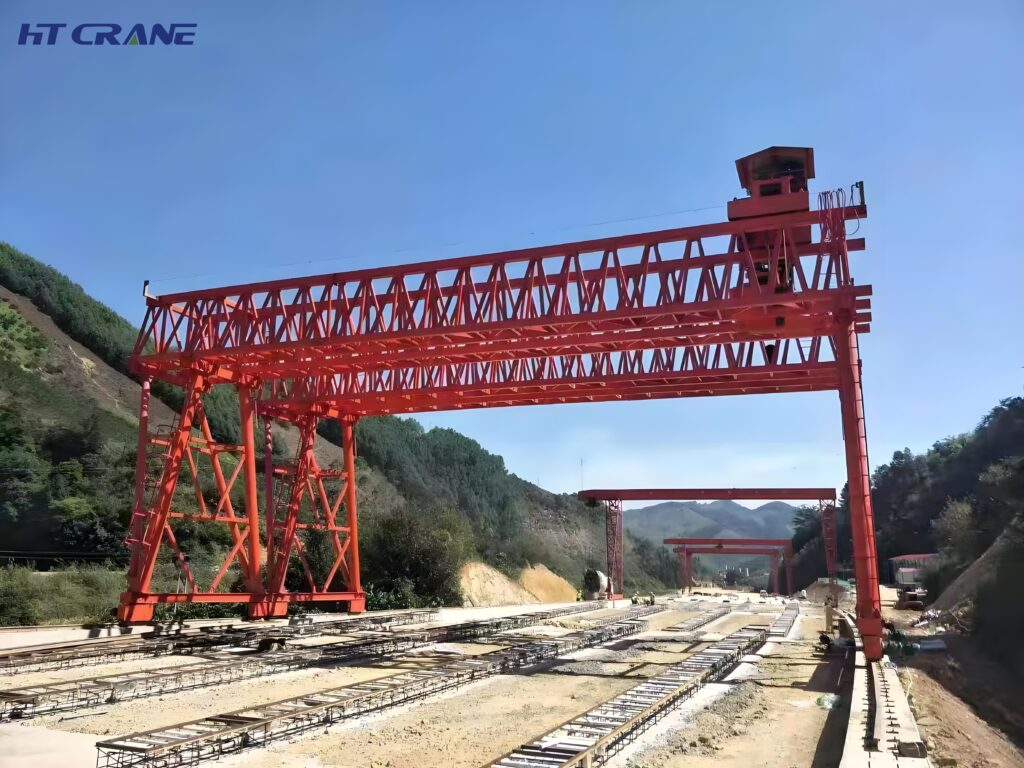
The MG Truss Type Double Girder Gantry Crane replaces solid box beams with an open lattice truss structure. Steel members are arranged in triangulated patterns between top and bottom chords. This achieves high structural strength with significantly less material. Dead weight drops. Wind resistance decreases. Transport volume reduces.
For outdoor sites in coastal, high-altitude, or open-plain environments, wind load is a primary engineering concern. A solid box beam acts like a sail — it catches wind across its full surface area. A truss beam lets wind pass through the lattice with minimal resistance. This fundamental difference makes the Truss type the safer structural choice for exposed locations where wind speeds regularly exceed 10 m/s.
The lighter self-weight also reduces foundation and rail requirements. Ground bearing pressure drops. Civil construction costs on site go down. For remote infrastructure projects — hydropower stations, railway freight depots, or coastal port auxiliary operations — where logistics and site preparation budgets are constrained, the Truss type offers an economically sound solution without sacrificing lifting performance. Anti-corrosion treatment on all truss members extends service life in marine and chemical-adjacent environments.
| Parameter | Specification |
|---|---|
| Load Capacity | 40–100 ton |
| Span | 20–40 m |
| Lifting Height | 9–12 m |
| Lifting Speed | 0.8–3 / 8 m/min |
| Hoist Running Speed | 1.2–8 m/min |
| Crane Travel Speed | 2–12 m/min |
| Work Duty Class | A5 |
Best for: Hydropower station gate operations. Railway freight yard container and rail handling. Port auxiliary lifts for non-containerized heavy parts. Open-air sites in high-wind regions. Corrosion resistance makes the Truss type suitable for coastal and marine-adjacent environments.
| Feature | A-Frame | U-Frame | Box Type | Truss Type |
|---|---|---|---|---|
| Capacity Range | 50–120 t | 5–50 t | 5–500 t | 40–100 t |
| Max Span | 35 m | 35 m | 36 m | 40 m |
| Max Lift Height | 13 m | 13 m | 22 m | 12 m |
| Wind Resistance | High | Medium | Medium | High |
| Self Weight | Medium | Medium | Heavy | Light |
| Transport Cost | Medium | Medium | High | Low |
| Best Environment | Outdoor/Port | Indoor/Factory | Mill/Logistics | Open-Air |
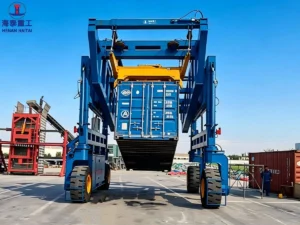
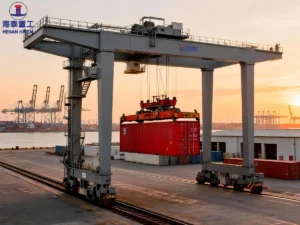
The MG crane’s large span and double-cantilever structure allow efficient container handling across multiple lanes. With outreach of up to 7.5 meters, it covers wide berths without repositioning. Port operations in Brazil, Egypt, Malaysia, and Indonesia have deployed MG-series cranes for large-scale infrastructure projects.
The MG series runs stably in temperatures from –25°C to +40°C. It works with grab buckets, electromagnetic hoists, and other attachments. That makes it suitable for continuous handling of ore, steel billets, and bulk industrial materials in extreme conditions. Explosion-proof variants are available for sensitive environments on request.
Prefabricated beam installation requires both high lift height and precise positioning. The MG Box type handles this with its low-speed lifting range (0.1 m/min) and intelligent control systems. In large factories, the same crane moves oversized assemblies between production zones with minimal manual intervention.
The MG crane’s main beams and legs connect via high-strength bolts. This modular approach has direct procurement benefits. Components ship in standard containers. On-site assembly requires fewer specialized tools. Lead time for installation shortens compared to fully-welded rigid frames.
For remote sites or projects with limited access roads, this matters. A 500-ton Box type can arrive in sections and be assembled on location without heavy transport permits for oversized loads. Ask your supplier to confirm which sections require special handling before finalizing logistics planning.
The MG crane supports three control modes simultaneously:
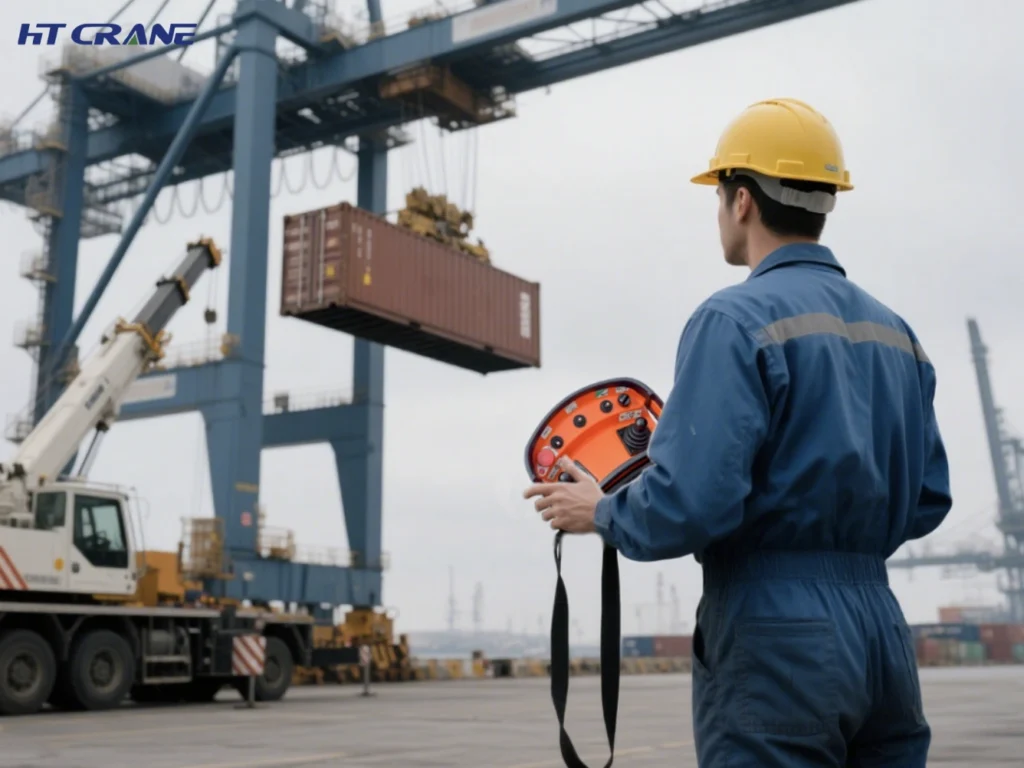
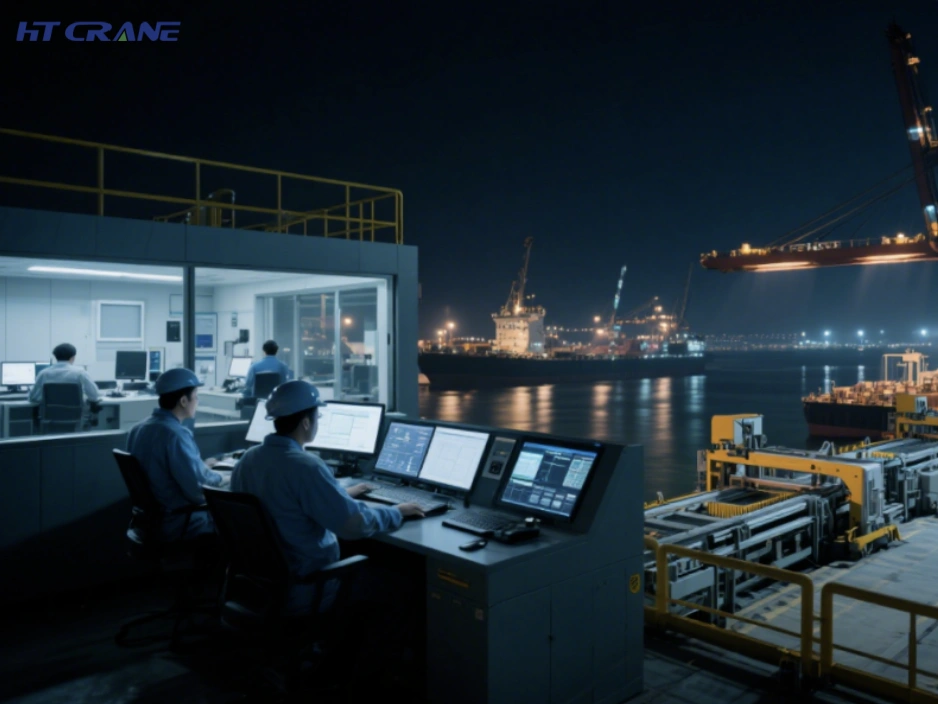
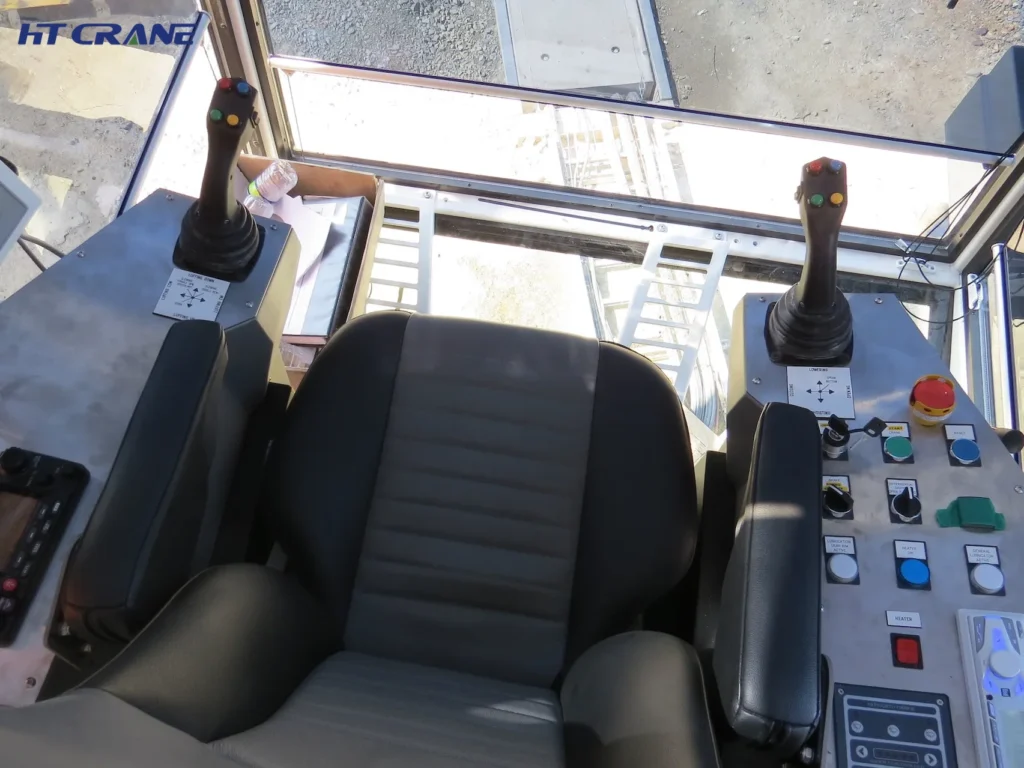
Power feed options include conductive cable drums or enclosed busbar systems. Busbar systems reduce cable wear in high-cycle environments. For outdoor rail yards, sealed cable drums perform better in wet conditions.
The MG Heavy Duty Trolley Gantry Crane is a well-engineered solution for operations that demand reliability, adaptability, and load capacity above what light-duty cranes can handle. The four type variants — A-frame, U-frame, Box, and Truss — cover most heavy industrial use cases from 50-ton outdoor port work to 500-ton indoor steel mill applications.
Before requesting a quote, prepare the following details:
With these inputs, an engineer can confirm the right type, work duty class (A5 standard or higher for intensive cycles), and specify the trolley configuration. Custom spans, double hooks, and explosion-proof ratings are available on all four types.










Not every facility has the floor space for a full gantry crane. Not every building has the roof structure to support an overhead travelling crane. A semi gantry crane solves both problems at once — and for a significant number of industrial buyers, it is the most practical and cost-effective crane configuration available. The semi gantry crane uses one leg on the ground and one side supported by an existing building column or runway rail on the wall. This hybrid design reduces the crane’s footprint, eliminates one set of floor rail foundations, and integrates with the building structure in a way that a full gantry crane cannot. The result is maximum coverage in minimum space — at a lower civil works cost than either alternative. What Is a Semi Gantry Crane? The Defining Structure A semi gantry crane — also called a half gantry crane — has an asymmetric support structure. One end of the main girder rests on a standard leg that runs on a ground-level rail. The other end is supported by a trolley or bracket that runs…

When the load is heavy, the span is wide, or the hook height requirement exceeds what a single girder crane can deliver — a double girder gantry crane is the answer. It is the structural choice for heavy industry, and for good reason: two main girders share the load, allow a higher-positioned hoist, and provide the structural rigidity needed for large spans and demanding duty cycles. Buyers often reach the double girder decision after outgrowing a lighter crane or after realizing that a single girder model cannot meet their hook height or span requirements. The challenge then becomes specification: double girder cranes involve more variables, more civil infrastructure, and larger capital commitment than their lighter counterparts. This page walks you through what defines a double girder gantry crane, what to specify, where it fits, and how to evaluate a supplier for a purchase of this significance. What Is a Double Girder Gantry Crane? A double girder gantry crane uses two parallel horizontal girders — the main beams — supported at each end by leg structures that run on ground-level rails.…