


Choosing the wrong gantry crane costs more than money. It costs downtime, structural risk, and rework. If you’re sourcing a heavy duty trolley gantry crane for a port, steel mill, rail yard, or large factory, the MG series is one of the most proven options on the market today.
This page covers everything procurement teams need: how each MG type differs, what specs apply to your load and environment, and how to match the right configuration to your site conditions. No guesswork. Just practical guidance.
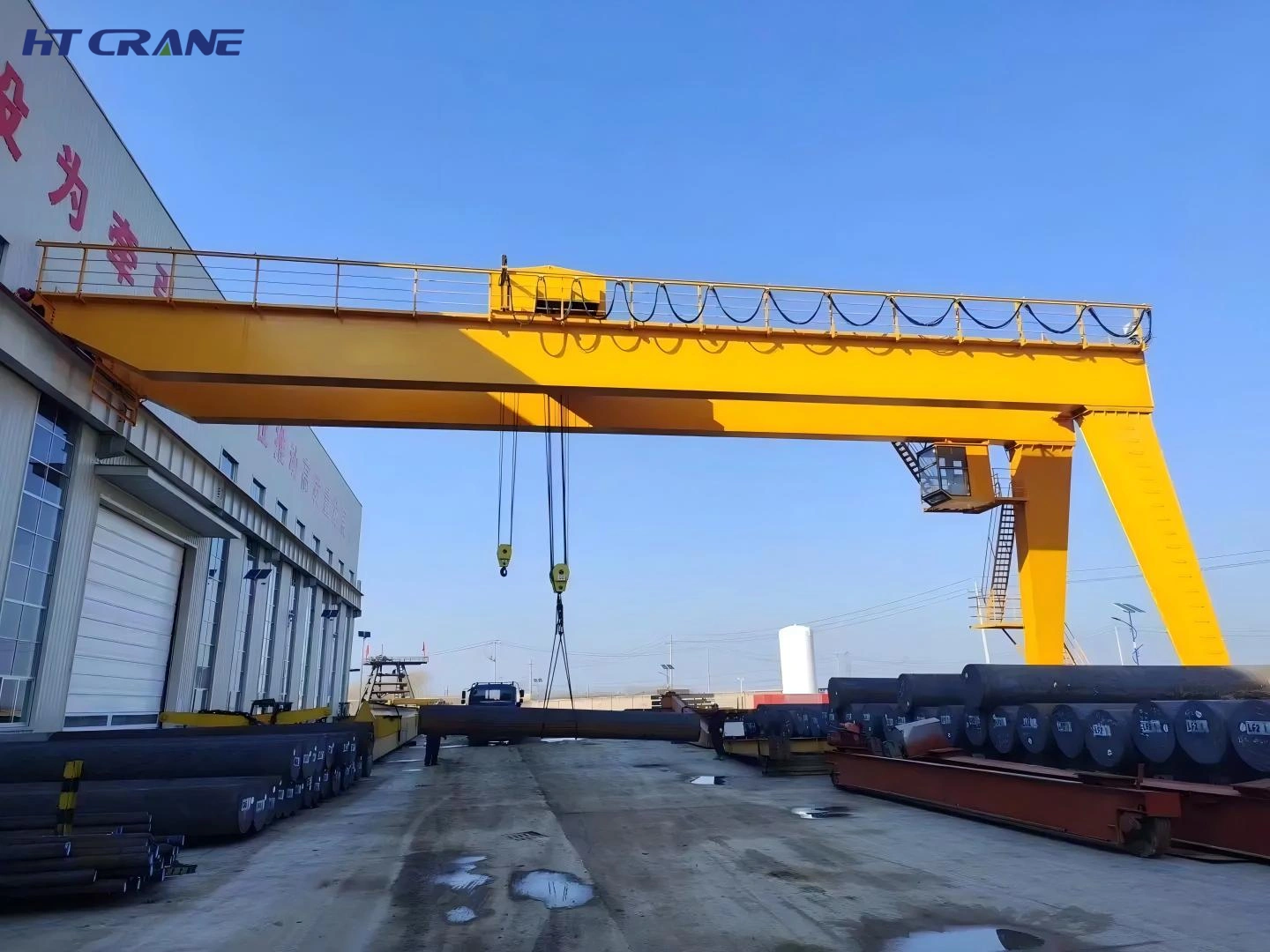
The MG gantry crane is a double-beam, trolley-type outdoor crane built for heavy industrial lifting. Its structure uses a box-type welded double beam with π-shaped legs. This design increases torsional rigidity significantly. The crane handles loads from 5 tons up to 500 tons. It runs on ground rails and supports spans from 18 to 40 meters.
Unlike single-beam gantry cranes, the MG series uses two parallel main beams. This distributes the load more evenly. The trolley travels between the beams, allowing precise positioning over wide spans. The π-leg design keeps the center of gravity low. That matters when handling asymmetric loads or working near site edges.
The full variable frequency drive (VFD) system adjusts power output automatically based on load. Compared to traditional fixed-speed drives, this reduces energy consumption by 20–30%. Over a 10-year service cycle, that’s a meaningful operating cost difference.
Every MG heavy duty trolley gantry crane ships with multiple protection layers. These include:
The hardened gear reducer and three-in-one transmission system reduce mechanical wear. That means longer service intervals and lower maintenance frequency in demanding environments.
The MG series comes in four structural configurations. Each serves a different use case. Understanding the differences prevents costly over-specification or under-specification.
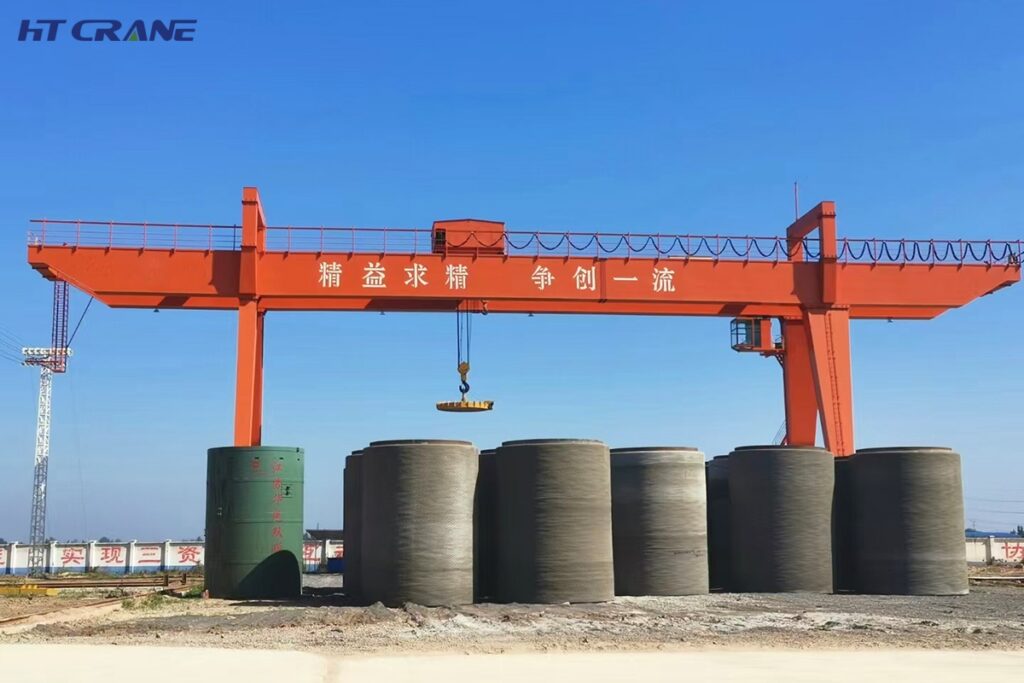
The A-Frame Double Girder Gantry Crane is a heavy-duty outdoor lifting solution built for large-tonnage operations. Its signature “A”-shaped legs form a wide, triangulated support base. This geometry distributes lateral forces efficiently. The result is a crane that stays stable under wind load, uneven ground conditions, and asymmetric lifts.
The double-girder main beam sits across the top of the A-legs. The electric trolley travels along the full span between beams. This allows precise load positioning anywhere across the working zone. Main and auxiliary hooks can be fitted simultaneously. Dual-trolley configurations support synchronized lifts of long or oddly shaped components.
Structurally, the A-frame variant is the go-to choice when lift weights exceed 50 tons and the site is exposed to outdoor conditions. It meets the rigidity demands of steel mill crane duty while maintaining the span range needed for port berth coverage.
| Parâmetro | Especificação |
|---|---|
| Capacidade de carga | 50–120 ton |
| Span | 18–35 m |
| Altura de elevação | 10–13 m |
| Velocidade de elevação | 3.9 / 7.2 m/min |
| Velocidade do carrinho | 3.8–38 m/min |
| Crane Travel Speed | 3–30 m/min |
| Classe de serviço de trabalho | A5 |
| Fonte de energia | 3-phase AC, 380V 50Hz |
Ideal para: Steel billet and coil handling in steel mills. Container loading at small-to-mid ports. Wind turbine blade and tower installation. Heavy equipment assembly in nuclear or power plants. Where complex lifts need dual trolleys or main-and-auxiliary hook configurations, the A-frame handles it.
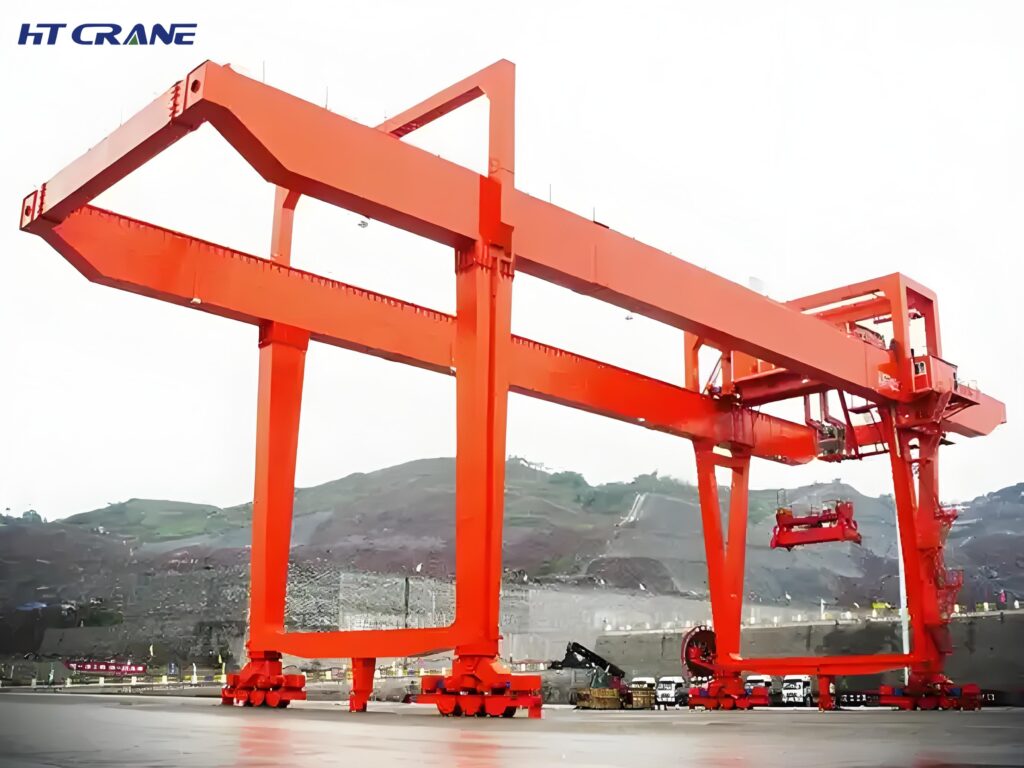
The U-Frame Double Beam Trolley Gantry Crane takes a different structural approach. Instead of angled A-legs, it uses vertical or near-vertical U-shaped outriggers. The space between the legs is wider and more open. Long materials — steel plates, vehicle frames, pre-cut profiles — can pass under the crane body without obstruction.
This clearance is the defining advantage of the U-frame design. In automotive plants, it allows full vehicle frames to move laterally through the crane’s working zone. In metal processing facilities, steel sheets up to several meters in length travel freely beneath the structure. This removes the need for secondary repositioning equipment.
The double-beam construction gives the U-frame solid rigidity for loads up to 50 tons. It handles impact loads well. Dusty, humid, and high-vibration factory environments do not degrade its structural performance over time. The U-frame suits indoor and semi-indoor sites where medium tonnage and material geometry are both key selection factors.
| Parâmetro | Especificação |
|---|---|
| Capacidade de carga | 5–50 ton |
| Span | 18–35 m |
| Altura de elevação | 10–13 m |
| Velocidade de elevação | 5.4–7.5 m/min |
| Velocidade de funcionamento do guincho | 5.9–13.3 m/min |
| Crane Travel Speed | 30–45 m/min |
| Classe de serviço de trabalho | A5 |
Ideal para: Machine part handling in heavy machinery factories. Vehicle frame transport in automotive plants. Cross-zone warehouse movement. New energy battery component logistics. The U-frame resists impact well and performs reliably in dusty or humid environments.
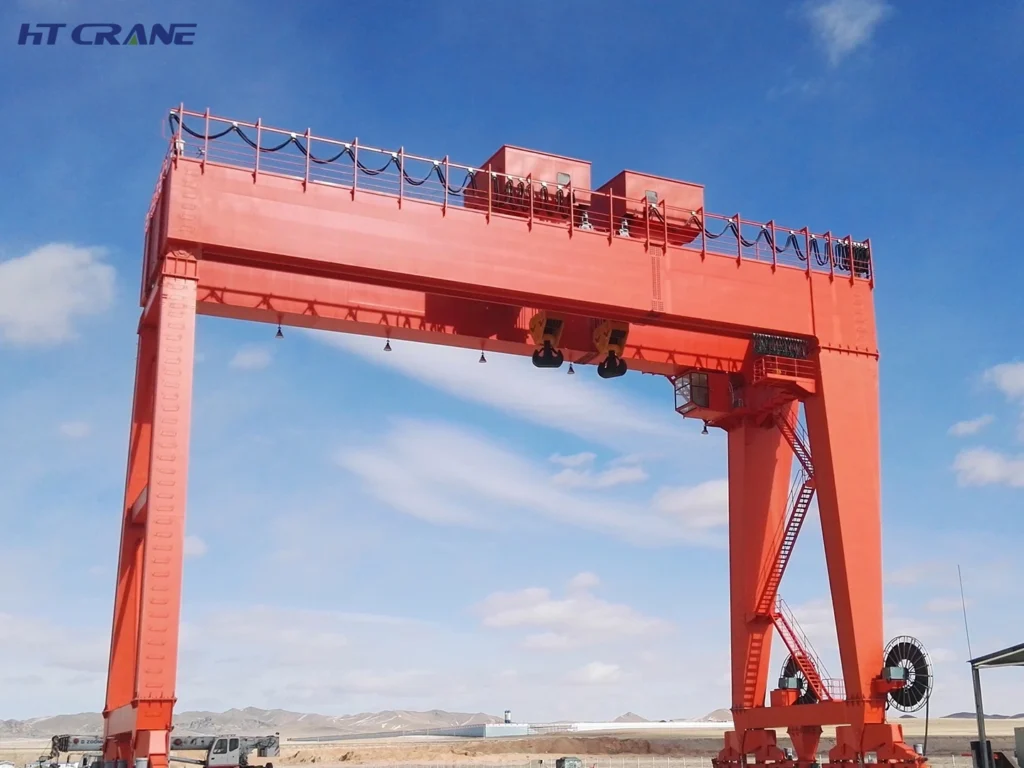
The MG Box Type Double Beam Gantry Crane is the highest-capacity variant in the MG series. It handles loads from 5 tons up to 500 tons. The main beams are fabricated from thick steel plates welded into a closed box cross-section. This profile achieves maximum bending and torsional stiffness for a given beam weight.
The box beam’s rigid geometry is critical for high-tonnage precision work. When a 300-ton load hangs mid-span, beam deflection must remain within tight tolerances. The box structure keeps deflection predictable and within ISO 22986 crane stiffness standards. That matters in applications like prefabricated bridge beam placement, where millimeter-level accuracy affects structural alignment.
The outriggers connect rigidly to the main beams — not with pins or bolted flanges, but through full-penetration welds. This lowers the whole-machine center of gravity. The crane resists overturning moments even under eccentric loads. For the most demanding industrial lifting environments — metallurgical plants, heavy machinery assembly halls, and large logistics centers — the Box type delivers the structural performance that lighter configurations cannot match. Double hooks are available for complex lift sequences.
| Parâmetro | Especificação |
|---|---|
| Capacidade de carga | 5–500 ton |
| Span | 18–36 m |
| Altura de elevação | 10–22 m |
| Velocidade de elevação | 0.1–1 / 7 m/min |
| Velocidade de funcionamento do guincho | 0.5–5 m/min |
| Crane Travel Speed | 1–10 m/min |
| Classe de serviço de trabalho | A5 |
Ideal para: Iron and steel metallurgy. Metal processing plants. Heavy machinery manufacturing and assembly lines. Large-scale warehouse and 3D logistics facilities. When tonnage is high and precision matters, the Box type is the standard choice. Double hooks are available on request.
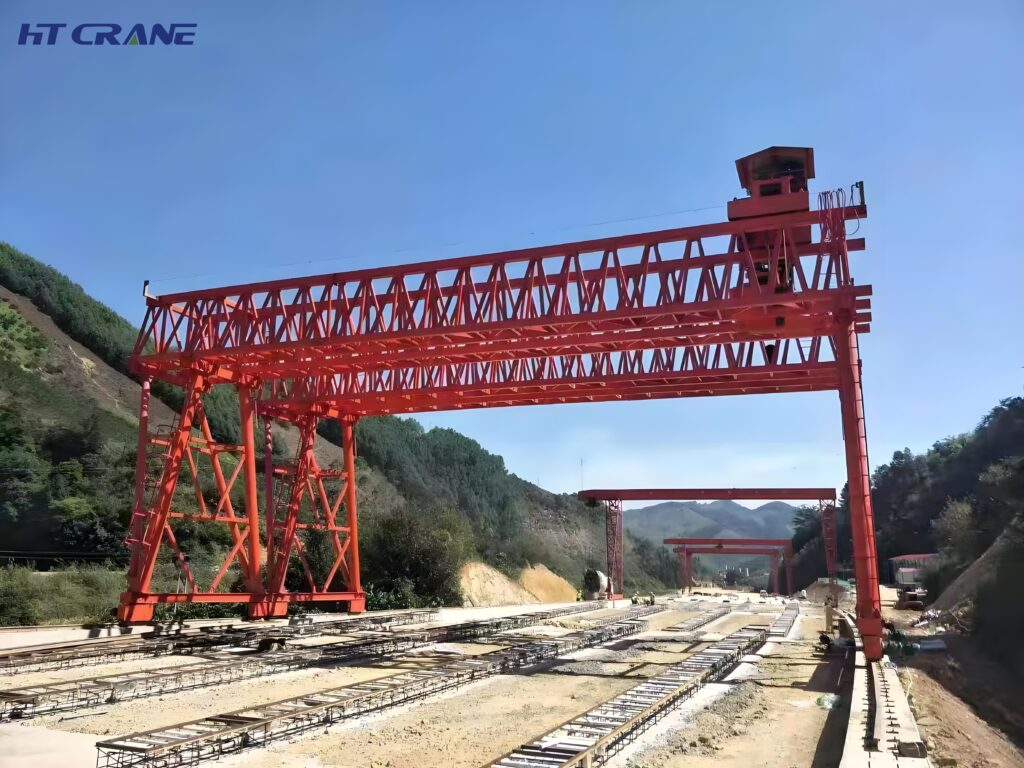
The MG Truss Type Double Girder Gantry Crane replaces solid box beams with an open lattice truss structure. Steel members are arranged in triangulated patterns between top and bottom chords. This achieves high structural strength with significantly less material. Dead weight drops. Wind resistance decreases. Transport volume reduces.
For outdoor sites in coastal, high-altitude, or open-plain environments, wind load is a primary engineering concern. A solid box beam acts like a sail — it catches wind across its full surface area. A truss beam lets wind pass through the lattice with minimal resistance. This fundamental difference makes the Truss type the safer structural choice for exposed locations where wind speeds regularly exceed 10 m/s.
The lighter self-weight also reduces foundation and rail requirements. Ground bearing pressure drops. Civil construction costs on site go down. For remote infrastructure projects — hydropower stations, railway freight depots, or coastal port auxiliary operations — where logistics and site preparation budgets are constrained, the Truss type offers an economically sound solution without sacrificing lifting performance. Anti-corrosion treatment on all truss members extends service life in marine and chemical-adjacent environments.
| Parâmetro | Especificação |
|---|---|
| Capacidade de carga | 40–100 ton |
| Span | 20–40 m |
| Altura de elevação | 9–12 m |
| Velocidade de elevação | 0.8–3 / 8 m/min |
| Velocidade de funcionamento do guincho | 1.2–8 m/min |
| Crane Travel Speed | 2–12 m/min |
| Classe de serviço de trabalho | A5 |
Ideal para: Hydropower station gate operations. Railway freight yard container and rail handling. Port auxiliary lifts for non-containerized heavy parts. Open-air sites in high-wind regions. Corrosion resistance makes the Truss type suitable for coastal and marine-adjacent environments.
| Recurso | A-Frame | U-Frame | Box Type | Truss Type |
|---|---|---|---|---|
| Faixa de capacidade | 50–120 t | 5–50 t | 5–500 t | 40–100 t |
| Extensão máxima | 35 m | 35 m | 36 m | 40 m |
| Altura máxima de elevação | 13 m | 13 m | 22 m | 12 m |
| Resistência ao vento | Alto | Médio | Médio | Alto |
| Peso próprio | Médio | Médio | Pesado | Luz |
| Transport Cost | Médio | Médio | Alto | Baixo |
| Melhor ambiente | Outdoor/Port | Indoor/Factory | Mill/Logistics | Open-Air |
The MG crane’s large span and double-cantilever structure allow efficient container handling across multiple lanes. With outreach of up to 7.5 meters, it covers wide berths without repositioning. Port operations in Brazil, Egypt, Malaysia, and Indonesia have deployed MG-series cranes for large-scale infrastructure projects.
The MG series runs stably in temperatures from –25°C to +40°C. It works with grab buckets, electromagnetic hoists, and other attachments. That makes it suitable for continuous handling of ore, steel billets, and bulk industrial materials in extreme conditions. Explosion-proof variants are available for sensitive environments on request.
Prefabricated beam installation requires both high lift height and precise positioning. The MG Box type handles this with its low-speed lifting range (0.1 m/min) and intelligent control systems. In large factories, the same crane moves oversized assemblies between production zones with minimal manual intervention.
The MG crane’s main beams and legs connect via high-strength bolts. This modular approach has direct procurement benefits. Components ship in standard containers. On-site assembly requires fewer specialized tools. Lead time for installation shortens compared to fully-welded rigid frames.
For remote sites or projects with limited access roads, this matters. A 500-ton Box type can arrive in sections and be assembled on location without heavy transport permits for oversized loads. Ask your supplier to confirm which sections require special handling before finalizing logistics planning.
The MG crane supports three control modes simultaneously:
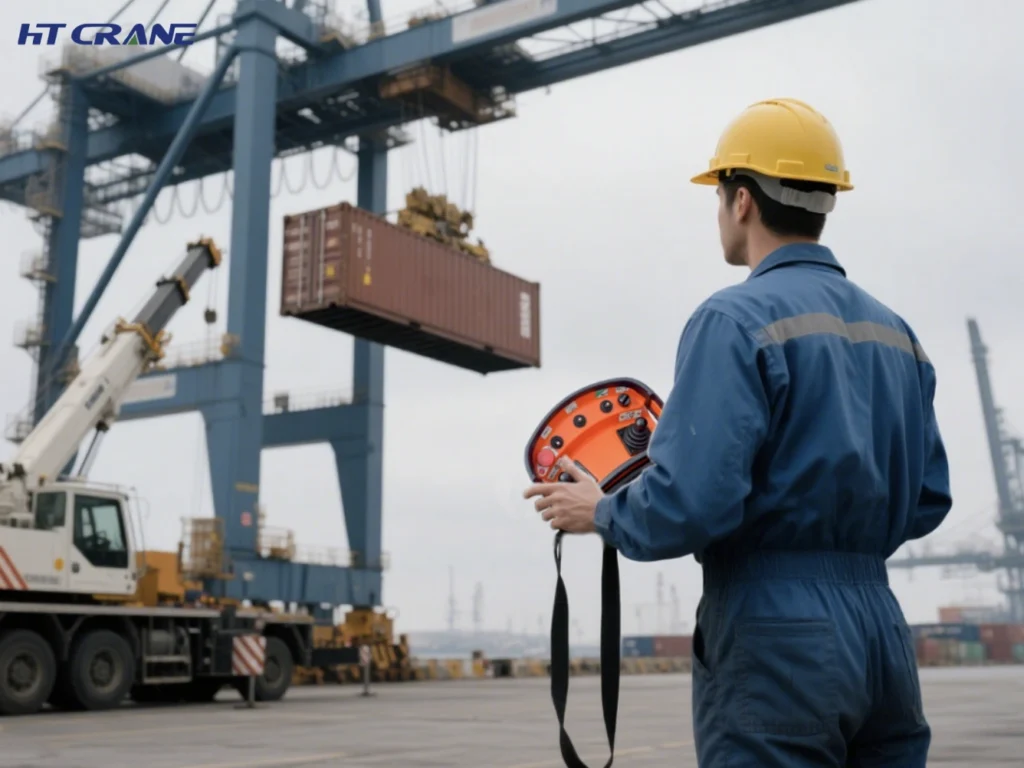
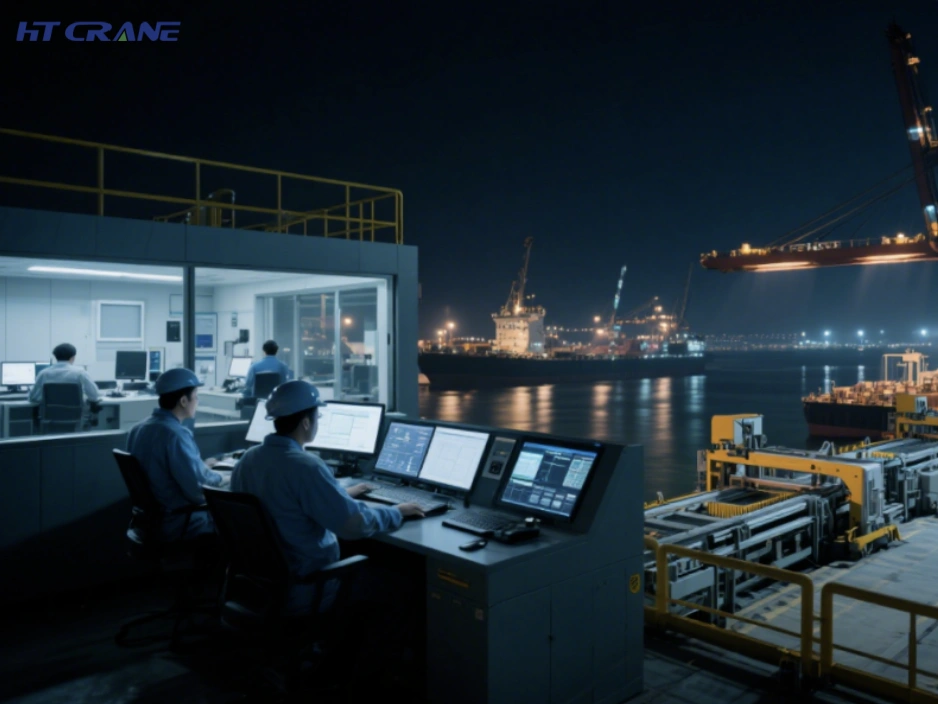
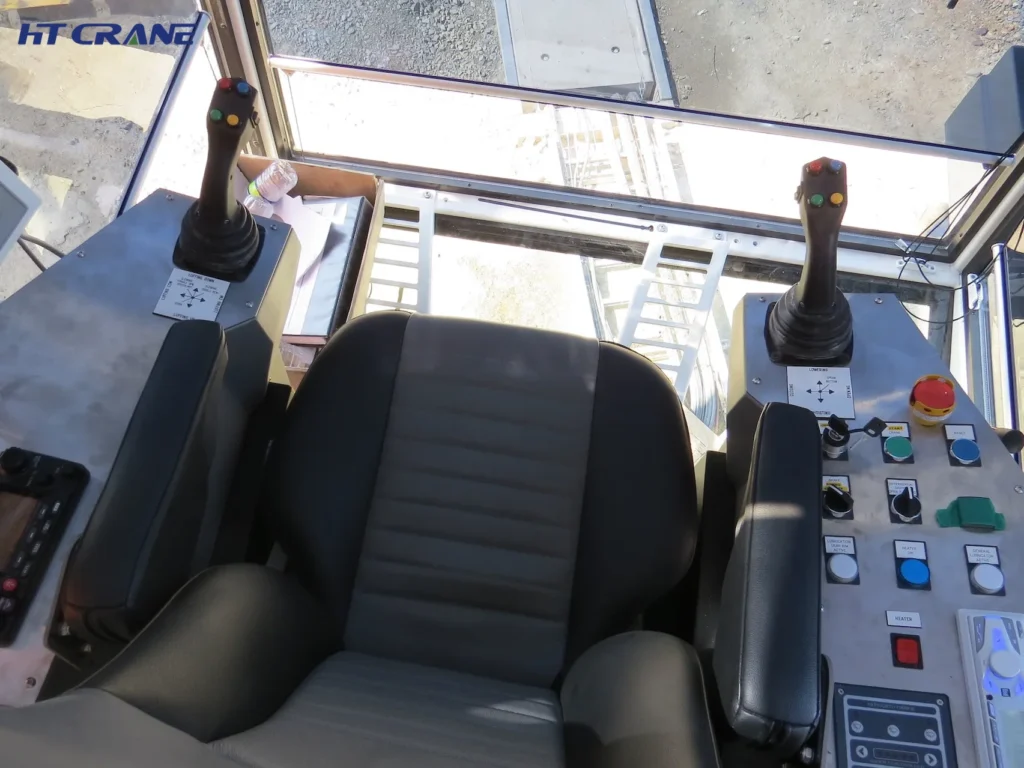
Power feed options include conductive cable drums or enclosed busbar systems. Busbar systems reduce cable wear in high-cycle environments. For outdoor rail yards, sealed cable drums perform better in wet conditions.
The MG Heavy Duty Trolley Gantry Crane is a well-engineered solution for operations that demand reliability, adaptability, and load capacity above what light-duty cranes can handle. The four type variants — A-frame, U-frame, Box, and Truss — cover most heavy industrial use cases from 50-ton outdoor port work to 500-ton indoor steel mill applications.
Before requesting a quote, prepare the following details:
With these inputs, an engineer can confirm the right type, work duty class (A5 standard or higher for intensive cycles), and specify the trolley configuration. Custom spans, double hooks, and explosion-proof ratings are available on all four types.










Nem todas as instalações têm espaço suficiente para uma ponte rolante pórtico completa. Nem todos os edifícios têm a estrutura de telhado adequada para suportar uma ponte rolante móvel. Uma ponte rolante semipórtico resolve ambos os problemas de uma só vez — e para um número significativo de compradores industriais, é a configuração de ponte rolante mais prática e econômica disponível. A ponte rolante semipórtico utiliza uma perna no solo e uma lateral apoiada em uma coluna existente do edifício ou em um trilho de sustentação na parede. Esse design híbrido reduz a área ocupada pela ponte rolante, elimina um conjunto de fundações de trilhos no piso e se integra à estrutura do edifício de uma forma que uma ponte rolante pórtico completa não consegue. O resultado é a máxima cobertura em um espaço mínimo — com um custo de obras civis menor do que qualquer uma das alternativas. O que é uma ponte rolante semipórtico? A estrutura que a define Uma ponte rolante semipórtico — também chamada de meia ponte rolante pórtico — possui uma estrutura de suporte assimétrica. Uma extremidade da viga principal repousa sobre uma perna padrão que se desloca sobre um trilho no nível do solo. A outra extremidade é suportada por um carrinho ou suporte que se desloca…

Quando a carga é pesada, o vão é amplo ou a altura do gancho necessária excede o que uma ponte rolante de viga simples pode oferecer, a solução é uma ponte rolante de viga dupla. Ela é a escolha estrutural ideal para a indústria pesada, e por um bom motivo: duas vigas principais compartilham a carga, permitem um içamento em posição mais elevada e fornecem a rigidez estrutural necessária para grandes vãos e ciclos de trabalho exigentes. Os compradores geralmente optam pela ponte rolante de viga dupla depois de superarem a capacidade de uma ponte rolante mais leve ou ao perceberem que um modelo de viga simples não atende às suas necessidades de altura do gancho ou vão. O desafio, então, passa a ser a especificação: as pontes rolantes de viga dupla envolvem mais variáveis, mais infraestrutura civil e um investimento de capital maior do que suas contrapartes mais leves. Esta página explica o que define uma ponte rolante de viga dupla, o que especificar, onde ela se encaixa e como avaliar um fornecedor para uma compra dessa importância. O que é uma ponte rolante de viga dupla? Um guindaste pórtico de viga dupla utiliza duas vigas horizontais paralelas — as vigas principais — apoiadas em cada extremidade por estruturas de apoio que se deslocam sobre trilhos ao nível do solo.


























