


Steel mill cranes always operate in the most demanding environments in any industrial sector. The loads are heavy, the duty cycles are relentless, and the consequences of crane downtime reach directly into production output. A crane that fails during a pour, a tap, or a charging sequence does not just incur repair cost — it disrupts the entire production line downstream.
Getting the right steel mill crane into the right position in a steel facility is not a single decision. Different areas of the mill handle different materials in different ways. The raw material storage yard has different requirements from the casting bay. The scrap charging area is nothing like the finished product warehouse. Each zone demands a crane type matched to the specific task, duty class, and operating environment.
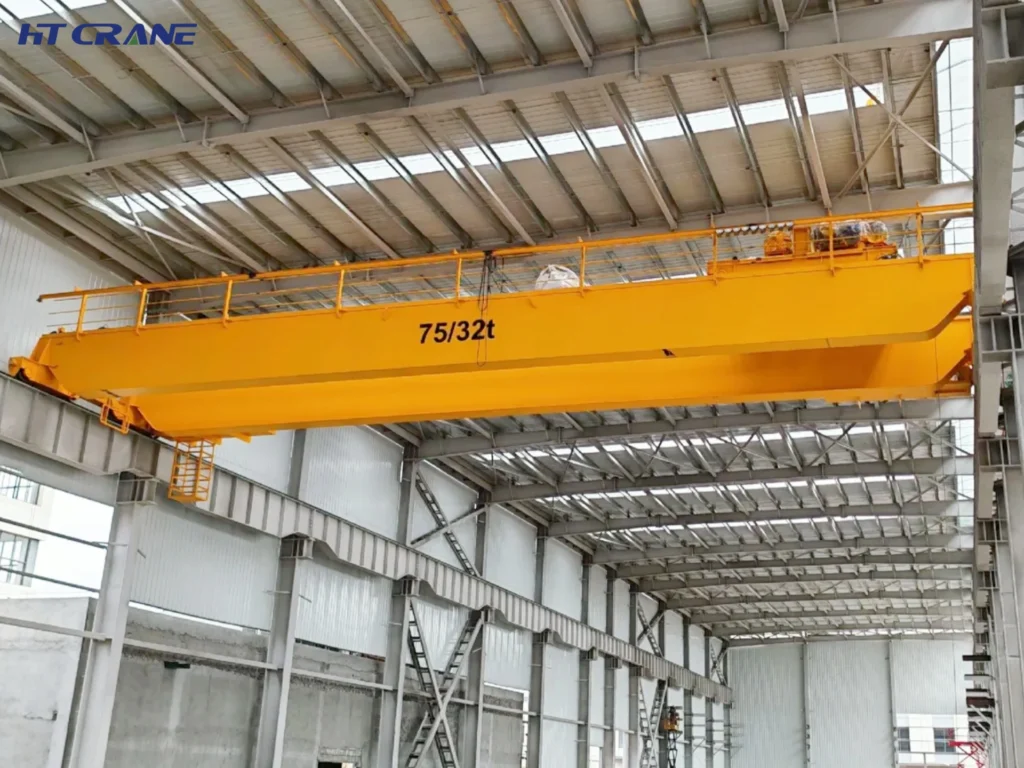
The QD double girder overhead steel mill crane is the workhorse of the indoor steel facility. It is a standard double girder overhead crane designed for general heavy lifting — maintenance tasks, equipment replacement, coil and slab handling in storage bays, and general-purpose material movement wherever a dedicated specialist crane is not required. Most steel mills have multiple QD cranes distributed across maintenance bays, warehouse areas, and secondary processing zones.
The QD handles loads where the primary requirement is reliable, repeatable heavy lifting without the specialized features that grab, magnet, or twin-hook operations require. It is the lowest-complexity crane in the mill’s fleet — straightforward to operate, straightforward to maintain, and straightforward to specify.
| Parâmetro | Faixa de especificações |
|---|---|
| Capacidade de elevação | 5T – 500T |
| Span | 10,5 m – 35,5 m |
| Altura de elevação | 6m – 30m |
| Classe de serviço de trabalho | A3 – A6 (ISO 4301 / GB/T 3811) |
| Velocidade de içamento | 2 – 12 m/min |
| Sistema de acionamento | AC VFD (standard) |
| Tipo de guincho | Wire rope crab trolley |
| Padrão de projeto | GB/T 14405, EN 13001 |
| Certificação | CE, ISO 9001 |
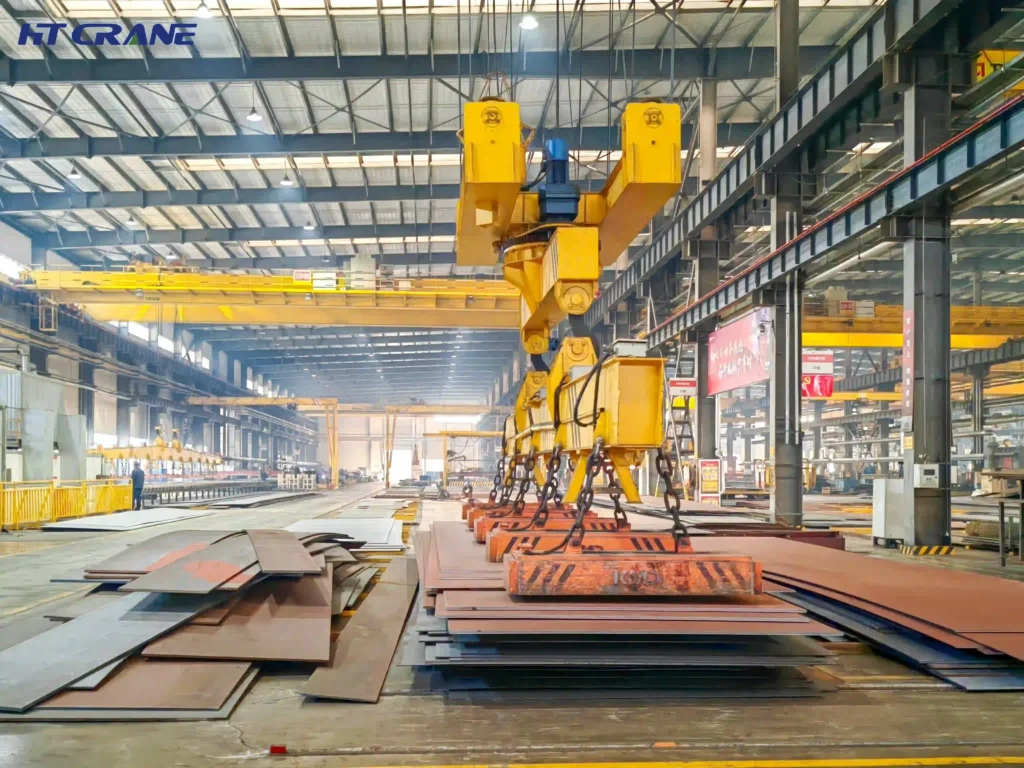
The QC electromagnetic steel mill crane serves every area of the steel facility that handles ferromagnetic material without slings. Scrap charging yards, billet and bloom storage, plate handling in rolling mill runout areas, and mixed steel inventory in service center bays all require a crane that picks up and releases steel loads without manual rigging contact.
The electromagnet is integrated into the crane from the ground up — it is not a portable lifting magnet retrofitted to a hook crane. The onboard DC rectifier, battery backup system, and purpose-rated trolley are co-engineered as one machine. This distinction is important: a retrofit arrangement cannot match the duty cycle rating or operational reliability of a purpose-built QC crane in demanding steel mill service.
| Parâmetro | Faixa de especificações |
|---|---|
| Capacidade de elevação | 5T – 100T |
| Span | 10,5 m – 35,5 m |
| Altura de elevação | 6m – 20m |
| Classe de serviço de trabalho | A5 – A7 |
| Magnet Diameter | 500mm – 2,000mm |
| Coil Duty Rating | ED 40% – ED 75% |
| Coil Insulation Class | Class F (standard); Class H (hot material) |
| Material Temp Rating | Up to 100°C (standard); up to 700°C (metallurgical spec) |
| Battery Backup | 30 minutes minimum — standard |
| Rectifier Type | Thyristor, closed-loop current control |
| Padrão de projeto | GB/T 14406, EN 13001 |
| Certificação | CE, ISO 9001 |
The QE dual-trolley double girder steel mill crane carries two independent trolleys on a single bridge. Each trolley has its own hoist, its own travel drive, and its own hook. The two trolleys can operate independently for separate lifts, or they can be synchronized to lift a single long load from two pickup points simultaneously.
This configuration is essential wherever the steel mill handles long structural sections, large fabrications, or heavy assemblies that cannot be balanced from a single central pickup point. Rolling mill guide frames, large rolls and shafts, long slab transfers, and structural maintenance in the mill building itself are common QE applications. The twin-hook tandem lift allows the operator to tilt the load by raising one trolley while holding the other — a capability that significantly reduces rigging complexity for awkward sections.
| Parâmetro | Faixa de especificações |
|---|---|
| Capacity — Each Trolley | 10T – 200T per trolley |
| Combined Tandem Capacity | Up to 400T (synchronized mode) |
| Span | 15m – 40m |
| Altura de elevação | 6m – 30m |
| Trolley Spacing (adjustable) | 3m – 12m (load-dependent) |
| Synchronization | PLC load-sharing control — ±2% tolerance |
| Classe de serviço de trabalho | A5 – A7 |
| Sistema de acionamento | Inversor de frequência CA — todos os movimentos |
| Padrão de projeto | GB/T 14405, EN 13001, FEM 1.001 |
| Certificação | CE, ISO 9001 |
The QZ crane is designed for bulk material handling — it carries a grab bucket rather than a hook, and the four-rope hoist system operates both the crane travel and the grab open-and-close functions through a coordinated drive system. In steel mill applications, the QZ handles scrap in charging yards, coal and ore in raw material storage bunkers, and slag in processing areas.
The key operational difference from a hook crane is duty class. Grab crane operations are inherently high-cycle — the crane picks, carries, and releases multiple times per hour throughout every shift. This demands A6 or A7 work duty class as a minimum. A hook crane spec applied to a grab crane application will reach its structural fatigue limit years ahead of schedule
| Parâmetro | Faixa de especificações |
|---|---|
| Capacidade de elevação | 5T – 50T (grab + load) |
| Span | 10,5 m – 35,5 m |
| Altura de elevação | 6m – 25m |
| Classe de serviço de trabalho | A6 – A7 (minimum — grab duty) |
| Tipo de agarrar | Clamshell (loose bulk); orange-peel (scrap, irregular material) |
| Grab Drive | Four-rope hoist system (holding + closing ropes) |
| Rope Type | ISO 2408 compliant, rotation-resistant |
| Cabin | Operator cabin standard — floor window option |
| Sistema de acionamento | AC VFD — all motions including grab open/close |
| Padrão de projeto | GB/T 14405, EN 13001 |
| Certificação | CE, ISO 9001 |
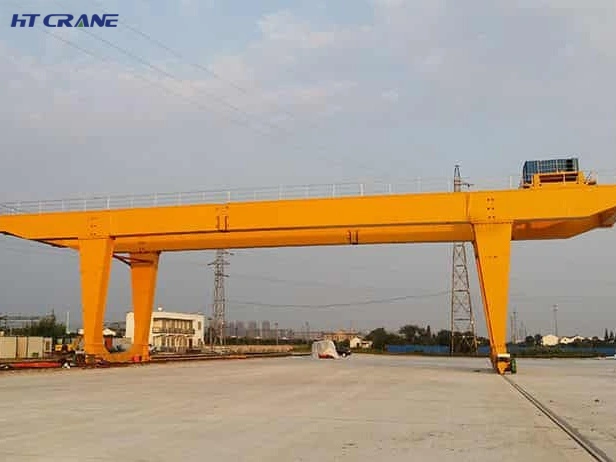
The U-type gantry crane operates in the outdoor storage and logistics areas of the steel facility — raw material stockyards, finished product dispatch areas, and transfer yards between processing zones. It travels on ground-level rails across a wide outdoor bay, covering areas where indoor crane coverage is not available and mobile equipment cannot match the throughput or lift capacity required.
The U-type designation refers to the structural profile: two vertical legs connected by a horizontal crossbeam at height, with a box-section girder spanning between them. The legs and crossbeam form a U shape when viewed from the end. This structure provides a clear working span below the girder without any obstruction — essential for handling long products like coils, slabs, or pipe bundles that must pass under the crane structure during loading and unloading.
| Parâmetro | Faixa de especificações |
|---|---|
| Capacidade de elevação | 10T – 500T |
| Span | 18m – 60m |
| Altura de elevação | 6m – 18m |
| Classe de serviço de trabalho | A4 – A6 |
| Tipo de perna | Fixed height or adjustable |
| Sistema de viagem | Rail-mounted, double-flange wheel |
| Tipo de trilho | QU70 – QU120 |
| Tipo de guincho | Wire rope crab trolley or electric hoist |
| Sistema de acionamento | AC VFD — travel and hoist |
| Cantilever Option | Single or double cantilever available |
| Proteção contra corrosão | Minimum 280 microns DFT for outdoor use |
| Padrão de projeto | GB/T 14406, EN 13001 |
| Certificação | CE, ISO 9001 |
The five crane types above are not interchangeable. The correct selection for each area of the facility follows from the material type, duty cycle, and operating environment:
| Mill Zone | Recommended Crane Type | Key Reason |
|---|---|---|
| Scrap charging bay | QC electromagnetic or QZ grab | No manual rigging; high-cycle duty |
| Billet / bloom storage (indoor) | QC electromagnetic | Fast cycle; no sling labor |
| Raw material bunker (coal/ore) | QZ grab | Bulk pickup and release cycle |
| Rolling mill — long section handling | QE twin-trolley | Balanced tandem lift for long loads |
| Maintenance bay | QD general purpose | Standard hook lift; lower duty |
| Finished product warehouse | QD or QC (plate/coil) | Load type determines magnet or hook |
| Outdoor stockyard / dispatch | U-type gantry | Wide span; outdoor rail operation |
| Slag processing area | QZ grab | Heavy scrap; A6/A7 duty required |
Use this table as a starting point, not a final answer. The actual selection for each zone must be confirmed against the specific duty cycle, span, hook height, and environmental conditions at your facility. Providing these parameters to your crane supplier allows them to produce a configuration that fits your operation — not a generic catalogue product.
Steel mill crane procurement is not a single transaction. It is a fleet specification exercise covering multiple crane types, multiple mill zones, and a range of duty classes and technical requirements that vary significantly from one area of the facility to the next. Getting the right crane into the right zone with the right duty class is the difference between a fleet that runs reliably for 20 years and one that requires major repairs within the first five.
Entre em contato com a HT Crane hoje mesmo. Para discutirmos o seu projeto e recebermos um orçamento personalizado.









Se você administra uma marina, estaleiro ou instalação naval, já conhece os problemas: embarcações paradas na água aguardando manutenção, rampas de lançamento que danificam os cascos e guindastes que simplesmente não foram projetados para barcos. Um guindaste pórtico para embarcações resolve todos esses três problemas em uma única máquina. Ele levanta, move e lança embarcações com segurança — sem trilhos fixos, sem danos ao casco e sem atrasar o seu estaleiro. Esta página aborda tudo o que você precisa para avaliar um guindaste pórtico para embarcações: o que ele faz, onde funciona, o que torna o nosso diferente e as especificações técnicas completas. Se você estiver pronto para especificar uma unidade, nossa equipe de engenharia responde às solicitações em até 24 horas. Descrição do Produto: Um guindaste pórtico para embarcações — também chamado de guindaste móvel para barcos, guindaste autopropelido para barcos — é um guindaste sobre pneus projetado especificamente para movimentação de embarcações. A estrutura do pórtico se estende sobre o barco na água. Cintas de poliéster são posicionadas sob o casco. A embarcação é então içada e transportada para qualquer lugar em terra. Sem trilhos. Sem infraestrutura fixa. Apenas uma máquina que realiza o transporte de materiais para fora da água…

Escolher o fornecedor certo de guindastes RTG impacta toda a sua operação portuária ou de pátio. Uma escolha errada significa atrasos, tempo de inatividade e reparos dispendiosos. Nós ajudamos você a evitar isso. Como fabricante e exportador certificado de guindastes RTG, fornecemos guindastes pórticos sobre pneus de alto desempenho, projetados para terminais de contêineres, pátios intermodais e centros logísticos em todo o mundo. Descrição do Produto: Um guindaste RTG (Guindaste Pórtico sobre Pneus) é um guindaste móvel projetado para empilhar e movimentar contêineres ISO em pátios de contêineres portuários e depósitos no interior. Ao contrário dos guindastes sobre trilhos (Guindaste Pórtico para Contêineres RMG), os guindastes RTG funcionam sobre pneus, o que lhes confere total mobilidade pelo pátio sem infraestrutura fixa. 👉Veja o Guia de Compra Profissional: Guindaste RTG vs. Guindaste RMG: Qual deles é o mais adequado para o seu projeto? Os guindastes RTG são a espinha dorsal das operações modernas de terminais de contêineres. Eles preenchem a lacuna entre os guindastes de navio para terra e o transporte horizontal, permitindo o empilhamento, a recuperação e a organização eficientes de contêineres no pátio. Por que comprar conosco? A HT Cranes é uma fabricante profissional de guindastes RTG com mais de 15 anos de experiência em içamento. Nossos guindastes são exportados para portos e terminais logísticos em todo o Sudeste Asiático, Oriente Médio e Europa.
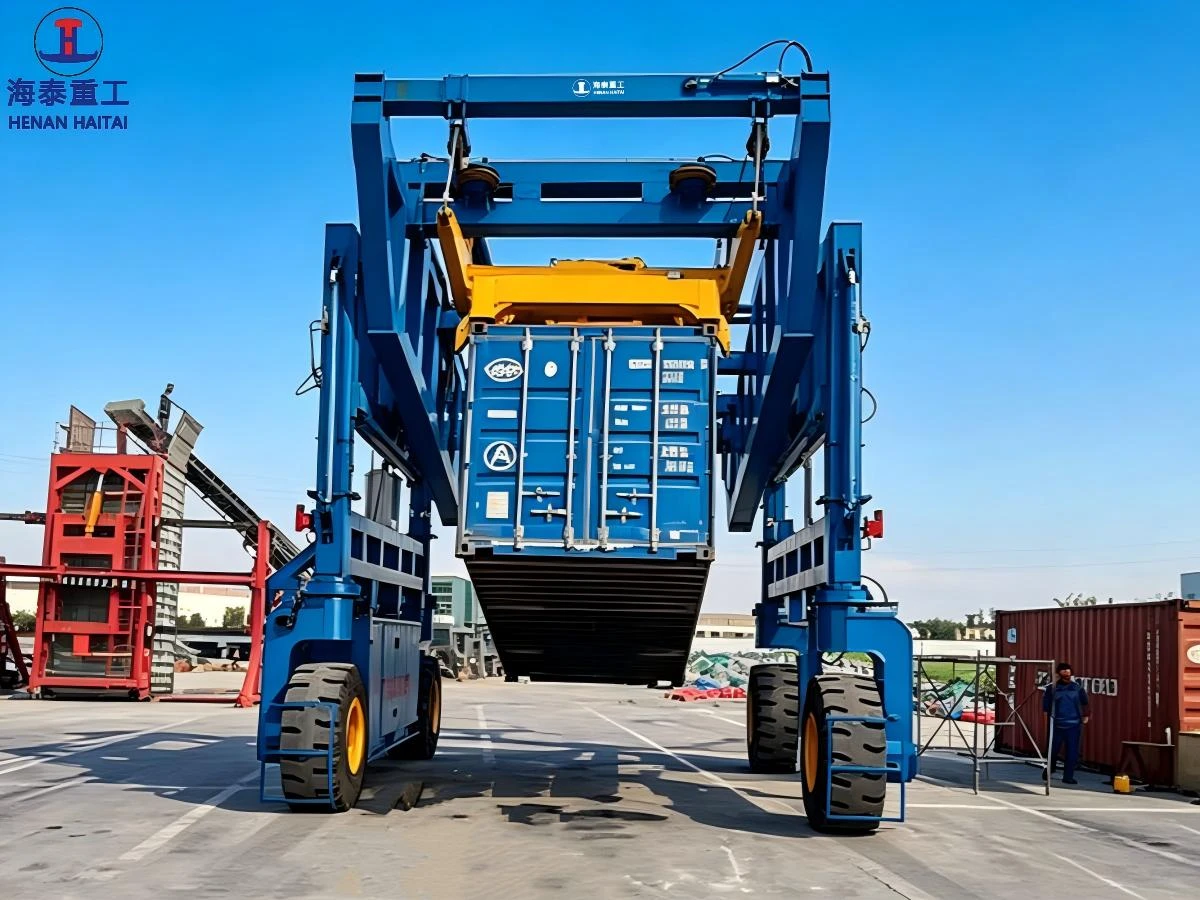
Se você trabalha com contêineres pesados, estruturas de aço ou cargas industriais de grandes dimensões — e seu local não possui infraestrutura de energia fixa — um pórtico hidráulico é provavelmente a solução mais prática disponível. Ele levanta, se desloca e posiciona cargas sem a necessidade de estruturas suspensas, trilhos ou fornecimento de energia de alta tensão. Uma única máquina. Mobilidade total. Obras civis mínimas. O que é um Pórtico Hidráulico? O Conceito Básico Um pórtico hidráulico é um veículo autopropelido para içamento de cargas pesadas. Ele se posiciona sobre a carga — levantando-a por baixo usando um spreader hidráulico ou uma viga de elevação — e se move livremente pelo pátio sobre pneus. Todo o ciclo de elevação e deslocamento é alimentado por um sistema diesel-hidráulico integrado. Ao contrário dos guindastes elétricos ou movidos a cabo, o pórtico hidráulico possui sua própria fonte de energia. Isso o torna totalmente independente da infraestrutura do pátio. Você pode implantá-lo em qualquer lugar onde a superfície suporte as cargas das rodas — sem necessidade de instalação fixa. Como Funciona o Sistema Hidráulico O motor aciona bombas hidráulicas que fornecem fluido pressurizado aos cilindros de elevação, motores de acionamento e atuadores de direção. Todos os movimentos — levantar, abaixar, deslocar e direcionar —…

























