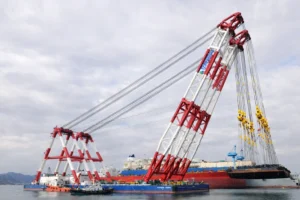
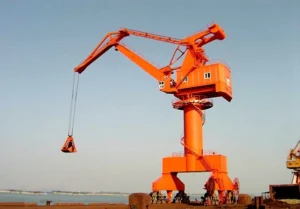
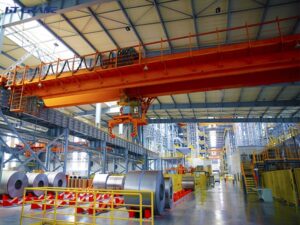
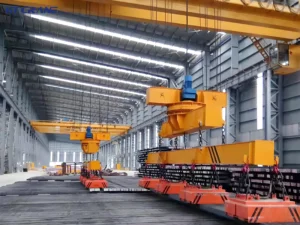
If you’re responsible for port equipment procurement or terminal planning, the term shipping container gantry crane comes up constantly — yet the differences between an STS, RTG, RMG, and MHC are rarely explained in plain language. Make the wrong choice, and you’re looking at years of operational inefficiency or capital locked into the wrong machine.
This guide cuts through the confusion. You’ll get a clear breakdown of what each crane type does, where it performs best, and what technical parameters actually matter when comparing options. Whether you’re evaluating a new terminal build, expanding yard capacity, or replacing aging equipment, this article gives you a practical reference point before you engage suppliers.
By the end, you’ll understand the functional role of each crane category, the key specs that drive performance and cost, and the operational trade-offs that rarely appear in a product brochure.


What Is a Shipping Container Gantry Crane?
A shipping container gantry crane is a large-scale industrial lifting system designed specifically to move ISO shipping containers — typically 20-foot (TEU) or 40-foot (FEU) units — within ports, rail terminals, and intermodal yards. Unlike general-purpose overhead cranes, container gantry cranes are engineered around the standardized dimensions of ISO containers and the demands of high-throughput logistics operations.
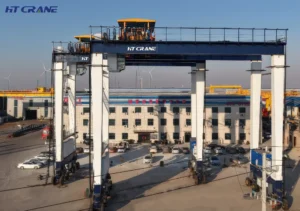
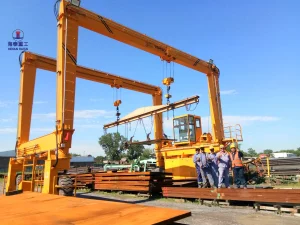
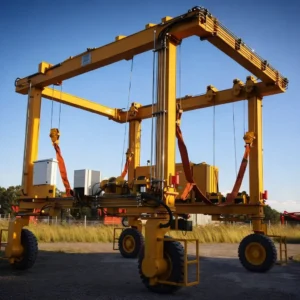
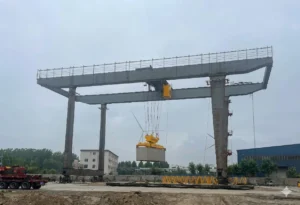
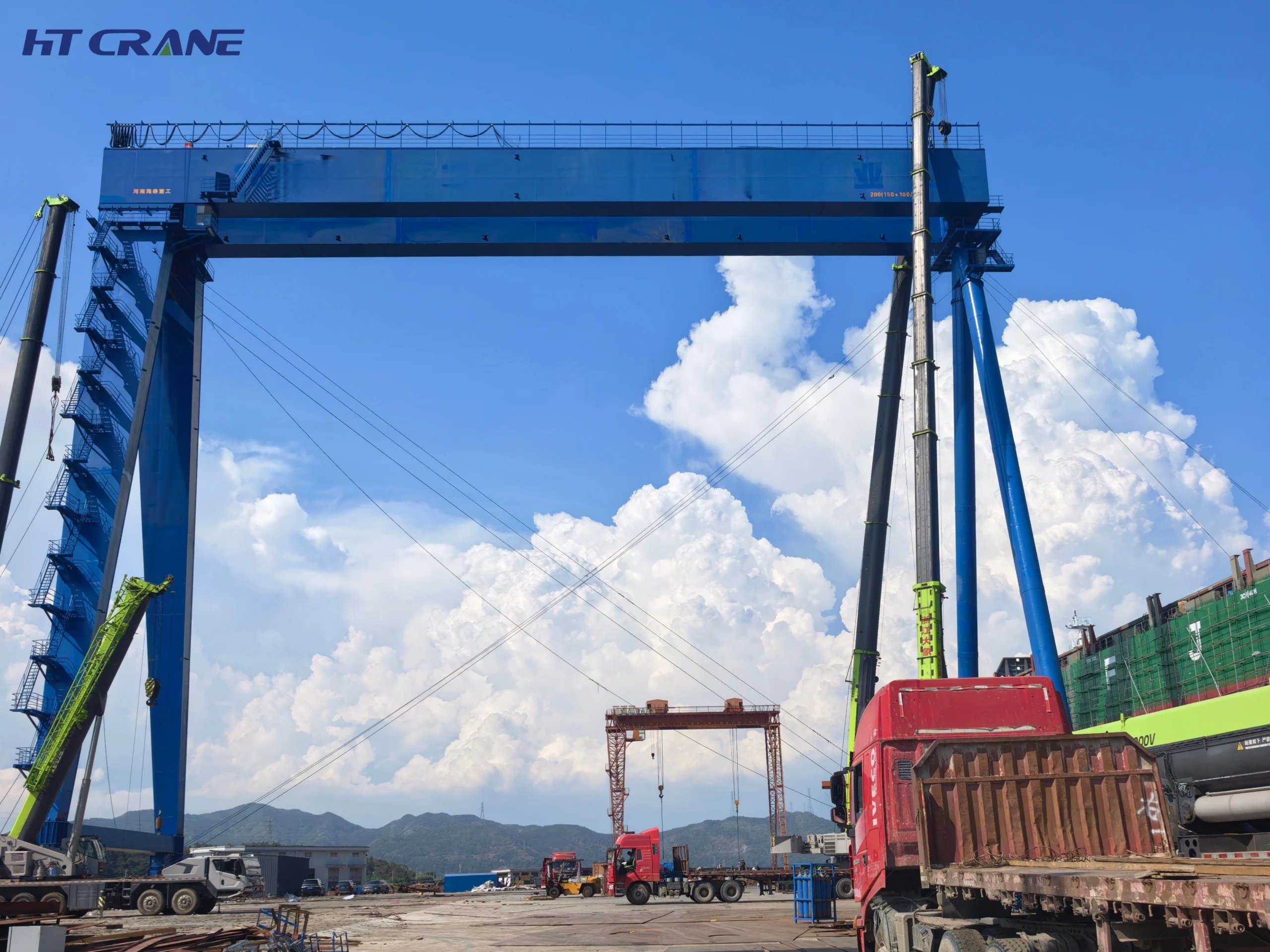
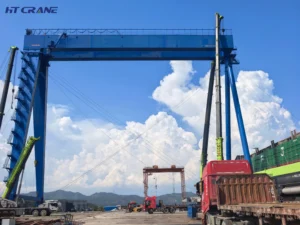
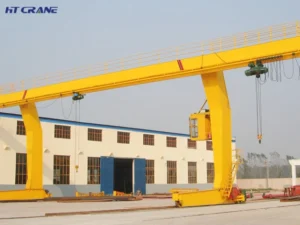
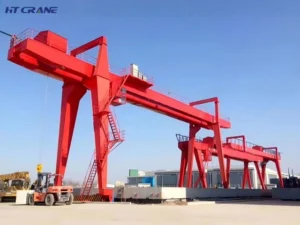
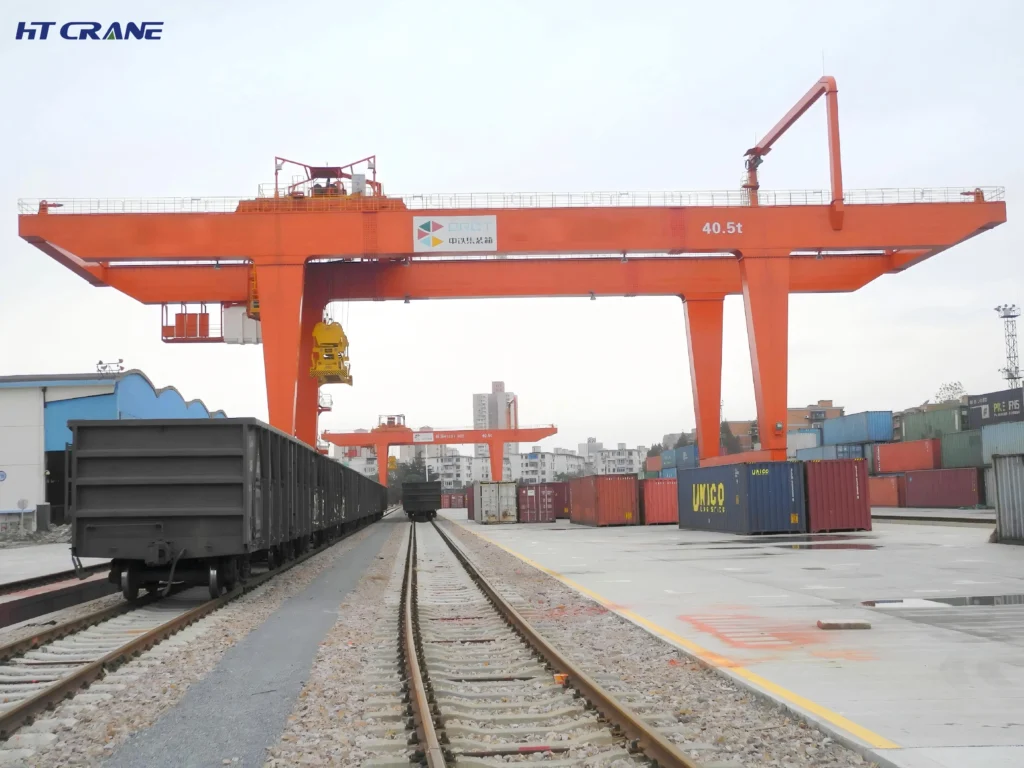
The defining structural feature is the gantry frame: two vertical legs connected by a horizontal bridge (girder), which supports a traveling trolley and spreader. The spreader locks onto the corner castings of a container for precise, secure lifts.
How Container Gantry Cranes Fit Into Terminal Operations
In a typical port terminal workflow, containers arrive by vessel, are transferred to the yard for temporary storage, and eventually move out via truck or rail. Each handoff point — ship-to-shore, yard stacking, and landside transfer — typically involves a different crane type optimized for that stage.
Understanding this workflow is the foundation for selecting the right equipment. A crane optimized for quayside unloading will perform poorly as a yard stacker, and vice versa.
The 4 Main Types of Shipping Container Gantry Cranes
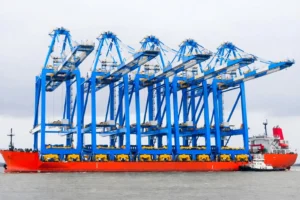
STS (Ship-to-Shore Crane)
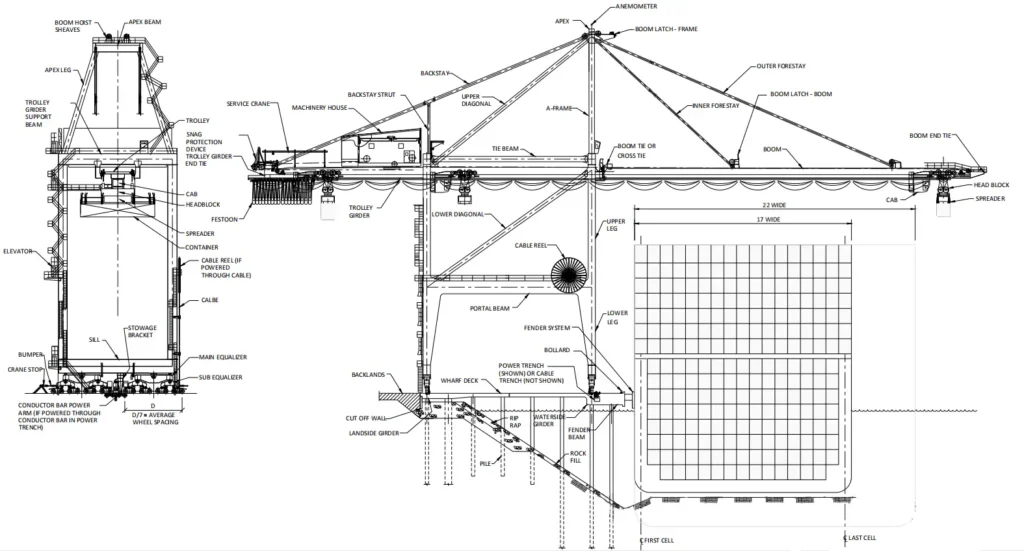
The Ship-to-Shore crane, commonly called an STS crane or quay crane, is the largest category of shipping container gantry crane. It operates at the waterfront, directly loading and unloading vessels docked at the berth.
STS cranes are rail-mounted and travel along the quay to position over different bays of a vessel. The boom extends over the ship’s deck, and the trolley travels horizontally to pick containers from holds or hatch covers. Modern STS cranes handle vessels up to and beyond 24,000 TEU capacity.
Key operational parameters for STS cranes:
| Parameter | Typical Range | Notes |
|---|---|---|
| Outreach (under spreader) | 50 – 75 m | Determined by vessel beam |
| Safe Working Load (SWL) | 40 – 65 t (twin-lift up to 100 t) | ISO 4301 / FEM 1.001 |
| Lift height above rail | 30 – 50 m | Varies by vessel type |
| Hoist speed (no load) | 90 – 120 m/min | Productivity-critical |
| Rail gauge | 15.24 m – 30.48 m | Site-specific |
Data reference: FEM Section I (Crane Design Standards), PEMA (Port Equipment Manufacturers Association) Industry Reports 2022–2024
STS cranes are the productivity backbone of any container terminal. Gross crane rates (moves per hour) of 25–35 are standard; high-performance automated terminals report rates above 40.
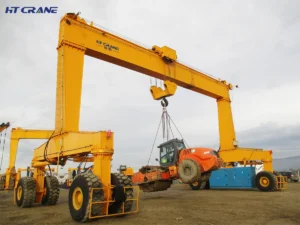
RTG (Rubber-Tyred Gantry Crane)

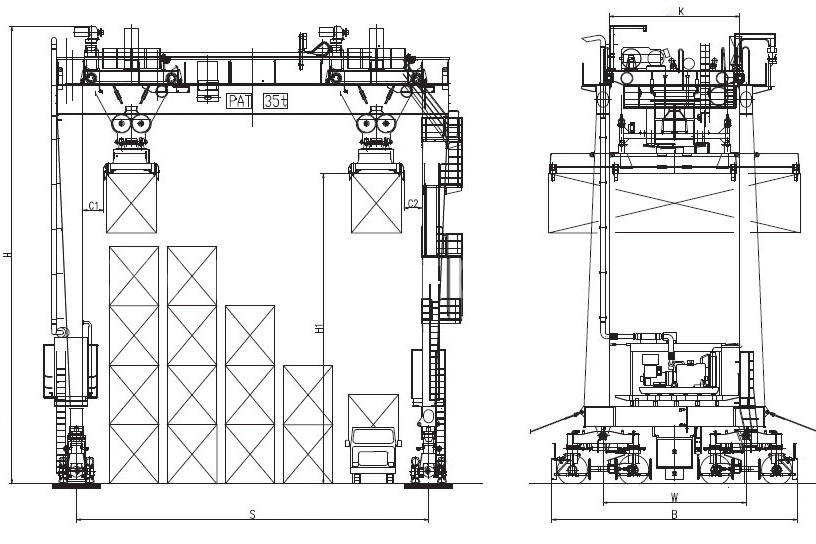
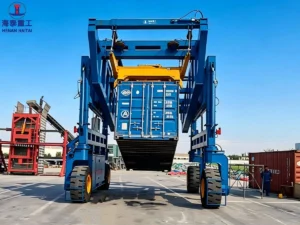
The RTG crane (Rubber-Tyred Gantry) is the dominant container stacking solution in flexible yard environments. As the name suggests, it runs on rubber tyres rather than rails, giving it the ability to travel between yard lanes without fixed infrastructure.
RTG cranes straddle a stack of containers — typically 6 or 7 containers wide plus one truck lane — and can stack containers 4 or 5 high. Their mobility makes them well-suited to terminals that need to reconfigure yard layouts or expand incrementally.
Key operational parameters for RTG cranes:
| Parameter | Typical Range | Notes |
|---|---|---|
| Stacking height | 1-over-4 to 1-over-5 | (1 container in spreader + 4 or 5 in stack) |
| Span (containers + truck lane) | 6+1 or 7+1 | Standard configurations |
| Safe Working Load | 40 – 50 t | ISO 4301 compliant |
| Travel speed | 70 – 130 m/min | Cross-travel of trolley |
| Power source | Diesel-electric, cable reel, or battery hybrid | Environmental regulations driving electrification |
Data reference: ISO 4301-1:2016, HHLA Annual Operations Report 2023, Kalmar RTG Product Specifications 2023
A practical note on RTG electrification: major operators including DP World and PSA International have committed to transitioning diesel RTG fleets to electric or hybrid power in line with IMO and local port emissions targets. Buyers should factor electrification readiness into procurement decisions now.
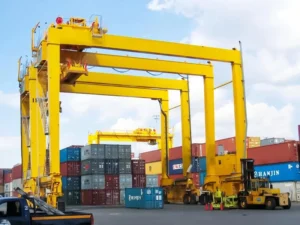
RMG (Rail-Mounted Gantry Crane)

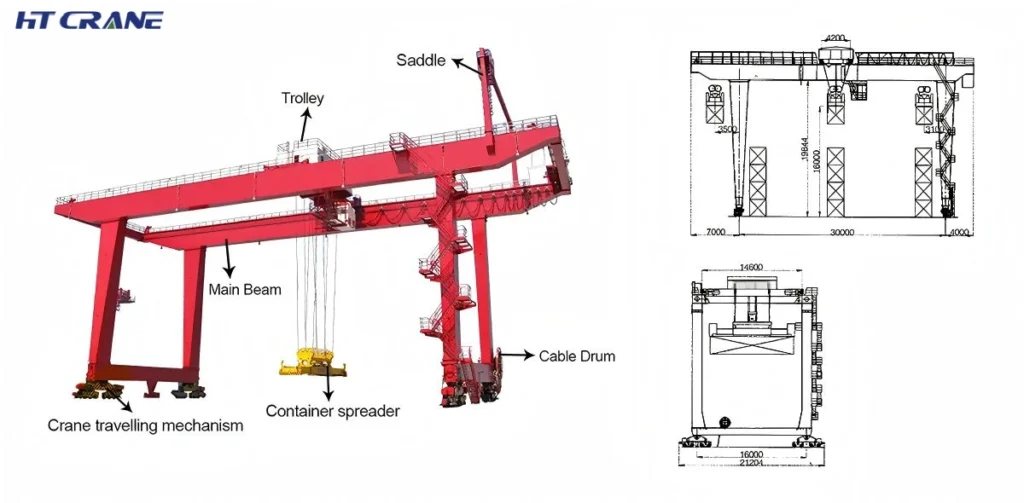
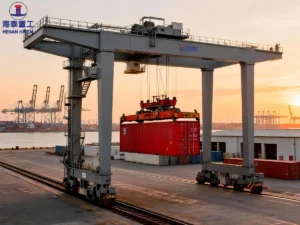
The RMG crane (Rail-Mounted Gantry) operates on fixed rails laid in the yard and offers higher precision and automation potential than RTGs. Because it runs on rails, it requires more upfront civil infrastructure investment — but delivers lower operating costs per move over time, particularly in automated or semi-automated terminals.
RMG cranes are increasingly common in automated container terminals (ACTs), where they operate without human drivers in the cab. Systems such as those at APM Terminals Rotterdam (Maasvlakte II) and Hamburg’s HHLA CTA use RMG-based automation to achieve consistent throughput with reduced labor.
Key operational parameters for RMG cranes:
| Parameter | Typical Range | Notes |
|---|---|---|
| Stacking height | 1-over-4 to 1-over-6 | Higher than RTG in automated yards |
| Span | 8+1 to 12+1 (containers + lanes) | Wider than RTG — higher density |
| Safe Working Load | 40 – 65 t | Twin-lift options available |
| Positioning accuracy (automated) | ±10 mm | Key for auto-stacking |
| Power source | Electric (rail-mounted cable or busbar) | Fully electric — no diesel dependency |
Data reference: FEM 1.001 (4th ed.), Konecranes AutoRMG Specifications 2023, APM Terminals Maasvlakte II Case Data
The trade-off is clear: RMG requires fixed rail infrastructure and significant upfront investment, but in high-volume automated operations, the total cost of ownership over a 20–25-year asset life often favors RMG over RTG.
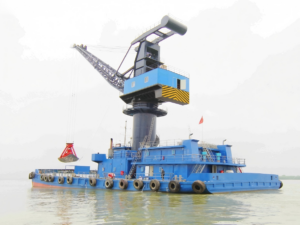
MHC (Mobile Harbour Crane)
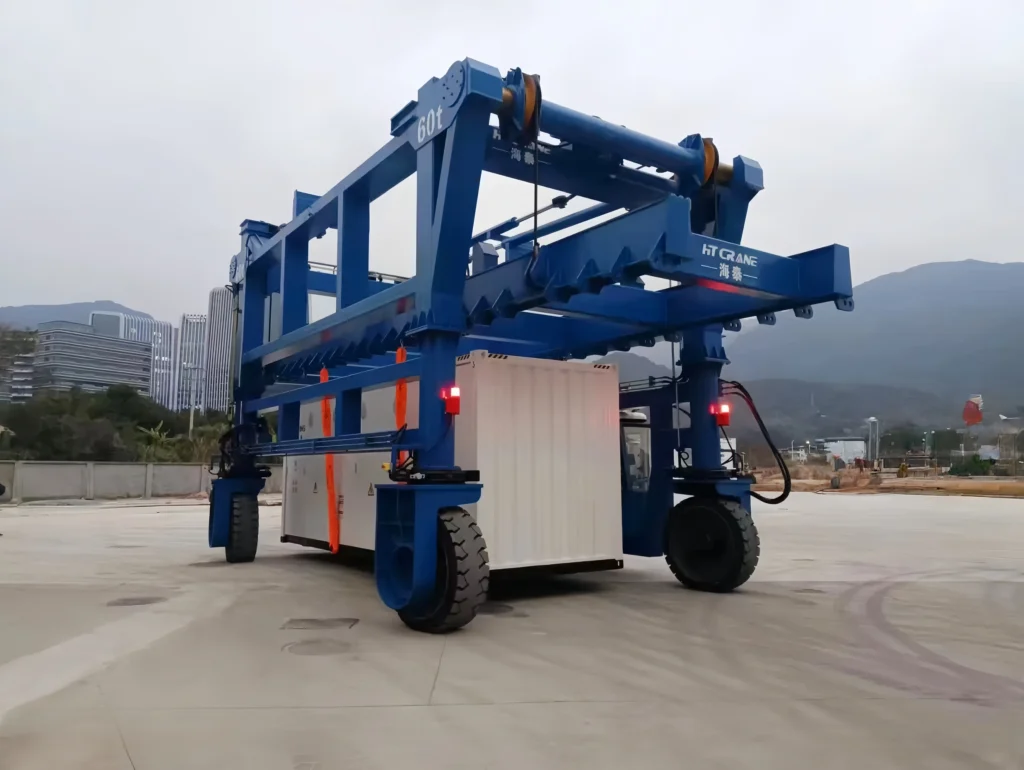
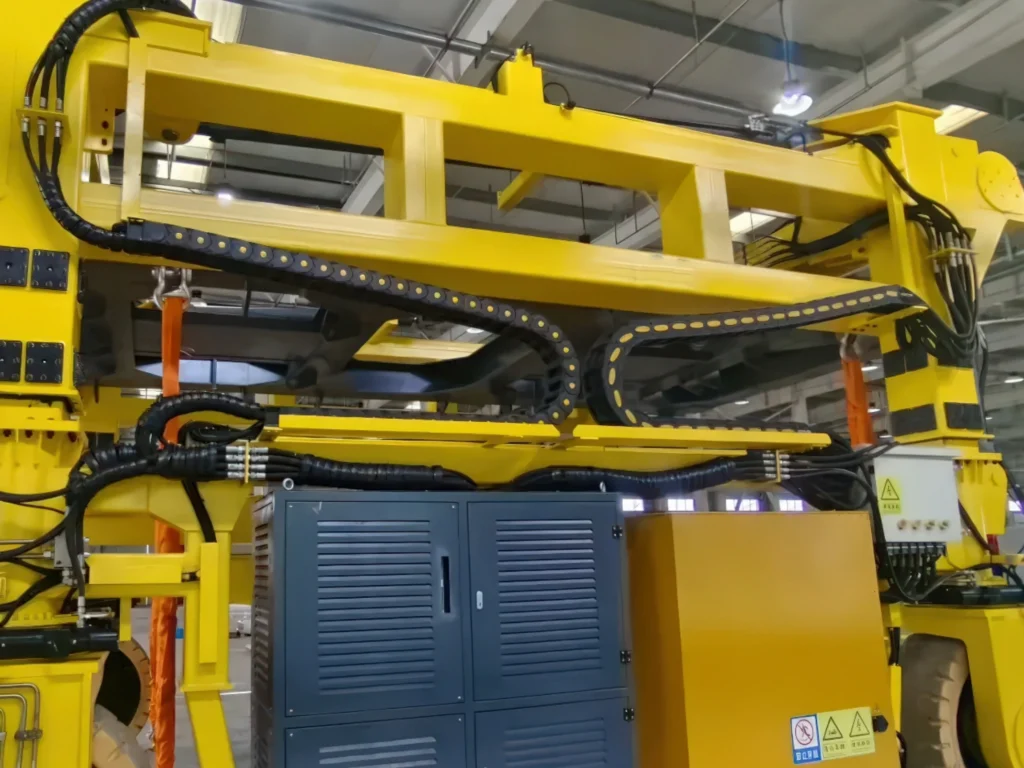
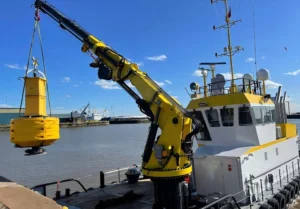
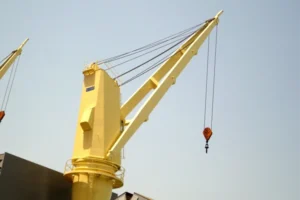
The Mobile Harbour Crane (MHC) is the most versatile unit in the container gantry family — though strictly speaking, it is not a gantry crane in structural form. It is included here because it frequently performs ship-to-shore container handling functions as a direct alternative or supplement to STS cranes, particularly in smaller ports or multi-purpose terminals.
MHCs are free-slewing, rail-free cranes mounted on a wheeled undercarriage. They can handle containers, bulk cargo, break-bulk, and project cargo using interchangeable attachments. For ports handling mixed cargo types or lower container volumes, an MHC offers operational flexibility that a dedicated STS crane cannot match.
Key operational parameters for MHC:
| Parameter | Typical Range | Notes |
|---|---|---|
| Maximum lifting capacity | 100 – 308 t | Liebherr LHM 800 at upper end |
| Outreach | 20 – 54 m | Varies by model |
| Container handling capacity | Up to 65 t with spreader | IMO/ISO compliant |
| Repositioning | Self-propelled on quay | No fixed rail required |
| Typical gross crane rate | 15 – 25 moves/hour | Lower than STS for pure container ops |
Data reference: Liebherr MHC Product Data 2024, Konecranes Gottwald MHC Specifications 2023
MHC deployment is particularly common in emerging market ports, small-to-medium regional terminals, and ro-ro/container mixed-use facilities where capital budget constraints or cargo flexibility requirements rule out dedicated STS cranes.
STS vs RTG vs RMG vs MHC: Side-by-Side Comparison
| Feature | STS | RTG | RMG | MHC |
|---|---|---|---|---|
| Primary function | Ship/vessel unloading | Yard stacking | Yard stacking | Ship unloading / mixed cargo |
| Mobility | Rail (quayside) | Rubber tyre (flexible) | Fixed rail (yard) | Self-propelled (free) |
| Automation potential | High (semi/full auto) | Medium (semi-auto) | High (full auto) | Low |
| Infrastructure requirement | High (quay rail) | Low-medium | High (yard rail + civil) | Low |
| Typical SWL | 40–100 t | 40–50 t | 40–65 t | 100–308 t |
| Best suited for | Large container terminals | Flexible/mid-size yards | Automated high-density yards | Small ports / multi-purpose |
Note: Cost ratings are relative indicators only. Actual pricing varies significantly by specification, supplier, and market conditions.
Key Technical Specs That Actually Drive Procurement Decisions
Beyond the headline numbers, experienced procurement teams look at several parameters that rarely appear in the brochure summary but have a direct impact on operational cost and lifecycle performance.
Spreader Type and Compatibility
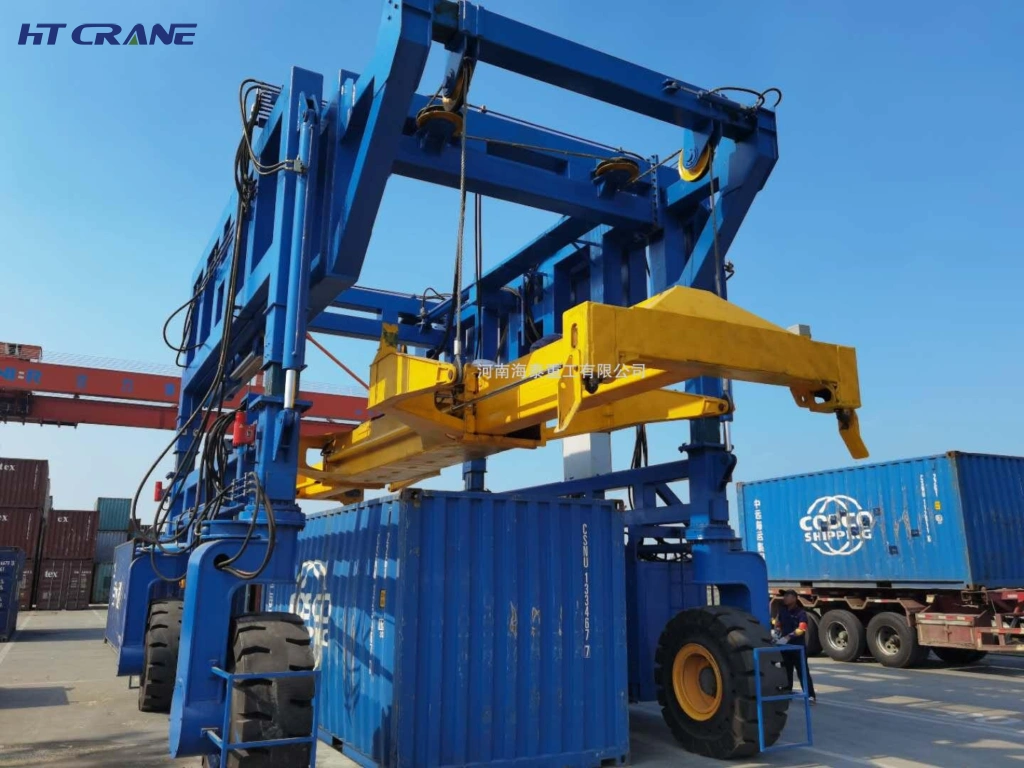
The spreader is the interface between crane and container. Tandem spreaders (handling two 20-foot containers simultaneously) can effectively double throughput on compatible crane models. Verify compatibility with your container fleet mix — particularly if handling 45-foot or high-cube units.
Anti-Sway and Positioning Systems
Container handling precision directly affects cycle time. Modern STS and RMG cranes incorporate active anti-sway control and laser or camera-based positioning systems. For automated RMG operations, positioning accuracy to ±10 mm is a baseline requirement for reliable auto-stacking.
Power and Electrification Readiness
With port decarbonization targets accelerating across the EU, Asia-Pacific, and North America, cranes procured today should be evaluated for their electrification pathway. Diesel RTGs can be retrofitted with cable reel or battery hybrid systems, but the cost and operational disruption is significant. Specifying electric-ready infrastructure from the outset is increasingly standard practice.
Maintenance Access and Spare Parts Lead Time
For port operators, unplanned crane downtime directly translates to vessel delay and demurrage costs. When comparing suppliers, assess service network coverage, mean time between failures (MTBF) data, and spare parts availability for critical components (hoisting wire ropes, spreader twist locks, drive systems). This data should be requested as part of the technical proposal, not assumed.
Selecting the Right Crane Type: A Decision Framework
Choosing the right shipping container gantry crane is not purely a technical decision — it sits at the intersection of throughput targets, capital budget, terminal layout, and long-term operational strategy.
For greenfield deep-sea container terminals: An STS fleet combined with automated RMG yard cranes is the benchmark solution for terminals targeting annual throughputs above 500,000 TEU. This is the configuration deployed at major automated terminals including Maasvlakte II (Rotterdam) and Qingdao Port (China).
For regional or feeder terminals (100,000–500,000 TEU): RTG-based yards with semi-automated operations offer a balance of flexibility and cost. This is the most common configuration globally.
For multi-purpose or capacity-constrained ports: MHC units provide the flexibility to handle containers alongside bulk and break-bulk cargo without committing to dedicated STS infrastructure. Ports in West Africa, Southeast Asia, and Latin America frequently use this model.
For terminal expansions and brownfield sites: The existing infrastructure — quay rail gauge, yard pavement load rating, electrical supply capacity — often constrains the crane choice more than throughput targets do. A detailed site assessment before equipment specification is essential.
Summary and Action Points
A shipping container gantry crane is not a single product — it is a category of four meaningfully different machine types, each optimized for a distinct role in the container logistics chain.
- STS cranes handle ship-to-shore transfer at the quay — highest throughput, highest capital cost.
- RTG cranes offer flexible yard stacking with lower infrastructure requirements — the most widely deployed yard crane type globally.
- RMG cranes deliver high-density, automation-ready yard operations — best for large terminals with long planning horizons.
- MHC cranes provide multi-cargo versatility for smaller or mixed-use terminals.
Before engaging crane suppliers, establish your throughput targets, site constraints, automation ambitions, and electrification requirements. These four parameters will narrow your crane type selection faster than any product comparison spreadsheet.
FAQ
Q1: What is the difference between an STS crane and a gantry crane?
An STS (Ship-to-Shore) crane is a specific type of shipping container gantry crane designed for quayside operation — loading and unloading vessels at berth. All STS cranes are gantry cranes by structure (two legs, horizontal bridge, traveling trolley), but not all container gantry cranes are STS cranes. RTG and RMG cranes are also gantry-type, operating in the yard rather than at the waterfront. The term “gantry crane” describes the structural form; “STS,” “RTG,” and “RMG” describe the application and mobility configuration.
Q2: How do I choose between an RTG and an RMG for my container yard?
The core trade-off is flexibility versus density and automation potential. RTGs run on rubber tyres and can be repositioned between yard lanes, making them better suited to terminals where yard layout may change or where expansion is incremental. RMGs run on fixed rails and require more upfront civil investment, but they support higher stacking density, better positioning accuracy, and full automation. For terminals planning long-term automation or handling above 300,000–400,000 TEU annually, RMG typically delivers better total cost of ownership over a 20-year horizon. For smaller or more flexible operations, RTG is usually the practical choice.
Q3: What is a typical lifespan for a shipping container gantry crane, and how does maintenance affect it?
Container gantry cranes are typically designed for a 25-year service life under normal operating conditions, in line with FEM 1.001 and ISO design standards. Actual service life depends heavily on maintenance discipline — particularly on high-wear components such as wire ropes (typical replacement interval: 2–4 years depending on cycle count), spreader twist locks, and wheel flanges on rail-mounted units. Operators that implement condition-based monitoring and adhere to OEM-recommended PM schedules consistently achieve crane availability rates above 95%, while neglected fleets can see availability drop below 85%, with significant impact on terminal throughput.
Q4: Can a Mobile Harbour Crane (MHC) replace an STS crane for container operations?
In pure throughput terms, no — a dedicated STS crane will outperform an MHC for container handling at busy deep-sea terminals. STS gross crane rates of 25–35 moves per hour exceed what MHC can achieve on containers. However, for ports handling below roughly 100,000–150,000 TEU annually, or for multi-purpose terminals where the same crane needs to handle containers, bulk, and project cargo, an MHC is often the economically rational choice. Several mid-size ports in Europe and Southeast Asia operate MHC fleets successfully for container handling where dedicated STS investment cannot be justified on volume alone.
Q5: What certifications and standards should I verify when procuring a container gantry crane?
For international procurement, the key standards to verify include: ISO 4301 (crane classification and design criteria), FEM 1.001 (European Federation of Materials Handling — structural and mechanical design), CE marking (required for equipment sold into EU markets, covering machinery directive compliance), and IEC 60034 / IEC 61800 for electrical drive systems. For automated cranes, additionally verify compliance with ISO 13849 (safety of control systems) and any local port authority or national standards applicable to your jurisdiction. Always request third-party certification documentation — not just supplier declarations — as part of the technical bid requirements.