Rubber Tyred Gantry Cranes dominate intermodal yards and container terminals worldwide because they balance mobility, capacity, and cost in a way few other systems can match.But here’s where many buyers get stuck: the sales brochures all look similar. The specs blur together. And the wrong choice can lock your operation into years of underperformance.
This guide cuts through that noise. We explain how Rubber Tyred Gantry Cranes actually work, what separates a good unit from a great one, and what questions you must ask before signing any purchase order.
What Is a Rubber Tyred Gantry Crane?
The Basic Concept
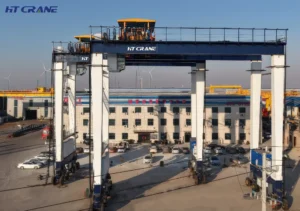
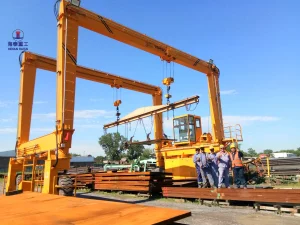
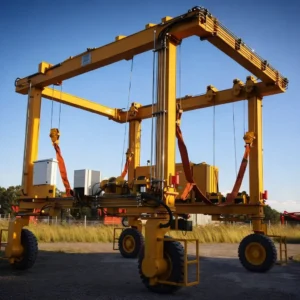
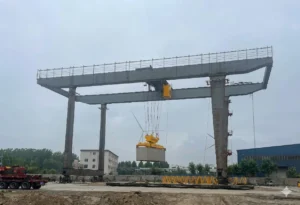
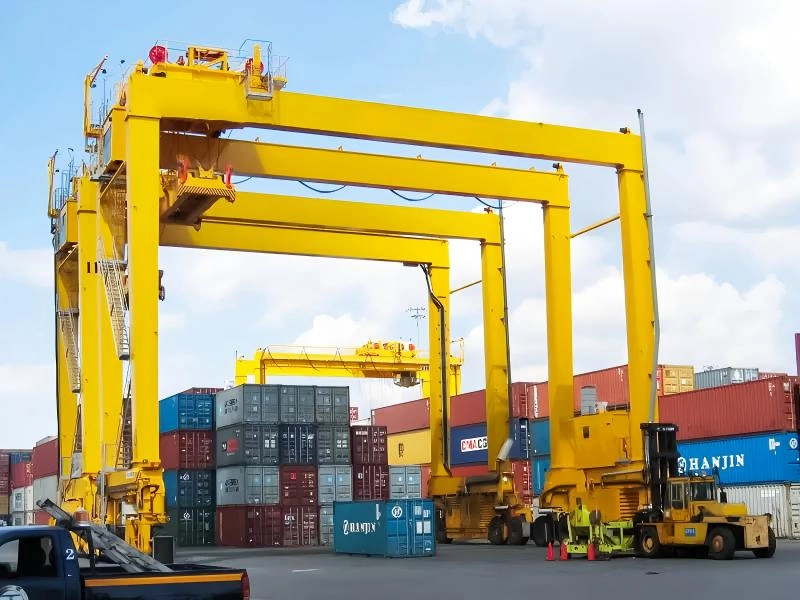
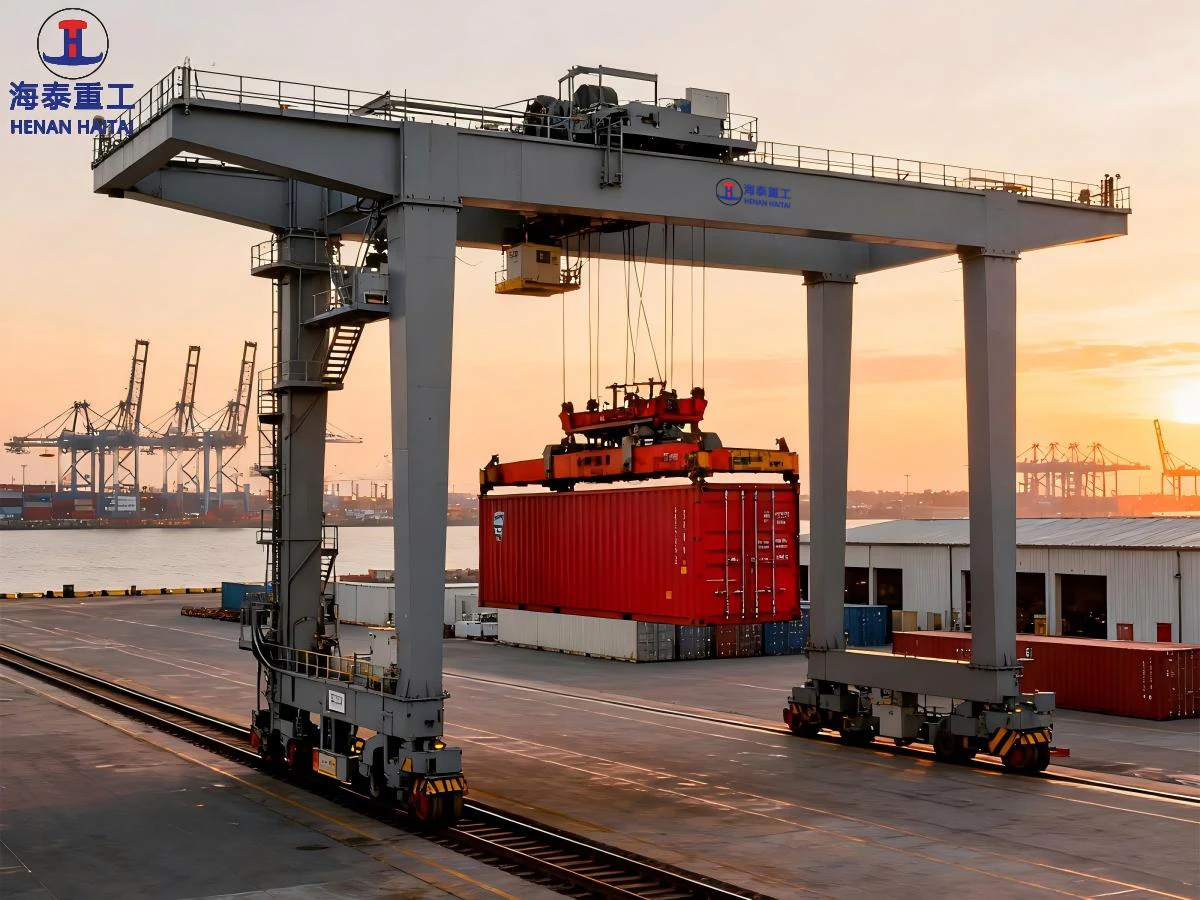
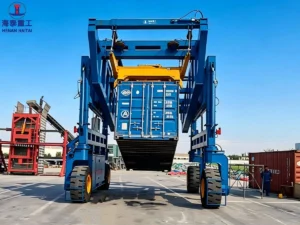
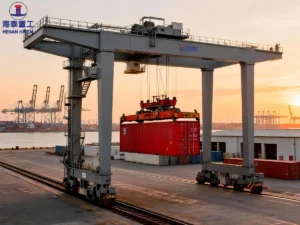
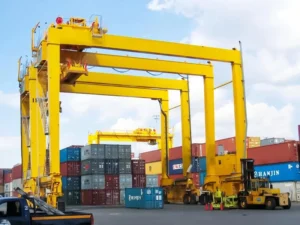
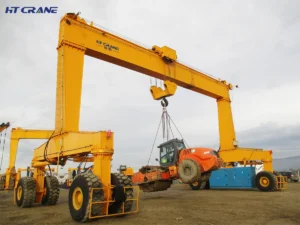
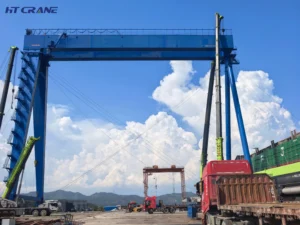
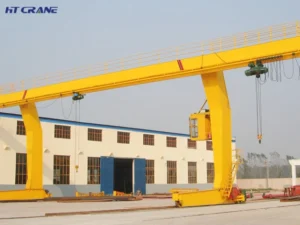
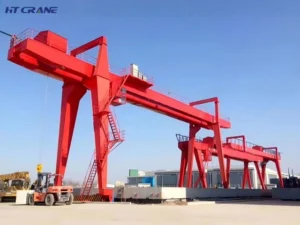
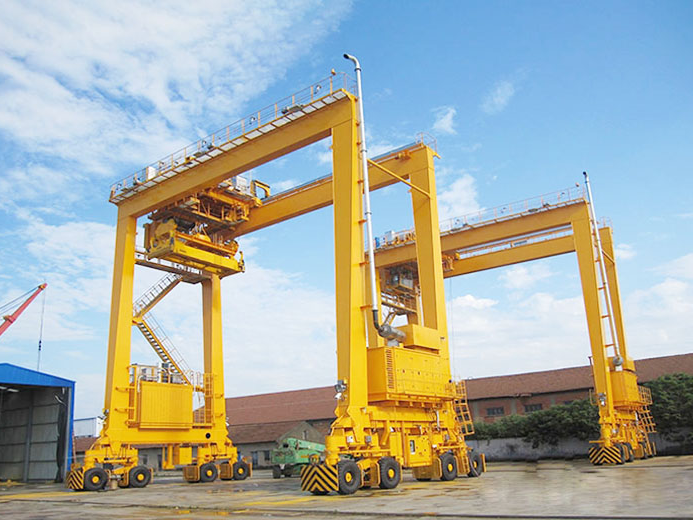
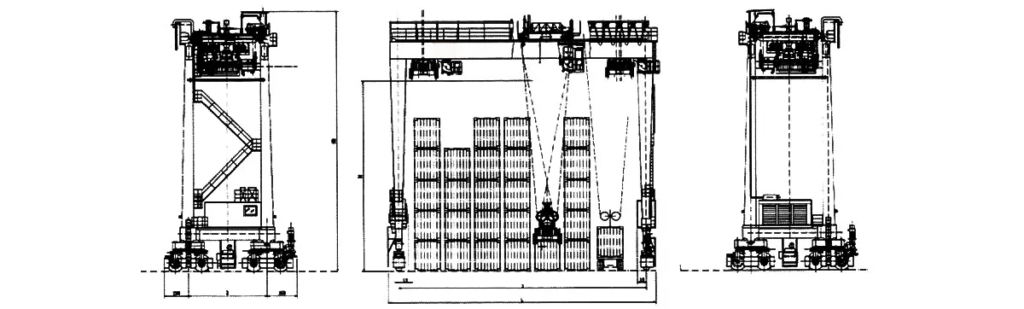
A Rubber Tyred Gantry Crane (RTG) is a mobile gantry crane that straddles rows of shipping containers in a yard or terminal. Unlike rail-mounted gantry cranes (RMG), RTGs travel on rubber tires. This gives them the flexibility to move freely across a paved surface without fixed infrastructure.
The crane lifts containers using a spreader bar attached to a hoist trolley. The trolley travels horizontally along the gantry beam. The entire structure moves down container rows on its rubber wheels. This combination of vertical lift, horizontal travel, and longitudinal movement allows one RTG to service multiple container rows.
Most RTGs are designed to straddle 6 or 7 container rows, with a stacking height of 4 to 6 containers high. These numbers directly affect how much storage density your yard can achieve.
Key Mechanical Components
Understanding what’s inside the machine helps you evaluate what you’re buying:
| Component | Function | What to Look For |
|---|---|---|
| Hoist System | Lifts and lowers containers | Load capacity (SWL), hoist speed |
| Spreader | Grips ISO containers | Telescopic range, auto-twist locks |
| Trolley | Moves container side to side | Travel speed, positioning accuracy |
| Gantry Structure | Main frame, spans container rows | Steel grade, fatigue rating |
| Rubber Tyres | Supports weight, enables movement | Load rating, turning radius |
| Power System | Drives all functions | Diesel, hybrid, or electric |
Each of these components has its own spec sheet. When comparing vendors, compare component-level specs — not just headline lifting capacity.

How the Power System Works — And Why It Matters Most
Diesel vs. Hybrid vs. Electric RTGs
The power system is the most consequential decision in RTG procurement. It affects your operating cost, emissions compliance, and long-term maintenance budget.
Diesel RTGs are the traditional option. They carry their own generator and fuel tank. Setup is simple — no external infrastructure needed. They work well in locations where grid power is unavailable or unreliable. The trade-off is fuel consumption. A diesel RTG can consume 15–25 liters of diesel per hour under load, depending on duty cycle.
Diesel-electric hybrid RTGs recover energy from lowering loads and braking. That energy is stored in capacitors or batteries and reused during the next lift cycle. Many operators report fuel savings of 30–40% compared to conventional diesel units. This is now the most common configuration for new purchases.
Electric RTGs (eRTGs) draw power from the grid via a cable reel or overhead conductor rail. They produce zero direct emissions during operation. Operating costs are significantly lower than diesel. The upfront investment includes grid connection infrastructure, which adds to total project cost.
The right choice depends on your existing infrastructure, local energy costs, emissions regulations, and planned operational hours.
Automation Levels: Manual to Semi-Auto
RTGs now come in three broad automation tiers:
- Manual – Operator in cabin controls all movements
- Semi-automated – Automated horizontal travel, manual landing
- Fully automated – Remote monitoring only, no cabin operator needed
Automation increases throughput consistency and reduces long-term labor cost. It also increases upfront cost and demands more rigorous IT integration planning.
Technical Specifications That Drive Buying Decisions
Lifting Capacity and Span
RTG cranes are rated by Safe Working Load (SWL). Most standard units are rated at 40–50 tonnes SWL, covering standard and overweight ISO containers. Verify the SWL applies at full outreach — some specs quote capacity at a favourable load radius only.
Span is described as “X over Y” — for example, 6+1 means the crane straddles 6 container rows with one truck lane. Wider spans mean fewer crane movements to cover a given yard area, improving efficiency.
Stacking Height
Common configurations are:
- 1-over-4 – Picks one container, stacks up to 4 high
- 1-over-5 – Higher density, used in space-constrained terminals
- 1-over-6 – Less common, requires specific structural design
Higher stacking reduces yard footprint but increases structural load on the gantry and foundation requirements.
Travel and Lift Speeds
| Movement | Typical Range | High-Performance Range |
|---|---|---|
| Hoist speed (laden) | 18–24 m/min | Up to 30 m/min |
| Trolley speed | 45–70 m/min | Up to 90 m/min |
| Gantry travel speed | 90–130 m/min | Up to 150 m/min |
| Lowering speed (unladen) | 30–45 m/min | Up to 60 m/min |
Higher speeds directly improve moves per hour (MPH). Target your MPH requirements first, then work backward to the specs that support that throughput.
What to Verify Before You Buy
Compliance and Certification
All RTGs sold into regulated markets must meet applicable standards. Key references include:
- ISO 4301 – Classification of cranes
- EN 13001 – Crane safety design principles (EU)
- FEM 1.001 – European crane design rules
- CE Marking – Required for European markets
Ask vendors for third-party test reports, not just self-certifications. For large orders, independent factory inspection during manufacturing is worth the investment.
After-Sales Support and Spare Parts
The crane you buy is a 15–20 year asset. The vendor’s support capability matters as much as the machine’s specs.
Key questions to ask:
- Where is the nearest service center?
- What is the guaranteed spare parts availability period?
- What is the typical lead time for critical components (hoist gearbox, spreader)?
- Is remote diagnostics included or optional?
Vendors with local service infrastructure and bonded spare parts warehouses reduce your risk of extended downtime.
Total Cost of Ownership
Never evaluate RTGs on purchase price alone. Build a 10-year TCO model that includes:
- Fuel or electricity cost (based on your planned duty cycle)
- Scheduled maintenance labor and parts
- Unscheduled repair history (request from reference customers)
- Tire replacement (a major cost item — quality tires last 3,000–5,000 operating hours)
- Operator training and certification
Buyers who focus on TCO rather than unit price consistently make better long-term decisions.
Summary
Rubber Tyred Gantry Cranes are proven, flexible equipment for container yard operations. The key variables — power system, automation level, span, and stacking height — must be matched to your specific throughput targets and site conditions.
Start with your operational requirements. Define your moves per hour target, yard layout, and infrastructure constraints. Then evaluate vendors against those parameters, not the other way around.
Request reference site visits. Talk to operators, not just procurement managers. And build your TCO model before you finalize any shortlist.
The right RTG is not the cheapest RTG. It is the one that delivers the lowest cost per container move over its working life.

FAQ
Q1: What is the typical lifespan of a Rubber Tyred Gantry Crane?
A well-maintained RTG crane has a design life of 20–25 years under standard duty cycles. Actual service life depends on maintenance quality, operating hours, and load intensity. Major structural components like the gantry frame are typically designed to ISO or FEM fatigue class standards. Operators who follow OEM maintenance schedules and conduct regular non-destructive testing (NDT) on welds regularly achieve the full design life. Refurbishment programs — including hoist system replacement and cabin upgrades — can extend operational life further at lower cost than new equipment.
Q2: How many containers per hour can an RTG crane handle?
A standard manually-operated RTG typically achieves 20–25 moves per hour under normal operating conditions. Semi-automated RTGs can reach 25–30 moves per hour with consistent positioning accuracy. Fully automated RTGs in optimized terminal environments have demonstrated 30+ moves per hour in sustained operation. Actual throughput depends on container dwell patterns, yard layout, and truck arrival rates. Your target moves per hour should drive equipment selection — vendors can provide simulation models based on your operational data.
Q3: Can RTG cranes handle 45-foot containers and non-ISO cargo?
Most modern RTGs are fitted with telescopic spreaders that handle 20-foot, 40-foot, and 45-foot ISO containers. Handling non-ISO or out-of-gauge cargo requires a beam spreader or lifting frame, which is typically an optional attachment. Confirm spreader compatibility with your cargo mix during the specification stage. Some ports handling a high proportion of 45-foot units specify this as a standard requirement rather than an option.
Q4: What ground bearing pressure do RTG cranes require?
RTG cranes exert significant point loads on the yard surface through their wheel assemblies. Typical ground bearing pressure requirements range from 15 to 25 tonnes per axle depending on crane configuration and load. Your civil engineering team should assess existing pavement structure before procurement. Many terminal operators discover that upgrading to a heavier RTG specification requires pavement reinforcement — a cost that must be factored into the project budget early.
Q5: What is the difference between an RTG and an RMG crane?
A Rail-Mounted Gantry (RMG) crane runs on fixed rails embedded in the yard, while an RTG operates on rubber tires across open pavement. RMGs offer higher precision, lower energy consumption per move, and longer spans — but require significant civil infrastructure investment and cannot be relocated. RTGs offer deployment flexibility, lower initial infrastructure cost, and easier expansion. Most greenfield terminals choose RTGs for operational flexibility. High-density automated terminals often prefer RMGs for their precision and efficiency at scale.