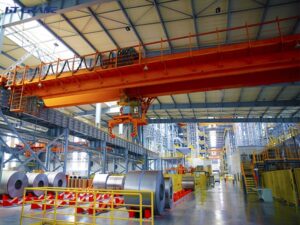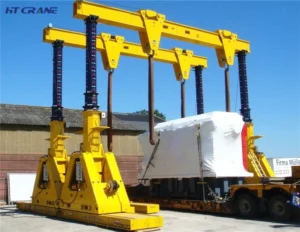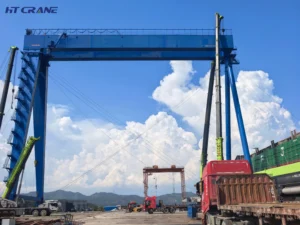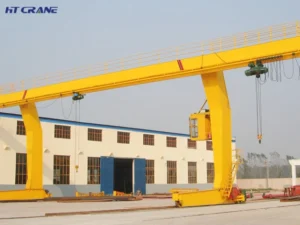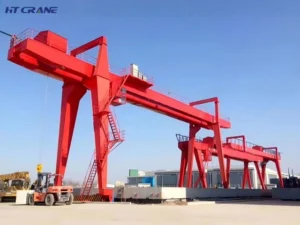


Steel mill cranes always operate in the most demanding environments in any industrial sector. The loads are heavy, the duty cycles are relentless, and the consequences of crane downtime reach directly into production output. A crane that fails during a pour, a tap, or a charging sequence does not just incur repair cost — it disrupts the entire production line downstream.
Getting the right steel mill crane into the right position in a steel facility is not a single decision. Different areas of the mill handle different materials in different ways. The raw material storage yard has different requirements from the casting bay. The scrap charging area is nothing like the finished product warehouse. Each zone demands a crane type matched to the specific task, duty class, and operating environment.
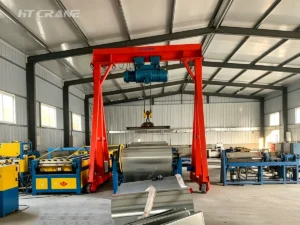
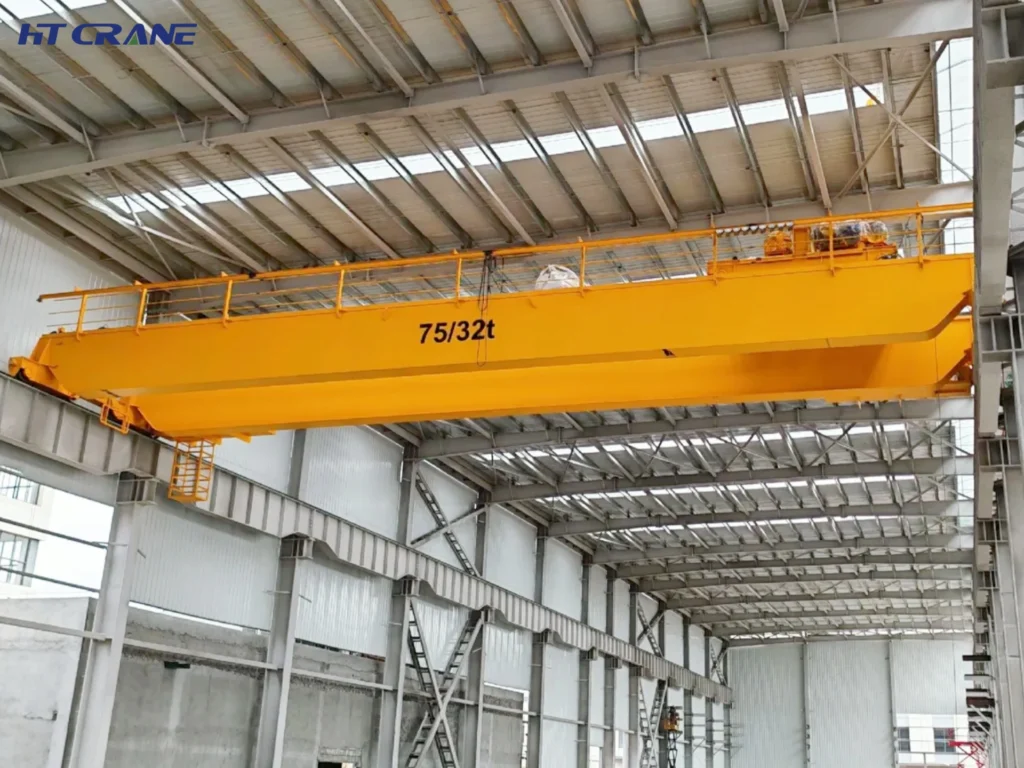
The QD double girder overhead steel mill crane is the workhorse of the indoor steel facility. It is a standard double girder overhead crane designed for general heavy lifting — maintenance tasks, equipment replacement, coil and slab handling in storage bays, and general-purpose material movement wherever a dedicated specialist crane is not required. Most steel mills have multiple QD cranes distributed across maintenance bays, warehouse areas, and secondary processing zones.
The QD handles loads where the primary requirement is reliable, repeatable heavy lifting without the specialized features that grab, magnet, or twin-hook operations require. It is the lowest-complexity crane in the mill’s fleet — straightforward to operate, straightforward to maintain, and straightforward to specify.
| Parameter | Specification Range |
|---|---|
| Lifting Capacity | 5T – 500T |
| Span | 10.5m – 35.5m |
| Lifting Height | 6m – 30m |
| Work Duty Class | A3 – A6 (ISO 4301 / GB/T 3811) |
| Hoisting Speed | 2 – 12 m/min |
| Drive System | AC VFD (standard) |
| Hoist Type | Wire rope crab trolley |
| Design Standard | GB/T 14405, EN 13001 |
| Certification | CE, ISO 9001 |
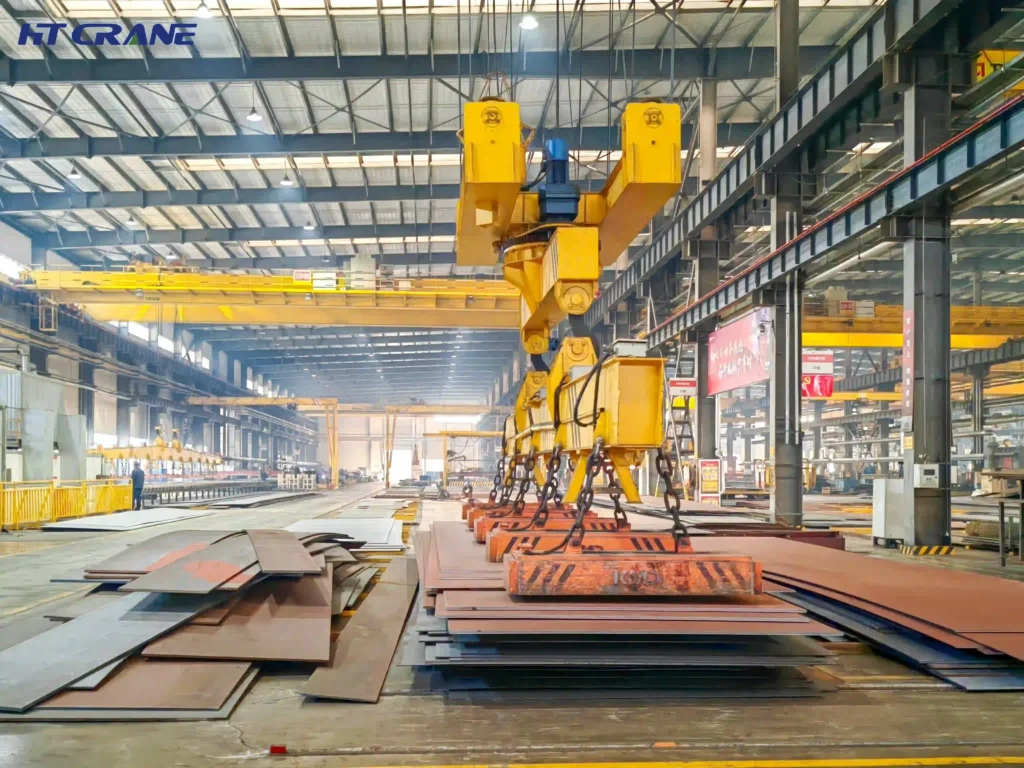
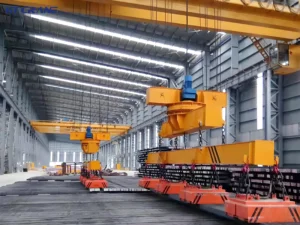
The QC electromagnetic steel mill crane serves every area of the steel facility that handles ferromagnetic material without slings. Scrap charging yards, billet and bloom storage, plate handling in rolling mill runout areas, and mixed steel inventory in service center bays all require a crane that picks up and releases steel loads without manual rigging contact.
The electromagnet is integrated into the crane from the ground up — it is not a portable lifting magnet retrofitted to a hook crane. The onboard DC rectifier, battery backup system, and purpose-rated trolley are co-engineered as one machine. This distinction is important: a retrofit arrangement cannot match the duty cycle rating or operational reliability of a purpose-built QC crane in demanding steel mill service.
| Parameter | Specification Range |
|---|---|
| Lifting Capacity | 5T – 100T |
| Span | 10.5m – 35.5m |
| Lifting Height | 6m – 20m |
| Work Duty Class | A5 – A7 |
| Magnet Diameter | 500mm – 2,000mm |
| Coil Duty Rating | ED 40% – ED 75% |
| Coil Insulation Class | Class F (standard); Class H (hot material) |
| Material Temp Rating | Up to 100°C (standard); up to 700°C (metallurgical spec) |
| Battery Backup | 30 minutes minimum — standard |
| Rectifier Type | Thyristor, closed-loop current control |
| Design Standard | GB/T 14406, EN 13001 |
| Certification | CE, ISO 9001 |
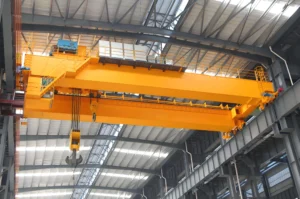
The QE dual-trolley double girder steel mill crane carries two independent trolleys on a single bridge. Each trolley has its own hoist, its own travel drive, and its own hook. The two trolleys can operate independently for separate lifts, or they can be synchronized to lift a single long load from two pickup points simultaneously.
This configuration is essential wherever the steel mill handles long structural sections, large fabrications, or heavy assemblies that cannot be balanced from a single central pickup point. Rolling mill guide frames, large rolls and shafts, long slab transfers, and structural maintenance in the mill building itself are common QE applications. The twin-hook tandem lift allows the operator to tilt the load by raising one trolley while holding the other — a capability that significantly reduces rigging complexity for awkward sections.
| Parameter | Specification Range |
|---|---|
| Capacity — Each Trolley | 10T – 200T per trolley |
| Combined Tandem Capacity | Up to 400T (synchronized mode) |
| Span | 15m – 40m |
| Lifting Height | 6m – 30m |
| Trolley Spacing (adjustable) | 3m – 12m (load-dependent) |
| Synchronization | PLC load-sharing control — ±2% tolerance |
| Work Duty Class | A5 – A7 |
| Drive System | AC VFD — all motions |
| Design Standard | GB/T 14405, EN 13001, FEM 1.001 |
| Certification | CE, ISO 9001 |
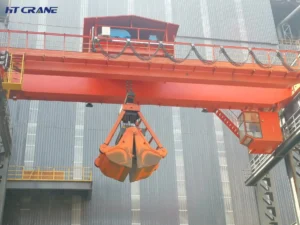
The QZ crane is designed for bulk material handling — it carries a grab bucket rather than a hook, and the four-rope hoist system operates both the crane travel and the grab open-and-close functions through a coordinated drive system. In steel mill applications, the QZ handles scrap in charging yards, coal and ore in raw material storage bunkers, and slag in processing areas.
The key operational difference from a hook crane is duty class. Grab crane operations are inherently high-cycle — the crane picks, carries, and releases multiple times per hour throughout every shift. This demands A6 or A7 work duty class as a minimum. A hook crane spec applied to a grab crane application will reach its structural fatigue limit years ahead of schedule
| Parameter | Specification Range |
|---|---|
| Lifting Capacity | 5T – 50T (grab + load) |
| Span | 10.5m – 35.5m |
| Lifting Height | 6m – 25m |
| Work Duty Class | A6 – A7 (minimum — grab duty) |
| Grab Type | Clamshell (loose bulk); orange-peel (scrap, irregular material) |
| Grab Drive | Four-rope hoist system (holding + closing ropes) |
| Rope Type | ISO 2408 compliant, rotation-resistant |
| Cabin | Operator cabin standard — floor window option |
| Drive System | AC VFD — all motions including grab open/close |
| Design Standard | GB/T 14405, EN 13001 |
| Certification | CE, ISO 9001 |
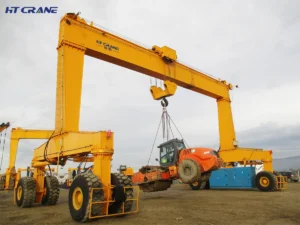
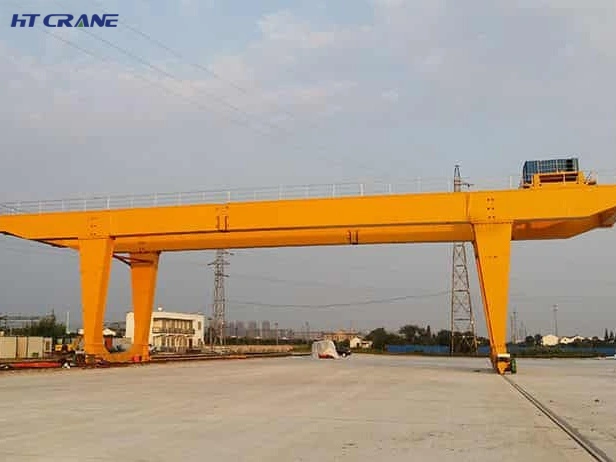
The U-type gantry crane operates in the outdoor storage and logistics areas of the steel facility — raw material stockyards, finished product dispatch areas, and transfer yards between processing zones. It travels on ground-level rails across a wide outdoor bay, covering areas where indoor crane coverage is not available and mobile equipment cannot match the throughput or lift capacity required.
The U-type designation refers to the structural profile: two vertical legs connected by a horizontal crossbeam at height, with a box-section girder spanning between them. The legs and crossbeam form a U shape when viewed from the end. This structure provides a clear working span below the girder without any obstruction — essential for handling long products like coils, slabs, or pipe bundles that must pass under the crane structure during loading and unloading.
| Parameter | Specification Range |
|---|---|
| Lifting Capacity | 10T – 500T |
| Span | 18m – 60m |
| Lifting Height | 6m – 18m |
| Work Duty Class | A4 – A6 |
| Leg Type | Fixed height or adjustable |
| Travel System | Rail-mounted, double-flange wheel |
| Rail Type | QU70 – QU120 |
| Hoist Type | Wire rope crab trolley or electric hoist |
| Drive System | AC VFD — travel and hoist |
| Cantilever Option | Single or double cantilever available |
| Corrosion Protection | Minimum 280 microns DFT for outdoor use |
| Design Standard | GB/T 14406, EN 13001 |
| Certification | CE, ISO 9001 |
The five crane types above are not interchangeable. The correct selection for each area of the facility follows from the material type, duty cycle, and operating environment:
| Mill Zone | Recommended Crane Type | Key Reason |
|---|---|---|
| Scrap charging bay | QC electromagnetic or QZ grab | No manual rigging; high-cycle duty |
| Billet / bloom storage (indoor) | QC electromagnetic | Fast cycle; no sling labor |
| Raw material bunker (coal/ore) | QZ grab | Bulk pickup and release cycle |
| Rolling mill — long section handling | QE twin-trolley | Balanced tandem lift for long loads |
| Maintenance bay | QD general purpose | Standard hook lift; lower duty |
| Finished product warehouse | QD or QC (plate/coil) | Load type determines magnet or hook |
| Outdoor stockyard / dispatch | U-type gantry | Wide span; outdoor rail operation |
| Slag processing area | QZ grab | Heavy scrap; A6/A7 duty required |
Use this table as a starting point, not a final answer. The actual selection for each zone must be confirmed against the specific duty cycle, span, hook height, and environmental conditions at your facility. Providing these parameters to your crane supplier allows them to produce a configuration that fits your operation — not a generic catalogue product.
Steel mill crane procurement is not a single transaction. It is a fleet specification exercise covering multiple crane types, multiple mill zones, and a range of duty classes and technical requirements that vary significantly from one area of the facility to the next. Getting the right crane into the right zone with the right duty class is the difference between a fleet that runs reliably for 20 years and one that requires major repairs within the first five.
Contact HT Crane today to discuss your project and receive a tailored quotation.










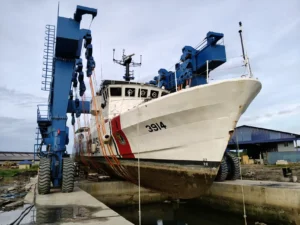
If you manage a marina, boatyard, or naval facility, you already know the pain: vessels stuck in the water waiting for maintenance, slipways that damage hulls, and cranes that simply weren’t built for boats. A marine travel lift solves all three problems in a single machine. It lifts, moves, and launches vessels safely — without fixed rails, without hull damage, and without slowing down your yard. This page covers everything you need to evaluate a marine travel lift: what it does, where it works, what makes ours different, and the full technical specs. If you are ready to specify a unit, our engineering team responds to enquiries within 24 hours. Product Description A marine travel lift — also called a boat travel lift, mobile boat hoist, or self-propelled boat hoist — is a rubber-tyred gantry crane designed specifically for vessel handling. The portal frame straddles the boat in the water. Polyester slings are positioned under the hull. The vessel is then lifted clear and driven anywhere on land. No rail tracks. No fixed infrastructure. Just one machine that handles haul-out,…
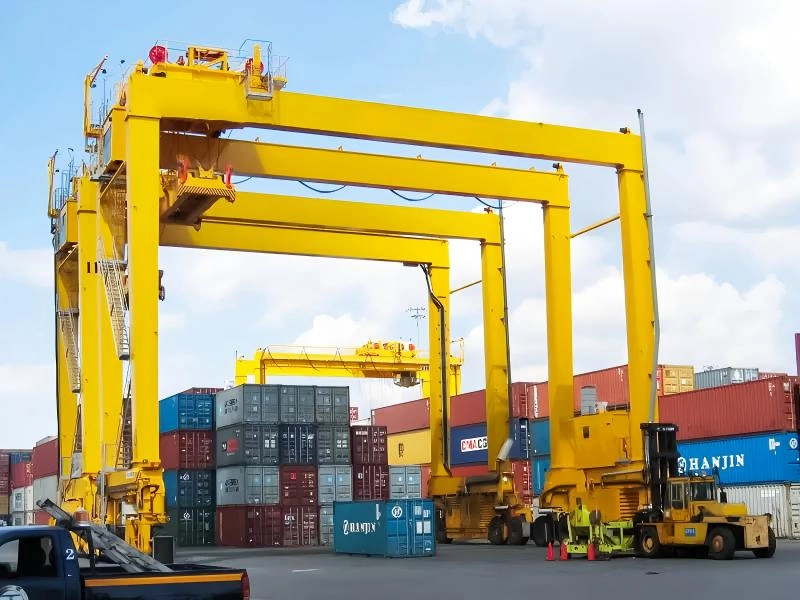
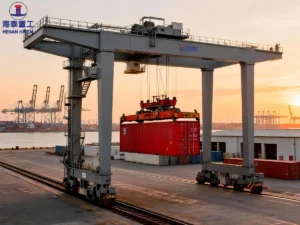
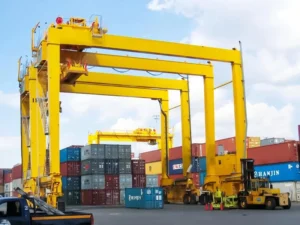
Choosing the right RTG crane supplier impacts your entire port or yard operation. A wrong choice means delays, downtime, and costly repairs. We help you avoid that. As a certified RTG crane manufacturer and exporter, we supply high-performance rubber tyred gantry cranes built for container terminals, intermodal yards, and logistics hubs worldwide. Product Description An RTG crane (Rubber Tyred Gantry Crane) is a mobile overhead crane designed to stack and move ISO containers in port container yards and inland depots. Unlike rail-mounted cranes(RMG Container Gantry Crane), RTG cranes run on rubber tyres — giving them full mobility across the yard without fixed infrastructure. 👉View Professional Buying Guide: RTG Crane vs RMG Crane: Which One Actually Fits Your Project? RTG cranes are the backbone of modern container terminal operations. They bridge the gap between ship-to-shore cranes and horizontal transport, enabling efficient container stacking, retrieval, and yard organization. Why Buy From Us? HT Cranes is a professional manufacturer of RTG cranes with over 15 years of lifting experience. Our cranes are exported to ports and logistics yards across Southeast Asia, the Middle…
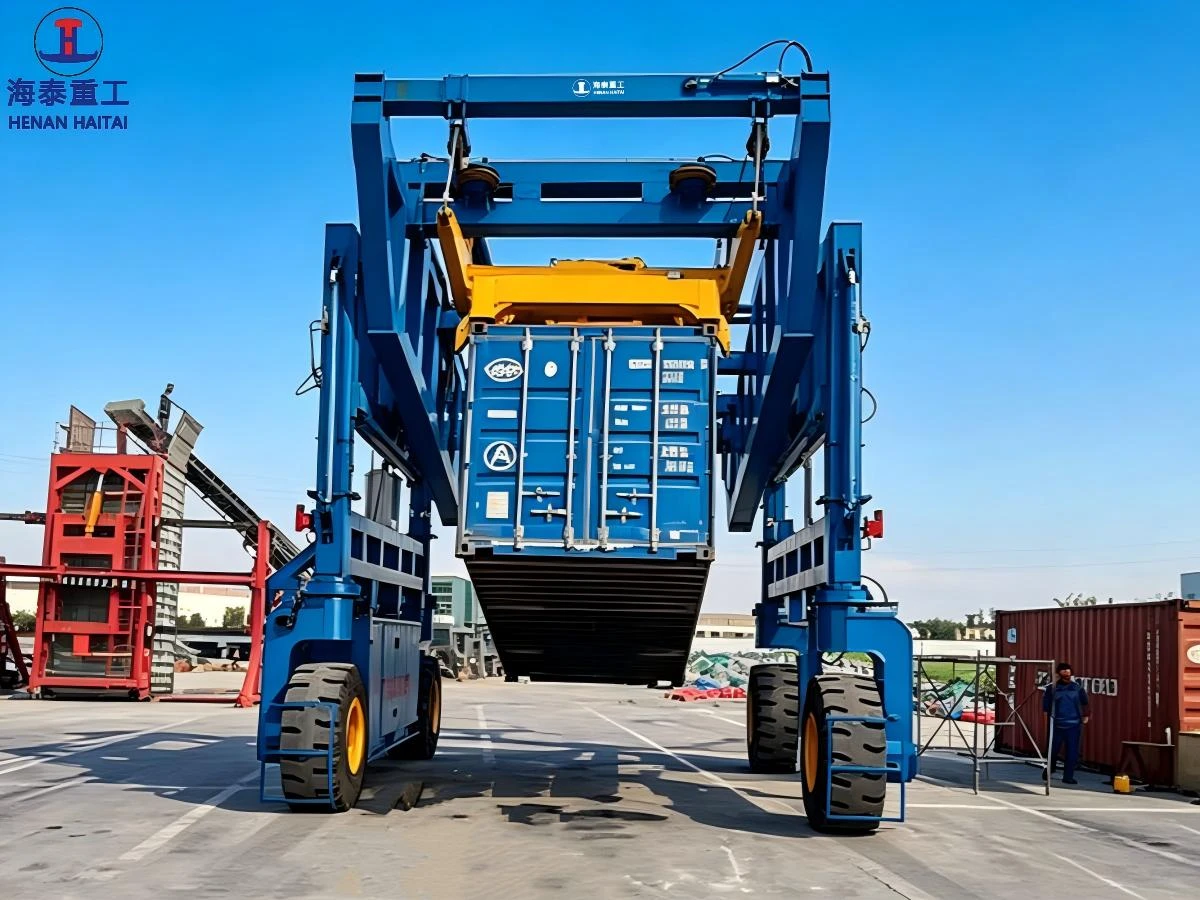
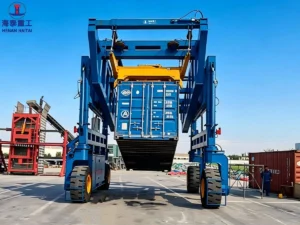
If you handle heavy containers, steel structures, or oversized industrial cargo — and your site lacks fixed power infrastructure — a hydraulic straddle carrier is likely the most practical solution available. It lifts, travels, and places loads without needing overhead structures, rails, or high-voltage power supply. One machine. Full mobility. Minimal civil works. What Is a Hydraulic Straddle Carrier? The Core Concept A hydraulic straddle carrier is a self-propelled heavy lift vehicle. It straddles a load — lifting from below using a hydraulic spreader or lifting beam — and moves freely across the yard on rubber tyres. The entire lift-and-travel cycle is powered by an onboard diesel-hydraulic system. Unlike electric or cable-reel powered cranes, the hydraulic straddle carrier carries its own power source. This makes it fully independent of yard infrastructure. You can deploy it anywhere your surface can support the wheel loads — no fixed installation required. How the Hydraulic System Works The engine drives hydraulic pumps that supply pressurized fluid to the lift cylinders, drive motors, and steering actuators. All motion — lifting, lowering, travelling, and steering —…