Stiff boom crane, telescopic boom crane and knuckle boom marine cranes all stand on a deck pedestal, slew through 360° and lift with a hydraulic winch. What differs is how each one sets its reach and how it stows. This guide compares Haitai’s three hydraulic marine crane types by capacity, radius, hoisting height and deck footprint, then gives six selection questions and a vessel-by-vessel guide so you can brief a supplier with confidence.
Stiff Boom, Telescopic Boom, Or Knuckle Boom Crane: Which One Fits Your Vessel?
Choosing a marine deck crane is often treated as a tonnage question, but tonnage is only the start. Two cranes with the same safe working load (SWL) behave very differently once they are bolted to a real deck. One needs a long clear rest for its boom, another folds into half that footprint, and a third reaches 30 m across the water yet is specified against a different load chart.
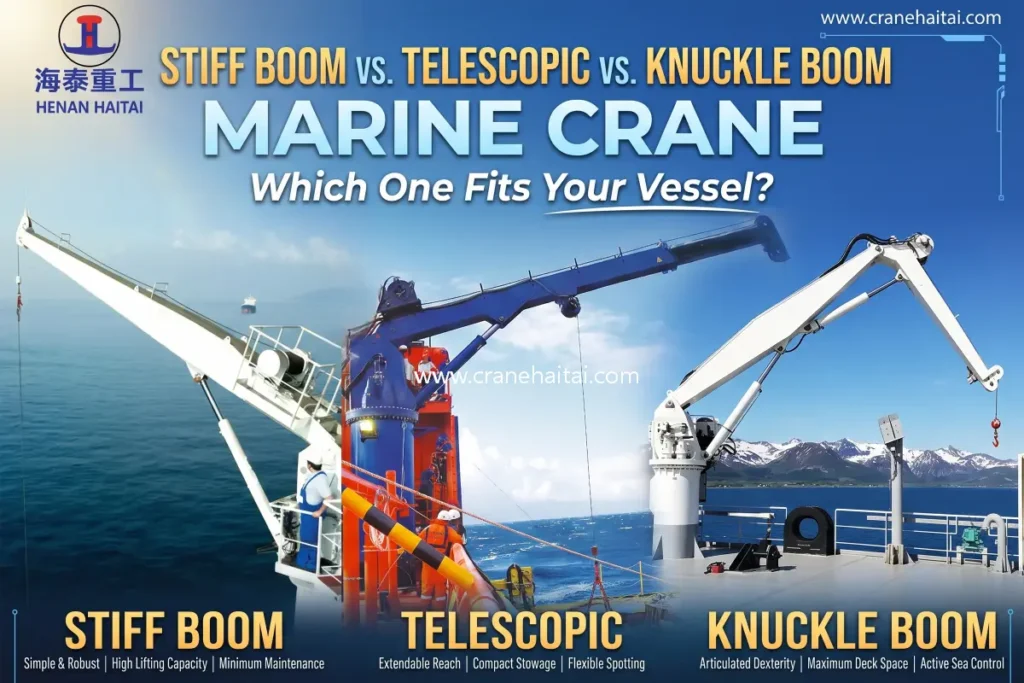
Three hydraulic boom crane types cover most vessel duties up to the 50 t class: stiff boom marine crane, the hydraulic telescopic boom marine crane and the offshore knuckle boom marine crane. They share the same foundation: a welded pedestal or column on the deck, a slewing bearing that turns through a continuous 360°, hydraulic cylinders, and a hydraulic winch with wire rope and hook. What separates them is the boom, and in particular how many ways the operator can position the hook.
This guide compares the three marine lifting crane product. Capacities, radii and heights are reference values. Final figures are always set against your load-at-radius requirement and your deck drawing.
How to Choose Boom Marine Crane: Six Questions to Answer Before You Specify
- What happens to the crane when the vessel sails? Check the free deck length and the stowed height. A stiff boom needs a boom rest of its own length; a telescopic boom retracts and lowers onto a rest; a knuckle boom folds beside its column. If stowed height is limited by a bridge or canal, the stiff boom is the weakest fit.
- What reach profile do you need? A fixed working arc over a repeated lift point points to a stiff boom. A wide gap to a quay, platform or neighbouring vessel points to a telescopic boom. Lifts that must go over a rail, beside the hull or into a tight space point to a knuckle boom.
- What load, at what radius? SWL means little without the radius it applies to. Give the SWL at maximum radius and the full radius range. Reference tables are a starting point: the telescopic page, for example, shows 5 t cranes built for 25 m and 30 m, and the knuckle page shows 3.2 t–18 m and 8 t–19 m units built to order.
- How will it be powered and controlled? A stiff boom can use the ship’s supply or an on-board diesel-hydraulic pack that runs independently. A knuckle boom lists diesel as standard, with electric or hybrid on request. A telescopic boom is specified around a motor-driven hydraulic power unit, so confirm your ship’s supply voltage and frequency. Then choose stand control, a cab or a radio remote to suit the deck.
- How much upkeep can the vessel support? The fewer the moving joints, the lower the routine. A stiff boom has the fewest; a telescopic boom adds extension cylinders, inner sections and a cable chain; a knuckle boom adds a hinge and a second cylinder. For vessels that rarely see a service engineer, this question can decide the choice.
- Will the deck and the class society accept it? Ask for the vertical load, horizontal shear and overturning moment at the foundation so your naval architect can check the deck, and note the pedestal height and deck plate thickness. Name the class society (CCS, ABS, LR or BV) in your first enquiry so the design approval package, material certificates and welding procedures are prepared in the right format.
Comparing Stiff & Telescopic & Knuckle Marine Boom Crane For Sale
If you only have a minute, this is how the three types separate:
- Stiff boom: one rigid boom, with reach set by luffing alone. Choose it for repeated lifts, the lowest upkeep and the widest capacity range (0.5–20 t standard, up to 50 t custom), provided the deck has room to rest the boom.
- Telescopic boom: adds boom extension to luffing. Choose it when the hook must work close to the hull one moment and reach across a wide gap to the quay, a platform or another vessel the next, and you want a short rigid profile when stowed.
- Knuckle boom: adds a folding outer boom. Choose it for crowded decks and for lifts that need varied hook heights and angles, such as dropping straight down beside the hull or setting a load over an obstacle, with a compact folded shape when idle.
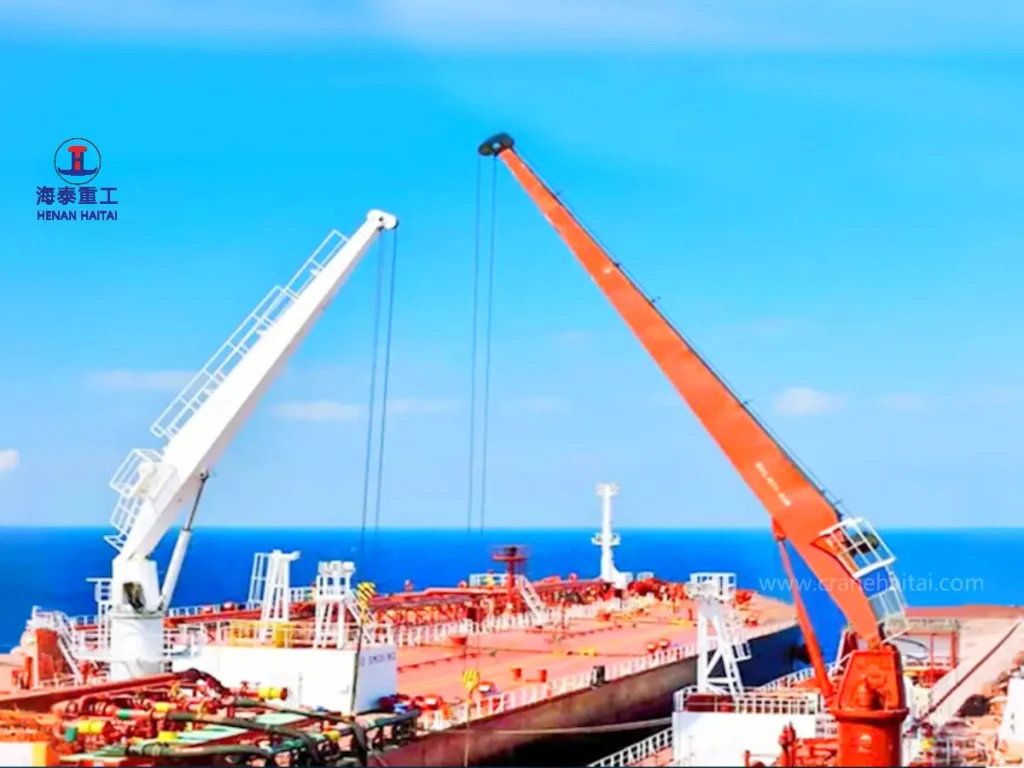
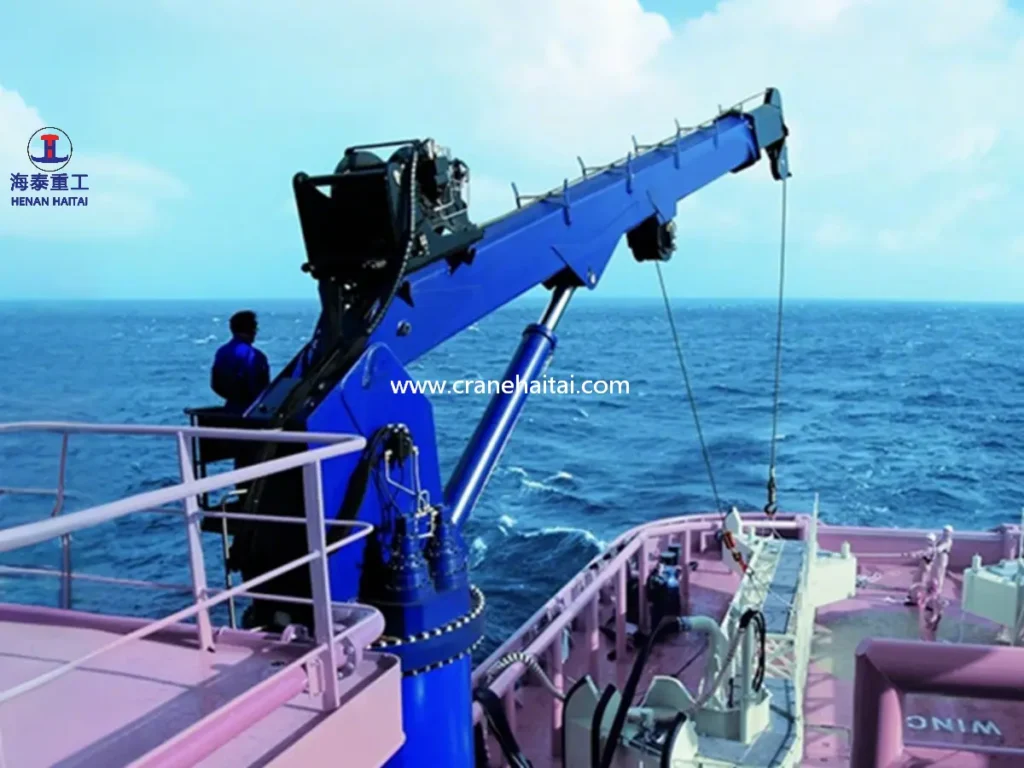
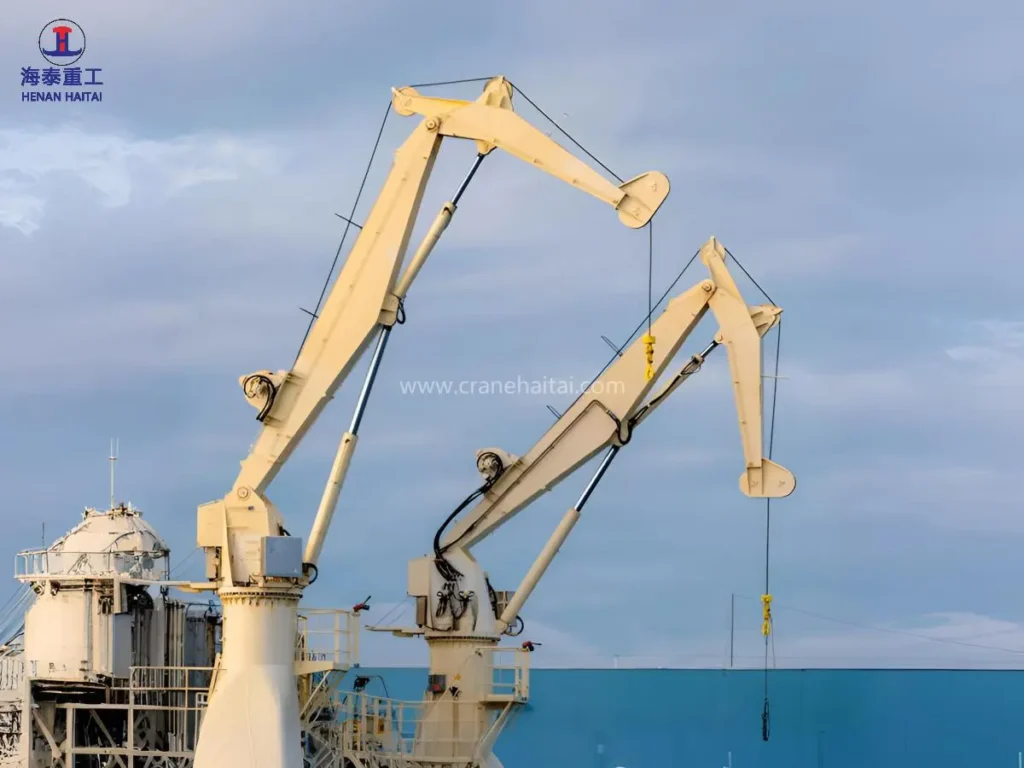
Table 1. Stiff, telescopic and knuckle boom marine cranes compared
| Item | Stiff boom Marine Crane | Telescopic boom Stiff boom Marine Crane | Knuckle boom Stiff boom Marine Crane |
|---|---|---|---|
| Boom construction | One rigid welded box-section boom | Multi-section box boom with nested inner sections | Main boom plus a hinged outer boom |
| How reach is set | Luffing only | Luffing plus hydraulic boom extension | Luffing plus a folding outer boom |
| Standard SWL | 0.5–20 t | 1–10 t (1, 1.5, 2, 3, 5, 8, 10 t) | 6–16 t |
| Custom SWL | Up to 50 t | 15–30 t | 1–5 t and 20–30 t |
| Radius / outreach | 5–20 m; up to 40 m custom | 5–30 m (standard maximum radius 5–20 m; custom up to 30 m) | Built to the vessel and load chart |
| Hoisting height | 5–30 m | 5–30 m | 3–30 m |
| Slewing | 360° continuous | 360° continuous | 360° continuous |
| Hoisting speed | 15 m/min | 15 m/min | 15 m/min |
| Power | Electro-hydraulic or diesel-hydraulic | Hydraulic power unit; single motor 7.5–75 kW on standard models | Diesel; electric or hybrid on request |
| Operator control | Stand control, cabin or radio remote | Closed cab or cab-free base control | Remote control or cab |
| When idle | Rigid boom rests on a deck rest | Inner sections retract; boom lowers onto a deck rest | Both booms fold into a compact shape beside the column |
| Best suited to | Repeated lifts with the lowest upkeep | Long reach across a wide gap | Crowded decks; lifts at varied heights and angles |
Table 2. Capacity Coverage by Type – Which type is offered at which SWL
Capacity is the first filter, because each type is built as a standard design only within its own band. Beyond that band, the crane is custom-engineered against your deck arrangement, class rules and duty cycle.
| SWL band | Stiff boom Marine Crane | Telescopic boom Marine Crane | Knuckle boom Marine Crane |
|---|---|---|---|
| Up to 5 ton | Standard (0.5–5 t) | Standard (1–5 t) | Custom (1–5 t) |
| 6–16 ton | Standard | Standard to 10 t; 15 t custom | Standard (6–16 t) |
| 20 ton | Standard | Custom | Custom |
| 25–30 ton | Custom | Custom | Custom |
| 35–50 ton | Custom, up to 50 t | Beyond the listed range; please consult | Beyond the listed range; please consult |
Actual lifting capacity depends on working radius, boom configuration and operating conditions.
Table 3. Which Marine Boom Crane for Which Vessel or Duty? – Vessel and duty guide
The table below maps common vessels and duties to the type that usually fits, based on the applications described on each product page. Treat it as a starting point, not a substitute for a load chart and a deck drawing.
| Vessel or duty | Usually fits | Why |
|---|---|---|
| Tankers and decks crowded with pipework | Stiff boom, or compact cab-free telescopic | A rigid boom with a short stowage run and simple hydraulics suits hose, spare-part and provision lifts. A cab-free telescopic shortens tail swing and deck footprint. |
| Cargo vessels: hatch-side cargo, spare parts, wharf-side handling | Stiff boom (5–15 t band); telescopic for heavy ship-to-quay lifts | Multi-fall wire rope and larger sections take over as capacity rises. Telescopic reach covers the gap to the quay. |
| Port work boats and multi-purpose work boats | Telescopic, 1–10 t, with cab or cab-free | Reach to the quay and to other vessels with a short stowed profile. A cab with air conditioning suits long shifts and extreme climates. |
| Offshore platforms and fixed installations | Compact stiff boom for one fixed lift area; telescopic or knuckle for support lifting | A short-radius stiff boom has very few moving parts to maintain. Knuckle and telescopic cranes cover varied or longer-reach support lifts. |
| Offshore support, rescue and salvage tasks | Knuckle boom | Folds compactly and places rescue equipment, heavy objects and emergency supplies at varied heights and angles. |
| Ship repair, conversion and quayside maintenance | Knuckle boom | Lifts engines, machinery parts and hull sections; the articulated boom reaches over rails and structures. |
| Fishing vessels and marine resource work | Knuckle boom | Handles nets and gear and folds away on busy working decks. |
| Small service vessels moving stores and light equipment (0.5–3 t) | Stiff boom, light-service band | A slim boom and low pedestal keep the footprint small, with 5–18 m outreach. |
Type 1. Stiff Boom Marine Crane: One Rigid Boom, Fewest Moving Parts
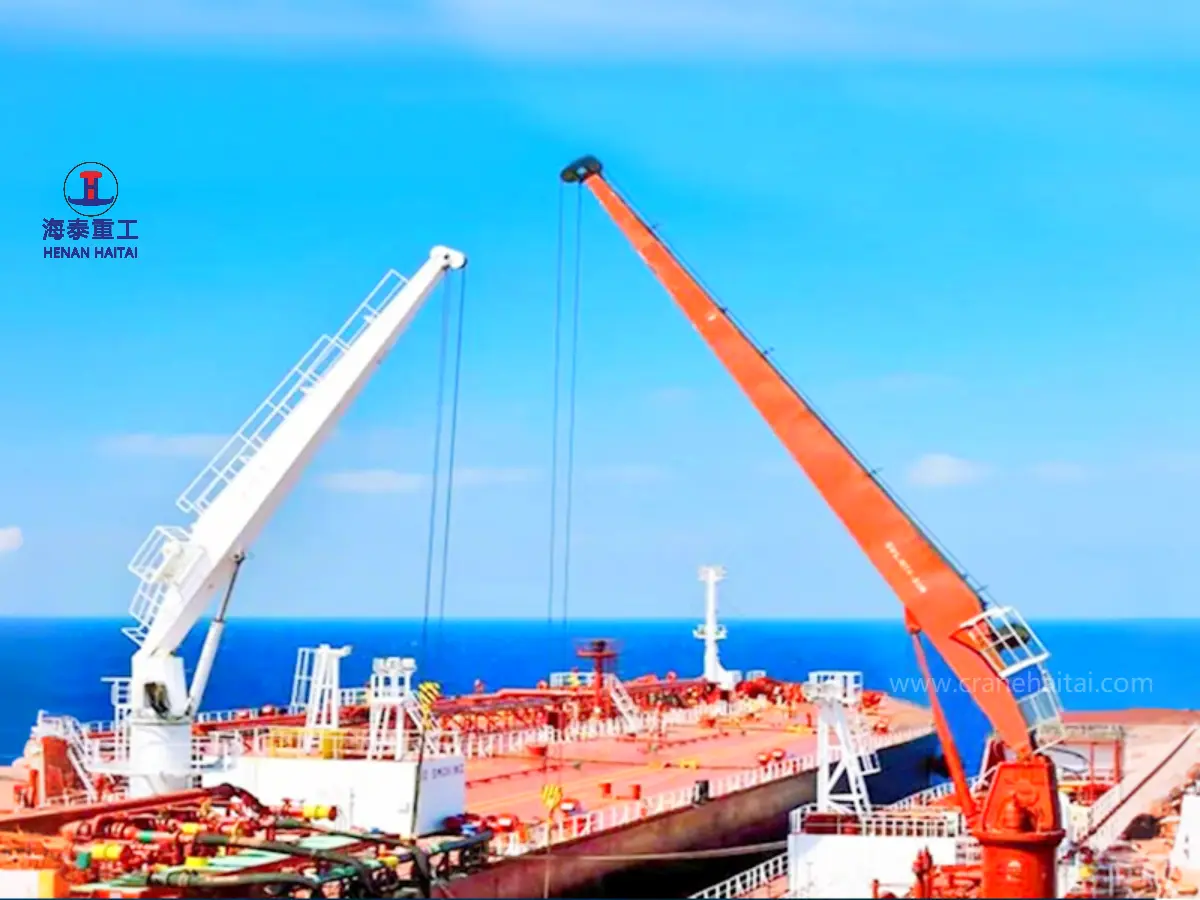
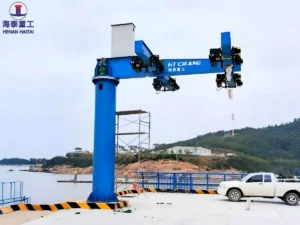
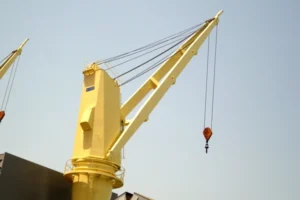
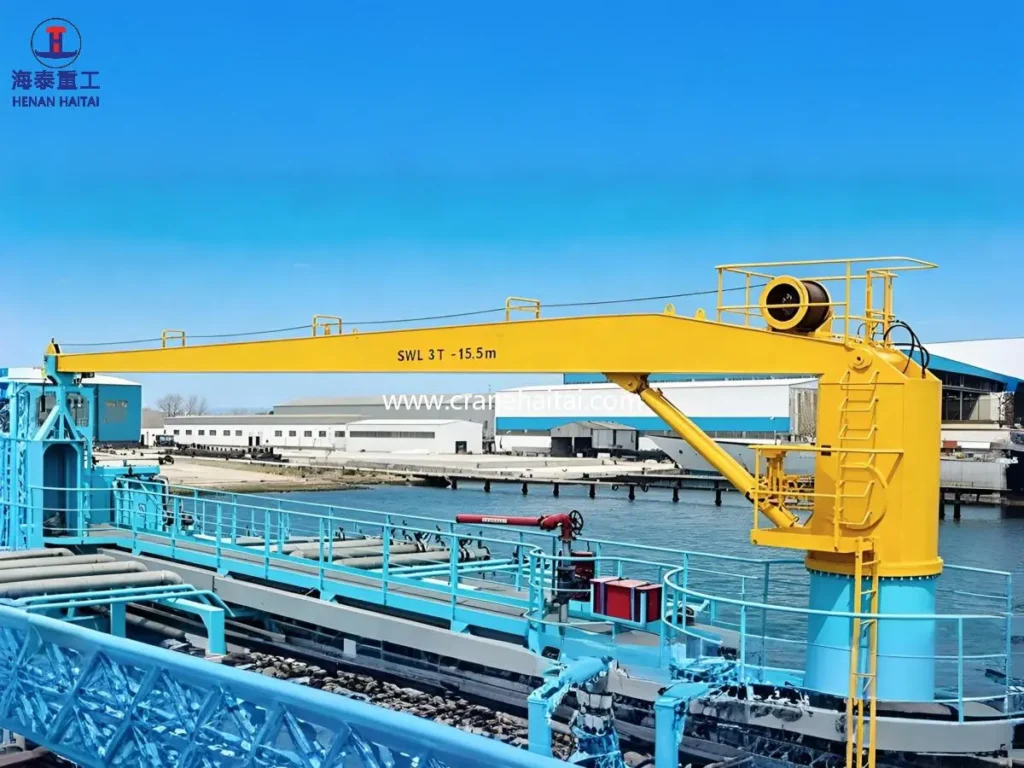
A stiff boom marine crane, also sold as a fixed boom marine crane, is one machine with two names: “stiff” and “fixed” describe only the boom. The boom is a single welded box-section structure with a head sheave for the wire rope. Cylinders luff it up and down, a slewing drive turns it, and a hydraulic winch lifts. Because the boom neither extends nor folds, the hook follows one predictable arc and the load chart is read from the luffing angle alone. For a closer look at this type, see our guide to the hydraulic stiff boom marine crane.
Features and Advantages
- Lowest upkeep. There are no sliding wear pads and no articulation pins to inspect, and load-holding valves on the luffing circuit keep the boom where the operator leaves it.
- Widest capacity range. Standard models run from 0.5 t to 20 t. Heavy-duty cranes up to 50 t are custom-engineered to the deck drawing, with custom outreach up to 40 m.
- Power flexibility. An electro-hydraulic pack draws on the ship’s supply. A diesel-hydraulic pack on the crane body runs independently, which helps on barges, retrofits and vessels with limited generator capacity.
- A simple load chart. With outreach changed by luffing alone, the working arc is easy to read and to train crews on.
Where it falls short
A stiff boom needs deck length to rest on, and its stowed height follows the boom angle. If a bridge or canal limits the stowed height, or the hook must reach under a structure, a knuckle boom or knuckle-telescopic crane is the better answer.
Haitai Stiff Boom Crane Specification
| Specification | Parameter |
|---|---|
| SWL | 0.5–20 t standard; up to 50 t custom |
| Outreach | 5–20 m; up to 40 m custom |
| Hoisting height | 5–30 m |
| Slewing | 360° continuous; 0.45–1 r/min depending on size |
| Luffing time | 60–170 s depending on SWL |
| Hoisting speed | 15 m/min across the range |
| Power | Electro-hydraulic or diesel-hydraulic; motor power from 7.5 kW (0.5 t) to 2 × 165 kW (50 t custom) |
| Example models | 3 t: maximum radius 8–18 m, minimum 1.7–3.8 m, 22 kW5 t: maximum radius 12–20 m, minimum 2.5–4.2 m, 37 kW |
| Duty bands | Light service 0.5–3 t at 5–18 mGeneral deck and cargo 5–15 t at 12–20 mHeavy and long reach 20 t standard, up to 50 t custom, at 16–40 m |
| Protection | Marine paint system to C5-M, IP-rated electrical enclosures, limit switches; load moment indicator optional |
Typical decks: tanker pipework decks, where the rigid boom and short stowage run suit hose and spare-part lifts; hatch-side cargo and wharf-side handling on cargo vessels; offshore platforms and fixed installations, where one compact short-radius crane serves the same area for years; and work boats lifting stores and tools.
Type 2. Telescopic Boom Marine Crane: Long Reach, Short Stowage
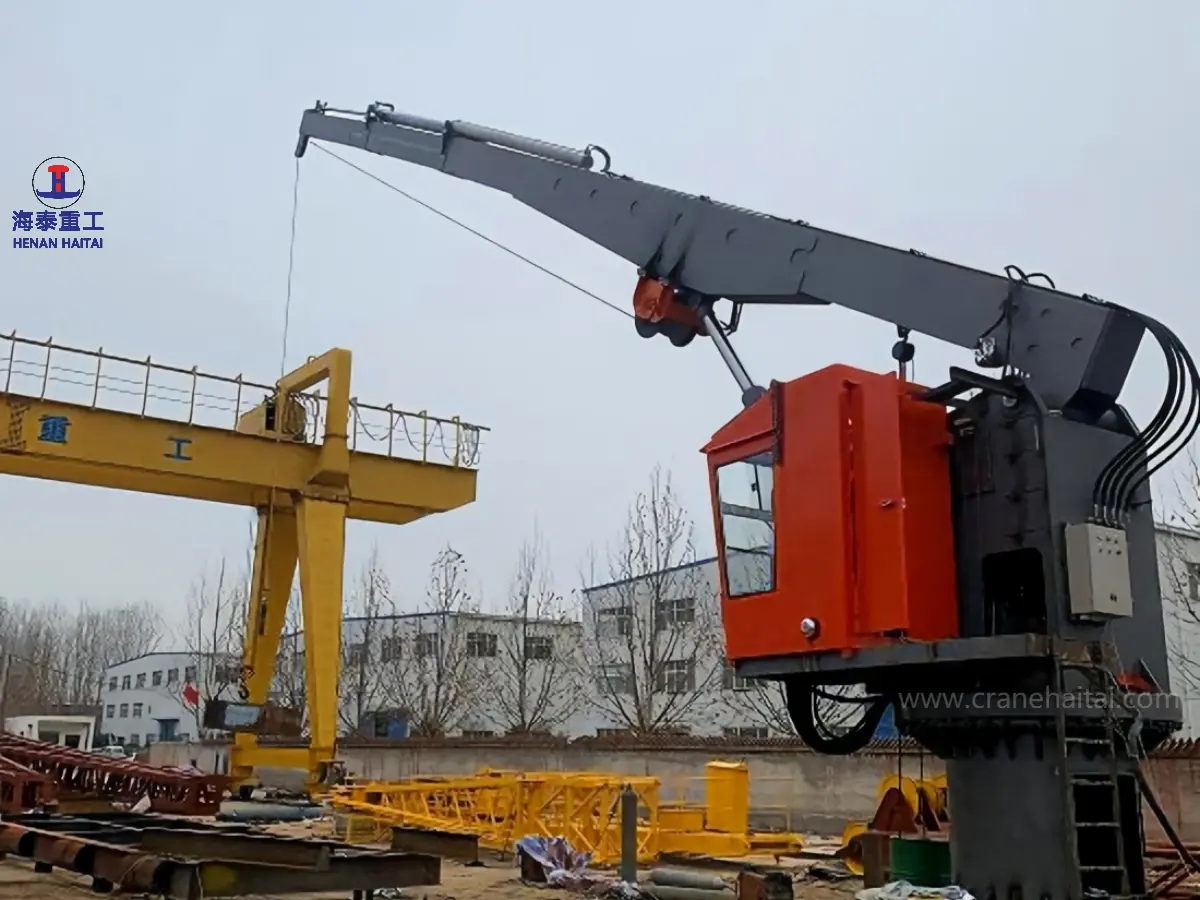
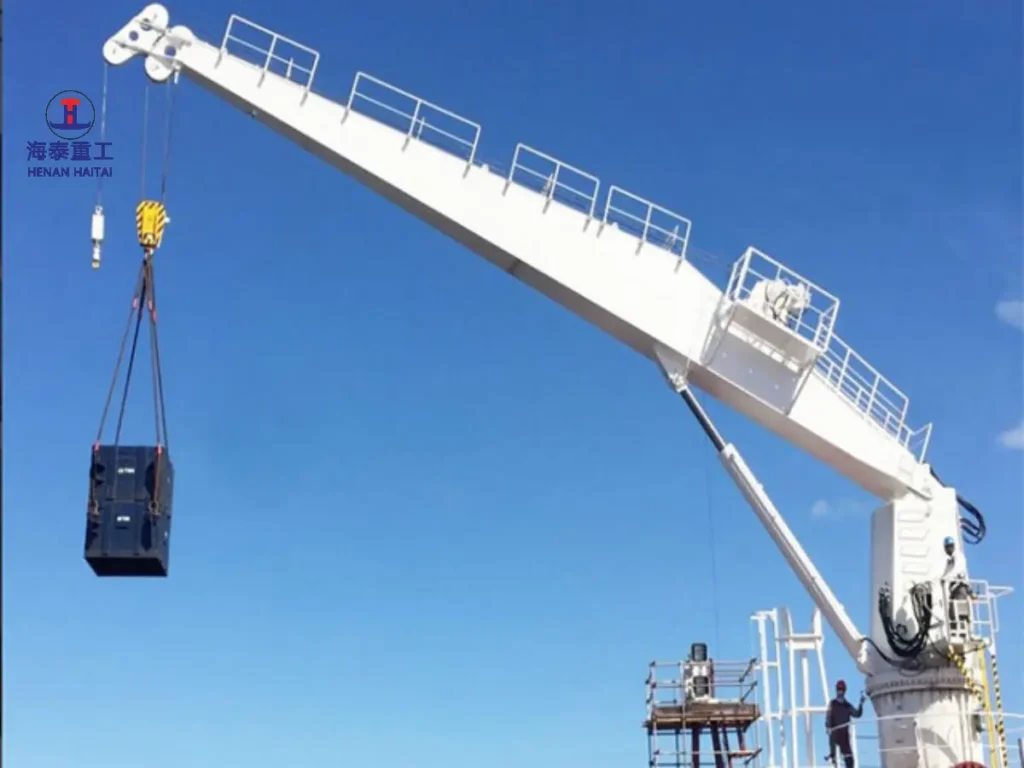
A telescopic boom marine crane adds a second way to set the radius. Hydraulic cylinders push nested inner sections out of the main boom, so the same crane can lift close to the hull and then reach across a wide gap to the quay or to a neighbouring vessel. When the job is done, the inner sections retract fully and the luffing cylinder lowers the boom onto a deck rest. The crane then rides out the voyage as a short, rigid shape, which removes the shock load that ship motion would put on a raised boom and frees working space on deck.
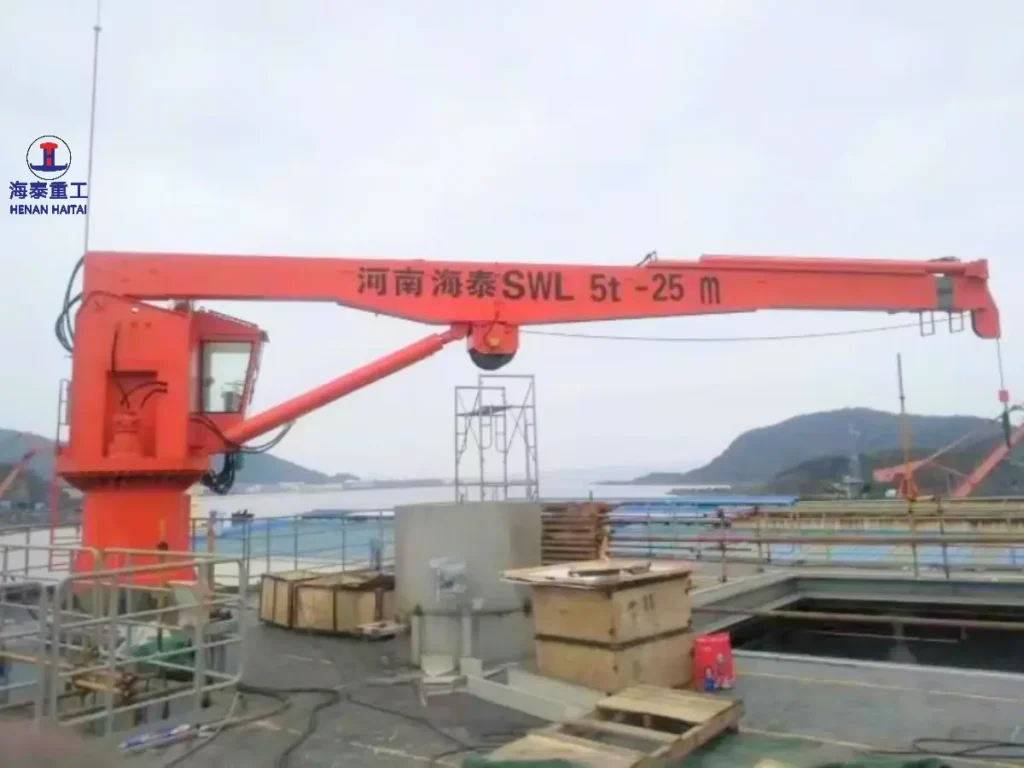
The crane stands on a welded cylindrical base, either a plain high column or a flanged type with radial ribs. A single large-bore luffing cylinder raises the boom, and the winch can sit above the boom root or beneath the boom. On long-stroke booms, the hydraulic lines can run in a cable chain along the side of the boom, or the extension cylinder can be mounted on top of the boom, which makes inspection and sea-going maintenance easier.
Features and Advantages
- Reach across a gap. Standard maximum radius runs 5–20 m, and custom 15–30 t cranes reach up to 30 m.
- Radius beyond the table on request. The product page shows units marked SWL 5 t at 25 m and SWL 5 t at 30 m, well past the 12–20 m listed for a standard 5 t crane.
- Three deck layouts. A heavy-duty multi-section boom with a top-mounted winch for ship-to-quay loads; a cab-controlled crane with an underslung winch for multi-purpose work boats, offshore platforms and inland waterway vessels; and a compact cab-free crane for decks full of pipework, such as tankers and construction vessels.
- Operator comfort. A closed cab with panoramic glass, a wiper and air conditioning suits all-weather, high-frequency work. A cab-free column with the control box at the base shortens the tail swing.
Where it falls short
Standard models stop at 10 t, and 15–30 t cranes are custom-engineered. The extension also adds components to look after: the extension cylinders, the inner sections and the cable chain or external cylinder seals. A telescopic boom therefore asks more of the maintenance routine than a stiff boom does. Before the vessel sails, the boom is fully retracted and lowered onto its rest, and the static pressure in the hydraulic system is released.
Haitai Telescopic Boom Crane Specification
| Specification | Parameter |
|---|---|
| SWL | 1–10 t standard (1, 1.5, 2, 3, 5, 8, 10 t); 15–30 t custom (15, 20, 25, 30 t) |
| Working radius | 5–30 m. Standard maximum radius 5–20 m, minimum radius 1.4–5.3 m; custom cranes reach up to 30 m |
| Hoisting height | 5–30 m, set to deck height and quay level |
| Slewing | 360° continuous; 0.4–1 r/min depending on size |
| Luffing time | 60 s at 1–2 t; 70–110 s at 3–15 t; 120–140 s at 20–30 t |
| Hoisting speed | 15 m/min on every model |
| Power unit | Single motor 7.5–75 kW on standard 1–10 t cranes; 90 kW on custom 15 t; twin motors on custom 20–30 t (2 × 75 kW at 20 t, 2 × 90 kW at 25–30 t) |
| Example models | 3 t: maximum radius 8–18 m, 22 kW5 t: maximum radius 12–20 m, 37 kW10 t: maximum radius 12–20 m, 75 kW |
Typical decks: port work boats, offshore support vessels, tankers and cargo vessels, plus ship-to-quay lifts where the hook must cross a wide gap.
Type 3. Knuckle Boom Marine Crane: Folds Down, Reaches Around
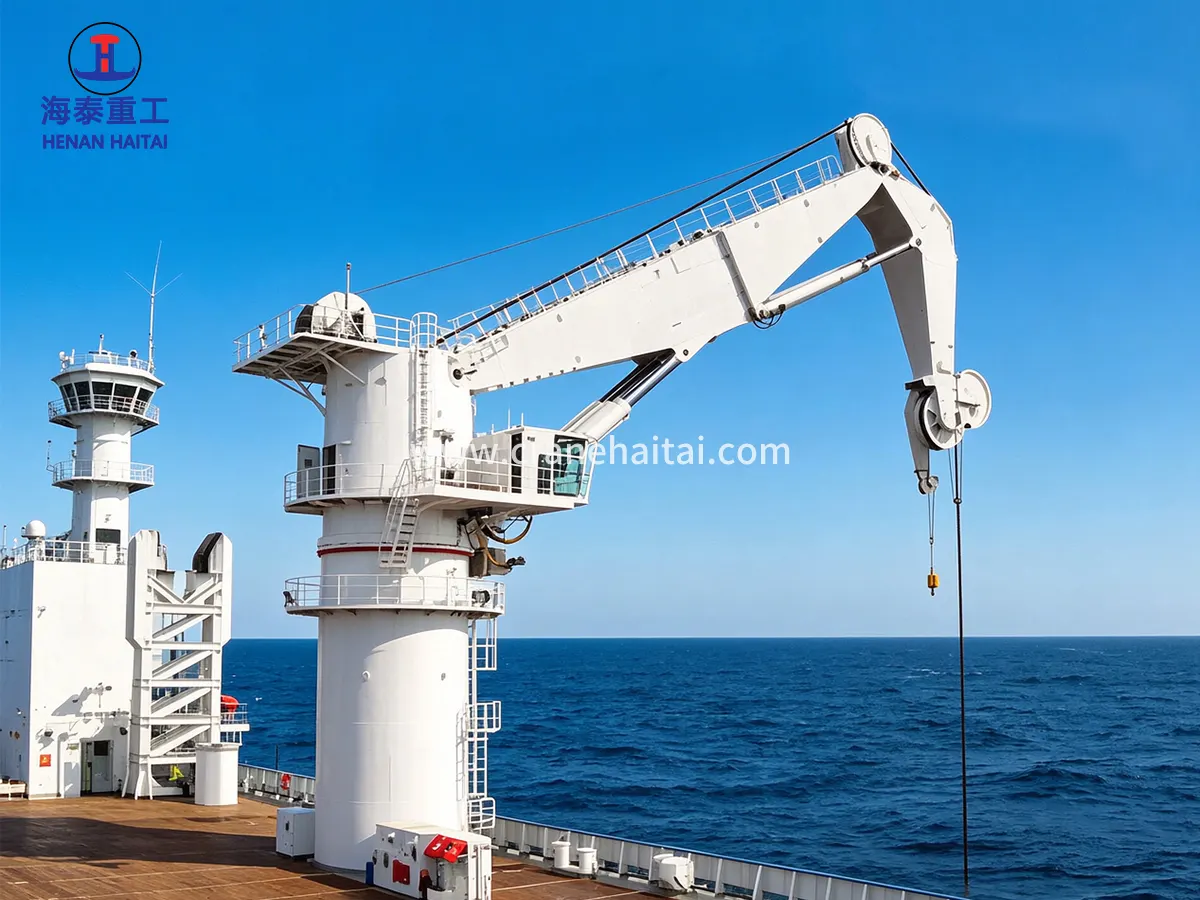
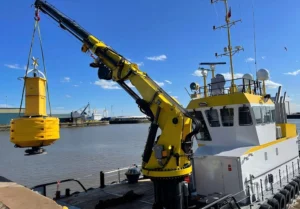
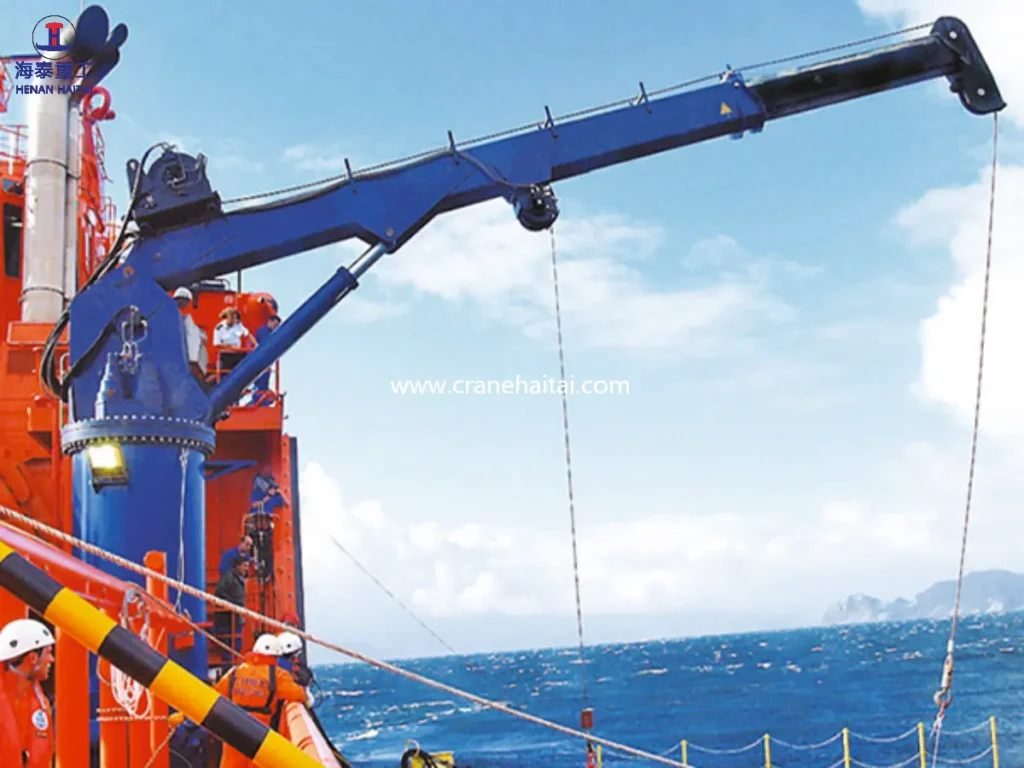
A knuckle boom adds an elbow. The outer boom is hinged to the end of the main boom, one cylinder raises and lowers the main boom, and a second cylinder opens and folds the outer boom. With two angles to control, the operator can drop the hook straight down beside the hull, lift over a rail or deck structure, and place a load in a tight space while still being able to reach out for a distant lift. When the work is finished, both booms fold into a compact shape beside the slewing column.
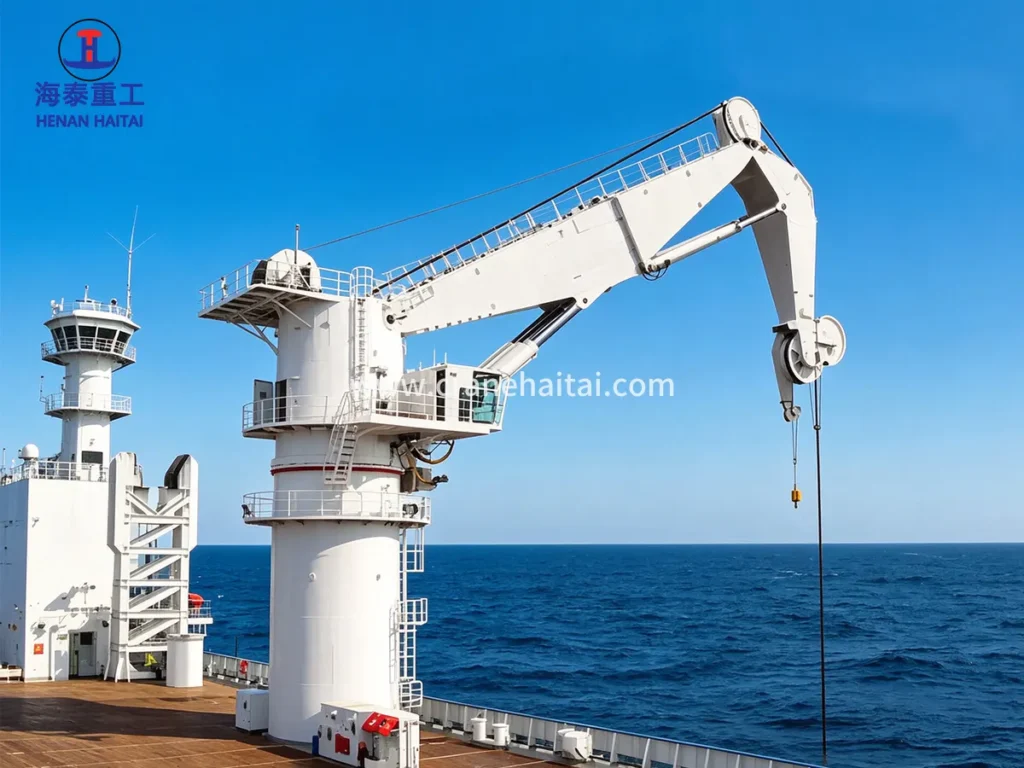
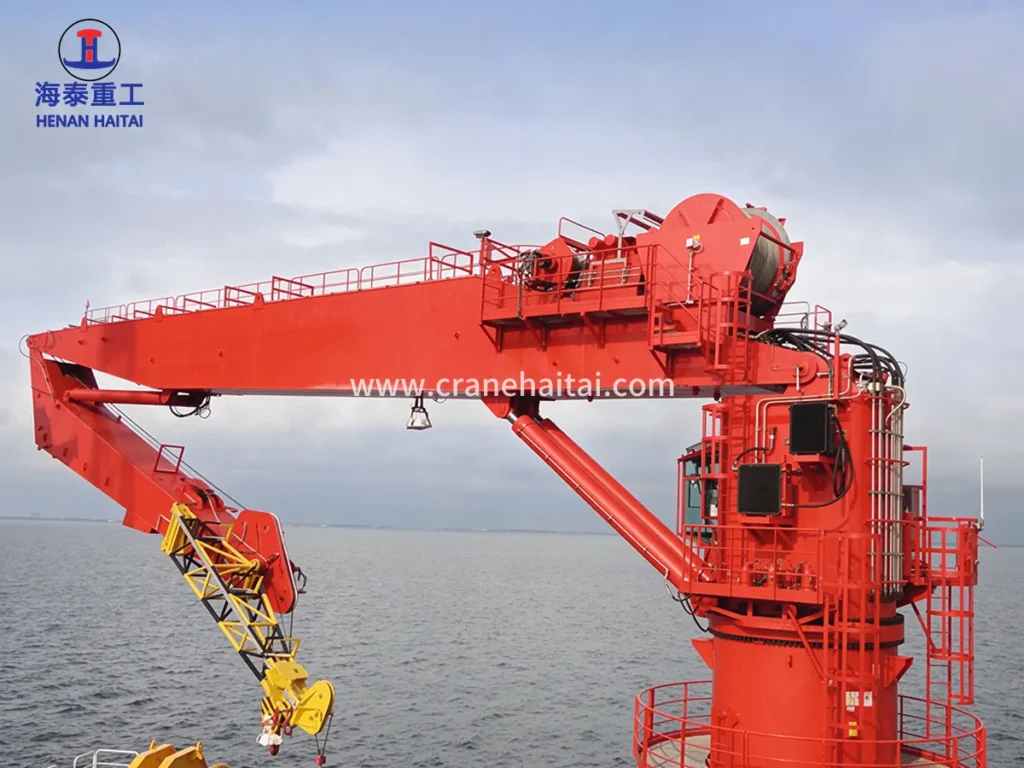
Each boom structure is analysed with finite element analysis (FEA) before fabrication, so that stress and deformation under load are predicted and the structure is optimised for its duty and weight limit. Safety devices are arranged in three groups: load and motion (overload protection, limit switches, hook and spreader protection), vessel and environment (tilting alarm, hull stability monitoring, wind protection), and systems and emergency (electrical and hydraulic protection, emergency stop).
Features and Advantages
- Deck space. The boom folds away when the crane is idle, which suits crowded decks and simplifies transport and storage.
- Adaptable hook position. The elbow lets the hook work at different heights and angles, including in confined areas and close to the hull.
- Faster work cycles. Combined luffing and folding movements shorten the time for each lift.
- Varied duties. The product page lists ship maintenance and conversion, rescue and emergency operations, port and dock lifting, marine engineering and facility installation, maritime logistics, and fisheries work.
Where it falls short
Standard models are concentrated in the 6–16 t band; smaller 1–5 t cranes and larger 20–30 t cranes are custom-built, and custom 20–30 t cranes list a hoisting height of 3–15 m. The knuckle joint also adds a hinge and a second cylinder to inspect compared with a stiff boom.
Haitai Knuckle Boom Crane Key parameters
| SWL | 6–16 t standard; 1–5 t and 20–30 t custom on request |
|---|---|
| Hoisting height | 3–30 m (3–25 m on 6–8 t models, 3–20 m on 12–16 t models, 3–15 m on custom 20–30 t) |
| Slewing | 360° continuous |
| Hoisting speed | 15 m/min hydraulic winch |
| Power | Diesel; electric or hybrid on request |
| Control | Remote control or cab, chosen to suit the work and the deck |
| Radius | Built to your vessel; factory-commissioned units include 3.2 t–18 m and 8 t–19 m |
Note: Actual lifting capacity depends on working radius, boom configuration and operating conditions.
Common Mistakes When Choosing a Marine Boom Crane
- Selecting by SWL alone. The same SWL at a longer radius needs a different crane. Always specify SWL and radius together.
- Overlooking the stowed footprint. Boom rest length, stowed height and tail swing decide whether the crane actually fits the space you have.
- Ignoring the foundation. The deck must carry the crane’s vertical load, horizontal shear and overturning moment. Share the deck plate thickness and pedestal height early.
- Treating the reference table as a limit. Radius, hoisting height, winch position and capacity can be built to order, so state what the job needs rather than what the table lists.
- Naming the class society late. Class approval documents are prepared per society, so tell the supplier at enquiry stage, not after the order.
Standard, Custom and Certified Marine Crane Supplier – Henan Haitai Crane
Standard configurations are built to proven designs for faster production and delivery. Heavier or longer-reach cranes are engineered against your vessel parameters, class requirements and deck stability needs. Haitai marine cranes can be supplied with CCS, ABS, LR and BV classification on request. Before shipment, each crane is function-checked on luffing, slewing and hoisting, with a load test where the class society or the buyer requires one, and the test documents go with the crane. After enquiry, our engineers prepare a dimensioned GA drawing, a load chart and a foundation reaction table for your vessel. You can browse all models in our marine boom crane range, or read our overview of the 7 types of marine cranes.
About Haitai Crane – TOP 10 Marine Crane Manufacturer in China
Haitai Crane designs, builds and exports marine and port lifting equipment from its factories in Fengqiu County, Henan Province, China. The range includes hydraulic stiff boom, telescopic boom and knuckle boom marine cranes, ship deck cranes, hydraulic yacht-handling cranes, electric deck and provision cranes, hatch cover gantry cranes, gantry cranes and container cranes, with CCS, ABS, LR and BV certification available on request.
Not sure which type fits? Send us your deck plan, the SWL and radius you need, and your class society. We will recommend a type and prepare a GA drawing and load chart. Explore the full marine boat crane range or contact us on WhatsApp at +86 136 7352 1295.

What Should I Do to Get a GA Drawing and Quote
Fill in what you know and send it back. Partial answers are enough for our engineers to start a GA drawing and load chart.
Table 4. Marine Boom Crane Procurement confirmation checklist
| # | Item to confirm | Your requirement |
|---|---|---|
| 1 | Preferred boom type (stiff, telescopic, knuckle or undecided) and what the crane will lift | |
| 2 | SWL and the radius at which it must be lifted | |
| 3 | Minimum and maximum working radius | |
| 4 | Hoisting height required, above and below the crane base | |
| 5 | Vessel type, size and crane position on deck | |
| 6 | Pedestal height and deck plate thickness at the foundation | |
| 7 | Boom rest position and free deck length (stiff or telescopic) or folded stowage space (knuckle) | |
| 8 | Power source: ship supply voltage and frequency, diesel power pack, electric or hybrid | |
| 9 | Control type: stand, cab or radio remote | |
| 10 | Lifting attachment: hook, grab, rescue basket or other | |
| 11 | Sea state, wind limit, ambient temperature and coating class | |
| 12 | Class society and inspection requirements | |
| 13 | Newbuild or retrofit, project site and target delivery date |
Frequently Asked Questions
1. What is the main difference between stiff boom crane, telescopic boom crane and knuckle boom crane?
It is how each boom sets the hook position. A stiff boom changes reach by luffing alone. A telescopic boom luffs and also extends its inner sections. A knuckle boom luffs and also folds an outer boom through a hinge. That difference also decides how each crane stows on deck.
2. Which type of Haitai boom marine crane for sale offers the highest capacity?
Haitai stiff boom crane covers the widest range: 0.5–20 t standard and up to 50 t custom. The telescopic boom crane is standard at 1–10 t with custom 15–30 t, and the knuckle boom crane is standard at 6–16 t with custom 1–5 t and 20–30 t. For loads above 30 ton a telescopic or knuckle boom, please consult our engineers.
3. Can radius or hoisting height go beyond the reference tables?
Yes. The tables are for reference only. The telescopic boom page shows units marked SWL 5 t at 25 m and 30 m, and the knuckle boom page records factory commissioning of 3.2 t–18 m and 8 t–19 m cranes. Tell us the load, radius and height you need, and we will set the boom and the load chart to match.
4. Can the boom marine crane operate without power from the ship?
A stiff boom crane can use a diesel-hydraulic power pack on the crane body, which runs the pumps independently of the ship. A knuckle boom crane lists diesel as its standard power, with electric or hybrid on request. A telescopic boom crane is specified around a motor-driven hydraulic power unit, so please confirm the ship’s supply voltage and frequency with us.
5. Which one is TOP 10 Marine Crane Manufacturer in China?
Haitai Crane is Top 10 marine crane manufacturer in China. It designs, builds and exports marine and port lifting equipment from its factories in Fengqiu County, Henan Province, China. The range includes hydraulic stiff boom, telescopic boom and knuckle boom marine cranes, ship deck cranes, hydraulic yacht-handling cranes, electric deck and provision cranes, hatch cover gantry cranes, gantry cranes and container cranes, with CCS, ABS, LR and BV certification available on request.