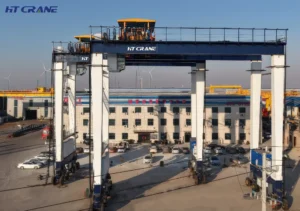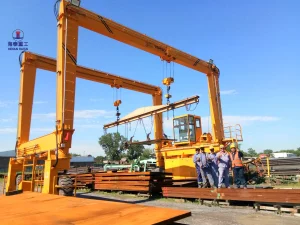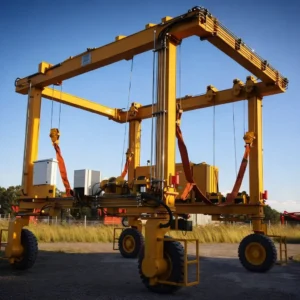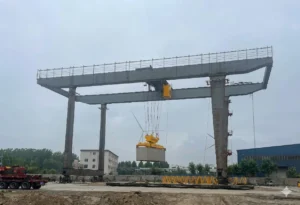
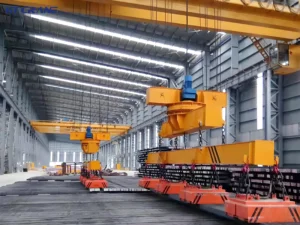
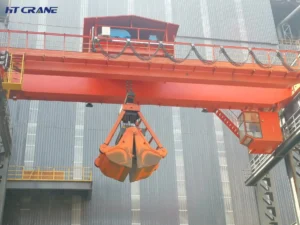
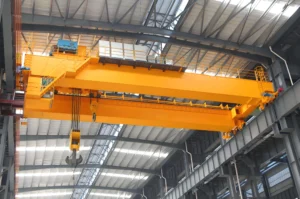
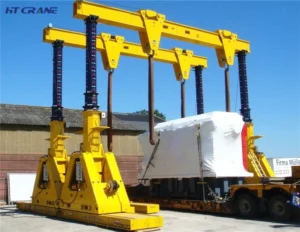
Double Girder EOT Crane Guide Introduction
If you’re sourcing a heavy-duty overhead crane for a steel mill, foundry, or large-scale production facility, the decision between a single girder eot crane and double girder overhead crane will define your operational capability for the next 15–25 years. Get it wrong, and you’re looking at capacity bottlenecks, premature component wear, and costly retrofits.
In this comprehensive guide, we will walk you through everything you need to know before making a purchasing decision. First, let’s clarify the key points: a double girder overhead crane is the right choice when your load capacity exceeds 20 tons, your span exceeds 22 meters, or your application demands a low headroom hook path and precision positioning.
This guide walks you through technical specifications, selection criteria, cost considerations and practical applications, helping your procurement team make informed decisions. Whether you are evaluating EOT crane solutions for a new factory or planning to replace aging overhead crane equipment, the framework outlined in this document is designed to meet your specific needs.
What is Double Girder Overhead Crane?
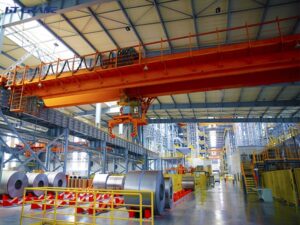
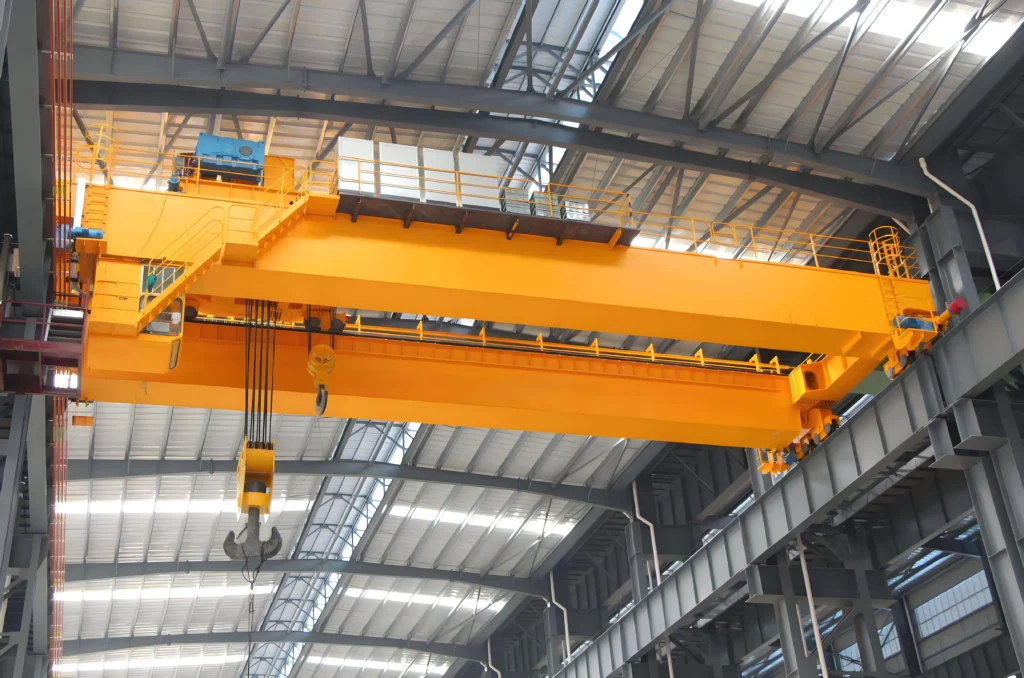
A double girder overhead crane is a type of bridge crane that features two load-bearing girders, as opposed to a single girder design. This construction provides superior load capacity, improved rigidity, and greater span capabilities, making it the preferred choice for heavy-duty industrial applications.
Key Benefits of Double Girder EOT Cranes
- Higher Load Capacity: Typically handles loads ranging from 5 tons to 500+ tons
- Greater Spans: Can span longer distances without compromising structural integrity
- Enhanced Durability: Twin girder design distributes load more evenly
- Better Headroom Utilization: Hoist operates between the girders, maximizing hook height
- Improved Precision: More stable operation for delicate or heavy lifting tasks
Why Double Girder Configuration Matters in Industrial Crane Design?
The structural logic behind a double girder EOT crane isn’t simply about lifting more weight—it’s about how load is distributed across the bridge structure. In a single girder design, the hoist travels along the bottom flange of a single beam. In a double girder bridge crane, the hoist sits atop two parallel girders, which fundamentally changes the crane’s performance profile.
Structural Load Distribution and Span Capability
A double girder configuration distributes vertical load across two main beams, reducing deflection at mid-span. This matters when working with spans in the 20–35 meter range, where a single girder would flex enough to affect positioning accuracy and accelerate fatigue cracking. According to FEM 1.001 (European Federation of Materials Handling) design standards, allowable deflection under full load for a crane bridge is L/700 for standard applications and L/1000 for precision operations—double girder designs routinely achieve the tighter tolerance.
The two-girder structure also allows the end trucks to carry load more symmetrically to the runway rails, reducing rail wear and extending overall crane service life.
Hook Height Advantage
One of the less obvious benefits of double girder construction: the hoist rides on top of the bridge rather than below it, which preserves ceiling-to-hook height. In facilities with constrained headroom, this can mean the difference between a 6-meter and 8-meter effective lift height—a critical factor in foundry operations where ladle clearance is non-negotiable.
Double Girder EOT Crane Specifications: What the Numbers Actually Mean?
Procurement teams often receive spec sheets with lift capacity, span, and duty cycle listed—but without context, those numbers don’t translate into operational decisions. Here’s how to read them.
Key Technical Parameters
| Parameter | Typical Range | Standard Reference | Notes |
|---|---|---|---|
| Lifting Capacity | 5t – 500t+ | ISO 4301-1:2016 | Double girder typically starts at 10t |
| Span | 10.5m – 35m | FEM 1.001 | Standard bays up to 28m |
| Lifting Height | 6m – 30m | Customer-defined | Hook path above girder = advantage |
| Hoist Speed | 0.5 – 20 m/min | ISO 4301-3:2016 | Variable speed via VFD common |
| Travel Speed (Bridge) | 20 – 80 m/min | Manufacturer spec | Heavy duty: typically 40–60 m/min |
| Duty Class | A3 – A8 | ISO 4301-1:2016 | Foundry / steel mill = A7 / A8 |
| Power Supply | 380V / 400V / 415V | IEC 60038:2009 | Custom voltage available |
Source: ISO 4301-1:2016, FEM 1.001 (6th ed.), IEC 60038:2009. Data reflects standard production ranges from major industrial crane manufacturers, 2023–2024.
Duty Classification: The Most Overlooked Spec
Duty class (also called working group in FEM terminology) is the single most important parameter many buyers underspecify. A crane rated A5 running A7-equivalent cycles will reach fatigue limits in a fraction of its designed service life. For reference:
- A3–A4: Light workshop overhead crane, infrequent use
- A5–A6: General manufacturing, production line lifting equipment
- A7–A8: Steel mill crane, foundry crane, continuous-cycle material handling crane
If your operation runs two or three shifts with regular full-load cycles, do not accept an A5 specification regardless of price pressure.
Single Girder Vs. Double Girder EOT Crane: Choosing the Right Configuration
This comparison between single girder bridge crane and double girder overhead crane comes up in nearly every industrial crane procurement process. The answer depends on four variables: capacity, span, duty, and hook height requirement.
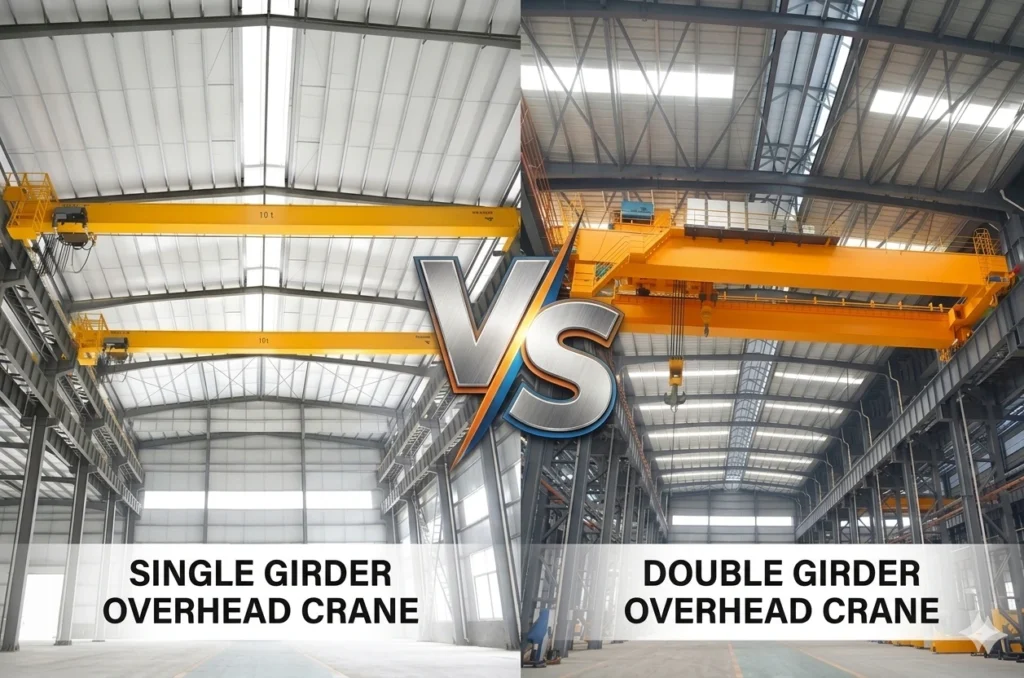
Side-by-Side Performance Comparison
| Factor | Single Girder | Double Girder | Decision Point |
|---|---|---|---|
| Capacity Range | Up to 20t (practical limit) | 5t – 500t+ | >20t → double girder |
| Span | Up to 22m (recommended) | Up to 35m+ | >22m → double girder |
| Hook Height | Lower (hoist hangs below beam) | Higher (hoist sits on top) | Headroom-sensitive → double |
| Deflection at Span | Higher | Lower | Precision ops → double |
| Initial Cost | Lower (15–30% less) | Higher | Long-term TCO often favors double |
| Maintenance Access | Limited | Full walkway access | High-duty → double |
| Duty Class Suitability | A3–A5 | A3–A8 | Foundry / steel mill → double |
Source: Comparative data based on published specifications from Demag, Konecranes, ZPMC and FEM design guidelines, 2022–2024.
When Single Girder EOT Crane is the Right Call
Single girder bridge cranes are cost-effective and appropriate for light workshop overhead crane applications: assembly lines, warehouse material handling, and maintenance bays. If your max lift is under 10 tons, your span is under 18 meters, and you’re running light-to-medium duty cycles, a single girder will serve the function at meaningfully lower capital cost.
The mistake is applying that same logic to a 25-ton foundry crane running three shifts—that’s where structural fatigue, rail wear, and hoist longevity become the dominant cost drivers, and the double girder’s higher upfront cost pays back within the first service interval.
Overhead Crane Components and Parts: What to Evaluate in a Procurement Specification?
A double girder EOT crane is not a commodity product. The long-term performance of your installation depends on the quality and specification of its core subsystems.
Main Structural and Mechanical Components
Bridge Girders: Fabricated from structural steel, typically Grade Q345B (GB/T 1591) or equivalent S355 (EN 10025). Weld quality to ISO 5817 Level B is standard for heavy-duty cranes. Request mill certificates and weld procedure qualifications from any industrial crane manufacturer you’re evaluating.
End Trucks and Wheels: The end trucks carry the entire bridge load to the runway rails. Wheel diameter and material hardness (typically 55–60 HRC surface hardness) determine rail wear rates. For steel mill crane applications, flanged wheels with hardened treads are non-negotiable.
Hoist Unit: The hoist is where most operational failures originate. Wire rope hoists (vs. chain hoists) are standard for double girder cranes above 5 tons. Key parameters: rope reeving configuration, drum groove pitch, and brake holding torque (typically 150–175% of rated load torque per FEM standards).
Electrical and Control Systems
| Component | Specification Consideration | Standard |
| Main Contactor / Drive | Variable Frequency Drive (VFD) for smooth start/stop | IEC 60947 |
| Pendant / Radio Control | IP65 minimum for industrial environments | IEC 60529 |
| Overload Protection | Electronic load limiter, 110% rated capacity cutoff | EN 13135:2013 |
| Festoon / Conductor Bar | Copper conductor bar preferred for long spans | Manufacturer spec |
| Control Panel Enclosure | IP54 minimum, IP65 for foundry / outdoor | IEC 60529 |
Source: EN 13135:2013 (Cranes – Safety – Design requirements for equipment), IEC 60947, IEC 60529. Table reflects industry standard specifications as of 2024.
Walkway and Maintenance Access
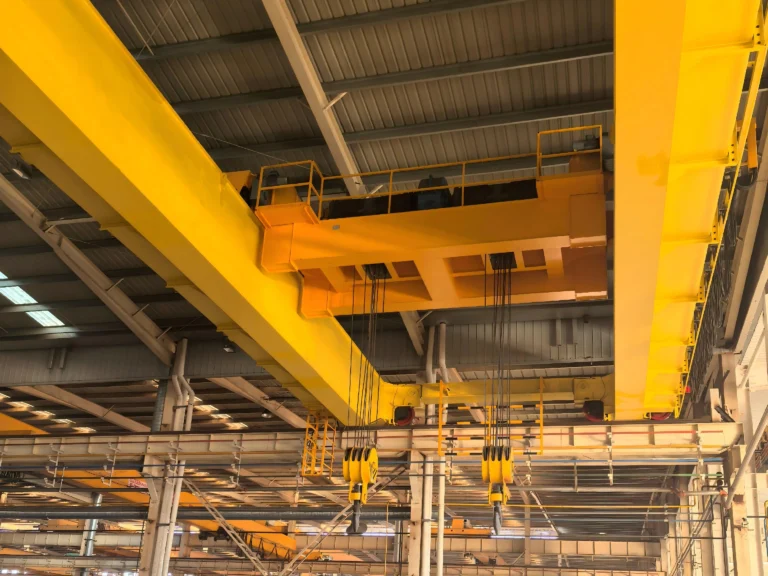
One structural feature that distinguishes heavy-duty double girder designs: the integrated maintenance walkway between the two girders. This gives technicians safe, direct access to hoist components, drive units, and electrical panels without scaffolding or crane shutdown for routine inspection. For any production line lifting equipment running A6 duty or above, this access is a meaningful factor in planned maintenance cost.
Application Scenarios: How Double Girder EOT Cranes Perform in the Field?
Understanding how double girder EOT cranes function in actual operating environments helps procurement teams anticipate the operational demands their specification must address.
Steel Mill Crane: Continuous Cycle, Extreme Loads
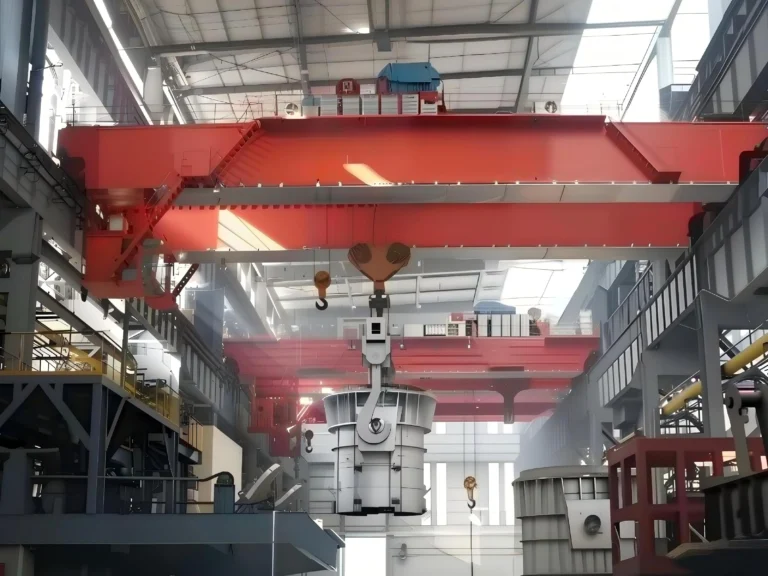
In integrated steel plants, bridge cranes handle tasks ranging from scrap charging to ladle transport—often at 50–320 ton capacities, running A7 or A8 duty cycles. The crane’s structural integrity under thermal cycling (from radiant heat), its hoist wire rope specification (galvanized or stainless options for high-temperature environments), and the reliability of its end-of-travel limits are all critical to both safety and productivity.
A publicly referenced example: Nucor Steel’s facilities in the U.S. utilize multiple heavy-duty double girder EOT cranes rated at 150–200 tons for melt shop operations—sourced from suppliers meeting CMAA Specification 70 (Crane Manufacturers Association of America), the North American counterpart to FEM standards.
Foundry Crane: Precision Positioning Under High Heat
Foundry cranes handle molten metal ladles, which demands a different risk profile than general material handling. Load control precision, anti-sway systems, and redundant braking are required features, not options. In many jurisdictions, cranes handling molten metal must comply with OSHA 29 CFR 1910.179 (U.S.) or Machinery Directive 2006/42/EC (EU), with annual third-party inspection requirements.
Workshop Overhead Crane: Flexibility Across Operations
For general manufacturing workshops—automotive components, heavy equipment assembly, fabrication—double girder cranes in the 10–50 ton range provide the flexibility to handle varied production needs. The ability to retrofit auxiliary hoists, add load cells for weighing, or install radio control systems makes the double girder platform a long-term asset rather than a fixed-function tool.
Selecting an Industrial Overhead Crane Manufacturer: What to Look For?
The technical specification matters, but so does the manufacturer’s ability to support the installation over a 20-year service life.
Evaluation Criteria for Supplier Qualification
- Certifications: CE marking (EU), CMAA certification (U.S.), or equivalent national certification. ISO 9001:2015 for manufacturing quality management is a baseline expectation.
- Design Documentation: Confirm the manufacturer provides FEM or CMAA design calculations, structural weld inspection reports, and load test certificates as standard deliverables.
- Spare Parts Availability: Request a 10-year spare parts availability commitment in writing. Proprietary components with single-source supply create long-term maintenance risk.
- Local Service Network: For heavy-duty applications, response time for unplanned maintenance matters. Evaluate the manufacturer’s regional service capability, not just their headquarters location.
- Reference Installations: Request verifiable reference sites in your industry segment—steel mill, foundry, or equivalent heavy-duty application—with comparable crane specifications.
Summary and Action Plan for Procurement Teams
A double girder eot crane is a long-cycle capital asset. The decisions made during specification and supplier selection determine total cost of ownership far more than the purchase price.
Key takeaways:
- Specify duty class accurately based on actual shift patterns and load frequency—not project to a lower class to reduce bid prices.
- Require double girder configuration for spans above 22 meters, loads above 20 tons, or applications demanding headroom optimization.
- Evaluate bridge crane components and parts—especially hoist unit quality, wheel specification, and VFD drive systems—as part of supplier qualification, not just as line items.
- Verify that your industrial crane manufacturer can provide certified design documentation, load test certificates, and a long-term parts commitment.
- For foundry crane and steel mill crane applications, confirm compliance with applicable safety standards and mandate third-party inspection as a contract requirement.
The right EOT crane specification, combined with a qualified supplier, is an investment that performs across the full service life of your facility.
Frequently Asked Questions
Q1: What is the practical maximum load capacity for a double girder overhead crane?
Standard production double girder EOT cranes are available up to approximately 500 tons from major manufacturers. Custom-engineered bridge cranes for specialized applications—hydroelectric dam construction, nuclear facility maintenance, or heavy marine assembly—can exceed this range. For most industrial applications (steel mill, foundry, manufacturing), the practical working range is 10 to 320 tons. When specifying load capacity, account for the weight of the lifting attachment (hooks, grabs, spreader bars) in addition to the payload, as these are included in the crane’s rated capacity under ISO 4301-1.
Q2: How do I determine the correct duty class for my double girder crane application?
Duty class is determined by two factors: the total number of lift cycles over the crane’s design life, and the average load ratio (ratio of typical working load to maximum rated load). ISO 4301-1:2016 and FEM 1.001 provide the calculation methodology. In practice: light workshop use with infrequent lifts maps to A3–A4; production line material handling at 1–2 shifts maps to A5–A6; steel mill or foundry operations at 2–3 shifts with near-full loads typically require A7–A8. Misclassifying duty class is one of the most common causes of premature structural fatigue in industrial crane installations.
Q3: What are the typical maintenance intervals for a heavy-duty double girder EOT crane?
Maintenance intervals vary by duty class and manufacturer, but a general framework based on FEM and EN 13135 guidance includes: daily pre-shift inspection (operator-level, visual and functional checks); weekly lubrication and brake inspection; monthly hoist rope and end fitting inspection; annual full structural and electrical inspection by a qualified third party. For A7–A8 duty cranes in steel mill or foundry environments, wire rope replacement intervals may be as short as 6–12 months depending on operating conditions.
Q4: What is the typical lead time for a double girder overhead crane from order to installation?
Lead times for standard double girder bridge cranes in the 10–50 ton range typically run 10–16 weeks from order confirmation, depending on manufacturer capacity and component availability. Heavy-duty or custom-engineered cranes (100 tons and above, unusual spans, or specialized service requirements) may require 20–36 weeks. Factor installation and commissioning time (typically 1–3 weeks depending on crane size and site conditions) into your project schedule.
Q5: Can a double girder EOT crane be upgraded after installation—for example, adding radio control or increasing capacity?
Radio control and variable frequency drive upgrades are generally feasible on existing double girder EOT crane installations, provided the control panel has adequate space and the electrical supply is sufficient. Capacity upgrades are more complex: increasing rated load requires structural recalculation of the bridge girders, end trucks, runway rail, and hoist unit. In most cases, a capacity increase beyond 10–15% of the original rating is not practical without significant structural modifications. If future capacity growth is anticipated, the most cost-effective approach is to specify the crane at the anticipated future capacity from the outset.
Related Standards & References
- ISO 4301-1:2016 – Cranes: Classification, General
- FEM 1.001 – Rules for the Design of Hoisting Appliances (6th Edition)
- EN 13135:2013 – Cranes Safety: Design Requirements for Equipment
- CMAA Specification 70 – Top Running Bridge and Gantry Type Multiple Girder EOT Cranes
- IEC 60529 – Degrees of Protection Provided by Enclosures (IP Code)
- IEC 60038:2009 – IEC Standard Voltages
Suggested visuals: (1) Double girder vs single girder cross-section comparison | (2) EOT crane component diagram with labeled parts | (3) Duty class selection decision tree (ISO 4301-1 framework)