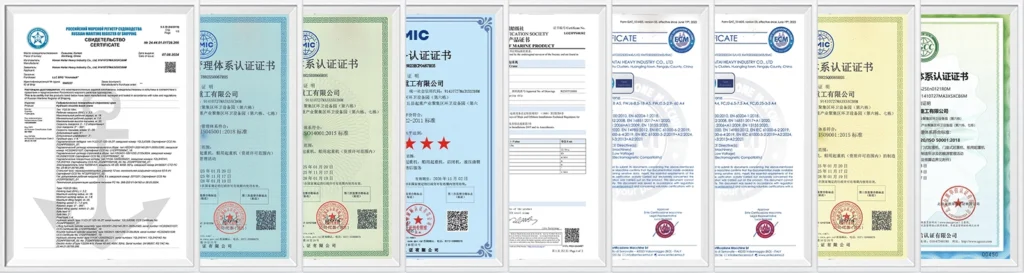
Certified marine cranes are not optional. For any crane installed on a vessel, offshore platform, or port service ship operating in international waters, classification society approval is a prerequisite — for vessel registration, insurance coverage, and project acceptance by operators and charterers alike.
Three classification societies appear most frequently in marine crane procurement: CCS (China Classification Society), ABS (American Bureau of Shipping), and BV (Bureau Veritas). All three provide internationally recognized crane certification, but they have different regional strengths, different approval workflows, and different levels of acceptance depending on the project type and vessel flag.
This guide explains what marine crane certification involves, how CCS, ABS, and BV compare in practice, and how to select the right certification for your specific project. Whether you are a shipowner, shipyard procurement manager, or offshore contractor, the goal is to help you avoid costly mistakes before manufacturing begins.
What Is Marine Crane Certification?
Marine crane certification is the formal process by which a classification society reviews, inspects, and approves a crane for installation and operation on a marine vessel or offshore structure. It is not a single test or stamp — it is a structured technical review that covers the crane’s design, materials, fabrication, testing, and operational safety systems.
Certification confirms that the crane meets defined standards for:
- Structural integrity: the crane’s frame, boom, slewing ring, and connections can withstand the design loads, including dynamic loads from vessel motion
- Lifting safety: rated capacity, safety factors, and overload protection systems are correctly engineered
- Operational reliability: all mechanical, hydraulic, and electrical systems function within approved parameters under marine operating conditions
- Compliance with marine standards: the crane meets the classification society’s rules for marine lifting equipment, which are considerably more demanding than most land-based crane standards
Marine cranes face conditions that land-based cranes do not. Vessel motion introduces dynamic loads. Saltwater environments accelerate corrosion. Offshore operations involve simultaneous loads from vessel heave, crane swing, and suspended load motion. These factors explain why marine crane certification requirements are structurally and technically more stringent than standard industrial lifting equipment compliance.
Why Crane Certification Matters
Safety Assurance
Classification approval is fundamentally a safety instrument. It provides an independent technical review that the crane’s design and construction meet defined safety standards. For cranes operating over water, handling loads adjacent to personnel, or lifting on moving platforms, the consequences of structural or mechanical failure are severe. Certification does not eliminate risk, but it provides systematic verification that known risk factors have been addressed in the design and manufacturing process.
Regulatory Compliance
Most flag states require that cranes installed on vessels under their registry hold valid classification approval from a recognized society. Without it, the vessel may not obtain or maintain its certificate of seaworthiness. For offshore projects, the crane approval documentation is typically a mandatory submission requirement during project tendering and contract award.
Insurance and Liability
Marine insurers routinely require evidence of valid crane certification before providing coverage for lifting operations or vessel hull and machinery policies. A crane operating without current classification approval creates an insurance gap that can expose the shipowner or operator to uninsured liability in the event of an incident. Project-specific cargo and liability insurers for offshore operations apply the same requirement.
International Acceptance
A certification from a recognized classification society — CCS, ABS, BV, Lloyd’s Register, DNV, or others — is accepted across most international marine jurisdictions. This matters for vessels that operate across multiple flag states and for manufacturers that supply cranes into global export markets. Certification from a less-recognized body may create acceptance problems in certain ports, under certain flag administrations, or on projects where the owner has specified a particular society.
Overview of Major Marine Classification Societies
CCS — China Classification Society
CCS is the national classification society of China, headquartered in Beijing. It is a member of the International Association of Classification Societies (IACS), which means its rules and approval processes meet the common structural and safety standards shared across IACS member societies.
CCS is the dominant classification body for vessels built in Chinese shipyards and has strong recognition across the Asia-Pacific region. For marine crane manufacturers based in China, CCS certification is the standard approval pathway for the domestic market and for many export projects where the buyer accepts CCS-class documentation.
ABS — American Bureau of Shipping
ABS is a U.S.-based classification society with headquarters in Houston, Texas. It has particular depth in offshore oil and gas applications — ABS rules for offshore lifting equipment and crane design are detailed and widely referenced in the global offshore industry.
ABS certification is typically required or strongly preferred for cranes installed on vessels registered under the U.S. flag, for offshore assets operating under U.S. jurisdictional oversight, and for international offshore projects where the operator or charterer specifies ABS approval. ABS maintains a strong global surveyor network with particular concentration in the Gulf of Mexico, the North Sea, and Southeast Asian offshore regions.
BV — Bureau Veritas
Bureau Veritas is a French classification society headquartered in Paris. It holds IACS membership and operates one of the largest global surveyor networks in the industry. BV has strong market presence in European shipbuilding, commercial shipping, and the offshore wind sector.
BV certification is commonly required for vessels registered under French, Belgian, and several other European flags, and is frequently specified on offshore wind installation vessel projects and European-led offshore energy developments. BV’s technical rules are rigorous and its approval processes are well documented, making it a common choice for manufacturers seeking broad European market acceptance.
CCS Certification Requirements for Marine Cranes
CCS crane certification follows the society’s Rules for the Classification of Sea-Going Ships and associated guidelines for deck machinery and lifting appliances.
- Design Review: The manufacturer submits engineering drawings, structural calculations, load case analyses, and equipment specifications to CCS for technical review. CCS surveyors assess whether the design meets the applicable rules for marine crane structural design, safety factors, and operational requirements. Design approval is issued before manufacturing begins.
- Material Approval: Steel plate, structural sections, forgings, and castings used in the crane structure must be sourced from CCS-approved mills or certified to recognized material standards. Mill certificates are reviewed and retained as part of the approval documentation.
- Welding Inspection: All critical structural welds are subject to CCS supervision during fabrication. Welding procedures must be pre-qualified and welders must hold valid CCS qualifications for the relevant weld processes and joint configurations.
- Manufacturing Surveillance: A CCS surveyor attends key stages of the manufacturing process — typically including structural assembly, hydraulic system installation, and electrical system integration — to verify that production matches the approved design.
- Load Testing: CCS requires both static and dynamic load testing prior to certification. Standard static test loads are typically 125% of rated capacity, applied to verify structural integrity without permanent deformation. Dynamic testing verifies operational function at or above rated load under representative operating conditions.
- Common Applications: Chinese shipyards, coastal and inland waterway vessels, port service craft, regional offshore support vessels, and export cranes destined for buyers who accept CCS-class documentation.
- Practical Considerations: CCS certification is generally the most cost-effective option for cranes manufactured in China. Surveyor availability in Chinese manufacturing locations is excellent. For projects outside the Asia-Pacific region or those requiring acceptance by charterers who specify non-CCS approval, the manufacturer may need to obtain dual certification or a letter of equivalence from another society.
ABS Certification Requirements for Marine Cranes
ABS certification for marine cranes is governed by the ABS Rules for Building and Classing Marine Vessels and the ABS Guide for Certification of Lifting Appliances.
- Engineering Review: ABS requires a complete design package submission including structural drawings, finite element analysis (FEA) for critical components, wire rope or chain system calculations, hydraulic system schematics, and electrical documentation. The technical review is thorough, particularly for cranes with offshore lifting applications where dynamic load assessment is detailed.
- Offshore Lifting Requirements: For cranes intended for offshore oil and gas operations, ABS applies additional requirements covering crane boom design for multi-directional wave-induced motion, pedestal and foundation design for offshore platform integration, and offshore personnel transfer (OPT) lifting requirements where applicable. These requirements reflect ABS’s deep experience in the offshore sector.
- Structural Verification: Critical structural members are assessed against ABS structural rules, including fatigue life calculations for components subject to cyclic loading during offshore operations.
- Testing and Inspection: ABS requires witnessed load testing at the manufacturer’s facility or at a recognized test facility. Test load requirements align broadly with other IACS member societies. NDT inspection of critical welds is required and must be performed by certified personnel using ABS-accepted procedures.
- Common Applications: U.S.-flag vessels, Gulf of Mexico offshore assets, international FPSO and offshore platform projects, offshore support vessel new builds specifying ABS class, and projects where the operator or major oil company requires ABS documentation.
- Practical Considerations: ABS certification carries strong recognition in North American and Gulf of Mexico offshore markets and is widely accepted across international offshore project specifications. Survey scheduling with ABS in non-U.S. manufacturing locations requires advance coordination, and certification costs tend to be higher than CCS for equivalent crane specifications.
BV Certification Requirements for Marine Cranes
BV certification for marine lifting appliances is governed by the BV Rules for the Classification of Steel Ships and NR 526, BV’s Rules for Lifting Appliances on Board Ships and Offshore Units.
- Technical Design Review: BV design review covers structural analysis, lifting system engineering, hydraulic and electrical documentation, and safety device specifications. BV applies detailed review procedures for cranes destined for offshore wind installation vessels, a sector in which BV has developed specific technical guidance reflecting the demands of monopile, jacket, and transition piece installation lifting.
- Manufacturing Inspection: BV surveyors conduct in-process inspections at key manufacturing milestones. BV maintains a large global surveyor network, which generally supports accessible survey scheduling across major industrial manufacturing regions.
- Quality Assurance Procedures: BV places emphasis on the manufacturer’s quality management system as part of the approval framework. ISO 9001 certification or equivalent documented quality controls are typically expected, with BV retaining the right to audit manufacturing quality processes.
- Functional Testing: BV requires comprehensive functional testing of all operational systems — including overload protection, emergency stop, anti-two-block systems, and safe load indicators — prior to certification.
- Common Applications: European-flag vessels, offshore wind installation vessels, commercial shipping newbuilds at European yards, international marine projects where BV is specified by the vessel operator, and projects involving French or Belgian flag registration.
- Practical Considerations: BV certification provides strong acceptance across European markets and is increasingly referenced in offshore wind project specifications globally. BV’s technical requirements for offshore applications are detailed. Lead times for design review can be longer than CCS for first-time applicants who do not have an established BV approval relationship.
CCS vs ABS vs BV — Key Differences
| Category | CCS | ABS | BV |
|---|---|---|---|
| Headquarters | Beijing, China | Houston, USA | Paris, France |
| IACS Member | Yes | Yes | Yes |
| Primary Market Strength | China, Asia-Pacific | USA, offshore oil & gas, international | Europe, offshore wind, international |
| Offshore Oil & Gas Expertise | Moderate | High | Moderate-High |
| Offshore Wind Expertise | Developing | Moderate | High |
| Global Surveyor Coverage | Strong in Asia | Strong in Americas, offshore regions | Strong globally |
| Certification Cost | Generally lower | Generally higher | Mid to higher range |
| Design Review Depth | Standard IACS level | Detailed for offshore applications | Detailed, with QMS emphasis |
| Best Project Fit | China-built cranes, Asia-Pacific projects | U.S.-flag, offshore O&G, international | European flag, offshore wind, European projects |
| Acceptance in Chinese Yards | Excellent | Good | Good |
| Acceptance in European Projects | Limited for some specs | Widely accepted | Preferred |
The table above reflects general market positioning. Many projects accept multiple classification societies, and dual certification — where a crane holds approval from two societies simultaneously — is not uncommon on high-value or internationally operating vessels.
How to Choose the Right Certification for Your Marine Crane
Vessel Registration Location
The flag state of the vessel often determines which classification societies are accepted. Many flag states mandate IACS member society approval, which includes all three discussed here. Some flags have preferred or mandated societies — vessels registered under Chinese flag typically use CCS, while vessels under certain European flags may have BV or Lloyd’s Register as the default society.
Shipowner Requirements
Many shipowners specify the classification society in their crane purchase order or vessel specification. This is the most direct guidance available and should be confirmed before initiating any certification process. Proceeding without confirming owner requirements is one of the most common and costly mistakes in marine crane procurement.
Offshore Project Requirements
Offshore oil and gas operators and their engineering contractors typically specify ABS or DNV for offshore lifting equipment in international projects. European offshore wind projects increasingly specify BV, DNV, or Lloyd’s Register. Confirming the project-specific requirement at the enquiry stage prevents late-stage certification changes.
Regional Regulatory Preferences
For cranes primarily operating within Chinese coastal and inland waters, CCS certification is fully accepted and is the most practical choice. For cranes that will operate across multiple international jurisdictions, ABS or BV certification provides broader acceptance with fewer case-by-case approval requirements.
Customer-Specified Classification Society
In many commercial marine transactions, the buyer simply specifies the required society in the purchase contract. Where no society is specified, the manufacturer should proactively request clarification before beginning the design submission process. Changing the certification society after design approval has been issued requires resubmission of drawings and recalculation of fees, adding both time and cost to the project.
Conclusion
CCS, ABS, and BV are all credible, IACS-member classification societies capable of providing internationally recognized marine crane certification. The right choice is not primarily about which society has better technical rules — all three meet IACS common standards — but about which society’s approval is required or preferred by the vessel flag, project operator, and end customer.
CCS is the natural choice for China-built cranes operating in the Asia-Pacific region. ABS brings unmatched depth in offshore oil and gas applications and strong acceptance in North American and international offshore markets. BV offers broad European market coverage and is increasingly the reference society for offshore wind projects globally.
Select the classification society before beginning the design submission process. Confirm the requirement in writing with the vessel owner or project operator. Allow adequate schedule margin for design review and surveyor attendance. These three steps prevent the most common and costly marine crane certification mistakes.
Request a marine crane certification consultation for your project. Contact our engineering team for classification approval support across CCS, ABS, and BV. Discuss your certified marine crane requirements with our technical specialists.

Frequently Asked Questions
Can a marine crane hold certification from more than one classification society simultaneously?
Yes. Dual certification — where a crane is reviewed and approved by two classification societies simultaneously during the manufacturing process — is technically possible and commercially available. It requires submitting design documentation to both societies, coordinating survey attendance for both during manufacturing and testing, and paying certification fees to both. Dual certification is most commonly requested on high-value cranes for vessels that may operate under different flag registrations during their service life, or on cranes where the shipyard holds one class and the owner specifies another. It adds cost and administrative complexity but eliminates the need for retroactive certification if the vessel’s operating requirements change.
How long does marine crane certification typically take from design submission to final certificate?
The total timeline depends on the classification society, the complexity of the crane, and the manufacturer’s document preparation quality. Design review typically requires four to twelve weeks from a complete submission. Manufacturing inspection milestones are scheduled during production and depend on the crane’s build schedule. Load testing and final certification typically occur in the last two to four weeks before delivery. From initial design submission to final certificate, total elapsed time for a standard marine deck crane is typically four to eight months. Offshore cranes with more complex design review requirements can take longer. Incomplete or poor-quality initial submissions are the most common cause of extended design review timelines.
What happens if a marine crane fails its load test during certification?
A load test failure triggers a formal non-conformance process. The classification society surveyor documents the failure, and the manufacturer must identify the root cause — whether structural, mechanical, hydraulic, or related to a safety device — and implement corrective action. Depending on the nature of the failure, this may require repair, component replacement, or redesign of the affected system. The corrective work must be reviewed and approved by the surveyor before retesting. The additional time and cost of failure investigation, repair, and retest are borne by the manufacturer. This is why pre-test verification of all systems and a dry run of safety device function checks before the witnessed test are standard good practice.
Is CCS certification accepted on vessels operating in European waters?
CCS is an IACS member society, and its certification is technically recognized under the IACS framework. However, acceptance in specific European operating contexts depends on additional factors: the vessel’s flag state, the port state control requirements of the countries where the vessel operates, and the requirements of any charterer or project operator. Some European flag states do not recognize CCS as an approved society for vessels on their registry. Some offshore operators and charterers in European waters specify non-CCS approval by name. It is not accurate to say CCS is universally rejected in European waters, nor is it accurate to assume it will always be accepted. Confirming acceptance with the relevant flag administration and any project-specific operator specifications is essential before proceeding with CCS certification for a crane intended for European deployment.
What documentation is provided after marine crane certification is complete?
Upon successful completion of the certification process, the classification society issues a formal certificate of approval or a lifting appliance certificate — the exact document title varies by society. This certificate identifies the crane by manufacturer, serial number, rated capacity, and certification standard, and specifies any operational limitations. Supporting documentation typically includes the approved design drawings stamped by the society, the load test report, the NDT inspection report, and any material or welding inspection records. This documentation package is the evidence of certification and must be maintained onboard the vessel throughout the crane’s service life. Periodic renewal surveys — typically every five years — are required to maintain the certificate in valid status.