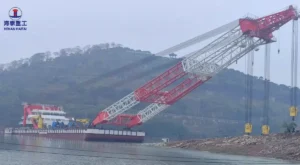
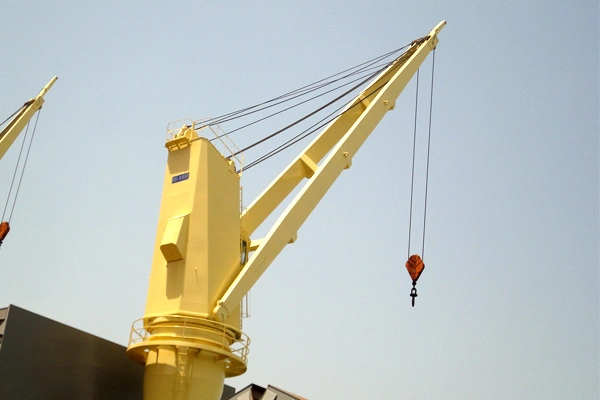
A ship deck crane’s rated capacity is not a single number you can read off a specification sheet and apply universally. It is a capacity that changes with boom angle, working radius, sea state, and vessel stability — and misunderstanding that relationship is one of the most common sources of unsafe lifting incidents in marine operations.
Vessel owners, ship operators, and procurement teams regularly encounter this problem. A crane rated at 25 tonnes sounds adequate for the job. But at the required working radius, in the actual sea state, on the specific vessel where it is installed — that 25 tonnes may not be the safe operational limit at all. Understanding how marine deck crane load ratings are defined, calculated, and applied in real conditions is not a technical detail reserved for engineers. It is essential knowledge for anyone responsible for selecting, operating, or procuring lifting equipment on a vessel.
This guide explains how ship deck crane capacities are determined, how to read a crane load chart, what standards govern marine crane safety, and what factors vessel owners must evaluate before specifying a crane for their application.
What Is a Ship Deck Crane?
Definition and Working Principle
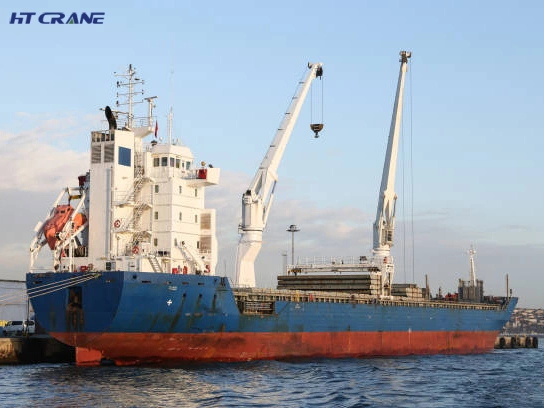
A ship deck crane — also called a marine deck crane or vessel crane — is a lifting system permanently installed on the deck of a ship, offshore platform, or marine vessel. It lifts, swings, and lowers cargo, equipment, and supplies using a combination of hoisting, slewing, and luffing (boom angle change) movements. Unlike shore-based cranes, a marine deck crane must function reliably in the dynamic environment of a vessel at sea — subject to rolling, pitching, heaving, wind, and wave-induced motion.
Main Structural Components
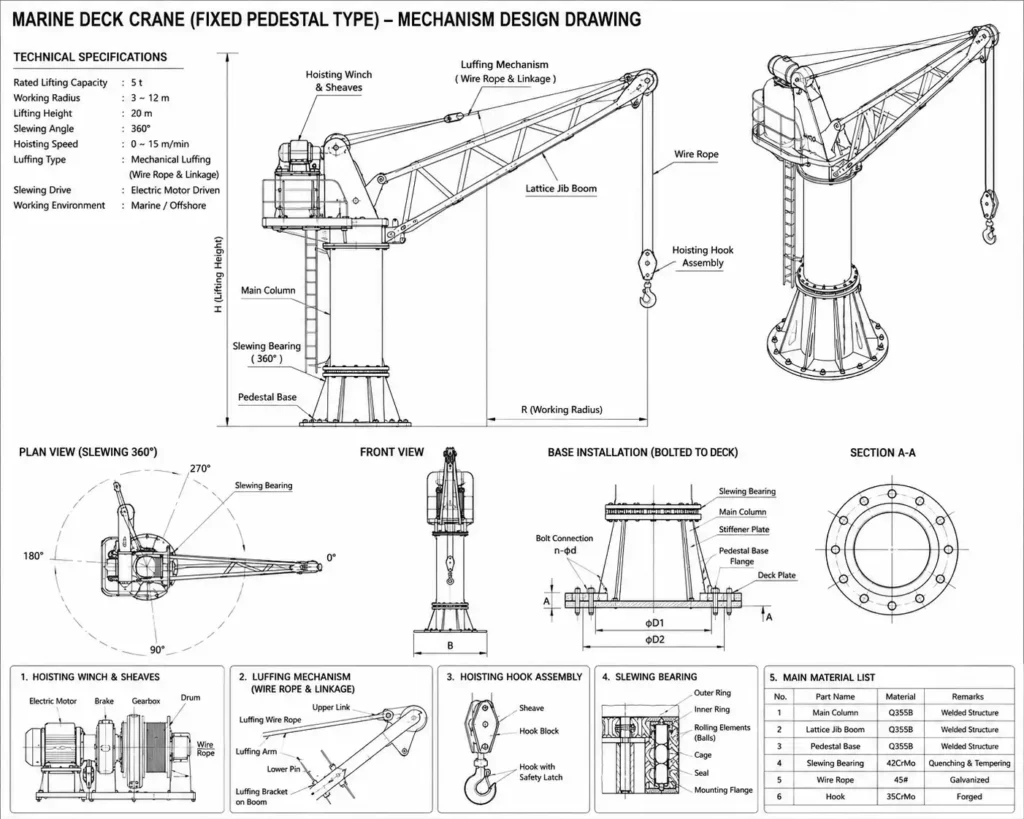
- Pedestal: The fixed base structure mounted to the vessel’s deck, through which all crane loads are transferred to the ship’s structure
- Slewing system: The rotating mechanism that allows the crane to swing through its working arc, typically 360 degrees
- Boom: The structural arm that extends outward from the crane body, defining the working radius and hook height
- Winch and hoisting system: The powered drum and wire rope or chain system that raises and lowers the load
- Hydraulic or electric drive: The power system driving all crane motions — most marine deck cranes use hydraulic or electro-hydraulic systems for their compact power density and reliability in marine environments
Common Crane Types on Vessels
Telescopic boom crane: The boom extends and retracts to vary the working radius. Simple to operate, with a consistent load capacity across a range of reach positions. Common on cargo vessels and offshore supply ships.
Knuckle boom crane: The boom articulates at a mid-point, allowing compact stowage and precise positioning in confined spaces. Widely used on offshore support vessels and fishing vessels where deck space is limited.
Stiff boom crane: A fixed-length boom with no telescoping or knuckling. Higher structural efficiency for a given weight, used where reach variability is less important than lift capacity and simplicity.
What Does Ship Deck Crane Load Rating Mean?
Safe Working Load
The load rating of a ship deck crane is expressed as its Safe Working Load (SWL) — the maximum load the crane is designed to lift under defined conditions. SWL is not the crane’s theoretical breaking load or its structural ultimate capacity. It is the load that can be handled safely within the designed safety margins, at a specified radius, in defined operating conditions.
The distinction between maximum rated load and operational SWL is critical. The nameplate or specification may state a maximum figure — typically at the shortest working radius and the most favorable boom angle. At longer radii or higher boom angles, the SWL reduces. The load chart defines this relationship across the crane’s full working envelope.
Why Marine Crane Ratings Differ from Land-Based Cranes
A land-based crane operates on a stable foundation. Its rated capacity is determined primarily by structural strength and stability of the crane itself. A marine deck crane operates on a vessel that moves — and that motion introduces load effects that do not exist in shore-based lifting.
Vessel motion in waves imposes dynamic forces on the lifted load. A 10-tonne load lifted from a stationary deck imposes 10 tonnes on the crane structure. The same load lifted while the vessel heaves, rolls, and pitches imposes significantly higher peak forces — the dynamic load factor multiplies the static load by a coefficient that increases with sea state severity. Marine cranes are designed and rated with this dynamic environment in mind; applying a land crane’s static load rating to an offshore operation produces an unsafe result.
How Ship Deck Crane Load Ratings Are Calculated
Boom Length and Working Radius
Working radius — the horizontal distance from the crane’s slewing center to the hook — is the primary variable in crane load capacity. As the boom extends outward, the overturning moment on the crane structure increases for any given load. To maintain structural safety margins, the maximum load the crane can safely lift decreases as radius increases.
This relationship is not linear. A crane rated at 25 tonnes at 5 metres radius may be rated at 10 tonnes at 12 metres radius. Operators must consult the load chart for every lift configuration — not apply the crane’s headline capacity across all situations.
Vessel Stability and List
A crane lifting a load applies a turning moment to the vessel as well as to the crane structure. The vessel’s metacentric height (GM) — a measure of its stability — determines how far it will heel under that moment. Classification society rules require crane installations to be assessed against the vessel’s stability characteristics; crane load ratings may be restricted based on the stability of the specific vessel the crane is installed on.
A vessel with reduced stability — from cargo distribution, fuel consumption, or flooding — has a reduced safe lifting envelope even if the crane itself is unchanged. Vessel operators must account for current loading conditions, not just the crane’s rated capacity in isolation.
Dynamic Load Factor
In offshore and open-sea operations, wave-induced vessel motion imposes a dynamic amplification on all lifted loads. Classification societies publish dynamic load factors (DLF) that account for this amplification as a function of sea state and lifting operation type. A typical DLF for offshore crane operations in moderate sea states ranges from 1.1 to 1.3 — meaning a 10-tonne static load creates a dynamic peak load equivalent of 11 to 13 tonnes on the crane structure.
DNV-ST-0378 (Offshore and Platform Lifting Appliances, Det Norske Veritas) and similar standards from ABS and Lloyd’s Register provide the calculation methodology for dynamic load factors in offshore crane design and operation. These factors are built into the crane’s rated SWL for its specified operating environment.
Crane Structural Strength
The boom, slewing ring, pedestal, and deck connection are all structural elements with defined load limits. The weakest element in the load path defines the crane’s capacity at any given configuration. For telescopic booms, capacity at extended reach is often governed by boom bending stress rather than by hydraulic system limits. For knuckle boom cranes, the articulation joint and its hydraulic cylinders are often the governing elements at certain configurations.
Hydraulic and Mechanical System Limits
The hoisting winch, hydraulic pump, and control system all have defined performance limits. Maximum line pull on the hoisting drum, maximum hydraulic working pressure, and duty cycle rating for the hydraulic system all set boundaries on crane performance. These limits interact with structural limits — in some configurations, the hydraulic system limit is reached before the structural limit, and vice versa.
Environmental Conditions
Wind speed is a direct factor in crane load rating. Most marine deck cranes are rated for operation up to a defined wind speed — typically 20 to 25 m/s for standard offshore supply vessel cranes. Above this wind speed, operations must cease regardless of the static load capacity. In Arctic or high-wind operating areas, reduced operational wind speed limits may apply, and the crane’s effective working capacity under load in high winds must be verified against the manufacturer’s load chart.
Understanding Ship Deck Crane Load Charts
What a Load Chart Shows
A typical marine deck crane load chart presents:
- Maximum SWL at each working radius: The load limit at each radius step across the crane’s working envelope
- Boom angle restrictions: Some configurations may be restricted to certain boom angle ranges for structural reasons
- Reeving configuration: Whether the chart applies to single or double fall hoisting — reeving affects both the load capacity and the hoisting speed
- Sea state and operational limits: The maximum sea state (expressed as significant wave height or sea state class) within which the rated capacity applies
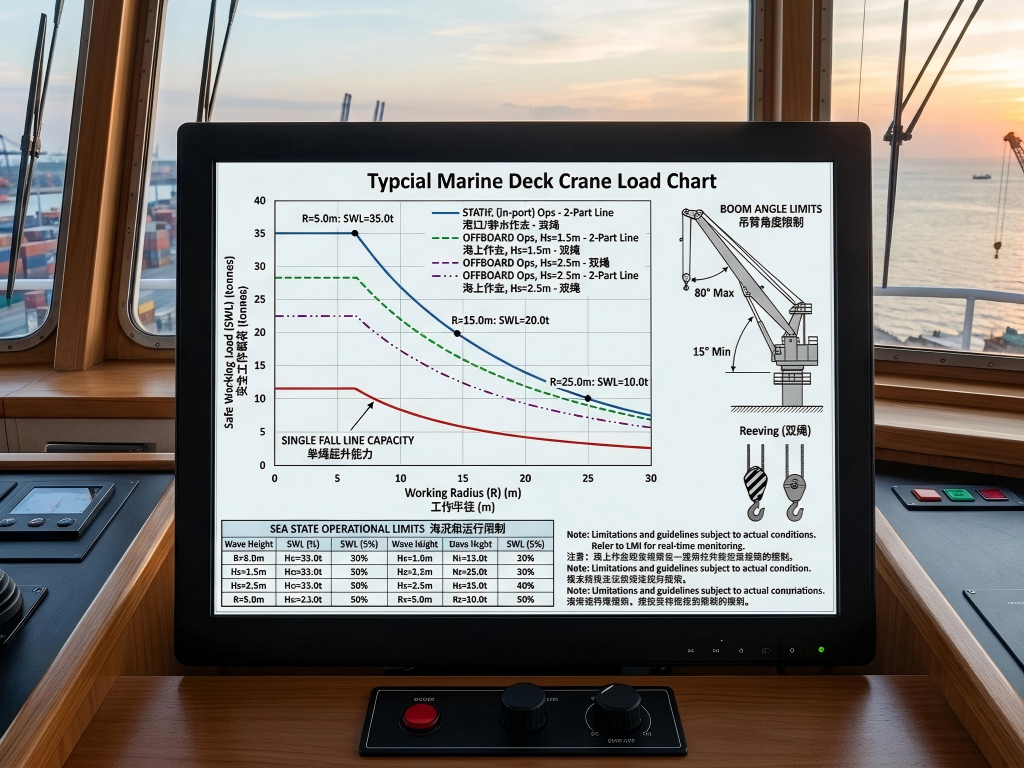
Reading a Load Chart in Practice
An offshore supply vessel crane rated at 30 tonnes SWL at 8 metres radius may show 18 tonnes SWL at 14 metres radius and 12 tonnes at 18 metres radius. An operator planning to lift a 15-tonne package at 16 metres radius must verify that the chart permits this — in this example, it does not at standard reeving, and the lift would need to be replanned.
This is not an edge case. Working radius requirements change constantly in offshore cargo operations — ship position relative to the platform, deck layout constraints, and cargo positioning all affect the actual radius at which lifts occur. Operators must plan each lift against the load chart, not against the headline capacity.
Why Strict Compliance Is Non-Negotiable
Exceeding the load chart limits — even marginally — removes the designed safety margin from the crane structure. Marine lifting accidents frequently involve loads that were individually within the crane’s maximum rated capacity but exceeded the capacity at the actual working radius used. Classification societies and flag state authorities treat load chart violations as serious safety incidents. Operators and vessel owners carry direct liability for injuries, equipment damage, and environmental consequences when crane operations exceed rated limits.
Common Ship Deck Crane Load Capacity Ranges
| Crane Type | Typical SWL Range | Common Applications |
|---|---|---|
| Small deck crane | 1–10 t | Fishing vessels, utility boats, crew transfer vessels |
| Medium marine crane | 10–50 t | Cargo ships, offshore supply vessels, research ships |
| Heavy-duty offshore crane | 50–300 t | Offshore platforms, heavy construction vessels, subsea support |
| Specialist subsea crane | 300 t+ | Deep-water installation vessels, cable lay ships |
These ranges are indicative. Actual crane selection is driven by the specific lift profile of the vessel’s operation — the heaviest regular lift, the required working radius for that lift, the vessel’s stability characteristics, and the operating sea state. A 50-tonne crane installed on a vessel with inadequate stability may have a lower effective SWL than a well-designed 30-tonne crane on a more stable hull.
Safety Standards and Marine Certifications
Marine deck cranes must comply with the classification rules of the applicable marine authority for the vessel’s flag state and trading area. The major classification societies are:
- DNV (Det Norske Veritas): DNV-ST-0378 covers offshore and platform lifting appliances; DNV rules apply to a large proportion of the global offshore fleet
- ABS (American Bureau of Shipping): ABS Rules for Building and Classing Marine Vessels, Part 4 covers deck machinery including cranes
- BV (Bureau Veritas): BV NR 526 covers lifting appliances on ships and offshore units
- CCS (China Classification Society): Rules for Classification of Sea-going Ships, applicable to Chinese-flagged vessels
Key Safety Requirements
Load testing: Factory proof load testing at 125% of rated SWL is standard before delivery. Periodic load testing during the crane’s service life is required by most classification societies.
Overload protection: Rated capacity indicators (RCIs) or load moment indicators (LMIs) alert operators when the crane approaches its SWL limit. Automatic cutout systems prevent hoisting beyond rated load on most modern marine cranes.
Anti-two-block (ATB) systems: Prevent the hook block from contacting the boom tip — a potentially catastrophic event that has caused numerous marine lifting accidents. ATB systems are mandatory on most offshore-rated marine cranes.
Emergency stop: Independent emergency stop capability, operable from the crane cab and from deck level, is a standard safety requirement.
Regular inspection: Classification societies require periodic inspection — typically annual or biennial — with documented records. Flag state port state control officers may inspect crane documentation and condition during vessel port calls.
Conclusion
Ship deck crane load ratings are not a single figure — they are a capacity profile that varies with working radius, vessel stability, environmental conditions, and operational sea state. Understanding this relationship is fundamental to safe marine crane operation and to making the correct procurement decision for a vessel’s lifting requirements.
The key principles are straightforward: SWL defines the safe operational limit, not a theoretical maximum; the load chart defines how that SWL varies across the crane’s working envelope; and dynamic load effects in offshore conditions mean that static load calculations are not sufficient for marine applications. Classification society standards — DNV, ABS, BV, CCS, Lloyd’s Register — establish the design and testing framework that ensures marine cranes are built and operated to these principles.
For vessel owners and procurement teams, the most important step is defining the actual lifting task in full — the loads, the radii, the sea state, the duty cycle, and the operational environment — before evaluating crane options. A crane specified against real operational requirements, certified by the appropriate classification society, and supported by a manufacturer with marine project experience will deliver safe, reliable service across its operational life.
Request a customized marine crane solution matched to your vessel type, lifting requirements, and operational area. Contact our engineering team for a vessel crane consultation — we develop crane specifications based on real operational parameters, not generic capacity categories.

Frequently Asked Questions
What is the difference between SWL and WLL for a marine deck crane?
SWL (Safe Working Load) and WLL (Working Load Limit) are often used interchangeably, but they have a technical distinction in some contexts. SWL is the load a crane or lifting appliance is designed to handle safely under defined conditions — it incorporates the safety factor built into the design. WLL is typically used for individual lifting accessories — slings, shackles, hooks — and represents the maximum load that component should carry in service. For marine deck crane specifications and load charts, SWL is the standard term. When specifying the complete lifting system — crane plus rigging — both the crane SWL and the WLL of all rigging components must be compatible with the planned lift weight.
How often must a ship deck crane be load tested?
Initial proof load testing at 125% of rated SWL is required before delivery and classification approval. After installation on the vessel, classification societies typically require periodic load testing at defined intervals — commonly every five years, though this varies by classification society and crane type. Annual visual and functional inspections by a competent person are required more frequently. Flag state regulations and individual classification society rules should be consulted for the specific inspection and testing schedule applicable to a given vessel and crane installation. Records of all inspections and tests must be maintained as part of the crane’s certification documentation.
Can a ship deck crane be uprated to a higher SWL after installation?
In principle, yes — but in practice, uprating a marine deck crane is a significant engineering and certification process, not a simple adjustment. It requires a structural analysis of the crane at the proposed higher SWL, verification that the vessel’s deck structure can handle the increased pedestal loads, review and approval by the applicable classification society, and load testing at the new rating. In most cases, the cost and complexity of uprating an existing crane approaches the cost of replacing it with a correctly-rated unit. If future capacity growth is anticipated, the correct approach is to specify the crane at the required future capacity from the outset.
What sea state restrictions typically apply to offshore deck crane operations?
Most marine deck cranes for offshore supply vessel applications are rated for operations up to a defined significant wave height — commonly Hs 3.0 to 3.5 metres for standard offshore supply vessel cranes, with reduced SWL limits applying in higher sea states. Above the maximum rated sea state, lifting operations must cease. Cranes equipped with active heave compensation (AHC) can operate in higher sea states than non-compensated units, but AHC does not eliminate sea state restrictions entirely — it extends them. The specific sea state limits for any crane installation are defined in the manufacturer’s operating manual and must be reflected in the vessel’s lifting procedures.
Does the working radius affect SWL for all types of marine deck cranes equally?
The relationship between working radius and SWL varies by crane type and structural design, but the principle — capacity decreases as radius increases — applies universally. Knuckle boom cranes typically have a more complex load chart than stiff boom cranes because their capacity is governed by different structural elements at different boom configurations. Telescopic boom cranes show a relatively predictable reduction in SWL as the boom extends. In all cases, the manufacturer’s load chart for the specific crane model is the authoritative reference — general rules of thumb about radius-capacity relationships should never be substituted for the actual load chart in operational planning.