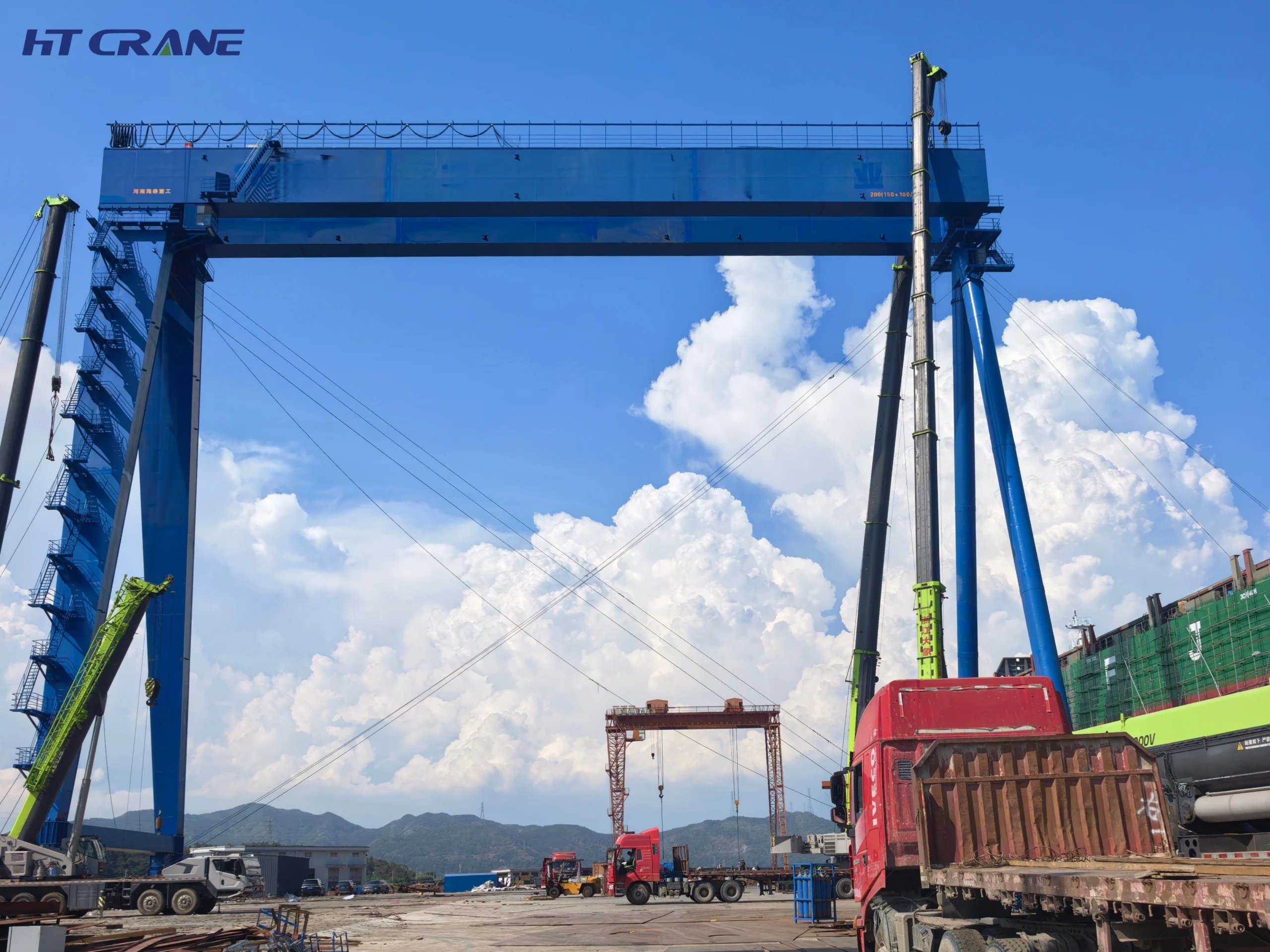
This case study documents a completed 500 ton shipyard gantry crane project delivered to a major shipbuilding facility on Shanghai’s Changjiang (Yangtze River) waterfront.
From the buyer’s initial technical brief to final handover and commissioning — this article covers the project scope, technical decisions, CCS certification process, delivery challenges, and the operational outcomes the yard achieved.
If you are evaluating a similar procurement — whether for a Shanghai facility or any Chinese shipyard — this project gives you a ground-level reference for what a well-executed gantry crane project looks like in practice.

Project Background of the 500 Ton Shipyard Gantry Crane
The Client and Their Facility
The client is a medium-sized shipbuilding company located in the Chongming Island area of Shanghai, specializing in bulk carriers, tankers, and general cargo vessels in the 15,000–50,000 DWT range. The yard occupies a riverside site of approximately 35 hectares with two building berths and one drydock.
Their existing crane infrastructure was aging — a pair of older portal cranes, each rated at 200T — and had become the production bottleneck. Block sections that needed to weigh 400–500T to match their production program had to be sub-divided into smaller sections, increasing the number of berth joints to be welded and slowing the production cycle. A single high-capacity crane was the strategic investment required to unlock the next stage of yard development.
The yard had an active production program with vessels under construction. Installation had to minimize disruption to ongoing production — a schedule constraint that shaped every aspect of the project planning.
Why 500T Was the Right Capacity?
The decision to specify 500T main hoist capacity was driven by the yard’s heaviest planned block section: a double-bottom tank section for a 35,000 DWT bulk carrier, with a target block weight of 420T including temporary installation steelwork and lifting beams.
The selection rationale: maximum planned block weight (420T) multiplied by 1.15 safety factor for weighing uncertainty and future planning flexibility, plus 30T allowance for lifting beams and rigging gear, gave a total lifted weight of 513T. The 500T SWL with a verified overload capacity to 110% (550T) at factory acceptance test provided the required coverage.
This calculation approach — working back from the heaviest planned lift, not selecting a round number — is the correct methodology for any shipyard gantry crane capacity decision.
Technical Specification of 500 Ton Shipyard Gantry Crane
Main Crane Parameters
| Parameter | Specified Value |
|---|---|
| Main Hoist Capacity | 500T |
| Auxiliary Hoist Capacity | 100T |
| Span (Rail Centreline to Rail Centreline) | 126m |
| Cantilever — Quayside | 18m |
| Cantilever — Inland Side | 12m |
| Total Working Width | 156m |
| Main Hook Lifting Height | 62m above rail level |
| Auxiliary Hook Lifting Height | 68m above rail level |
| Main Hoist Speed (Full Load) | 1.2 m/min |
| Main Hoist Speed (No Load) | 8 m/min |
| Auxiliary Hoist Speed (Full Load) | 4 m/min |
| Trolley Travel Speed | 25 m/min |
| Gantry Travel Speed | 18 m/min |
| Work Duty Class | A6 (ISO 4301) |
| Total Crane Weight (Approx.) | 2,400T |
| Rail Type | QU120 heavy crane rail |
| Power Supply | 10kV yard supply, crane-side transformer to 6kV |
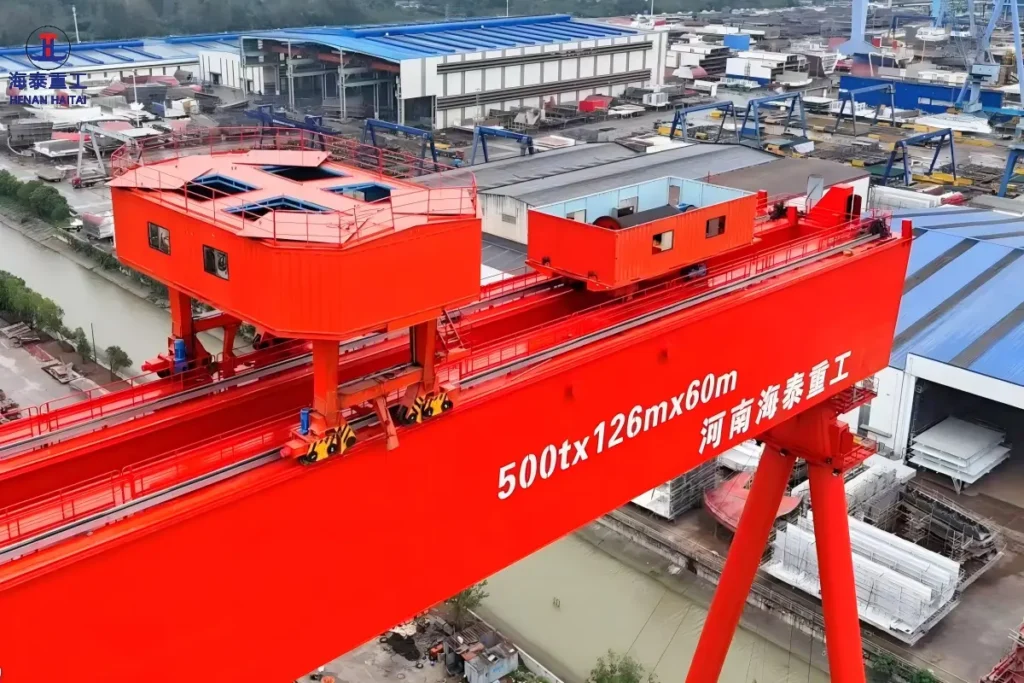
The main girder uses box section construction — fabricated from Q345B structural plate with full-penetration welds on all primary joints. The box girder cross-section measures 4.2m height × 2.8m width, providing the bending stiffness required for the 126m span while keeping the structure within the rail foundation design parameters.
The 500 ton shipyard gantry crane uses a rigid leg on the quayside rail and a flexible (hinged) leg on the inland rail. The flexible leg uses a pin connection at the girder-to-leg junction, allowing ±35mm rotation to accommodate differential thermal expansion between the two rail tracks across the 126m span — a design feature that prevents accumulated thermal stress from inducing fatigue at the main structural connections.
Anti-Sway and Positioning System
At a main hook height of 62 metres and a trolley travel speed of 25 m/min, uncontrolled pendulum swing at the hook can reach 2–3 metres at full travel — creating unacceptable positional error when lowering a 420T block section onto building berth frames. The control system includes:
- Electronic anti-sway using drive motion profiling on the trolley axis
- Laser distance sensor on the hook block providing real-time position feedback to the cabin display
- Slow-approach mode: the trolley and gantry automatically reduce to creep speed (3 m/min) when the hook approaches within 5m of the programmed landing coordinate
- Residual swing at landing position: less than 150mm at standard operating speed
This system allows a two-operator team (crane operator + signalman) to land a 400T block section within 50mm of target in standard conditions — matching the production accuracy targets the yard’s block assembly planning requires.
Corrosion Protection System
The Changjiang waterfront location presents a challenging corrosion environment: high humidity year-round, salt-laden air from the estuary, and tidal variation in the dock area. The coating system specified for this project exceeds our standard shipyard specification:
| Layer | Material | DFT |
|---|---|---|
| Surface preparation | Sa 2.5 blast (ISO 8501-1) | — |
| Primer | Zinc-rich epoxy (65% zinc) | 75 microns |
| Mid-coat | High-build epoxy | 150 microns |
| Topcoat | Aliphatic polyurethane | 80 microns |
| Stripe coat | Applied to all welds, edges, bolt heads | Additional layer |
| Total DFT | 305 microns minimum |
All fasteners exposed to the external environment use hot-dip galvanized bolts and stainless steel washers. Electrical enclosures are IP65-rated throughout.
CCS Certification Process
Why CCS Was Required
CCS (China Classification Society) certification is the standard for lifting equipment at classified Chinese shipyards. The buyer’s facility holds a CCS-classified shipbuilding license, and the insurance and quality management requirements of their major clients — Chinese state-owned shipping companies — specify CCS-certified cranes for their nominated yards.
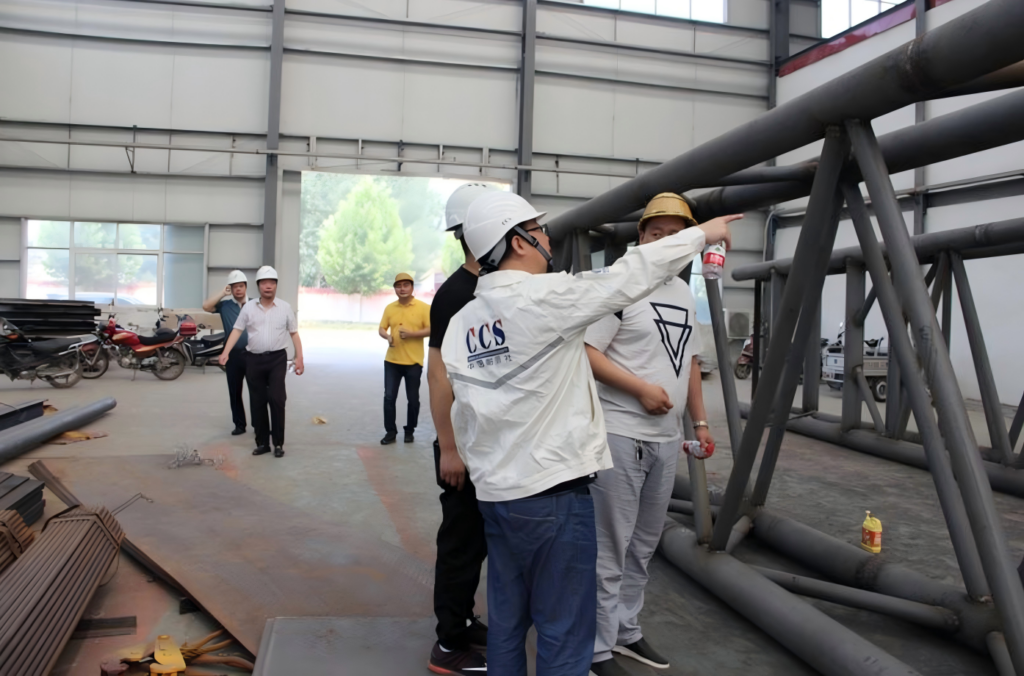
CCS crane certification covers structural design review, material traceability, welding procedure qualification, manufacturing quality audits, and witnessed load testing. The CCS surveyor is present at key manufacturing milestones and at factory acceptance testing.
Why CCS Was Required
CCS (China Classification Society) certification is the standard for lifting equipment at classified Chinese shipyards. The buyer’s facility holds a CCS-classified shipbuilding license, and the insurance and quality management requirements of their major clients — Chinese state-owned shipping companies — specify CCS-certified cranes for their nominated yards.
CCS crane certification covers structural design review, material traceability, welding procedure qualification, manufacturing quality audits, and witnessed load testing. The CCS surveyor is present at key manufacturing milestones and at factory acceptance testing.
Delivery and Installation
Shipping From Factory to Shanghai
The crane was fabricated at our manufacturing base in Liaoning Province and shipped to Shanghai by sea and river barge — a two-stage transport. The main girder was fabricated in three sections for transport: the central section (58m long, 480T) and two end sections including the cantilevers (each approximately 49m long, 320T). The legs, trolley, and running gear were shipped as separate units.
Total shipment: 4 main structural sections + 2 trolley assemblies + running gear and electrical packages — 8 vessel loads over a 3-week delivery window.
Road transport from the river landing point to the yard was the most logistically complex phase. The central girder section required a 96-wheel modular transporter and advance coordination with the Shanghai port authority and municipal traffic management for the 8km yard access route. This coordination began 6 weeks before the planned delivery date.
Site Erection Sequence
Site erection was planned to minimize disruption to the yard’s active production program. The erection sequence was:
- Rail installation (pre-crane arrival): new QU120 rail installed on the pre-constructed foundations. Rail alignment surveyed and verified before crane delivery.
- Leg erection: both crane legs erected and temporarily braced — 12 days.
- Central girder section lift (using the yard’s existing 200T cranes in tandem): central section lifted into position and bolted to leg top connections — 4 days including alignment.
- Cantilever section installation: two cantilever end sections bolted to the central girder — 3 days each.
- Trolley assembly: main hoist trolley assembled on the girder rails in place — 8 days.
- Electrical installation: conductor rail, cable tray, control panels, and cabin — 15 days.
- Commissioning: no-load tests, load tests, and operator training — 12 days.
Total site erection time: 58 days. The yard’s berth No.1 was unaffected throughout erection. Berth No.2 was offline for 22 days during the central girder lift — the single operation that required the berth area to be cleared.
Commissioning and Handover
Operator Training
Three of the yard’s crane operators were trained over 8 days at the completion of commissioning. Training covered:
- Full crane operating procedure including anti-sway system use
- Pre-shift inspection checklist
- Emergency procedures: power failure, emergency stop, manual lowering of load
- Slow-approach mode and programmable landing position use
- Daily maintenance checks
All three operators completed the training program and were assessed as competent for unsupervised operation before handover. An operator manual in simplified Chinese was provided with the crane documentation package.
Why Choose HT Crane for Your Shipyard Gantry Crane Project?
Henan Haitai Heavy Industry Co., Ltd. is a nationally certified Class-A special equipment manufacturer for shipyard gantry and portal cranes in China, with a track record of export projects across Southeast Asia, Central Asia, the Middle East, Africa, and Europe.
- 37+ special equipment type-test certificates
- 23+ utility model patents
- Quality, environmental, and occupational health management systems certified to ISO 9001 / ISO 14001 / ISO 45001
- Classification society recognition: ABS, CCS, BV, DNV, RMRS, ZC
- 40,000 m² production facility with CNC machining, robotic welding, and laser cutting
- 60+ certified welders (CCS, ABS, BV)
- 24-hour nationwide service hotline and international after-sales support network
Contact HT Crane today to discuss your project and receive a tailored quotation.