Choosing between an RTG crane and an RMG crane is one of the most consequential decisions in any container terminal or yard project. Get it right, and you gain years of efficient, cost-effective operations. Get it wrong, and you’ll be dealing with expensive constraints you can’t easily undo.
Here’s the short answer: RTG cranes suit flexible, mid-scale operations with limited upfront budgets. RMG cranes are built for high-volume, automated terminals designed for the long haul.
But the real decision depends on your specific site conditions, throughput targets, automation goals, and total budget — not just the sticker price of the equipment. This article walks you through every key factor so you can make a confident, informed call.
What Are RTG and RMG Cranes?
Before comparing them head-to-head, it helps to understand what each crane is actually built for.
RTG Crane (Rubber-Tyred Gantry Crane)
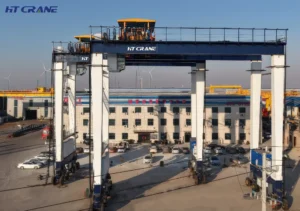
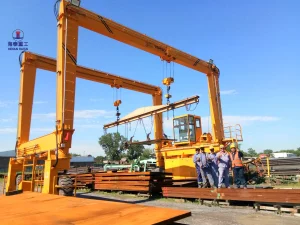
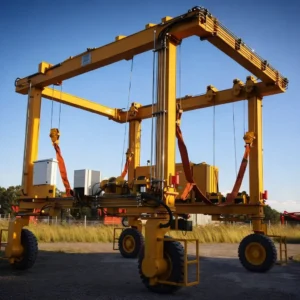
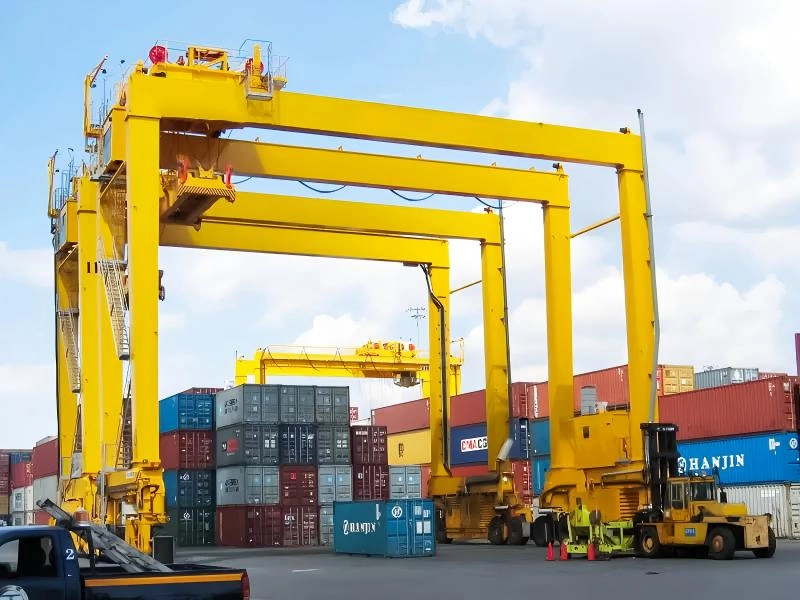
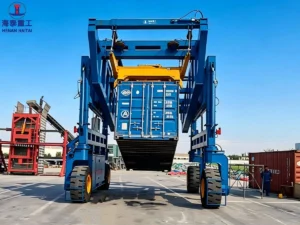
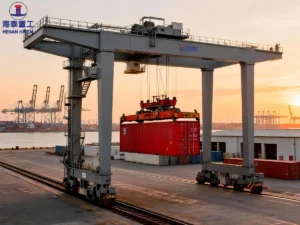
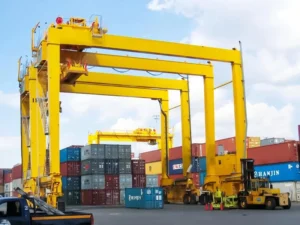
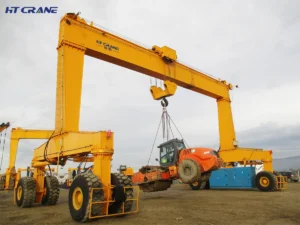
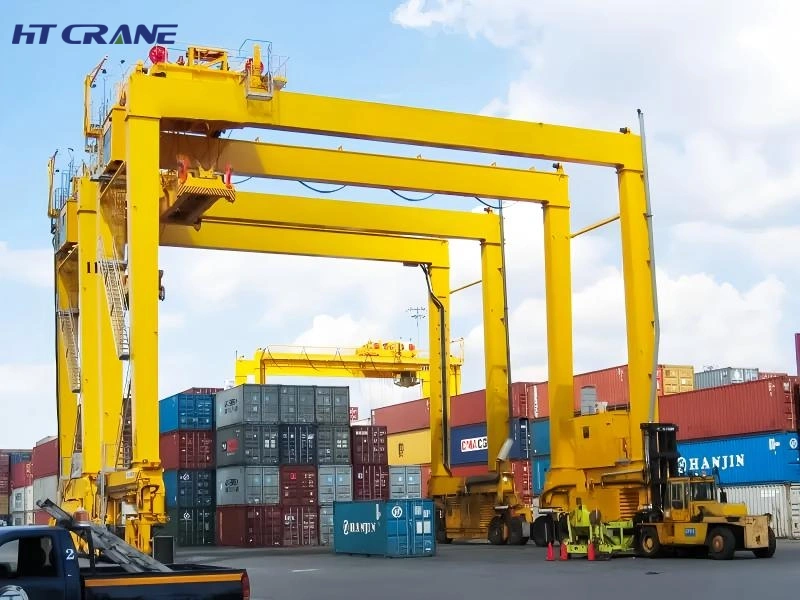
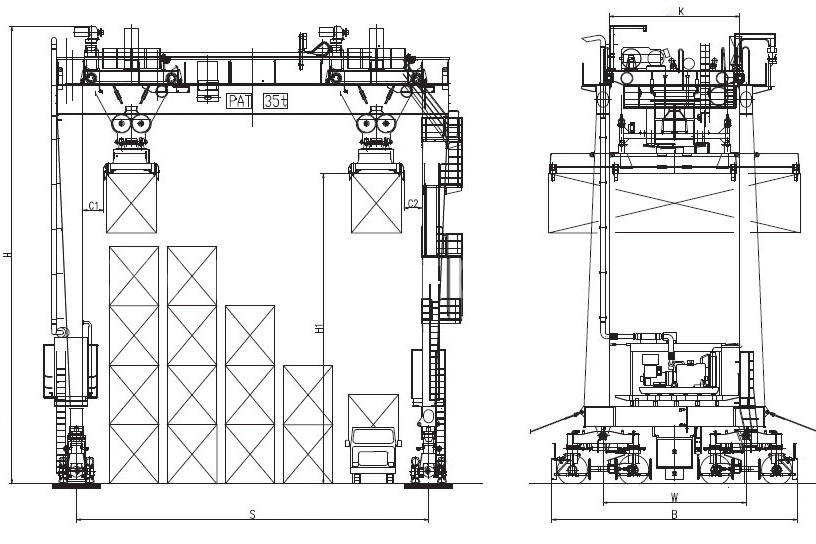
An RTG crane travels on rubber tires across a paved yard surface. It doesn’t need fixed rail infrastructure, which makes it easy to deploy and reposition. RTGs are the most widely used crane type in container terminals worldwide. They typically straddle six container rows plus one truck lane, stacking containers up to five or six high.
Most RTG cranes run on diesel engines, though hybrid and fully electric variants are increasingly available. Operators typically control the crane from a cabin at height, or via remote operation in semi-automated setups.
RMG Crane (Rail-Mounted Gantry Crane)
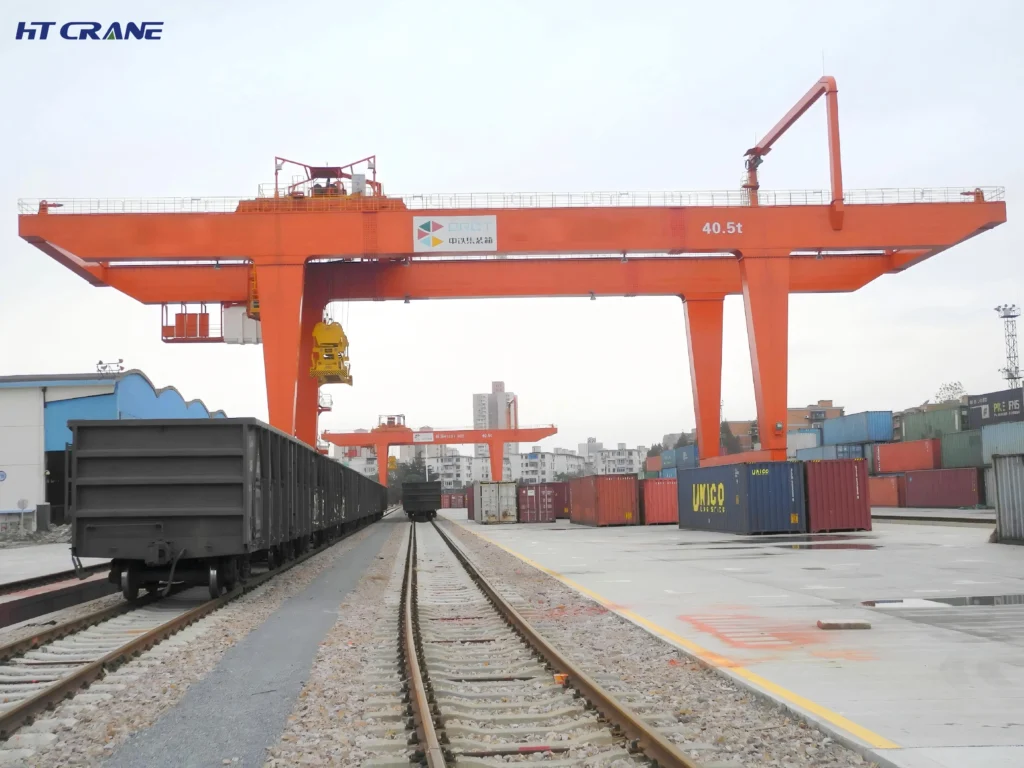
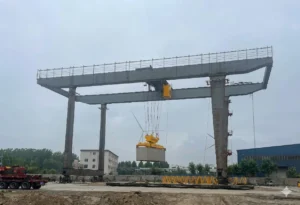
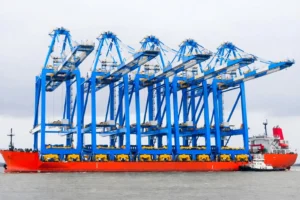
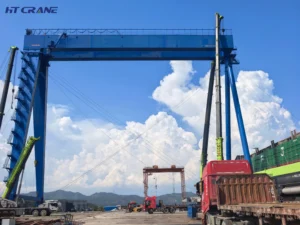
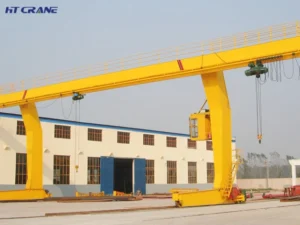
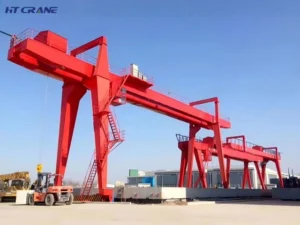
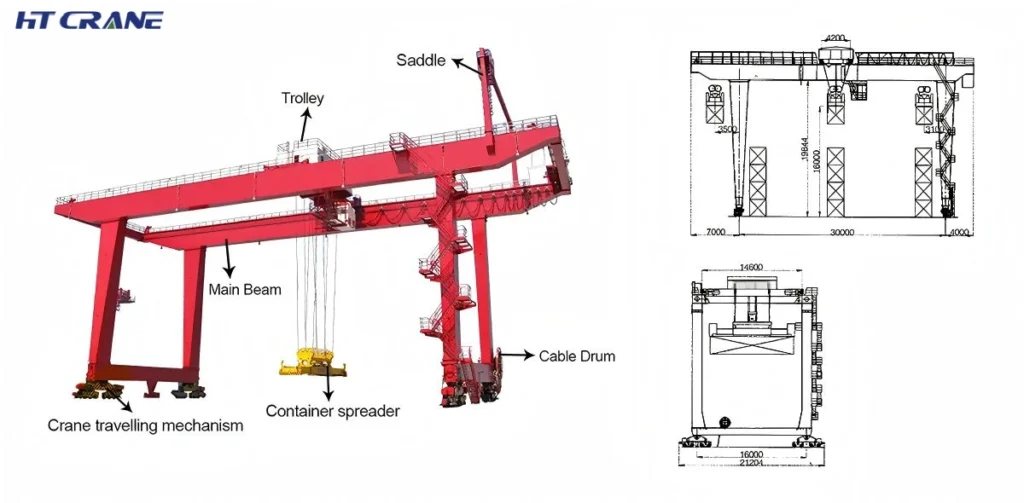
An RMG crane runs on fixed steel rails embedded in the yard. It is electrically powered via conductor rails or festoon cables, producing zero direct emissions during operation. RMG cranes are typically larger, faster, and more precise than RTGs — and they form the backbone of modern automated container terminals (ACTs).
RMG cranes are often integrated with AGVs (Automated Guided Vehicles) and terminal operating systems to enable fully unmanned stacking operations.
RTG vs RMG: Head-to-Head Comparison
The table below summarizes the key differences across the dimensions that matter most to decision-makers.
| Criteria | RTG Crane | RMG Crane |
|---|---|---|
| Mobility | High — moves freely across yard | Fixed — runs on rails only |
| Power Source | Diesel / hybrid / electric | Full electric (low operating cost) |
| Upfront Cost | Lower equipment cost | Higher (includes rail & civil works) |
| Operating Cost | Higher (fuel, tires, drivers) | Lower (electric, fewer operators) |
| Automation Level | Semi-automatic possible | Fully automatic achievable |
| Positioning Accuracy | ±15–30 mm | ±5 mm (automated systems) |
| Throughput Capacity | Moderate | High |
| Carbon Emissions | Moderate to high (diesel) | Near-zero |
| Deployment Speed | Fast | Requires longer lead time |
| Layout Flexibility | High — easy to reconfigure | Low — layout is fixed |
Both crane types can meet ISO 4310 structural and safety requirements. Compliance with EN 15011 and relevant CE marking standards applies to both when sold in European markets.
Key Factors That Should Drive Your Decision
Choosing a crane type isn’t about which is “better” in the abstract. It’s about which fits your actual constraints.
Factor 1 — Throughput Volume and Terminal Scale
If your terminal handles above 1.5–2 million TEU annually and is designed for long-term high-density operations, RMG cranes offer a compelling advantage. Their speed, precision, and automation capability translate directly into throughput.
For smaller or mid-size terminals — say, under 1 million TEU/year — RTGs often deliver adequate performance without the heavy infrastructure investment that rail systems demand.
Factor 2 — Budget Structure: CapEx vs. OpEx
This is where many buyers make mistakes. RTG cranes have lower upfront capital expenditure. But over a 15–20 year lifecycle, the gap reverses.
Diesel fuel, tire replacements (typically every 2,000–4,000 operating hours), and the ongoing cost of crane operators all add up. RMG cranes powered by electricity cost significantly less per move over time. For operations running 24/7, the operational savings from RMG can offset the higher initial investment within 8–12 years, depending on energy prices and labor costs.
The right framing isn’t “which is cheaper” — it’s “what can we afford now, and what will cost less over the life of the asset?”
Factor 3 — Automation Goals
If full automation is on your roadmap, RMG is the clear path. Rail-based operation gives the crane a fixed, predictable trajectory — the foundation of reliable automated stacking. Systems like ASC (Automated Stacking Crane) configurations are built on this principle.
RTG cranes can be semi-automated with remote operation and optical positioning systems. However, achieving full automation on rubber-tired equipment requires significantly more complex technology and investment. For most operators, semi-automated RTG is a practical middle ground — not a full automation solution.
Factor 4 — Site Conditions and Layout Flexibility
New greenfield terminals offer the most freedom. If you’re building from scratch on solid ground, RMG becomes far more viable — you can engineer the civil foundations from the start.
Brownfield projects, port expansions, or temporary operations are a different story. RTG cranes can be deployed with minimal ground preparation. They can also be relocated or sold if operational needs change — a flexibility RMG rails simply cannot offer.
Factor 5 — Environmental and Regulatory Requirements
Ports in the EU, California, and several Asian jurisdictions face increasing pressure to reduce diesel emissions. Many port authorities now require or incentivize electric equipment. Electric RTG variants (e-RTG with cable reels or battery packs) address this — but they carry additional cost and operational constraints.
RMG cranes, running entirely on grid electricity, are the cleaner solution by default. For terminals pursuing green port certification or seeking to align with IMO and local environmental mandates, RMG provides a more straightforward path.
Typical Project Scenarios
Understanding which crane fits which situation helps make the decision concrete.
When RTG Is the Right Choice
- Mid-size container terminals expanding capacity without full redevelopment
- Inland container depots (ICDs) or logistics parks needing operational flexibility
- Ports in developing markets where capital budgets are constrained
- Short- to medium-term operations where site use may change
- Retrofit projects where existing yard infrastructure can’t support rails
When RMG Is the Right Choice
- New automated terminals designed for 20+ year operational lifespan
- High-throughput international hub ports requiring maximum moves per hour
- Green port projects with emission reduction commitments
- Operations integrating AGVs or automated truck handling at the landside
- Operators with high labor costs seeking to reduce headcount through automation
Total Cost of Ownership: A Simplified View
Assume a 15-year operational period with 10 cranes in a mid-to-large terminal. The numbers below are illustrative directional estimates — actual figures vary significantly by region, energy prices, and crane specification.
| Cost Category | RTG (Diesel) | RMG (Electric) |
|---|---|---|
| Equipment Purchase | Lower | Higher |
| Civil & Rail Infrastructure | Minimal | Significant |
| Annual Energy Cost per Crane | Higher | Lower |
| Tire & Engine Maintenance | Recurring | Not applicable |
| Operator Labor (per crane) | Required | Reduced/Eliminated (automated) |
| 15-Year TCO Direction | Front-loaded savings, higher OpEx | Higher CapEx, lower long-term OpEx |
For long-horizon projects, RMG’s lifecycle economics are generally more favorable. For shorter horizons or capital-constrained projects, RTG preserves cash and maintains flexibility.
Summary: How to Make the Final Call
There is no universal winner between RTG and RMG. Both are proven, widely deployed technologies with strong track records in global port operations.
Use this as your decision filter:
- Choose RTG if you need flexibility, faster deployment, lower upfront cost, or are operating at moderate scale.
- Choose RMG if you’re building for automation, long-term efficiency, high throughput, or environmental compliance.
- Consider a hybrid approach — some terminals deploy RTG in early phases and plan for RMG conversion as volume grows and automation becomes viable.
The most important step is to match the equipment to your actual 10–20 year operational strategy — not just your current budget or the equipment your neighbors are using.
Why Choose Haitai?
Henan Haitai Heavy Industry Co., Ltd. is a nationally certified special equipment manufacturer founded in 2015, holding ISO 9001, ISO 14001, and ISO 45001 certifications, with products approved by ABS, CCS, BV, DNV, and RMRS classification societies.
With over 30 patents and a 40,000 m² production facility, Haitai delivers customized lifting solutions to clients across six continents.Whether you need standard configurations or purpose-built equipment, Haitai provides end-to-end support backed by a 24/7 service
Our Case Studies:90-Ton Rubber Tyred Gantry Crane YTL90t-8m Successfully Exported to Mexico
FAQ
Q1: Can an RTG crane be converted to fully electric operation?
Yes. Electric RTG (e-RTG) variants exist and are increasingly common. They typically use cable reel systems or lithium-ion battery packs to eliminate diesel consumption. Conversion kits are also available for existing diesel RTGs from several manufacturers. However, e-RTG systems involve additional infrastructure — cable management trenches or charging stations — and operational adjustments. They reduce emissions significantly but don’t match the precision or full-automation capability of rail-mounted systems.
Q2: How long does it take to commission an RMG crane system compared to RTG?
RTG cranes can be deployed relatively quickly once the yard surface is ready — typically within weeks of equipment delivery. RMG crane projects require rail installation, civil foundation work, and electrical infrastructure, which can extend the project timeline by 12–24 months depending on site complexity and scope. This lead time is a serious planning factor for terminals facing near-term capacity pressure.
Q3: Which crane type handles wind and weather conditions better?
Both crane types are engineered for outdoor port environments and must comply with EN 13001 and ISO 4310 design standards for wind loading. RMG cranes, being rail-anchored, typically have more stable structural dynamics in high-wind conditions. RTG cranes are subject to travel limitations in strong crosswinds due to their rubber-tire configuration. Site-specific wind studies should inform specification requirements for either crane type in exposed coastal or elevated locations.
Q4: Is it possible to automate an existing RTG fleet?
Partial automation is achievable. Several technology providers offer retrofit semi-automation packages for RTG cranes, including remote operation cabins, optical positioning systems, and anti-collision sensors. Full, unmanned automation on free-roaming RTGs remains technically challenging and expensive. Most terminal operators pursuing true automation choose to transition to RMG systems rather than fully automate an existing RTG fleet.
Q5: What should I ask a crane supplier before making a final decision?
Key questions include: What is the design service life of the crane (typically 25 years per ISO 4301 classification)? What are the spare parts availability and lead times for your region? Does the crane comply with local CE or equivalent certification requirements? What after-sales service and training support is included? Can you provide references from terminals with comparable throughput and operational conditions? How does the warranty handle structural versus mechanical versus electrical components? Getting detailed, specific answers to these questions is as important as comparing headline specifications.