The Workhorse of Ports, Shipyards, and Bulk Terminals
Some lifting environments demand more than a fixed crane can deliver. When cargo volumes are high, quay space is limited, and operations run continuously around the clock, a portal crane is often the equipment that makes it all work.
Portal cranes are widely used in the mechanized loading and unloading of cargo in ports and docks, the assembly of hulls and maintenance of ships in shipyards, and the construction of large hydropower stations. Their combination of 360° slewing, luffing boom, and rail travel makes them one of the most versatile heavy-lifting platforms available in port and industrial environments.
This guide explains what a portal crane is, how it works, what types exist, where each type performs best, and what to consider when choosing one for your operation.
What Is a Portal Crane?
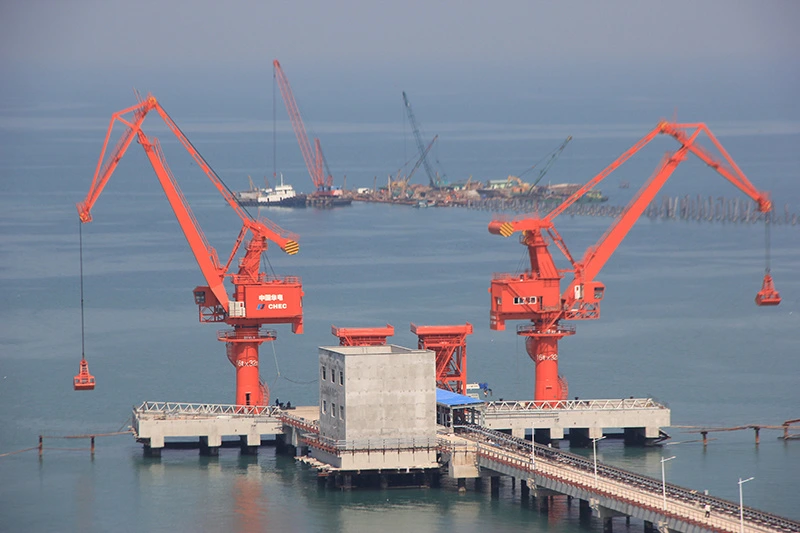
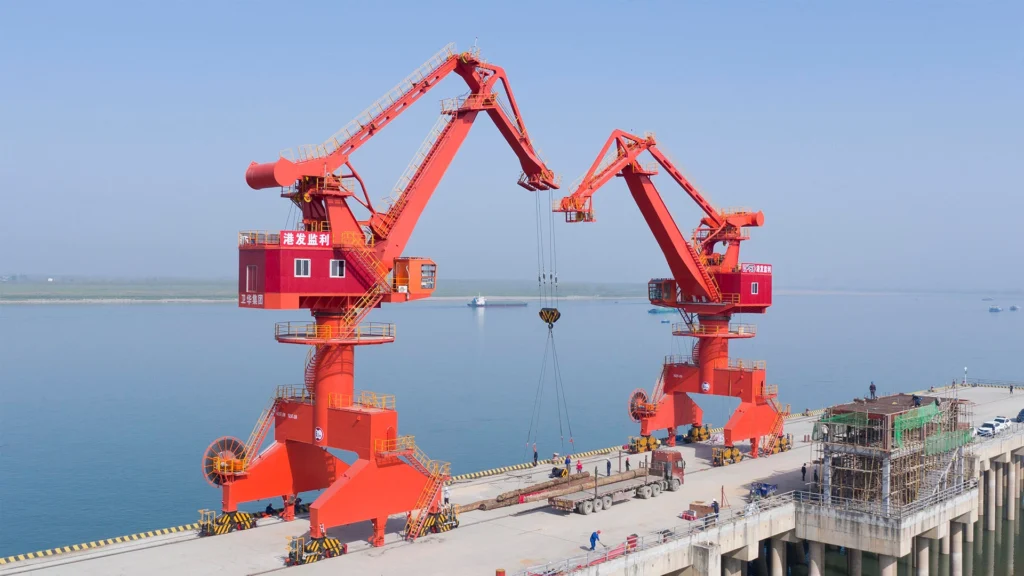
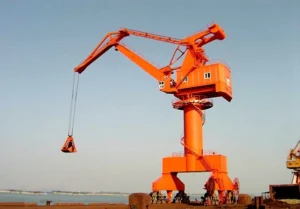
A harbour portal crane is a typical slewing-jib crane with a gantry-type structure that travels along rails. It integrates lifting, slewing, luffing, and traveling functions, and is widely used in ports, docks, shipyards, and offshore engineering for heavy-duty lifting operations.
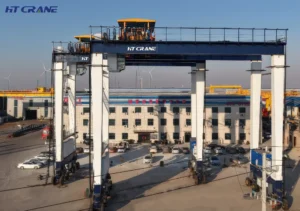
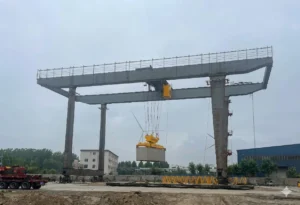
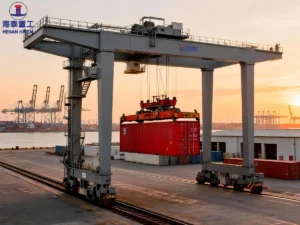
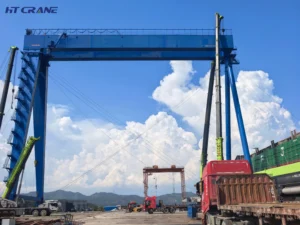
The name comes from the structure itself. The crane’s undercarriage forms a portal — an open frame with two legs and a crossbeam — that straddles the rail track and allows vehicles, rail wagons, and other equipment to pass underneath. This elevated structure allows trucks and rail wagons to pass underneath, optimising terminal logistics.
On top of this portal base sits a fully rotating upper structure carrying the boom, hoisting mechanism, and operator cab. The result is a crane that can travel along the quay, rotate 360°, and adjust its boom radius — all independently — giving it exceptional coverage from a fixed rail path.
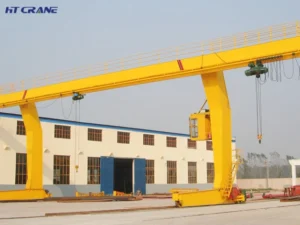
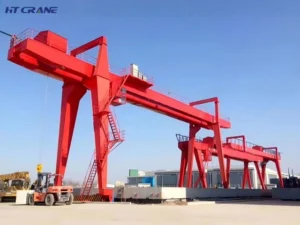
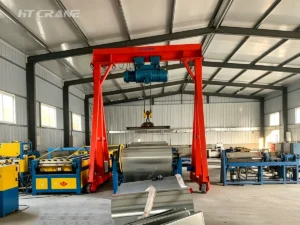
This is what distinguishes a portal crane from a standard gantry crane. A gantry crane moves loads in fixed linear axes. A portal crane adds full slewing and luffing capability, making it effective across a wide working arc rather than just the area directly below the bridge.
How Does a Portal Crane Work?
A portal crane coordinates four independent movements to position a load precisely within its working radius:
Traveling — the entire portal structure moves along ground-level rails, covering the full length of the quay or work area.
Slewing — the upper structure rotates up to 360°, allowing the boom to cover a full circle around the crane’s position on the track.
Luffing — the boom raises or lowers its angle, changing the working radius without moving the crane along the rail. This allows precise positioning over a ship’s hold or a specific point on the quay.
Hoisting — the lifting mechanism raises and lowers the load vertically to the required height.
By combining these four axes, the operator can place the hook — or grab, or spreader — at virtually any point within the crane’s operational envelope. Equipped with grabs or hooks as lifting devices, it performs loading and unloading tasks efficiently, and can handle offshore wind turbine components, marine engineering materials, general cargo, bulk materials, and containers with high efficiency and reliability.
Types of Portal Cranes
Portal cranes are categorized by boom structure and by application environment. Understanding both dimensions helps identify the right configuration for a specific operation.
By Boom Structure
Four-Link Portal Crane
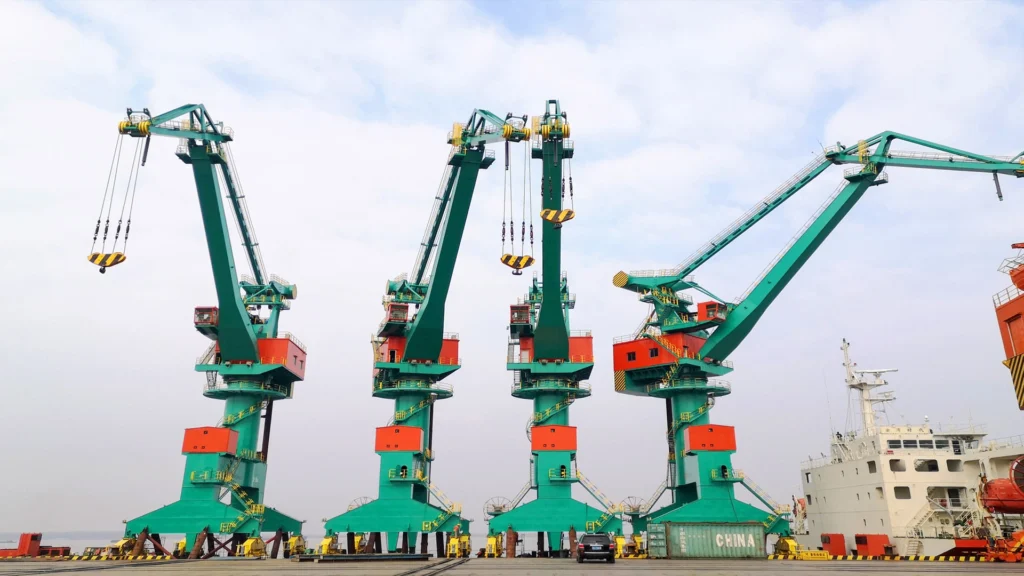
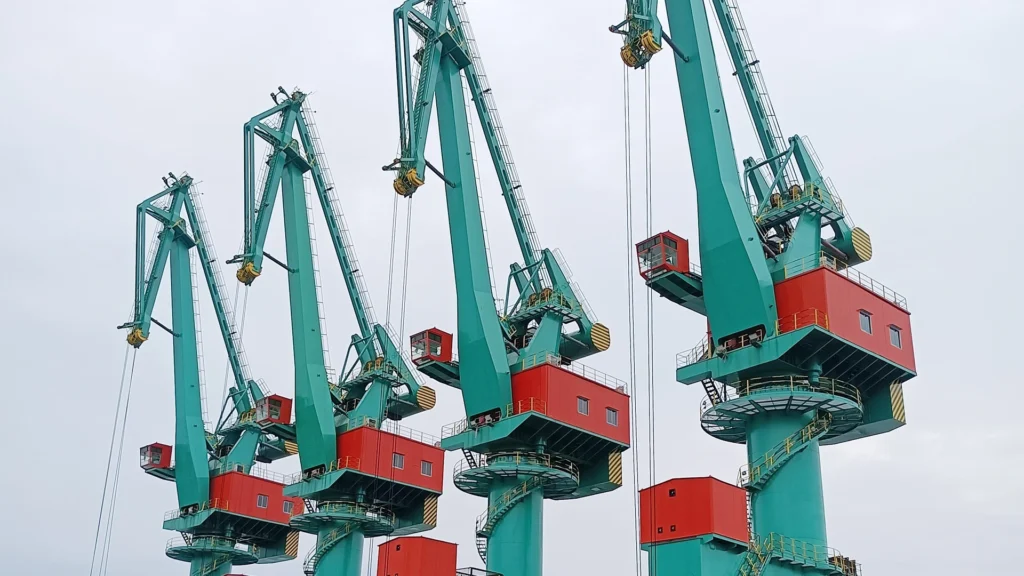
The four-link portal harbour crane uses a lever-operated counterweight balance and cylindrical body or four-legged gantry form, using hooks or grabs for general cargo or bulk cargo loading and unloading.
The four-link boom maintains a roughly constant hook height as the radius changes — a significant operational advantage when handling bulk materials or general cargo. The counterweight system balances the load moment mechanically, reducing stress on the slewing bearing and extending service life.
Best for: General cargo handling, bulk material operations, mixed cargo terminals where maintaining consistent hook height across the working radius improves operational control.
Single Boom Portal Crane


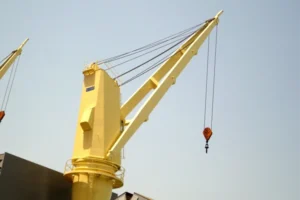
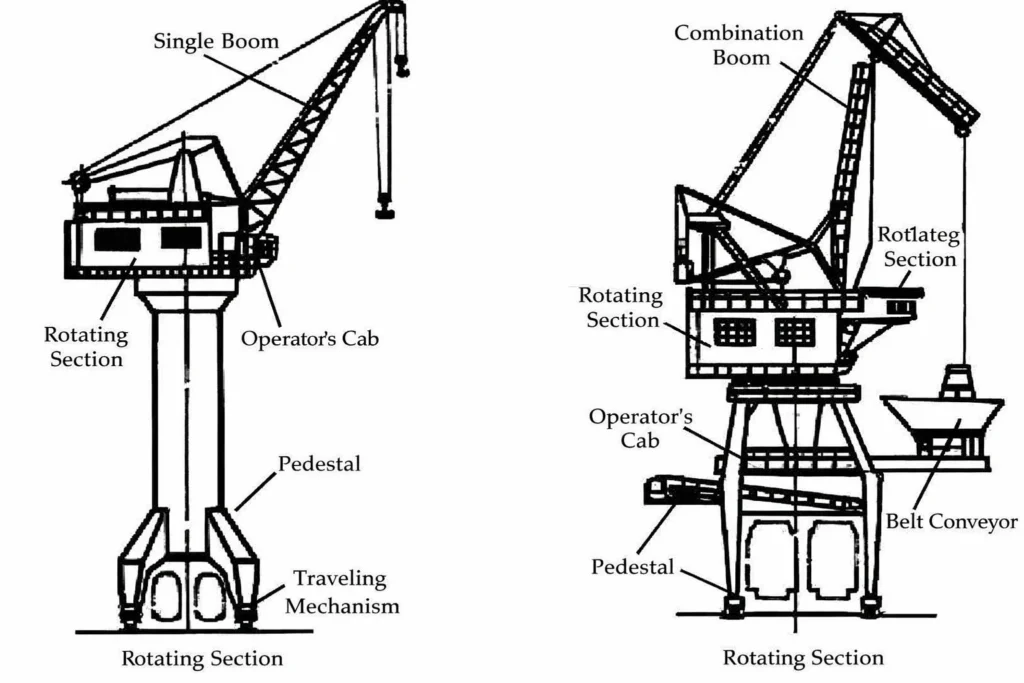
Single-jib portal cranes feature a compact structure with 360° full slewing capability and deliver extensive operational coverage and heavy-duty continuous operation resilience. Compared to four-link portal cranes, they feature lighter deadweight, lower energy consumption, and reduced maintenance costs.
The single boom design is simpler in structure and lighter overall. Hook height does change as the radius adjusts, which is less critical for container handling where the spreader positioning system compensates for this variation.
Best for: Container terminals, bulk terminals prioritizing energy efficiency, and operations where lower deadweight reduces quay infrastructure load requirements.
By Application Environment
Port Portal Crane
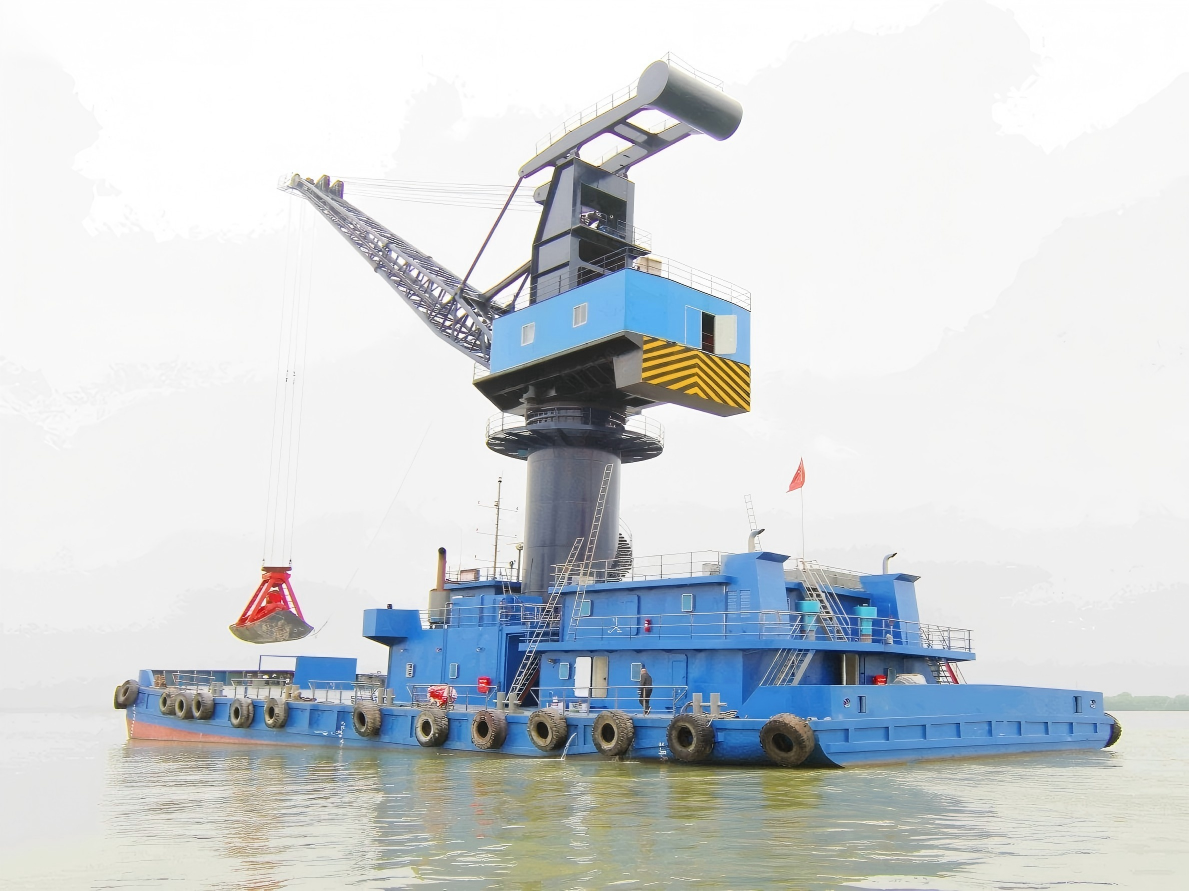
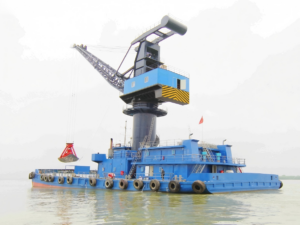
Port portal cranes handle the full range of cargo types found at commercial terminals — containers, bulk materials, general cargo, and project cargo. Dock portal slewing cranes maintain a constant hook height during boom movement, making them ideal for handling bulk materials. Their 360° rotating platform and tilting jib system cover a wide working range.
The rail-mounted portal base keeps the quay clear. Trucks, rail wagons, and terminal vehicles pass freely beneath the portal frame, maintaining terminal flow without interference from the crane’s footprint.
Shipyard Portal Crane
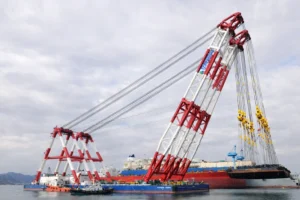
Shipyard portal cranes are employed for assembling large structural sections and installing electromechanical equipment during ship construction and repair, with key features including large lifting capacities and high precision in hoisting operations.
Shipyard operations demand higher precision and often higher capacity than general cargo terminals. Hull sections are large, irregularly shaped, and must be placed accurately within tight assembly tolerances. Portal cranes in this environment are typically configured with precision positioning systems and, in some cases, tandem lifting capability for very large sections.
Portal Crane Key Specifications
| Parameter | Typical Range |
|---|---|
| Lifting capacity | 10 – 80 tons (standard); higher on custom builds |
| Working radius | Up to 75 m |
| Lifting height above rail | 10 – 80 m |
| Lifting height below rail | 5 – 30 m |
| Slewing range | 360° continuous |
| Travel | Rail-mounted along quay |
Standard configurations include 8 models of portal slewing crane, with single boom and four-link jib systems available, with hoisting capacity ranging from 16 to 80 tons. Custom builds for shipyard and heavy industrial applications can significantly exceed these ranges.
Where Portal Cranes Are Used
Bulk Terminals
Bulk terminals handle coal, ore, grain, sand, and similar loose materials in very high volumes. Efficient bulk cargo handling with proven turnover rates of up to 2,300 tonnes per hour ensures maximum productivity at terminals equipped with portal cranes fitted with clamshell grabs or orange-peel attachments.
The 360° slewing capability allows a single portal crane to serve both the ship’s hold and the quayside receiving equipment — conveyor belts, stockpile areas, or trucks — without repositioning along the rail for each cycle.
Container Terminals
In container terminals, portal cranes complement STS cranes and yard equipment by handling ship-to-shore transfers at smaller berths or acting as multipurpose handlers. Container cranes are equipped with a specialized handling tool called a spreader, which can be lowered on top of a container and locks onto the container’s four locking points using a twistlock mechanism.
Portal cranes configured for container work use the same spreader technology and can be switched between container and bulk handling by changing the lifting attachment — a practical advantage for terminals handling mixed cargo flows.
Shipyards
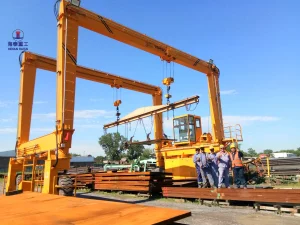
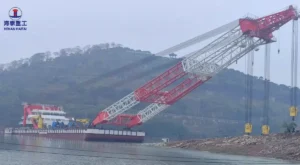
Portal cranes are used for the assembly of hulls and the maintenance of ships in the shipbuilding process in shipyards. In this environment, the crane must handle not just the weight but also the shape of large structural components. Wide outreach, high precision, and in many cases tandem-crane coordination are standard requirements.
Hydropower and Heavy Construction
Large infrastructure projects — dam construction, power station assembly, heavy bridge works — use portal cranes for component placement where the combination of high capacity, slewing coverage, and rail mobility provides operational flexibility that fixed cranes cannot match.
Portal Crane vs. Other Port Cranes
| Crane Type | Slewing | Rail Travel | Container | Bulk | Typical Capacity |
|---|---|---|---|---|---|
| Portal Crane | 360° | Yes | Yes | Yes | 10–80 t |
| STS Crane | Fixed axis | Yes | Yes | No | 40–100+ t |
| RTG Crane | Fixed axis | Rubber tyre | Yes | No | 35–70 t |
| RMG Crane | Fixed axis | Rail | Yes | No | 35–70 t |
| Mobile Harbour Crane | 360° | Rubber tyre | Yes | Yes | 40–125 t |
The portal crane occupies a distinct position in this landscape. It shares the 360° slewing capability of mobile harbour cranes but operates on rails rather than rubber tyres — making it more stable under heavy loads and better suited to long-term fixed installations on quays with defined operational lanes.
Key Components of a Portal Crane
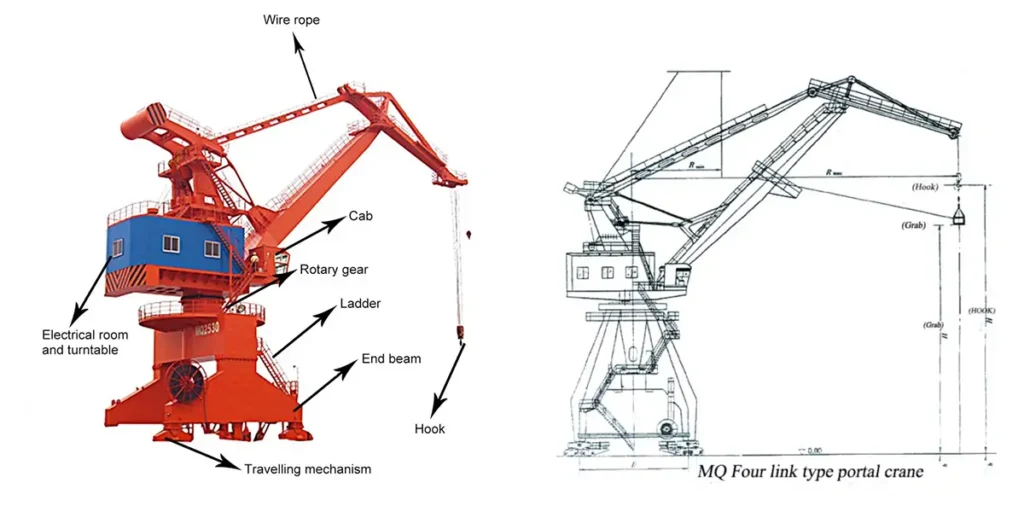
Understanding the main components helps when specifying equipment or planning maintenance.
| Component | Function |
|---|---|
| Portal frame (gantry base) | Two-leg rail-mounted structure; allows traffic to pass beneath |
| Slewing ring | Connects upper rotating structure to portal; enables 360° rotation |
| Boom (single or four-link) | Extends outreach; adjusts working radius via luffing mechanism |
| Luffing mechanism | Changes boom angle to adjust working radius |
| Hoisting mechanism | Raises and lowers load — motor, gearbox, drum, wire rope, hook or grab |
| Slewing mechanism | Rotates the upper structure around the slewing ring |
| Travel mechanism | Drives the portal along the rail track |
| Operator cab | Provides visibility and control over all crane functions |
| Electrical system | Powers all drives; includes VFD control for smooth, efficient operation |
| Wind-proof device | Track clamps and anchors prevent movement in high-wind conditions |
Modern portal cranes incorporate variable frequency drives (VFD) across all major motion axes. All traveling mechanisms utilize AC frequency control with limit switches and interlock protection systems, providing excellent operational safety. This not only improves control precision but also enables regenerative braking — recovering energy during load lowering and feeding it back into the power supply.
What to Consider When Selecting a Portal Crane
Three parameters drive the specification decision:
Cargo type and attachment requirements. Bulk handling requires a grab — clamshell, orange-peel, or box type depending on material. Container handling requires a spreader. General cargo uses a hook. Some terminals need all three, which requires a quick-change attachment system.
Quay layout and infrastructure. Rail gauge, quay edge loading limits, available height for boom stowage, and traffic flow beneath the portal all influence the configuration. Portal slewing cranes require a rail-mounted foundation designed to support the portal structure and ensure precise alignment.
Required throughput. A terminal moving 2,000 tonnes of bulk per hour has fundamentally different equipment requirements from one handling mixed general cargo. Cycle time, grab volume, hoisting speed, and slewing speed all feed into productivity calculations that should be modelled before finalizing the specification.
Summary
A portal crane is a rail-mounted slewing crane built around a portal frame that allows traffic to pass freely beneath it. Its four-axis movement — traveling, slewing, luffing, and hoisting — gives it the operational flexibility to handle multiple cargo types across a wide working arc from a fixed rail position.
The two main boom configurations — four-link and single boom — serve different operational priorities. Four-link designs maintain consistent hook height, favoring bulk and general cargo work. Single boom designs are lighter and more energy-efficient, favoring container operations and mixed cargo terminals.
Whether the application is a bulk terminal handling millions of tonnes of coal annually, a container port managing fast-turnaround vessel calls, or a shipyard assembling the next generation of commercial vessels, the portal crane remains one of the most practical and durable solutions in heavy port and industrial lifting.

FAQ
Q1: What is the difference between a portal crane and a gantry crane?
Both use a portal or gantry frame structure, but the key operational difference is slewing capability. A conventional gantry crane moves loads in fixed linear axes — longitudinal bridge travel and lateral trolley travel. A portal crane adds 360° slewing and boom luffing on top of the rail-travel base, allowing it to cover a full working circle around each position on the track. This makes portal cranes suitable for ship loading and unloading operations where the crane must reach different points on a vessel’s deck from a single position, while gantry cranes are better suited to structured yard operations where loads move in defined lanes.
Q2: What cargo can a portal crane handle?
Portal cranes are among the most versatile lifting systems in port operations. With a hook, they handle general cargo, machinery, steel, and oversized project loads. With a clamshell or orange-peel grab, they handle bulk materials including coal, ore, grain, sand, and gravel. With a container spreader, they handle standard 20-foot and 40-foot ISO containers. Many terminals use quick-change attachment systems that allow the same portal crane to switch between bulk, general cargo, and container operations within a single shift — a practical advantage for multipurpose terminals.
Q3: How does a portal crane differ from a ship-to-shore (STS) crane?
An STS crane is a specialized container crane with a fixed boom that extends over the vessel and a trolley that travels along the boom. It is optimized purely for high-speed container transfers between ship and shore and does not slew. A portal crane has a rotating upper structure and a luffing boom, giving it 360° working coverage and the ability to handle different cargo types. STS cranes achieve higher cycle rates for pure container operations at large terminals. Portal cranes offer more versatility and are better suited to terminals handling mixed cargo or operating at smaller throughput volumes.
Q4: What is the typical lifting capacity of a portal crane?
Standard portal cranes cover a capacity range of 10 to 80 tons, with the most common configurations in the 16 to 50 ton range for port and terminal applications. Custom-engineered units for shipyard use can reach significantly higher capacities. The capacity requirement should be determined by the maximum unit load — including the weight of the lifting attachment — plus any dynamic load factors specified by the applicable design standard such as FEM or ISO 4301.
Q5: What maintenance does a portal crane require?
Portal cranes require regular attention to the slewing ring and its lubrication — the slewing bearing carries the full load moment of the upper structure and is the most maintenance-critical component. Wire rope inspection and lubrication follow the same criteria as any heavy crane, with reference to ISO 4309 for discard decisions. The travel wheels, rail condition, and luffing mechanism require periodic inspection. Electrical systems — particularly VFD units and limit switches — should be checked on a schedule appropriate to the operating duty. Marine environments accelerate corrosion on all steel components, making surface coating inspection and touch-up a regular maintenance requirement for quayside installations.