Choosing the right Rubber Tired Gantry Crane configuration directly impacts your terminal’s throughput capacity, stacking density, and total cost of ownership. This guide compares single girder and double girder RTG cranes across lifting capacity, span, duty class, and port application fit — helping procurement teams and terminal planners match crane specification to operational reality, from feeder ports to high-volume container terminals.
Which RTG Crane Is Right for Your Container Terminal?
Choosing between a single girder Rubber Tired Gantry Crane and double girder Rubber Tired Gantry Crane affects everything from your container yard’s stack density to your long-term maintenance budget. Both configurations move containers. But they do it differently — and for different operational profiles.
The short answer:
- Single girder RTG cranes suit lighter-duty, cost-sensitive, or space-constrained port container handling applications.
- Double girder RTG cranes are the standard for high-throughput container terminals handling 20–55 ton loads across wide spans.
The long answer: It depends on your specific port layout, throughput targets, and total cost of ownership requirements.
This RTG crane comparison covers the structural differences, RTG crane specifications, capacity and span data, application fit, and the key questions your procurement team should ask before selecting a gantry crane configuration type.
What Is a Rubber Tired Gantry Crane: single girder vs double girder for container handling?
Rubber Tired RTG Crane Introduction
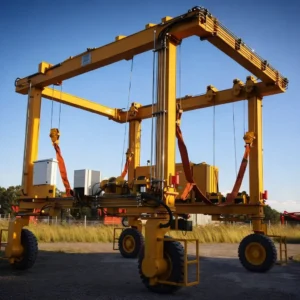
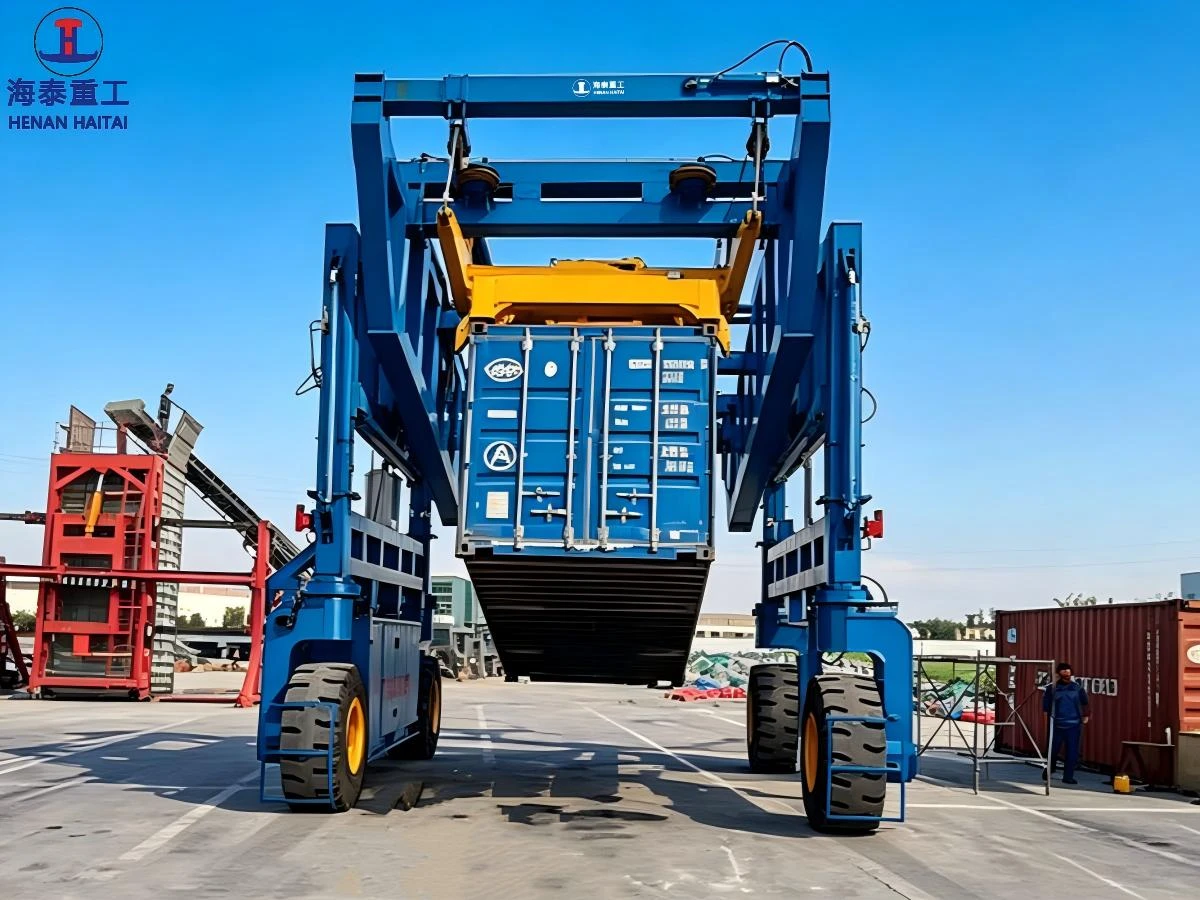
A Rubber Tired Gantry Crane is a mobile gantry crane mounted on rubber tires rather than fixed rails, allowing it to travel between container rows without dedicated track infrastructure. This mobility makes it the dominant container yard equipment choice for medium-to-large container terminals worldwide.
Unlike rail-mounted gantry (RMG) cranes, RTG cranes can be repositioned across the yard as operational demand shifts — a significant advantage in terminals with variable throughput patterns or phased expansion plans. Major RTG crane suppliers including ZPMC, Liebherr, and Konecranes manufacture both single and double girder variants, though the double girder design represents the large majority of port gantry crane deployments globally.
Single Vs. Double Girder RTG Crane Structural Differences
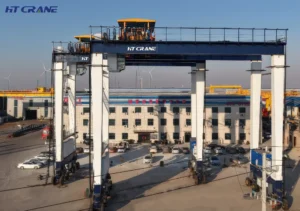
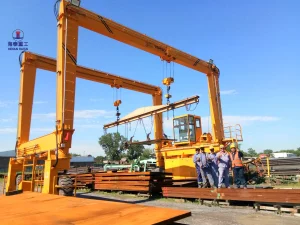
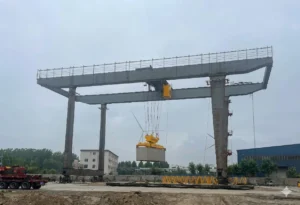
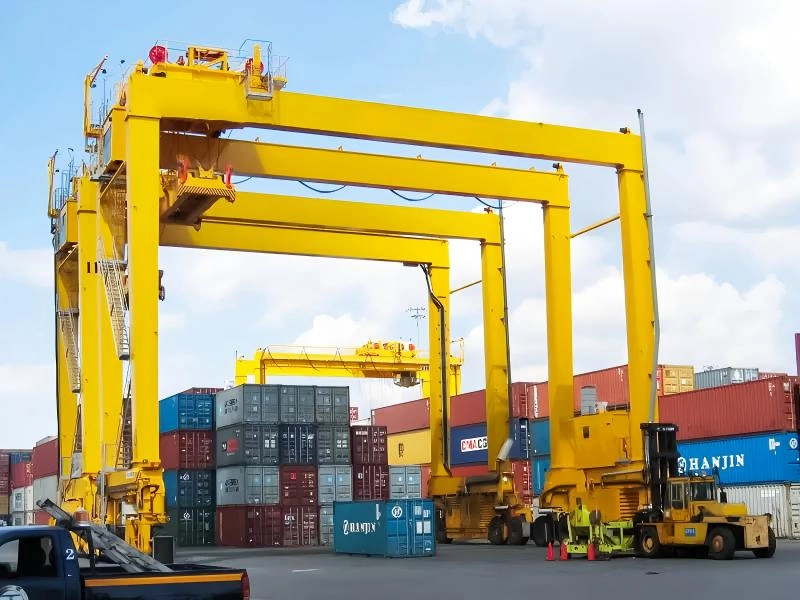
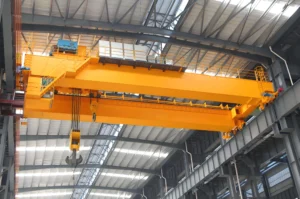
The girder is the horizontal bridge beam that carries the trolley and hoist across the crane’s span. In a single girder RTG crane, one main beam supports the trolley, which typically hangs below or rides along the bottom flange. In a double girder RTG crane, two parallel main beams carry the trolley on top — providing greater structural rigidity, higher load capacity, and a wider range of span options.
This structural distinction drives almost every performance difference between the two configurations.
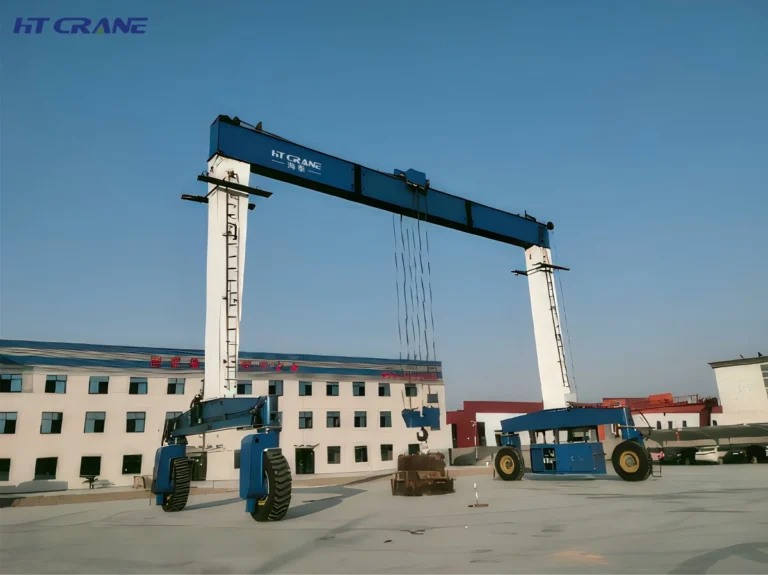
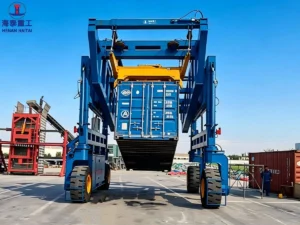
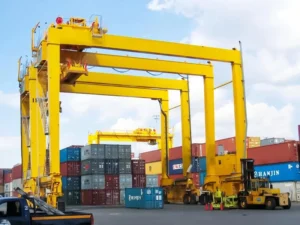
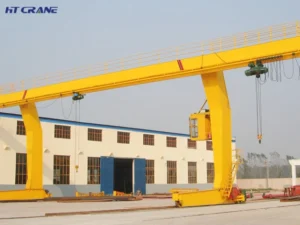
Single Girder Rubber Tired Gantry Crane
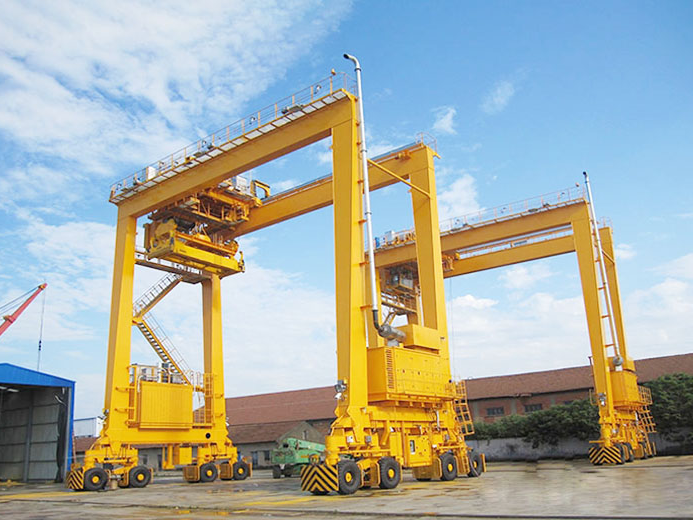
RTG Container Gantry Crane
Single Girder Rubber Tired Gantry Crane: Capabilities, Strengths, and Limits
The single girder RTG crane offers a simpler structural design that translates into lower initial procurement cost and reduced structural steel weight. For certain port applications and inland container depots, these advantages are decisive.
RTG Crane Specifications: Single Girder
| Parameter | Typical Range | Notes |
| Lifting Capacity | 20t – 40t | Practical limit around 40t |
| Span | 15m – 23m | Typically covers 4–5 container rows |
| Stacking Height | 1 over 3 to 1 over 4 | Lower than double girder |
| Structural Weight | Lower | Reduced foundation / tire loading |
| Drive Configuration | Diesel or electric | Shore power connection available |
| Duty Class | A5 – A6 | Moderate throughput operations |
Source: ISO 4301-1:2016, FEM 1.001 design classification framework; specifications based on published data from major RTG crane manufacturers.
Advantages of Single Girder RTG Crane
The primary advantages of single girder RTG cranes center on cost and simplicity. With less structural steel, the manufacturing cost runs 15–25% lower than a comparable double girder unit. The lighter self-weight also reduces tire loading, which matters on quayside aprons with load-per-axle restrictions.
Maintenance access for the hoist and trolley is straightforward on single girder designs, and the reduced component count means fewer failure points in routine operation. For inland container depots, rail yards, or port facilities handling predominantly 20-foot containers at moderate volumes, this configuration delivers adequate performance at lower capital outlay.
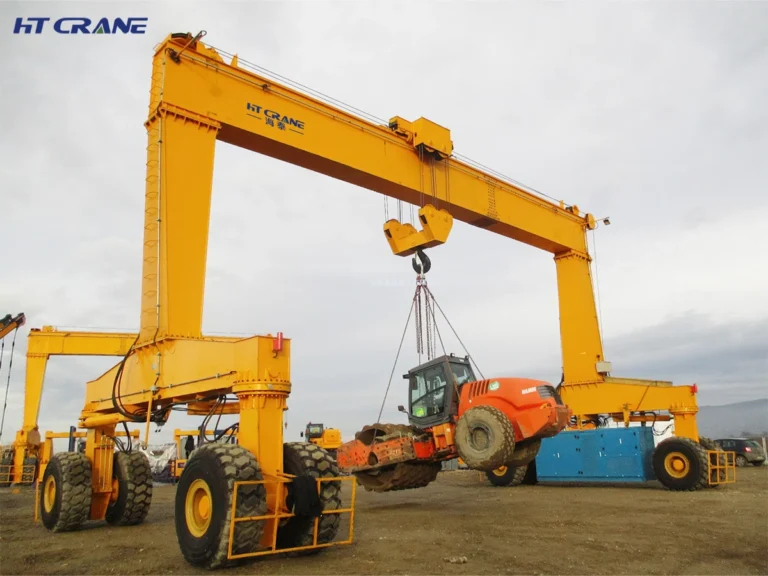
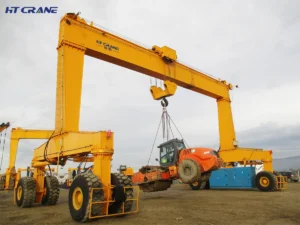
Single Girder Rubber Tired Gantry Crane
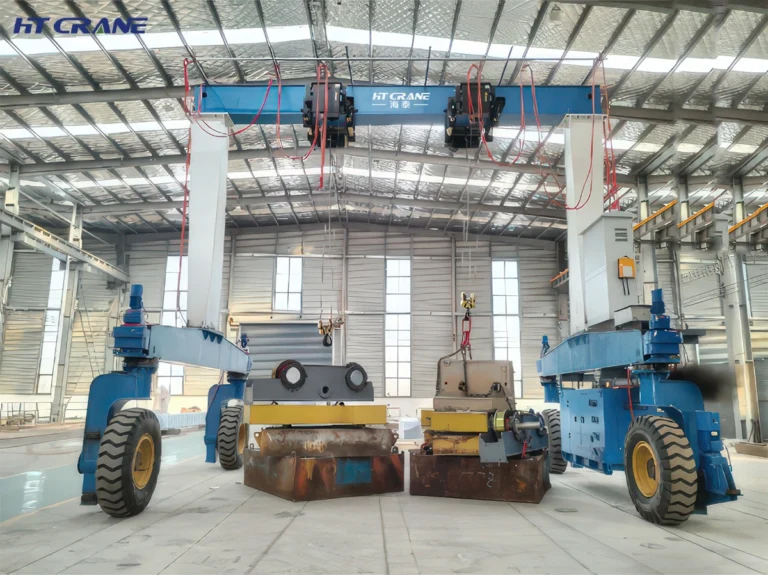
Single Girder Rubber Tired Gantry Crane
When to Choose Single Girder RTG Crane?
Single girder RTG cranes are not suited for high-stack, wide-span container yard operations. The structural deflection characteristics of a single beam limit practical span to around 23 meters — insufficient to span 6 or 7 container rows plus truck lane, which is the standard layout for modern container terminals. Load capacity above 40 tons is also impractical in single girder form, ruling out heavy out-of-gauge cargo and twin-lift spreader configurations.
Double Girder RTG Crane: The Port Container Handling Standard
The double girder RTG crane is the dominant configuration in commercial container terminal operations worldwide. Its two-beam bridge structure enables the span, capacity, and stacking height that modern port container handling demands.
RTG Crane Specifications: Double Girder
| Parameter | Typical Range | Notes |
| Lifting Capacity | 35t – 65t | Twin-lift up to 65t |
| Span | 23m – 35m | Covers 6–7 container rows + truck lane |
| Stacking Height | 1 over 4 to 1 over 6 | Terminal-dependent |
| Structural Weight | Higher | Requires adequate yard surface loading |
| Drive Configuration | Diesel-electric or full electric | Grid-connected RTG standard in new projects |
| Duty Class | A6 – A8 | High-throughput continuous operation |
Source: ISO 4301-1:2016, ZPMC and Liebherr published product specifications, terminal equipment procurement specifications from Port of Rotterdam and PSA Singapore, 2022–2024.
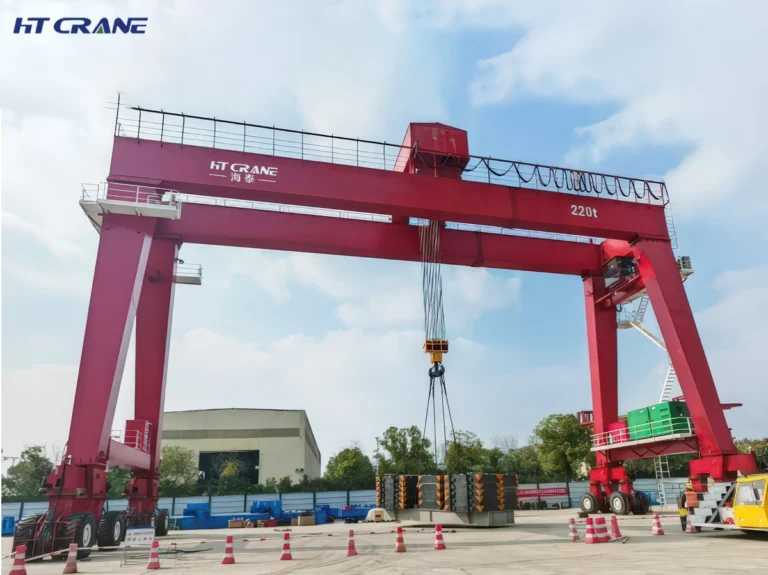
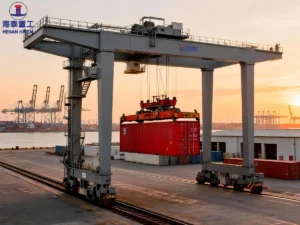
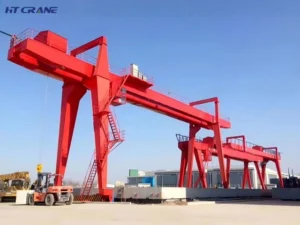
Double Girder Rubber Tired Gantry Crane
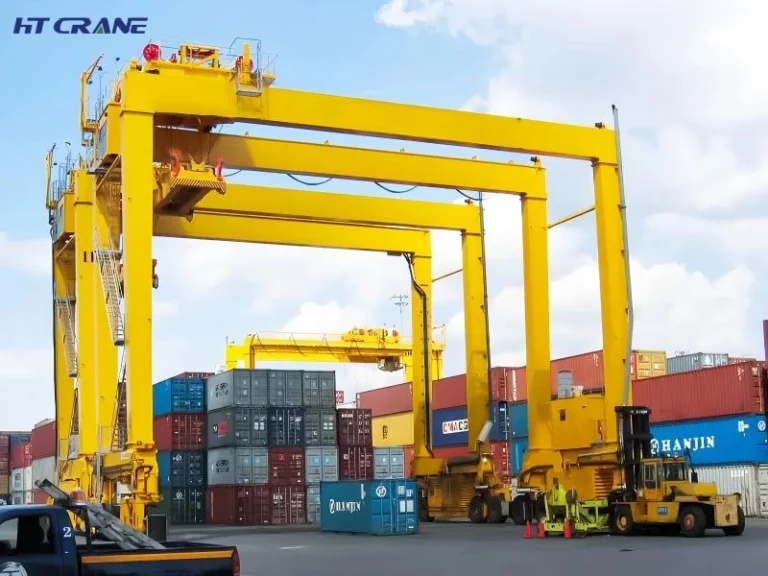
Double Girder Rubber Tired Gantry Crane
When to Choose Double Girder RTG Crane?
The double girder RTG crane is the right choice when any of the following apply to your operation:
- Container throughput exceeds 200,000 TEU per year per crane — the structural duty cycle demands A6 or higher classification
- Span requirement exceeds 23 meters — needed to cover 6 container rows plus a central truck lane
- Twin-lift operations are planned — lifting two 20-foot containers simultaneously requires capacity in the 55–65 ton range
- Stacking height of 1 over 5 or above is required — double girder structural rigidity supports the taller hoist path without excessive deflection
- Electric RTG (E-RTG) conversion is anticipated — double girder platforms accommodate cable reel or conductor rail systems for shore power more readily than single girder designs
The double girder configuration also provides an integrated maintenance walkway between the two beams, giving technicians direct access to trolley drives, hoist components, and electrical panels — an important operational consideration for high-duty port machinery running across multiple shifts.
Single Girder vs Double Girder Gantry Crane: Side-by-Side Comparison
Understanding the difference between single and double girder RTG cranes across every key procurement dimension helps your team align specification to operational reality.
| Comparison Factor | Single Girder RTG | Double Girder RTG | Decision Driver |
| Lifting Capacity | Up to 40t | Up to 65t (twin-lift) | Heavy cargo / twin-lift → double |
| Span Coverage | 4–5 container rows | 6–7 rows + truck lane | Standard terminal layout → double |
| Stacking Height | 1 over 3–4 | 1 over 4–6 | Density targets → double |
| Initial Cost | 15–25% lower | Higher | Budget-constrained, lower volume → single |
| Structural Weight | Lower | Higher | Apron load limits → evaluate carefully |
| Maintenance Access | Basic | Walkway between girders | High-duty ops → double |
| Duty Class Fit | A5–A6 | A6–A8 | Throughput determines class |
| E-RTG Conversion | Limited | Well-supported | Electrification roadmap → double |
| Typical Application | Inland depot, feeder port | Main line terminal | Volume and cargo type → determines fit |
Source: FEM 1.001 design guidelines, published RTG specifications from ZPMC, Konecranes, and Liebherr, 2022–2024.
RTG Crane Application: Matching Configuration to Terminal Type
Container handling equipment selection is ultimately a throughput and infrastructure problem. The right gantry crane configuration type depends on where your terminal sits in the port hierarchy.
Main Line Container Terminals
High-volume container terminals — handling 500,000 TEU annually per yard block — need double girder RTG cranes without exception. The combination of wide span (covering the standard 6-wide stacking pattern plus truck lane), high lift capacity for twin-lift operations, and A7/A8 duty classification is only achievable in double girder form. Terminals operated by DP World, PSA, and Hutchison Port Holdings predominantly run double girder RTG fleets, with recent procurement trends favoring fully electric configurations from suppliers including ZPMC and Konecranes.
Feeder Ports and Regional Container Facilities
Mid-size facilities handling 100,000–400,000 TEU annually represent the most complex selection decision. A single girder RTG crane may be technically adequate for current volumes but could constrain the facility within its operating lifespan. The standard recommendation in this range: specify double girder at the outset, sized for anticipated future throughput rather than current peak, and plan for E-RTG conversion in the second operational decade.
Inland Container Depots and Rail Terminals
Inland facilities — container freight stations, dry ports, intermodal rail yards — typically handle lower volumes with more varied cargo types. Single girder RTG cranes or mobile gantry crane alternatives may be appropriate here, particularly where maximum individual lift weights fall below 35 tons and span requirements are modest. The lower capital cost and simpler maintenance profile align well with the operational profile of these facilities.
RTG Crane Buying Guide: Key Questions for Procurement Teams
A structured RTG crane selection process should resolve these questions before a specification is issued to potential gantry crane manufacturers and suppliers:
- What is the design throughput in TEU per year, per crane, at peak? This determines minimum duty class and directly influences whether single or double girder is appropriate.
- What is the required span? If your container yard layout requires covering 6 rows plus a truck lane, single girder is off the table.
- Is twin-lift planned or anticipated? If yes, specify double girder with 55t+ capacity from the outset.
- What is the yard surface load capacity? Double girder RTG cranes are heavier; confirm the apron and yard pavement can support the increased tire loading.
- What is the electrification roadmap? New terminal projects in the EU and increasingly in Asia are specifying E-RTG as standard. Confirm that your selected double girder platform supports shore power integration.
- Who will service the crane fleet? Evaluate the RTG crane supplier’s regional service network, spare parts availability, and training provision — not just the unit price.
Summary: Choosing the Right RTG Crane Configuration
The rubber tired gantry crane market offers both single and double girder options, but for the majority of container port applications, the double girder RTG crane is the specification that matches operational reality. Its capacity range, span capability, duty classification, and long-term electrification compatibility make it the standard in modern container yard equipment planning.
Single girder RTG cranes remain viable for lower-throughput facilities, inland depots, and cost-constrained feeder port operations where current and future volume genuinely does not justify the double girder specification premium.
The key procurement principle: match the gantry crane configuration to your 15-to-20-year operational outlook, not your current peak. Underspecified port machinery is the most expensive mistake a terminal can make.
Frequently Asked Questions
Q1: What is the main difference between a single girder and double girder Rubber Tired Gantry crane in container terminal operations?
The structural difference — one vs. two main bridge beams — determines the practical capacity and span of the RTG crane. Single girder RTG cranes are limited to roughly 40 tons lifting capacity and spans covering 4–5 container rows. Double girder RTG cranes support up to 65 tons (including twin-lift configurations) and spans of 23–35 meters covering 6–7 container rows plus truck lane. For most commercial container terminals, the double girder configuration is the standard because it aligns with the 6-wide stacking layout and throughput demands of modern operations.
Q2: What lifting capacity should I specify for a double-girder Rubber Tired Gantry Crane in a container port application?
Standard specification for a double girder RTG crane at a main line container terminal is 40–45 tons under spreader for single-lift operations, and 55–65 tons for twin-lift (two 20-foot containers simultaneously). When specifying lifting capacity, account for the spreader weight (typically 4–6 tons for a telescopic twin-20 spreader) in addition to the container payload. Confirm whether your terminal handles out-of-gauge or heavy cargo that could approach or exceed standard container weight limits, as this affects both hoist and structural specification.
Q3: How do I decide between a diesel-electric and fully electric RTG crane for a new terminal project?
Diesel-electric RTG cranes offer operational flexibility without fixed power infrastructure, and they remain the practical choice for terminals in locations with unreliable grid supply or where yard layout makes cable connection impractical. Fully electric RTG cranes (E-RTG) eliminate diesel operating costs and emissions, which is increasingly a regulatory requirement in EU ports and a competitive differentiator globally. The capital cost premium for E-RTG is typically offset within 5–8 years through fuel and emissions savings, depending on local energy costs. For new greenfield terminal projects, E-RTG specification is now standard practice among major port equipment procurement teams.
Q4: What span should I specify for an RTG crane in a 6-wide container yard layout?
A 6-wide container yard layout — six rows of 40-foot containers plus a central truck lane — requires a crane span of approximately 23.47 meters under ICHCA/ISO standard container and lane dimensions. In practice, RTG crane suppliers typically offer this as a standard span option at 23.47m or 23.6m. If your terminal layout includes a wider truck lane or has non-standard container spacing, verify the exact span requirement with your terminal planner before issuing specifications to RTG crane manufacturers. Span is a fixed structural dimension; it cannot be adjusted after manufacture.
Q5: What should I look for when evaluating RTG crane suppliers for a port equipment procurement project?
Beyond price and technical specification, evaluate:
- (1) Reference installations at comparable terminals — request verifiable site references with crane age, duty classification, and operational availability data;
- (2) Spare parts supply chain — confirm regional parts availability and lead times for high-wear items (wheels, wire rope, spreader components);
- (3) Commissioning and training capability — new crane deployment requires on-site commissioning support and operator / maintenance training as standard deliverables;
- (4) After-sales service network — assess whether the RTG crane supplier has a regional service presence or relies entirely on factory dispatch, which affects response time for unplanned downtime events;
- (5) Compliance documentation — CE marking, load test certificates, and type-approval documentation should be standard inclusions, not optional extras.
Related Standards & References
- ISO 4301-1:2016 – Cranes: Classification, General
- FEM 1.001 – Rules for the Design of Hoisting Appliances (6th Edition)
- EN 13135:2013 – Cranes Safety: Design Requirements for Equipment
- ICHCA International – Container Terminal Planning Guidelines
- ZPMC RTG Product Range Specifications, 2023
- Liebherr LHM / RTG Product Documentation, 2023