Military naval facilities operate under pressure that civilian marinas rarely experience. Vessels must be hauled, inspected, repaired, and redeployed on tight schedules. Equipment failure is not just a maintenance problem — it is an operational readiness problem.
Marine travel lifts have become a core infrastructure component in modern military dockyards and naval bases. They replace or supplement traditional dry dock systems by offering faster vessel turnaround, greater operational flexibility, and significantly lower infrastructure dependency. From patrol boat maintenance to heavy naval vessel handling, the marina travel lift is now a standard tool in defense maritime operations worldwide.
This guide is written for naval engineering teams, military procurement departments, and shipyard project managers evaluating marine boat lifting equipment for defense applications. It covers what military-grade systems require, how they differ from civilian configurations, and what to define before approaching a supplier.
What Is a Marine Travel Lift and How Does It Work
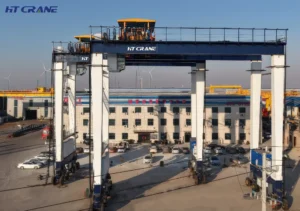
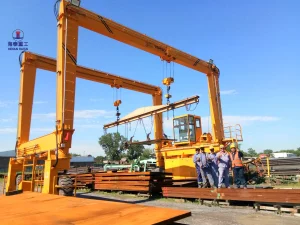
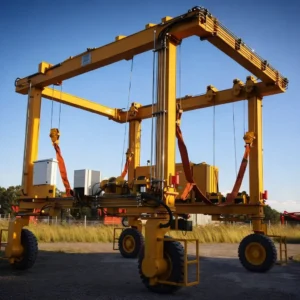
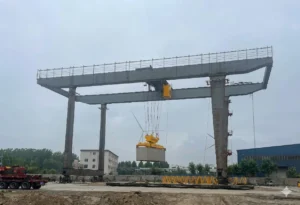
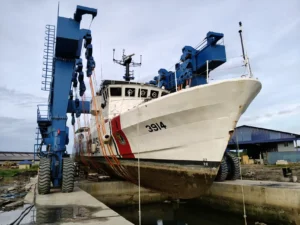
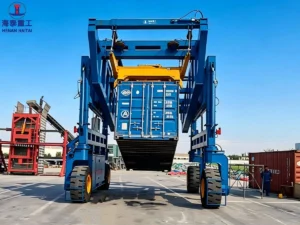
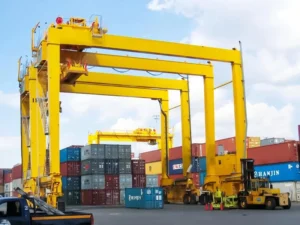
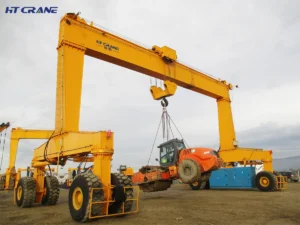
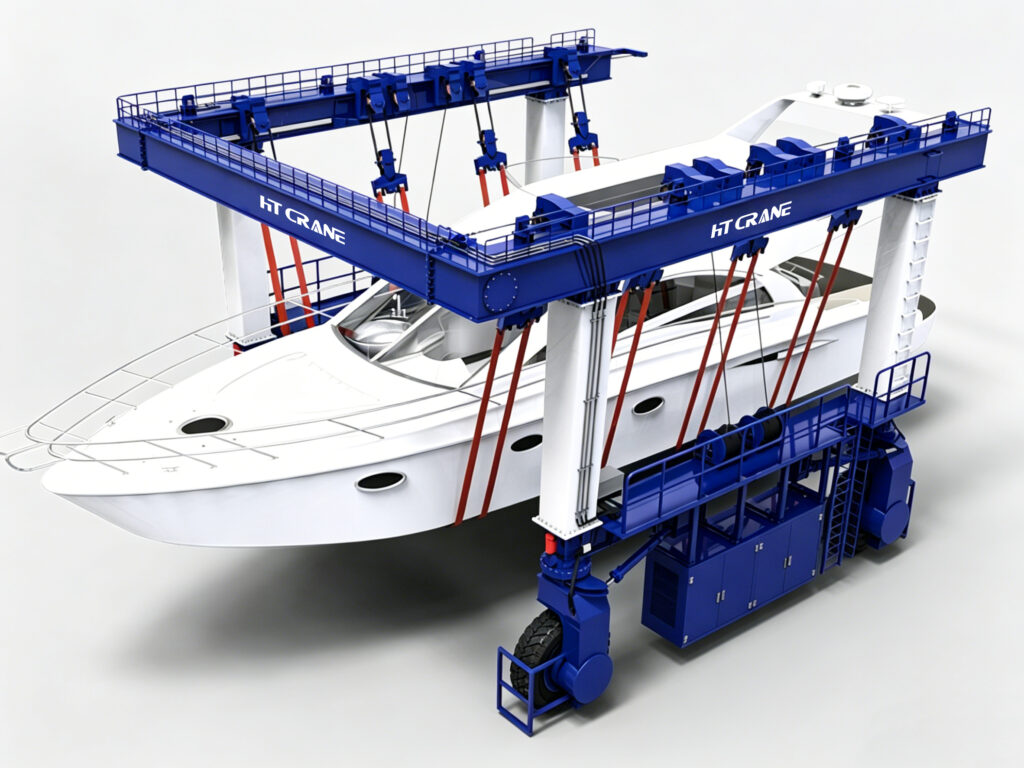
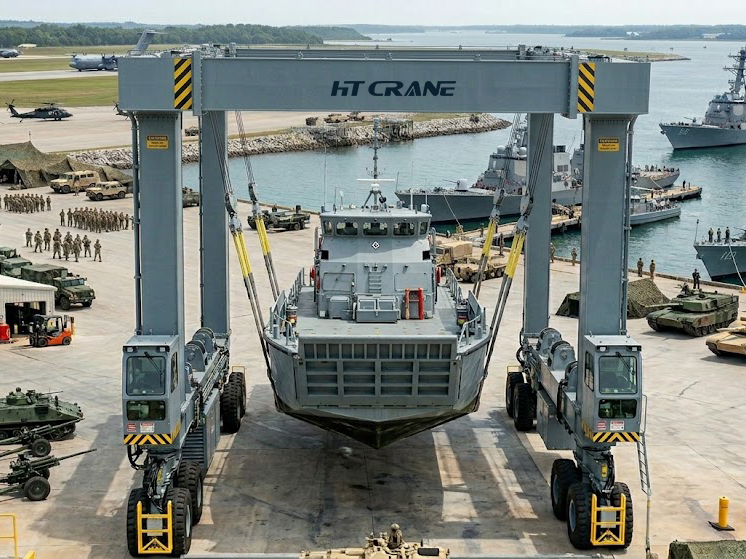
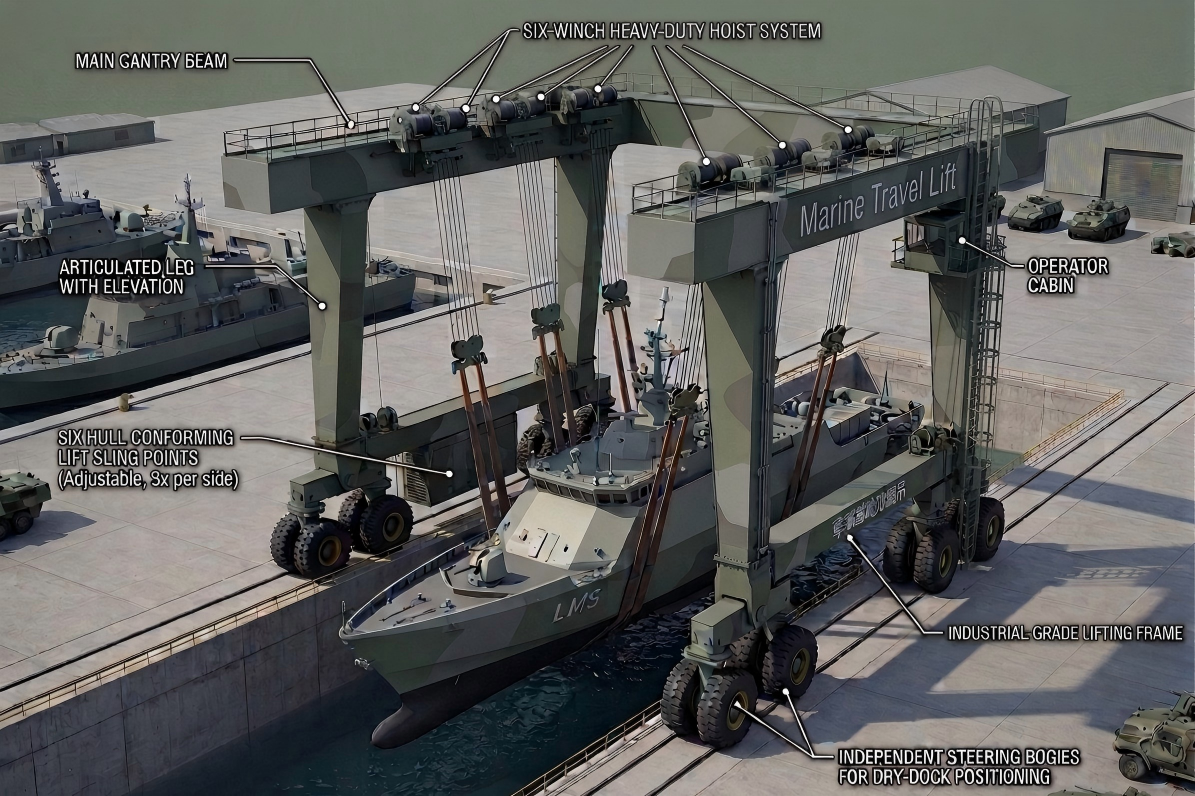
A marine travel lift — also called a boat hoist crane or mobile boat hoist — is a self-propelled rubber-tired gantry crane that straddles a vessel in the water, lifts it using textile slings, and transports it across a hardstand to a maintenance or storage position. One integrated machine handles the complete haul-out cycle without transferring the vessel between equipment.
Main Structural Components
- Lifting frame and crossbeam: The primary structural element. Leg clearance determines the maximum vessel beam the system can accommodate.
- Sling system: Nylon or polyester textile slings positioned beneath the hull. Sling configuration is adapted to vessel type — monohull, multihull, or flat-bottomed craft.
- Hydraulic lifting mechanism: Synchronised hydraulic cylinders raise and lower the sling beam with controlled, even load distribution.
- Wheel assemblies and drive system: Solid rubber tires on diesel-hydraulic or electric drive units. Multi-axle configurations distribute load across a larger hardstand footprint.
- Steering system: Two-wheel, four-wheel, or all-wheel crab steering for maneuvering in confined shipyard environments.
Capacity Range Overview
| Configuration | Lifting Capacity | Typical Application |
|---|---|---|
| Light marina lift | 15–50 tons | Small patrol craft, RIBs |
| Mid-range shipyard lift | 50–200 tons | Coastal vessels, support craft |
| Heavy-duty naval lift | 200–500 tons | Large naval vessels, landing craft |
| Ultra-heavy systems | 500+ tons | Major warships, amphibious craft |
Why Military Bases Use Marine Travel Lifts
Traditional dry docks remain in service at major naval facilities — but they are expensive to construct, slow to operate, and unavailable for simultaneous multiple-vessel maintenance. The marine travel lift addresses each of these limitations directly.
Operational Applications in Naval Environments
Military bases use heavy-duty marine travel lifts across a range of operational scenarios:
- Patrol boat and fast attack craft maintenance: Frequent haul-outs for hull inspection, antifouling, and propulsion system servicing
- Rescue and auxiliary vessel handling: Rapid deployment and recovery requirements with minimal preparation time
- Amphibious craft transport: Moving landing craft and amphibious vehicles between water and maintenance areas
- Dry storage management: Securing vessels out of water during operational standby or adverse weather periods
- Emergency repair operations: Fast-turnaround maintenance when fleet readiness is the priority
Advantages Over Traditional Dry Dock Systems
| Factor | Traditional Dry Dock | Marine Travel Lift |
|---|---|---|
| Vessel turnaround | Hours to days | 30–90 minutes |
| Infrastructure cost | Very high | Moderate |
| Multiple vessel handling | One at a time | Multiple units simultaneously |
| Operational flexibility | Fixed location | Mobile across hardstand |
| Expansion scalability | Major civil works | Additional units |
Key Requirements for Military Marina Travel Lift Systems
Military applications impose requirements that standard commercial travel lifts are not designed to meet. Each of the following must be addressed explicitly in the procurement specification.
Heavy-Duty Lifting Capacity
Naval vessels are heavier, wider, and structurally more complex than civilian craft of equivalent length. A travel lift 500 ton system — or beyond — is a realistic requirement for facilities handling larger patrol vessels, landing craft, or support ships. Lifting stability under eccentric loads is critical. Military procurement specifications should define not just maximum rated capacity but also dynamic load performance and sling load distribution requirements across the vessel’s hull contact points.
High Safety Standards
Military facilities operate to safety standards that exceed civilian marina requirements. Key safety system requirements include:
- Overload protection: Automatic load limiting with audible and visual warning systems
- Anti-sway control: Active or passive systems to prevent load oscillation during travel
- Redundant hydraulic circuits: Independent lifting circuits on each sling point, maintaining load control under single-circuit failure
- Emergency stop systems: Multiple operator-accessible emergency stops with automatic safe-load-hold function
- Wind resistance rating: Structural design confirmed for operational wind speeds at the facility location
For vessels above 200 tons, dual independent hoist systems — where each sling point operates on a separate hydraulic circuit — are the baseline safety standard in defense applications.
Precision Maneuverability
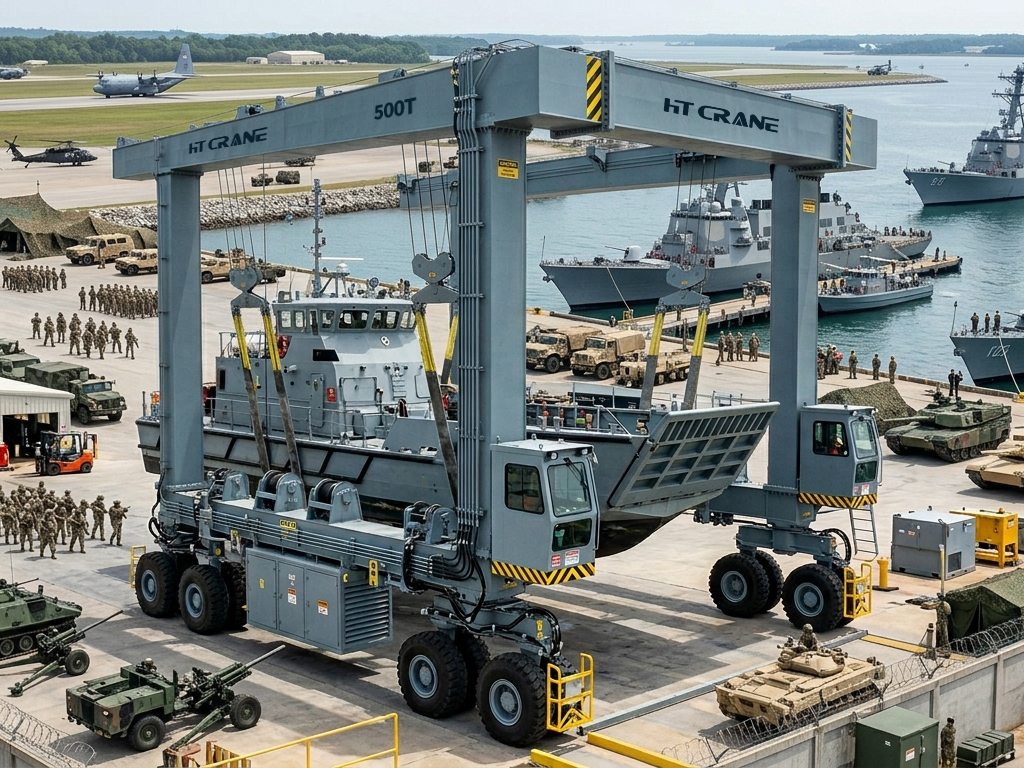
Naval dockyards are operationally dense environments. Travel lanes are narrow, vessels are berthed in close proximity, and positioning accuracy directly affects both safety and throughput. All-wheel (crab) steering — which allows lateral movement of the entire machine without frame rotation — is a functional requirement in most military shipyard applications, not an optional upgrade. Multi-axle steering configurations provide the turning radius control needed to position large-capacity units in confined hardstand layouts.
Corrosion Resistance
Coastal and maritime operating environments are aggressive. Salt air, tidal spray, and high-humidity conditions accelerate corrosion in structural steel, electrical systems, and hydraulic components. Military-grade marine boat lifting equipment requires:
- Marine-grade protective coatings on all structural steelwork
- Hot-dip galvanizing or equivalent corrosion treatment on exposed fasteners and fittings
- Sealed electrical enclosures rated for marine environments (IP65 minimum)
- Stainless steel or corrosion-resistant alloy hardware at critical connection points
- Scheduled corrosion inspection protocols documented in the maintenance manual
Continuous Heavy-Duty Operation
Military maintenance facilities do not operate on standard commercial schedules. Multi-shift operations, surge maintenance periods, and emergency readiness requirements mean that naval vessel handling equipment must be specified for continuous heavy-duty duty cycles. Under ISO 4301-1, high-frequency military applications typically fall in the M7 to M8 duty classification range. Specifying a lighter duty class to reduce upfront cost produces predictable outcomes: accelerated wear, premature component failure, and unplanned downtime at operationally critical moments.
Civilian vs Military Marine Travel Lift: Key Differences
The engineering gap between a civilian marina lift and a military-grade system is substantial. Understanding these differences helps procurement teams avoid underspecifying for defense applications.
| Feature | Civilian Marina Lift | Military Travel Lift |
|---|---|---|
| Duty cycle | Moderate (M4–M6) | Heavy continuous (M7–M8) |
| Safety redundancy | Standard single circuit | Dual independent systems |
| Vessel types | Yachts, recreational boats | Naval vessels, military craft |
| Lifting capacity | Typically under 200 tons | 200–500+ tons |
| Corrosion protection | Standard commercial coating | Marine-grade, enhanced treatment |
| Control systems | Standard pendant/remote | Advanced diagnostics, access control |
| Structural design life | 15–20 years standard use | 20–25 years heavy-duty use |
| Certification | CE / commercial standard | Defense-grade, third-party verified |
Common Military Applications for Boat Hoist Cranes
Naval Dockyards
Major naval bases use travel lift 500 ton systems alongside traditional dry docks to handle the full spectrum of fleet maintenance — from fast patrol vessels to larger support ships. The travel lift handles routine haul-outs while the dry dock is reserved for major overhaul work.
Coast Guard and Border Security Stations
Coast guard facilities typically operate mixed fleets of patrol boats, rescue craft, and interceptor vessels requiring frequent maintenance cycles. Mid-range travel lifts in the 50–200 ton range are the standard configuration at these facilities.
Amphibious Vehicle Maintenance Bases
Landing craft and amphibious assault vehicles present unique handling challenges — flat hull forms, wide beams, and heavy displacement. Custom sling configurations and extended beam width are standard requirements for these applications.
Offshore Defense Support Operations
Forward operating bases and offshore support facilities require travel lifts designed for remote operation with limited maintenance infrastructure. Reliability, simplified servicing, and extended service intervals are the primary specification priorities in these environments.
Customization Options for Military Travel Lifts
Factory-standard configurations address civilian marina requirements. Military applications routinely require custom engineering across multiple system areas.
Capacity and Structural Customization
Capacity requirements for defense applications range from 100-ton systems for coast guard stations to travel lift 500 ton configurations for major naval dockyards. Custom span widths — to accommodate specific vessel beam dimensions — and increased lifting heights for vessels with tall superstructures are both standard customization requests in military procurement.
Intelligent Control and Monitoring Systems
Modern military travel lifts integrate control technology that goes beyond basic pendant operation:
- Remote diagnostics: Real-time system health monitoring accessible to maintenance teams off-site
- Automated sling synchronisation: Load balancing across multiple sling points without manual adjustment
- Load monitoring and logging: Continuous recording of lift cycles, peak loads, and operational hours for maintenance planning
- Operator access control: PIN or credential-based system access limiting operation to authorised personnel
Extreme Environment Adaptation
Military facilities operate in environments ranging from Arctic cold to tropical heat. Configuration options for extreme environments include cold-weather hydraulic fluid specifications and heated component enclosures for sub-zero operations, tropical climate corrosion packages for high-humidity coastal environments, and high-wind operational ratings with structural confirmation for facilities in exposed coastal positions.
Security-Focused Features
Defense procurement increasingly includes operational security requirements for lifting equipment. Access-controlled operator interfaces, audit-logged operational records, and physically secured control panels are now standard requests in military travel lift specifications.
Conclusion
Marine travel lifts are a critical component of modern military vessel maintenance infrastructure. Naval bases, coast guard stations, and defense shipyards that adopt correctly specified heavy-duty marine travel lift systems achieve faster vessel turnaround, greater operational flexibility, and lower lifecycle maintenance costs compared to facilities relying solely on traditional dry dock approaches.
Military applications demand more than commercial marina configurations deliver. Higher duty cycles, redundant safety systems, corrosion-resistant construction, and custom capacity engineering are baseline requirements — not premium options.
Ready to define your military marine travel lift requirement? Contact our engineering team to discuss your naval facility’s specific vessel handling needs. We provide customised travel lift 500 ton solutions and full-range naval vessel handling equipment engineered for defense applications — from initial specification support through to commissioning and lifecycle maintenance planning.

FAQ
Q1: What lifting capacity is required for a military marine travel lift?
Military facility requirements vary significantly by vessel type. Coast guard and border patrol stations handling fast patrol craft typically require travel lifts in the 50–200 ton range. Naval dockyards handling larger support vessels, landing craft, or amphibious assault vehicles commonly require 300–500 ton systems. Always apply a 25–30% buffer above your heaviest vessel’s displacement. Operating consistently near maximum rated capacity accelerates mechanical wear and shortens structural service life. For facilities with mixed fleets, specify for the heaviest and widest vessel — both capacity and span are binding constraints that must be confirmed independently.
Q2: How does a military travel lift differ from a standard commercial marina lift?
The core differences are duty cycle, safety redundancy, and structural specification. Military travel lifts are designed for continuous heavy-duty operation at M7 to M8 duty classification under ISO 4301, compared to the M4 to M6 range typical of civilian marina applications. Safety systems include dual independent hydraulic hoist circuits, redundant braking, and emergency load-hold functions that maintain vessel control under single-component failure. Structural corrosion protection, access control systems, and third-party certification requirements also exceed civilian standards. These differences reflect the operational consequences of equipment failure in a defense environment — which are fundamentally different from those in a commercial marina.
Q3: What hardstand specification is required for a 500-ton military travel lift?
Wheel load data under full rated capacity is provided by the manufacturer as part of their technical submittal and must be reviewed by a geotechnical and structural engineer before hardstand construction or upgrade. At 500-ton capacity, wheel loads are substantial — reinforced concrete hardstand designs for heavy military travel lifts typically require detailed bearing capacity analysis based on site-specific soil conditions. Hardstand thickness, reinforcement specification, and joint design must all be confirmed against the manufacturer’s certified wheel load data. Commission the geotechnical survey and structural design in parallel with equipment procurement — not after the travel lift has been ordered.
Q4: Can a marine travel lift operate in extreme weather and coastal environments?
Yes, provided it is specified and configured for the operating environment. Standard commercial travel lifts are designed for moderate coastal conditions. Military facilities in Arctic, tropical, or high-wind coastal environments require specific adaptations: cold-weather hydraulic specifications and heated enclosures for sub-zero operations; enhanced corrosion protection packages for high-humidity tropical environments; and structural wind resistance confirmation for exposed coastal positions. These requirements must be explicitly stated in your procurement specification — do not assume that a general “marine environment” rating covers extreme condition operation without engineering confirmation from the supplier.
Q5: What certifications should a military marine travel lift carry?
For European defense procurement, CE marking under the Machinery Directive 2006/42/EC is the baseline certification requirement. This requires a Declaration of Conformity, structural calculation documentation, and a risk assessment covering all operating modes including emergency procedures. Third-party load test certification — conducted on-site after installation — is standard practice for military applications and is typically required by the facility’s safety authority before the unit enters operational service. For facilities in North American defense jurisdictions, ASME B30 compliance is the relevant standard. Confirm certification requirements with your procurement authority and facility safety officer before issuing the RFQ, as adding compliance documentation after order placement is significantly more complex and costly.