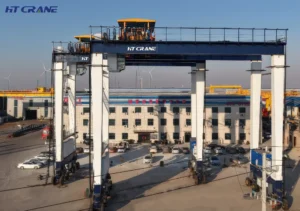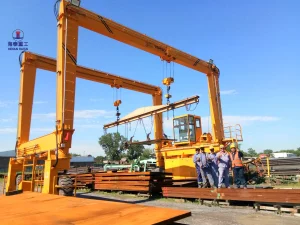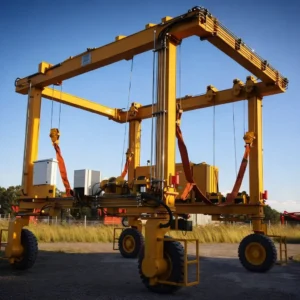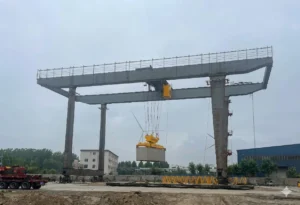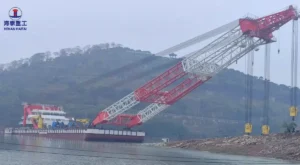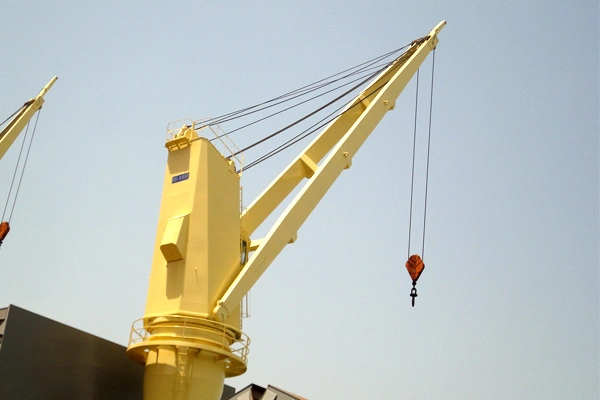
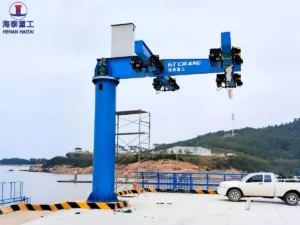
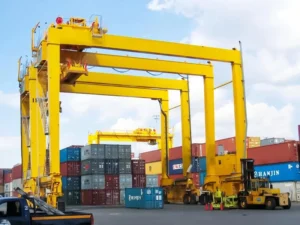
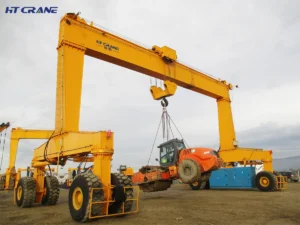
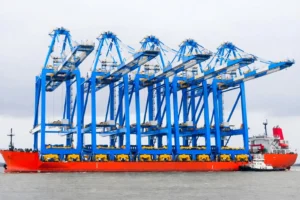
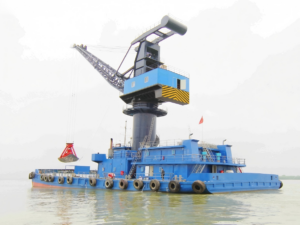

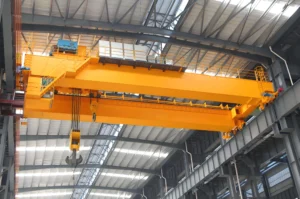
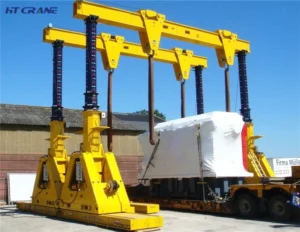
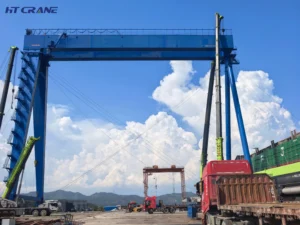
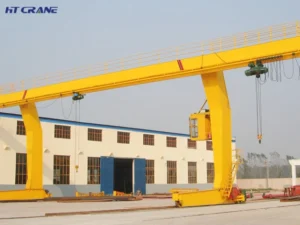
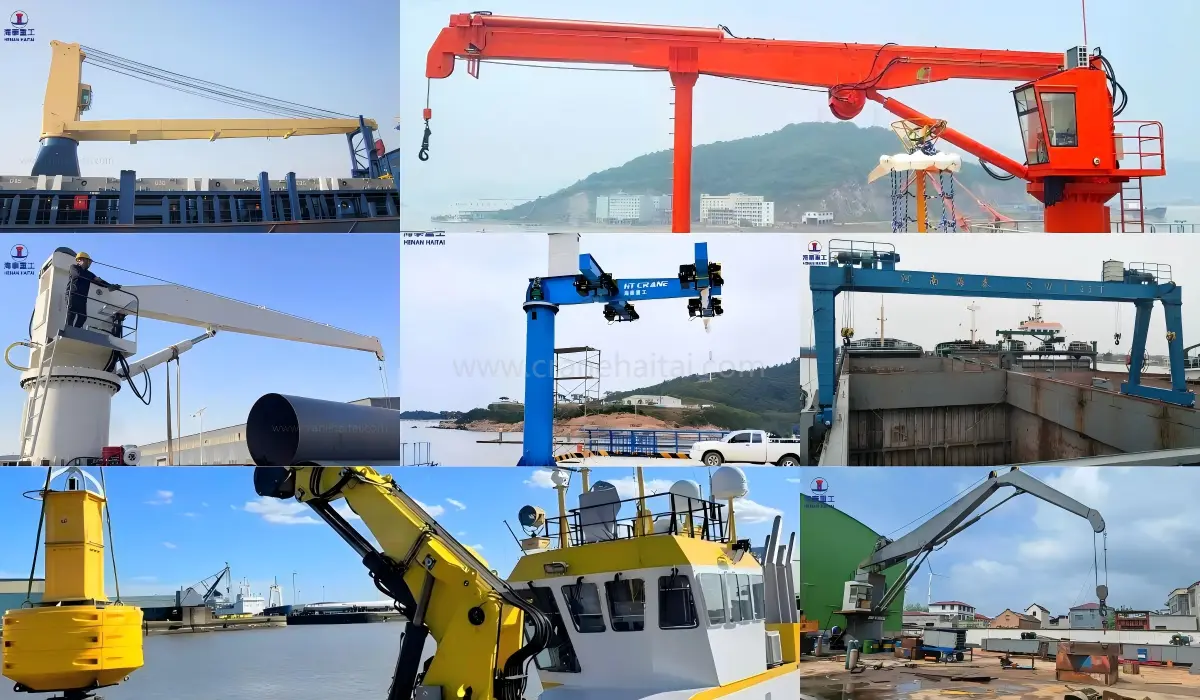
Seven primary types of marine cranes configurations dominate today’s newbuild and retrofit specifications. Knowing which geometry suits your deck, your cargo, and your classification society is the difference between an asset that performs reliably for twenty years and one that fouls the hatch coaming on day one.
Marine cranes are classified primarily by boom geometry, drive system, and structural mounting. This guide evaluates seven working configurations — hydraulic stiff boom, telescopic boom, knuckle boom, knuckle-telescopic, marine jib cranes, ship’s cargo cranes (Ke Ling Diao), and hatch cover gantry cranes — covering SWL and outreach ranges, foundation loads, stowed air draft, hydraulic versus electric drives, and how CCS, ABS, LR, and BV approvals affect your procurement schedule.
Why Marine Cranes Are Classified by Boom Geometry, Not Just Tonnage?
Buyers usually open an inquiry with a tonnage figure — “we need a 5-tonne marine crane.” However, on a vessel, tonnage alone almost never determines the crane selection. Two 5-tonne cranes can have completely different foundation reactions, vastly different stowed heights, and entirely different coverage envelopes for the only question that matters on a working deck: can the hook reach the cargo without the boom colliding with deck structures?
That is why the marine industry classifies cranes by their boom geometry. The boom design determines the reach envelope, the overturning moment transferred into the vessel’s structure, the stowage footprint, and the maintenance requirements for hydraulic components exposed to marine environments.
Below are the seven main configurations engineered for shipboard and offshore applications.
Understanding the Core Mounting Interface: Marine Deck Cranes
Before selecting a boom geometry, it is essential to define the deck mount classification. Any marine deck crane structurally integrated into a ship’s deck — via a bolted or welded foundation ring, a king post, or a pedestal column — is fundamentally a deck-mounted crane.
This classification defines the primary structural interface: a deck-mounted crane transmits heavy vertical loads, radial shear, and large overturning moments directly into the deck plating. Consequently, the foundation must align with structural bulkheads, web frames, or purpose-built insert plates with doublers and bracket reinforcements. We issue precise vertical load, horizontal load, and overturning moment figures for every unit in standard class-surveyor formats.
The Seven Working Configurations of Types of Marine Cranes
Table 1 — Marine Crane Types & Indicative Specification Ranges
| Crane types of marine cranes | SWL range | Max outreach | Диапазон поворота | Drive system | Stowed footprint | Primary application |
|---|---|---|---|---|---|---|
| Hydraulic stiff boom | 1 – 60 t | 3 – 35 m | 360° непрерывный | Electro-hydraulic | Large (boom rest) | Heavy lift, offshore supply |
| Hydraulic telescopic boom | 0.5 – 15 t | 4 – 25 m | 360° непрерывный | Electro-hydraulic | Compact (retracted) | Tender handling, stores, survey |
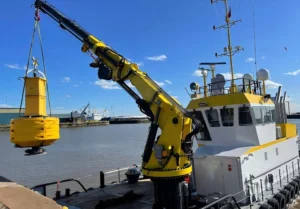
| Hydraulic knuckle boom | 0.5 – 30 t | 4 – 30 m | 360° непрерывный | Electro-hydraulic | Very compact (folded) | Height-restricted decks, access |
| Knuckle-telescopic boom | 0.5 – 20 t | 5 – 35 m | 360° непрерывный | Electro-hydraulic | Very compact | Superyachts, OSVs, research |
| Marine jib crane | 0.25 – 10 t | 1.5 – 8 m | 180°–360° | Electric / manual | Минимальный | Engine room, provision handling |
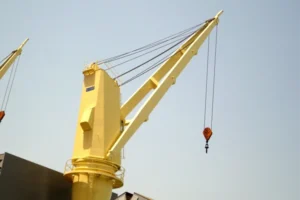
| Ship’s cargo crane | 5 – 80 t | 8 – 36 m | 360° непрерывный | Electric / electro-hydraulic | Medium (pedestal) | Bulk & general cargo handling |
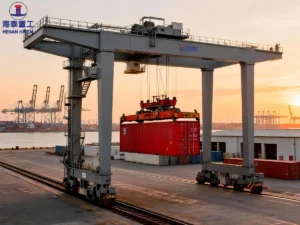
| Hatch cover gantry crane | 5 – 40 t | Rail span / beam | Rail traveling | Electric | Parked at hatch end | Pontoon hatch cover handling |
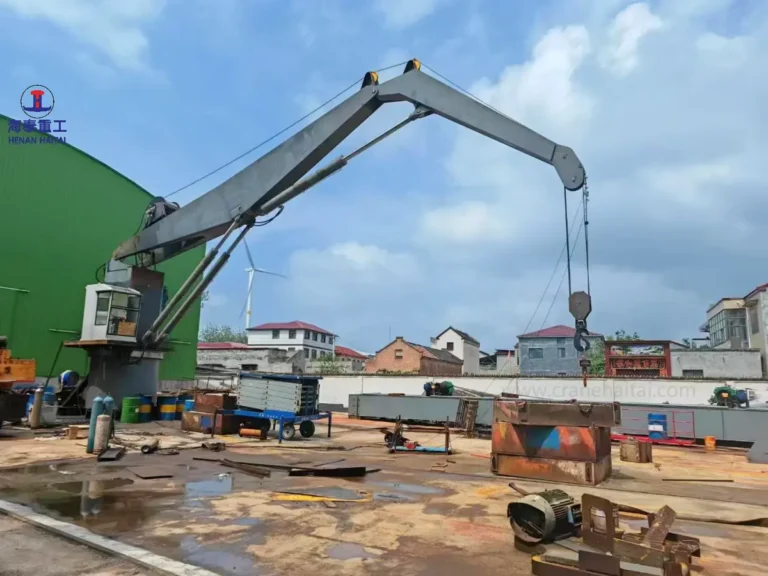
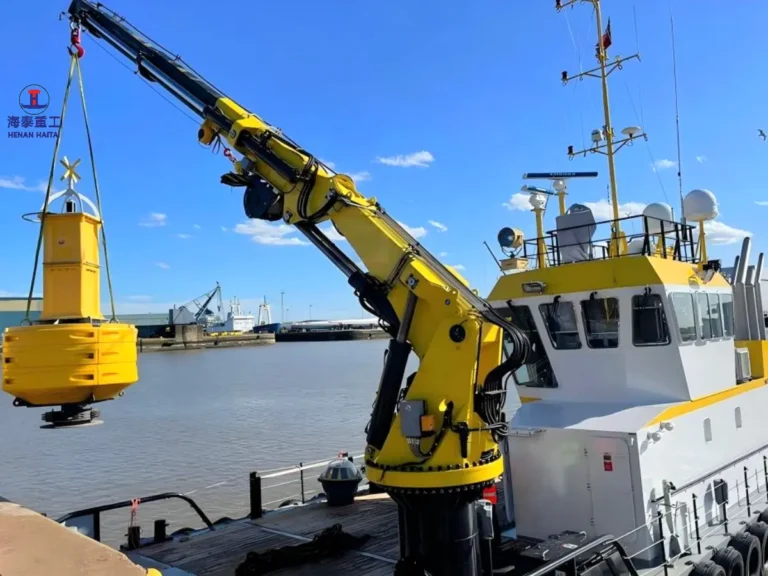
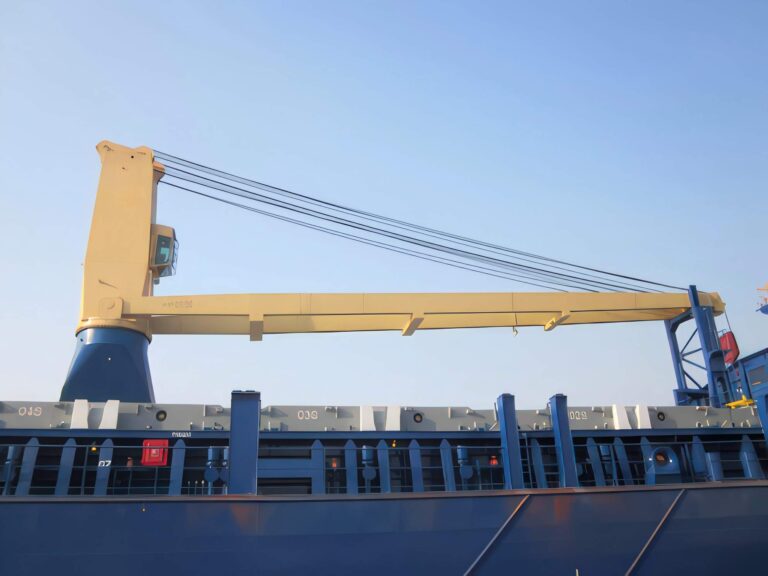
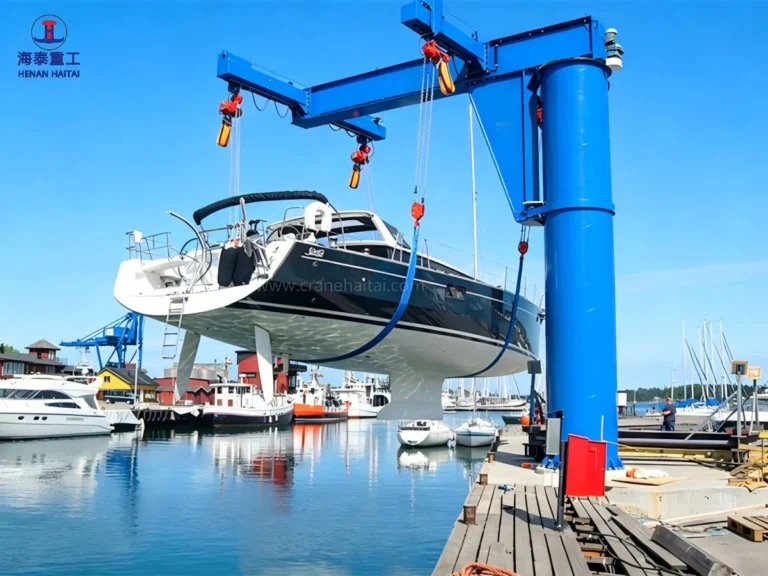
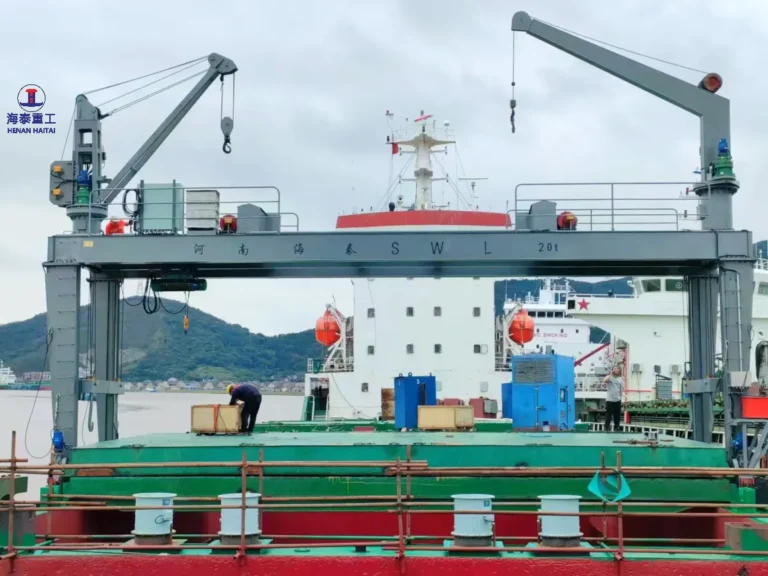
1. Hydraulic Stiff Boom Marine Crane
HEAVY DUTY · SIMPLEST STRUCTURE
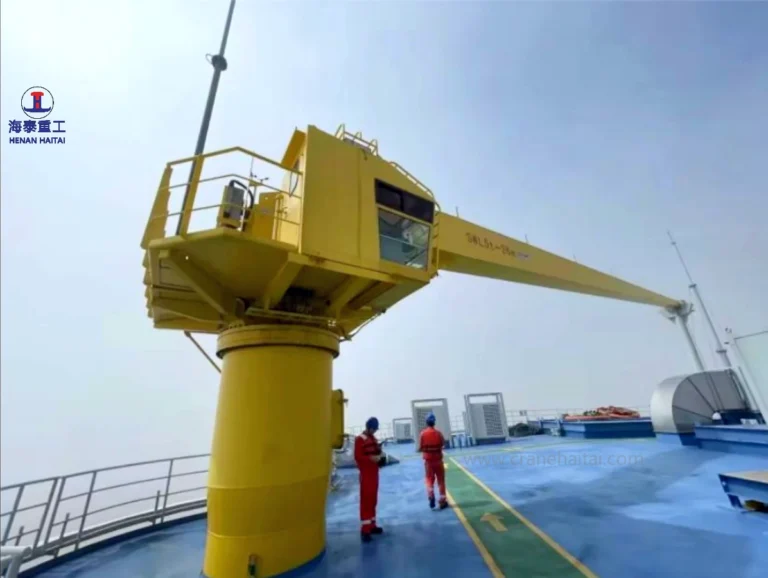
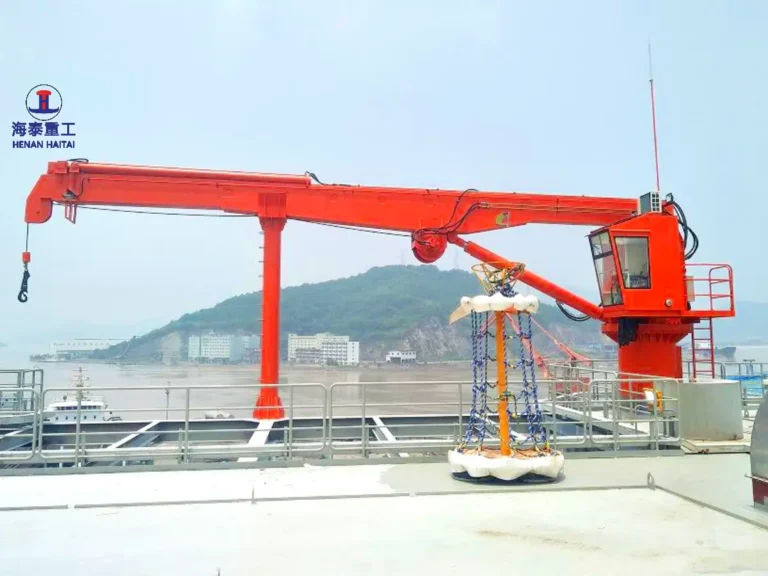
Structure: a rigid, one-piece box-section boom pinned at the slew column and luffed by hydraulic cylinders. No articulation joints or sliding sections.
Characteristics: the stiff boom is the marine workhorse. Featuring a single welded box girder with no articulation, it offers the highest strength-to-weight ratio and the fewest wearable parts — one luffing cylinder pair, one slew drive, and one winch. Radius changes solely via luffing, creating a simple arc envelope. This predictable geometry makes stiff boom cranes ideal for heavy-lift duties and long-service applications requiring minimal maintenance.
Trade-off: the boom stows at a steep angle or requires an extended boom rest, occupying significant deck length and increasing stowed air draft.
Типичные области применения: heavy cargo handling, engine room hatch operations, offshore supply duties, and capacities above 10 t SWL.
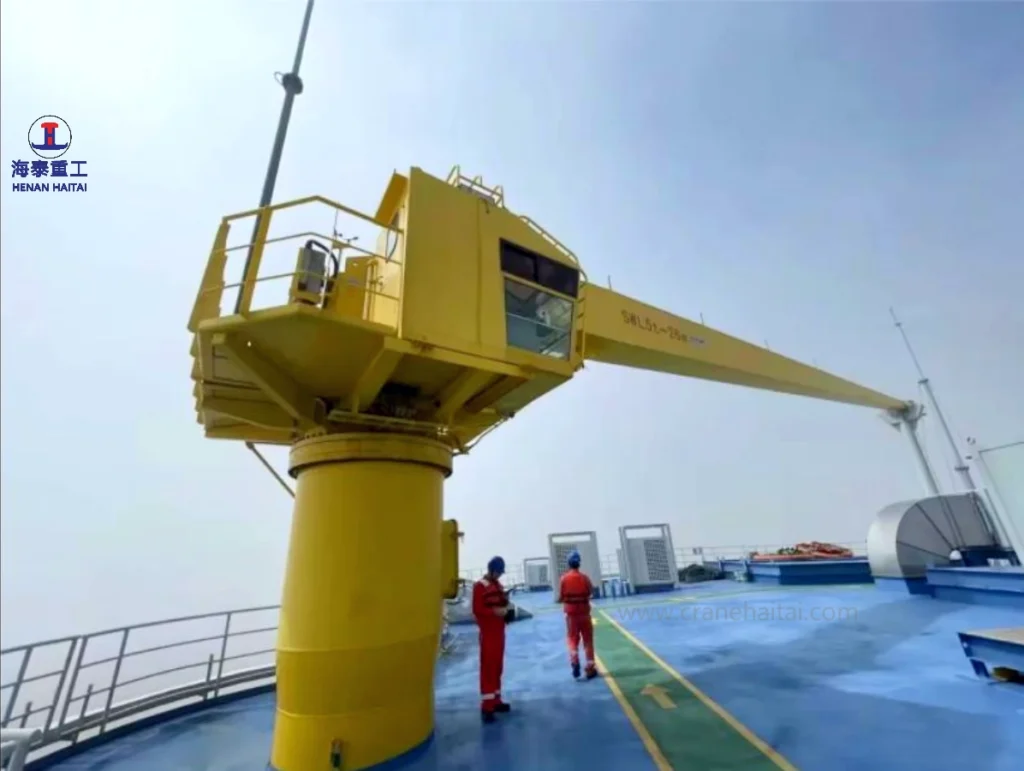
2. Hydraulic Telescopic Boom Marine Crane
FLEXIBLE WORKING RADIUS
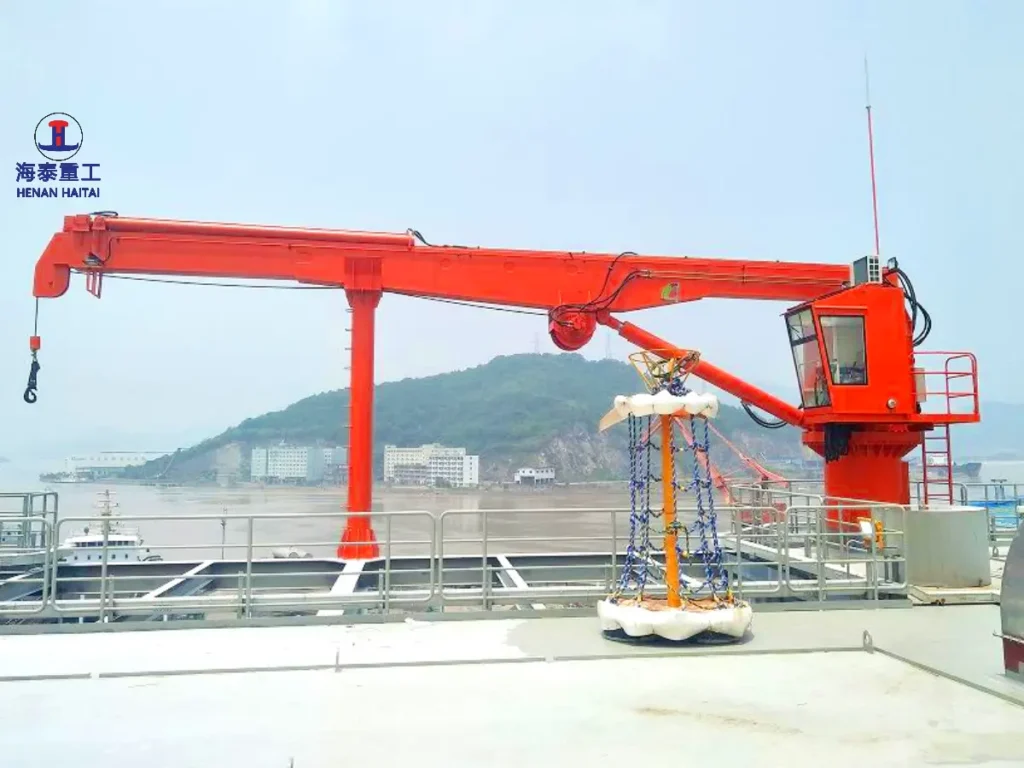
Structure: nested box sections extended via internal hydraulic cylinders, operating on low-friction wear pads between sections.
Characteristics: a telescopic boom alters its operational radius without changing the boom angle — a major advantage when maneuvering past obstructions such as bulwarks, fixed hatch coamings, or tender garages. It stows fully retracted, occupying far less deck space than a stiff boom of equivalent outreach.
Trade-off: rated SWL drops significantly as sections extend due to internal cylinder weights and structural leverage. Always verify the full load chart rather than relying solely on maximum SWL figures.
Key considerations: inspect wear pads regularly and prevent seawater ingress at section joints. Specify stainless steel or hard-chromed cylinder rods for exposed marine installations.
Типичные области применения: yacht tender handling, survey equipment deployment, and stores handling on space-constrained decks.
3. Hydraulic Knuckle Boom Marine Crane
SPACE-SAVING · HIGHLY FLEXIBLE
Structure: main boom featuring an articulated outer jib, driven by independent hydraulic cylinders hinged on a primary pin.
Characteristics: knuckle boom geometry solves stowage and obstruction challenges. When folded, the crane collapses tightly against its base or mast house, maintaining a minimal stowed air draft for canal and bridge transits. In operation, the articulated joint allows the hook to travel nearly vertically, reach underneath structures, or lower loads below the crane base level.
Trade-off: increased pivot pins, cylinders, and hydraulic lines require additional inspection points. The knuckle joint represents a fatigue-critical location that demands bushed, greasable pin assemblies.
Типичные области применения: provision handling, offshore personnel access, vessels with strict height restrictions, and workboat launch/recovery.
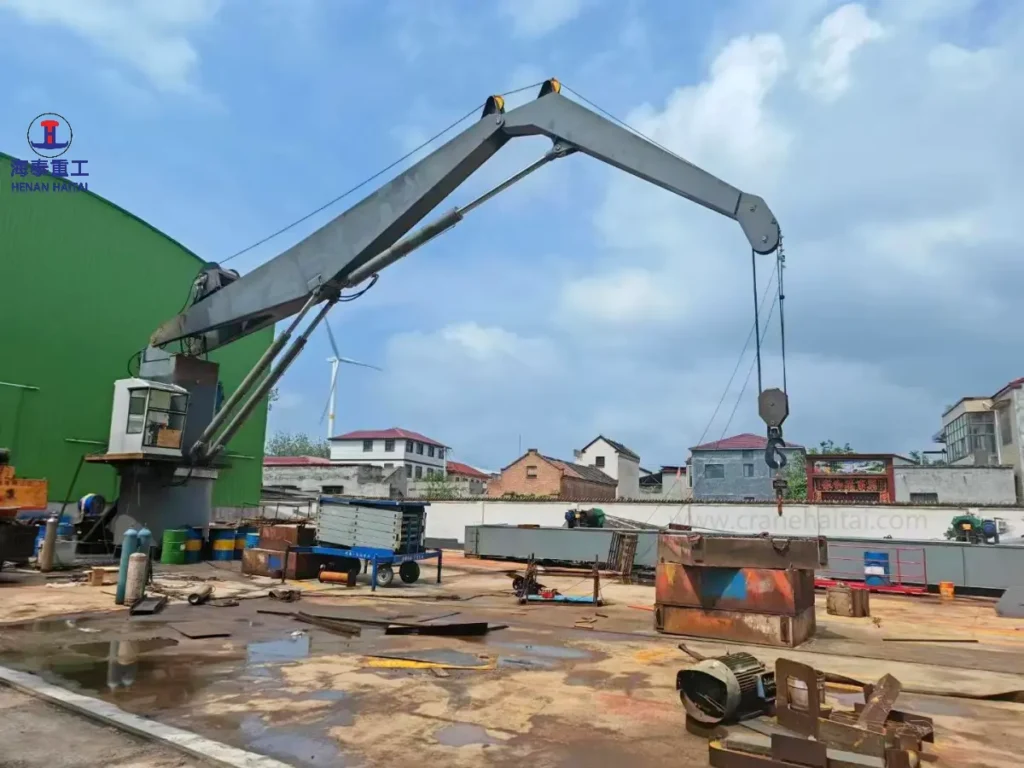
4. Knuckle-Telescopic Boom Marine Crane
MAXIMUM OPERATIONAL ENVELOPE
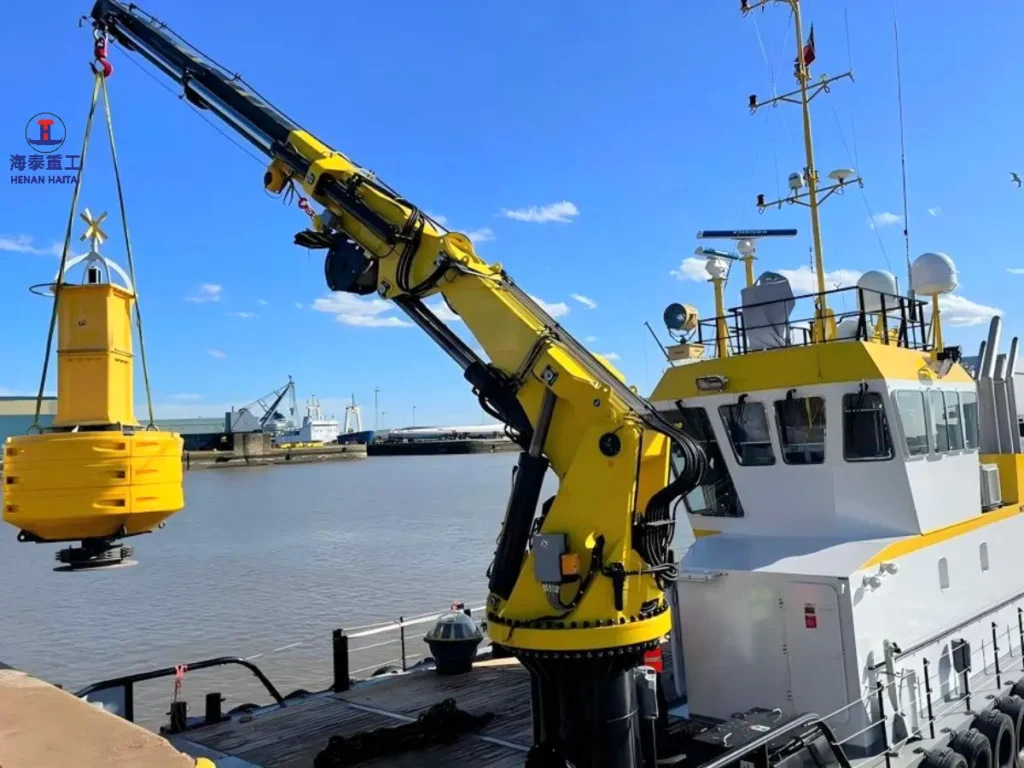
Structure: articulated knuckle geometry combined with a telescoping outer boom section.
Characteristics: represents the most versatile geometric envelope available for deck mounting. Combines the folding capability of a knuckle crane with the precise radial extension of a telescopic boom. It enables operators to maneuver loads into tight garages or under bridge sightlines from a single pedestal installation.
Trade-off: highest hydraulic complexity, higher capital cost, and a steep capacity reduction at full extension. Requires dedicated hose reels, protected hydraulic power units (HPUs), and thorough operator training.
Типичные области применения: superyachts, Offshore Support Vessels (OSVs), and oceanographic research vessels.
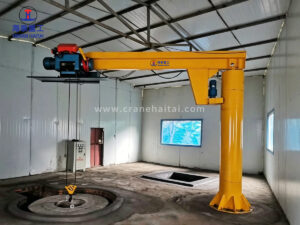
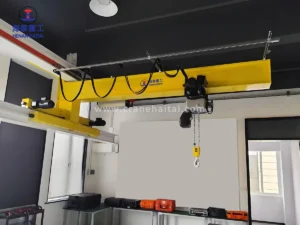
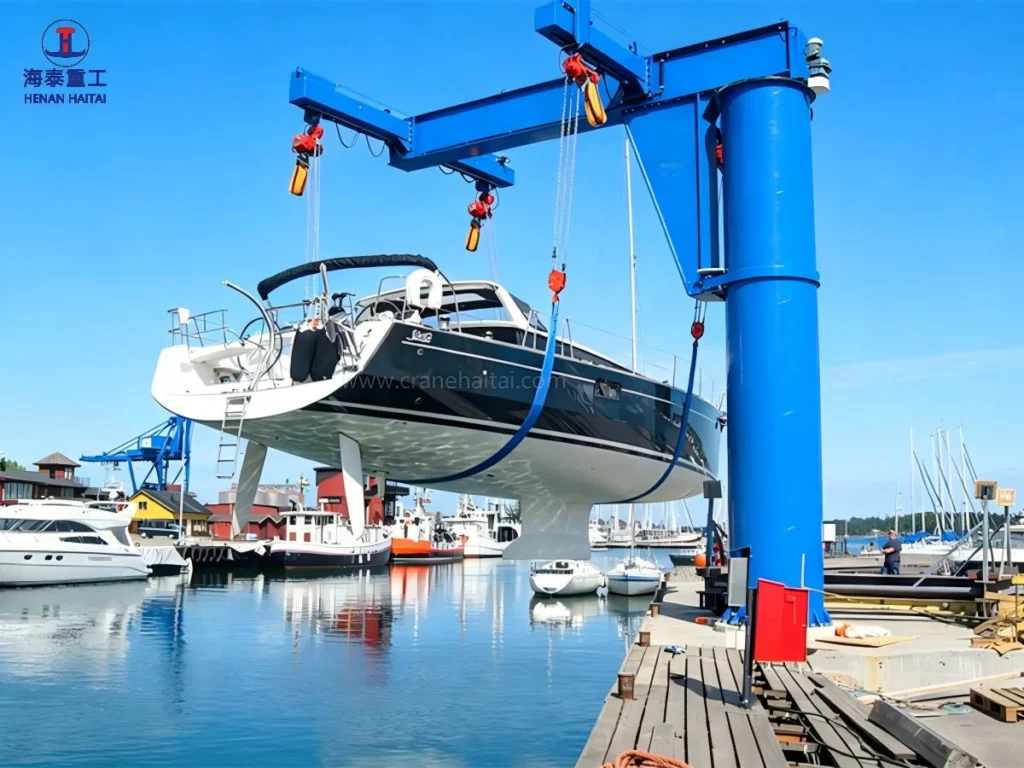
5. Marine Jib Crane
SHORT RANGE · COST-EFFECTIVE
Structure: a fixed vertical column supporting a fixed or slewing horizontal jib arm, equipped with a hoist or traveling trolley.
Characteristics: highly simplified design consisting of a column, arm, and hoist. Outreach is fixed or adjusted manually/electrically along the jib track. With no luffing cylinder system, the deadweight is low, installation cost is minimal, and maintenance requirements are negligible.
Trade-off: limited coverage area and lower overall capacity compared to multi-cylinder hydraulic cranes.
Типичные области применения: engine room casing lifts, provision door handling, workshop maintenance, and fixed-point pump/filter servicing.
6. Ship’s Cargo Crane
CONTINUOUS HEAVY CARGO DUTY
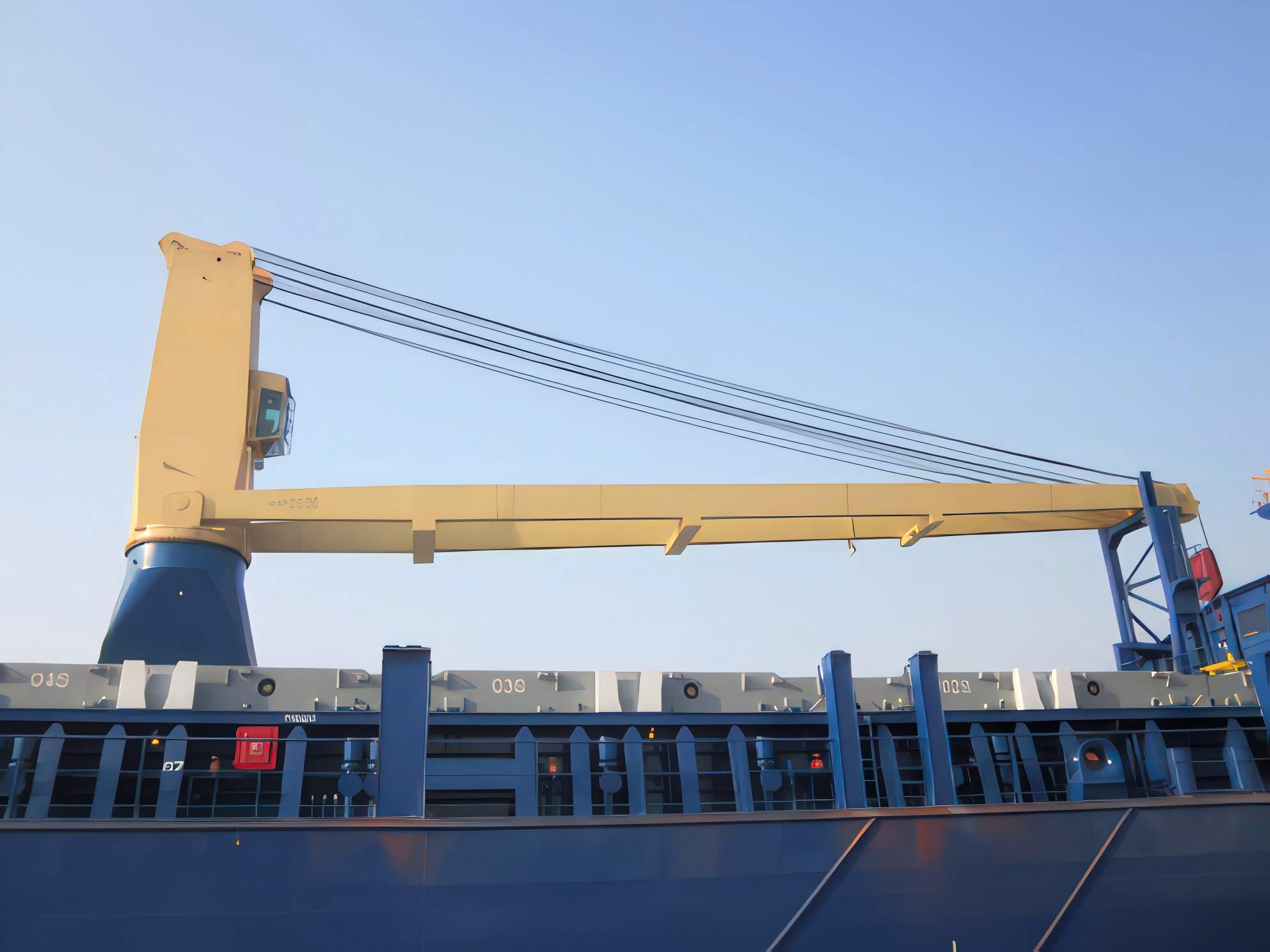
Structure: high-duty pedestal or king-post crane, typically employing heavy-duty stiff boom geometry designed for continuous duty cycles using grabs, hooks, or spreaders.
Characteristics: commonly designated as Ke Ling Diao in Asian shipbuilding, cargo cranes are categorized by high mechanism duty classes rather than basic geometry alone. While a stores crane performs occasional lifts per month, a ship’s cargo crane operates continuously under full load. They feature reinforced slewing bearings, forced-cooled motors, electro-hydraulic or fully electric drives, and integrated operator cabins.
Trade-off: substantial weight and high foundation load impact on deck framing.
Типичные области применения: bulk carriers, general cargo ships, multipurpose vessels, and self-discharging cargo operations.
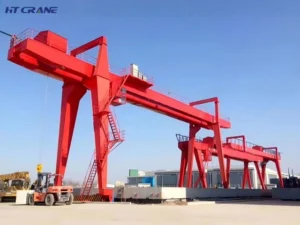
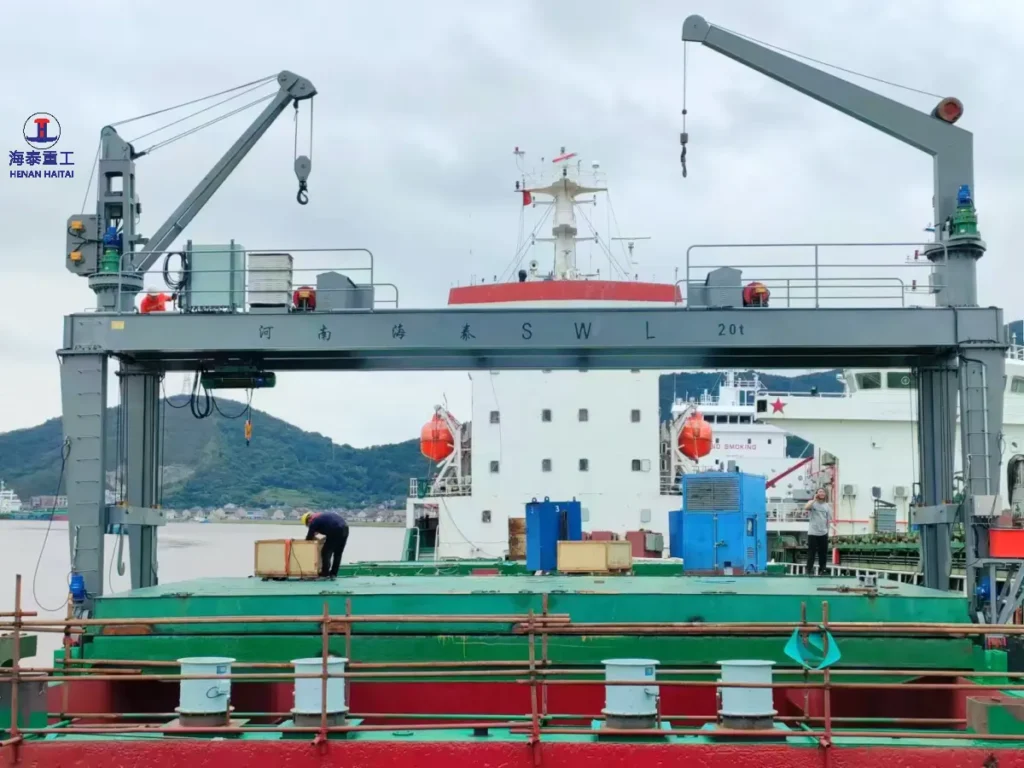
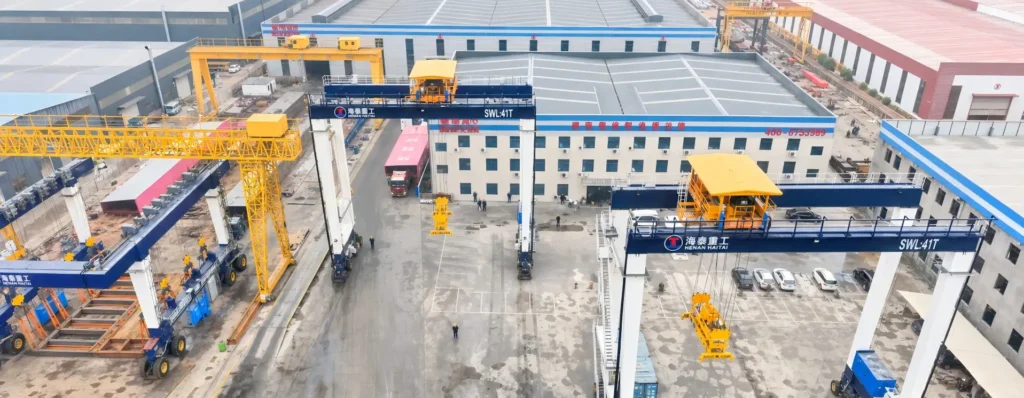
7. Hatch Cover Gantry Crane
DECK-TRAVERSING CARGO & COVER HANDLING
Structure: a gantry frame spanning the deck beam, traveling longitudinally on deck-mounted rails equipped with twin hoists or specialized lifting beams.
Characteristics: specifically designed to travel along the length of cargo holds to stack, stow, or shift heavy pontoon hatch covers without consuming valuable boom outreach.
Trade-off: requires precise deck-rail alignment, power feeding systems along the deck length, and dedicated rail stowage locks.
Типичные области применения: container ships, bulk carriers with pontoon hatch covers, and specialized multi-purpose deck barges.
Specifications above are indicative. Every marine crane is custom-engineered to vessel arrangements, required duty groups, operational sea states, and ambient temperature requirements.
Hydraulic vs. Electric Drive Systems
① Electro-Hydraulic Drives
Most boom-type marine cranes utilize an electric motor driving a hydraulic pump. Hydraulics offer smooth proportional control, inherent shock absorption against wave action, and high power density within compact cylinders.
② Fully Electric Drives
Preferred for heavy-duty cargo cranes and traveling gantry cranes. Variable Frequency Drives (VFDs) deliver high energy efficiency, precise positioning, reduced noise, and eliminate hydraulic oil contamination risks over cargo holds.
③ Marine Execution Essentials
Regardless of drive selection, all units must feature IP-rated enclosures, marine-grade cable glands, stainless steel fasteners, and protective coatings certified for C5-M offshore corrosivity environments.
Certification & Classification Society Approval
Marine cranes require two concurrent approval streams:
Product Design Approval: verification of structural calculations, material traceability, welding procedures (WPS), hydraulic/electrical schematics, and load charts.
Shipboard Installation Approval: verification of deck foundation reinforcement, power supply integration, and an onboard overload proof test witnessed by a class surveyor.
Specifying the required classification society (CCS, ABS, LR, BV, etc.) during initial inquiries saves 4 to 6 weeks in project execution by streamlining drawing submission packages.
How to Choose: the Five Decisive Questions
- What is the required load at maximum outreach?
Define capacity as a combined load-and-radius figure (e.g., 5 t @ 20 m), not maximum SWL alone. This single metric determines structural sizing. - Are there strict air draft or sightline limits?
Bridge clearance, canal locks, and navigation sightlines often necessitate knuckle geometries that fold compactly below deck obstructions. - Is the lift location fixed or variable?
If lifting occurs at a single static location (e.g., over a maintenance hatch), a marine jib crane provides a cost-effective solution without complex hydraulics. - What is the expected operating duty cycle?
Periodic stores duty versus continuous heavy grab operations dictate entirely different mechanism groups, motor cooling specifications, and wire rope safety factors. - What structural support exists below deck?
Foundation reactions must be directly absorbed by primary vessel bulkheads and web frames. Requesting foundation load tables early prevents costly structural rework.
About Us – Компания Henan Haitai Heavy Industry Co, Ltd.
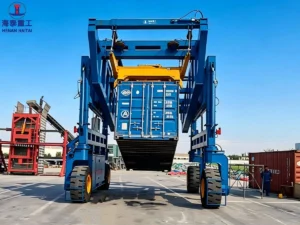
Haitai Crane is a specialized manufacturer of heavy lifting machinery for marine, shipyard, and industrial applications. Our product portfolio includes deck cranes, ship’s cargo cranes (Ke Ling Diao), hydraulic yacht handling cranes, hatch cover gantry cranes, rail-mounted container cranes, and custom marine winches.All equipment can be delivered with product certifications from CCS, ABS, LR, and BV.
We engineer every crane specifically to match the deck arrangement drawings provided by the shipyard, providing complete foundation load tables, load charts, and classification design review packages with every order.
Request a Customized General Arrangement Drawing
Provide your required SWL at maximum radius, stowed height limit, and classification society, and our engineering team will generate a dimensioned General Arrangement (GA) drawing, load chart, and foundation reaction table for your vessel.
Table 2 — Types of Marine Cranes Procurement Confirmation Sheet
| # | Parameter to confirm | Project requirement |
| 1 | Preferred crane type (stiff / telescopic / knuckle / knuckle-telescopic / jib / cargo / gantry) | |
| 2 | Safe Working Load (SWL) and corresponding operational radius | |
| 3 | Maximum working outreach and minimum radius | |
| 4 | Hook travel distance (lifting height above / below crane base) | |
| 5 | Slewing range requirement (360° continuous or restricted arc) | |
| 6 | Operating duty cycle (lifts per hour / daily operating hours) | |
| 7 | Vessel type, principal dimensions (LOA/Beam), and deck installation location | |
| 8 | Stowed air draft constraints and available deck footprint | |
| 9 | Mounting configuration (deck foundation ring / pedestal / king post / rail tracks) | |
| 10 | Available power supply (voltage, phase, frequency, available kW) | |
| 11 | Lifting attachments (standard hook / grab / container spreader / rescue frame) | |
| 12 | Operator control preference (cab control / stand control / wireless radio remote) | |
| 13 | Design sea state, dynamic amplification factors, and operational wind limit | |
| 14 | Ambient operating temperature range and coating protection class | |
| 15 | Required classification society (CCS / ABS / LR / BV / DNV / other) | |
| 16 | Project scope (newbuild or retrofit) and target delivery schedule | |
| 17 | Scope of supply (equipment only / installation supervision / commissioning / spares) |

Часто задаваемые вопросы
Q1: What is the primary operational difference between a knuckle boom crane and a telescopic boom crane?
A knuckle boom articulates at a central hinge, enabling vertical hook paths, reaching under deck structures, and stowing into a low profile. A telescopic boom extends straight sections horizontally, allowing precise radius adjustments without altering the main boom angle. Choose knuckle geometry for height-restricted stowage or over-obstacle reaching; choose telescopic geometry for fine radius control on clear decks.
Q2: Which crane configuration is recommended for a 5,000 DWT general cargo vessel?
For general cargo and hatch work, an electro-hydraulic stiff boom pedestal crane rated between 8 t and 16 t SWL located between hatch covers is standard. If the vessel operates on inland waterways with bridge height restrictions, a knuckle boom crane is preferred to keep stowed air draft low.
Q3: Can your marine cranes be certified by CCS, ABS, LR, or BV?
Yes. We supply design calculations, material certificates, WPS documents, and schematics fully compliant with CCS, ABS, LR, and BV rules. Naming the required class society at the enquiry stage ensures design approval packages are submitted promptly.
Q4: How are foundation calculations handled for retrofit installations?
We require the vessel’s structural deck plan, framing arrangement, and available deck power. From these, we calculate and provide the foundation reaction loads (vertical force, horizontal shear, and overturning moment). The shipyard or naval architect uses these parameters to design necessary under-deck stiffening and insert plates.
Q5: Why does rated lifting capacity decrease as outreach increases?
Capacity is governed by the structural overturning moment rather than winch cable strength alone. As the load radius increases, the leverage applied to the slew bearing and foundation increases proportionally. Therefore, SWL decreases at longer radii to maintain structural safety factors.