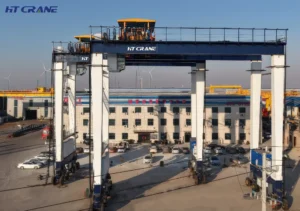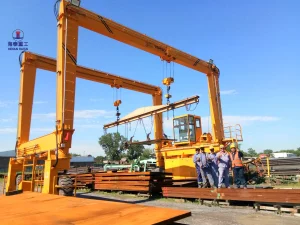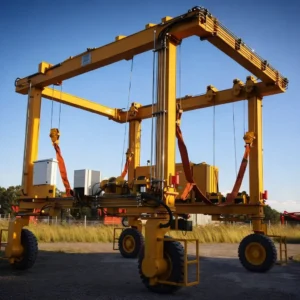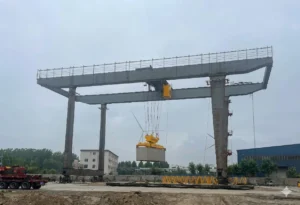
In manufacturing, construction, automotive repair and heavy logistics, moving massive weights safely and efficiently is essential to meeting operational requirements and is also core to business profit. Fixed overhead bridge cranes, the long-standing industry standard for heavy lifting, yet still have major limitations: high installation cost, permanent anchoring and no flexibility.
Он 1-10 Ton Portable Gantry Crane is a versatile, cost-effective, mobile lifting solution for modern industrial dynamic needs. If your business needs flexible heavy lifting at variable work sites, it is not just an option but a strategic investment.
In this comprehensive guide, we will explore the unparalleled benefits of 1-10 ton portable gantry crane, diverse applications, and key factors to consider when purchasing one portable gantry crane for your facility.
The Anatomy of 1-10 Ton Portable Gantry Crane
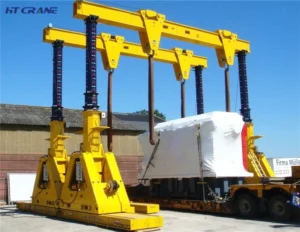
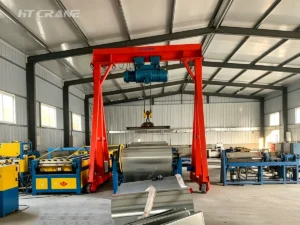
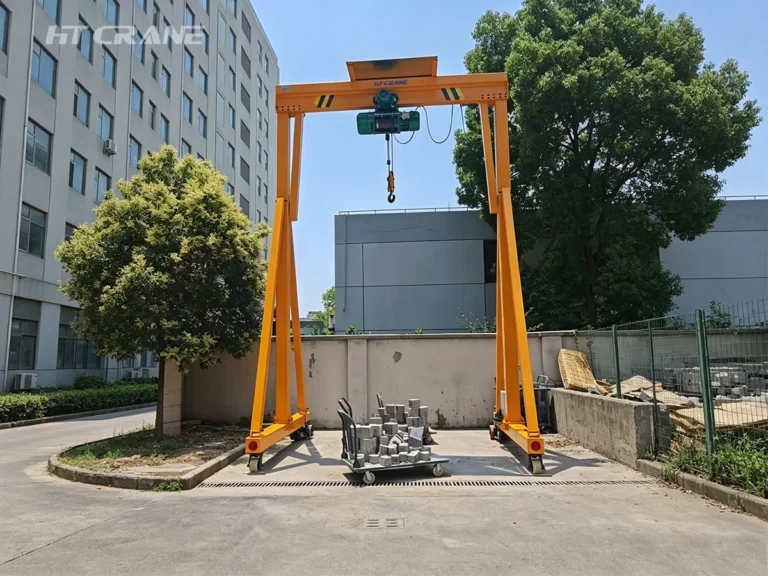
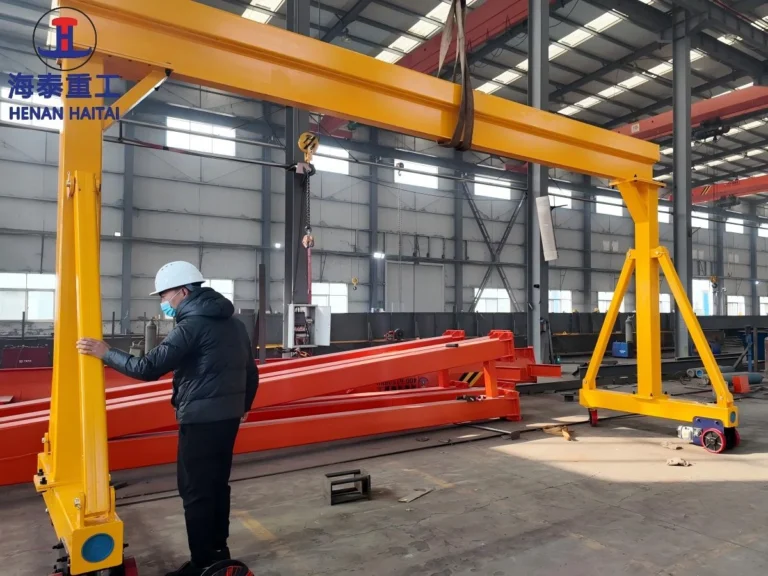
A portable gantry crane is an A-frame lifting device supported by two legs and a horizontal bridge beam. Unlike permanent overhead cranes, these units are mounted on locking casters or wheels, movable by hand or tow mechanism. The 1-10 ton capacity is the industry “sweet spot”, filling the gap between light-duty shop cranes and large fixed industrial gantries.
Within this range, you will typically find two primary materials:
- Heavy-Duty Steel: Ideal for the higher end of the spectrum (5-10 tons), offering maximum strength and durability for rugged environments.
- Aluminum: Perfect for the lower to mid-range (1-5 tons), providing an exceptional strength-to-weight ratio, making the crane incredibly easy to maneuver without sacrificing lifting power.
5 Core Advantages of Investing in a 1-10 Ton Portable Gantry Crane
1. Unmatched Mobility and Flexibility
1-10 ton portable gantry cranes can be moved to any work location, repositioned across sites, and stored after use to free up space, overcoming the location restriction of fixed cranes.
The defining feature of a portable gantry crane is its ability to go where the work is. In a large warehouse or manufacturing floor, workstations change, and projects evolve. A fixed bridge crane restricts your lifting to a specific bay. A 1-10 ton portable gantry crane can be rolled down aisles, moved outside to a loading dock, or repositioned across a construction site. When the job is done, it can be rolled out of the way, freeing up valuable floor space.
2. Cost-Effective Alternative to Fixed Cranes
Fixed cranes require high upfront installation cost, while portable gantry cranes deliver comparable lifting capacity at much lower cost, and often provide extra tax advantages as movable equipment.
Installing a permanent overhead bridge crane requires structural steel supports, runway beams, specialized labor, and often, permitting. The upfront capital expenditure can be staggering. A portable gantry crane offers a comparable lifting capacity at a fraction of the cost. Furthermore, because it is not permanently affixed to the building, it is considered a piece of movable equipment rather than a building modification, often providing distinct tax advantages (such as Section 179 deductions in the U.S.).
3. Easy Assembly, Disassembly, and Relocation
Most 1-10 ton portable gantry cranes adopt modular bolt-together design, and can be reassembled at new sites in hours, which is valuable for mobile contractors and growing businesses.
Most 1-10 ton portable gantry cranes are designed with a modular, bolt-together construction. This means they can be disassembled, transported to a new job site or facility, and reassembled in a matter of hours. For contractors who move between sites, or growing businesses that may relocate to a larger warehouse, this portability is invaluable. You take your heavy lifting capabilities with you.
4. Adjustable Height and Span
Premium portable gantry cranes support adjustable beam height to adapt to different ceiling heights and obstacles, and adjustable span to fit different load sizes and aisle widths, optimizing space use.
Space optimization is critical in any industrial setting. Many premium portable gantry cranes feature telescoping legs that allow you to adjust the height of the beam. This is crucial for facilities with varying ceiling heights or when you need to lift a load over an obstacle but lower the crane tofit under a low doorway. Additionally, the span (the distance between the two legs) can often be adjusted to accommodate different load sizes and aisle widths.
5. Enhanced Workplace Safety
Manual or makeshift lifting of 1 to 10 tons risks severe accidents and regulation violations. Portable gantry cranes are designed with strict safety factors and lockable casters to keep stable during lifting.
Lifting 1 to 10 tons manually or with makeshift rigging is a recipe for catastrophic accidents and OSHA violations. Portable gantry cranes are engineered with strict safety factors, often featuring a 3:1 or 5:1 safety ratio on structural components. Equipped with heavy-duty locking swivel casters, once the crane is positioned, the wheels can be locked securely in place, ensuring the crane remains stable during the lifting process.
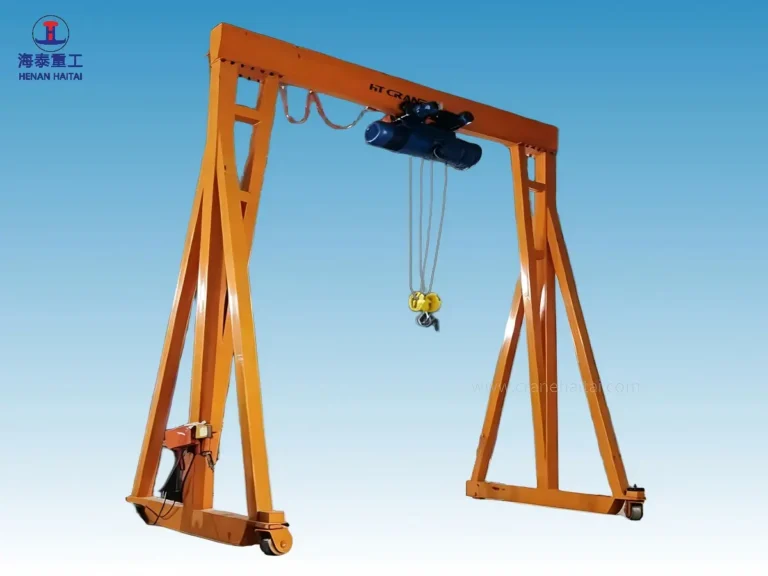
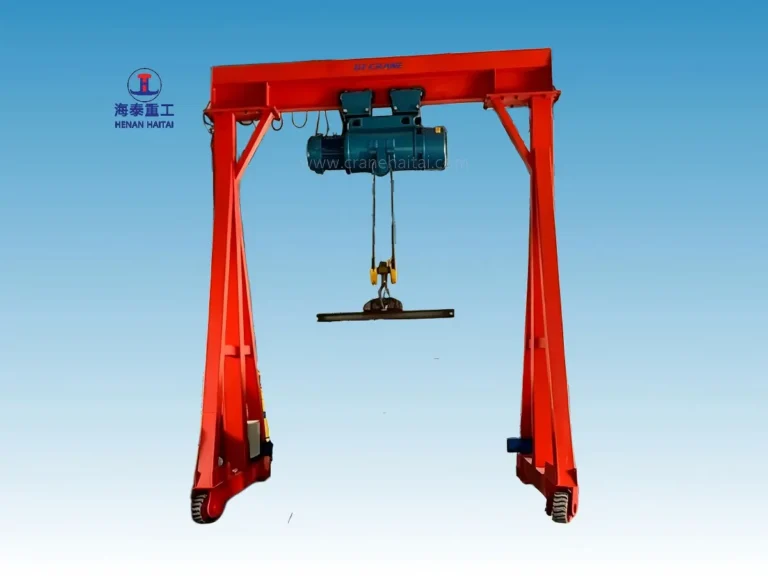
Diverse Applications Across Industries of Haitai’s 1-10 Ton Portable Gantry Crane
The versatility of the 1-10 ton capacity range makes these cranes indispensable across a wide variety of sectors:
- Manufacturing and Machining: Lifting heavy molds, engine blocks, or raw materials onto CNC machines. Because the crane can be moved machine-to-machine, one crane can service an entire shop floor.
- Automotive and Marine Repair: Pulling and installing heavy diesel engines, transmissions, or marine propellers. The portability allows mechanics to bring the crane directly over the vehicle or vessel.
- Construction Sites: Lifting HVAC units onto roofs, positioning heavy steel beams, or moving pallets of bricks. Outdoor-rated cranes with pneumatic wheels are specifically designed for rough terrain.
- Warehousing and Logistics: Loading and unloading oversized or exceptionally heavy pallets that standard forklifts cannot handle, or reaching into areas where a forklift cannot maneuver.
- Power and Utility Maintenance: Lifting heavy transformers, generators, or switching gear in tight, confined spaces where larger boom trucks cannot reach.
The Buyer’s Guide: How to Select the Right 1-10 Ton Portable Gantry Crane?
To ensure you get the maximum return on your investment (ROI), it is crucial to select a crane matching your operational requirements perfectly. When making your purchase decision, evaluate the following factors:
1. Determine Your Maximum Lifting Capacity
Buy a crane for future, not current load needs. Never buy a crane based on your current load weights; buy based on your future needs. Because you should take variables of facility expansion, loads change, crane wear into account for long-term use.
A 5-ton crane offers safety buffer for 4-ton maximum loads. If your heaviest load is 4 tons, selecting a 5-ton crane is an optimal choice. For loads over 5 tons, choose heavy-duty steel gantry cranes with robust A-frame legs and reinforced I-beams.
2. Evaluate the Lifting Height and Span
Measure your facility ceiling height, loaded machinery height, and load height. Confirm the crane’s maximum under-beam clearance fits your hoist and rigging. Similarly, measure your narrowest aisle to ensure the gantry crane’s span allows for easy maneuverability.
3. Choose the Right Caster/Wheel System
The wheels dictate how portable your crane truly is.
- Phenolic or Polyurethane Casters: Best for smooth, indoor concrete floors. They are quiet, non-marking, and roll easily.
- Pneumatic Wheels: Essential if you are moving the crane outdoors, across gravel, dirt, or uneven pavement.
- V-Groove Wheels: Ideal if your facility has embedded steel tracks for guided movement.
4. Hoist Compatibility
A gantry crane is only as good as the hoist attached to it. Ensure the bridge beam is compatible with your preferred hoisting mechanism—whether that is an electric chain hoist, a wire rope hoist, or a heavy-duty manual chain block. Check the beam flange width to ensure your hoist trolley will mount securely.
5. Look for Reputable Certifications and Support
Always purchase from a reputable manufacturer that adheres to stringent engineering standards (such as ASME, ISO, or CE certifications). Look for cranes that come with a comprehensive warranty and access to spare parts. Industrial equipment takes a beating; knowing you have manufacturer support ensures longevity and peace of mind.
The ROI: Why Upgrading Now Pays Off Later
Investing in a 1-10 ton portable gantry crane is an investment in operational velocity. By reducing the time it takes to move heavy materials, you drastically cut down on labor costs and workflow bottlenecks. Workers can execute heavy lifts in minutes that would otherwise take hours of manual maneuvering or waiting for a shared overhead crane to become available.
Furthermore, the reduction in workplace injuries cannot be overstated. Musculoskeletal disorders and back injuries are among the most common and costly workplace compensation claims. By mechanizing your lifts, you protect your most valuable asset—your workforce.
Conclusion to ROI on Haitai’s 1-10 ton portable gantry crane
Haitai’s 1-10 ton portable gantry crane represents the perfect intersection of heavy-duty capability and ultimate flexibility. It eliminates the constraints of permanent infrastructure, adapts to changing workflow demands, and provides a safe, efficient method for moving heavy materials.
Whether you are operating a precision machine shop, a heavy-duty repair facility, or an outdoor construction site, a portable gantry crane is the pivotal tool that will elevate your operational capacity. Don’t let rigid lifting solutions bottleneck your productivity. Explore our premium selection of 1-10 ton portable gantry cranes today, and give your business the lifting power it needs to reach new heights.

Highly Searched FAQs about 1-10 Ton Portable Gantry Crane
Q1: How much weight can a portable gantry crane safely lift?
Portable gantry cranes in this category safely lift between 1 and 10 tons. However, you must never exceed the manufacturer’s stated capacity. It is highly recommended to purchase a crane with a slightly higher capacity than your current heaviest load to ensure a safety buffer. For example, if your maximum load is 4 tons, a 5-ton crane reduces mechanical stress and prolongs the equipment’s lifespan. Always verify the specific load rating on the crane’s ID tag before hoisting.
Q2: Can a portable gantry crane be used outdoors?
Yes, portable gantry cranes can be used outdoors, but you must select the right model. For outdoor use, choose a crane with a weather-resistant finish, such as powder-coated or galvanized steel, to prevent rust. Additionally, ensure the crane is equipped with pneumatic (air-filled) wheels rather than standard polyurethane casters. Pneumatic wheels are necessary for safely navigating rough, uneven terrain like gravel, dirt, or grass. Always lock the wheels during the lift and avoid using the crane in high winds.
Q3: Do I need to permanently anchor a portable gantry crane to the floor?
No, permanent anchoring is not required. A primary benefit of a portable gantry crane is that it is freestanding and fully mobile. However, stability is crucial during operation. While you don’t bolt it to the floor, you must engage the heavy-duty locking casters or wheel brakes before lifting any load. For extremely heavy loads near the 10-ton上限, some models feature optional floor jacks or outrigger stabilizers for added safety, but these are temporary adjustments, not permanent installations.
Q4: Can I move the portable gantry crane while it is carrying a load?
Generally, no. Portable gantry cranes are designed to lift and lower loads, not to transport them across a facility. Moving the crane while a load is suspended can cause tipping, structural failure, or severe injury. The standard safety protocol is to position the crane over the load, lock the casters, lift the load, move it along the bridge beam (trolley), and lower it onto a cart or pallet jack for transport. Always unlock the casters only after the load is fully lowered.
Q5: What is the difference between an adjustable height and a fixed height gantry crane?
A fixed-height gantry crane has a set, unchangeable beam elevation, making it suitable for facilities with standard ceiling clearances and consistent lifting requirements. An adjustable-height gantry crane features telescoping legs, allowing you to raise or lower the bridge beam. This is highly beneficial for navigating under low doorways, fitting under varying ceiling heights, or lifting loads over tall obstacles. Adjustable models offer maximum versatility, though fixed-height cranes often provide slightly higher load stability.