Heavy lifting on water creates problems that land-based equipment simply cannot solve. Fixed cranes need permanent infrastructure that doesn’t exist at an offshore worksite. Mobile cranes can’t reach a platform installation site or a mid-channel salvage job. And a standard barge doesn’t have the lift capacity for serious marine construction.
A floating crane is a heavy-lift crane mounted on a pontoon or barge, built to operate directly on open water without permanent shore infrastructure. A floating crane solves all three at once, bringing certified heavy-lift capability directly to wherever the work is happening.
This article explains what a floating crane for sale actually is, how it is built, its main structural components, the specifications that define a project, where the equipment is used in offshore and marine construction, and what to check before ordering one from a floating crane manufacturer.
Что такое плавучий кран?
A floating crane for sale is a heavy-lift crane mounted on a pontoon or barge, designed to operate directly on water rather than from a fixed shore structure. Because it carries its own floating foundation, it needs no jetty, no rail, and no permanent civil works — it can be towed or self-propelled to the worksite, positioned, and put straight into service. Most units are built to run both hook and grab attachments on the same machine, so one crane can handle project cargo one day and bulk material discharge the next.
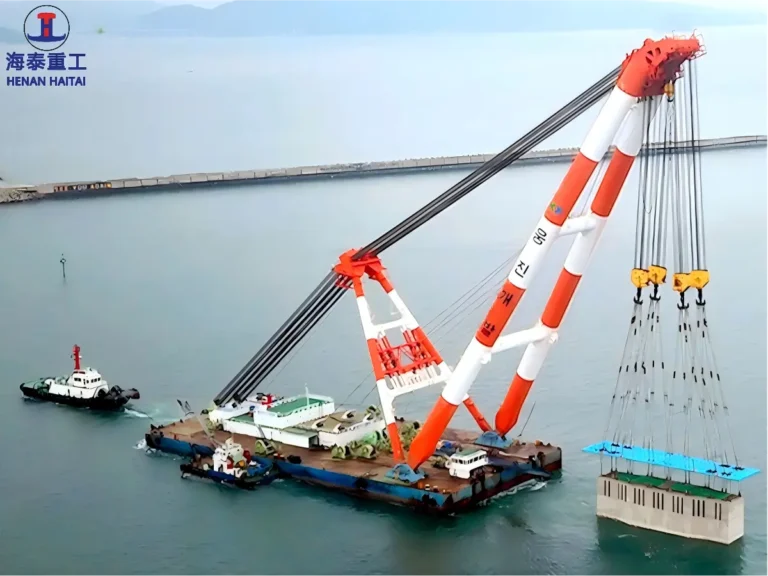
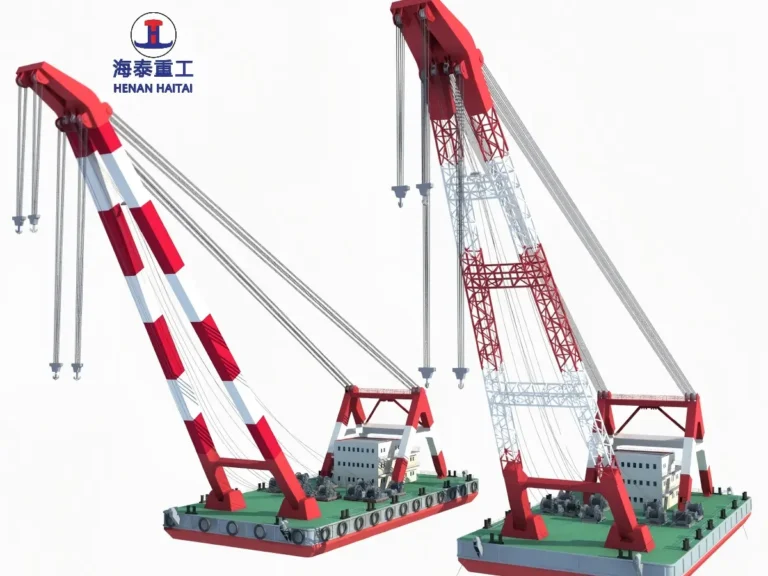
Key Structural Components of a Floating Crane for Sale
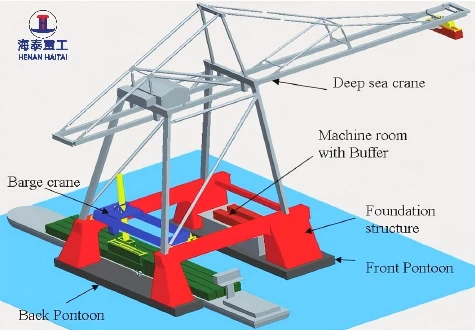
A floating crane is built around a small number of major assemblies, each engineered for the loads and motion of an open-water platform:
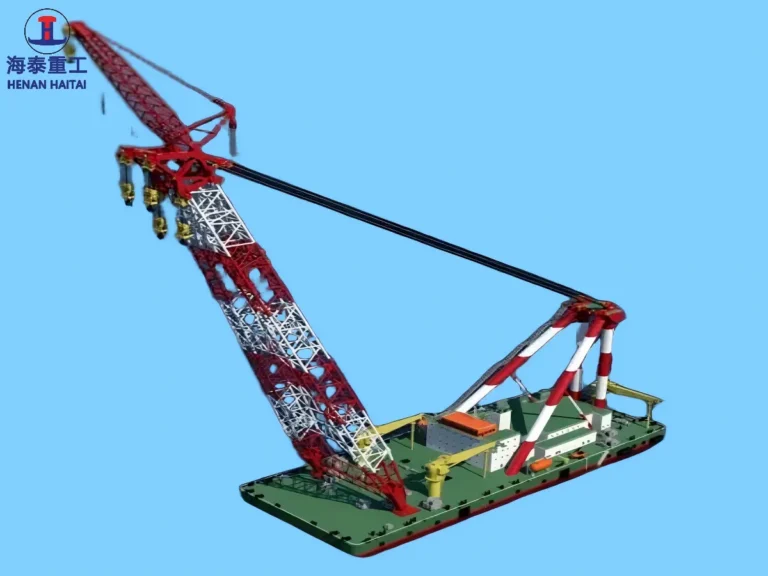
- Deep-sea (main) crane structure — the boom and A-frame assembly that carries the hook or grab through the working radius; on larger units this is a lattice tower structure rather than a solid boom, to keep self-weight down relative to lifting capacity.
- Barge crane / slewing platform — the rotating upper structure and machinery deck that carries the hoist, luffing, and slewing drives, mounted on the pontoon base.
- Machine room with buffer — houses the electrical control system and drive machinery, with buffer/damping elements that absorb dynamic loads transmitted from wave action and load swing.
- Foundation structure — the reinforced base connecting the slewing platform and boom structure to the pontoons, engineered to distribute lifting loads evenly across the hull.
- Front and back pontoons — the floating hull sections that provide buoyancy and stability; pontoon size and ballast configuration are sized to the crane’s maximum lifting capacity and working radius.
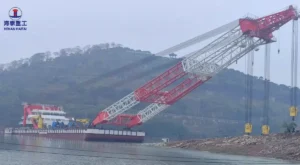
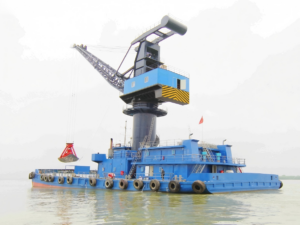
Main structural components of a floating crane: boom, machine room, foundation structure, and front/back pontoons.
Key Features That Define a Reliable Floating Crane
Built for open-water heavy lifting, a floating crane combines structural strength, operational flexibility, and marine-certified engineering. Five features define reliable performance:
- Single-arm balanced luffing system — the single-boom wire rope luffing mechanism keeps the hook path horizontal throughout the full radius range, so load height stays constant as the boom angle changes, eliminating the need for simultaneous hoisting corrections.
- 360° continuous slewing under load — full rotation under working load lets the crane cover waterside and landside simultaneously from one fixed barge position, with AC variable frequency drive control giving smooth, stepless speed adjustment across the arc.
- Hook & grab dual operation mode — the same crane handles both attachments without structural modification: hook mode for precise general cargo and project lifting, grab mode for continuous bulk discharge of coal, sand, ore, and aggregates.
- Marine-grade corrosion protection — structural steel undergoes shot blasting and multi-layer anti-corrosion coating rated for open marine environments, with mechanical components sealed against continuous salt air, humidity, and wave splash.
- CCS, ABS, BV & DNV certification — designed and built to CCS Code for Lifting Equipment of Ships and Offshore Facilities, with ABS, BV, and DNV certification available on request, meeting the documentation requirements for marine project approval, offshore deployment, and insurance compliance.
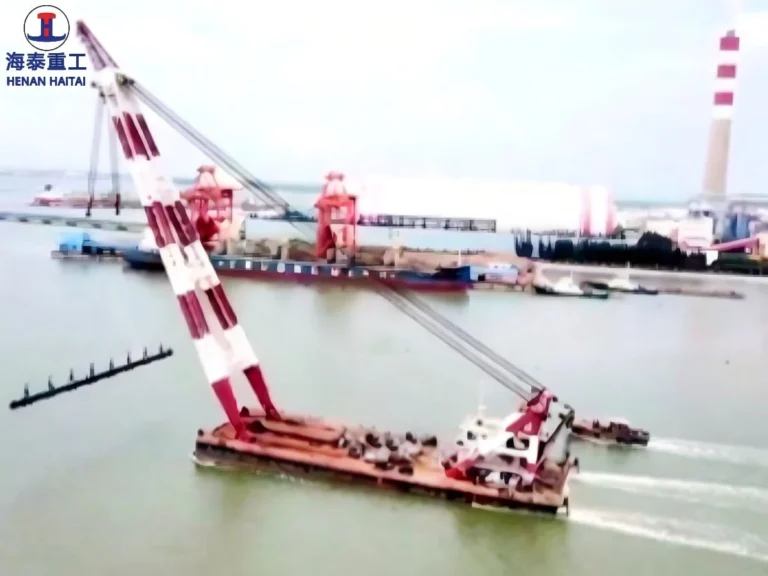
Haiati Floating Crane Technical Specifications
A floating crane’s exact configuration always depends on lifting capacity, water conditions, and project scope, but the following ranges reflect the standard performance envelope that buyers should use as a starting reference:
Floating Crane Technical Specifications Table
| Parameter of Haitai Floating Crane | Стандартный диапазон |
|---|---|
| Грузоподъемность | Custom available |
| Рабочий радиус (макс.) | 15m – 50m |
| Высота подъема | 15m – 60m |
| Диапазон поворота | 360° непрерывный |
| Скорость подъема | 10–40 м/мин |
| Скорость люфта | 10–30 м/мин |
| Скорость поворота | 0.5 – 2 rpm |
| Crane Traveling Speed | 3 – 30 m/min |
| Размер понтона | Индивидуальная грузоподъемность |
| Источник питания | Напряжение переменного тока 380 В / 50 Гц (возможно изготовление на заказ по индивидуальному заказу) |
| Класс рабочей обязанности | A5 / A6 |
| Сертификация | CCS · ABS · BV · DNV · RMRS |
| Рабочая температура | -20°C – +45°C |
Offshore construction, salvage operations, and large-scale port development often push beyond these standard figures. Lifting capacity, working radius, pontoon dimensions, self-propulsion systems, and power configuration can all be tailored to the specific project and sea state a client is working in.
Floating Crane Different Lifting Capacity
The lifting capacity of floating cranes varies widely; small floating cranes have a capacity of approximately 50 tons, while large, heavy-duty floating cranes and crane vessels can reach several thousand tons or even 20,000 tons.
Lifting Capacity Categories
- Small/Port Floating Cranes: Lifting capacity generally ranges from 10 tons to 80 tons; these are primarily used for routine cargo handling at inland river terminals and ports.
- Medium-Sized Engineering Floating Cranes: Lifting capacity ranges from 100 tons to 1,000 tons; these are commonly used for coastal bridge construction and the hoisting of small-to-medium-sized offshore structural components.
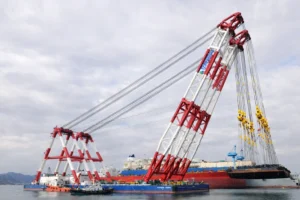
- Heavy-Duty or Giant Lifting Vessels: With lifting capacities reaching 1,200 tons, 3,000 tons, or even 20,000 tons, these vessels are used for the installation of large offshore wind turbines, steel box girders for cross-sea bridges, and deep-sea oil platform modules.
Factors Affecting Lifting Capacity
- Working Radius: The farther the boom extends and the farther it is from the vessel’s center of gravity, the lower the safe lifting capacity.
- Fixed vs. Rotating Configuration: Fixed (non-rotating) cranes typically have a higher maximum lifting capacity than fully rotating cranes.
- Ballast Water Adjustment: During operations, ballast water must be injected into or discharged from the ship’s holds to maintain hull stability and prevent capsizing.
Application Scenarios for Floating Cranes
Floating cranes operate wherever fixed infrastructure ends and open water begins:
- Offshore oil & gas construction — installing platform modules, subsea pipelines, and offshore structures at locations far from any fixed crane, with no jetty or foundation required.
- Marine salvage operations — handling the full salvage sequence from initial lift through controlled recovery to vessel transfer, with 360° slewing covering the full working arc around a salvage site without repositioning the barge.
- Bridge & waterway construction — placing precast bridge sections, pier foundations, and waterway infrastructure directly over water at precise positions, with the horizontal hook path keeping sections level throughout placement.
- Port & harbor development — placing quay structures and caisson foundations alongside dredging and piling work, handling large prefabricated components delivered by sea without intermediate handling.
- Bulk cargo & ship-to-shore transfer — at ports without fixed unloading equipment, a grab-fitted floating crane discharges coal, ore, grain, and aggregates directly from vessel to barge or quayside storage.
Floating crane configurations: standard lattice-boom design and heavy-duty tower-boom design for higher lifting capacity.
Floating Crane For Sale vs. Portal Crane For Sale
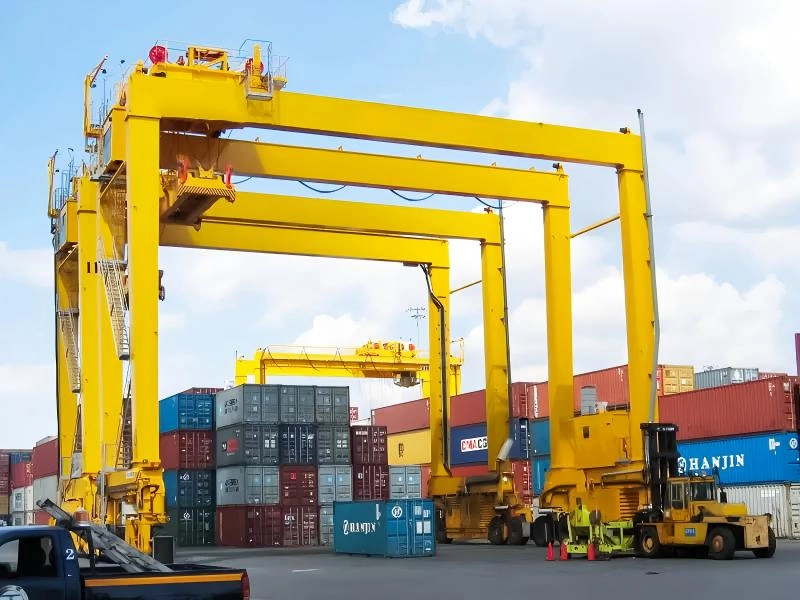
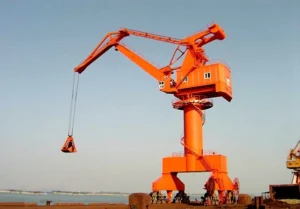
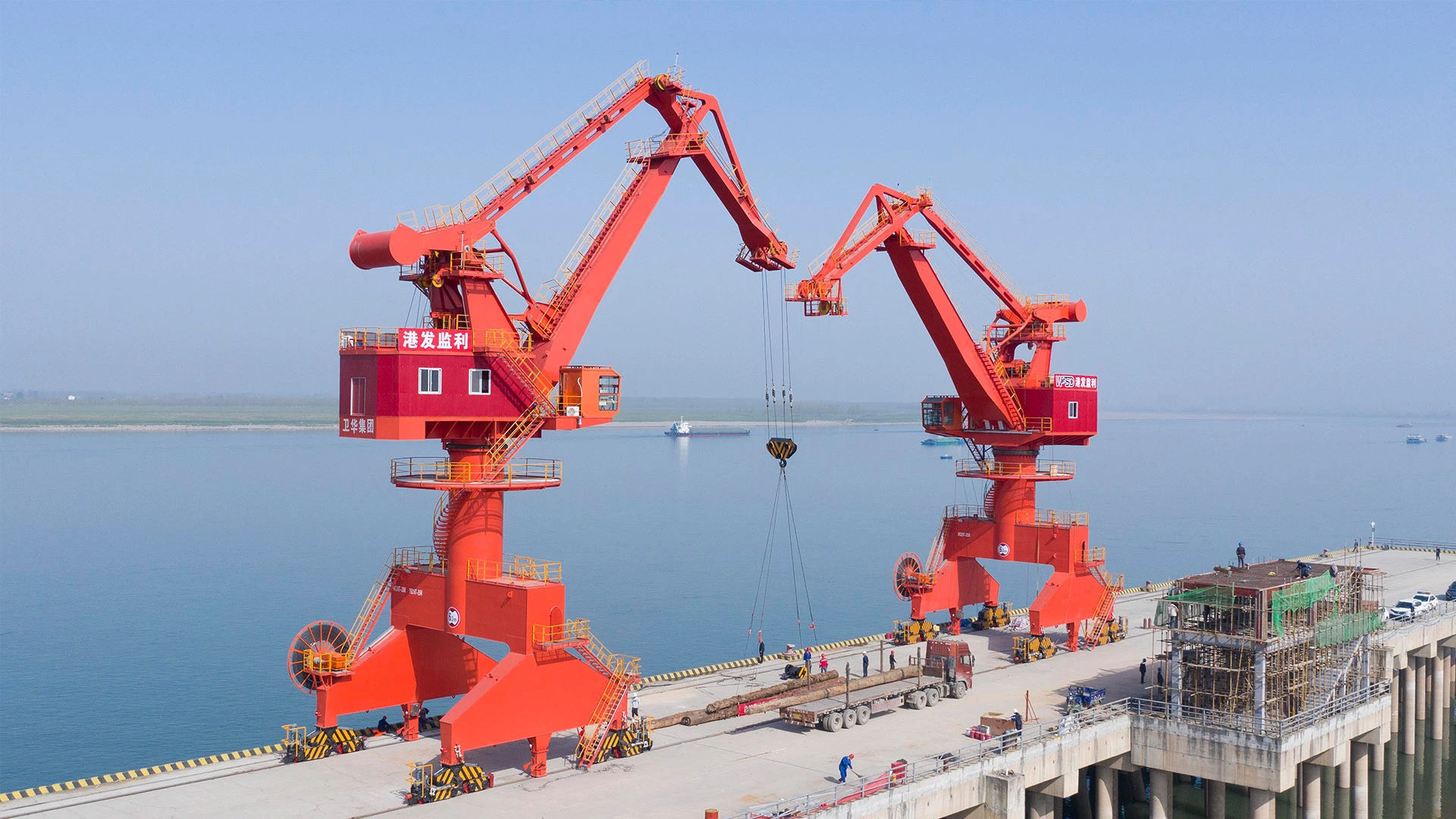
The two pieces of equipment are often compared on the same project shortlist, but they solve different problems. A portal crane is mounted on a fixed or rail-mounted shore-based structure, which means it needs permanent civil works but offers a stable, repeatable working position. A floating crane is mounted on a pontoon or barge, trading that fixed stability for the ability to operate directly on water and reposition to different worksites without any shore infrastructure at all. The right choice comes down to whether a project needs shore-based repeatability or open-water reach.
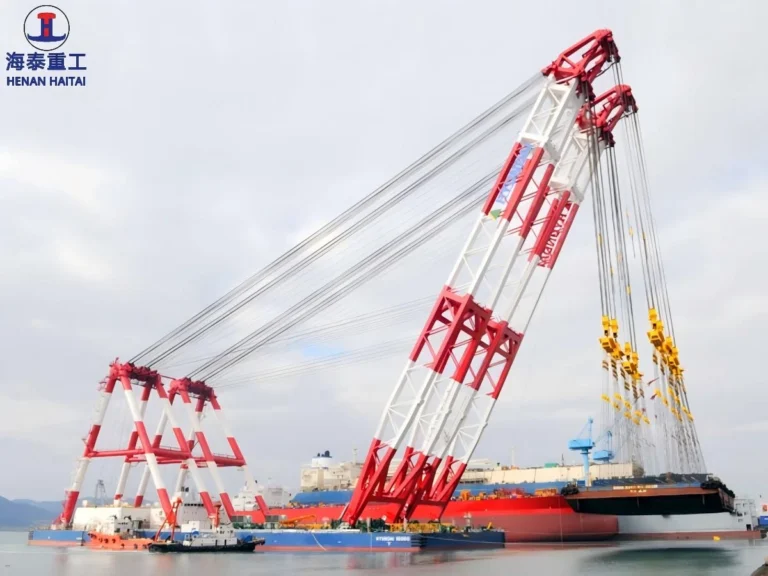
Floating Crane for Sale
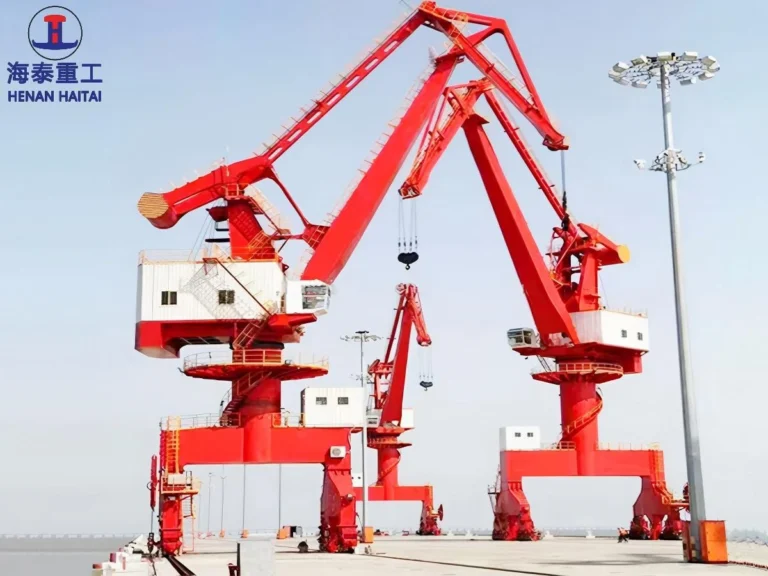
Portal Crane for Sale
What to Verify Before Ordering a Floating Crane?
A floating crane is a significant capital investment operating in one of the more demanding environments any lifting equipment sees. Before signing a contract, buyers should confirm:
- Classification society documentation — CCS compliance as a baseline, with ABS, BV, DNV, or RMRS certification matching the flag state and insurance requirements of the destination project.
- Pontoon and stability calculations — ballast configuration and stability margins verified against the crane’s maximum lifting capacity and working radius, not just the hull dimensions.
- Corrosion protection specification — coating system, blast preparation standard, and film thickness suited to the specific marine environment (open sea vs. sheltered water vs. brackish estuary conditions differ significantly).
- Attachment flexibility — confirm hook and grab modes are both supported without structural modification if the project scope includes both general cargo and bulk handling.
- Factory acceptance testing and delivery method — whether the unit is tested and load-proofed before shipment, and how it will be delivered to a coastal or inland worksite.
About Haitai Crane — Chinese Floating Crane Manufacturer
Henan Haitai Heavy Industry Co., Ltd. (HT Crane) is a nationally certified Class-A special equipment manufacturer for gantry, portal, and marine cranes in China, holding 37+ special equipment type-test certificates and 23+ utility model patents, with quality, environmental, and occupational health systems certified to ISO 9001, ISO 14001, and ISO 45001. Its floating crane series is built to CCS standards with ABS, BV, DNV, and RMRS certification available, manufactured at a 40,000 m² production facility with CNC machining, robotic welding, and laser cutting, and supported by 60+ certified welders (CCS, ABS, BV).
For marine contractors and port developers evaluating a floating crane manufacturer, that combination of classification-society certification, in-house structural engineering, and factory acceptance testing before shipment is intended to reduce both technical risk and delivery uncertainty on equipment that will spend its working life on open water.

Заключение
A floating crane earns its place on a project the moment fixed infrastructure isn’t an option — offshore platform work, salvage, bridge and waterway construction, port development, or bulk transfer at a terminal with no fixed unloading equipment. Getting the specification right means treating lifting capacity, working radius, and pontoon stability as one connected engineering problem rather than three separate line items, and verifying classification society documentation before committing to a supplier. Done properly, a floating crane brings certified heavy-lift capability to almost any worksite water can reach.
FAQs About Marine Heavy Lift Floating Cranes
Q1. What is the difference between a floating crane and a portal crane?
A portal crane is mounted on a fixed or rail-mounted shore-based structure. A floating crane is mounted on a pontoon or barge, allowing it to operate directly on water and reposition to different worksites. The right choice depends on whether a project requires shore-based or open-water lifting capability.
Q2. Can a floating crane be customized for a specific project?
Yes. Lifting capacity, working radius, pontoon dimensions, self-propulsion systems, and power supply can all be configured to match a specific project and water conditions, since offshore construction, salvage, and port development projects routinely fall outside standard catalog ranges.
Q3. What certifications should a floating crane carry?
A floating crane should be built to CCS Code for Lifting Equipment of Ships and Offshore Facilities as a baseline, with ABS, BV, DNV, or RMRS certification available depending on the flag state and insurance requirements of the destination project and market.
Q4. Can one floating crane handle both hook and grab operations?
Yes, most floating cranes are built to run hook and grab attachments on the same machine without structural modification — hook mode for precise general cargo and project lifting, and grab mode for continuous bulk discharge of coal, sand, ore, and aggregates.
Q5. What determines a floating crane’s working radius and lifting height?
Working radius (typically 15–50m) and lifting height (typically 15–60m) are set by the boom length and luffing system, which are in turn sized to the pontoon’s stability envelope and the crane’s rated lifting capacity — larger capacity and radius require a wider, more heavily ballasted pontoon base to keep the unit stable under full load.