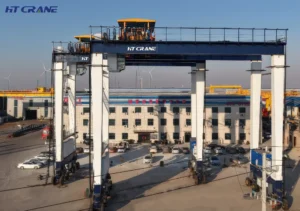
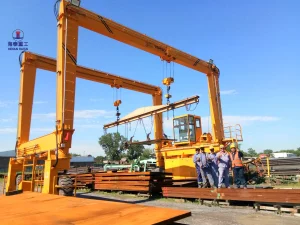
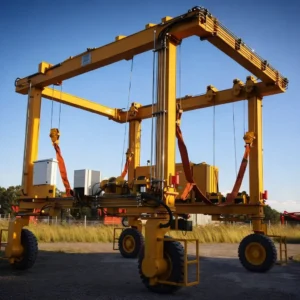
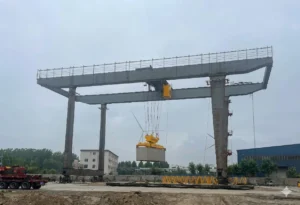
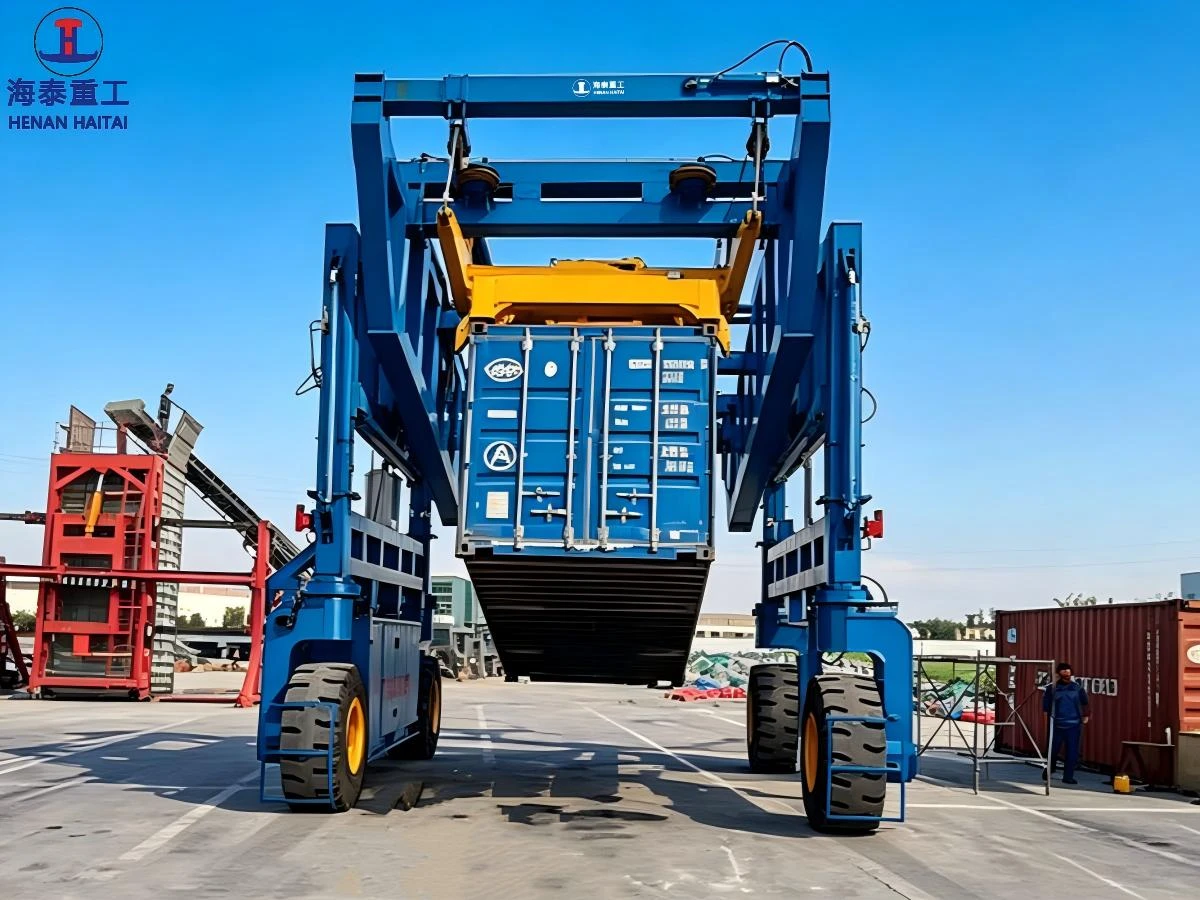
Перевозчики с козлами for sale range from around $150,000 for a compact rubber-tyred unit to $500,000+ for a heavy industrial portal-type unit built for port or shipyard use. Those two numbers reflect two entirely different machines — and two very different procurement decisions. If you have received wildly different quotes for the same stated capacity, that gap almost certainly comes from comparing the wrong product types.
The most common mistake buyers make is describing a load requirement without specifying the application context. A 40 t lifting capacity means one thing in a warehouse and something structurally unrelated in a container terminal. Misaligned specifications waste weeks of supplier communication and often result in a unit that cannot operate on day one.
This guide helps you identify which category of straddle carrier matches your operation in under five minutes, understand what drives the price difference, and submit an RFQ that gets you a comparable, accurate quotation first time.
Straddle Carrier for Sale: Types & Price Ranges (2026, Indicative FOB Factory)
| Тип | Емкость | Водить машину | Price Range (USD) | Лучше всего подходит для |
|---|---|---|---|---|
| Straddle Carrier(compact) | 10–40 t | Diesel / LPG / Electric | $150,000 – $300,000 | Warehouses, timber yards, logistics |
| Straddle Carrier(heavy) | 40–60t | Diesel-electric | $250,000 – $500,000 | Container depots, precast yards |
| Custom ultra-heavy | 80t+ | Electric / Hybrid | $500,000+ | Shipyards, nuclear modules, bridge beams |
Indicative market-reference prices, FOB China factory. Final price depends on span, height under beam, automation level, paint specification, and destination port.

Two Product Categories: Determine Which One You Need First
This is the single most important judgment call in the entire procurement process. Getting it wrong means every subsequent conversation with a supplier starts from the wrong baseline.
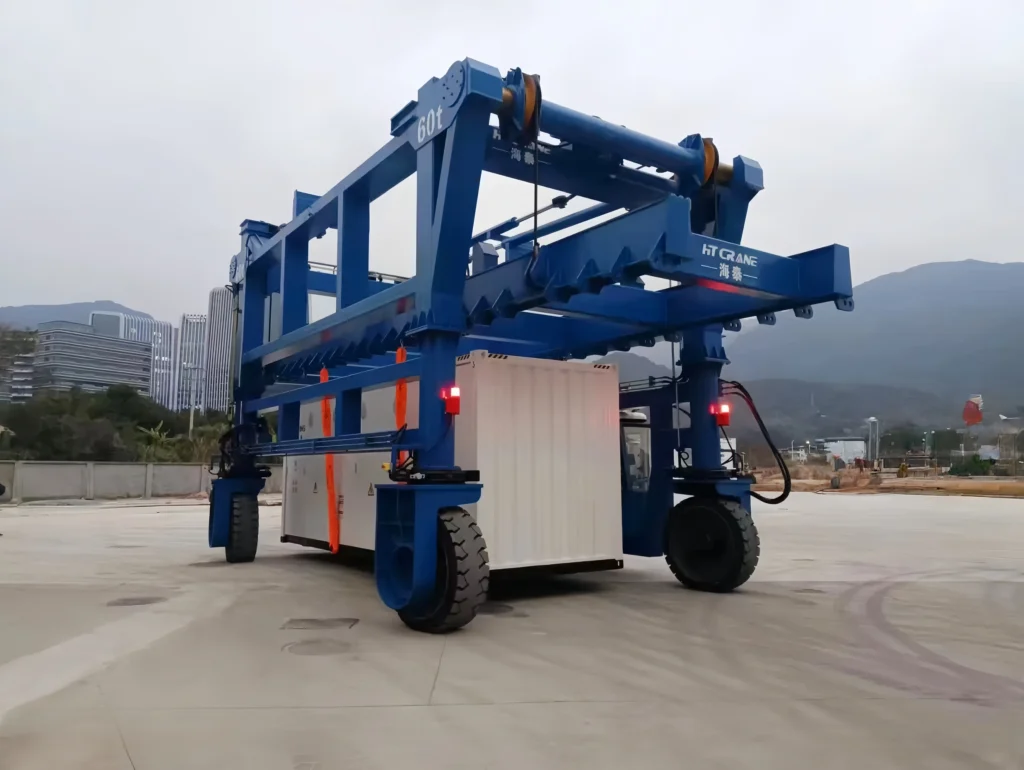
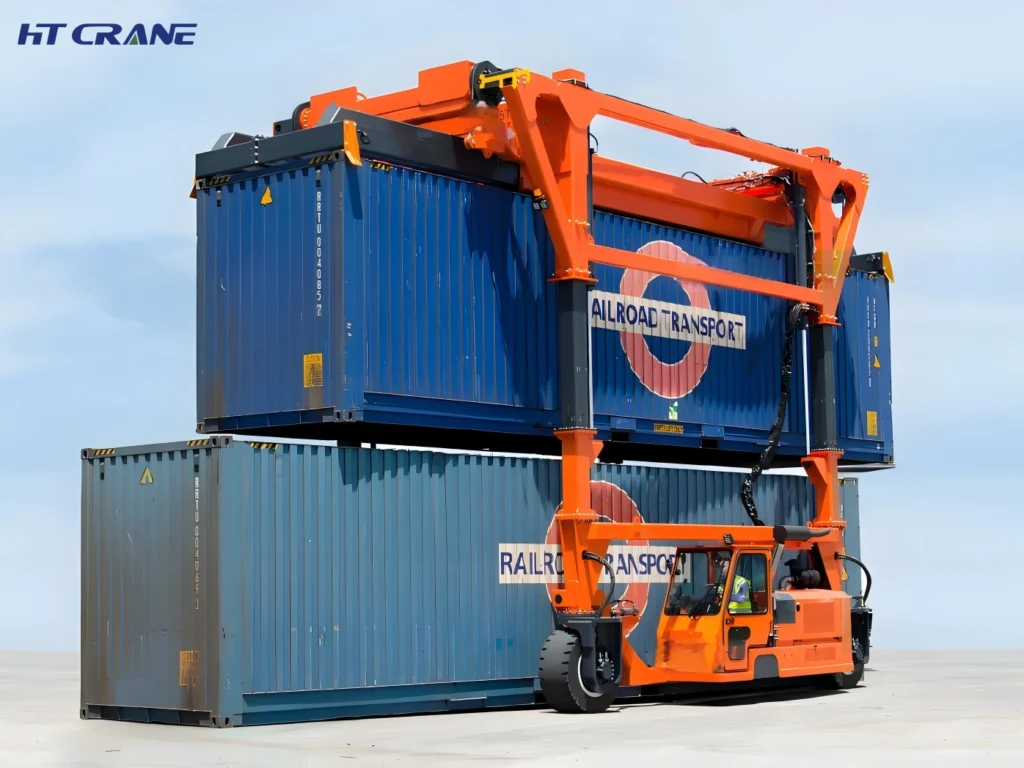
Rubber-Tyred Straddle Carrier
The rubber-tyred straddle carrier is a self-propelled, wheeled machine that straddles its load and lifts it from below using a hydraulic or wire rope hoist system. It runs on solid or pneumatic tyres, requires no fixed rails or ground infrastructure beyond a compacted surface, and can travel in multiple directions including sideways — a key advantage in confined yard layouts.
Lifting capacities in this category typically range from 5 t to 55 t. The machine handles shipping containers, precast concrete elements, steel coils, timber bundles, and other unitised heavy loads. Drive options include diesel, LPG, and fully electric variants. Electric models have become significantly more common since 2023 as facilities face emissions regulations and seek to reduce operating costs.
Key advantages for this category:
- No rail infrastructure or civil works required at installation
- Can be operational within days of delivery
- Lower total acquisition cost and shorter lead time (8–14 weeks typical)
- Suitable for indoor and outdoor mixed-use environments
Straddle Carrier vs RTG — Not Sure Which One Fits?
If your operation involves stacking containers three or more high at high throughput, a rubber-tyred gantry crane (RTG) may be a more efficient choice than a straddle carrier. The straddle carrier wins on flexibility and independence from fixed infrastructure; the RTG wins on stacking height and land utilisation in dense container yards. For a detailed comparison including automation capabilities and ten-year total cost of ownership, see Straddle Carrier vs RTG: Automation & TCO Compared.
Matching Machine Type to Industry Application
The same nominal “straddle carrier” means different things across industries. Specifying by application rather than by capacity alone produces more accurate quotations and avoids structural mismatches.
Ports & Container Terminals
Port straddle carriers handle 20 ft, 40 ft, and 45 ft ISO containers. Typical capacity range is 30–60 t with lifting heights supporting 1-over-1, 1-over-2, or 1-over-3 stacking configurations (nominal stack heights of approximately 9’6″, 18’1″, and 26’8″ respectively). Drive systems are predominantly diesel-electric or diesel-hydraulic; battery-hybrid configurations are increasingly available and are required in some emission-controlled port zones.
Key procurement considerations for port applications:
- Stacking height requirement (determines height under beam and portal frame height)
- Container terminal operating system (TOS) integration and telematics compatibility
- Automation upgrade path — some platforms support conversion to semi-automated or fully unmanned operation without structural modification
- Tyre type and load rating for the specific apron surface
Entry-level port straddle carriers for sale from Chinese manufacturers are priced 40–60% below equivalent Western-brand units and can meet CE, GOST, or BV certification requirements. Verification of certification scope and third-party load test evidence remains essential regardless of origin.
Precast Concrete / Wind Energy / Steel Fabrication
This segment represents the largest growth area for heavy industrial straddle carriers. Precast concrete beam manufacturers need spans matching the widest element in production — typically 6–12 m — with hook heights that clear the tallest element plus rigging allowance. Wind turbine blade manufacturers require spans up to 20 m and specialised soft-sling or rotator fixtures to handle asymmetric loads without contact damage.
Steel fabrication facilities handling structural assemblies, pressure vessels, or offshore modules typically specify custom duty cycles (FEM M6 or M7) because of the high annual utilisation. At these duty levels, the cost of under-specification over a 10-year horizon — accelerated wear, unplanned downtime, shortened structural fatigue life — substantially exceeds any savings made at the point of purchase.
A representative procurement case for this segment: a precast yard requiring a 12 m span, 80 t capacity, rail-mounted electric straddle carrier with dual-speed hoisting and anti-sway control. Total project cost including rail foundation, electrical supply, and factory commissioning: approximately $480,000–$620,000 depending on automation specification (representative scenario, not a specific project).
Warehousing / Logistics / Timber & Coil Storage
Rubber-tyred straddle carriers in the 5–30 t range are the most practical handling solution for facilities that need to move heavy unit loads without the infrastructure investment of an overhead crane system. The all-directional steering capability allows precise load placement in aisles as narrow as the machine’s own footprint plus minimal clearance.
This application segment is typically not rail-dependent and prioritises low ground bearing pressure (to avoid damaging warehouse floors), compact turning radius, and straightforward operator training. Electric drive is increasingly preferred here due to zero exhaust emissions in enclosed buildings and lower energy cost per lift compared to diesel.
5 Variables That Explain Most of the Price Difference
If two quotations for nominally similar machines differ by 200% or more, one of the following five variables is almost certainly responsible.
1. Capacity × Span: The Structural Cost Driver
Span width and lifting capacity together determine the bending moment in the portal frame, which drives structural steel weight — and steel weight drives cost. Doubling the span at constant capacity approximately triples the steel in the main girder. A 10 t unit spanning 4 m and a 10 t unit spanning 8 m are not twice the price apart; they are typically three to four times apart on structure cost alone. When specifying, choose the minimum span that provides load width plus adequate clearance (typically 400–600 mm per side), not a round number that sounds safe.
2. Drive System: Upfront Cost vs 10-Year Operating Cost
| Система привода | Upfront Cost Premium | Annual Energy Cost (est.) | Примечания |
|---|---|---|---|
| Diesel / LPG | Исходный уровень | $18,000–$35,000 | Fuel + engine service; Stage V required in EU for new equipment |
| Diesel-electric | +8–15% | $16,000–$28,000 | Better fuel efficiency at variable speeds |
| Full electric (grid) | +20–35% | $4,000–$9,000 | Requires overhead line or cable reel infrastructure |
| Battery-hybrid | +30–50% | $6,000–$12,000 | Best for outdoor yards without grid connection |
Operating cost estimates are indicative figures based on typical 8-hour/day, 250-day/year utilisation. Actual figures vary by load cycle, local energy prices, and maintenance regime.
For operations planning a 10-year asset life, the total cost of ownership calculation nearly always favours electric or hybrid drive where infrastructure can be justified.
3. Automation Level & Control System
Four broadly distinct automation tiers apply to straddle carriers:
- Tier 1 — Manual (pendant / cabin): Baseline cost. Operator in cabin or on pendant controls all motions independently.
- Tier 2 — Radio remote + VFD: Adds $3000–$5000. Variable-frequency drives on all motions improve positioning precision and reduce mechanical stress.
- Tier 3 — PLC with anti-sway and positioning: Adds $8000–$30,000. Sensor-based load swing suppression, GPS or laser positioning, data logging. Reduces load damage incidents significantly in high-cycle operations.
- Tier 4 — Semi/fully automated: Adds $50,000–$80,000+. Autonomous travel, obstacle detection, automated spreader engagement, TOS integration. ROI typically achievable within 24–36 months at 100+ moves per shift (indicative calculation based on operator cost offset — actual ROI depends on local labour rates and cycle volume).
4. Certification Scope & Target Market
Different destination markets require different engineering documentation and testing procedures, which affect both design choices and procurement cost:
- CE (EU/EEA): Machinery Directive 2006/42/EC, structural calculations per EN 15011 or FEM 1.001, DoC, witnessed load test at 125% SWL
- GOST (Russia/CIS): Separate technical assessment, Rostechnadzor approval required for some categories
- BV / DNV / Lloyd’s Register: Maritime or offshore classification; additional structural and fatigue analysis
- AS 4991 (Australia): Hoisting appliance standard; requires local engineering sign-off in some states
Not all straddle carrier manufacturers hold pre-approval with every certification body. Confirm the target certification at the time of enquiry — some approvals require factory audits that add 4–6 weeks to the timeline.
5. Paint Specification & Operating Environment
Standard industrial finish (blast + primer + two topcoats, ~200 µm DFT) is adequate for inland dry environments. For coastal, port, or offshore applications, ISO 12944 category C4 or C5-M specification is required. This typically means hot-dip galvanising of fasteners and brackets, three-coat marine epoxy system (320+ µm DFT), and zinc-rich primer. Cost addition over standard: $8,000–$25,000 depending on surface area. Specifying a standard finish for a coastal port application will result in visible corrosion within 2–3 years and significantly increased maintenance cost over the asset life.
Get a Customised Straddle Carrier Quotation
Share your application type, capacity requirement, and site parameters. Our engineering team returns a preliminary GA drawing, specification sheet, and indicative price within 3–5 working days.
7 Parameters to Confirm Before Submitting Your RFQ
Providing these seven items upfront reduces back-and-forth from weeks to days and ensures the quotation you receive reflects your actual requirements.
- Maximum load weight (t) — gross weight including spreader bar, slings, and any tooling attached to the load
- Required span width — distance between rail centres (rail-mounted) or load width plus minimum 400 mm clearance per side (rubber-tyred)
- Height under beam (HUB) — tallest load height plus rigging height plus minimum 300 mm safety margin
- Ground or rail conditions — concrete grade and slab thickness (rubber-tyred); rail section size and gauge (rail-mounted)
- Available power supply — voltage, frequency, available amperage; or confirm diesel self-powered preference
- Operational cycle — lifts per shift, number of shifts per day, operating days per year (determines FEM duty class)
- Required certification and delivery destination — CE, GOST, BV/DNV, or other; destination port for shipping and import duty estimation
Lead time reference: Rubber-tyred units (10–40 t): 4-6 weeks. Heavy industrial portal units (40–60 t): 6-8weeks. Custom ultra-heavy (60 t+): 8-10 weeks. Confirm slot availability at time of enquiry if your project has a fixed commissioning date.
How to Evaluate a Straddle Carrier for Sale: Manufacturer Checklist
Manufacturing Certification & Quality System
A credible straddle carrier manufacturer holds ISO 9001:2015 certification scoped specifically to crane or lifting equipment manufacture — not a group-level certificate that covers unrelated product lines. For structural welding, EN ISO 3834-2 qualification is the relevant standard for fusion welding of metallic materials; ask for the welding procedure qualification records (WPQR) if your application involves a high duty class or critical lift environment.
For CE-marked equipment destined for EU markets, the manufacturer must maintain a complete technical file per Machinery Directive 2006/42/EC, including risk assessment, structural calculations, and conformity assessment procedure. Ask for the Declaration of Conformity document number and the notified body reference if a third-party conformity assessment has been used.
Verify certification numbers directly with the issuing body before contract signature. Certificate copies provided by the supplier cannot substitute for direct verification.
Third-Party Load Testing & Delivery Documentation
A witnessed load test at 125% of the Safe Working Load (SWL) is the minimum acceptable standard for any straddle carrier. The test certificate must be countersigned by an independent, accredited third-party inspector — Bureau Veritas, SGS, TÜV, or equivalent. Factory-issued test certificates without third-party countersignature carry limited evidentiary value for insurance, regulatory compliance, and liability purposes.
Required documentation at delivery:
- Declaration of Conformity (DoC) — CE markets
- Third-party witnessed load test certificate
- Operating and maintenance manuals in the buyer’s specified language
- Electrical schematics and PLC ladder logic (as-built version)
- Spare parts list with manufacturer part numbers
After-Sales Support Commitment
Confirm the following in writing before signing any purchase agreement:
- Spare parts availability period: Minimum 10 years for structural, drivetrain, and electrical components
- Wear items stock: Wire rope assemblies, brake pads, wheel sets, encoder units, and hydraulic seals should be available for dispatch within 72 hours
- Удалённая диагностика: PLC-equipped units should support Ethernet or 4G remote access for fault diagnosis without an engineer on site
- On-site commissioning: Confirm whether factory engineers attend commissioning, what defines “commissioning complete,” and who bears the cost of return visits if the first trip is inconclusive
Заключение
Two categories, five price drivers, seven RFQ parameters. That is the complete framework for sourcing a straddle carrier for sale — one that arrives on time, on budget, and without surprises at commissioning.
Start by confirming your product category — rubber-tyred compact or heavy industrial portal. Match it to your application and site conditions. Then use the seven-parameter checklist to submit a complete RFQ that allows any competent manufacturer to quote accurately on first response.
Three actions to take now:
- Identify your category (rubber-tyred or heavy industrial) using the type descriptions above
- Complete the 7-parameter checklist and attach it to your initial enquiry
- Confirm your required certification with your compliance or safety team before issuing any purchase order
Ready to Source? Contact Our Engineering Team
Submit your application parameters and receive a preliminary layout drawing, full specification sheet, and factory-direct price within 3–5 working days. CE, GOST, BV, and AS 4991 certifications available.
Часто задаваемые вопросы
Q1: What is the difference between a straddle carrier and a forklift?
A forklift carries its load on forks positioned in front of the mast, requiring the load to be accessible from one end. A straddle carrier straddles the load entirely — its legs pass on either side and lift from below — which means it can handle loads far wider, longer, or heavier than any counterbalance or reach truck. Straddle carriers also travel with the load suspended beneath the frame rather than elevated in front, giving a lower centre of gravity and better stability for heavy unit loads. For loads above approximately 5 t in awkward dimensions, the straddle carrier is typically more practical and safer than a high-capacity forklift.
Q3: Does a straddle carrier require special ground preparation or rails?
It depends on the type. Rubber-tyred straddle carriers require a compacted, level surface with adequate load-bearing capacity — typically minimum 150 kN/m² for units up to 30 t, verified by a structural engineer against your specific slab specification. No rail installation is needed. Rail-mounted portal straddle carriers require embedded rail foundations designed to the manufacturer’s wheel load specification, plus overhead power supply infrastructure or a cable reel system. Civil works for a rail-mounted installation typically add $40,000–$150,000 to the total project cost, depending on rail length, span, and local construction rates. This should be budgeted as part of the total capital cost from the outset.
Q4: How long does installation and commissioning take after delivery?
For rubber-tyred units, on-site commissioning is typically 2–5 days with factory engineer attendance. The machine is delivered fully assembled or in major sub-assemblies requiring minimal site work. For heavy industrial rail-mounted units, commissioning follows civil works completion and typically takes 7–21 days depending on automation complexity. Full commissioning is defined as completion of no-load test, full-load test at 100% SWL, and operator handover training. Build commissioning time into your project schedule before the machine leaves the factory — agreeing what “commissioning complete” means contractually avoids disputes over return visits.
Q5: What is the practical difference between a CE-certified straddle carrier and a standard export unit?
A CE-marked straddle carrier has been designed, calculated, built, and tested to a documented set of European harmonised standards (principally EN 15011 for bridge and gantry cranes, plus applicable Machinery Directive requirements). It comes with a Declaration of Conformity, a complete technical file retained by the manufacturer, and a witnessed load test certificate. A standard export unit may meet equivalent technical performance but lacks the documented evidence trail required by EU regulators, insurers, and many corporate health and safety policies. For operations in the EU/EEA, CE marking is a legal requirement. For operations outside the EU, CE certification is increasingly required by multinational buyers, project insurers, and bank financing conditions — even where it is not mandated by local law.