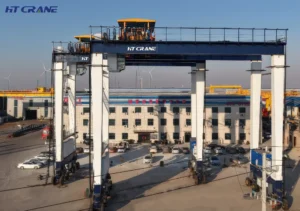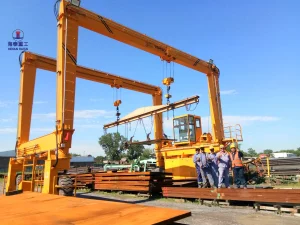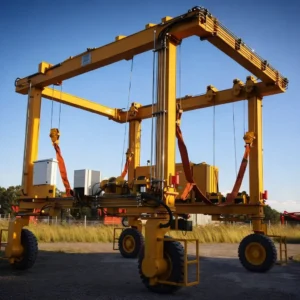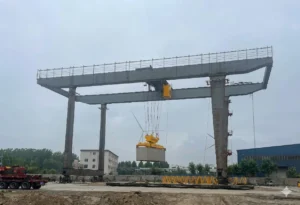
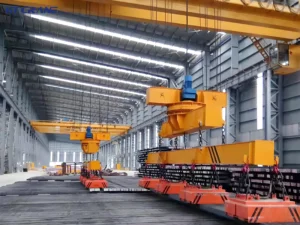
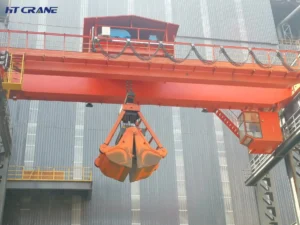
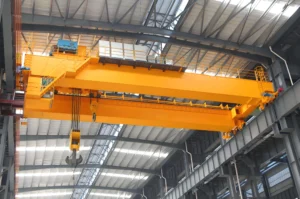
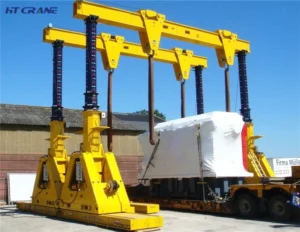
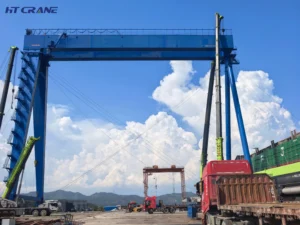
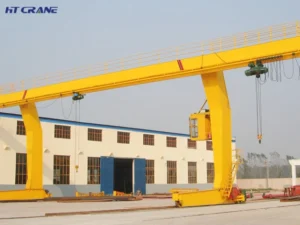
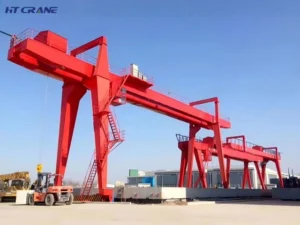
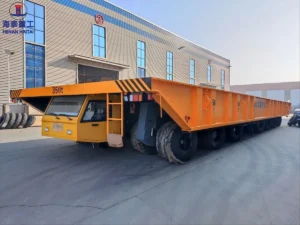
An RMG crane, or rail-mounted gantry crane, is the highest-density container stacking equipment used in yards and intermodal terminals. This article explains what an RMG crane actually is, how an RMG crane works, how it differs from an RTG crane, which specifications matter when writing a technical requirement, and walks through a real 45-ton, 32-meter RMG crane exported to a container terminal in Uzbekistan, showing how the technology performs in an actual cross-border delivery.
What Is RMG Crane? Rail-mounted Gantry Crane
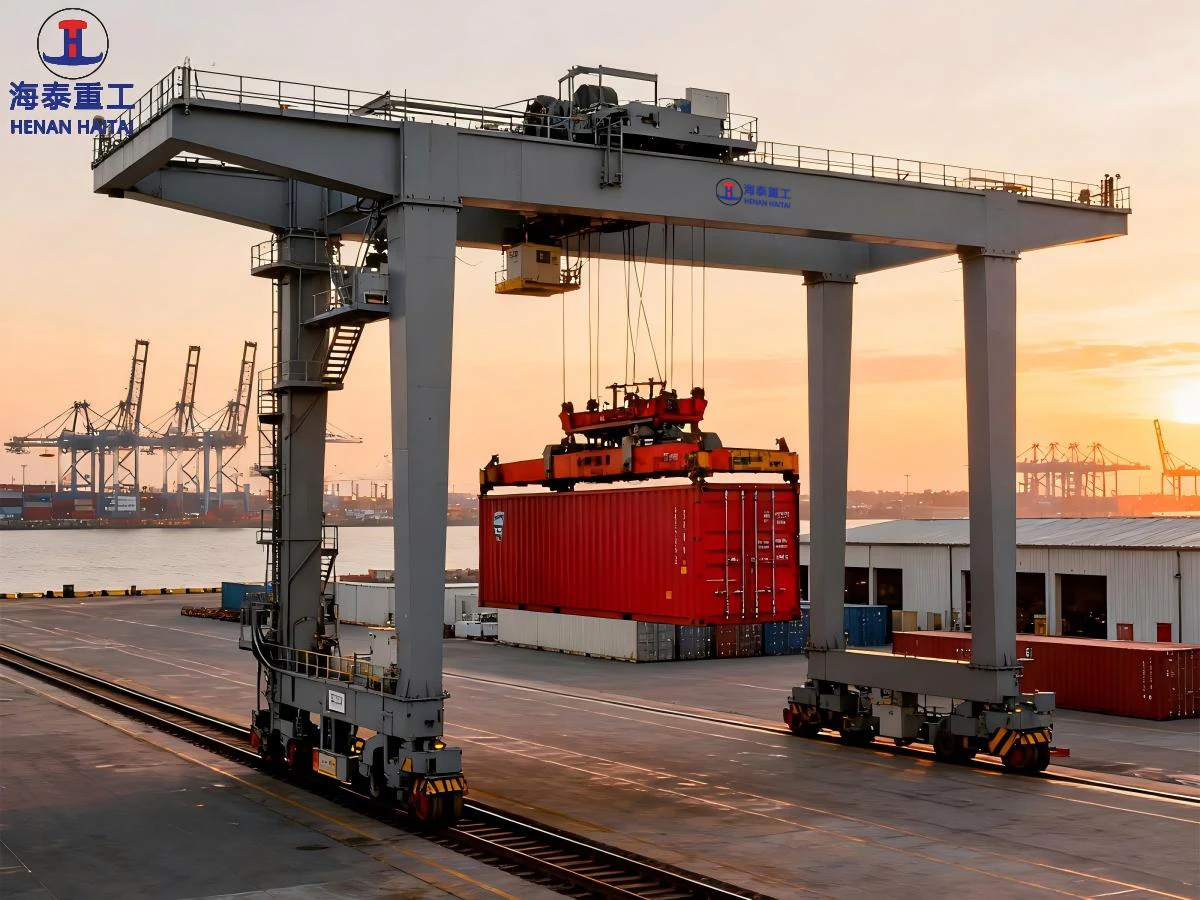
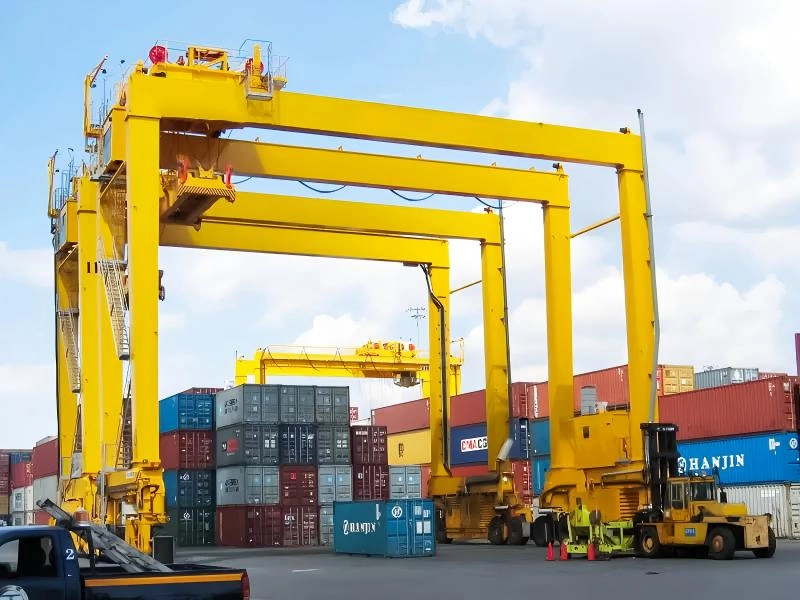
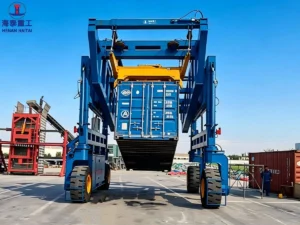
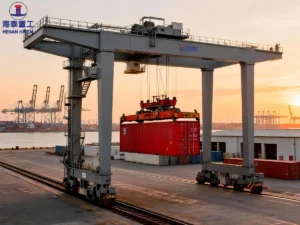
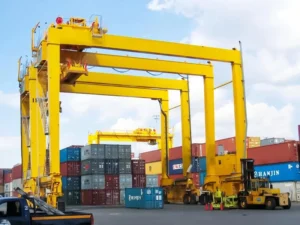
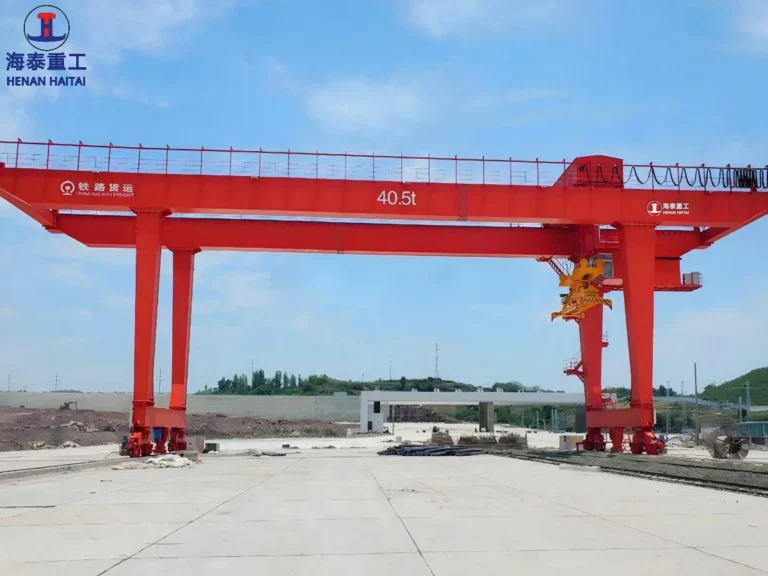
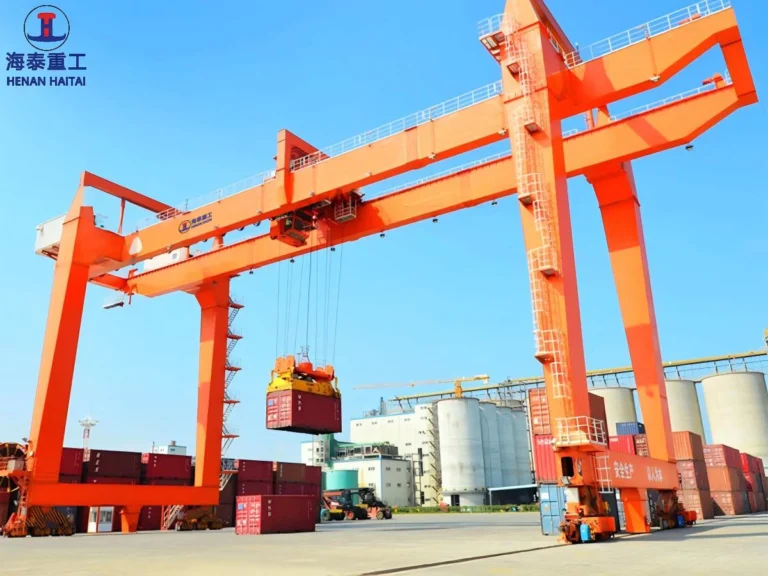
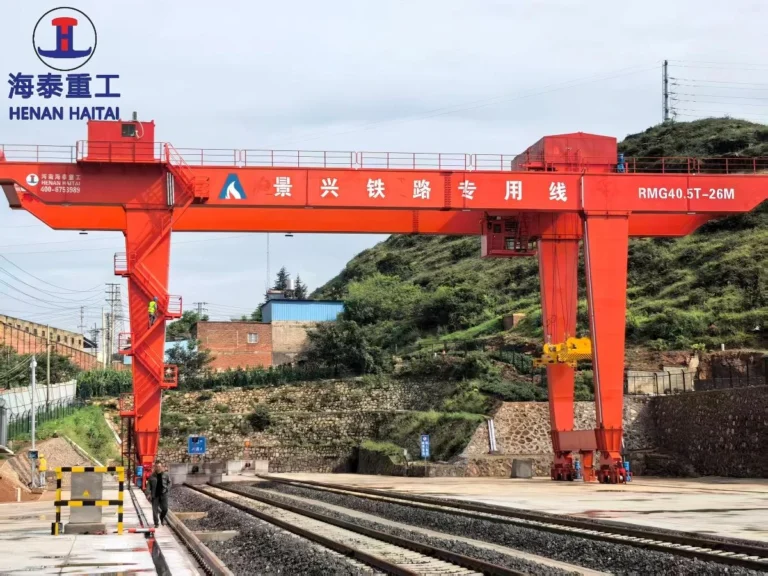
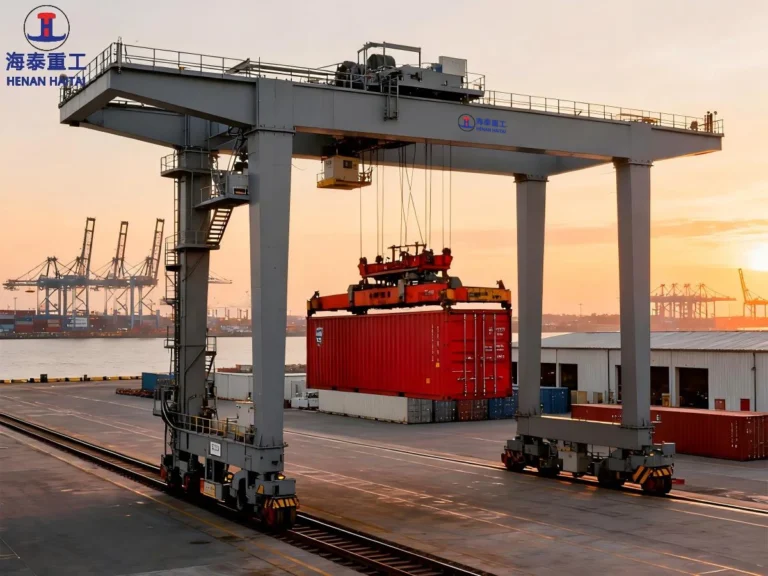
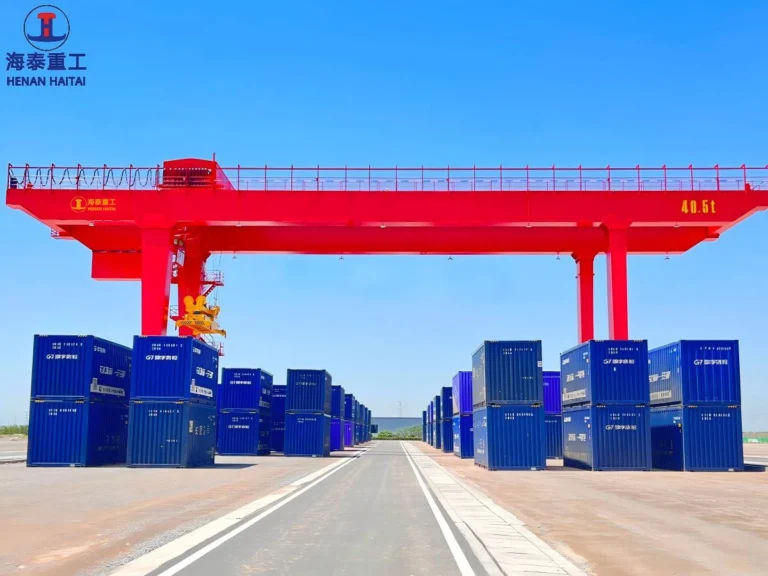
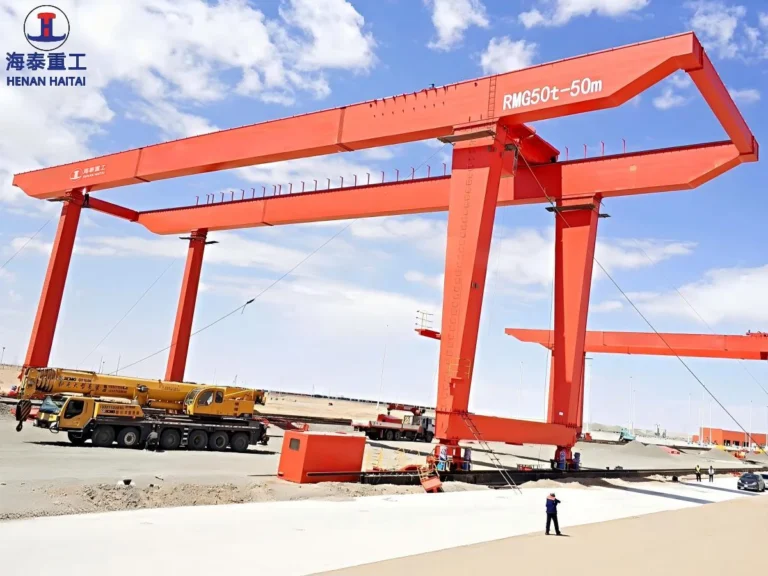
An RMG container gantry crane is a large gantry structure that travels on fixed rails installed on the ground. It spans multiple container rows and stacks containers within a defined block, moving along its rail axis to cover the full length of the storage yard while a trolley travels across the span to position the spreader over the target container.
If a terminal is running out of storage capacity but has no room to expand its footprint, the equipment question almost always comes down to one machine: the RMG crane. Rail-mounted gantry cranes deliver the highest container stacking density of any yard equipment type, which is why they sit at the core of the world’s busiest ports and are increasingly specified by mid-sized terminals planning for long-term growth.
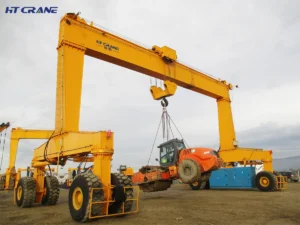
The difference from an RTG crane, which runs on rubber tyres and can relocate between blocks, is that an RMG crane operates inside a fixed corridor. That constraint is also its advantage: the rail system gives precise positioning, supports full automation, and allows higher stacking than a rubber-tyred machine can sustain without stability limitations.
RMG Crane vs RTG Crane: The Core Difference
Terminal planning teams often compare RMG and RTG cranes side by side before deciding which yard equipment fits a given throughput and budget:
| Фактор | Кран RMG |
|---|---|
| Система путешествий | Фиксированные направляющие |
| Высота штабелирования | До 1 из 7 |
| Плотность грунта | Высший |
| Мобильность между блоками | Исправлено — кран остается в блоке |
| Потенциал автоматизации | Максимальная высота (направляющая обеспечивает точное позиционирование) |
| Гражданская инфраструктура | Требуется фундамент для рельсов. |
| Идеальный размер предприятия | Более 500 000 TEU в год |
Электроэнергия в стандартном режиме
RMG cranes run on a fixed electrical supply, typically delivered through a conductor rail or festoon cable system, with no onboard diesel generator. That makes an RMG crane significantly cheaper to operate per move than diesel-electric alternatives, and increasingly decisive for terminals under emission-control commitments. Regenerative braking, which feeds energy back into the grid during hoist and gantry braking, is now standard on modern RMG designs and can offset 20–30% of gross energy consumption in high-throughput operation.
Technical Specifications of an RMG Crane
A typical Haitai RMG container gantry crane specification covers the following parameter ranges:
| Параметр | Диапазон технических характеристик |
|---|---|
| Грузоподъемность | 40–80 тонн (под разбрасывателем) |
| Охватывать | 20–60 м (может быть сконфигурировано в соответствии с планировкой складской площадки) |
| Высота штабелирования | от 1/4 до 1/7 |
| Консольная балка | 0–10 м с каждой стороны (проезд для грузовых автомобилей / железнодорожных путей) |
| Скорость подъема | 30–60 м/мин (при полной нагрузке) |
| Скорость троллейбуса | 70 – 180 м/мин |
| Скорость перемещения портала | 120 – 240 м/мин |
| Ширина колеи рельсов | Custom to project (500mm – 1,435mm typical) |
| Стандарт проектирования | FEM 1.001, ISO 4301, EN 13001 |
| Сертификация | CE (Директива ЕС о машиностроении 2006/42/EC), ISO 9001 |
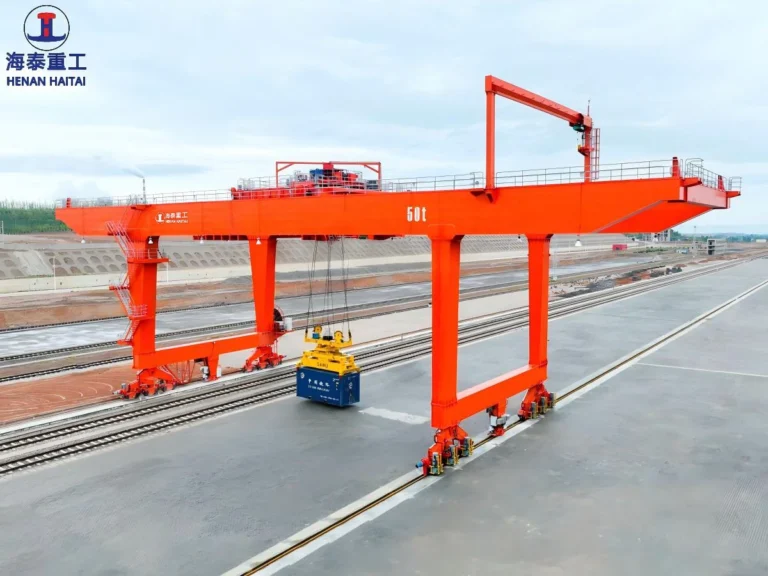
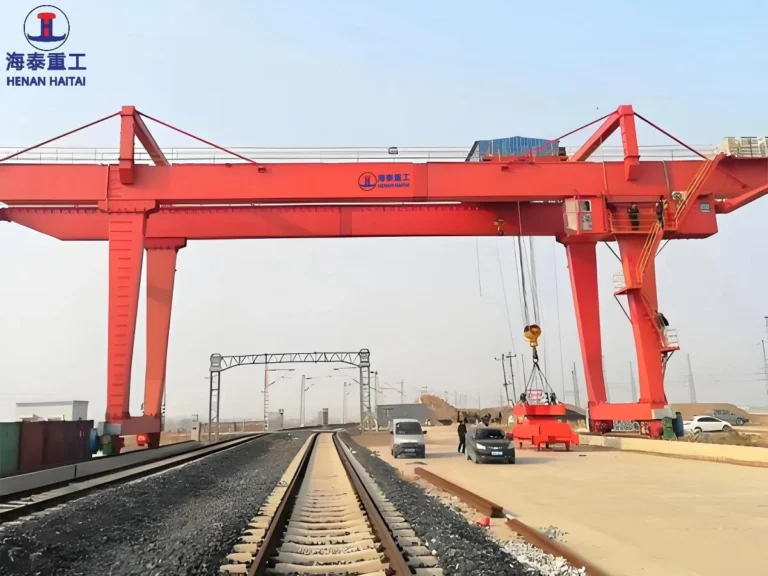
These parameters break down further into capacity classes depending on cargo type and automation ambition:
| Сорт | Грузоподъемность | Типичное применение |
|---|---|---|
| Стандарт | 40Т – 50Т | Контейнерные терминалы общего назначения, интермодальные площадки |
| Сверхпрочный | 51Т – 65Т | Высококубовые контейнеры, терминалы для негабаритных грузов |
| Вариант ASC | 40Т – 55Т | Полностью автоматизированные терминалы, новые площадки высокой плотности размещения грузов. |
Buyers should treat lifting capacity and span as the starting point, not the finish line — stacking height, cantilever, and rail gauge all depend on the specific yard layout and civil infrastructure available at the site.
Настройки автоматизации
RMG cranes are available at three automation levels, and the right choice depends on throughput, local labor market conditions, and capital budget:
- Manual operation — an operator in the cabin controls all movements; standard for smaller yards where labor cost is not the primary driver.
- Semi-automated (ARMG) — gantry travel and stacking sequences run automatically while an operator supervises via remote workstation and intervenes for exceptions; common at mid-size terminals upgrading from manual operation.
- Fully automated (ASC) — all crane functions, including truck interchange, run without an operator per crane; the standard configuration for new greenfield terminals above roughly 1 million TEU annual capacity.
Specifying an automation-ready RMG crane from the outset — rather than retrofitting a manual unit later — is almost always the more cost-effective path if automation is anywhere in a terminal’s five-year plan.
Where Can RMG Cranes Be Applied?
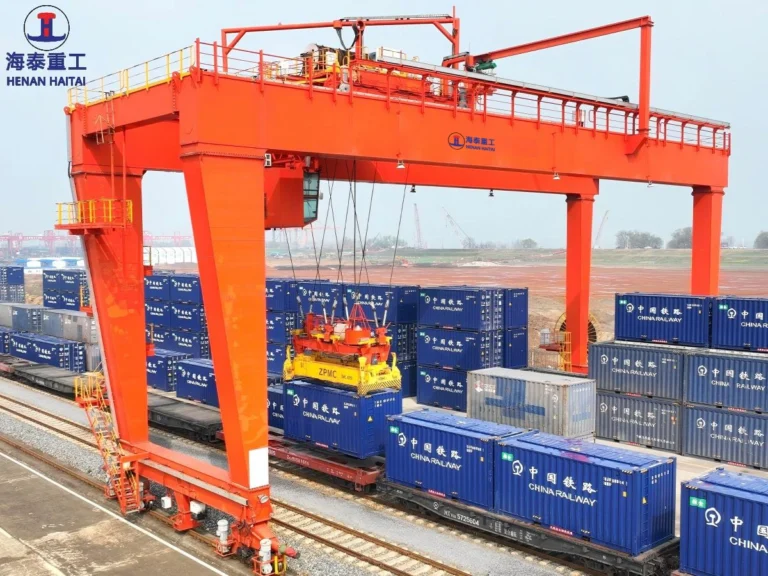
Container terminal storage yards remain the primary application: a typical RMG block covers 40–50 ground slots, stacks 1 over 6 high, and serves two truck lanes plus one rail or internal transport lane within a single crane corridor, reaching 75–85% ground slot utilization — consistently higher than any RTG-based layout.
RMG cranes are also the structural backbone of fully automated stacking systems (ASC) at the world’s highest-throughput terminals, since fixed rails give the positioning precision automation requires. Beyond port yards, RMG cranes are widely deployed at inland container depots and intermodal rail terminals, spanning a rail track to exchange containers between wagons on one side and truck lanes on the other. A further common project type is converting an existing RTG yard to RMG operation to increase stacking density and TEU capacity without acquiring additional land.
Structural and Safety Features That Matter
An RMG crane’s main girder, legs, and full frame are commonly built to FEM 1.001 and EN 13001 standards for a 25-year design life, using box-girder construction with full-penetration welds and non-destructive testing at critical joints. Rail bogies use hardened steel wheels and sealed bearings suited to the load cycles of continuous terminal operation.
On the control side, standard safety architecture includes anti-collision radar on gantry travel, spreader anti-sway control, overload protection with automatic cutoff, wind speed monitoring with automatic storm securing, and redundant PLC logic for safety-critical functions. In port environments, where salt air and constant equipment utilization accelerate coating degradation, a marine-grade three-coat epoxy system with Sa 2.5 blast preparation and a minimum 280-micron dry film thickness is the level of corrosion protection worth specifying.
Real Export Case: 45-Ton RMG Crane for a Container Terminal in Uzbekistan and Kazakhstan
A container terminal operator in Uzbekistan needed a heavy-duty, rail-mounted lifting solution for a high-throughput intermodal yard: consistent performance at 45 tonnes, a 32-metre span across the stacking lanes, anti-sway control for accurate placement at speed, real-time system monitoring, and equipment built to internationally recognized certification standards. After evaluating suppliers, the client selected Henan Haitai Heavy Industry Co., Ltd. (HT Crane) to design, build, and deliver the unit.
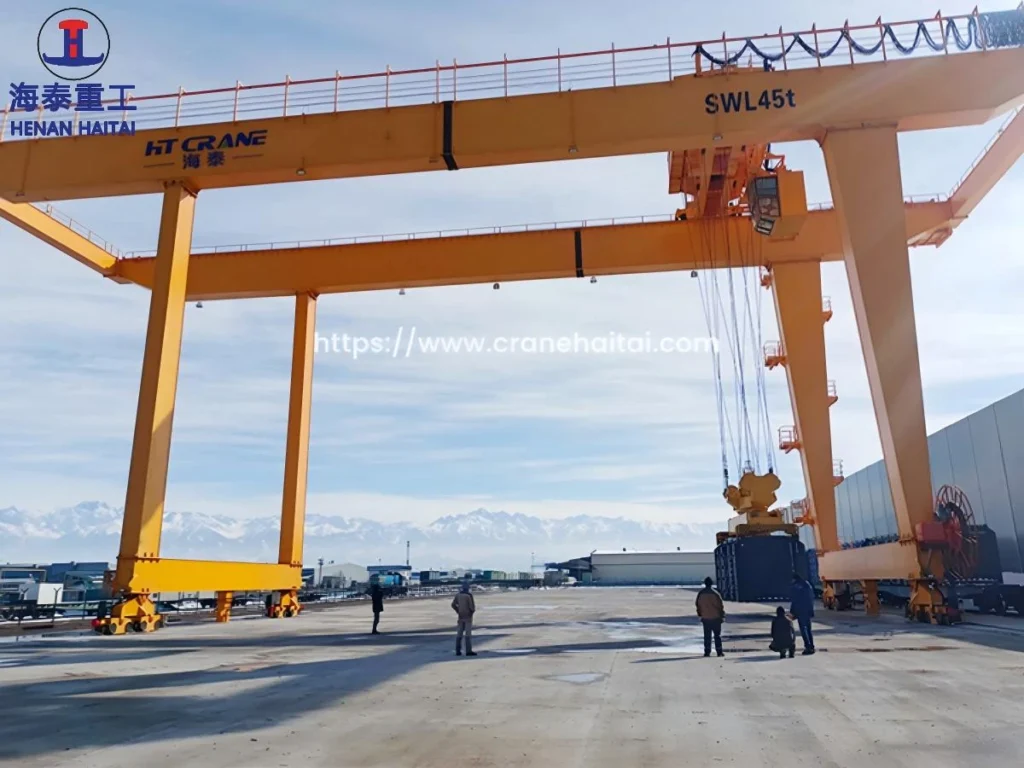
The Uzberkistan RMG Crane project carried three specific engineering challenges. First, at 32 metres span and 45 tonnes SWL, the main girder, legs, and drive systems needed careful structural engineering to keep deflection within design limits across the full span. Second, Uzbekistan is landlocked, so delivery required disassembly sequencing, anti-corrosion export packaging, and overland transport planning to keep components within road dimensional limits and undamaged over the cross-border route. Third, installation had to be commissioned on an active terminal site, coordinating erection, rail alignment, and electrical testing around the client’s operating schedule.
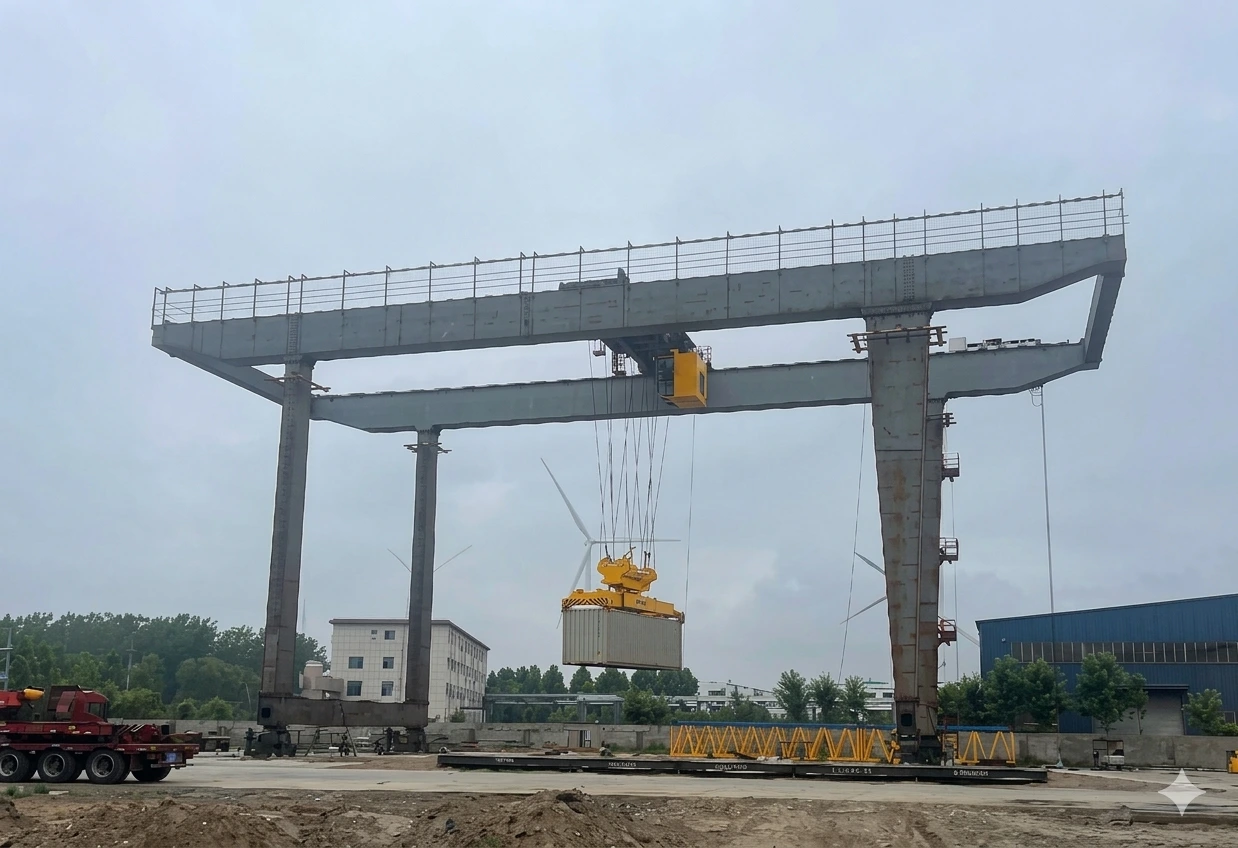
HT Crane’s solution centered on a box-section main girder and supporting legs sized for the 45-tonne / 32-metre combination, gantry travel on a variable-frequency-drive system for smooth acceleration and reduced rail-wheel shock, and a trolley fitted with an automatic telescopic spreader and precise rotating mechanism. A space eight-rope anti-sway mechanism controlled load pendulum motion during travel, while automatic cart deviation correction prevented rail gnawing and protected both rail and wheel sets over the equipment’s working life. An onboard intelligent fault detection system and a separated electrical control room — kept structurally apart from the running trolley to reduce vibration exposure — rounded out the reliability package.
| Параметр | Спецификация |
|---|---|
| Тип крана | RMG — Контейнерный козловой кран на рельсовом ходу |
| Допустимая рабочая нагрузка (SWL) | 45 т |
| Охватывать | 32 м |
| Каркас конструкции | Главная балка коробчатого сечения и опорные стойки |
| Путешествие на автомобиле | Частотно-регулируемый привод (ЧРП) |
| Система предотвращения раскачивания | Космический восьмитросовый противораскачивающийся механизм |
| Разбрасыватель | Автоматический телескопический, с точным вращением |
| Система управления | Интеллектуальный мониторинг, дистанционное управление |
| Место назначения | Узбекистан |
| Статус доставки | Отгружено и введено в эксплуатацию |
The crane passed full-load operational testing at HT Crane’s Henan production facility before shipment, was delivered overland via coordinated cross-border logistics, and was installed and commissioned on-site, with anti-sway and positioning systems verified against the terminal’s operational cycle requirements during commissioning.
About Haitai Crane — Компания «Хэнань Хайтай Тяжелая промышленность» (Henan Haitai Heavy Industry Co., Ltd.).
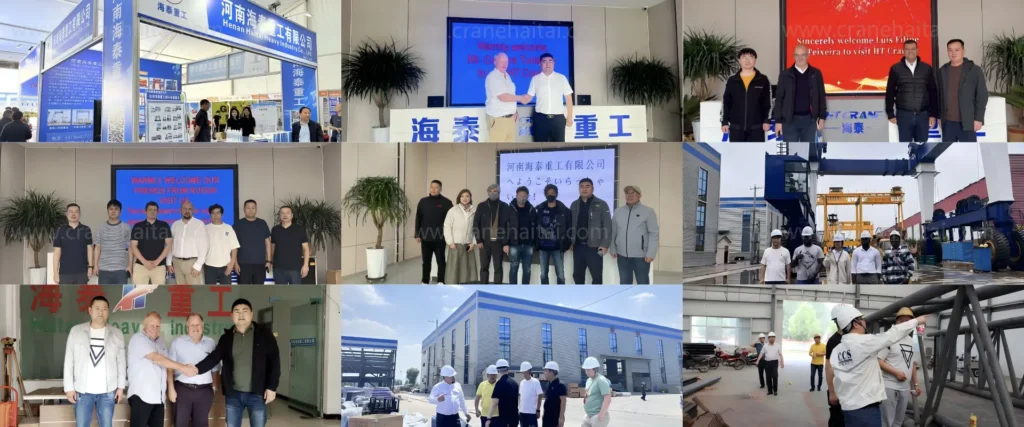
Henan Haitai Heavy Industry Co., Ltd. (HT Crane) is a nationally certified Class-A special equipment manufacturer for gantry and portal cranes in China, with export projects delivered across Southeast Asia, Central Asia, the Middle East, Africa, and Europe — the Uzbekistan RMG crane above being one example of that track record. The company holds 37+ special equipment type-test certificates and 23+ utility model patents, and its quality, environmental, and occupational health management systems are certified to ISO 9001, ISO 14001, and ISO 45001.
HT Crane’s RMG and RTG cranes carry classification society recognition from ABS, CCS, BV, DNV, RMRS, and ZC, and are manufactured at a 40,000 m² production facility equipped with CNC machining, robotic welding, and laser cutting, supported by 60+ certified welders (CCS, ABS, BV). For terminal operators evaluating an RMG crane manufacturer, that combination of in-house certification, structural engineering capability, and a 24-hour international after-sales network is intended to reduce both technical and delivery risk on a large, custom-built piece of infrastructure.
What to Ask and Evaluate for RMG Container Crane Supplier?
Before placing an order, it’s worth verifying four things with any supplier:
- CE Declaration of Conformity issued by the manufacturer itself, not a trading company — confirm the manufacturing entity matches the entity named on the CE document.
- Structural design certification — FEM 1.001 and EN 13001 compliance verified by an independent structural engineer, with a design appraisal certificate available on request.
- Reference terminals — names and locations of operating terminals running the supplier’s RMG cranes, with throughput and automation level you can verify independently.
- Automation upgrade path — if automation is on a five-year horizon, confirm what the control architecture requires to move from manual to semi-automated operation, and what that upgrade costs.
Заключение
An RMG container crane remains the highest-density, highest-automation-potential yard equipment available for container terminals, and for any operation planning growth beyond roughly 500,000 TEU — or any greenfield terminal where land efficiency is the primary constraint — it is the rational long-term infrastructure choice.
The Uzbekistan project shows what that looks like in practice: a 45-ton, 32-metre crane engineered, tested, and delivered overland to a landlocked market, then commissioned into full operational service.
Getting there requires more upfront engineering than an RTG purchase — rail foundation design, electrical supply planning, and automation decisions all need to happen early — but it pays back in a system built to run reliably for 25 years.

Часто задаваемые вопросы
Q1. What does RMG crane mean?
RMG stands for rail-mounted gantry. An RMG crane is a gantry-type container crane that travels on fixed rails installed on the ground, used to stack and retrieve containers within a defined yard block or intermodal rail terminal.
Q2. What is the difference between an RMG crane and an RTG crane?
An RMG crane runs on fixed rails and stays within its assigned block, while an RTG crane runs on rubber tyres and can move freely between blocks. The RMG’s fixed rail gives it higher stacking density, up to 1 over 7, and the highest automation potential, while the RTG trades some density for mobility and lower civil infrastructure cost.
Q3. What lifting capacity does an RMG crane typically have?
Standard RMG cranes are rated 40 to 80 tons under the spreader, split into a standard class (40–50T) for general container terminals and a heavy-duty class (51–65T) for high-cube or overweight cargo terminals.
Q4. Can an RMG crane be automated?
Yes. RMG cranes are available as manual, semi-automated (ARMG), or fully automated (ASC) systems. Because the rail provides precise positioning, RMG cranes support higher automation reliability than rubber-tyred equipment, which is why they are the structural basis for automated stacking systems at the world’s highest-throughput terminals.
Q5. How is an RMG crane delivered to a landlocked or overseas destination?
As shown in the Uzbekistan project, an RMG crane is disassembled into transport sections, anti-corrosion treated, and export-packed, with components sequenced and labeled for efficient on-site re-assembly. For landlocked destinations, this includes overland transport planning to keep sections within road dimensional limits before on-site installation, rail alignment, and electrical commissioning.