


Not every facility has the floor space for a full gantry crane. Not every building has the roof structure to support an overhead travelling crane. A semi gantry crane solves both problems at once — and for a significant number of industrial buyers, it is the most practical and cost-effective crane configuration available.
The semi gantry crane uses one leg on the ground and one side supported by an existing building column or runway rail on the wall. This hybrid design reduces the crane’s footprint, eliminates one set of floor rail foundations, and integrates with the building structure in a way that a full gantry crane cannot. The result is maximum coverage in minimum space — at a lower civil works cost than either alternative.
A semi gantry crane — also called a half gantry crane — has an asymmetric support structure. One end of the main girder rests on a standard leg that runs on a ground-level rail. The other end is supported by a trolley or bracket that runs on a runway rail attached to an existing building column, wall structure, or dedicated runway beam.
This means the crane covers the full span between the building column and the ground rail, without needing a second set of legs and without the full rail system that a standard gantry crane requires on both sides. The single leg travels on one ground rail. The other rail is elevated — mounted to the building structure at the required height.
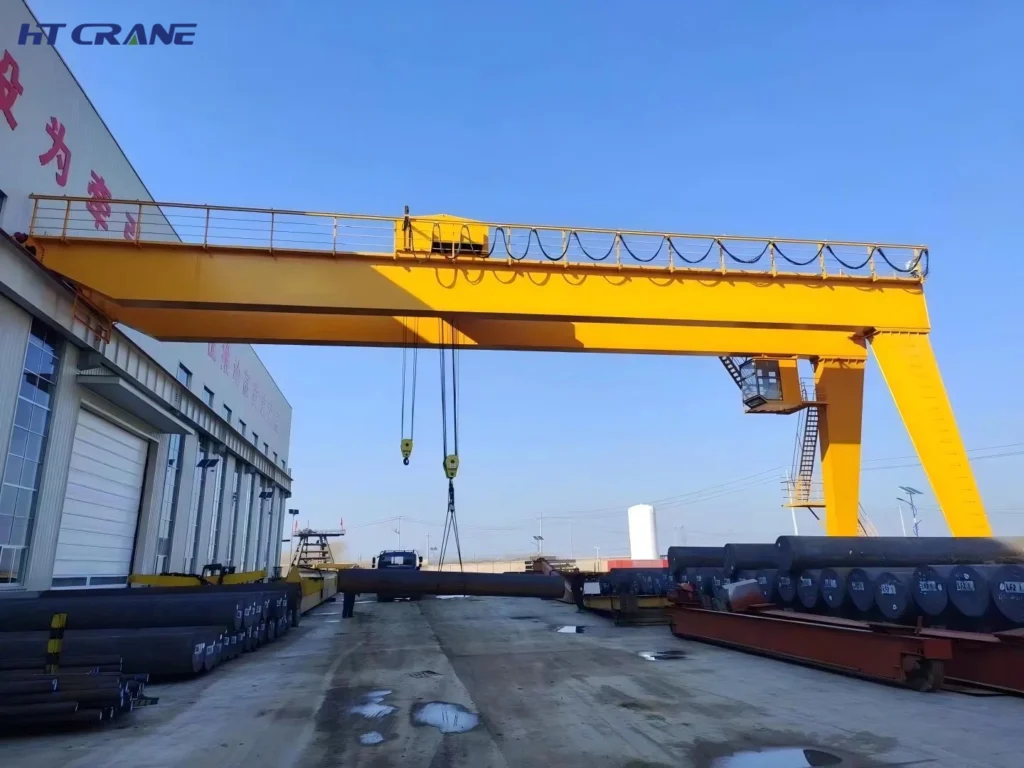
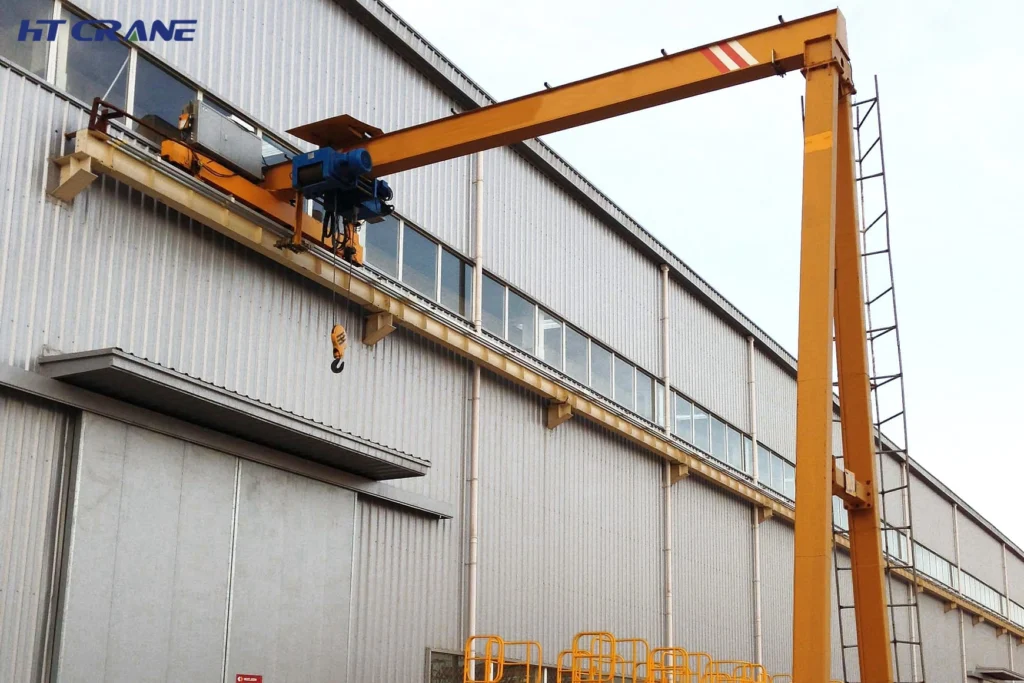
The semi gantry crane design emerged from a practical operational need: facilities where one side of the working area is bounded by a building wall or column line, and full floor coverage is required without the footprint of two independent rail systems.
Typical examples: a machine shop where equipment lines one wall and the crane must serve the full floor area; a loading bay where one wall is the building structure and the other side is open to a yard; a prefabrication area where columns on one side are structural and cannot be moved, but floor space on the other side is unobstructed.
Semi gantry cranes are available in both single and double girder configurations, following the same logic as standard gantry cranes:
| Facteur | Single Girder Semi Gantry | Double Girder Semi Gantry |
|---|---|---|
| SWL Range | 1T – 20T | 10T – 50T |
| Hauteur du crochet | Abaisser (palan sous la poutre) | Higher (trolley on top) |
| Portée | Up to 30m | Up to 40m |
| Poids structurel | Plus léger | plus lourd |
| Building Load | Inférieur | Plus haut |
| Best Fit | Workshops, light fabrication, maintenance | Heavy manufacturing, steel processing |
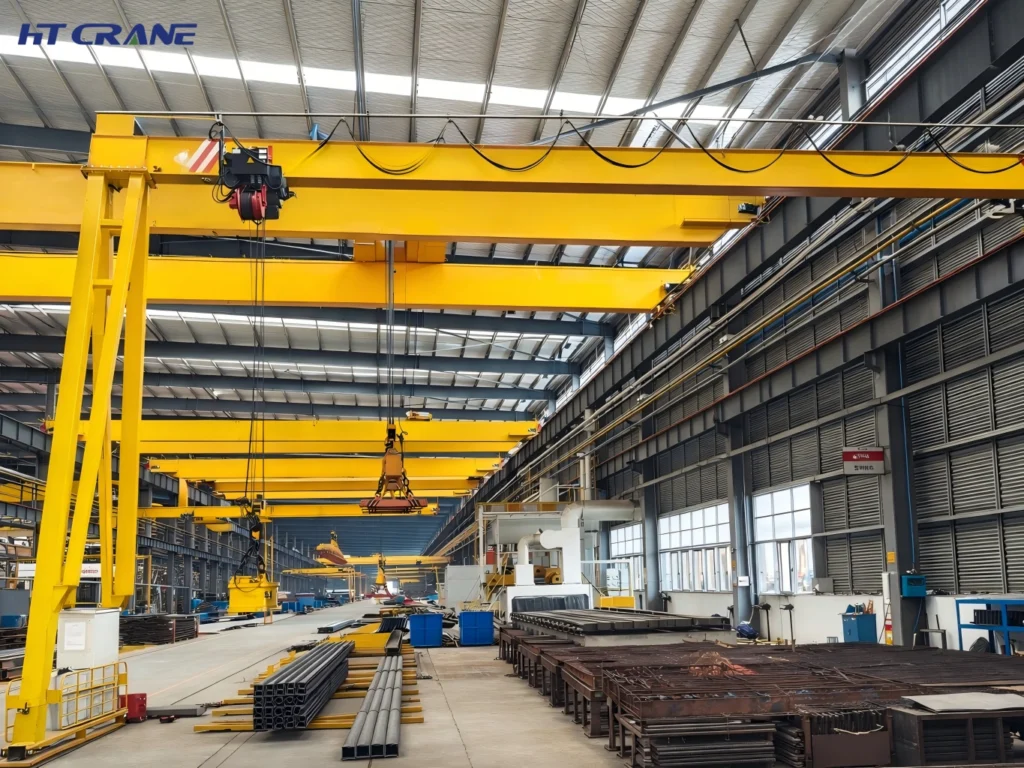
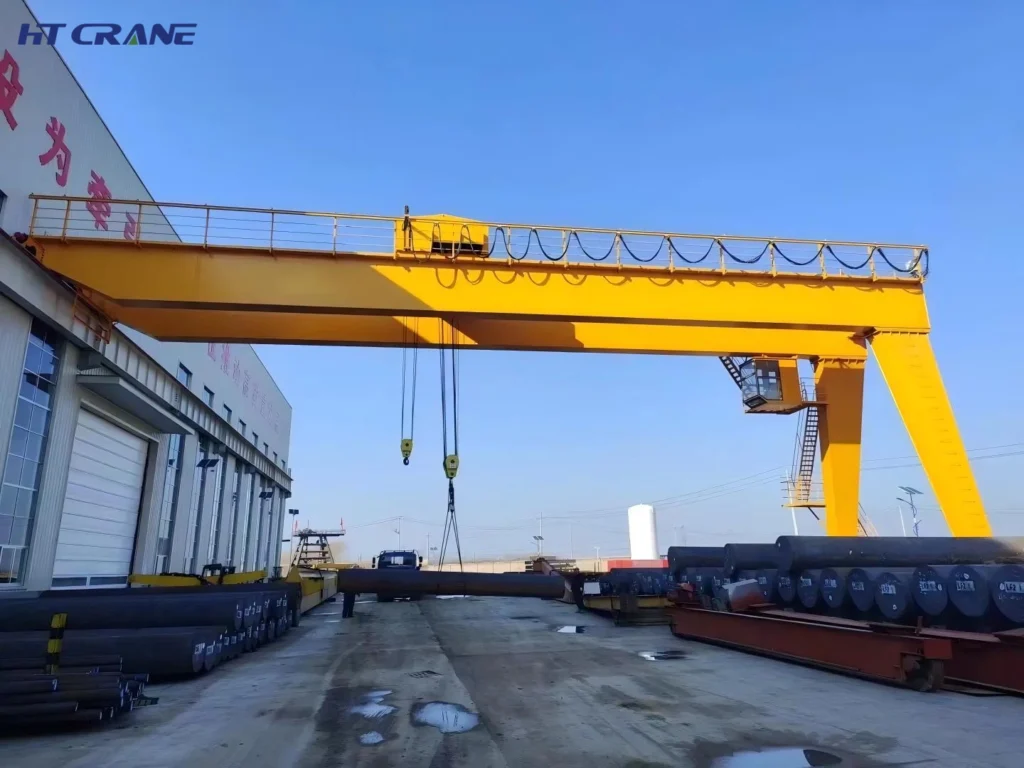
For the majority of semi gantry crane applications — workshop lifting from 3T to 16T — the single girder configuration is the appropriate and cost-effective choice. Double girder semi gantry cranes are used when hook height or heavy load requirements push beyond single girder limits.
| Paramètre | Gamme de spécifications |
|---|---|
| Charge de travail admissible (SWL) | 1T – 50T |
| Portée | 5m – 40m |
| Hauteur de levage | 3m – 15m (site dependent) |
| Vitesse de levage | 2 – 12 m/min (VFD control available) |
| Vitesse de déplacement du chariot | 10 – 40 m/min |
| Vitesse de déplacement du portique | 10 – 40 m/min |
| Leg Configuration | Single leg — fixed height or adjustable |
| Ground Rail | Standard crane rail (crane-supplied) |
| Wall/Column Rail | Runway beam — supplied or specified by buyer |
| Système d'entraînement | AC motor with VFD (all motions) |
| Classe de service | ISO M3 – M6 (FEM 1Am – 5m) |
| Contrôle | Pendant, radio remote |
| Norme de conception | EN 13001, FEM 1.001 |
| Certification | CE (Directive européenne Machines 2006/42/CE), ISO 9001 |
Three structural variants cover the full application range:
Standard single leg, fixed height — the most common configuration for permanent indoor installations. The leg height is set during design to match the building column rail height. Simple, cost-effective, and low-maintenance.
Adjustable leg height — the single leg is height-adjustable within a defined range. Useful when the crane is used in multiple areas with different column heights, or when the leg height may need to change as the facility evolves.
Cantilever extension — the girder extends beyond the ground rail end, providing lifting coverage outside the direct span between the leg and the building rail. Used when the working area extends beyond the column line into an open yard. The cantilever section must be designed and balanced carefully — it is not simply extending the girder without structural calculation.
This is the most common semi gantry crane application. The facility already has structural columns along one wall — either from the building’s original design or from a previous installation. Installing an overhead crane would require significant structural reinforcement. A full gantry crane would need rails on both sides and would occupy floor space that is currently used for equipment or workflow.
The semi gantry crane solution: a ground rail runs along the open side of the workshop floor. The existing building column carries a runway beam at the required height. The crane covers the full workshop width from column to ground rail, using the building’s own structure on one side and a minimal floor rail on the other. Civil works are reduced to one rail foundation instead of two. The building structure carries one side of the crane load — exactly what it was designed to do.
Facilities with covered loading bays — where one side is the building wall and the other side is open to a yard or loading apron — benefit directly from the semi gantry configuration. The covered side uses the building structure for the elevated rail. The open side uses a single ground rail with a standard leg.
This arrangement allows the crane to serve both the indoor storage area and the outdoor loading apron with one crane. No full gantry crane could achieve this without encroaching on the loading apron with a second set of legs. No jib crane covers enough area. The semi gantry is the natural solution.
Fabrication shops handling material up to 20T — structural steel, plate, piping, and assemblies — frequently operate in buildings where overhead cranes are impractical due to roof structure limitations and where a full gantry crane would create floor congestion. The semi gantry crane provides the lifting capacity needed without either constraint.
For this application, a 10T–16T single girder semi gantry with a span of 12–20 metres is typical. The semi gantry crane handles raw material receiving, in-process assembly moves, and finished product loading — the full production cycle — without forklift interference on the workshop floor.
Equipment maintenance bays — for large vehicles, power generation equipment, and industrial plant — often have one fixed wall structure and require lifting access across the full bay width. The semi gantry crane fits this geometry precisely: the wall carries one rail, the floor carries the other, and the full bay is covered with one crane and one operator.
For maintenance applications, the duty cycle is typically low — M3 or M4 — which means the crane is designed for moderate lift frequency rather than continuous production use. This affects the structural specification and the hoist duty rating. Always confirm the duty class with your supplier rather than defaulting to the heaviest available option.
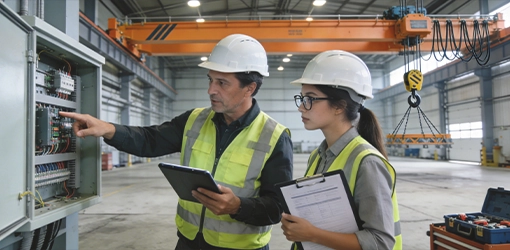
Before ordering a semi gantry crane, the building column or wall structure that will carry the elevated runway rail must be assessed by a structural engineer. The crane imposes dynamic loads on the building structure — not just the static weight of the crane and its load, but the accelerating and braking forces from gantry travel and hoist motion.
Many buyers assume that because the column is there, it can carry a crane. This assumption is frequently wrong. The original building design may not have included crane loads. The column section, connection details, and foundation may be adequate — or they may not be. This is not a risk worth taking. A structural assessment before procurement protects you from discovering the problem after the crane is installed.
grue HT provide a crane reaction load document — specifying the forces the crane imposes on the building structure — as part of our standard pre-contract technical package. Provide this to your structural engineer alongside the building drawings for the assessment.
The crane’s span is the distance between the centreline of the ground rail and the centreline of the elevated runway rail. This is not the same as the width of the working area — the leg and the building bracket each consume some of the span. Measure the actual working width you need to cover, then confirm the crane span required to achieve it.
Hook height is limited by the height of the elevated runway rail and the headroom available between the rail and the building structure above it. In buildings with limited clearance, this is frequently the binding constraint. Measure carefully and provide actual dimensions — not estimates — to your supplier.
Duty class determines how the crane structure and hoist are designed for fatigue life. Specifying a higher duty class than your operation requires adds unnecessary cost. Specifying too low creates a crane that reaches the end of its structural fatigue life before its expected service life — a failure mode that is not always visible until damage is already significant.
Estimate your average daily lifts, the typical load as a percentage of maximum SWL, and your intended crane service life in years. Provide these figures to your supplier and ask them to confirm the correct duty class per ISO 4301 or FEM 1.001. This is a basic application engineering step — any credible crane manufacturer will do it as a matter of standard process.
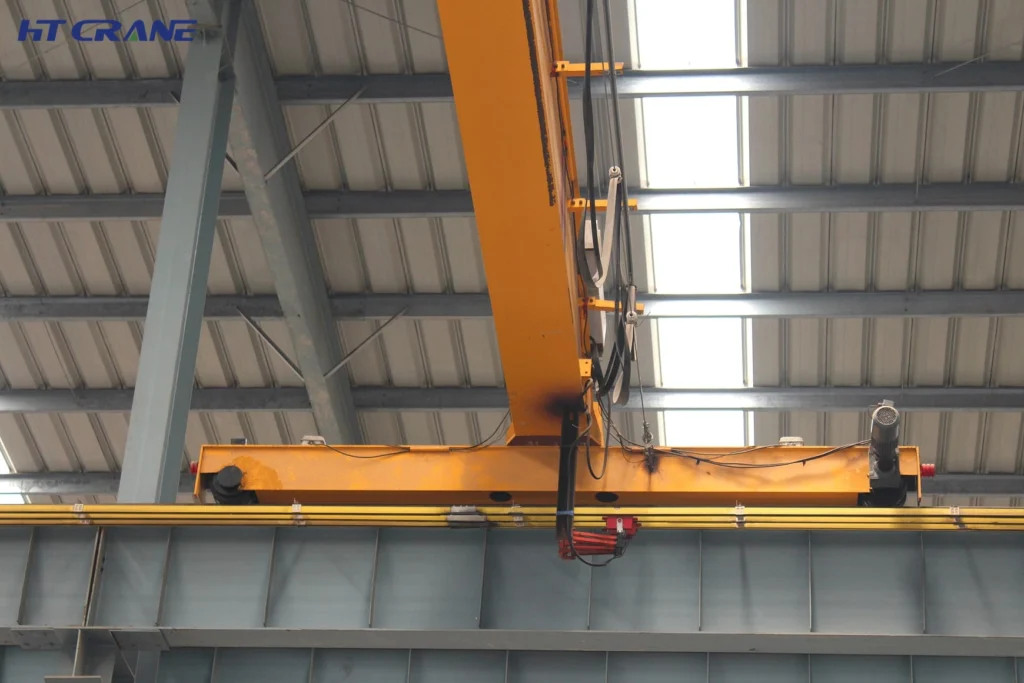
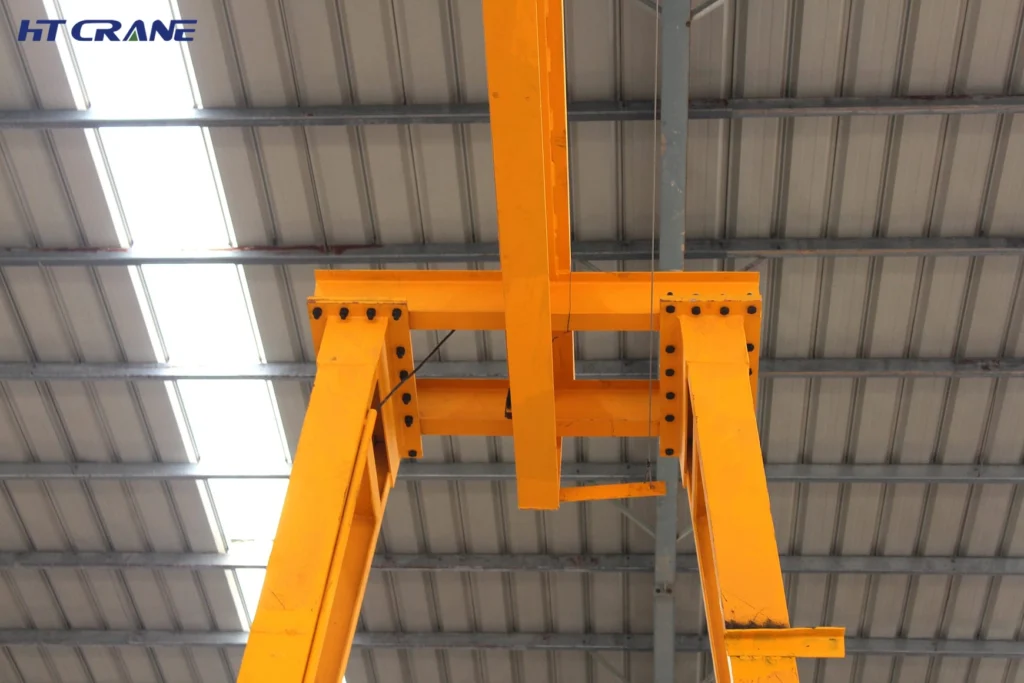
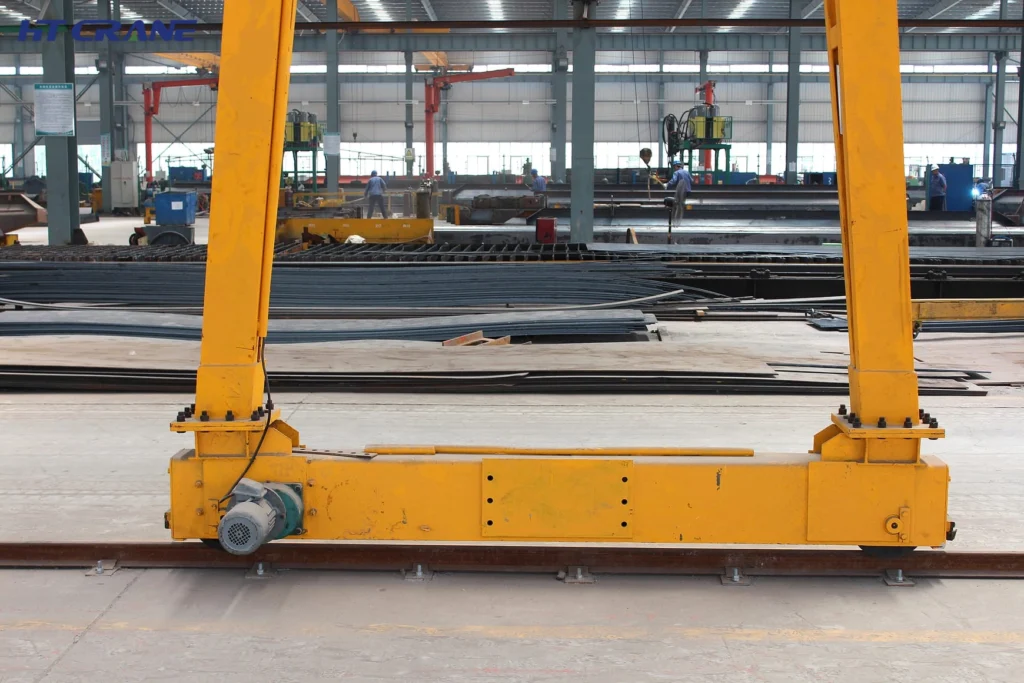
A semi gantry crane is a custom-engineered product. Every installation has a unique combination of span, height, building structure type, and operational requirement. A trading company cannot engineer this — they pass the specification to a manufacturer and mark up the result. You lose direct access to the engineers, you lose cost transparency, and you gain a layer of delay when technical questions arise during manufacturing or installation.
Buying direct means your specification goes to the engineers who will build the crane. Questions are answered by the people who designed it. Changes are implemented without intermediary delays. Documentation — CE certificate, load test report, structural drawings — comes directly from the manufacturing entity.
A semi gantry crane is the right solution when a full gantry crane creates too large a footprint, an overhead crane requires building upgrades that are not justified, and a jib crane does not cover enough area. It uses your building structure as one support, reduces civil works to a single ground rail, and delivers full working area coverage in a configuration that fits the geometry of the facility you actually have.
The specification process requires a structural assessment of your building and careful measurement of span and hook height. Both steps are straightforward with the right information — and we provide the crane reaction load data you need to make them simple.
Contact our engineering team with your span, load, hook height, and building structure details. We will provide a complete technical proposal and the structural load documentation your building engineer needs for the assessment.













Si vous gérez un port de plaisance, un chantier naval ou une installation navale, vous connaissez déjà les problèmes rencontrés : des bateaux immobilisés dans l’eau en attente de maintenance, des cales de halage qui endommagent les coques et des grues inadaptées à la manutention des bateaux. Un élévateur de bateaux mobile résout ces trois problèmes grâce à une seule machine. Il lève, déplace et met à l’eau les bateaux en toute sécurité, sans rails fixes, sans endommager la coque et sans ralentir votre chantier. Cette page présente tout ce dont vous avez besoin pour évaluer un élévateur de bateaux mobile : son fonctionnement, ses applications, les spécificités de notre modèle et ses caractéristiques techniques complètes. Si vous souhaitez commander un appareil, notre équipe d’ingénieurs répond à vos demandes sous 24 heures. Description du produit : Un élévateur de bateaux mobile, également appelé élévateur de bateaux mobile ou élévateur de bateaux automoteur, est une grue portique sur pneus conçue spécifiquement pour la manutention des bateaux. Le portique enjambe le bateau dans l’eau. Des élingues en polyester sont positionnées sous la coque. Le bateau est ensuite soulevé et transporté n’importe où à terre. Sans rails ni infrastructure fixe. Une seule machine permet de gérer la mise à sec…

Choisir le bon fournisseur de grues RTG a un impact sur l'ensemble de vos opérations portuaires ou de terminal. Un mauvais choix entraîne des retards, des temps d'arrêt et des réparations coûteuses. Nous vous aidons à les éviter. En tant que fabricant et exportateur certifié de grues RTG, nous fournissons des portiques sur pneus haute performance, conçus pour les terminaux à conteneurs, les parcs intermodaux et les plateformes logistiques du monde entier. Description du produit : Une grue RTG (grue portique sur pneus) est une grue mobile conçue pour empiler et déplacer les conteneurs ISO dans les terminaux à conteneurs portuaires et les dépôts intérieurs. Contrairement aux grues sur rails (grues portiques à conteneurs RMG), les grues RTG se déplacent sur pneus, ce qui leur confère une mobilité totale sur le terminal sans infrastructure fixe. 👉 Consultez notre guide d'achat professionnel : Grue RTG vs grue RMG : laquelle convient le mieux à votre projet ? Les grues RTG sont essentielles aux opérations modernes des terminaux à conteneurs. Elles comblent le fossé entre les grues portuaires et le transport horizontal, permettant un empilage, une récupération et une organisation efficaces des conteneurs. Pourquoi acheter chez nous ? HT Cranes est un fabricant professionnel de grues RTG, fort de plus de 15 ans d'expérience dans le levage. Nos grues sont exportées vers les ports et plateformes logistiques d'Asie du Sud-Est, du Moyen-Orient et d'Europe.
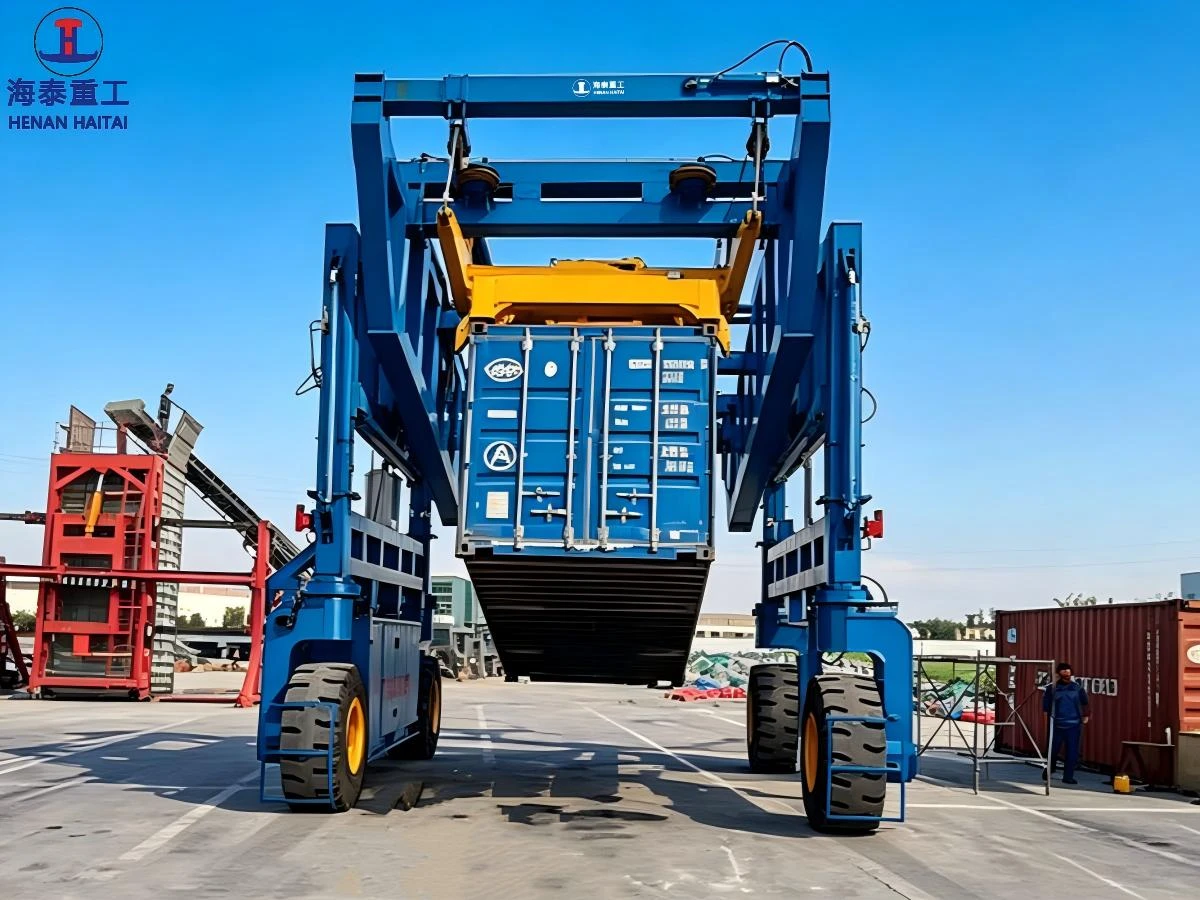
Si vous manipulez des conteneurs lourds, des structures métalliques ou des marchandises industrielles hors gabarit, et que votre site ne dispose pas d'infrastructure électrique fixe, un cavalier hydraulique est probablement la solution la plus pratique. Il lève, déplace et dépose les charges sans nécessiter de structures aériennes, de rails ou d'alimentation électrique haute tension. Une seule machine. Une mobilité totale. Des travaux de génie civil minimes. Qu'est-ce qu'un cavalier hydraulique ? Principe de base : Un cavalier hydraulique est un véhicule de levage lourd automoteur. Il enjambe la charge, la soulevant par le dessous à l'aide d'un écarteur hydraulique ou d'une poutre de levage, et se déplace librement sur pneus. L'ensemble du cycle de levage et de déplacement est alimenté par un système diesel-hydraulique embarqué. Contrairement aux grues électriques ou à câble, le cavalier hydraulique possède sa propre source d'énergie. Il est donc totalement indépendant de l'infrastructure du site. Vous pouvez le déployer partout où la surface supporte la charge des roues ; aucune installation fixe n'est requise. Fonctionnement du système hydraulique : Le moteur entraîne des pompes hydrauliques qui alimentent en fluide sous pression les vérins de levage, les moteurs d'entraînement et les actionneurs de direction. Tous les mouvements — soulever, abaisser, déplacer et diriger —…

























