Choosing the wrong grue à portique doesn’t just cost money — it costs you operational flexibility for the next 15–20 years. The right crane fits your heaviest lift, your tightest clearance, and the way your team actually works on the floor. The wrong one becomes a workaround you manage every shift.
Most buyers get into trouble not because they pick a bad product, but because they prioritize the wrong factor first. Load capacity is what they ask about. Span and headroom are what surprises them at installation.
This guide walks through the six factors that matter most when specifying a gantry crane — in the order they should be evaluated. By the end, you’ll have a clear framework to compare options and brief your engineering team or supplier with precision.


1. Define Your Maximum Rated Load Capacity
Start with the heaviest lift, not the average
Load capacity is the foundational spec — everything else is sized around it. But “what’s the heaviest thing I’ll lift?” is a more nuanced question than it appears. You need to account for the weight of the load itself, plus the weight of your lifting attachment: hooks, shackles, spreader beams, or custom fixtures. This combined weight is what the crane must be rated to handle.
Industry standard (FEM / ISO 4301): Rated capacity is the maximum safe working load (SWL) — it does not include the hook block or lifting accessories. Always factor these in explicitly when specifying.
A common mistake is to size the crane for current operations only. If you plan to add larger equipment, press tooling, or heavier assemblies within the next five years, size up now. Adding capacity later typically means replacing the entire structure.
Duty cycle affects structural fatigue — not just motor selection
Capacity is not just about peak load. It’s about how often that load is lifted. FEM and ISO classify cranes by duty group (A1–A8 under FEM, or M1–M8 under ISO 4301), which determines the structural fatigue life. A crane rated at 10t operated 50 times per day requires a very different specification than one that lifts 10t twice a week.
| FEM Duty Group | Typical Use | Relative Lift Frequency |
|---|---|---|
| A1–A2 | Maintenance bays, infrequent use | Faible |
| A3–A4 | General manufacturing, moderate use | Moyen |
| A5–A6 | Heavy production, frequent lifts | Haut |
| A7–A8 | Steel mills, continuous operation | Very High |
Source: FEM 1.001 Rules for the Design of Hoisting Appliances
Specifying the wrong duty group leads to fatigue cracks in the girder welds and premature structural failure — even when the rated load is never exceeded.
2. Determine Span and Headroom Requirements
Span: measure what the crane actually needs to cover
Span is the horizontal distance between the crane’s runway rails (or legs). For a freestanding gantry, it defines how wide of a work area the crane can serve.
Measure your working envelope — the full width of the floor area where loads will be moved — and add clearance for the crane legs themselves. Single girder gantry cranes typically require legs to extend beyond the work area by 500–800mm per side. Double girder configurations may require more, depending on the end truck design.
A key distinction:
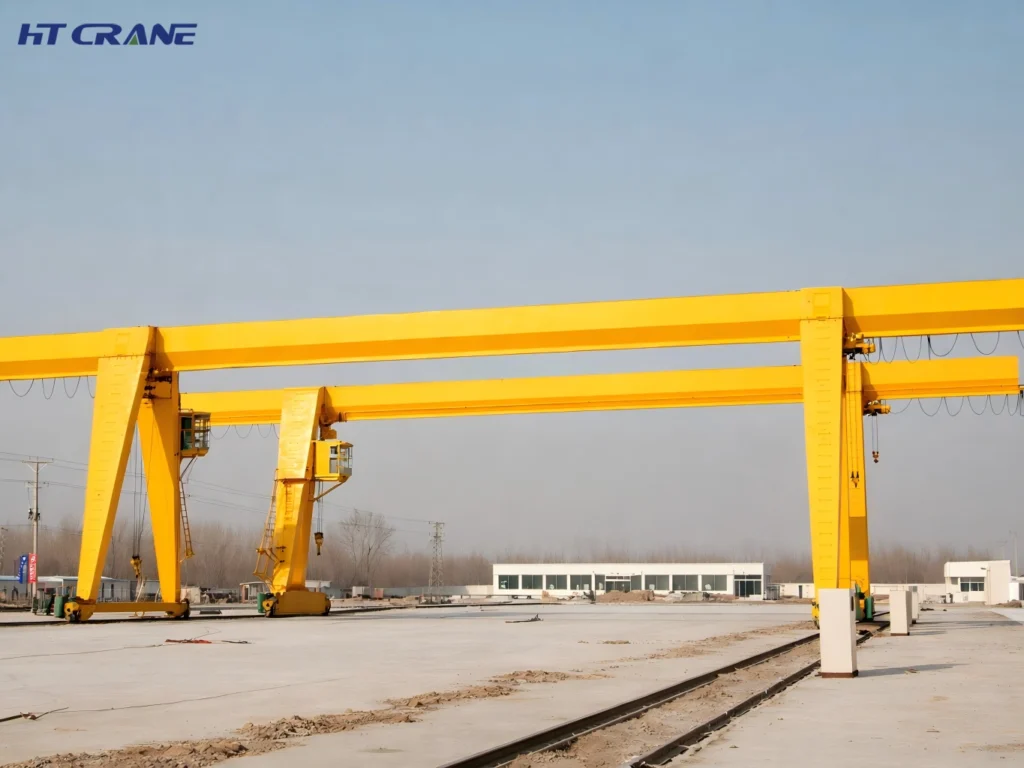
- Semi gantry crane: One leg runs on a rail or runway beam mounted to the building structure; the other runs on a floor rail. Useful when one wall can support a runway but a full overhead crane isn’t feasible.
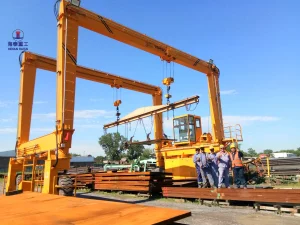
- Full gantry crane: Both legs travel on floor rails. Entirely self-supporting — no building structure required to carry the load.
Semi gantry configurations are often the right answer in facilities where the column grid supports a runway on one side, but the opposite side is open production space. They reduce the footprint compared to a full gantry while delivering most of the coverage.
Headroom: hook height is what matters, not overall height
Headroom — also called hook height — is the distance from the floor to the lowest point of the hook at its highest raised position. This is the spec that matters for your operation, not the overall crane height.
Two things consume headroom that buyers often forget:
- The hoist trolley itself — particularly with electric chain hoists, which have a fixed minimum headroom requirement.
- The load attachment — a 400mm spreader beam reduces your effective hook height by 400mm.
For confined spaces or low-ceiling workshops, adjustable gantry cranes (with telescoping legs) allow the hook height to be set to match the specific task — a practical solution when ceiling heights vary across facilities or job sites.
3. Match Crane Structure to Application
Single girder vs. double girder: the practical difference
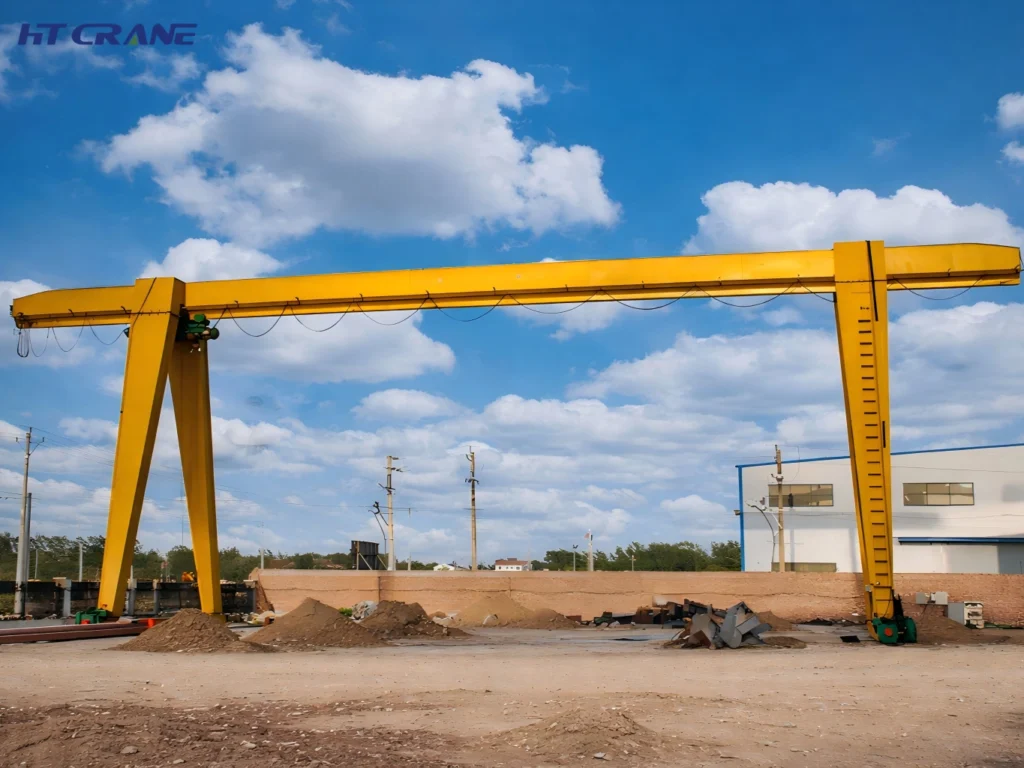
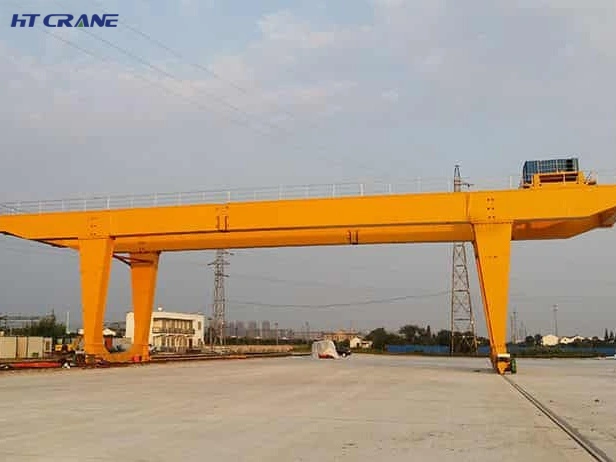
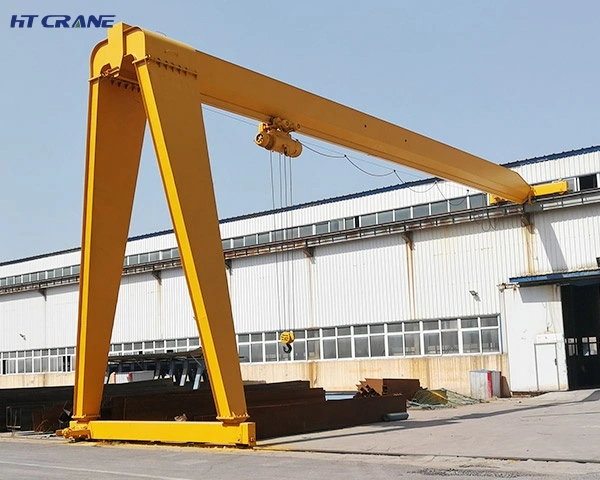
The choice between single and double girder is primarily driven by load capacity and headroom:
| Fonctionnalité | Poutre unique | Poutre double |
|---|---|---|
| Plage de capacité typique | 0.5t – 20t | 5t – 500t+ |
| Headroom efficiency | Good (hoist hangs below girder) | Better (hoist sits between girders) |
| Dead weight | Inférieur | Plus haut |
| Coût | Inférieur | Plus haut |
| Maintenance access | Limité | Walkway for servicing hoist |
| Span range | Up to ~30m practical | Up to 50m+ |
Capacity and span ranges are general market references; specific designs vary by manufacturer.
For most workshop and light industrial applications up to 10t, a single girder is the right choice — lower cost, simpler installation, adequate headroom. Double girder becomes the correct answer when capacity exceeds 20t, when spans exceed 25m, or when you need a trolley-mounted hoist that a maintenance team can service from above.
Truss vs. box girder construction
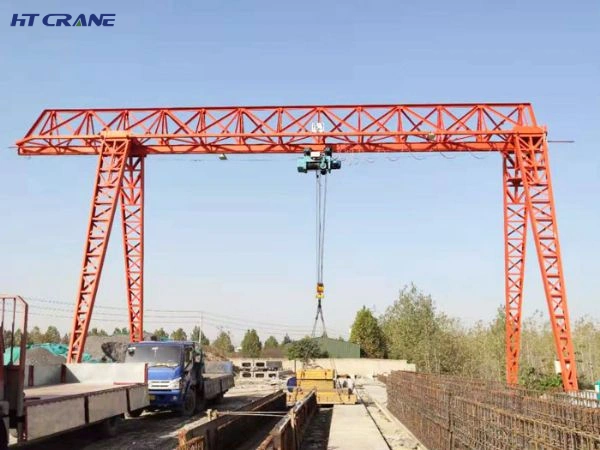
Most modern gantry cranes use welded box girder construction — a closed rectangular section that provides excellent stiffness-to-weight ratio and is straightforward to inspect for surface cracks.
Truss gantry cranes use an open lattice structure, typically for very long spans (>40m) or in applications where deadweight must be minimized — such as on weak-floor facilities or in outdoor portable configurations. Truss construction provides high span-to-weight efficiency but requires more thorough inspection of weld joints at each node.
For most facilities, box girder is the standard choice. Specify truss only when span or site constraints make it the logical answer.
4. Decide Between Rail-Mounted and Rubber-Tyred (Mobile) Configurations
Rail mounted gantry cranes (RMG): precision and heavy capacity
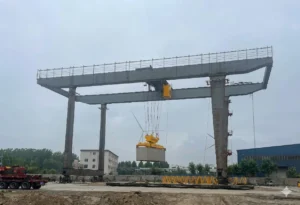
Rail mounted gantry cranes travel on fixed rails embedded in or mounted to the floor (or elevated runways). This provides precise, repeatable positioning and is the correct choice for:
- Container handling yards and intermodal terminals
- Automated storage and retrieval operations
- Very high capacity lifts (>50t) where lateral stability is critical
- Operations requiring centimeter-level positioning accuracy
The trade-off is flexibility. Once rails are laid, the crane’s coverage area is fixed. Rail installation also represents a significant civil engineering commitment.
Rubber tyred gantry cranes (RTG): flexibility over fixed coverage
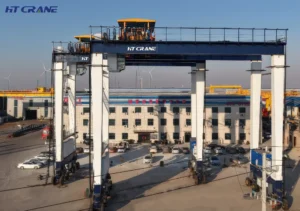
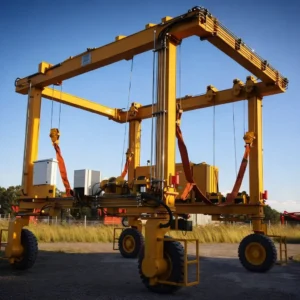
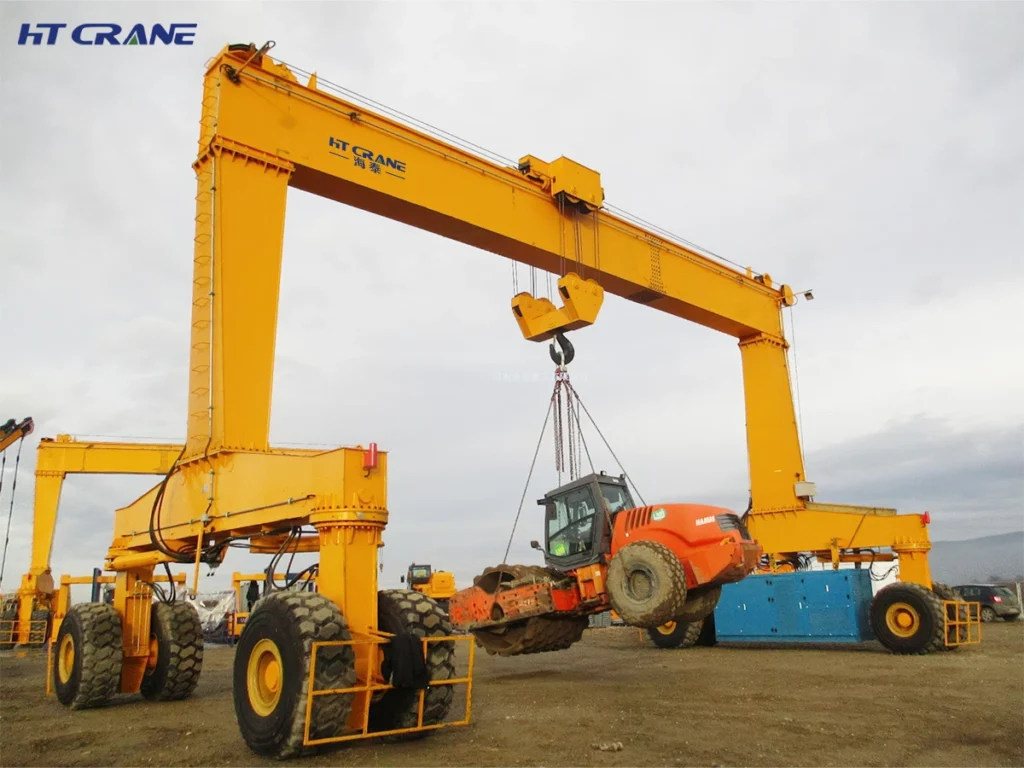
Rubber tyred gantry cranes travel on pneumatic tires rather than fixed rails. They can reposition between bays, be relocated to different facilities, or be added to a site without civil rail-laying work. RTGs are the dominant configuration in port container yards where flexibility across berths is required.
For manufacturing facilities, RTG configurations are less common — the inherent flexing of rubber tires introduces minor positional variation that can matter in precision assembly. For general material handling where ±50mm positioning is acceptable, they are a viable and flexible option.
5. Evaluate Your Mobility Requirements
Fixed vs. portable gantry cranes
Beyond rail vs. rubber tyre, the more fundamental question for smaller cranes (typically under 5t) is: does this crane need to move at all?
Fixed gantry cranes are anchored to floor rails or embedded anchor bolts. They provide maximum rigidity, higher duty cycle ratings, and are appropriate for dedicated lifting stations — press loading, assembly line service points, or maintenance bays.
Portable / adjustable gantry cranes travel on caster wheels (typically with locking mechanisms) and require no floor anchoring. They serve maintenance, field service, and facilities where the crane needs to move to the work rather than the reverse.
Key limitations of portable configurations: they are unsuitable for lifts exceeding approximately 5t, they require smooth, level floor surfaces, and they must never be moved while under load (unless specifically rated for dynamic travel by the manufacturer).
6. Confirm Compliance Requirements and Environmental Conditions
CE, ASME B30.2, and what they actually mean for your spec
The applicable standard depends on your facility’s location and, in some cases, your customer or export requirements:
- CE marking (EN 13157, EN 15011): Required for equipment placed on the market in the European Economic Area. Confirms conformity with EU Machinery Directive requirements.
- ASME B30.17 / B30.2: North American standards for overhead cranes and monorails; specifies safety requirements for design, installation, inspection, and operation.
- FEM 1.001: European Federation of Materials Handling standards — detailed design rules covering fatigue, duty classification, and structural calculation methods.
Specifying CE-certified equipment from a manufacturer who can provide a complete Declaration of Conformity and Technical File ensures your legal compliance and simplifies insurance qualification.
Outdoor and aggressive environments
Standard gantry cranes are rated for indoor, dry operation. If your application involves any of the following, specify this explicitly at inquiry:
- Outdoor operation: Requires weatherproofing of electrical components, stainless or galvanized hardware, and corrosion-resistant paint systems.
- High humidity or chemical exposure: May require sealed motor housings, special paint specification (e.g. C4 or C5 corrosivity class per ISO 12944).
- Extreme temperature: Motor ratings, lubricant viscosity, and seal materials must be specified for the operating temperature range.
- Hazardous areas (ATEX): Facilities with explosive atmospheres require ATEX-rated electrical components throughout.
A supplier who doesn’t ask about your operating environment before quoting is not specifying your crane — they’re quoting a standard product and assuming it fits.
Conclusion
The six factors covered here — rated capacity and duty cycle, span and headroom, structural type, mobility configuration, rail vs. rubber tyre, and compliance requirements — form a complete specification checklist for any gantry crane procurement.
Three actions to take before you request quotes:
- Confirm your maximum SWL including all lifting attachments, and identify the duty group that matches your actual lift frequency.
- Measure your working envelope and hook height requirement at the floor — not from drawings.
- Document your environmental conditions and applicable certifications before briefing suppliers.
A well-specified inquiry produces comparable quotes. An under-specified one produces variation that makes comparison nearly impossible — and risk that shifts to your side of the table.
Have a specific selection question your team needs to work through? Contact our engineering team for a no-obligation technical discussion.

FAQ
Q1:How do I know which duty group (FEM/ISO) to specify?
Duty group is determined by two variables: the spectrum of loads the crane will handle over its life (load spectrum class L1–L4) and the total number of working cycles expected (utilization class U0–U9). In practice, most general manufacturing applications fall into A3–A4 (FEM) / M3–M4 (ISO). A crane servicing a production line 2–3 shifts per day with near-full loads typically warrants A5. Your crane manufacturer should perform this classification based on your operational brief — if they don’t ask these questions, request that they do before finalizing the spec. Getting duty group wrong is one of the most common causes of premature fatigue failure in service.
Q2:What is the practical difference between a semi gantry and a full gantry crane?
A full gantry crane is entirely self-supporting — both legs travel on floor rails, and the structure carries all loads independently of the building. A semi gantry has one leg on a floor rail and the other end supported by a runway beam attached to the building’s columns or walls. The building must be structurally capable of carrying these loads. Semi gantry configurations reduce floor rail length by roughly half and can serve areas where a full gantry leg would obstruct workflows. The trade-off is that you must verify building structure capacity before specifying — a structural engineer review is typically required.
Q3:Can a gantry crane be used outdoors permanently?
Yes, but standard indoor cranes are not suitable for permanent outdoor use without modification. Outdoor cranes require weatherproofed electrical enclosures (IP55 minimum, IP65 for exposed sites), corrosion-resistant hardware, marine-grade or high-build paint systems (ISO 12944 corrosivity class C3–C5 depending on environment), and wind load calculations incorporated into the structural design. In regions with significant wind or seismic loading, the runway rail anchoring system must also be engineered for these loads. Always specify “outdoor permanent installation” explicitly in your inquiry — it affects multiple aspects of the design and cost.
Q4:What maintenance intervals should I plan for after installation?
Gantry cranes require both routine and periodic inspection under most regulatory frameworks. Under EN 13157 / LOLER (UK) and equivalent regulations, routine user checks before each shift are required. A formal periodic inspection by a competent person — typically every 6 or 12 months depending on duty — must be documented. Key maintenance items include: wire rope or chain inspection for wear and deformation, brake adjustment and testing, end-stop buffer condition, structural weld inspection for cracking, and lubrication of running wheels and gear units. The manufacturer’s maintenance manual is the authoritative schedule — request it as part of your supply documentation.
Q5:How does span affect girder deflection, and does it matter for my application?
Longer spans produce greater mid-span deflection under load. Most standards limit loaded deflection to span/750 for overhead cranes (a 15m span allows 20mm maximum deflection under full rated load). For most general lifting operations, this deflection is operationally invisible. It becomes significant in two scenarios: precision assembly where load positioning must be maintained to tight tolerances, and very long spans where accumulated deflection at the trolley affects hook height and horizontal drift. Double girder configurations have inherently greater stiffness than single girder for equivalent spans. If your application involves precision work or spans exceeding 20m, ask your supplier to confirm the designed deflection figure in their calculation documentation.