Buying a marine travel lift is not a catalogue decision. The right boat hoist for a 200-slip yacht marina looks nothing like the right unit for a commercial shipyard handling 500-ton vessels. Tonnage, span, wheel configuration, and application type all interact — and getting any one of them wrong creates operational problems that are expensive to fix after delivery.
This guide is written for marina operators, boatyard managers, and procurement teams who are evaluating marine travel lifts and want a clear, practical framework for making the right selection. It covers how to define your capacity requirement, how span affects your facility design, which configurations suit which applications, and what to confirm from any supplier before placing an order.
If you are actively sourcing a marine travel lift, this guide gives you the technical grounding to evaluate options with confidence — and the right questions to ask before committing to a purchase.
Что такое морской трамвайный подъемник?
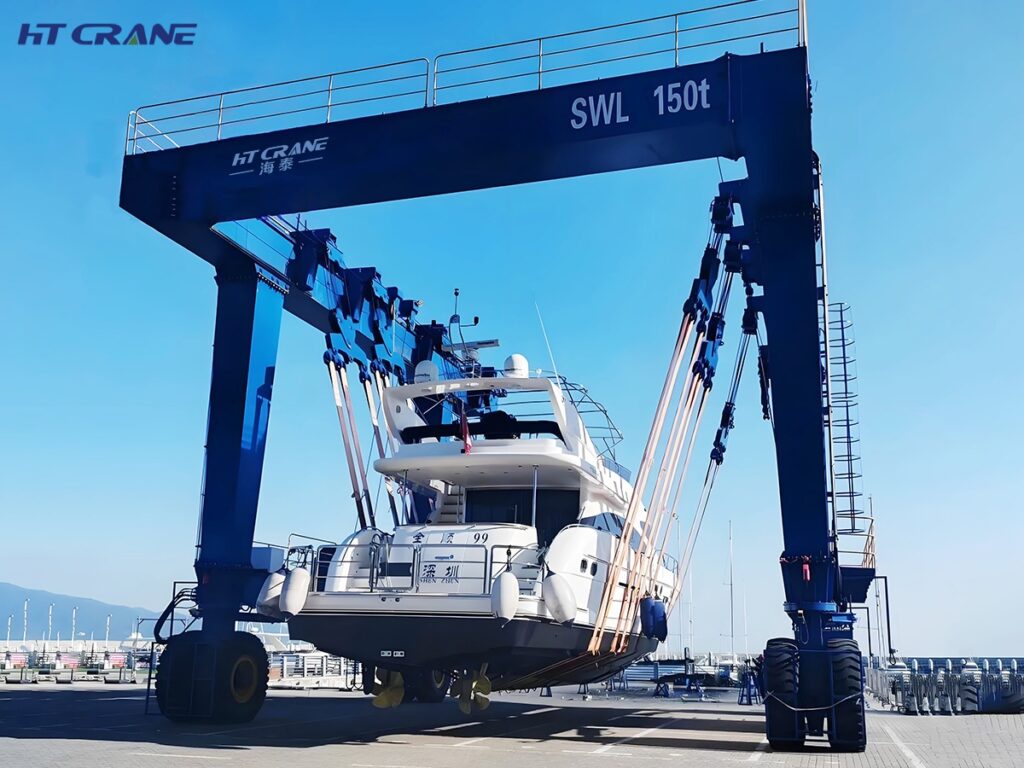
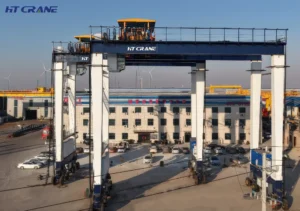
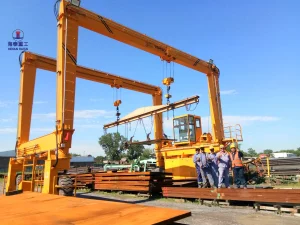
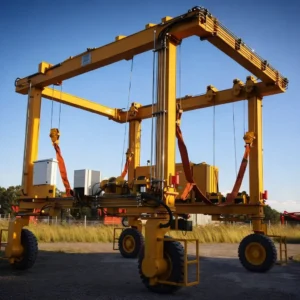
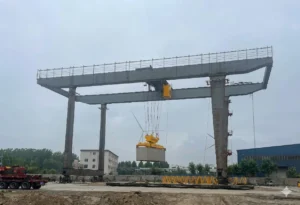
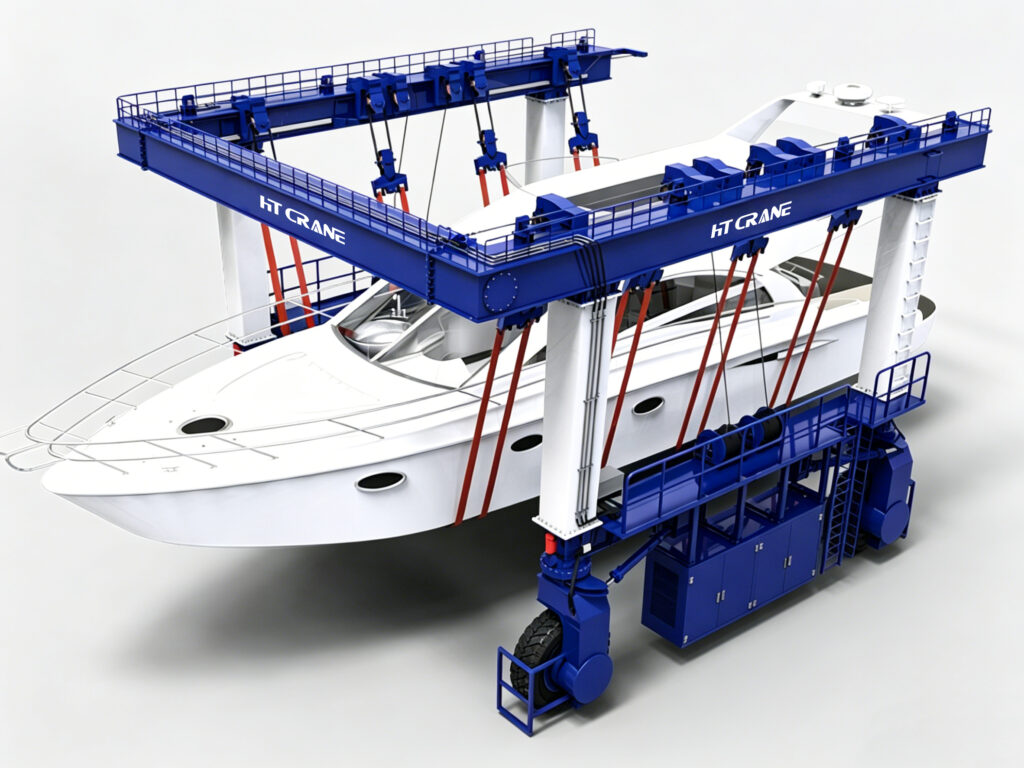
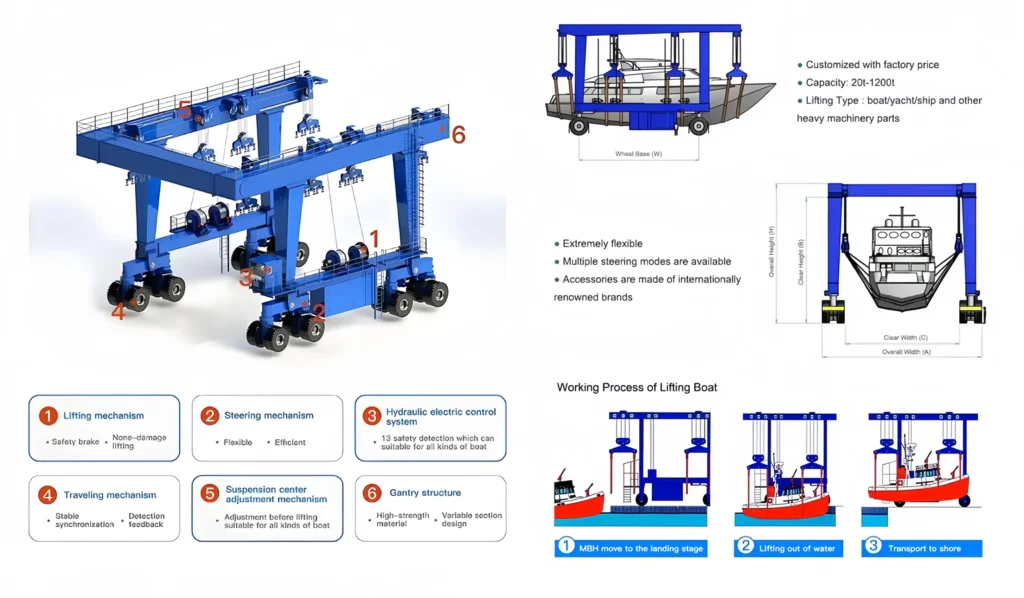
A морской транспортный подъемник — also referred to as a mobile boat hoist or boat travel lift — is a self-propelled rubber-tired gantry crane designed to lift, move, and launch vessels in marina and boatyard environments. It straddles the vessel in the water, suspends it using textile slings beneath the hull, and travels on solid rubber tires across the hardstand to the storage or maintenance area.
The marine travel lift operates as a complete handling system. Unlike fixed gantry cranes or straddle carriers, it combines lifting and horizontal transport in a single machine. One operator — using pendant or radio remote control — manages the entire haul-out cycle from water to hardstand without transferring the vessel between machines.
This integrated function is what makes the marine travel lift the dominant choice for boatyards handling vessels up to several hundred tons. Efficiency, flexibility, and minimal infrastructure dependency are the defining advantages.
Ключевые структурные компоненты
Understanding the main components helps procurement teams evaluate supplier specifications accurately:
- Main frame and crossbeam: The structural backbone. Width between legs defines maximum vessel beam capacity.
- Hoist system: Electric or hydraulic, single or dual drum. Dual independent hoists are required for vessels above certain weight thresholds.
- Система подвески: Nylon or polyester textile slings in fixed or adjustable configurations. Sling width and positioning must match your vessel mix.
- Travel drive: Diesel-hydraulic or electric. Diesel is standard for outdoor hardstand operations; electric suits indoor or emissions-restricted facilities.
- Система рулевого управления: Two-wheel, four-wheel, or all-wheel (crab) steering. Crab steering enables lateral movement without turning — essential for tight marina lanes.
Defining Your Tonnage Requirement
Lifting capacity is the first number most buyers focus on — and it is important. But the way you arrive at that number matters more than the number itself.
How to Calculate the Right Capacity
Start with the heaviest vessel currently in your fleet. Then apply a working buffer of 20–30% above that figure. This buffer protects against operating consistently at maximum rated load, which accelerates wear on structural members, hoist components, and wheel assemblies.
Do not specify to your current maximum if you expect fleet composition to change. A marina expanding from recreational sailing vessels to include larger motor yachts or commercial workboats within the next five years should specify for the anticipated fleet — not the current one.
Capacity Categories and Typical Applications
| Диапазон вместимости | Типичное применение | Примечания |
|---|---|---|
| 15–50 тонн | Yacht clubs, small marinas | Compact footprint, simpler operation |
| 50–150 тонн | Mid-size boatyards | Most common configuration globally |
| 150–300 tons | Commercial boatyards | Higher duty cycle, mixed vessel types |
| 300–600 tons | Industrial shipyards | Custom engineering standard |
| 600–1,000+ tons | Naval / offshore facilities | Full bespoke design required |
Ranges reflect standard market configurations. Confirm current availability with suppliers at RFQ stage.
Working Load vs. Rated Capacity
Confirm whether the supplier’s stated capacity refers to gross lifting load — including slings and rigging hardware — or net vessel weight alone. These figures differ. A marine travel lift rated at 200 tons gross capacity may have a net vessel capacity slightly below that once sling assembly weight is included. Request clarification in writing before comparing quotations.
Understanding Span: The Constraint Most Buyers Underestimate
Lifting capacity gets the attention. Span — the clear distance between the travel lift legs — is what determines whether the machine can actually straddle your vessels.
Why Span Is Often the Binding Constraint
A marina handling wide-beam catamarans, commercial fishing vessels, or large motor yachts may find that beam width, not vessel weight, is the primary selection constraint. A 50-ton catamaran with a 9-meter beam requires a travel lift with leg clearance exceeding 9 meters, regardless of its weight.
Standard span configurations range from approximately 5 meters to 30 meters of clear leg-to-leg distance. Custom spans beyond 30 meters are available from specialist manufacturers but extend both lead time and engineering cost.
Measuring Your Span Requirement
Measure the widest vessel in your current and anticipated fleet — including any fixed appendages such as outboard motor brackets or davits — and add a clearance margin of at least 300–500mm on each side. This margin allows safe sling positioning without contact between the frame and the hull.
For facilities handling multihull vessels alongside monohulls, confirm that the sling configuration can accommodate both hull geometries. Adjustable sling spreader systems allow a single travel lift to handle varied hull types without mechanical modification between haul-outs.
Span and Hardstand Layout
Span also affects your hardstand design. The travel lift’s leg width determines the minimum lane width required for movement across the yard. Wider units need wider lanes — and wider lanes reduce the number of vessel storage rows you can fit within a given hardstand area. Balance span against your storage density requirements during the facility planning stage, not after the travel lift has been ordered.
Application Types: Matching the Right Configuration to Your Facility
Marine travel lifts are not one-size-fits-all. Configuration choices — steering type, drive system, hoist configuration, and control system — should reflect your specific operational environment.
Small Marina and Yacht Club Applications
For facilities handling vessels up to approximately 50 tons, compact travel lifts with four-wheel steering and diesel-hydraulic drive are the standard choice. Operational simplicity and ease of maintenance matter more at this scale than advanced automation or high-cycle capacity.
Radio remote control is strongly recommended even for smaller units. It gives the operator full visibility of sling positioning and hull clearance from any angle — improving safety and reducing the risk of hull contact during haul-out.
Commercial Boatyard Applications
Mid-range travel lifts in the 50–300 ton category handle the widest variety of vessel types and operational profiles. All-wheel (crab) steering is particularly valuable here — it allows the operator to position the travel lift laterally without swinging the entire frame, which is critical in boatyards where vessels are stored in tight rows.
Duty cycle is an important specification factor for high-throughput boatyards. A facility launching and retrieving 10 or more vessels per day operates under significantly more demanding conditions than one handling 3–5 weekly. Duty classification under ISO 4301 should reflect actual operational intensity — not estimated usage.
Shipyard and Industrial Applications
Above 300 tons, marine travel lifts are engineered to order. Standard catalogue configurations do not apply at this scale. Buyers at this end of the market should expect custom structural design, extended lead times of 24–40 weeks, and a procurement process that involves detailed engineering review before order placement.
Third-party structural and load certification is standard practice for shipyard-grade equipment and is typically required by port authorities and insurance providers before the unit enters commercial service.
Ready to Source Your Marine Travel Lift
Selecting the right marine travel lift comes down to three decisions made in the right order: capacity, span, and configuration. Get these three aligned with your actual operational conditions and the rest of the procurement process becomes significantly more straightforward.
Define Your Specification First
Before approaching any supplier, document your minimum requirements in writing:
- Capacity: Heaviest vessel plus 20–30% buffer
- Охватывать: Widest vessel beam plus 300–500mm clearance each side
- Рабочий цикл: Estimated haul-outs per day or week across peak season
- Drive system: Diesel-hydraulic or electric based on your facility layout
- Steering: Standard or all-wheel crab steering based on your lane widths
- Certification: СЕ, BV, CCS, or market-specific compliance requirements
A written specification protects you during supplier comparison. It ensures every quotation you receive is responding to the same requirement — not the supplier’s preferred standard configuration.
Take the Next Step
If your specification is complete, you are ready to issue a formal RFQ. Request a technical submittal — not just a price — from each shortlisted supplier. Compare submittals against your specification. Confirm hardstand compatibility with your civil engineer. And verify after-sales support availability in your region before making a final decision.
If your specification is still in development, start with your vessel data. The heaviest hull and the widest beam define your equipment envelope. Everything else follows from there.
A properly engineered Marine Travel Lift, designed around real operational data and certified to relevant marine standards, delivers reliable vessel handling, reduced maintenance risk, and long-term operational efficiency.
Request a customized Морской туристический подъемник solution tailored to your vessel types and yard operations. Contact our engineering team for a detailed consultation — we design lifting systems based on real operational requirements, not generic capacity categories.

Часто задаваемые вопросы
Q1:What lifting capacity do I need for a marine travel lift?
Start with the heaviest vessel in your current fleet and add a 20–30% operational buffer above that figure. Avoid specifying to your exact maximum — equipment operating consistently at peak rated load experiences accelerated mechanical wear and shorter service life. If your fleet mix is likely to change within the next five to ten years, specify for your anticipated future requirement. Also confirm whether the supplier’s stated capacity refers to gross lifting load — including slings and hardware — or net vessel weight alone, as these figures differ and affect your effective working capacity.
Q2: How do I know if my hardstand can support a marine travel lift?
Manufacturers provide certified wheel load data under full rated capacity as part of their technical submittal. This data must be reviewed by a structural or civil engineer against your existing hardstand specification — or used to design new hardstand construction. Reinforced concrete pads for marine travel lift operations are typically designed to specific bearing capacity requirements, with thicknesses commonly ranging from 250mm to 500mm depending on soil conditions and wheel loads. Never assume an existing concrete pad is adequate without engineering verification — hardstand failure under load is a known risk in facilities that skip this step.
Q3: Can one marine travel lift handle both monohulls and catamarans?
Yes, provided the leg clearance — span — accommodates the widest vessel in your fleet, and the sling system is configured for both hull types. Catamarans require slings positioned under each hull rather than a single central cradle position. Adjustable sling spreader systems allow a single travel lift to handle varied hull geometries efficiently without mechanical modification between haul-outs. Confirm with your supplier that the sling configuration is compatible with your specific vessel mix before finalizing the order. Beam width of your widest catamaran is often the binding span constraint — not the heaviest vessel’s weight.
Q4: What is the difference between diesel-hydraulic and electric drive marine travel lifts?
Diesel-hydraulic drive is the standard configuration for outdoor hardstand operations. It requires no fixed electrical infrastructure, offers good mobility across large boatyards, and is straightforward to service. Electric drive systems — powered via cable reel or shore connection — eliminate diesel emissions and reduce operating noise, making them well suited to indoor shipyards, covered boathouses, and facilities operating under environmental or emissions restrictions. Electric units generally have lower long-term fuel and maintenance costs but require fixed power supply infrastructure. The right choice depends on your facility layout, local emissions regulations, and long-term operating cost priorities.
Q5: What warranty and after-sales support should I expect from a marine travel lift manufacturer?
Standard warranty terms from established manufacturers typically cover structural components for 12–24 months and mechanical and hydraulic components for 12 months from commissioning or 18 months from shipment, whichever occurs first. Consumable items — slings, seals, filters, and brake components — are generally excluded. Before purchasing, confirm who provides service support in your region and what the lead time is for major spare parts. For facilities in locations with limited local service infrastructure, negotiating an initial spare parts package as part of the purchase agreement is a practical way to reduce downtime risk during the warranty period and beyond.