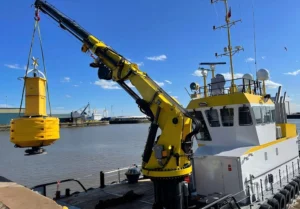
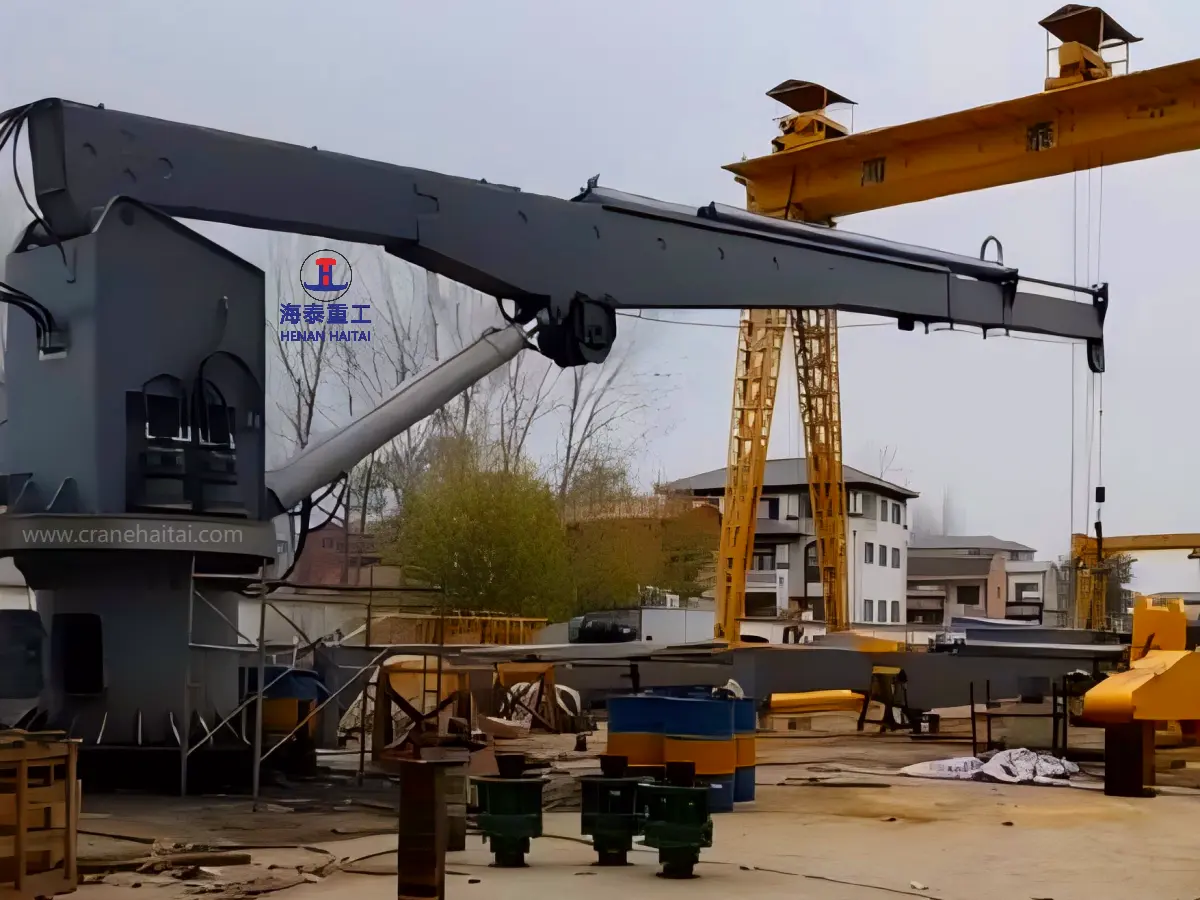
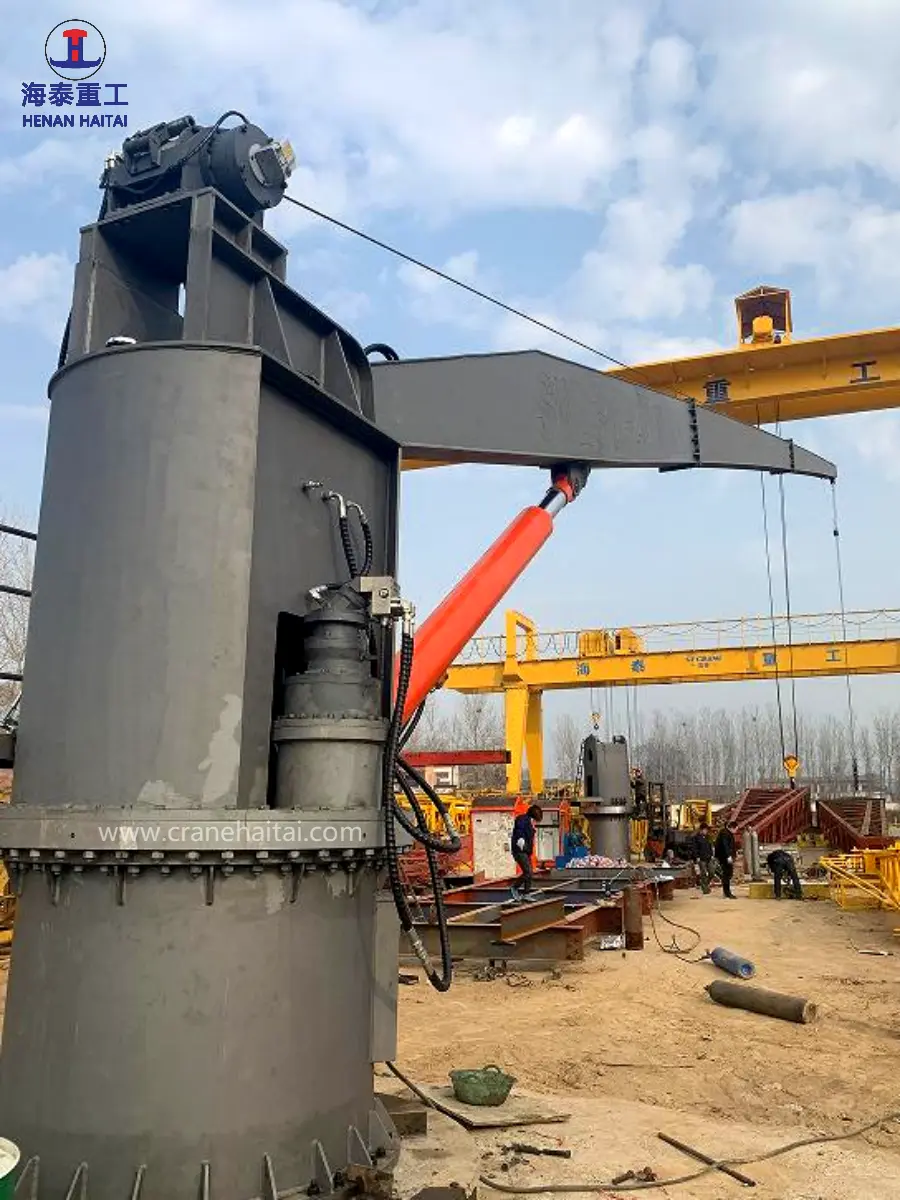
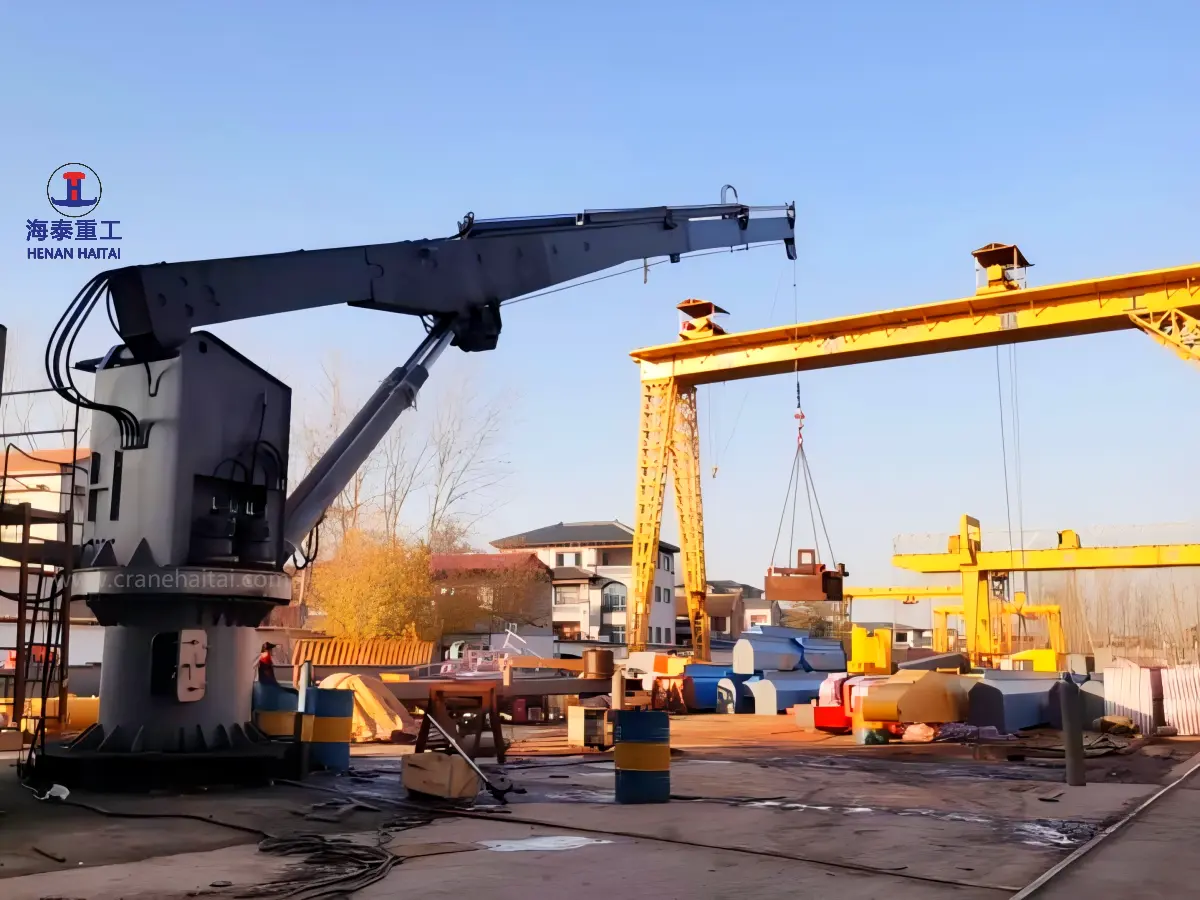
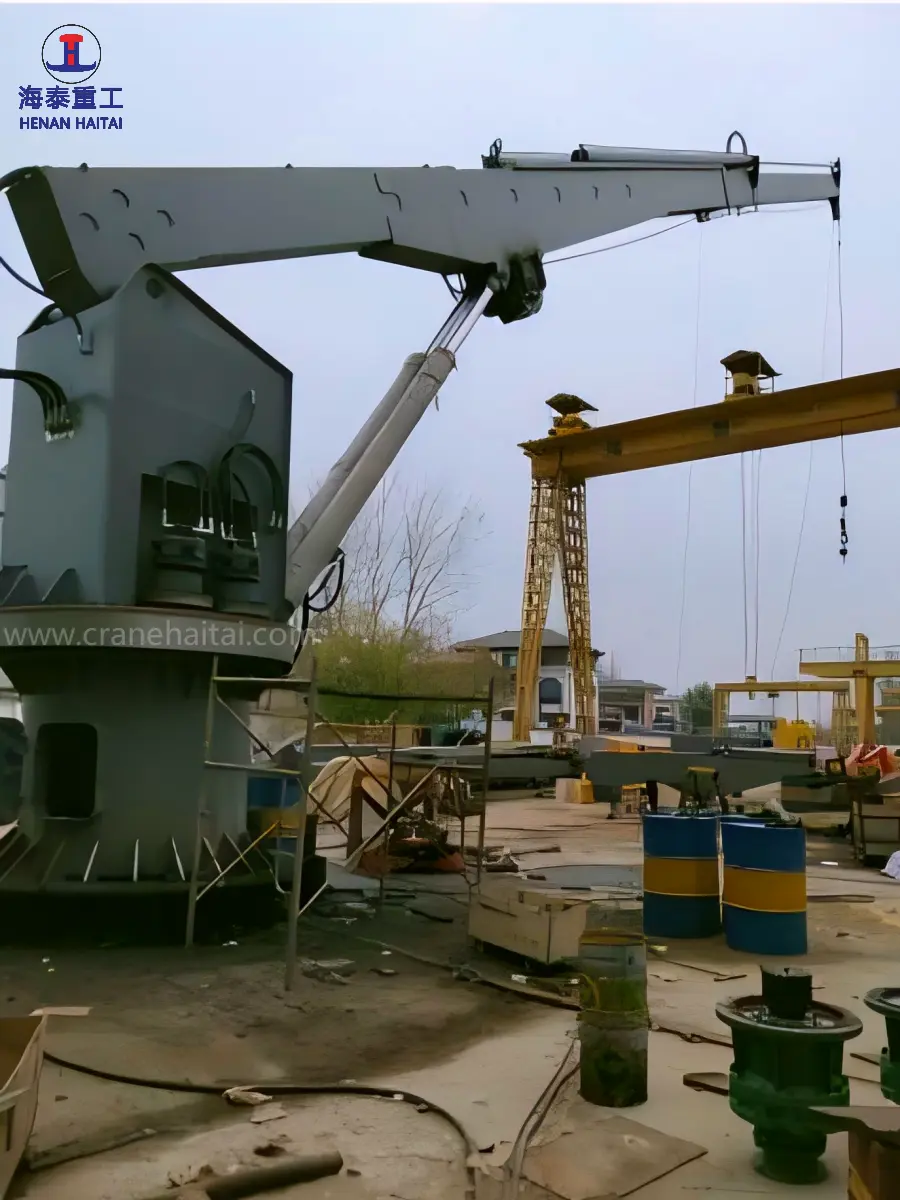
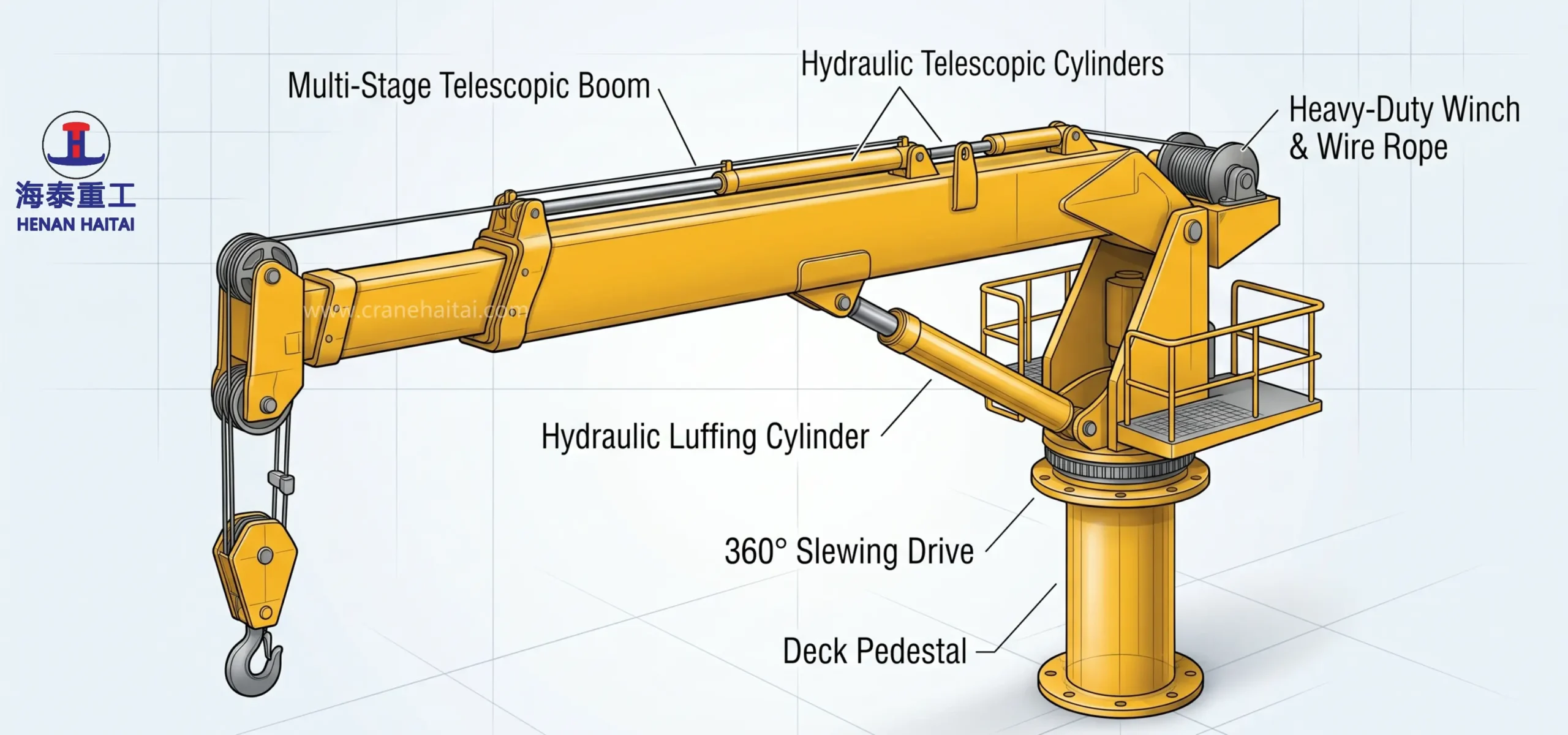
Haitai hydraulic telescopic boom marine crane is a full-hydraulic deck crane for port work boats, offshore platforms, tankers and cargo vessels. A 360° slewing column, a single luffing cylinder, a multi-section box boom and a hydraulic winch sit on one cylindrical base. The hook can reach far across the water, yet the stowed crane takes little deck space. Standard models cover 1 t to 10 t, and 15 t to 30 t cranes are custom-engineered to your vessel.
| Capacity (SWL) | Working Radius | Hoisting Height | Giro |
|---|---|---|---|
| 1 – 10 t standard; 15 – 30 t custom | 5 – 30 m | 5 – 30 m | 360° continuo |
A stiff boom marine crane changes its reach by luffing alone. A telescopic boom marine crane adds a second way to set the radius: hydraulic cylinders push nested inner sections out of the main boom. The same crane can therefore lift close to the hull, then reach across a wide gap to the quay or to a neighbouring vessel.
When work is finished, the inner sections retract fully into the main boom. The luffing cylinder then lowers the boom onto a rest on deck, so the crane rides out the voyage with a short, rigid profile. That removes the shock load caused by ship motion and frees working space on the deck. Owners with limited deck length or with long-reach duties tend to choose this type.
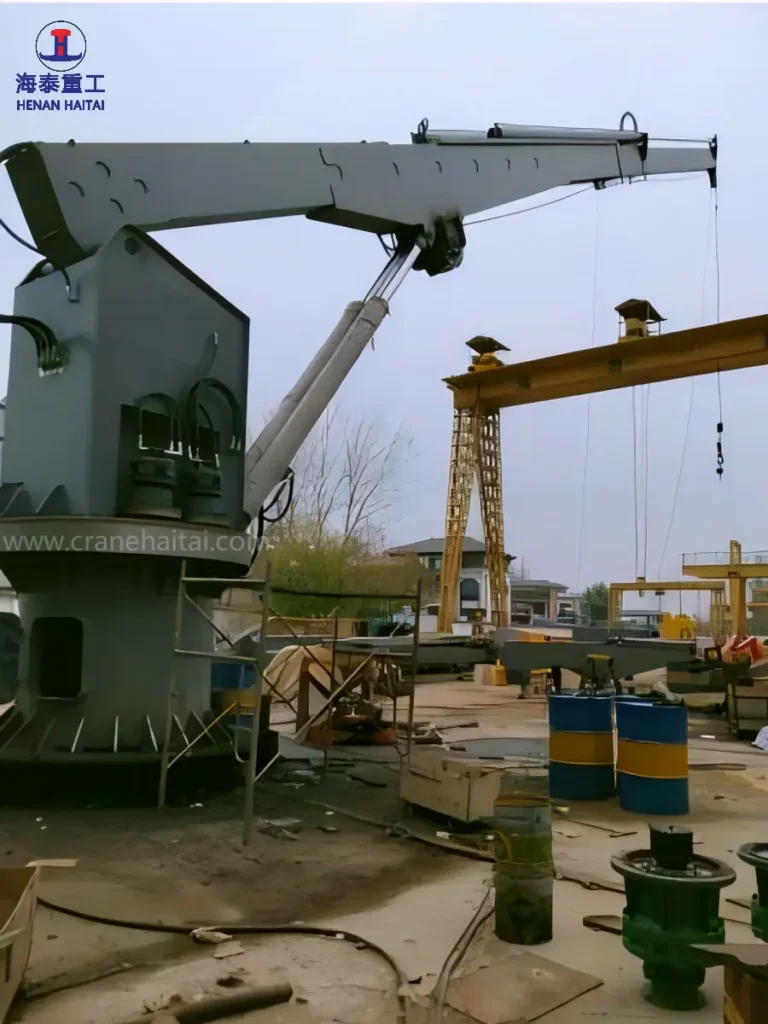
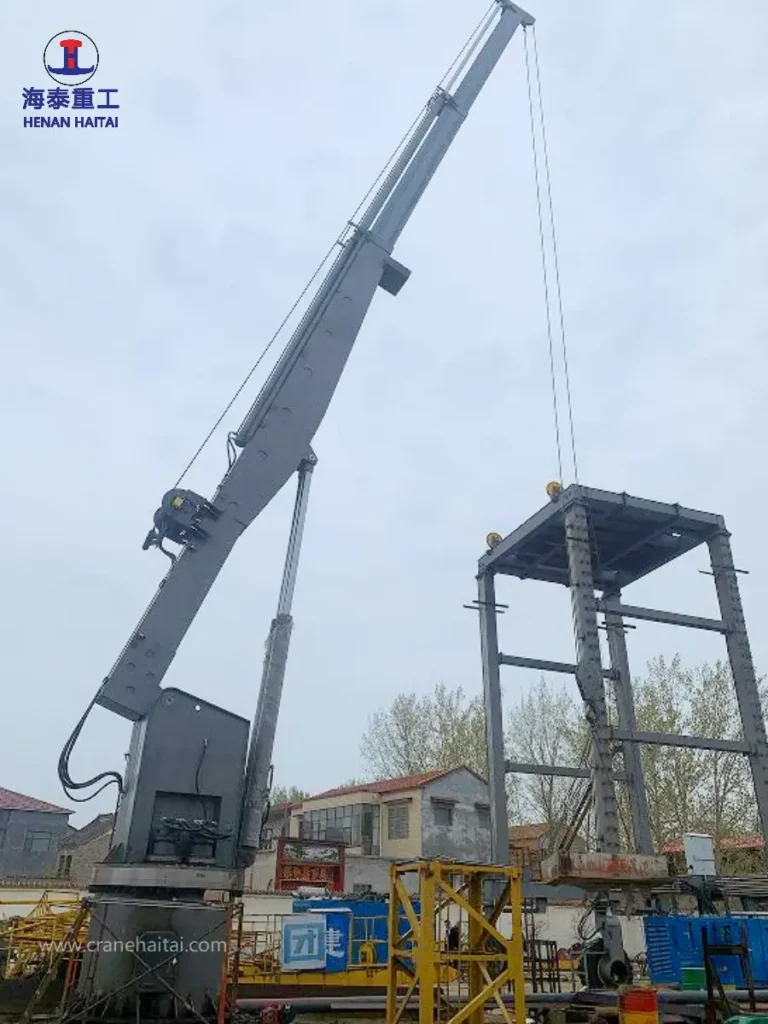
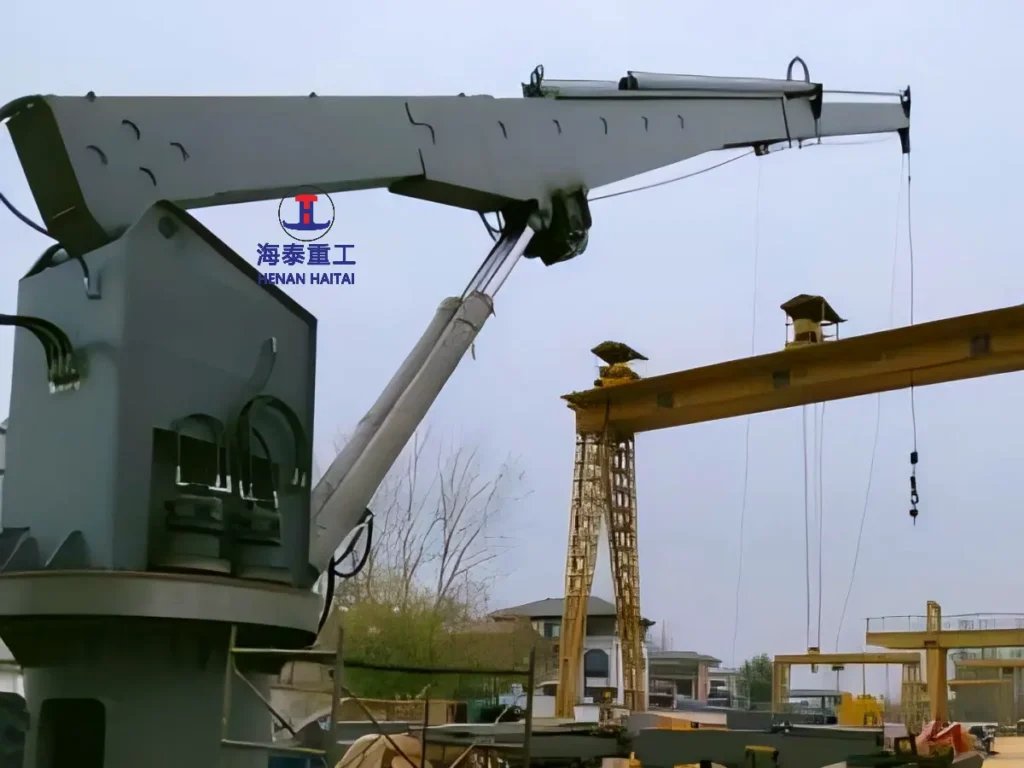
The crane stands on a welded cylindrical base, either a plain high column or a flanged type with radial ribs. It passes the working load, from 10 kN up to 300 kN, evenly into the hull structure. The slewing bearing is held by a full ring of high-strength bolts and turns continuously through 360°.
Slewing speed is matched to crane size: 1 r/min at 1–2 t, 0.9 r/min at 3 t, 0.75 r/min at 5–10 t, 0.6 r/min at 15–20 t, 0.5 r/min at 25 t and 0.4 r/min at 30 t. Long-reach loads are therefore positioned smoothly.
The main boom and every inner section are closed, welded box sections with high bending and torsional stiffness. On standard 1–10 t cranes the minimum radius is 1.4–5.3 m and the maximum radius is 5–20 m (5–18 m on 1–3 t models, 12–20 m on 5–10 t models). Custom 15–30 t cranes reach up to 30 m, with a minimum radius of 3.3–7.9 m.
To protect the hydraulic lines on a long-stroke boom, a flexible cable chain can run along the side of the main boom. Alternatively, the extension cylinder can be mounted outside on top of the boom, which makes inspection and sea-going maintenance easier.
For all-weather and high-frequency work, a closed cab can be fitted beside the column, with panoramic glass, wiper, ergonomic seat, two control levers and a roof-mounted air-conditioning unit. For crowded decks, a cab-free column design places the electrical control box at the base. A vertical ladder, handrails and a purpose-built boom rest keep both sailing and inspection work safe.
| SWL (t) | Rated load (kN) | Max. radius (m) | Min. radius (m) | Hoisting height (m) | Slewing (r/min) | Luffing time (s) | Motor power (kW) |
|---|---|---|---|---|---|---|---|
| 1 | 10 | 6 – 12 | 1.6 – 3.3 | 5 – 30 | 1 | 60 | 7.5 |
| 1.5 | 15 | 8 – 14 | 2.2 – 3.7 | 5 – 30 | 1 | 60 | 11 |
| 2 | 20 | 5 – 15 | 1.4 – 4.0 | 5 – 30 | 1 | 60 | 15 |
| 3 | 30 | 8 – 18 | 2.2 – 4.8 | 5 – 30 | 0.9 | 70 | 22 |
| 5 | 50 | 12 – 20 | 3.3 – 5.3 | 5 – 30 | 0.75 | 80 | 37 |
| 8 | 80 | 12 – 20 | 3.3 – 5.3 | 5 – 30 | 0.75 | 100 | 55 |
| 10 | 100 | 12 – 20 | 3.3 – 5.3 | 5 – 30 | 0.75 | 110 | 75 |
| 15 (custom) | 150 | 12 – 20 | 3.3 – 5.3 | 5 – 20 | 0.6 | 110 | 90 |
| 20 (custom) | 200 | 15 – 25 | 4.0 – 5.6 | 5 – 20 | 0.6 | 120 | 2 × 75 |
| 25 (custom) | 250 | 15 – 30 | 4.0 – 7.9 | 5 – 20 | 0.5 | 130 | 2 × 90 |
| 30 (custom) | 300 | 15 – 30 | 4.0 – 7.9 | 5 – 20 | 0.4 | 140 | 2 × 90 |
Please Note: Standard configurations up to 10 tons are built to our proven designs for faster production and delivery. Cranes of 15 tons and above (shaded rows) are custom-engineered to your vessel parameters, classification society requirements and deck stability needs. All ship telescopic boom crane models have a hoisting speed of 15 m/min and 360° continuous slewing. Hoisting height is 5–30 m, set to the project. Rated load in kN is the SWL in tonnes multiplied by 10. Data are for reference only.
The same marine crane principle is built in several layouts. These three cover most vessel types.
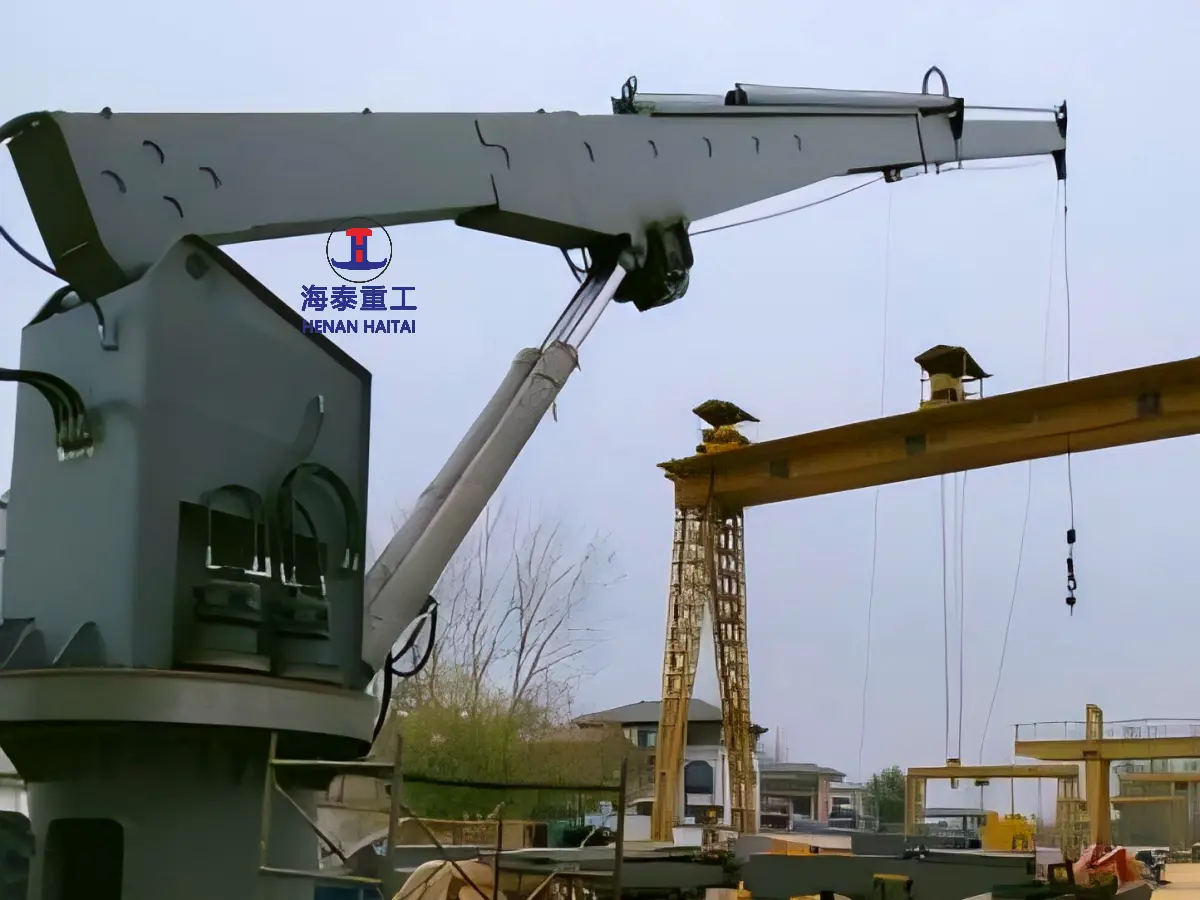
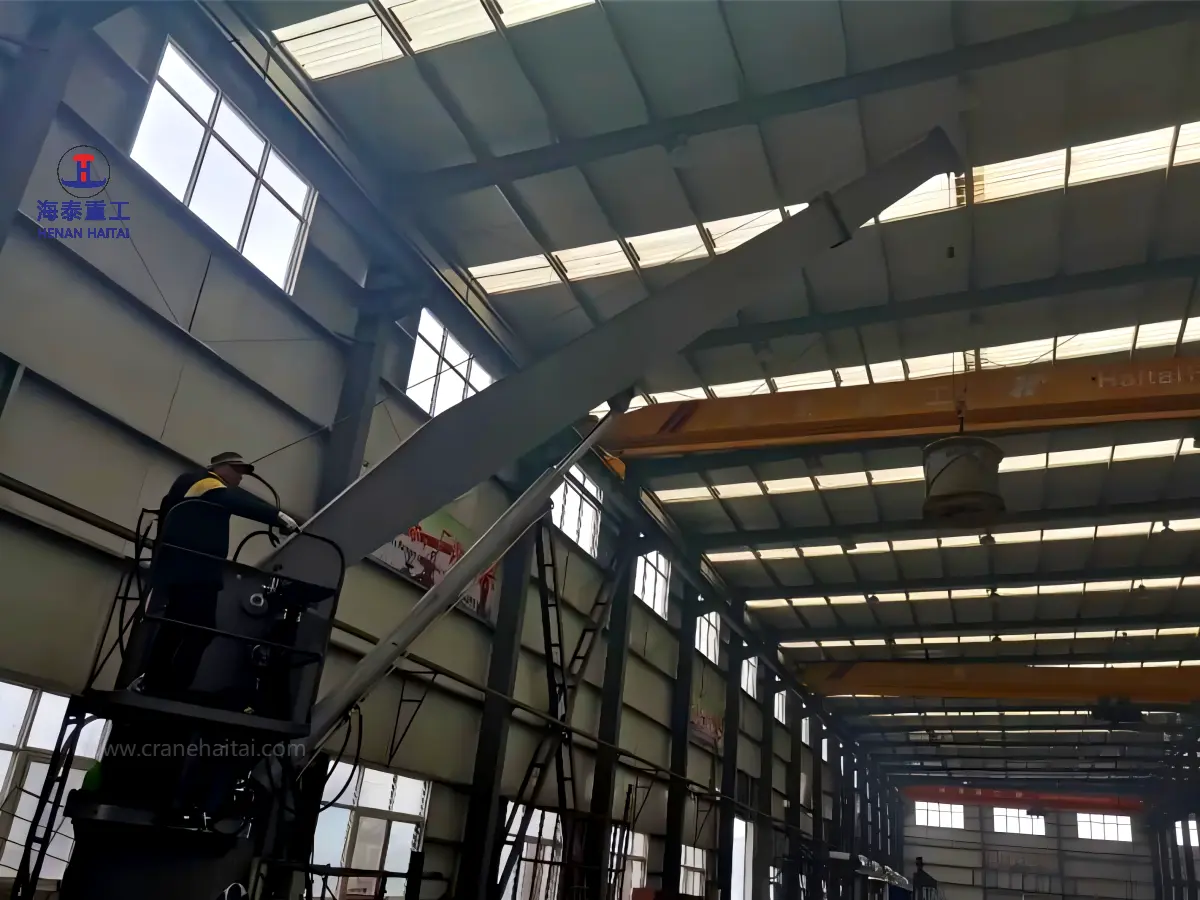
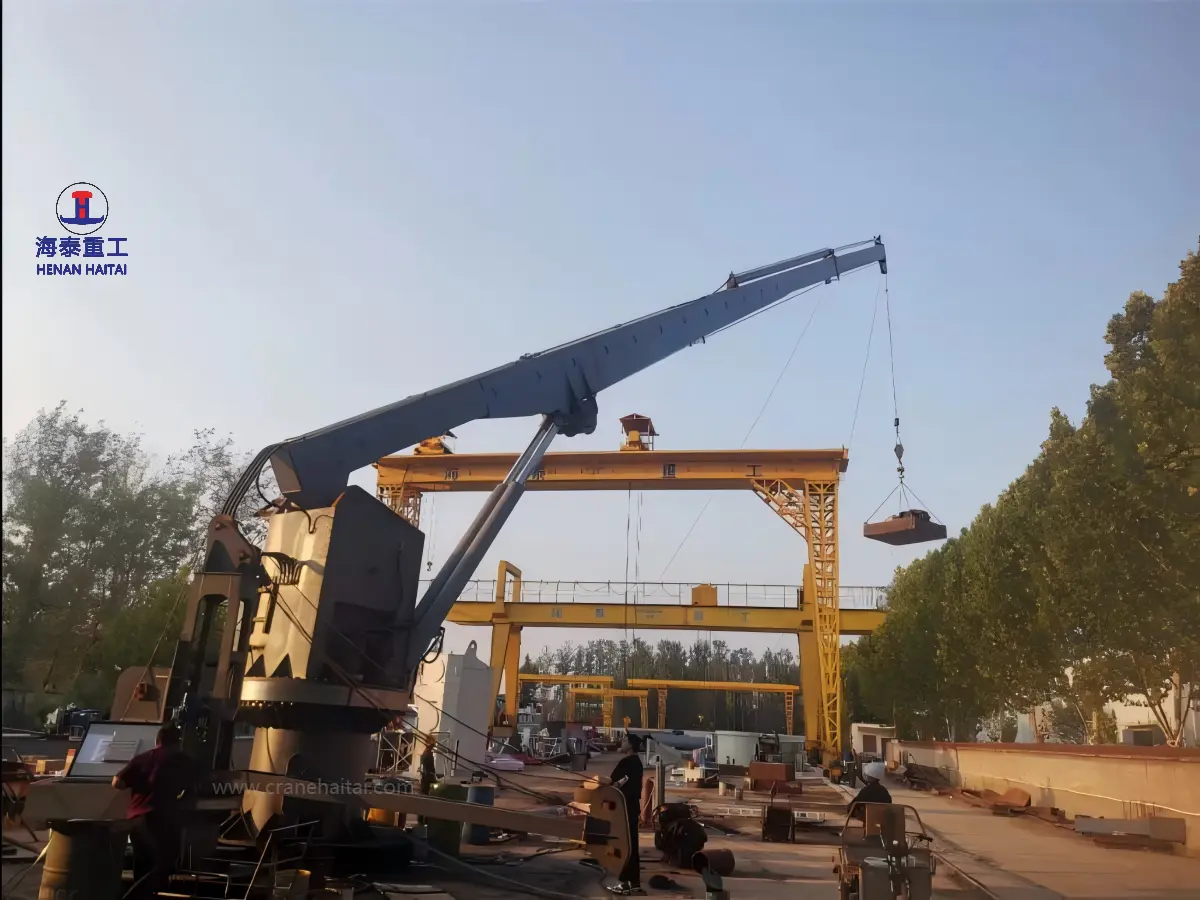
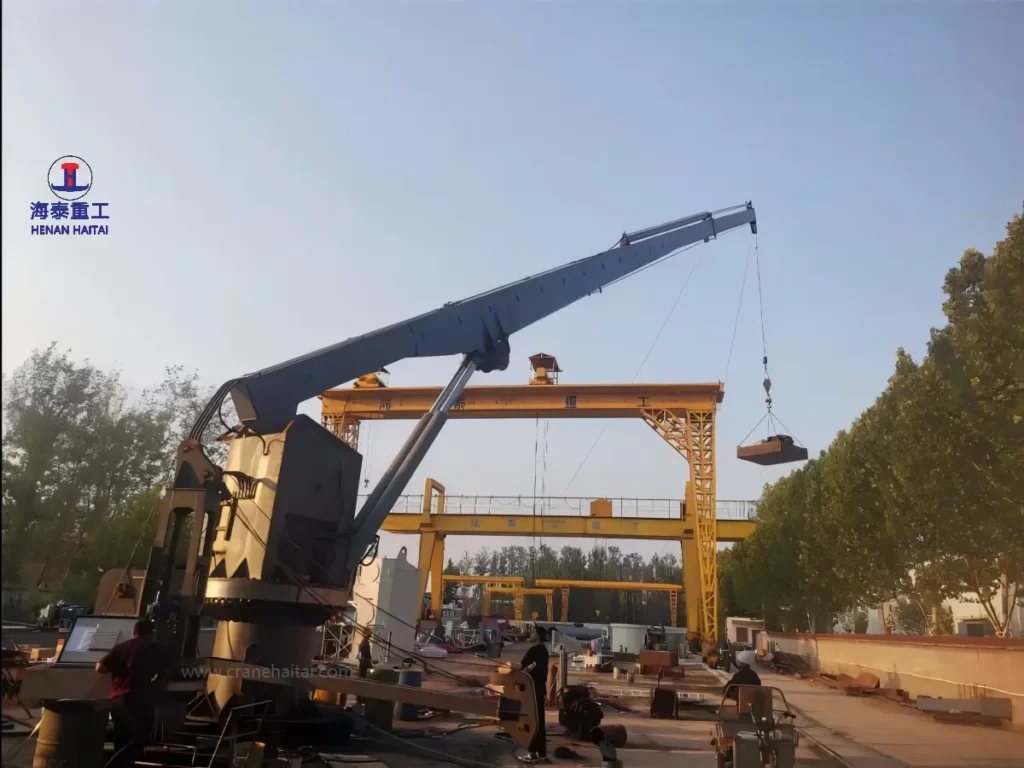
Suited to 8–10 t standard cranes and to custom 15–30 t cranes for heavy ship-to-quay loads. The boom has a yellow main section and two black inner sections, with a cable chain along its side. The winch drum sits above the boom root, and the rope runs along the top of the boom to the head. A multi-fall block hangs from the boom head, and the boom reaches over the ship’s side to lift a test load on the quay. A side-mounted cab gives a clear view of both the vessel side and the quay.
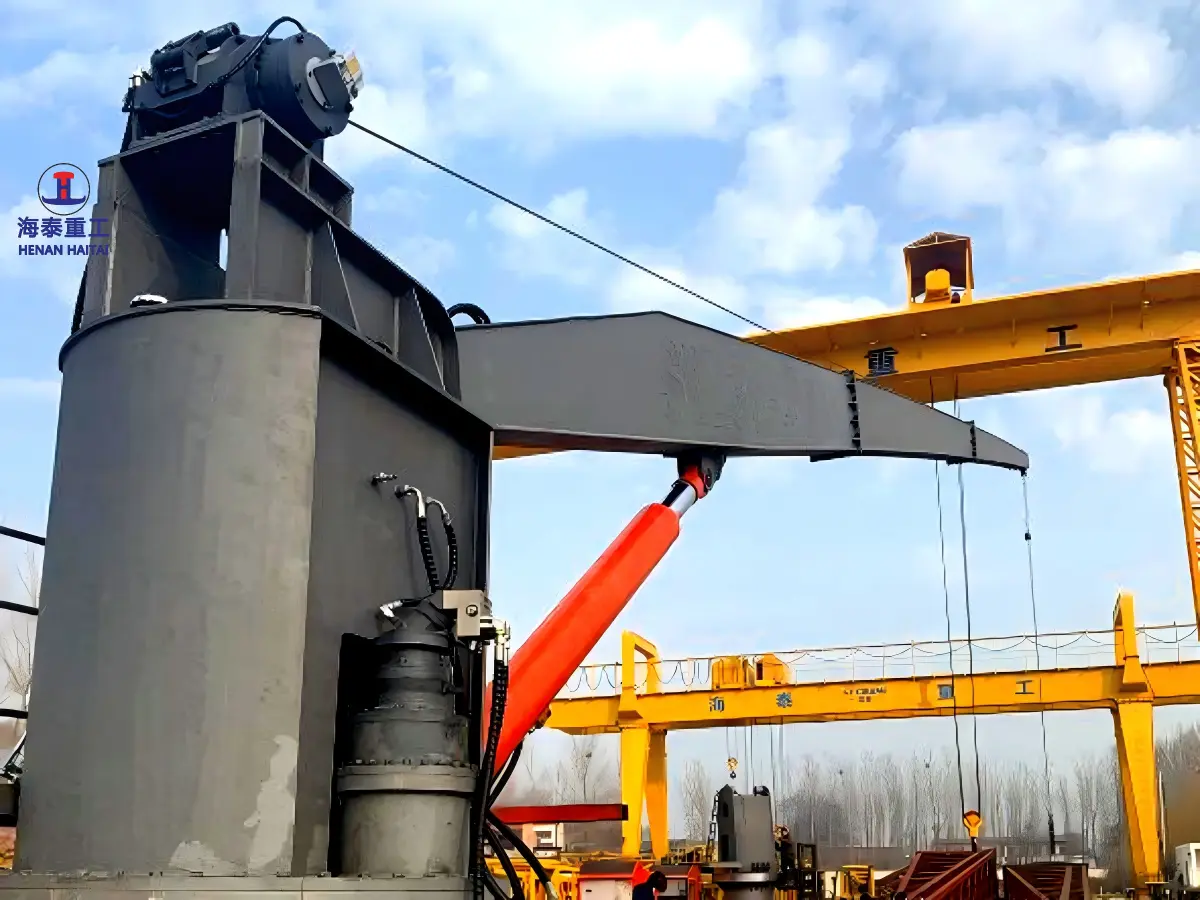
Suited to 5–10 t standard cranes (15 t on request) on multi-purpose work boats, offshore platforms and inland waterway vessels. The closed cab has a roof-mounted air-conditioning unit and suits hot, humid or cold waters. The winch hangs under the boom, and when idle the boom rests on a column fitted with climbing steps and ribs.
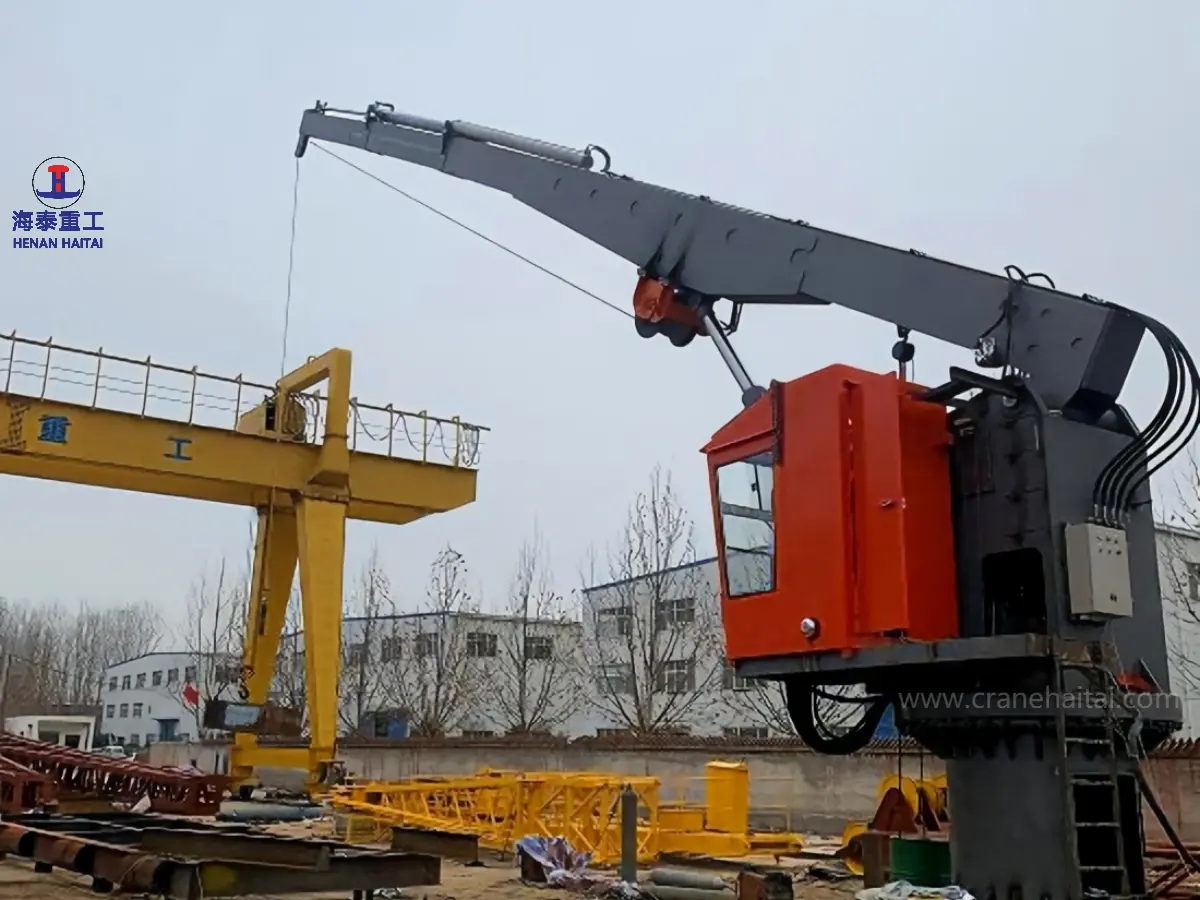
Suited to 1–10 t standard marine cranes on decks full of pipework, such as tankers and construction vessels. Dropping the cab shortens the tail swing and reduces deck footprint. The crane is controlled from the base, and the boom is retracted and rested on a support column at the deck front, clear of nearby equipment and workers.
| Artículo | Heavy-duty multi-section | Cab with underslung winch | Compact cab-free |
|---|---|---|---|
| Typical capacity | 8–10 t standard; 15–30 t custom | 5–10 t standard; 15 t custom | 1–10 t standard |
| Boom | Three sections, cable chain on the boom side | Telescopic box boom | Slim telescopic box boom |
| Winch and hook | Top-mounted winch, multi-fall block | Underslung winch, single hook | Compact winch, standard marine hook |
| Operator station | Side-mounted cab with wiper | Side-mounted cab with air conditioning | No cab, control at the base |
| Boom rest | Fully extended over the side for quay lifts; rest on deck when idle | Column with climbing steps and ribs | Support column at the deck front |
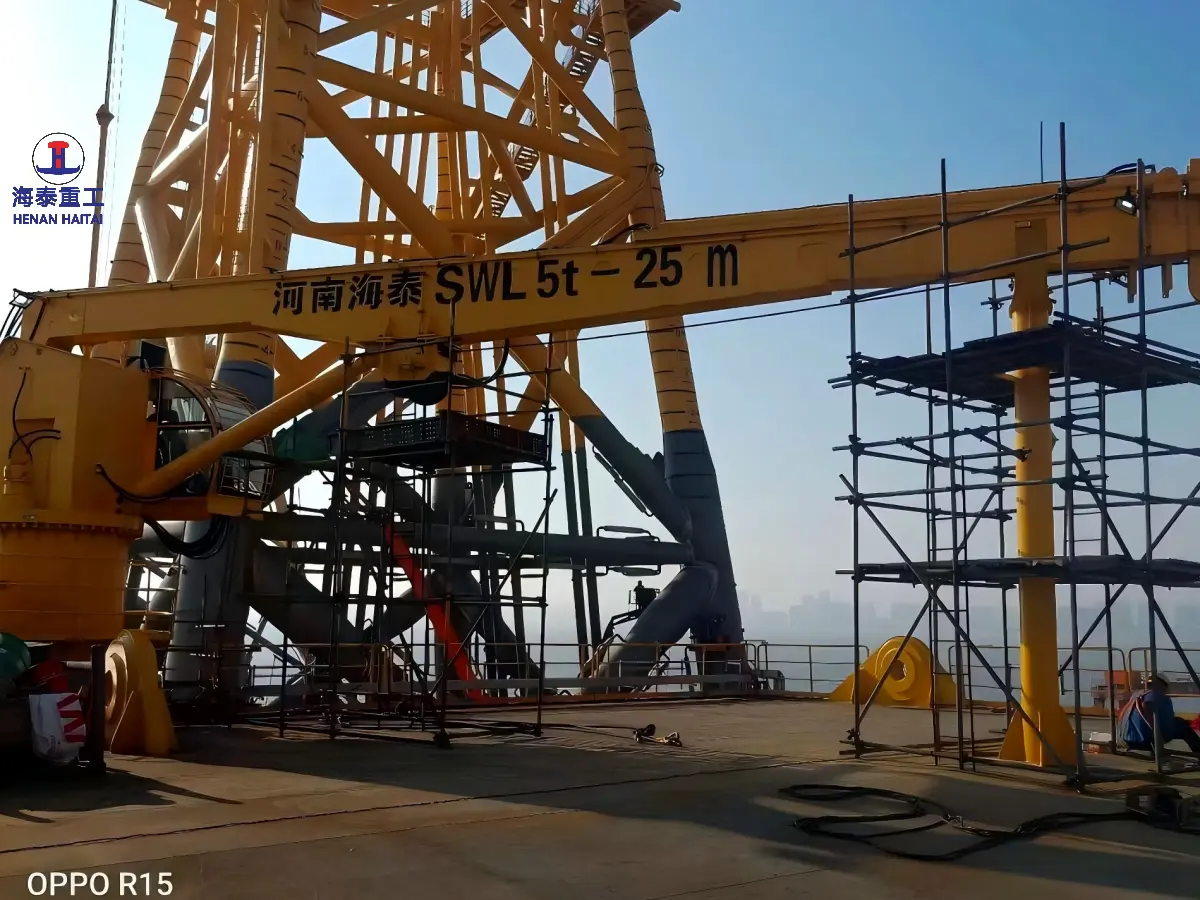
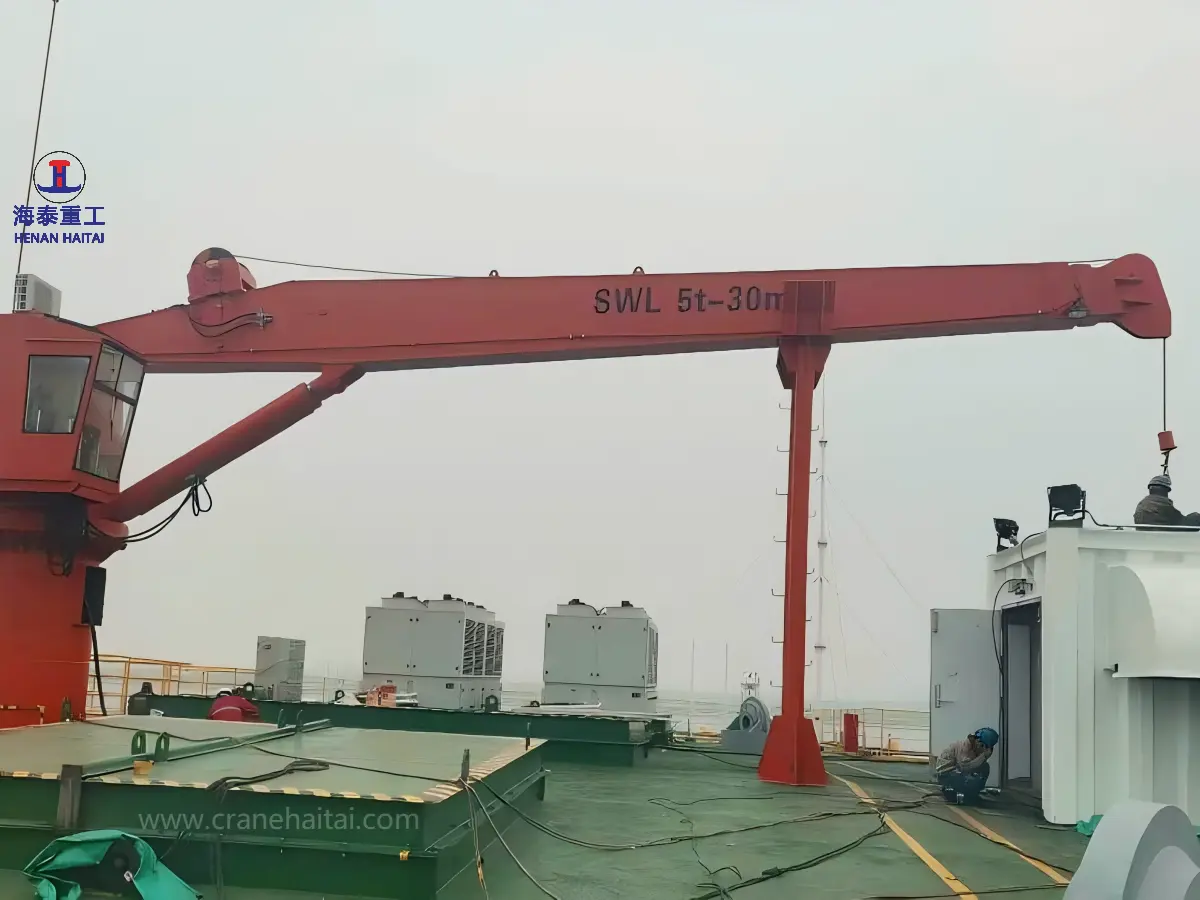
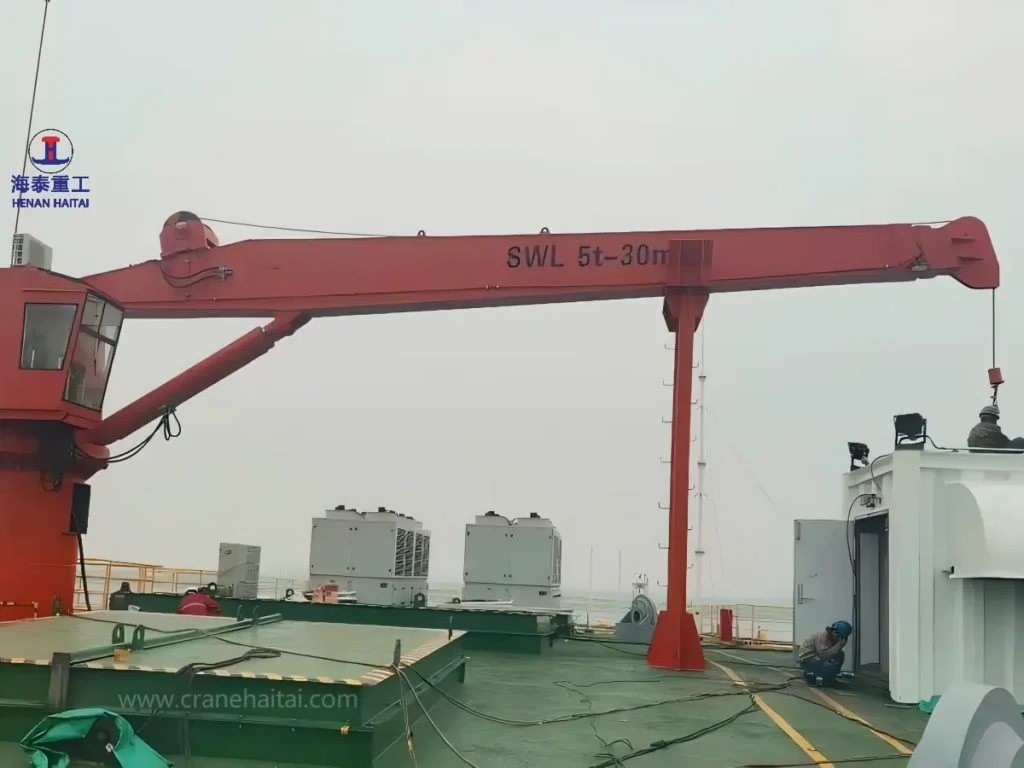
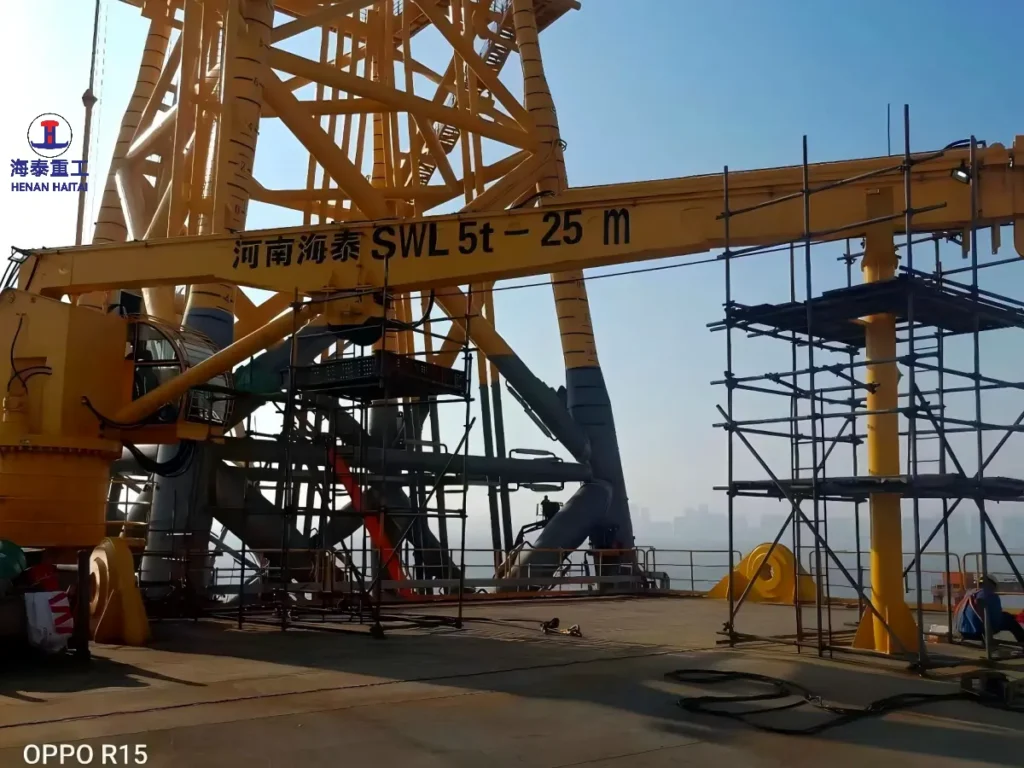
The standard table is a reference, and radius can be extended on request. The two marine cranes below are marked SWL 5 t at 30 m, longer than the 12–20 m maximum radius listed for a standard 5 t unit. Tell us the load and radius you need, and we will set the boom length and load chart to match.
Fill in what you know and send it back. Partial answers are enough for our engineers to start a GA drawing, load chart and foundation reaction table.
| # | Item to confirm | Your requirement |
| 1 | SWL and the radius it must be lifted at | |
| 2 | Minimum and maximum working radius | |
| 3 | Hoisting height required (5–30 m range) | |
| 4 | Vessel type, size and crane position on deck | |
| 5 | Pedestal height and deck thickness at the foundation | |
| 6 | Winch position (top-mounted or underslung) | |
| 7 | Cab or cab-free control, and climate (air conditioning needs) | |
| 8 | Power source (ship supply voltage / frequency) | |
| 9 | Boom rest position and free deck length | |
| 10 | Class society, coating colour and delivery date |
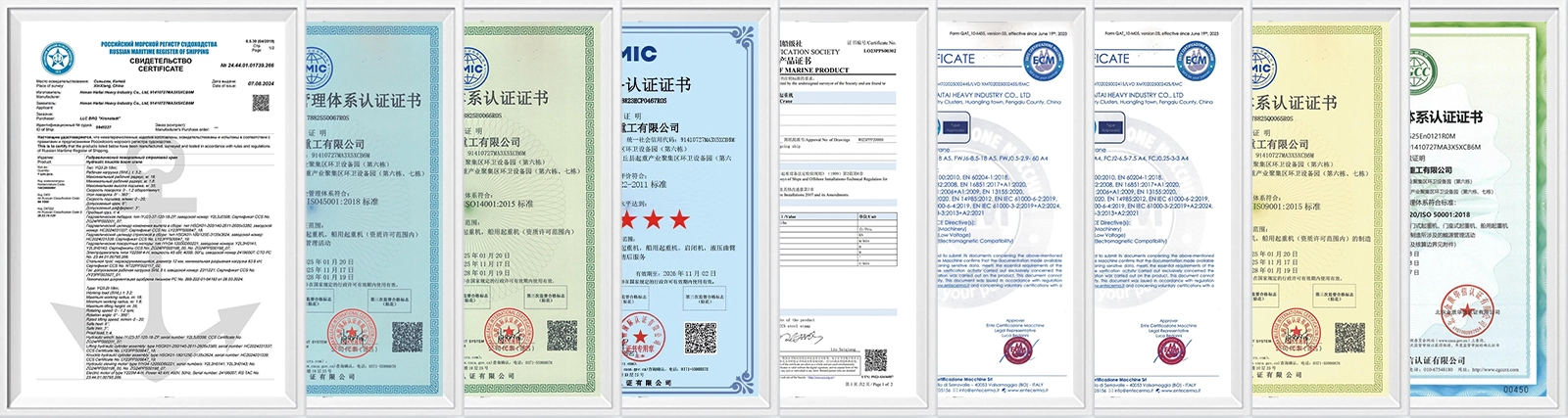
Need a Standard Telescopic Crane or a Heavy-Duty Custom Build? Whether you need a standard marine crane up to 10 tons or a custom-engineered 15–30 ton crane, Haitai’s engineering team will prepare the proposal and drawing for your vessel.
👉 [Request a Custom GA Drawing & Quote Today]










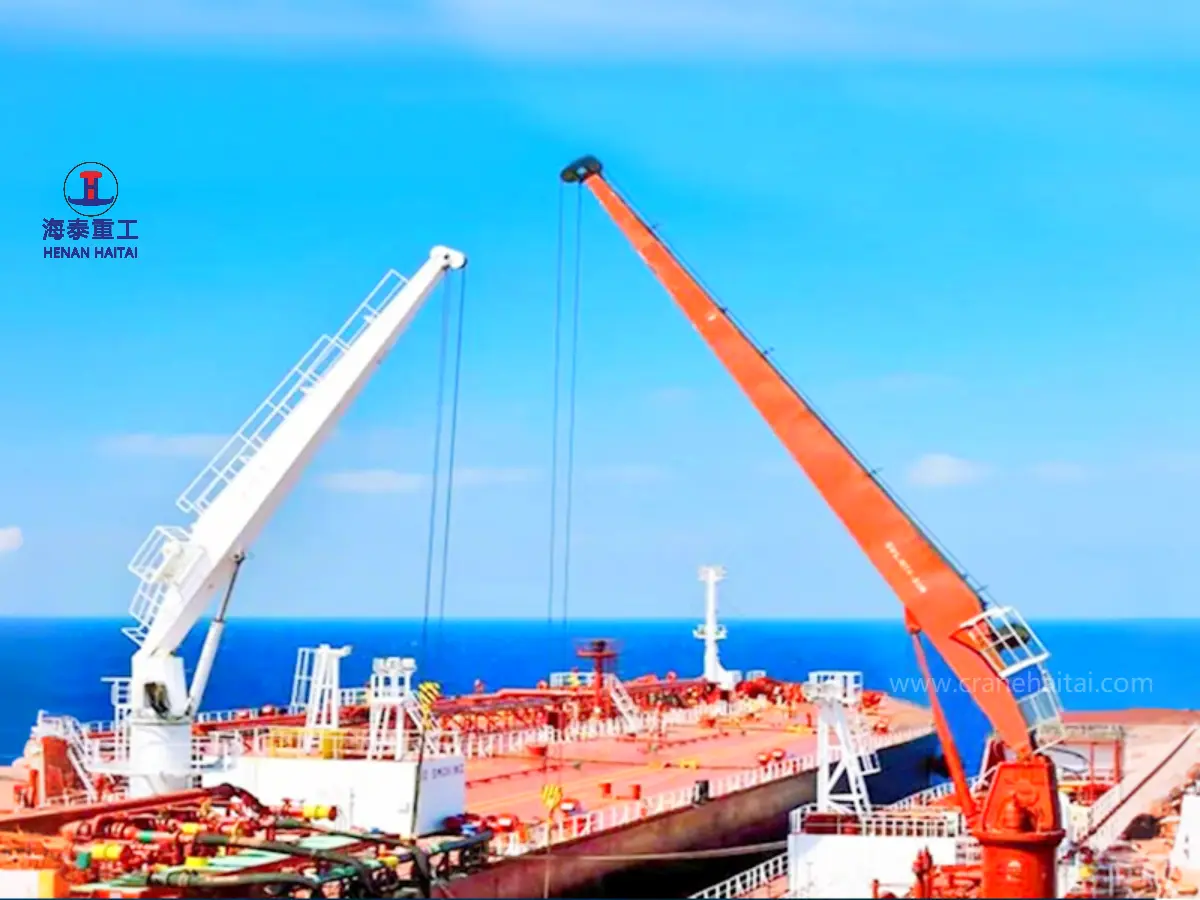
What Is Hydraulic Stiff Boom Marine Crane? Haitai hydraulic stiff boom marine crane is a pedestal-mounted deck crane built around one rigid boom. Hydraulic cylinders luff it, a slewing drive turns it through a full circle, and a hydraulic winch does the lifting. With no telescopic sections or knuckle joint, the load chart stays easy to read and upkeep stays low. Standard models cover 0.5 t to 20 t, and heavy-duty cranes up to 50 t are custom-engineered to your deck drawing. Capacity (SWL) Max Outreach Hoist Height Slewing Power 0.5 – 20 t standard, up to 50 t custom Up to 40 m 5-30 m 360° continuous Electro-hydraulic or diesel-hydraulic Stiff boom marine crane or fixed boom marine crane is one crane, two names. Buyers search for this crane under both names, and they mean the same thing. “Stiff” and “fixed” describe the boom length only. The boom cannot extend or fold, but the crane itself is far from static: it luffs up and down, slews around its pedestal, and hoists at every radius on its load chart. Outreach…

Una grúa marina de brazo articulado es uno de los equipos de cubierta más versátiles que puede transportar un buque. A diferencia de una grúa de cubierta de pluma recta, una grúa de pluma articulada se pliega de forma compacta cuando no está en uso, supera obstáculos y posiciona cargas con una precisión que una pluma fija simplemente no puede igualar. Para los armadores y los equipos de compras que evalúan las opciones de grúas de cubierta, la elección entre una pluma recta y una grúa de brazo articulado a menudo se reduce a una pregunta: ¿su operación requiere que la grúa trabaje en espacios confinados, alcance por debajo del nivel de la cubierta o maneje posiciones de carga irregulares? Si la respuesta es sí, una grúa marina de brazo articulado es casi con seguridad la opción correcta. Esta página explica qué son las grúas marinas de brazo articulado, dónde se utilizan, qué significan las especificaciones clave y cómo evaluar a los proveedores antes de comprometerse con una compra. ¿Qué es una grúa marina de brazo articulado? El concepto de diseño principal Una grúa marina de brazo articulado, también llamada grúa de pluma articulada o grúa marina articulada, utiliza dos o más secciones de pluma conectadas por articulaciones articuladas de accionamiento hidráulico. Esta articulación permite que la grúa…
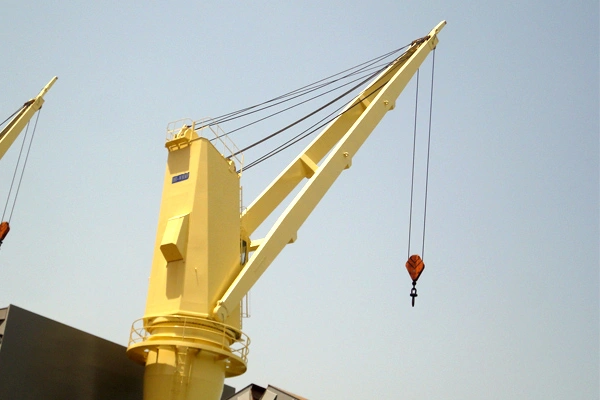
Seleccionar la grúa de cubierta incorrecta crea problemas que lo acompañarán durante toda la vida útil del buque. Capacidad de elevación insuficiente, alcance deficiente o una grúa no certificada por su sociedad de clasificación: cualquiera de estos factores puede retrasar el despacho portuario, aumentar los costos operativos o generar responsabilidad en caso de un incidente. Esta página ofrece a los gerentes de compras, armadores y equipos de compras de astilleros una visión general clara y práctica de qué buscar al adquirir una grúa de cubierta. Cubrimos los tipos de equipos, los parámetros técnicos clave, los requisitos de certificación y lo que distingue a un proveedor confiable de uno riesgoso. HT Crane fabrica y exporta grúas de cubierta en toda la gama de capacidades, y respaldamos cada unidad con la certificación de la sociedad de clasificación, pruebas de carga en fábrica y soporte de repuestos a largo plazo. ¿Qué es una grúa de cubierta? Función básica Una grúa de cubierta es un dispositivo de elevación giratorio montado permanentemente en la cubierta de un buque. Se encarga de la carga y descarga de mercancías en puertos donde el equipo terrestre no está disponible o es insuficiente. También apoya las operaciones de cubierta, las transferencias de equipos y las elevaciones de mantenimiento durante el viaje. Buque…