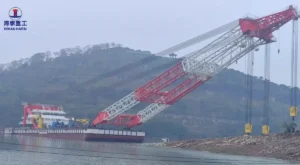
A fixed marine jib crane and a hydraulic boom crane can both lift 20 tons, yet they cost very different amounts to own. The colomn marine jib crane wins when lifts repeat inside about 10 m of reach and 12 m of height, beside a power supply and a solid base. The hydraulic boom crane wins when reach, height, luffing or independent power matter. This guide sets out the cost drivers, six boundary tests and a scenario guide so you can choose with confidence.
Ask a buyer to choose between a fixed marine jib crane and a hydraulic boom crane and the talk usually starts with tonnage — the wrong place to start. Both a fixed jib crane and a stiff boom crane cover 0.5–20 ton, yet one can cost far less to buy, install and run, depending on what the lift asks of it.
Comprehensive Selection Guide: When Should You Choose Fixed Marine Jib Crane Over Hydraulic Boom Crane?
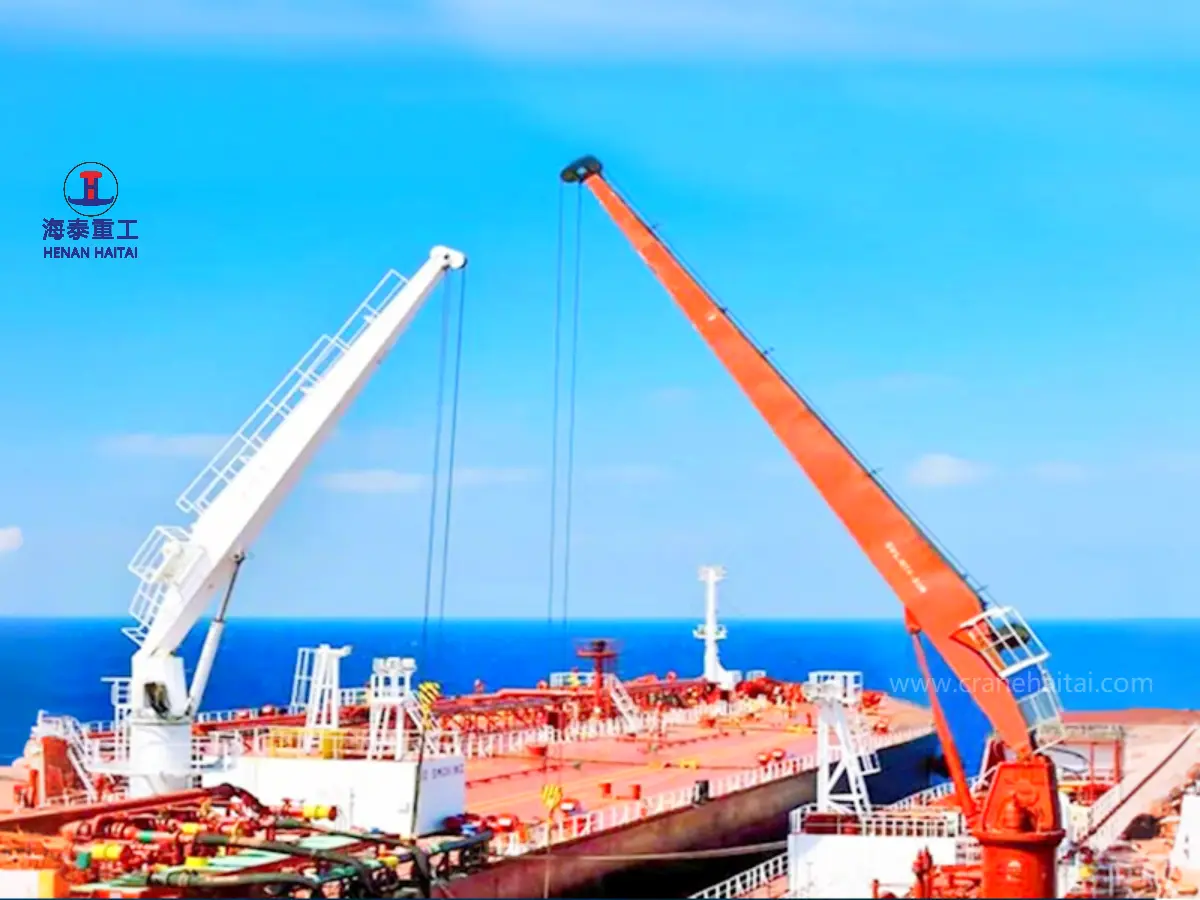
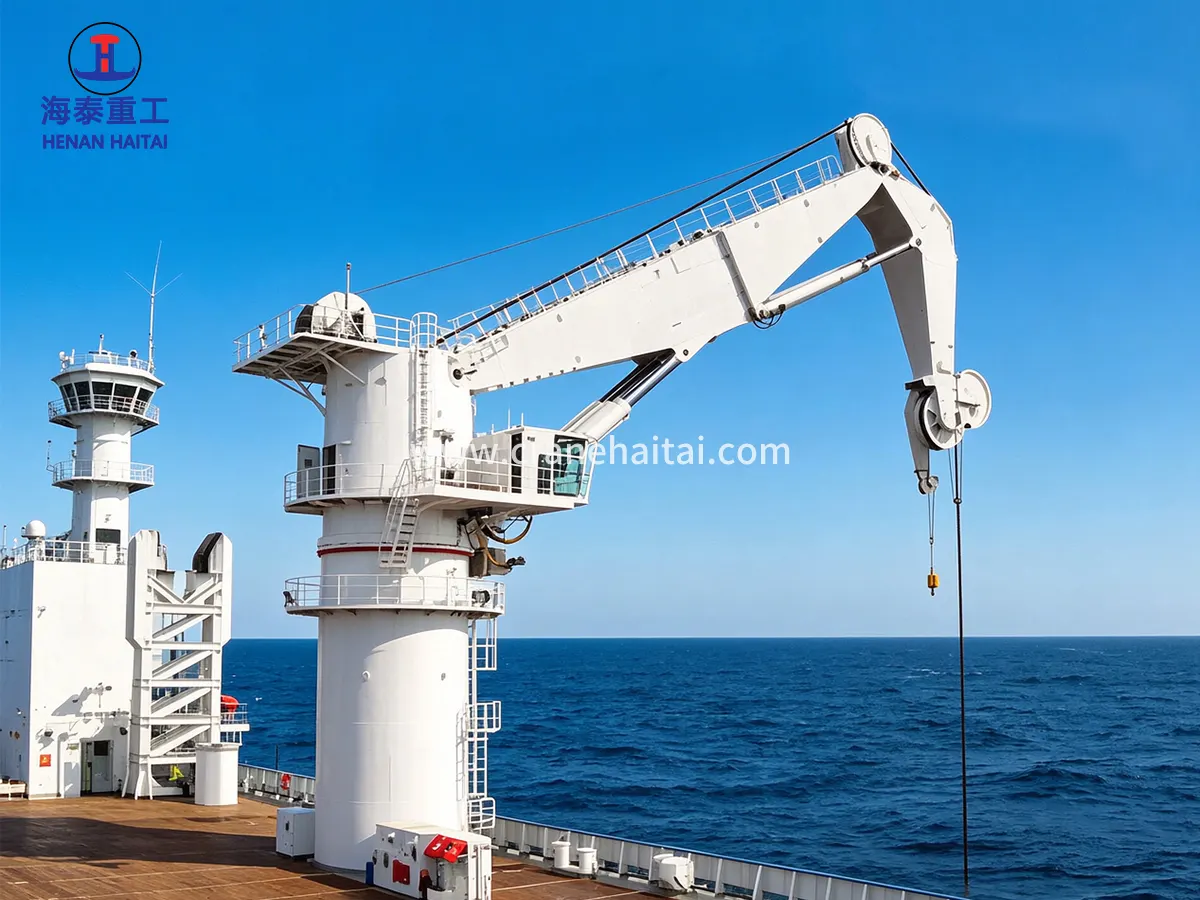
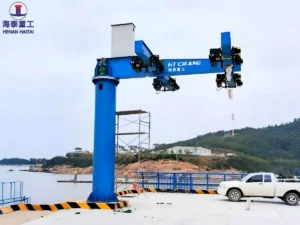
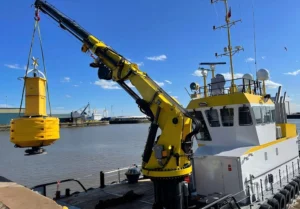
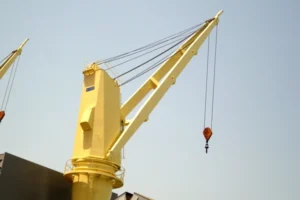
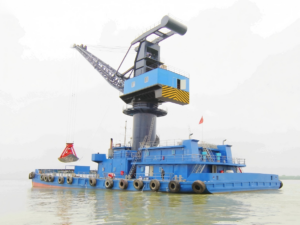
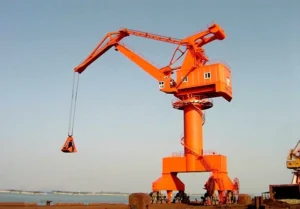
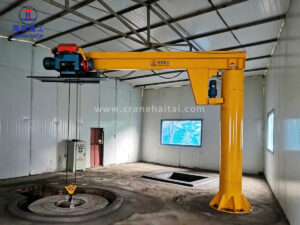
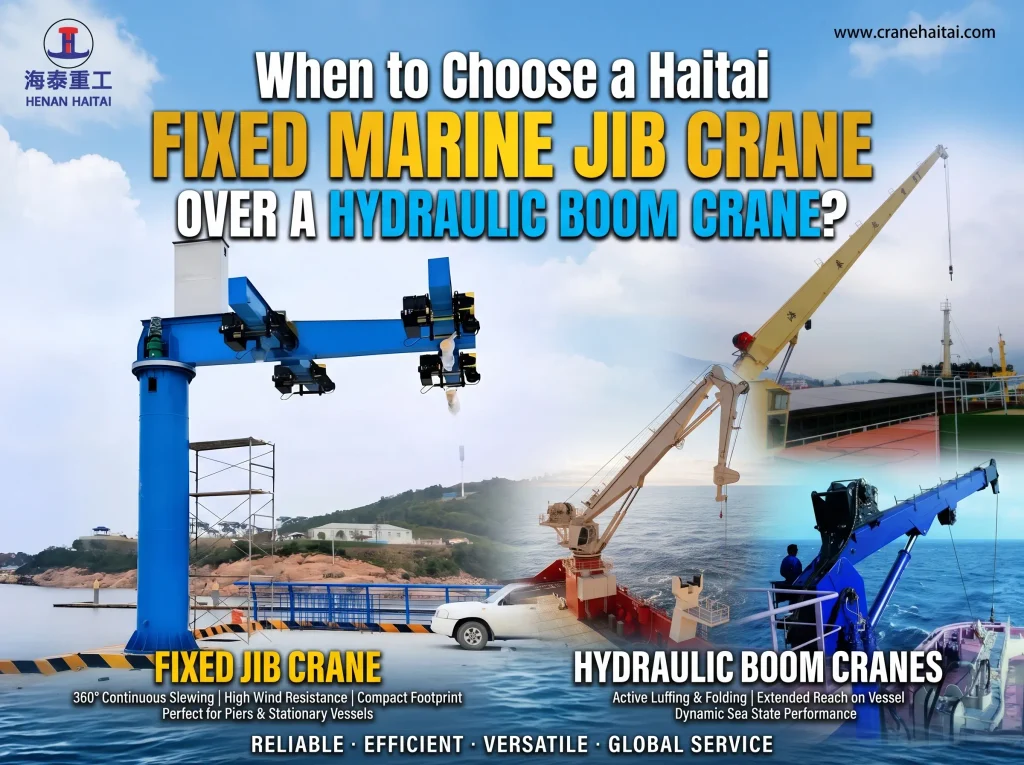
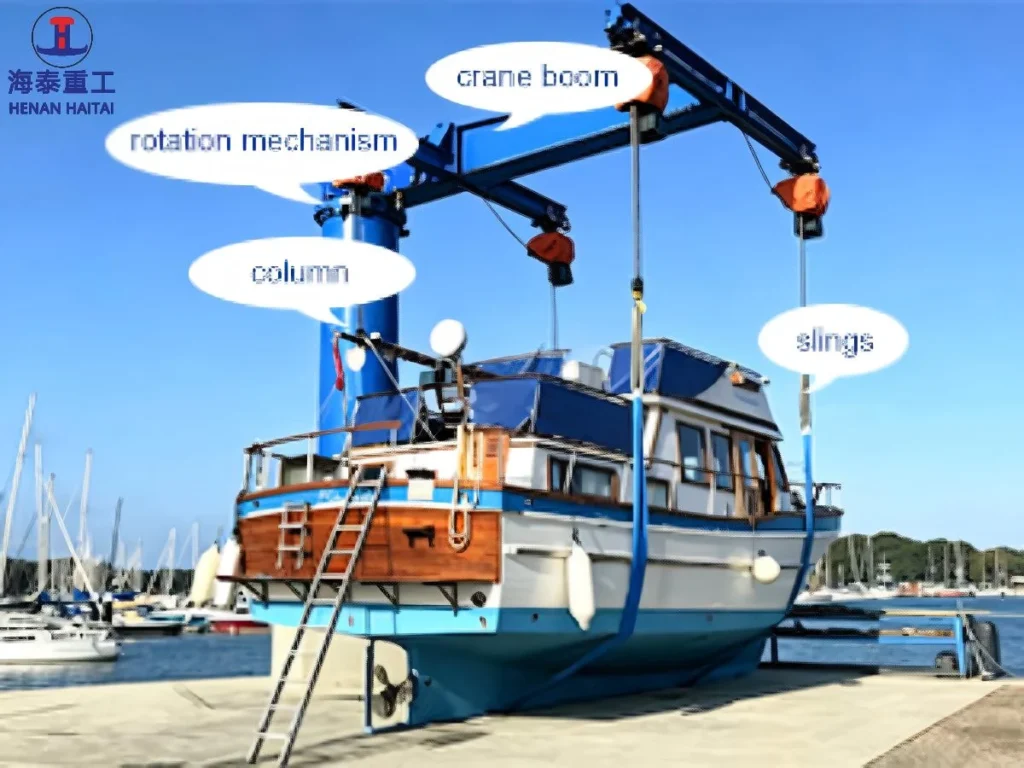
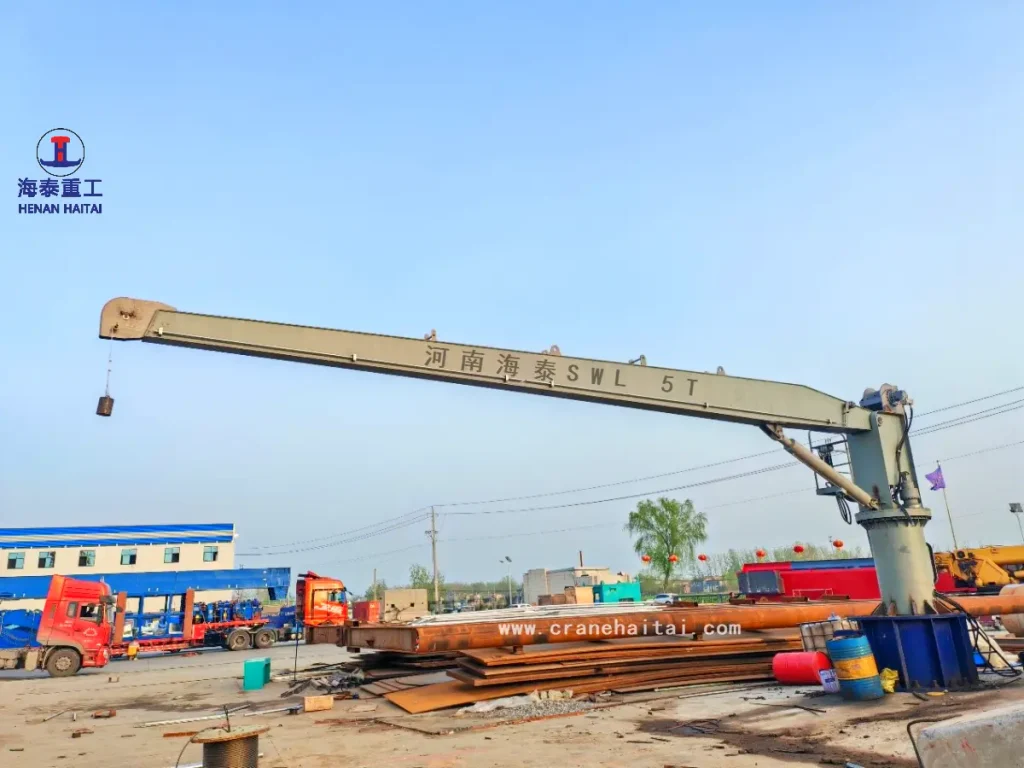
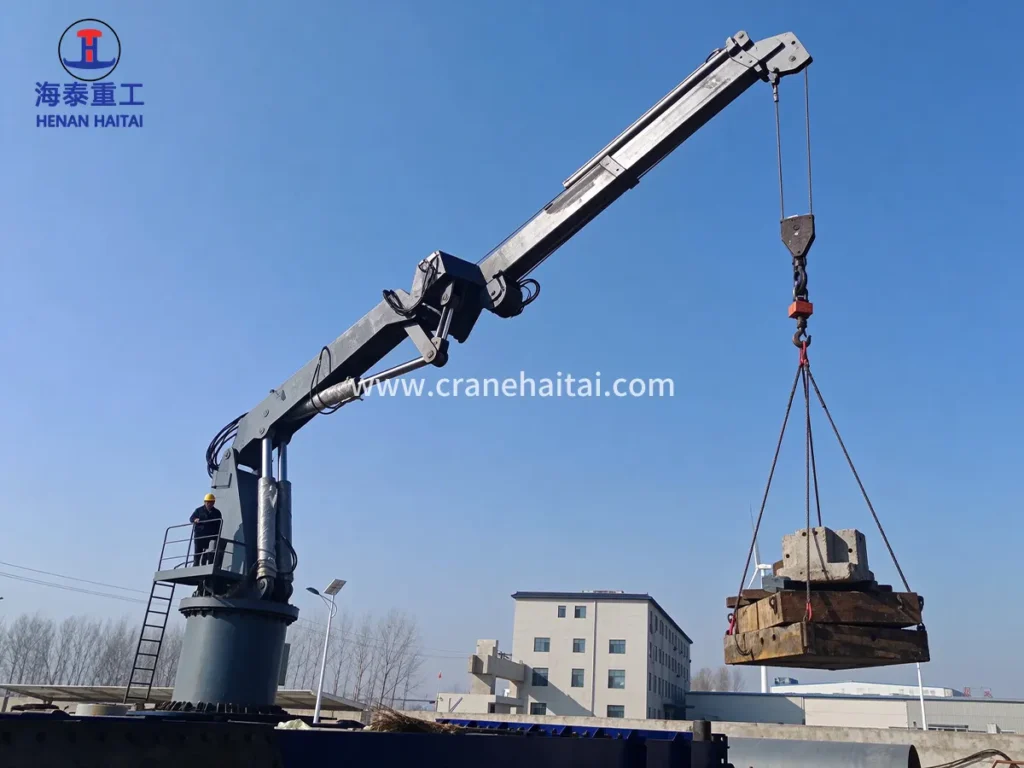
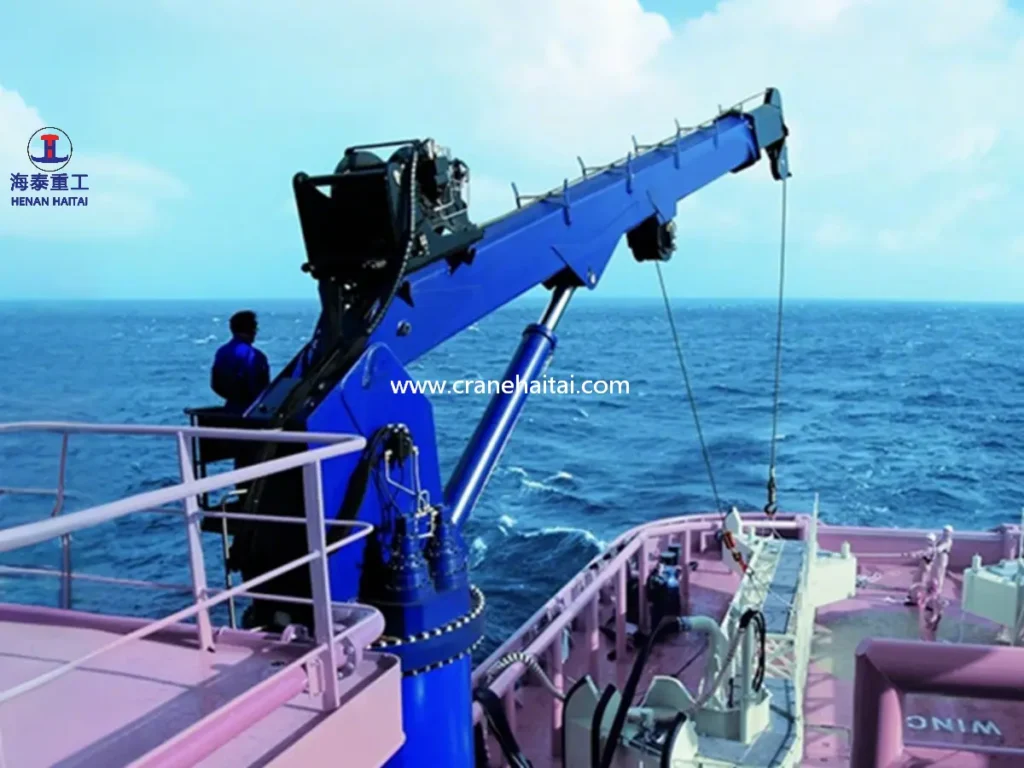
In this guide, a fixed marine jib crane is Haitai’s boat jib crane: a vertical mast or column carrying a rigid horizontal jib, with an electric chain hoist or wire rope hoist traveling along it. The jib does not luff, extend or fold; the hook is positioned by slewing 180°, 270° or 360° and running the hoist out along the jib. A hydraulic boom crane is a pedestal crane whose boom is moved by hydraulic cylinders: HT Crane’s stiff boom, telescopic boom y knuckle boom marine cranes.
The rest of this guide shows where the boundary falls. Some limits are hard — the jib simply cannot do the job. Others are economic — both fixed jib crane and hydraulic hydraulic crane can, but one costs less over its life.
Note: The figures come from the product page of each crane and are reference values. Final figures are always set against your own load, radius and site drawing. Get your own custom marine crane solution here.
Fixed Marine Jib Crane Vs Hydraulic Boom Crane: Which One Fits Your Port and Vessel?
- Choose the fixed boat jib crane when every lift happens inside a known arc, roughly within 10 m of radius and 12 m of hook height, at 20 t or less, beside an electric supply and a solid base such as a dock, quay wall, marina pier or a fixed deck position. The fixed boom crane is then simpler, has fewer systems to maintain and does not make you pay for reach you will never use.
- Choose the hydraulic boom crane when the hook must reach beyond about 10–15 m, lift higher than 12 m, change its working angle to clear an obstacle or cross a gap, stow compactly when idle, or run without relying on an external power supply. If the hydraulic boom crane wins, our companion guide, Stiff Boom vs. Telescopic vs. Knuckle Boom Marine Crane: Which One Fits Your Vessel?, helps you choose among the three hydraulic types.
- In between (about 10–15 m of radius), get both quoted at the same SWL, radius and height. This is where the economic boundary actually sits.
Comparing Fixed Jib Boom Crane & Hydraulic Boom Crane For Sale
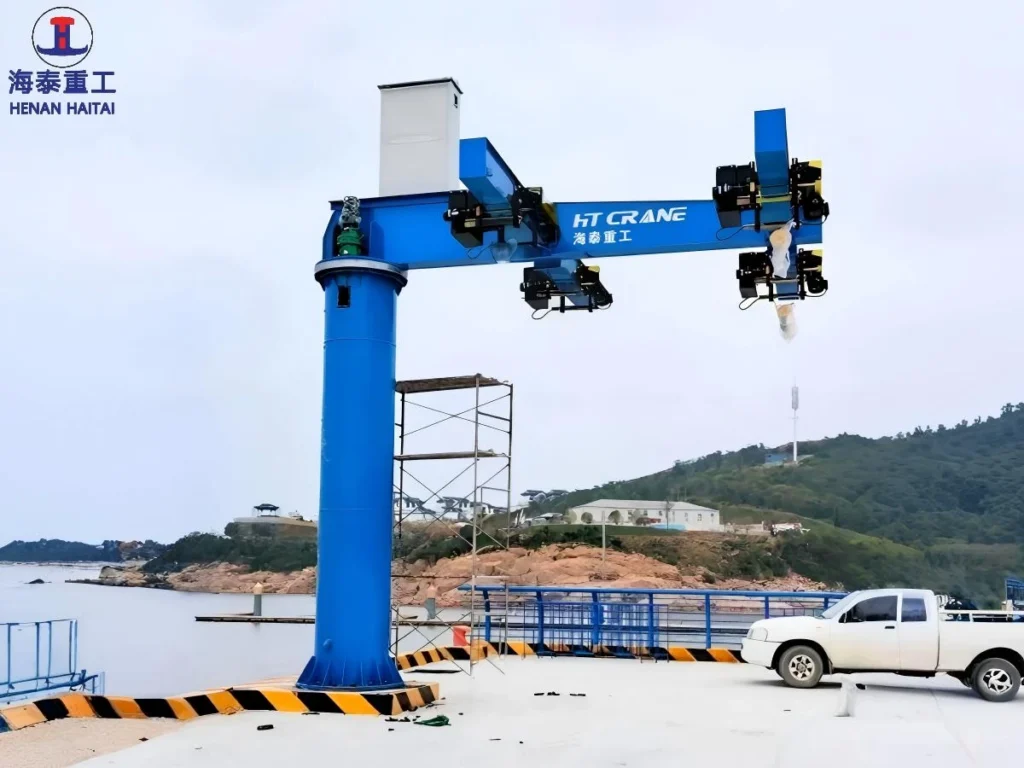
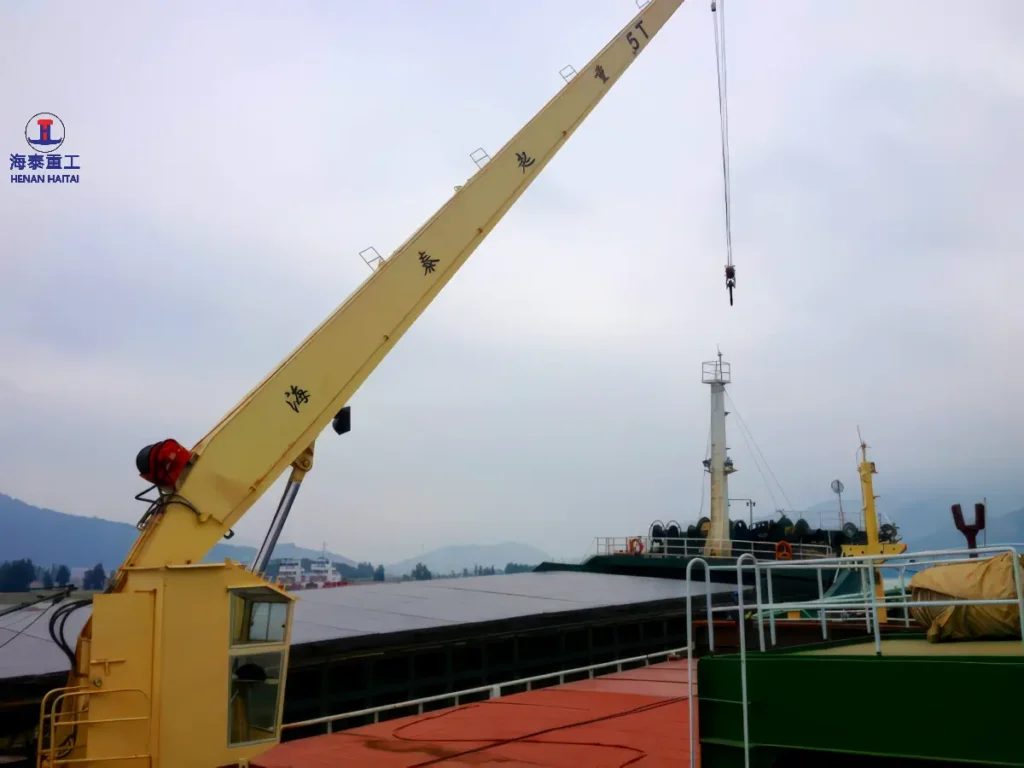
Table 1. Comparison of Technical Specifications for Two Marine Cranes
| Artículo | Fixed Marine Jib Crane | Hydraulic Boom Crane |
|---|---|---|
| Estructura | Vertical mast or column with a rigid horizontal jib; hoist travels along the jib | Pedestal crane with a boom moved by hydraulic cylinders: stiff, telescopic or knuckle |
| How the hook is positioned | Slewing plus hoist travel along the jib; jib angle is fixed | Slewing plus luffing; telescopic adds boom extension, knuckle adds a folding outer boom |
| SWL | 0.5–20 t standard; up to 50 t on request | Stiff: 0.5–20 t standard, up to 50 t custom Telescopic: 1–10 t standard, 15–30 t custom Knuckle: 6–16 t standard; 1–5 t and 20–30 t custom |
| Reach | Jib length 3–10 m standard; up to 15 m custom | Stiff: outreach 5–20 m, up to 40 m custom Telescopic: working radius 5–30 m Knuckle: built to the vessel |
| Altura de elevación | 3–12 m; customizable | 5–30 m (knuckle 3–30 m) |
| Rotation | 180° / 270° / 360°, configurable; 360° gives circular coverage | 360° continuo |
| Working duty | A5 as standard; heavier duty specified by daily lift cycles | Specified per project |
| Hoist | Electric chain hoist or wire rope hoist; manual hoist available | Hydraulic winch; 15 m/min on the stiff, telescopic and knuckle pages |
| Fuerza | 380 V / 50 Hz standard; other voltages supported | Stiff: electro-hydraulic or diesel-hydraulic Telescopic: hydraulic power unit, single motor 7.5–75 kW on standard models Knuckle: diesel; electric or hybrid on request |
| Control | Push-button or radio remote; cabin option | Stand control, cabin, radio remote or cab-free base control, by type |
| Mounting | Column on a concrete dock foundation, wall, dock-embedded mast or floating dock; flange or welded base on a vessel deck | Pedestal on the vessel deck, checked against the vertical load, horizontal shear and overturning moment |
| Protección contra la corrosión | Hot-dip galvanizing plus marine paint to C4–C5 (ISO 12944); C5-M for tropical or offshore sites; IP65 minimum enclosures | Marine paint system to C5-M (stiff boom page) |
| Proceso de dar un título | CE and ISO 9001:2015; class society approval (CCS, BV, DNV, ABS) on request for onboard use | CCS, ABS, LR and BV classification on request |
Where Each Crane Wins: Application Guide
The application guide table maps common applications to the crane that usually gives the better value. Treat it as a starting point, not a substitute for a load chart and a site drawing.
Table 2. Application Guide: Boat Jib Crane Vs Three Types of Hydraulic Boom Crane
| Solicitud | Usually the better value | Por qué |
|---|---|---|
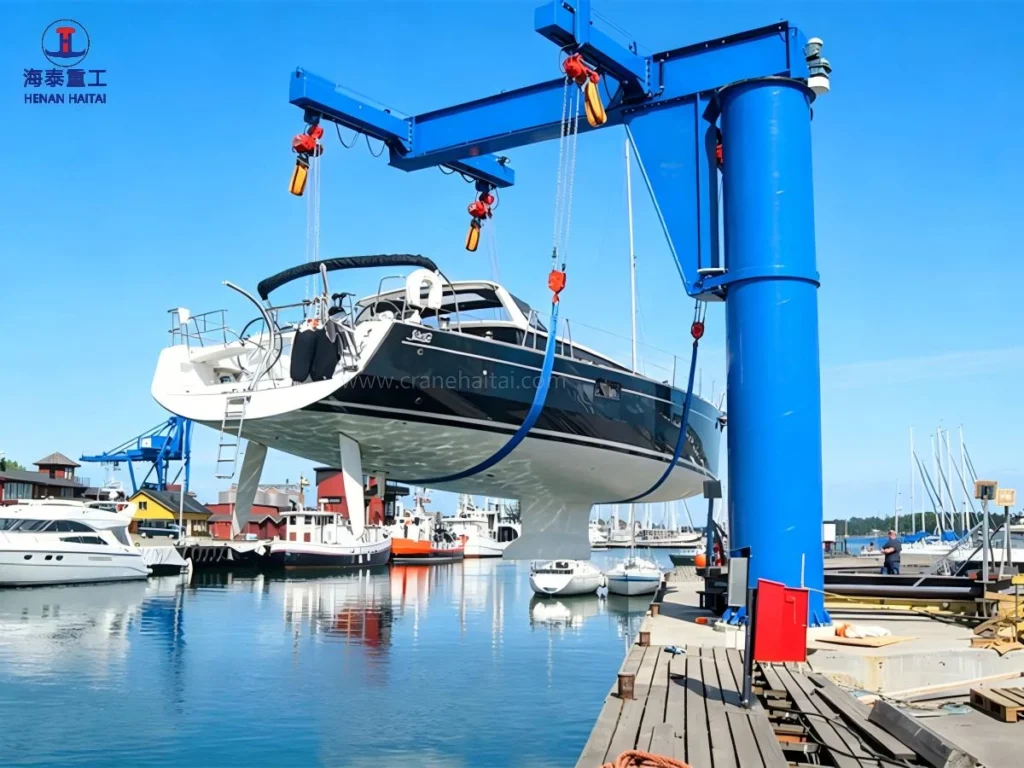
| Marina or yacht club launching and retrieving boats, 0.5–10 t | Fixed jib marine crane, column-mounted, 180°–270° | Fixed berth, short reach and shore power. A 5 t unit with a 6 m jib covers most vessels up to 40 ft LOA, and radio remote lets one operator work the lift. |
| Small shipyard or dry dock entrance, 10–20 t | Fixed jib marine crane with wire rope hoist | Higher duty cycle; the product page recommends FEM 3m and a wire rope hoist, with no rail or runway infrastructure needed. |
| Port or commercial dock handling workboats and patrol craft, 15–20 t | Fixed jib crane, 8–10 m boom, 360° | Serves both the waterside and landside of the dock without repositioning; an optional lifting frame and sling set suits boats without lifting points. |
| Offshore platform with one fixed lift area | Either, depending on reach and power | A fixed jib suits a short-radius area with spare electric power; a compact stiff boom suits a fixed area that needs longer reach or hydraulic independence. |
| Vessel deck handling tenders, rescue craft or deck cargo within short reach | Fixed jib crane, class-approved | Listed on the product page for onboard use; needs class society approval and a flange or welded deck base. |
| Cargo vessel or tanker lifting stores, hoses or spare parts across a quay gap beyond 10 m | Stiff or telescopic boom crane | Reach beyond the jib’s range. A telescopic boom retracts and rests on deck when the vessel sails. |
| Vessel deck lifts that go over rails or deck structures, or alongside the hull | Knuckle boom crane | The folding outer boom sets the hook at varied heights and angles and stows compactly. |
Three Illustrative Examples
These examples are illustrations of the reasoning, not customer cases.
A marina hauling 4 t boats.
The heaviest vessel is 4 t, so a 25% margin points to a 5 t crane. The lifts happen at a fixed dock edge, 6 m from the mast centreline, and shore power is on site. Every test lands on the jib side, and a hydraulic crane would add reach, height and a power pack that the marina never uses.
A quayside base serving a vessel moored 14 m out.
At 14 m the radius sits at the top of the fixed jib’s custom range of 15 m, while a stiff or telescopic boom is comfortably inside its standard range. This is the grey zone. A jib that long needs a heavier mast and foundation, so the quote comparison could go either way, and it is worth requesting both.
A working vessel landing 6 t on a quay 18 m away.
The radius is beyond any fixed jib. The crane must reach the quay, then lower onto a deck rest for sailing, which points to a telescopic boom. Here the question is no longer jib or hydraulic, but which hydraulic type.
What You Will Get With a Fixed Marine Jib Crane?
The boat jib crane page lists a set of features that explain why a fixed jib crane is the economical choice inside its envelope:
- Compact structure, small footprint. One column and one jib occupy a small area, which suits tight docks and decks.
- 360° flexible rotation with circular coverage. The jib sweeps a full circle, or a 180° or 270° arc where the site needs only part of it.
- Remote control and accurate movement. One operator can place the hook precisely, and the crane is easy to operate, which keeps labour cost low.
- Variable speed drive. Smooth starts and stops on slewing and hoisting, described by Haitai as energy-saving and environmentally friendly.
- Suited to fixed locations. The crane works best where the same operation repeats at one position, such as a berth, a dock edge or a yard station.
- High applicability. Typical loads include ships, bulk cargo and mechanical parts.
- Simple maintenance. Haitai states that maintenance costs are 50% lower than other cranes.
- Working duty A5 and personalized customization. A5 is the standard duty class. Jib length, rotation arc and mounting are customized to the site, and lifting height is 3–12 m.
Common Mistakes When Choosing Fixed Marine Jib Crane Over Hydraulic Boom Crane
- Buying for today’s radius. A fixed jib crane has one length and one rotation arc. If your needs may grow, price the longer jib or the hydraulic boom now, not after the first season.
- Comparing crane prices instead of installed prices. Foundation, electrical supply, deck strengthening and class approval can outweigh the gap between the two cranes.
- Skipping the margin. Marine lifts rarely lift clean. Specifying a crane at exactly the vessel’s weight is an underspecification.
- Ignoring duty class. A seasonal marina and a production shipyard need different FEM classes and, often, different hoist types.
- Leaving class approval until after the order. If the jib crane will be installed on a vessel, name the class society at the first enquiry.
- Letting tonnage decide. Between 0.5 t and 20 t both families are available, so radius, height, reach adjustment and site decide, not SWL.
What “Economical” Really Means: The Cost Drivers
The marine boat crane’s price tag is only one line in the cost of a lifting solution. The table below sets out the cost drivers that usually decide the comparison and which way each tends to point. This is general engineering guidance, not Haitai price data, and the size of each effect depends on your site.
Table 3. Cost Drivers Guide: Haitai Fixed Jib Cranes Vs Haitai Hydraulic Boom Cranes
| Cost driver | Fixed marine jib crane | Hydraulic boom crane |
|---|---|---|
| First cost at the same SWL and a short radius | Usually lower: a mast, a rigid jib and an electric hoist, with no hydraulic power pack or luffing cylinders to buy | Usually higher: cylinders, valves and a hydraulic power pack add cost, although a longer jib needs a heavier structure and narrows the gap |
| Foundation and installation | Concrete foundation with anchor bolts, a structural wall, a dock-embedded mast or a reinforced floating-dock base. No rail or runway is needed | Pedestal bolted or welded to the vessel deck; the deck must carry the vertical load, horizontal shear and overturning moment |
| Fuente de alimentación | Needs an electric supply (380 V / 50 Hz standard, other voltages supported); a manual hoist is also offered | Electro-hydraulic uses the ship’s or yard’s supply; a diesel-hydraulic stiff boom runs independently of it |
| Routine upkeep | Wire ropes, hooks, pins and the slewing mechanism; lubricate rotating parts every six months and carry out periodic load tests. Haitai states that maintenance costs are 50% lower than other cranes | The same rope and hook checks plus hydraulic oil, hoses, cylinders and seals; a telescopic boom adds extension cylinders, inner sections and a cable chain |
| Operation and labour | Easy to operate, with remote control and variable speed drive on slewing and hoisting; low labour cost | Operated from a stand, cab or radio remote depending on type; hydraulic power pack runs all motions |
| Reach you pay for | Fixed by the jib length, 3–10 m standard | Set per project; you pay for outreach you may not use if the job is short-range |
| Flexibility if the job changes | Jib length and rotation arc are fixed; rotation range cannot be added after manufacture | Luffing, telescopic or folding reach adapts to different lifts and positions |
| Class approval | Needed only when the crane is installed on a vessel; CE and ISO 9001:2015 cover shore use | Needed for sea-going installation; CCS, ABS, LR and BV on request |
General guidance only. Always request quotes for both options at the same SWL, radius and hook height, and compare the installed cost rather than the crane price.
Where the Boundary Falls: Six Tests
Run your project through these six tests. The first, second and fourth are hard limits: if the answer falls on the hydraulic side, the fixed jib cannot do the job however low its price. The third, fifth and sixth are economic tie-breakers: both cranes can do the job, and the answer decides which one costs less to own.
Table 4. Six boundary tests
| Test | Tipo | Fixed jib crane fits when | Hydraulic boom crane fits when |
|---|---|---|---|
| 1. Working radius | Hard limit | Radius is up to 10 m (3–10 m standard, 15 m custom) | Radius is beyond 10–15 m: stiff boom 5–20 m (up to 40 m custom), telescopic 5–30 m |
| 2. Hook height | Hard limit | Height is 3–12 m (customizable) | Height is above 12 m: 5–30 m (knuckle 3–30 m) |
| 3. Capacity | Tie-breaker | Up to 20 t standard, or up to 50 t on request | Stiff 0.5–20 t standard, up to 50 t custom; telescopic and knuckle booms stop at 30 t |
| 4. Reach adjustment | Hard limit | The hook works at a fixed radius arc and the jib never needs to change angle | The boom must luff, extend or fold to clear obstacles, cross a gap or stow |
| 5. Power and foundation | Tie-breaker | An electric supply and a concrete, wall, dock-embedded or floating-dock base already exist | The site has no supply or base, or the crane needs diesel-hydraulic independence |
| 6. Site and motion | Tie-breaker | Fixed dock, quay, marina pier or yard on a stable structure | A working vessel with roll, pitch and varied or long-radius lifts |
Test 1: Working radius
For a fixed jib the jib length is the radius: 3–10 m as standard and up to 15 m custom. Measure from the mast centreline to the furthest lifting point, then add 0.5–1 m of clearance and any fender projection at the dock edge, as the product page advises. Beyond about 10 m a longer jib needs a heavier mast and foundation, while the hydraulic options sit comfortably inside their standard range: stiff boom outreach of 5–20 m (up to 40 m custom) and telescopic boom working radius of 5–30 m.
Test 2: Hook height
Standard lifting height for the fixed jib is 3–12 m, customizable. Hydraulic boom cranes are listed at 5–30 m, and 3–30 m for the knuckle boom. If the hook has to work high above the dock or deck, for example to clear a superstructure or reach a higher platform level, the hydraulic range is the one built for it.
Test 3: Capacity
Both families cover up to 20 t as standard, so below 20 t capacity does not separate them. Above that, the fixed jib is available up to 50 t on request, as is the stiff boom crane in its custom range. The telescopic and knuckle booms stop at 30 t. For 20–50 t projects, ask for a quote on both so the structure, foundation and power cost can be compared directly.
Test 4: Reach adjustment
A fixed jib has one working arc. The hook is placed by running the hoist along the jib and by slewing, which is quick and precise, but the jib angle never changes. If a lift must pass over a rail or deck structure, reach across a gap that varies from lift to lift, or fold away when the vessel sails, a hydraulic boom is needed. A telescopic boom retracts and lowers onto a deck rest, a knuckle boom folds beside its column, and a stiff boom luffs to change its radius.
Test 5: Power and foundation
The fixed jib relies on electric power, 380 V / 50 Hz as standard with other voltages supported, and on a prepared base: concrete with anchor bolts, a structural wall, a dock-embedded mast or a reinforced floating-dock base. If a supply and a base already exist, the jib is usually the economical answer. If neither exists, the cost of bringing them can outweigh the price gap between the cranes. A diesel-hydraulic stiff boom crane carries its own power pack and runs independently of the ship’s or yard’s supply, and the knuckle boom lists diesel as its standard power.
Test 6: Site and motion
A fixed jib on a dock, quay wall, marina pier or shipyard stands on a stable structure. On a vessel the crane also faces roll, pitch and heel, wind load and class rules. The boat jib crane page does list onboard use for tenders, rescue craft and deck cargo, supplied with class society documentation on request, so a deck-mounted jib is possible. If the vessel is a working ship with long-radius or varied lifts, the hydraulic boom crane is the type designed around that duty.
Sizing a Fixed Marine Jib Crane Once You Have Chosen It
If the tests point to a fixed jib, five checks turn the choice into a specification:
- Capacity with a margin. Apply at least 25% above the heaviest load. Wind, wave action and water drainage add momentary overload in marine conditions, so a 4 t vessel needs a 5 t crane.
- Jib length. Measure from the mast centreline to the furthest lifting point, add 0.5–1 m of clearance, and add any fender projection at the dock edge.
- Rotation angle. 180° is enough when the crane serves one side of the dock. If loads move from the water to a land-side staging area, specify 270° or 360°. Rotation range cannot be added after manufacture.
- Duty class. Haitai’s standard working duty is A5, which sits at about FEM 2m. Match the FEM class to your daily lift cycles, as in Table 5, and state heavier duty at enquiry.
- Environment and power. Coastal saltwater sites need C4–C5 protection as a minimum, and tropical or offshore sites with continuous salt spray should specify C5-M. Confirm the supply voltage, frequency and available amperage before ordering.
Table 5. Recommended FEM duty class
| Operation type | Daily lift cycles | Recommended FEM class |
|---|---|---|
| Puerto deportivo de temporada, baja frecuencia | 1–5 | 1 de la madrugada |
| Puerto deportivo activo, uso regular | 5–15 | 2 metros |
| Astillero, uso en producción | 15–30 | 3 metros |
| Puerto comercial, intensivo | 30+ | 3m–4m |
About Haitai Crane – TOP 3 Marine Jib Crane Manufacturer in China
Grúa Haitai designs, builds and exports marine and port lifting equipment from its factories in Fengqiu County, Henan Province, China. The range includes boat jib cranes, hydraulic stiff boom, telescopic boom and knuckle boom marine cranes, ship deck cranes, hatch cover gantry cranes, gantry cranes and container cranes.
Not sure which side of the boundary your project falls on? Send us your load, radius, hook height and site conditions. We will recommend a crane type and prepare a GA drawing and load chart. Explore the full marine boat crane range, read our overview of the 7 types of marine cranes, compare the three hydraulic types in our boom crane guide, or contact us on WhatsApp at +86 136 7352 1295.
What Should I Do for a Marine Crane Recommendation and Quote
Fill in what you know and send it back. We will recommend a crane type and prepare a GA drawing and load chart from partial answers.
Table 6. Haitai Marine Boom Cranes Procurement confirmation checklist
| # | Artículo para confirmar | Su requisito |
|---|---|---|
| 1 | What will be lifted, and the weight of the heaviest load or vessel | |
| 2 | Working radius: distance from the mast centreline to the furthest lifting point, including clearance and fender projection | |
| 3 | Hook height required | |
| 4 | Rotation arc needed (180°, 270° or 360°) and which sides of the dock or deck must be served | |
| 5 | Mounting: column, wall, dock-embedded, floating dock or vessel deck | |
| 6 | Foundation condition: concrete, wall structural capacity, or deck plate thickness | |
| 7 | Power supply: voltage, frequency and available amperage, or whether diesel independence is needed | |
| 8 | Control type: push-button, radio remote or cabin | |
| 9 | Daily lift cycles and duty class | |
| 10 | Environment: coastal, tropical or offshore, with continuous salt spray or not | |
| 11 | Class society, if the crane is installed on a vessel | |
| 12 | Project site and target delivery date |

Preguntas frecuentes
1. Is a fixed marine jib crane cheaper than a hydraulic boom crane?
At the same SWL and a short radius, a fixed jib is usually simpler and lower in first cost, because it has an electric hoist and no hydraulic power pack or luffing cylinders. The installed cost depends on the foundation, the power supply and class approval, so we recommend quoting both options at the same SWL, radius and height. Haitai does not publish list prices.
2. What is the maximum radius of each type?
The fixed jib marine crane has a standard jib length of 3–10 m and up to 15 m custom. The stiff boom crane lists outreach of 5–20 m, up to 40 m custom, and the telescopic boom crane lists a working radius of 5–30 m.
3. Can a fixed jib crane be installed on a vessel deck?
Yes. The product page lists onboard use for tenders, rescue craft and deck cargo, with a flange base or welded base on the deck, and generally no major modification to the vessel. Installation on a vessel requires class society approval, which Haitai can supply on request.
4. Does a fixed jib crane need shore power?
It needs an electric supply: 380 V / 50 Hz as standard, with other voltages supported, and a manual hoist is also offered. If the site has no supply, a diesel-hydraulic stiff boom crane runs independently of the ship’s or yard’s power
5. Which certifications are available?
The boat jib crane is CE and ISO 9001:2015 certified, and class society approval (CCS, BV, DNV or ABS) is available on request for vessel installations. Hydraulic marine boom cranes can be supplied with CCS, ABS, LR and BV classification on request. Please name the class society in your first enquiry.