


Not every facility has the floor space for a full gantry crane. Not every building has the roof structure to support an overhead travelling crane. A semi gantry crane solves both problems at once — and for a significant number of industrial buyers, it is the most practical and cost-effective crane configuration available.
The semi gantry crane uses one leg on the ground and one side supported by an existing building column or runway rail on the wall. This hybrid design reduces the crane’s footprint, eliminates one set of floor rail foundations, and integrates with the building structure in a way that a full gantry crane cannot. The result is maximum coverage in minimum space — at a lower civil works cost than either alternative.
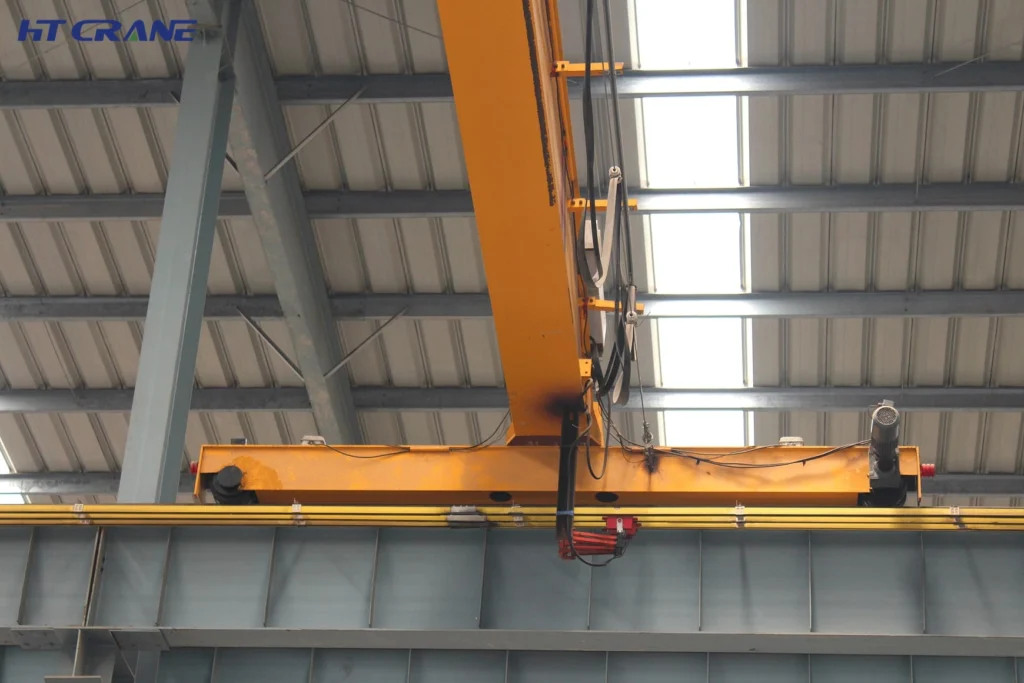
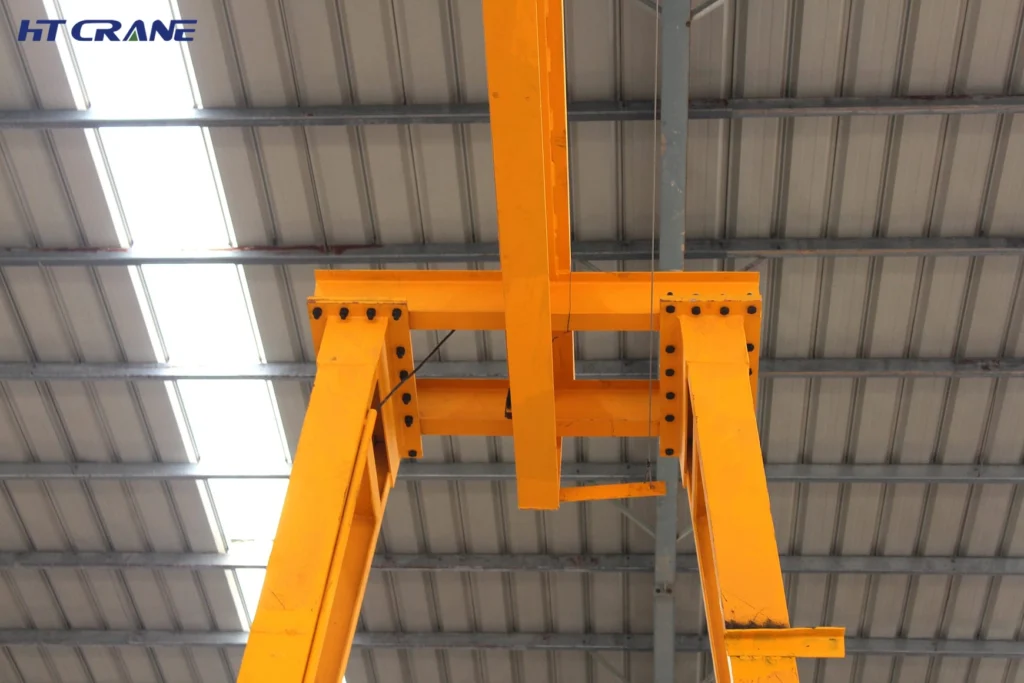
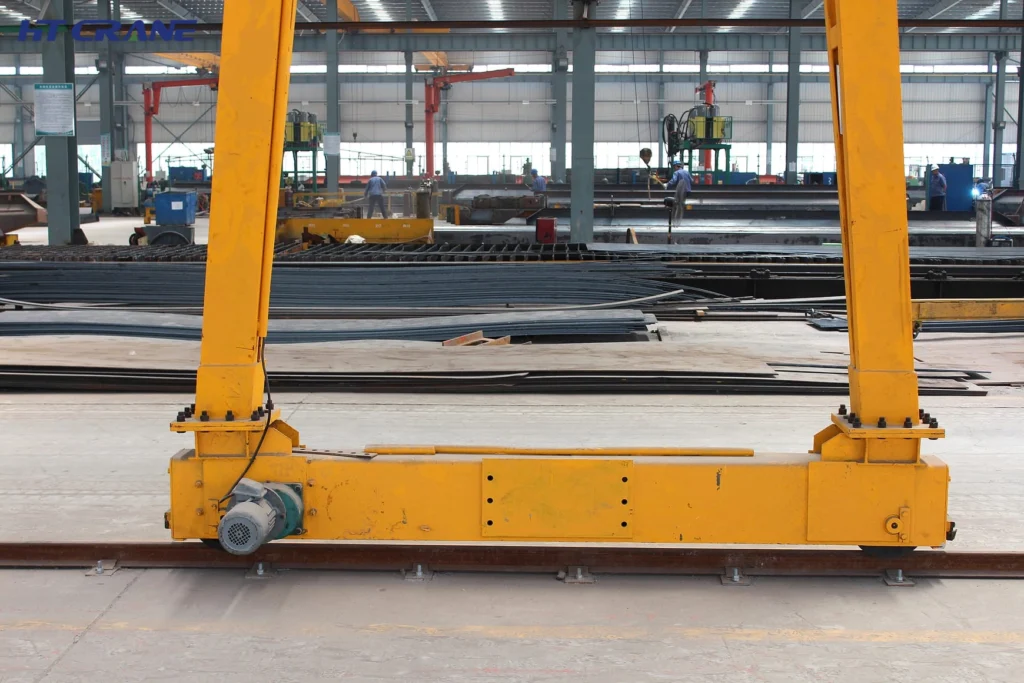
A semi gantry crane — also called a half gantry crane — has an asymmetric support structure. One end of the main girder rests on a standard leg that runs on a ground-level rail. The other end is supported by a trolley or bracket that runs on a runway rail attached to an existing building column, wall structure, or dedicated runway beam.
This means the crane covers the full span between the building column and the ground rail, without needing a second set of legs and without the full rail system that a standard gantry crane requires on both sides. The single leg travels on one ground rail. The other rail is elevated — mounted to the building structure at the required height.
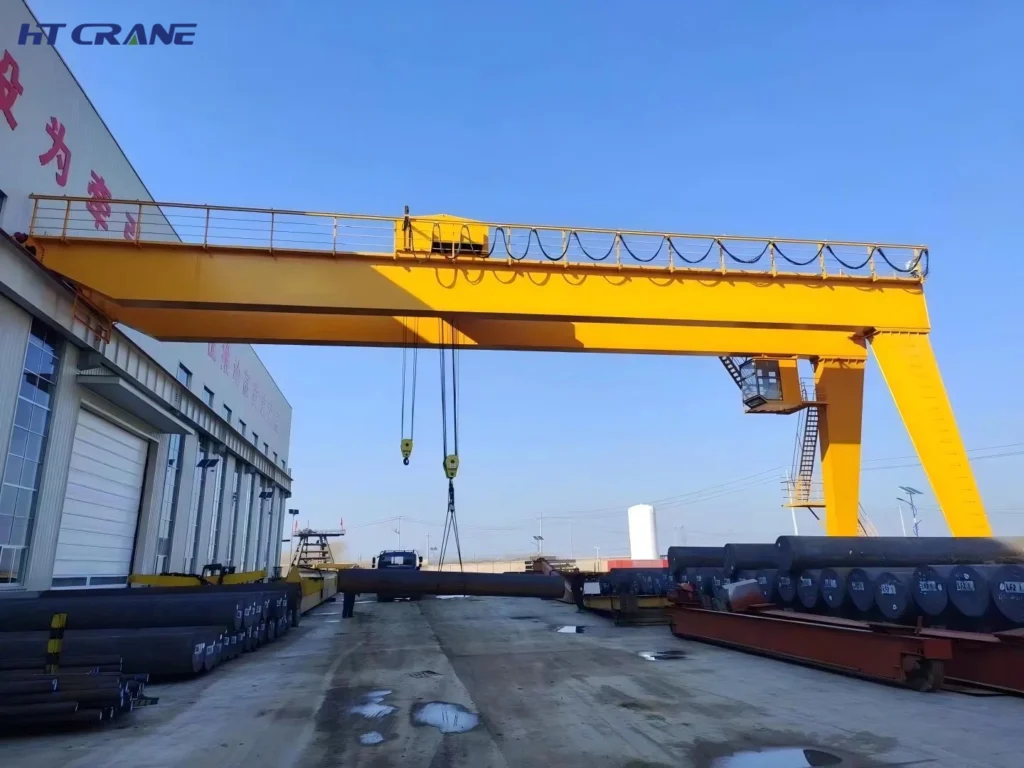
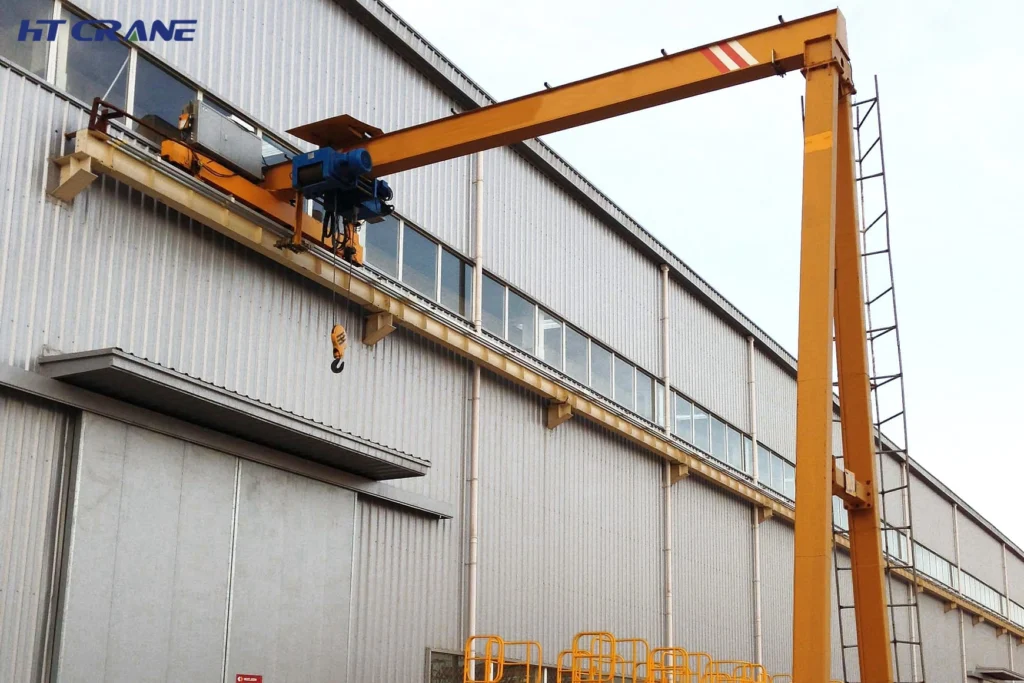
The semi gantry crane design emerged from a practical operational need: facilities where one side of the working area is bounded by a building wall or column line, and full floor coverage is required without the footprint of two independent rail systems.
Typical examples: a machine shop where equipment lines one wall and the crane must serve the full floor area; a loading bay where one wall is the building structure and the other side is open to a yard; a prefabrication area where columns on one side are structural and cannot be moved, but floor space on the other side is unobstructed.
Semi gantry cranes are available in both single and double girder configurations, following the same logic as standard gantry cranes:
| Factor | Single Girder Semi Gantry | Double Girder Semi Gantry |
|---|---|---|
| Rango SWL | 1T – 20T | 10T – 50T |
| Altura del gancho | Bajar (el polipasto se encuentra debajo de la viga) | Más alto (tranvía arriba) |
| Durar | Up to 30m | Up to 40m |
| Structural Weight | Encendedor | Más pesado |
| Building Load | Más bajo | Más alto |
| Mejor ajuste | Workshops, light fabrication, maintenance | Heavy manufacturing, steel processing |
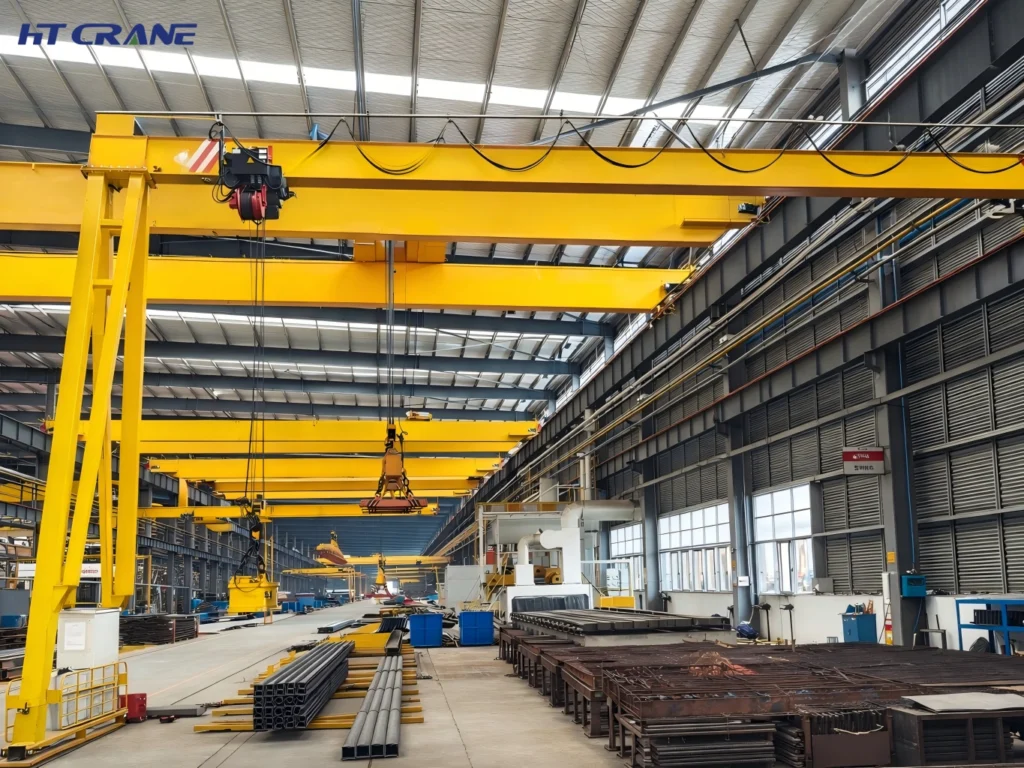
For the majority of semi gantry crane applications — workshop lifting from 3T to 16T — the single girder configuration is the appropriate and cost-effective choice. Double girder semi gantry cranes are used when hook height or heavy load requirements push beyond single girder limits.
| Parámetro | Rango de especificaciones |
|---|---|
| Carga de trabajo segura (SWL) | 1T – 50T |
| Durar | 5m – 40m |
| Altura de elevación | 3m – 15m (site dependent) |
| Velocidad de elevación | 2 – 12 m/min (VFD control available) |
| Velocidad de desplazamiento del carrito | 10 – 40 m/min |
| Velocidad de desplazamiento del pórtico | 10 – 40 m/min |
| Leg Configuration | Single leg — fixed height or adjustable |
| Ground Rail | Standard crane rail (crane-supplied) |
| Wall/Column Rail | Runway beam — supplied or specified by buyer |
| Sistema de transmisión | AC motor with VFD (all motions) |
| Clase de servicio | ISO M3 – M6 (FEM 1Am – 5m) |
| Control | Pendant, radio remote |
| Estándar de diseño | EN 13001, FEM 1.001 |
| Proceso de dar un título | CE (Directiva de Maquinaria de la UE 2006/42/CE), ISO 9001 |
Three structural variants cover the full application range:
Standard single leg, fixed height — the most common configuration for permanent indoor installations. The leg height is set during design to match the building column rail height. Simple, cost-effective, and low-maintenance.
Adjustable leg height — the single leg is height-adjustable within a defined range. Useful when the crane is used in multiple areas with different column heights, or when the leg height may need to change as the facility evolves.
Cantilever extension — the girder extends beyond the ground rail end, providing lifting coverage outside the direct span between the leg and the building rail. Used when the working area extends beyond the column line into an open yard. The cantilever section must be designed and balanced carefully — it is not simply extending the girder without structural calculation.
This is the most common semi gantry crane application. The facility already has structural columns along one wall — either from the building’s original design or from a previous installation. Installing an overhead crane would require significant structural reinforcement. A full gantry crane would need rails on both sides and would occupy floor space that is currently used for equipment or workflow.
The semi gantry crane solution: a ground rail runs along the open side of the workshop floor. The existing building column carries a runway beam at the required height. The crane covers the full workshop width from column to ground rail, using the building’s own structure on one side and a minimal floor rail on the other. Civil works are reduced to one rail foundation instead of two. The building structure carries one side of the crane load — exactly what it was designed to do.
Facilities with covered loading bays — where one side is the building wall and the other side is open to a yard or loading apron — benefit directly from the semi gantry configuration. The covered side uses the building structure for the elevated rail. The open side uses a single ground rail with a standard leg.
This arrangement allows the crane to serve both the indoor storage area and the outdoor loading apron with one crane. No full gantry crane could achieve this without encroaching on the loading apron with a second set of legs. No jib crane covers enough area. The semi gantry is the natural solution.
Fabrication shops handling material up to 20T — structural steel, plate, piping, and assemblies — frequently operate in buildings where overhead cranes are impractical due to roof structure limitations and where a full gantry crane would create floor congestion. The semi gantry crane provides the lifting capacity needed without either constraint.
For this application, a 10T–16T single girder semi gantry with a span of 12–20 metres is typical. The semi gantry crane handles raw material receiving, in-process assembly moves, and finished product loading — the full production cycle — without forklift interference on the workshop floor.
Equipment maintenance bays — for large vehicles, power generation equipment, and industrial plant — often have one fixed wall structure and require lifting access across the full bay width. The semi gantry crane fits this geometry precisely: the wall carries one rail, the floor carries the other, and the full bay is covered with one crane and one operator.
For maintenance applications, the duty cycle is typically low — M3 or M4 — which means the crane is designed for moderate lift frequency rather than continuous production use. This affects the structural specification and the hoist duty rating. Always confirm the duty class with your supplier rather than defaulting to the heaviest available option.
Before ordering a semi gantry crane, the building column or wall structure that will carry the elevated runway rail must be assessed by a structural engineer. The crane imposes dynamic loads on the building structure — not just the static weight of the crane and its load, but the accelerating and braking forces from gantry travel and hoist motion.
Many buyers assume that because the column is there, it can carry a crane. This assumption is frequently wrong. The original building design may not have included crane loads. The column section, connection details, and foundation may be adequate — or they may not be. This is not a risk worth taking. A structural assessment before procurement protects you from discovering the problem after the crane is installed.
Grúa HT provide a crane reaction load document — specifying the forces the crane imposes on the building structure — as part of our standard pre-contract technical package. Provide this to your structural engineer alongside the building drawings for the assessment.
The crane’s span is the distance between the centreline of the ground rail and the centreline of the elevated runway rail. This is not the same as the width of the working area — the leg and the building bracket each consume some of the span. Measure the actual working width you need to cover, then confirm the crane span required to achieve it.
Hook height is limited by the height of the elevated runway rail and the headroom available between the rail and the building structure above it. In buildings with limited clearance, this is frequently the binding constraint. Measure carefully and provide actual dimensions — not estimates — to your supplier.
Duty class determines how the crane structure and hoist are designed for fatigue life. Specifying a higher duty class than your operation requires adds unnecessary cost. Specifying too low creates a crane that reaches the end of its structural fatigue life before its expected service life — a failure mode that is not always visible until damage is already significant.
Estimate your average daily lifts, the typical load as a percentage of maximum SWL, and your intended crane service life in years. Provide these figures to your supplier and ask them to confirm the correct duty class per ISO 4301 or FEM 1.001. This is a basic application engineering step — any credible crane manufacturer will do it as a matter of standard process.
A semi gantry crane is a custom-engineered product. Every installation has a unique combination of span, height, building structure type, and operational requirement. A trading company cannot engineer this — they pass the specification to a manufacturer and mark up the result. You lose direct access to the engineers, you lose cost transparency, and you gain a layer of delay when technical questions arise during manufacturing or installation.
Buying direct means your specification goes to the engineers who will build the crane. Questions are answered by the people who designed it. Changes are implemented without intermediary delays. Documentation — CE certificate, load test report, structural drawings — comes directly from the manufacturing entity.
A semi gantry crane is the right solution when a full gantry crane creates too large a footprint, an overhead crane requires building upgrades that are not justified, and a jib crane does not cover enough area. It uses your building structure as one support, reduces civil works to a single ground rail, and delivers full working area coverage in a configuration that fits the geometry of the facility you actually have.
The specification process requires a structural assessment of your building and careful measurement of span and hook height. Both steps are straightforward with the right information — and we provide the crane reaction load data you need to make them simple.
Contact our engineering team with your span, load, hook height, and building structure details. We will provide a complete technical proposal and the structural load documentation your building engineer needs for the assessment.












Si administra un puerto deportivo, astillero o instalación naval, ya conoce el problema: embarcaciones atascadas en el agua esperando mantenimiento, rampas que dañan los cascos y grúas que simplemente no fueron construidas para barcos. Un elevador de viaje marino resuelve los tres problemas en una sola máquina. Eleva, mueve y bota embarcaciones de forma segura, sin rieles fijos, sin dañar el casco y sin ralentizar su astillero. Esta página cubre todo lo que necesita para evaluar un elevador de viaje marino: qué hace, dónde funciona, qué hace que el nuestro sea diferente y las especificaciones técnicas completas. Si está listo para especificar una unidad, nuestro equipo de ingeniería responde a las consultas en 24 horas. Descripción del producto Un elevador de viaje marino, también llamado elevador de viaje para barcos, elevador de barcos móvil o elevador de barcos autopropulsado, es una grúa pórtico sobre neumáticos diseñada específicamente para la manipulación de embarcaciones. El pórtico se coloca a ambos lados de la embarcación en el agua. Se colocan eslingas de poliéster debajo del casco. Luego, la embarcación se eleva y se conduce a cualquier lugar de tierra. Sin vías férreas. Sin infraestructura fija. Solo una máquina que se encarga del izado,…

Elegir el proveedor adecuado de grúas RTG impacta toda la operación de su puerto o patio. Una mala elección significa retrasos, tiempo de inactividad y reparaciones costosas. Le ayudamos a evitar eso. Como fabricante y exportador certificado de grúas RTG, suministramos grúas pórtico de alto rendimiento sobre neumáticos de caucho construidas para terminales de contenedores, patios intermodales y centros logísticos en todo el mundo. Descripción del producto Una grúa RTG (grúa pórtico sobre neumáticos de caucho) es una grúa aérea móvil diseñada para apilar y mover contenedores ISO en patios de contenedores portuarios y depósitos interiores. A diferencia de las grúas montadas sobre rieles (grúa pórtico para contenedores RMG), las grúas RTG funcionan sobre neumáticos de caucho, lo que les brinda total movilidad en el patio sin infraestructura fija. 👉Ver Guía de compra profesional: Grúa RTG vs. Grúa RMG: ¿Cuál se adapta realmente a su proyecto? Las grúas RTG son la columna vertebral de las operaciones modernas de terminales de contenedores. Cubren la brecha entre las grúas de barco a tierra y el transporte horizontal, lo que permite un apilamiento, recuperación y organización eficientes de contenedores en el patio. ¿Por qué comprar con nosotros? HT Cranes es un fabricante profesional de grúas RTG con más de 15 años de experiencia en elevación. Nuestras grúas se exportan a puertos y centros logísticos de todo el sudeste asiático, Oriente Medio…
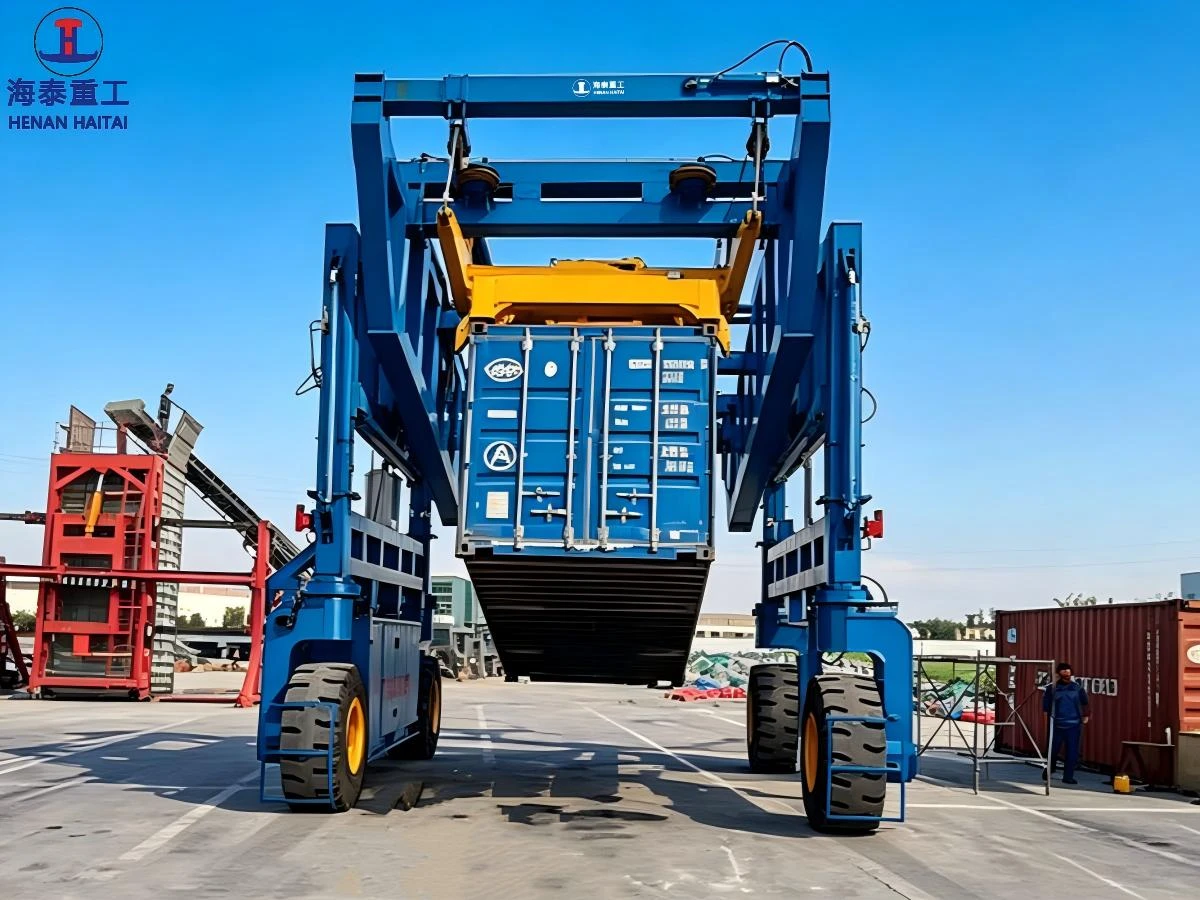
Si maneja contenedores pesados, estructuras de acero o carga industrial de gran tamaño, y su sitio carece de infraestructura de energía fija, una grúa pórtico hidráulica es probablemente la solución más práctica disponible. Eleva, transporta y coloca cargas sin necesidad de estructuras aéreas, rieles o suministro de energía de alto voltaje. Una sola máquina. Movilidad total. Obras civiles mínimas. ¿Qué es una grúa pórtico hidráulica? El concepto básico Una grúa pórtico hidráulica es un vehículo de elevación pesada autopropulsado. Se coloca a horcajadas sobre una carga, levantándola desde abajo mediante un separador hidráulico o una viga de elevación, y se mueve libremente por el patio sobre neumáticos de caucho. Todo el ciclo de elevación y desplazamiento es impulsado por un sistema diésel-hidráulico a bordo. A diferencia de las grúas eléctricas o de carrete de cable, la grúa pórtico hidráulica lleva su propia fuente de energía. Esto la hace totalmente independiente de la infraestructura del patio. Puede desplegarla en cualquier lugar donde su superficie pueda soportar las cargas de las ruedas, sin necesidad de instalación fija. Cómo funciona el sistema hidráulico El motor acciona las bombas hidráulicas que suministran fluido a presión a los cilindros de elevación, los motores de accionamiento y los actuadores de dirección. Todo movimiento —elevación, descenso, desplazamiento y dirección—…

























