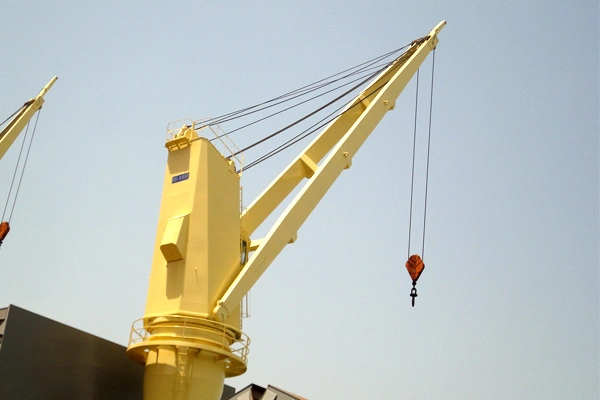
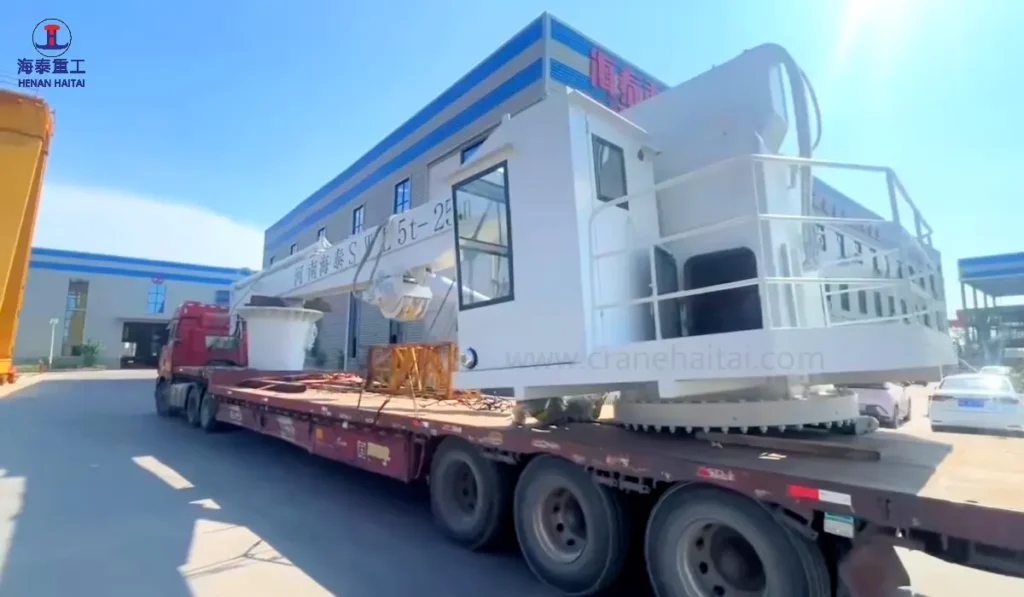
On September 17, 2026, Henan Haitai delivered a 5t, 25-meter hydraulic telescopic boom marine crane to a customer in Romania. Rated SWL 5t at full 25m radius, the crane is built for deck-mounted cargo and provisions handling aboard general cargo and multipurpose vessels, with a fully enclosed operator cabin for offshore weather conditions. Classed and certified to the customer’s choice of CCS and BV, the unit shipped from HT Crane facility on a flatbed trailer, boom cradled and pedestal base secured for the overland leg of its journey to port.
Project of Hydraulic Telescopic Boom Marine Crane
A hydraulic telescopic boom marine crane earns its keep on the kind of vessel that can not always count on shore cranes being available or affordable at every port — general cargo ships, multipurpose carriers, and offshore support vessels that need to load and discharge their own cargo.
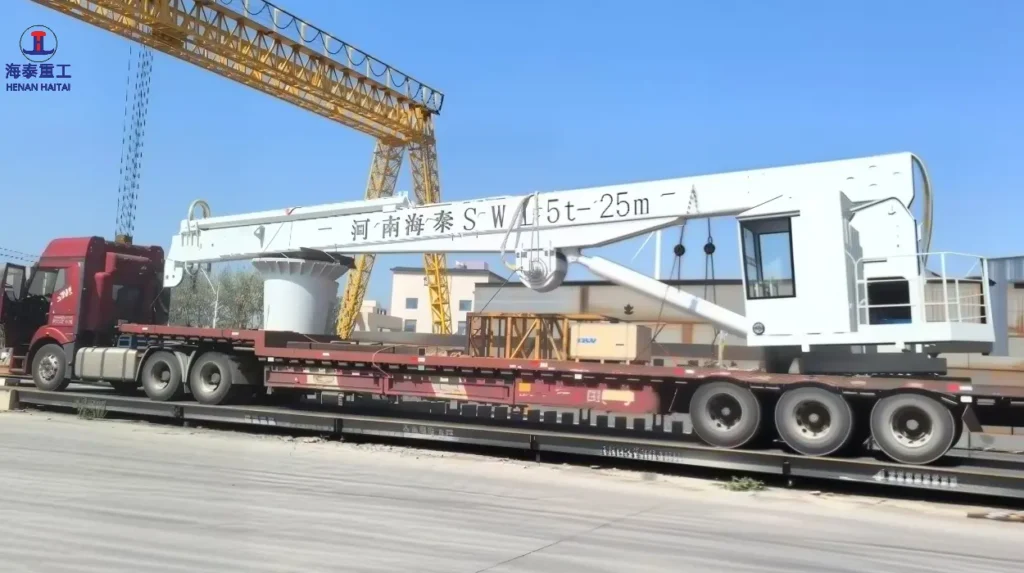
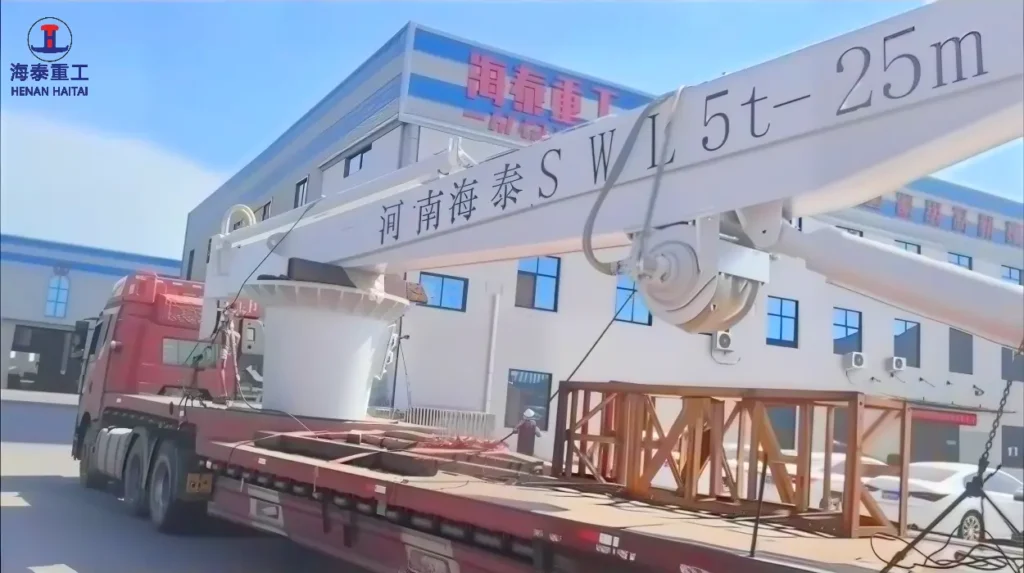
That was the application behind this order: On September 17, 2026, Henan Haitai delivered a 5-ton, 25-meter hydraulic telescopic boom marine crane to a customer in Romania, built to the SWL 5t-25m rating marked on the boom itself in the shipping photos.
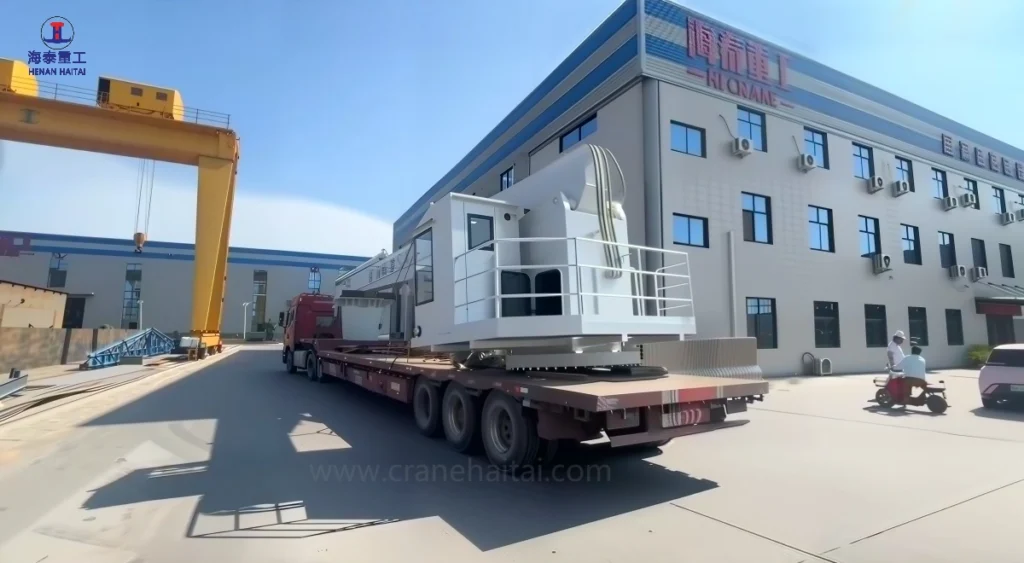
The crane’s pedestal-mounted structure, enclosed cabin, and telescoping boom section are visible in the delivery images, loaded onto a flatbed trailer at Haitai’s Henan yard for the overland transport to port ahead of vessel installation.
Classed and certified to the CCS and BV, the marine telescopic crane shipped from HT Crane’s Henan facility on a flatbed trailer, boom cradled and pedestal base secured for the overland leg of its journey to port.
Project Information Table
| Artículo | Especificación |
|---|---|
| Tipo de grúa | Hydraulic Telescopic Boom Marine Crane |
| Carga de trabajo segura (SWL) | 5 Tonnes |
| Maximum Working Radius | 25 m |
| Tipo de pluma | Hydraulic Telescopic Boom |
| Mounting | Pedestal-Mounted, 360° Slewing |
| Cabina | Enclosed Operator Cabin |
| Sistema de energía | Hydraulic (Luffing, Telescoping, Hoisting, Slewing) |
| Clasificación | CCS, BV (per customer requirement) |
| Fabricante | Compañía de Industria Pesada Henan Haitai, Ltd. |
| Proveedor | Compañía de Industria Pesada Henan Haitai, Ltd. |
| Destino | Romania |
| Delivery Date | September 17, 2026 |
Why Chose a Hydraulic Telescopic Boom Configuration?
A telescopic boom does one thing a fixed or knuckle boom can not: it changes its own length under load, extending or retracting hydraulically to adjust radius without swinging the boom angle first. For a 5-tonne crane rated to a 25-meter radius, that matters because deck cargo and provisions are not always sitting at a convenient distance from the telescopic crane’s pedestal — a container stack, a supply barge alongside, or a quay wall at varying distances all call for a different working radius, and a telescopic boom reaches each one without repositioning the vessel.
Working at the outer end of a 25-meter reach also means the rated 5 tonnes is a short-radius figure; capacity falls off as the boom extends, in line with the crane’s load chart. That is standard behavior for any telescopic marine crane, but it is worth restating because a buyer sizing a crane against a specific lift — a genset, a container, a pallet of stores — needs to check the load chart at the radius they will actually use, not just the headline SWL figure.
Hydraulic Telescopic Boom Crane Built for Vessel Deck Service
The hydraulic boom crane’s cabin — the enclosed white structure visible in the shipping photos, with its own windows, railed access platform, and roof-mounted boom foot — gives the operator a sheltered position with a clear sightline down to the working deck and over the side, which matters more on a moving vessel than it does at a fixed dockside job. The pedestal base bolts to a reinforced deck foundation and carries the full slewing ring beneath the cabin, so the whole upperworks — boom, cabin, hoist machinery — rotates as one unit rather than exposing separate rotating parts to weather and spray.
Hydraulic power runs the luffing, telescoping, hoisting, and slewing functions from a common power pack, which keeps the pedestal boom crane’s footprint and maintenance points concentrated in one machinery space rather than spread across the deck — usually the more practical layout for a vessel operator, since it leaves fewer places for saltwater and vibration to work on hydraulic fittings over years of service.
Packaging and Delivery Photos
¿Por qué elegir? Grúa Haitai? A Marine Crane Manufacturer in China
Henan Haitai designs and builds each marine crane order around the vessel it is going onto rather than adapting a generic land-based crane for shipboard use — pedestal size, deck foundation loading, cabin sightlines, and classification requirements are all specified before fabrication starts, not adjusted afterward. For this Romania order, that meant confirming the vessel’s deck layout and the customer’s preferred classification society ahead of production, so the marine deck crane’s structural certification matched what the vessel’s own class notation required.
Haitai Crane’s marine crane range covers hydraulic stiff boom, telescopic boom, knuckle boom, and knuckle-telescopic configurations built in the same Henan facility, along with hatch cover gantry cranes and deck equipment for the same vessel types — so a customer ordering a telescopic boom crane for one project can specify compatible deck equipment from the same supplier rather than coordinating separate vendors. Products are certified by CCS, BV, ABS, or LR depending on the customer’s flag state and class requirements.
Conclusión
Delivered on September 17, 2026, this 5t, 25-meter hydraulic telescopic boom marine crane reflects a straightforward brief: give a vessel operator deck-mounted lifting capability that reaches from a container stack to a supply barge without repositioning the ship, and build it to the classification the vessel’s flag state requires. For buyers weighing a similar order, the radius-dependent load chart and the choice of classification society are the two details that shape the rest of the specification — confirm those early, and the rest of the configuration follows from there.
Parameters & Requirements Checklist for Customization
Buyers specifying a hydraulic telescopic boom marine crane should have the following confirmed before requesting a quotation:
- Safe working load (SWL) required, and at what radius — a 5-tonne crane rated at short radius is a different specification from 5 tonnes at full 25-meter reach
- Maximum working radius needed for the vessel’s deck layout and typical cargo positions
- Vessel type and deck foundation details — steel grade, deck plating thickness, and available space for the pedestal and slewing ring
- Power supply available on board (voltage, frequency, or hydraulic power source if integrating with existing vessel systems)
- Classification society required — CCS, BV, ABS, LR, or another society tied to the vessel’s flag state
- Operating environment — ambient temperature range, exposure to spray or icing, and any offshore or arctic service requirements
- Cabin configuration — enclosed cabin, open console, or remote-control operation
- Installation timeline and whether the crane will be fitted at the builder’s yard, a separate outfitting yard, or after the vessel is already in service

Preguntas frecuentes
Q1. What does SWL 5t-25m mean for this marine crane?
SWL stands for safe working load, and 5t-25m means the crane is rated to lift 5 tonnes at its rated radius, with a maximum working radius of 25 meters. Because it is a telescopic boom, the safe working load decreases as the boom extends toward the 25-meter limit, so the full load chart should be checked against the radius the operation will use.
Q2. What vessels use a hydraulic telescopic boom marine crane like this one?
General cargo ships, multipurpose carriers, and offshore support vessels that load and discharge their own cargo, provisions, or equipment without relying on shore cranes are the most common users; the telescopic boom’s adjustable radius suits vessels where cargo is not always at a fixed distance from the crane’s pedestal.
Q3. Can Haitai certify this crane to different classification societies?
Yes. Haitai supplies marine cranes certified to CCS, BV, ABS, or LR depending on the customer’s flag state and class requirements, so the crane’s documentation matches what the vessel’s own classification calls for rather than requiring a separate certification process after delivery.
Q4. How is this crane installed on a vessel?
The hydraulic marine crane’s pedestal base bolts to a reinforced deck foundation built to the crane’s load and moment requirements; Haitai confirms the foundation specification with the customer or shipyard before fabrication so the crane and the deck structure are matched before the unit ships.
Q5. What information does Haitai need to quote a hydraulic telescopic boom marine crane?
Required SWL and working radius, vessel type and deck foundation details, available power supply, classification society, operating environment, and cabin configuration; Haitai’s engineering team can size and configure a crane once these are confirmed.