When it comes to localized, efficient lifting in a busy work environment, few machines can match the versatility and space-saving design of a jib crane. Offering up to 360 degrees of rotation, these cranes act as the “helping hands” of modern industrial and marine operations, handling tasks that would be inefficient or impossible for larger overhead cranes.
If you are looking to optimize your site’s lifting power, you will first need to answer: What is a jib crane, and which type best fits your environment? In this blog, we’ll break down the essentials and compare the 2 main types of pillar jib cranes (Pillar-Mounted Jib Cranes) designed for indoor and outdoor use by Haitai Crane.
What Is Jib Crane?
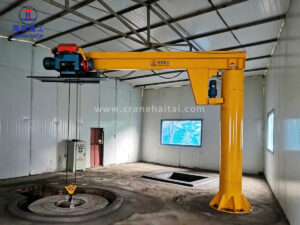
A jib crane is a type of lifting equipment that features a horizontal member (the boom or jib) that supports a movable hoist. This horizontal arm is attached to either a wall or a freestanding floor-mounted pillar (column).
By rotating the arm and moving the hoist back and forth, jib cranes can lift and transport materials within a semi-circular or full 360-degree circular working area. Jib cranes are commonly used in manufacturing, warehousing, boat yards, and loading docks to handle repetitive lifting, relieve overhead cranes, and ensure worker safety.
What is a Pillar-Mounted Jib Crane?
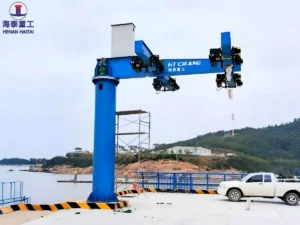
The most common and popular style is the Pillar Jib Crane (also known as a pillar-mounted, column, or freestanding jib crane).
Unlike wall-mounted systems, which require a structural building support, a pillar jib crane uses its own heavy-duty vertical column anchored securely to the ground. This gives you the freedom to place it exactly where you need it, often providing a 360-degree rotation for maximum reach.
To meet diverse industrial demands, Haitai Crane categorizes pillar jib cranes into two primary solutions: Indoor Industrial y Outdoor Marine.
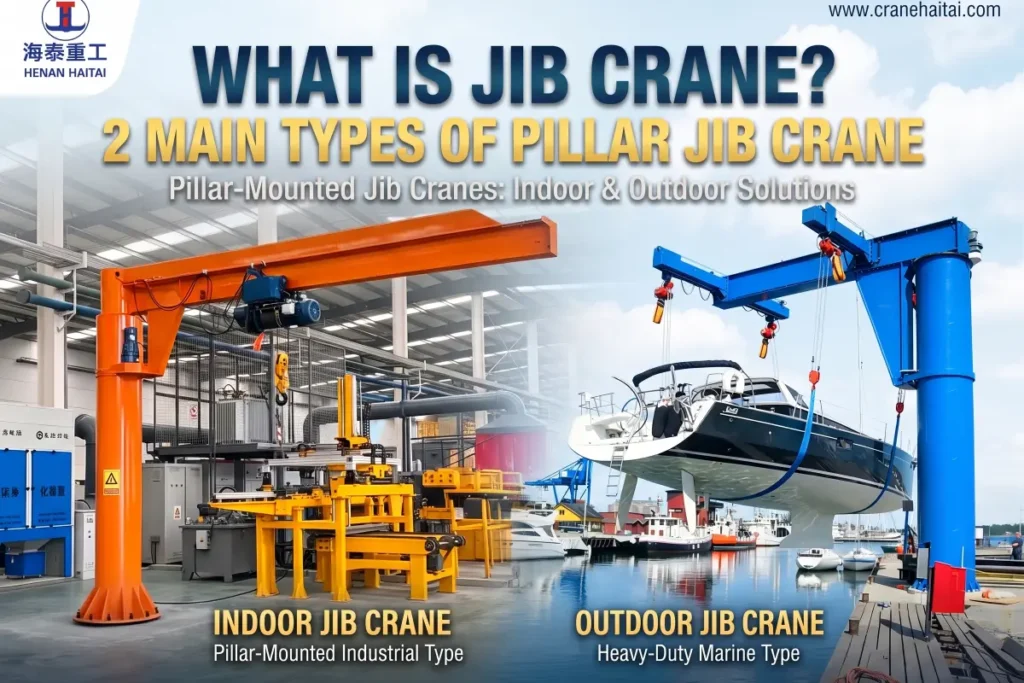
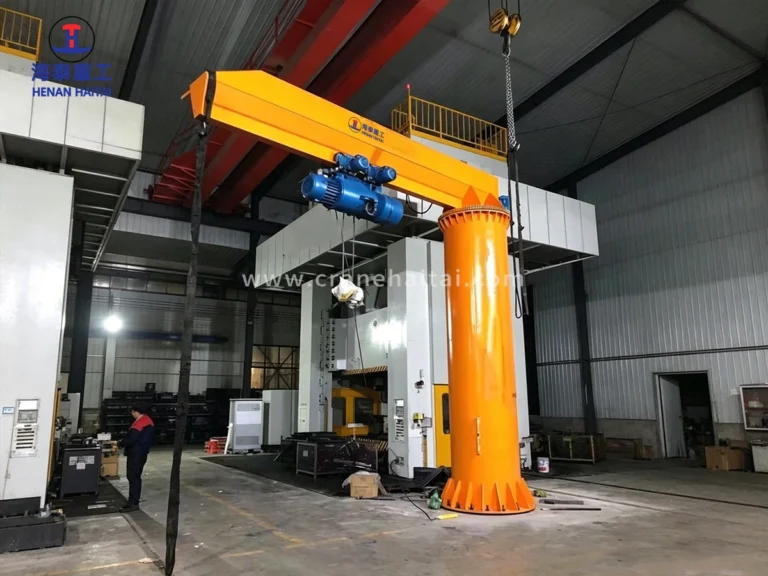
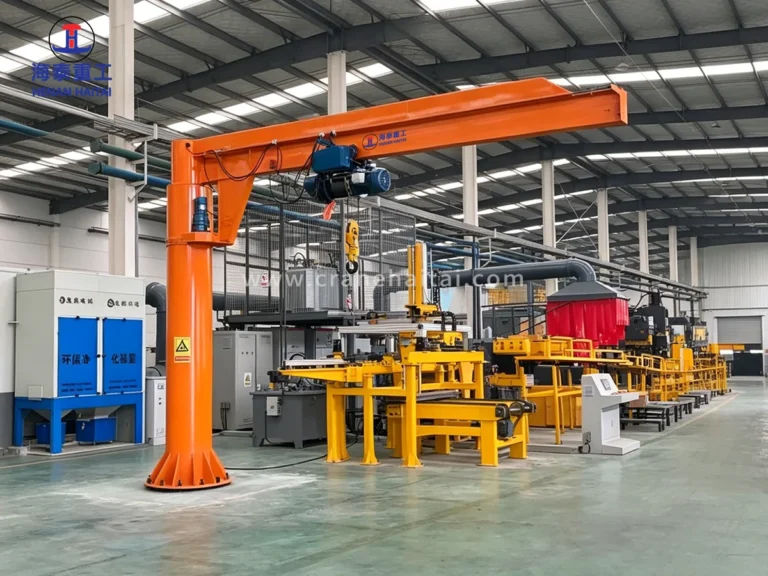
Type 1: Indoor Jib Crane (Pillar-Mounted Industrial Jib Crane)
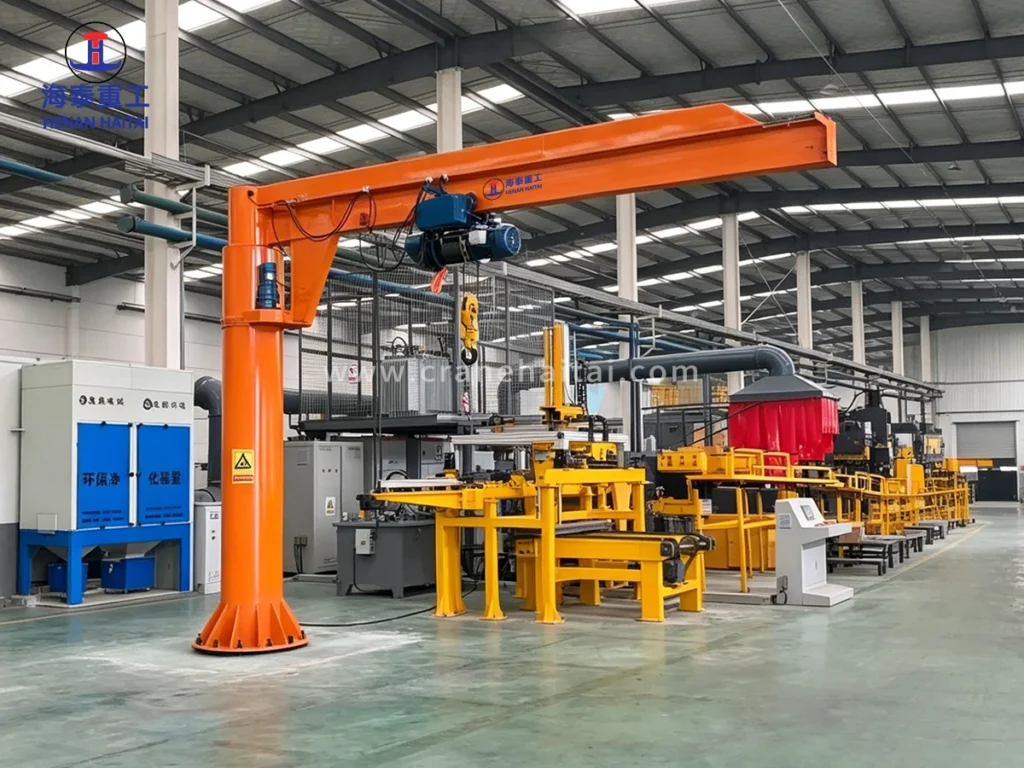
Indoor pillar-mounted jib cranes are the ultimate workhorse for indoor factories, machining workshops, assembly lines, and warehouse docks.
Features & Design
- Optimized for Tight Spaces: Compact Footprint that fits perfectly beside machines, workstations, or bays.
- Rotation Options: Available with 180° to a full 360° manual or motorized rotation (slewing).
- Hoisting System: Usually equipped with an electric wire rope hoist or a chain hoist for smooth, vertical movements.
- Power Supply: Powered by standard indoor electrical tracks or festoon cable systems.
Best Applications
- Machining & Assembly Workstations: Lifting heavy raw materials onto machinery or holding parts during assembly.
- Warehouse Load Handling: Quick, repetitive loading and unloading of pallets, parts, and equipment.
- Plant Maintenance: Safely moving heavy motors, tooling, and machinery parts during servicing.
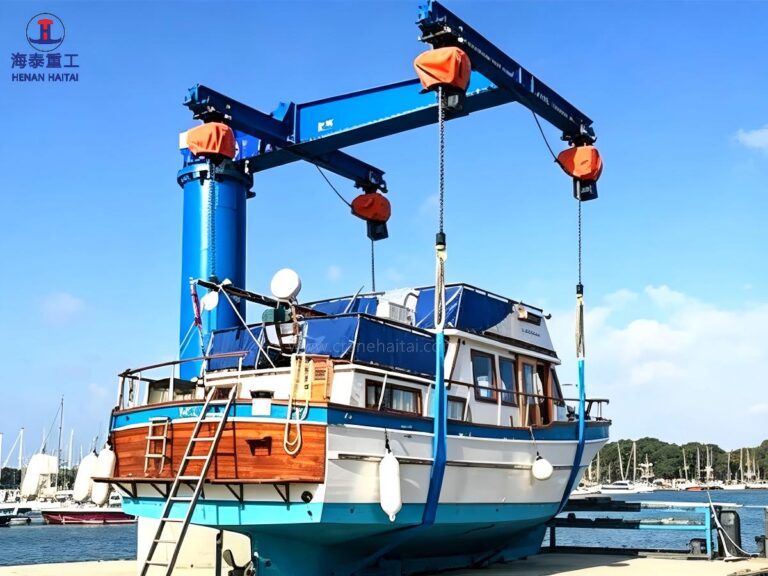
Type 2: Outdoor Marine Jib Crane (Heavy-Duty Marine JIb Crane)
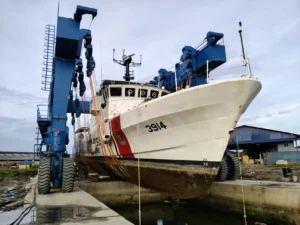
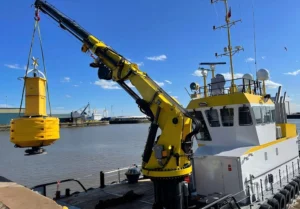
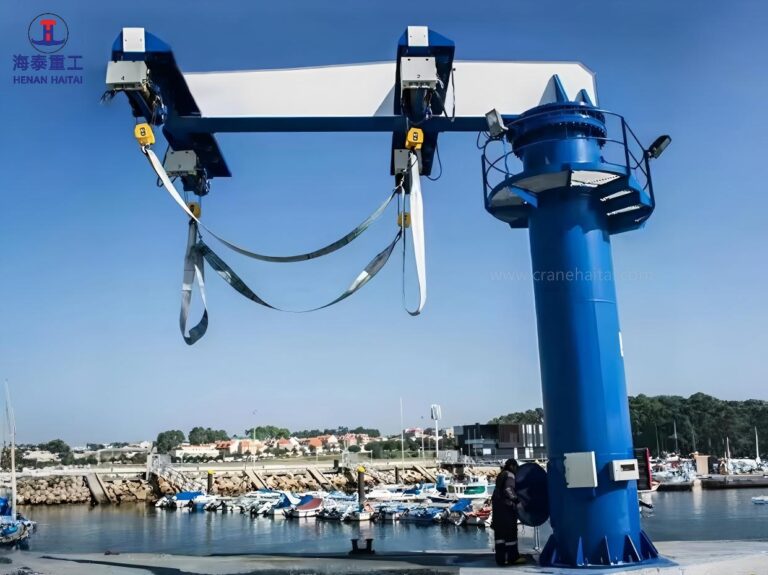
When you take the same “pillar” concept and put it next to saltwater, extreme weather, and massive hulls, you get the outdoor heavy-duty marine jib crane (also commonly called a boat jib crane).
Features & Design
- Heavy-Duty Construction: Often features a higher capacity and larger structural footprint to handle uneven boat loads.
- Corrosion & Weather Proofing: Built with specialized marine-grade coatings, galvanized components, and enclosed electrical systems to combat wind, rain, and saltwater.
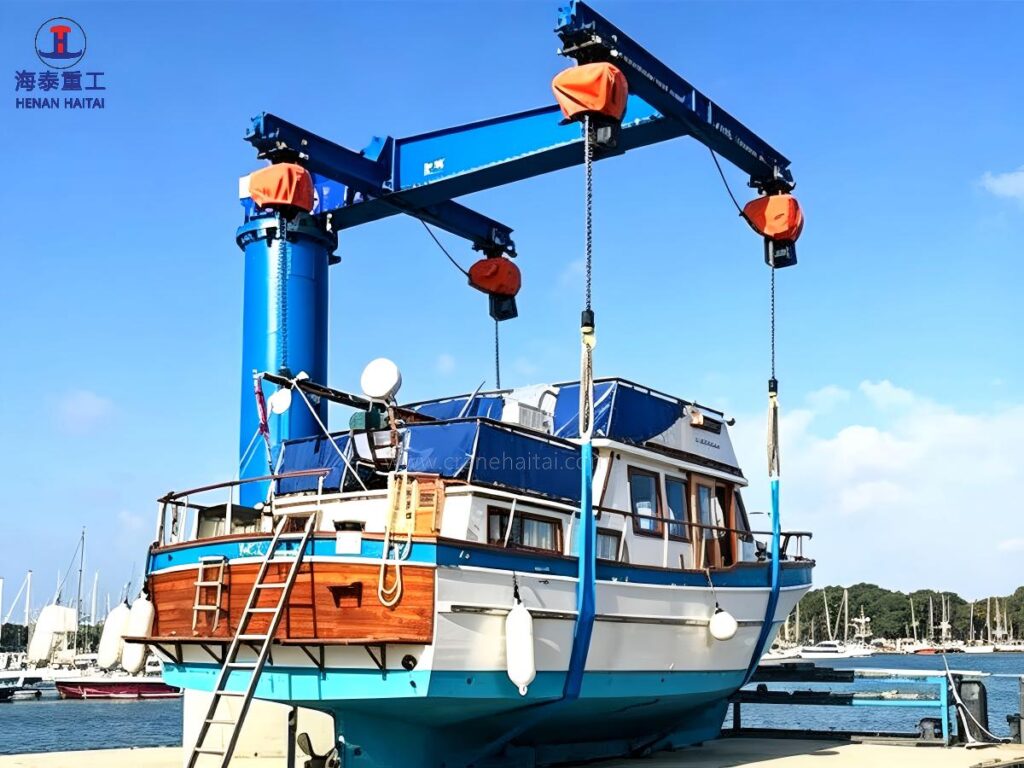
- Sling & Multi-point Rigging: Designed to connect securely to boat slings (as pictured) or custom yacht-lifting spreaders to evenly distribute weight and protect the hull.
- Precise Motorized Controls: Heavy-duty slewing (rotation) gear ensures smooth movement over open water even when wind and tides are factors.
Best Applications
- Marinas & Boat Yards: Hauling small to mid-sized yachts, sailboats, and workboats out of the water for maintenance, repair, or dry storage.
- Ports, Wharves & Docks: Loading and unloading cargo, heavy tools, and provisions from vessels to the pier.
- Offshore & Coastal Industries: Moving equipment, coastal defense materials, or marine supplies in harsh environments.
Main Differences: Indoor vs. Outdoor Pillar Jib Cranes
| Característica | Indoor Industrial Jib Crane | Outdoor Heavy-Duty Marine Jib Crane |
| Rated Load Ranges | 0.5-10 Tons | 0.5-20 Tons, Customized up to 50 Tons |
| Entorno típico | Workshops, factories, warehouses | Marinas, docks, boat yards, ports |
| Primary Targets | Machinery parts, pallets, tooling | Yachts, boats, coastal cargo, marine supplies |
| Protective Coatings | Standard industrial paint | Anti-corrosion, marine-grade epoxy coatings |
| Slewing Rotation | Manual or Electric (usually 360°) | Heavy-duty Motorized 360° |
| Water / Weather Resistance | Standard indoor enclosure rating | High-grade IP protection, waterproof covers for hoists/motors |
Why Choose Henan Haitai?
Haitai Crane – A Professional Jib Cranes Manufacturer
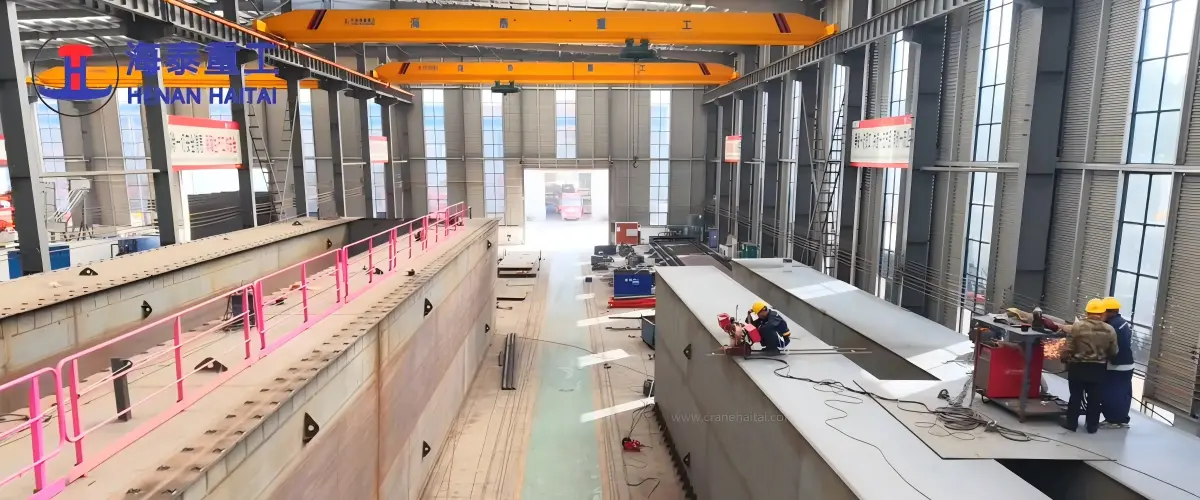
At Haitai Crane, we understand that no two workspaces are the same. A manufacturing workshop needs high efficiency, while a yacht club marina requires safety, rust prevention, and gentle handling.
- Tailor-made Design: Whether you need a 0.5-ton indoor workstation solution or a heavy-duty marine lifter, we customize height, span, and capacity to your needs.
- Reliability: Heavy-duty components, premium steel, and global-standard parts ensure your crane is built to last.
- Global Shipping & Setup: Based in Henan, China, we export and deliver tailored lifting solutions to ports, industrial sites, and marinas worldwide.
Have a specific lifting challenge or planning a shipyard upgrade? Talk to us today!
Contact Henan Haitai Heavy Industry Co., Ltd.
- Website: www.cranehaitai.com
- Correo electrónico: [email protected]
- Phone / WeChat / WhatsApp: +86 136 7352 1295
- Address: Huangling Town Industrial Zone, Fengqiu County, Henan Province, China.

FAQs about Haitai Jib Cranes
Q1: What is the maximum rotation angle for a pillar-mounted jib crane?
A: Standard pillar-mounted jib cranes from Haitai offer a full 360-degree rotation to maximize your working coverage. However, we can also customize the rotation to 180, 270 degrees, or add mechanical rotation limiters (stops) if your workspace has obstacles like walls, columns, or other machines that the boom must avoid.
Q2: What type of foundation is required for a freestanding pillar jib crane?
A: Because a pillar jib crane is self-supporting, it exerts significant downward, shear, and overturning force on the ground. A reinforced concrete foundation (concrete pour) is required, and its depth and size will depend on the crane’s capacity, span (arm length), and local soil conditions. Haitai will provide a custom foundation drawing and anchor bolt pattern for your local team to prepare before the crane arrives.
Q3: Can the rotation (slewing) be motorized, or is it always manual?
A: It can be both! For smaller capacities (typically under 2 tons) or shorter boom lengths, manual (hand-push) rotation is often sufficient and cost-effective. For heavier loads, long spans, or outdoor marine applications (where wind and tides add resistance), we strongly recommend motorized rotation (electrical slewing) for precise, effortless, and safe operation.
Q4: How do you protect outdoor marine jib cranes from rust and harsh coastal weather?
A: Outdoor and marine environments are highly corrosive, so Haitai applies specialized marine-grade protection, including:
- Anti-corrosion Coatings: Multi-layer marine epoxy paint systems (sandblasting + zinc-rich primer + intermediate & polyurethane topcoats).
- IP-rated Components: High-protection outdoor/marine motors, hoists, and electrical enclosures (IP55/IP65 or higher) with waterproof covers.
- Corrosion-resistant Hardware: Stainless steel or galvanized fasteners, fittings, and cables where applicable.
Q5: What safety features are included with your jib cranes?
A: Safety is our top priority. Our jib cranes come equipped with:
- Overload Limiters: To prevent lifting loads beyond the rated capacity.
- Limit Switches: For both hoisting (lifting) and travel (trolley/rotation) to prevent over-travel.
- Emergency Stop Button: On the pendant or remote control to cut power instantly in an emergency.
- Safety Latches: On the hooks to prevent slings or loads from slipping out.
- Slewing Buffer/Brake: For motorized models to ensure smooth stops and prevent load swinging.