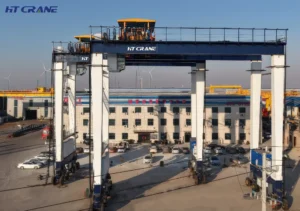
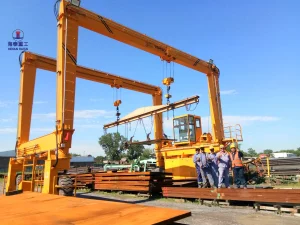
If you’re ready to specify a grúa pórtico hidráulica, this page covers everything from technical parameters to pricing and ordering. The full production range runs from 10 to 1,000 tons across three configurations — wheel-mounted for site flexibility, rail-mounted for high-cycle fixed installations, and folding for access-restricted or international project delivery. All models meet CE and ISO 4301-1 standards. Standard warranty is 24 months from commissioning date.
Product Models and Full Technical Specifications
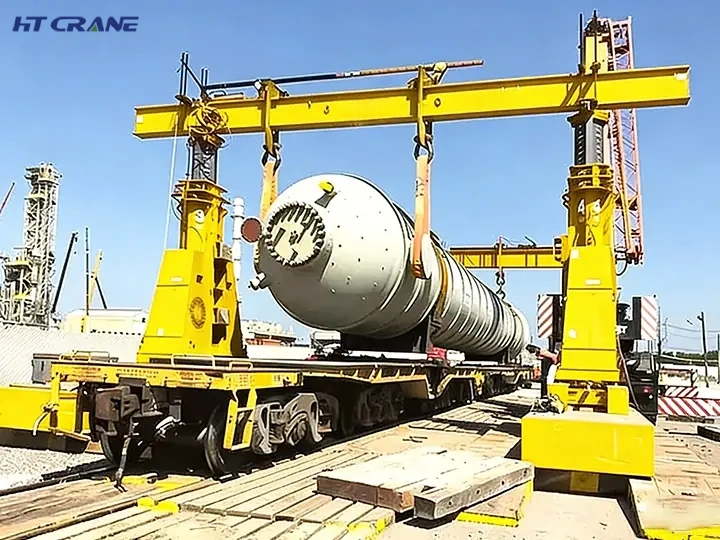
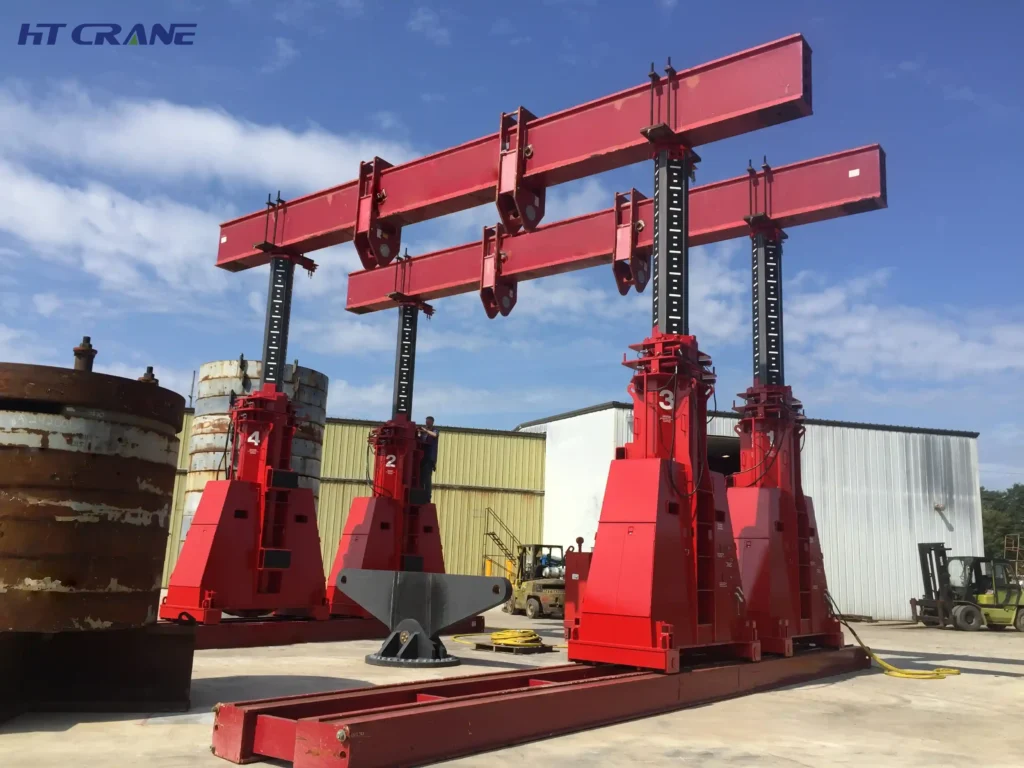

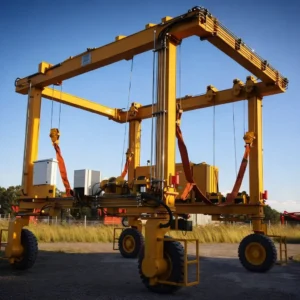
Grúa pórtico hidráulica montada sobre ruedas
The wheel-mounted model travels on rubber wheels or steel casters across any stable floor surface, with no rail installation required. It repositions freely between lift points, moves between bays within the same facility, or transfers to a different site entirely without runway infrastructure. Travel speed under full load runs from 3 to 8 m/min.
Best-fit scenarios: multi-position lifts during planned shutdowns, facilities without existing crane runways, projects where the lifting sequence cannot be fixed to a single travel axis, and sites requiring frequent crane relocation.
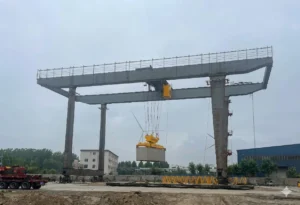
Grúa pórtico hidráulica montada sobre raíles
The rail-mounted model runs on fixed ground-level rails, delivering greater structural stability during loaded travel and more predictable ground pressure distribution across the rail length. For long-travel operations in industrial corridors — steel plant maintenance bays, shipbuilding berths, precast manufacturing yards — the rail configuration outperforms trackless alternatives in both precision and long-term structural performance.
Best-fit scenarios: permanent or semi-permanent installations with a defined travel path, facilities with existing runway infrastructure, high-cycle operations requiring consistent travel precision.
Grúa pórtico hidráulica plegable
The folding model reduces to standard container shipping dimensions for international project delivery or access-restricted sites. On arrival it deploys and locks into operational configuration without heavy auxiliary equipment. Folding does not compromise lifting capacity or synchronization accuracy — the same PLC control and ±1mm synchronization standard applies across all three configurations.
Best-fit scenarios: international EPC projects, sites with restricted access points, civil and infrastructure projects requiring crane transport through constrained entry paths.
Configuration Decision Matrix
| Wheel-Mounted | Rail-Mounted | Folding | |
|---|---|---|---|
| Rail installation required | No | Sí | No |
| Lo mejor para | Multi-position lifts | Fixed-path, high-cycle | Remote/international sites |
| Travel flexibility | Alto | Bajo | Alto |
| Structural stability (travel) | Medio | Alto | Medio |
| Shipping footprint | Estándar | Estándar | Mínimo |
| Ideal installation type | Temporary / portable | Permanent / semi-permanent | Project-based |
Price Reference Guide
What Determines the Final Price
Five variables drive the quotation for any hydraulic gantry crane project:
Capacidad de levantamiento is the primary cost driver — cylinder bore, structural steel section, and hydraulic system scale with tonnage. Durar affects crossbeam section and column base frame width; spans above 20 m require heavier structural engineering. Column stage configuration (2-, 3-, or 4-stage telescopic) adds cost at higher stage counts due to increased precision manufacturing requirements. Travel mode — rail versus trackless — affects the base frame and wheel assembly specification. Work duty class (A5 through A8 under ISO 4301-1) determines structural fatigue design life; A7 and A8 require heavier sections and more conservative design factors.
Custom requirements — corrosion-resistant coatings, explosion-proof electrical systems, extended operating temperature range, self-propelled chassis upgrades — are priced separately based on project scope.
Indicative Price Ranges by Capacity Tier
| Capacidad | Indicative FOB Price (USD) | Typical Configuration |
|---|---|---|
| 10 – 50 t | $18,000 – $55,000 | Standard wheel-mounted or folding, 2–3 stage |
| 50 – 200 t | $55,000 – $180,000 | Wheel-mounted or rail-mounted, 3 stage, custom span |
| 200 – 500 t | $180,000 – $420,000 | Rail-mounted, 4 stage, full engineering package |
| 500 – 1,000 t | $420,000+ | Full custom project scope, FAT, on-site commissioning |
All prices are indicative market references, FOB factory. Final quotation requires confirmed capacity, span, lifting height, duty class, and site conditions.
What a Factory-Direct Quote Includes
A factory-direct quotation from our facility covers: complete crane system (frame, lifting mechanism, traveling mechanism, HPU, control system, safety devices), factory acceptance test report, CE Declaration of Conformity, structural and electrical design documentation, and standard 24-month warranty. Freight, installation, commissioning, and operator training are quoted separately and can be bundled as a turnkey package on request.

Custom Configuration Options
Standard vs Custom Parameters
Every production model is configurable at the design stage. The following parameters can all be specified to match project requirements:
| Parámetro | Gama estándar | Custom Options |
|---|---|---|
| Capacidad de levantamiento | 10 – 1,000 t | Beyond 1,000 t by project |
| Durar | 8 – 35 m | Extended on request |
| Altura de elevación | 4,5 – 12 m | Extended with additional column stages |
| Column stages | 2 / 3 / 4 | Matched to headroom and lift height |
| Travel mode | Wheel / Rail | Self-propelled chassis upgrade available |
| Work duty | A5 – A8 | Per ISO 4301-1 |
| Fuente de alimentación | AC 380V / Diesel HPU | Dual-supply available |
| Operating temperature | -20°C a +50°C | Extended range on request |
Industry-Specific Configurations
Power generation projects typically specify 3- or 4-stage columns to accommodate generator stator and transformer core installation heights, combined with A6–A7 duty classification for maintenance cycle demands. Shipbuilding applications commonly require A7–A8 duty, extended span to cover berth widths, and multi-point synchronized lift configurations for hull block assembly. Civil infrastructure and underground projects — metro stations, TBM assembly chambers — prioritize low collapsed transport height and compact base frame dimensions for site access.
Special Environment Options
For marine and coastal environments: hot-dip galvanized structural steel and marine-grade electrical enclosures. For chemical plant and petrochemical applications: explosion-proof HPU and electrical control systems (ATEX certification available). For steel plant environments operating above the standard temperature ceiling: thermal insulation on hydraulic lines and high-temperature seal packages. All special environment configurations are engineered to order — share your site conditions at the inquiry stage.
Certifications and Quality Assurance
CE Marking and ISO 4301-1 Compliance
All production units are CE marked under the EU Machinery Directive. Structural design follows ISO 4301-1 duty classification standards. Safety performance meets the requirements of EN 13157 for manually and hydraulically operated lifting equipment. The complete Declaration of Conformity is issued with every unit and forms part of the standard delivery documentation.
Factory Acceptance Testing
Every crane undergoes full load testing at our factory before shipment. FAT covers: rated load lift test, overload test at 110% rated capacity, synchronization accuracy verification across all lifting points, travel mechanism function test, and safety device validation. Buyers are welcome to witness FAT in person or via live video link. Test reports and certificates are issued upon completion and ship with the equipment.
Garantía
Standard warranty: 24 months from commissioning date, covering structural, mechanical, and electrical components under normal operating conditions. Extended warranty and multi-year service contracts are available for fleet operators and facilities running A7–A8 duty cycles.
How to Order
What to Prepare Before Requesting a Quote
To receive a detailed technical proposal within 24 hours, provide the following at inquiry stage:
- Required lifting capacity (tons) and load center of gravity if known
- Required span and lifting height
- Intended travel mode (wheel-mounted / rail-mounted / folding)
- Work duty class or operating cycle description (lifts per shift, hours per day)
- Site conditions: indoor / outdoor, available headroom, floor type and load capacity
- Power supply availability: AC grid voltage and frequency, or diesel HPU required
- Any special environment requirements (temperature range, corrosion, explosion-proof)
The more complete your specification, the faster and more accurate the proposal. Our engineering team will follow up with layout drawings and load calculations at no cost before purchase commitment.
Inquiry to Delivery: Process Timeline
| Stage | Typical Duration |
|---|---|
| Technical proposal and quotation | Within 24 hours of inquiry |
| Engineering drawings and approval | 1–2 weeks |
| Production | 4–10 weeks (capacity and configuration dependent) |
| Factory Acceptance Testing | 1–3 days |
| Shipment | Per freight schedule |
| On-site installation and commissioning | 3–7 days (system size dependent) |
After-Sales: Spare Parts and Maintenance
Critical components — hydraulic cylinders, HPU pump assemblies, PLC modules, proportional valves, control pendants — are stocked for dispatch within 48–72 hours. Long-term spare parts supply agreements are available. Preventive maintenance contracts cover annual inspections, lubrication, wear part replacement, and safety audits. Remote diagnostics via our crane monitoring platform allows early fault identification before unplanned downtime occurs.
Conclusión
A hydraulic gantry crane purchase is an engineering decision as much as a procurement one. Capacity, span, duty class, and site conditions all affect which configuration delivers the performance and service life your project requires. Getting the specification right at the inquiry stage — rather than adjusting after delivery — is where the real cost saving happens.
Before you submit an inquiry:
- Confirm your maximum load weight and center of gravity, not just the nominal equipment weight.
- Specify the correct ISO 4301-1 duty class for your actual operating cycle — not the lightest class that technically covers your capacity.
- Request the CE Declaration of Conformity and FAT report as mandatory delivery documents, not optional additions.
Preguntas frecuentes
Q1: What is the minimum order quantity?
Single-unit orders are accepted. There is no minimum order quantity requirement. For fleet procurement or multi-unit projects — such as a precast manufacturing facility requiring multiple gantries for different bay widths — we offer volume pricing and a consolidated engineering package covering all units under a single project specification. Contact our team to discuss multi-unit configurations.
Q2: What is the typical production and delivery lead time?
Production lead time runs from 4 to 10 weeks depending on lifting capacity, column configuration, and current factory schedule. Standard configurations in the 10–200 ton range typically ship within 4–6 weeks. Custom-engineered units above 200 tons, or units with special environment specifications, run 8–10 weeks. Expedited scheduling is available for urgent project timelines — discuss your delivery requirement at the inquiry stage.
Q3: Can we visit the factory or witness the FAT before shipment?
Yes. Factory visits are welcome at any stage of production, and buyer witness of Factory Acceptance Testing is standard practice for capital equipment purchases of this type. If in-person attendance is not possible, FAT can be conducted via live video with documentation sent electronically. All test reports and certificates are issued immediately upon FAT completion.
Q4: How does the A5–A8 duty classification affect maintenance intervals?
Duty class directly determines the design fatigue life of the structural and mechanical components. An A5 crane designed for moderate operating cycles will require more frequent structural inspection and earlier major component replacement if operated at A7 or A8 intensity. Conversely, specifying A7 for a low-cycle application adds cost without benefit. Our engineering team will recommend the appropriate duty class based on your operating cycle description — lifts per shift, operating hours per day, and load spectrum — so maintenance intervals are realistic and warranty coverage applies correctly.
Q5: What technical information is required to generate an accurate quotation?
The minimum required: lifting capacity, span, lifting height, travel mode preference, and site power supply. A complete specification — including duty class, operating cycle description, floor conditions, headroom measurements, and any special environment requirements — allows us to produce a full technical proposal with layout drawings and load calculations rather than a broad indicative range. The more detail provided at the inquiry stage, the more precise and useful the proposal will be.