Boat crane lift” covers five distinct equipment categories — from a $800 quayside jib crane for engine hoisting to a $500,000+ marine travel lift for full vessel haul-out. Selecting the wrong type means either overpaying significantly or operating outside your crane’s legal load limit. This guide breaks down every major type by structure, capacity, and application, then gives you a step-by-step selection framework so your first supplier conversation is a specification discussion, not a guessing exercise.
Quick Reference: Boat Crane Lift Types at a Glance
| Tipo | Rango de capacidad | Aplicación principal | Indicative FOB Price |
|---|---|---|---|
| Grúa de pluma para barcos | 500 kg – 10T | Quayside engine, mast & gear hoisting | $800 – $15,000 |
| Wall-Mounted Jib Crane | 250 kg – 2T | Space-constrained wharfs & repair bays | $600 – $5,500 |
| Marine Gantry Crane | 2T – 50T+ | Vessel component lifting & small craft launch | $8,000 – $80,000+ |
| Elevador de viaje marino | 15T – 1,000T+ | Full vessel haul-out & launch | $40,000 – $500,000+ |
| Davit Crane | 50 kg – 500 kg | Tender launch, life raft, vessel-mounted use | $300 – $4,000 |
Prices are indicative FOB factory. Final cost depends on capacity, boom reach, hoist type, certification level, and surface treatment specification.
→ Not sure which type fits your operation? Request a Free Specification Review — our engineering team responds within 24 hours.
The 5 Main Types of Boat Crane Lift: Structures, Configurations & Applications
Understanding what each crane type is engineered to do — and equally important, what it is not designed for — prevents the most common and costly selection errors. The categories below are defined by structural form, rated load range, and the specific marine lifting task they are built to perform.
Boat Jib Crane: The Quayside Workhorse
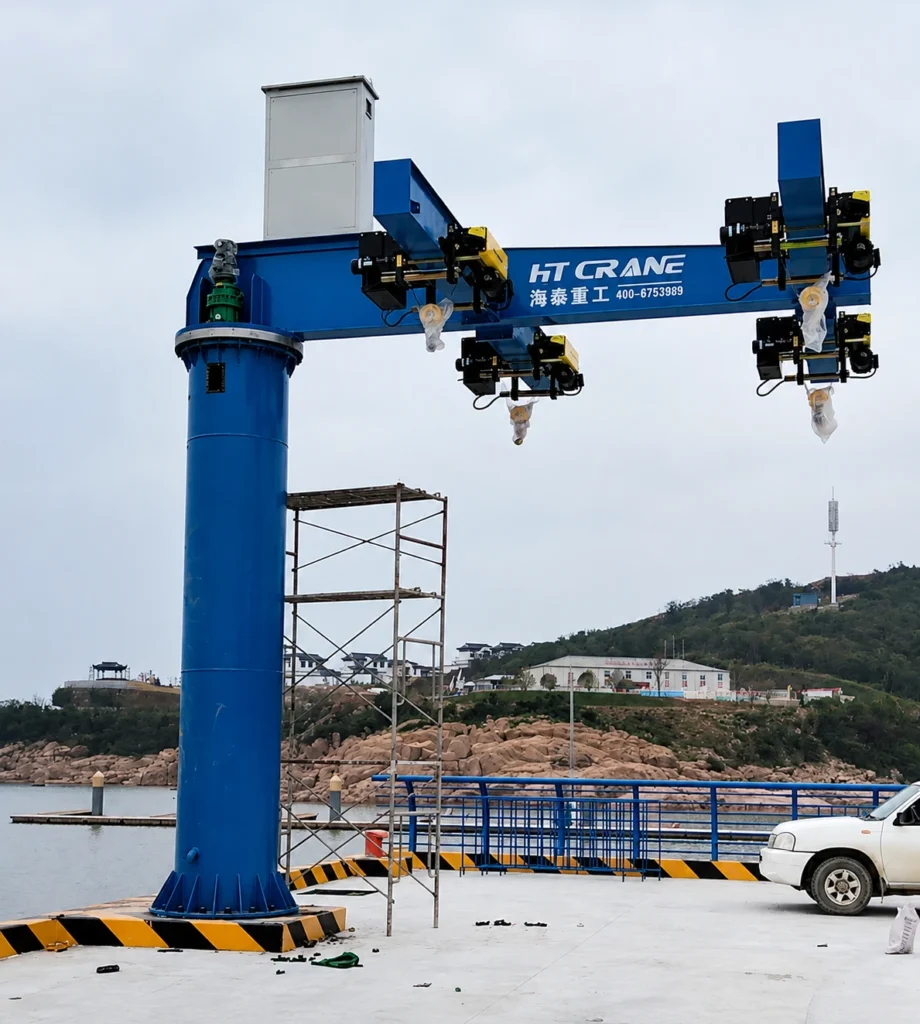
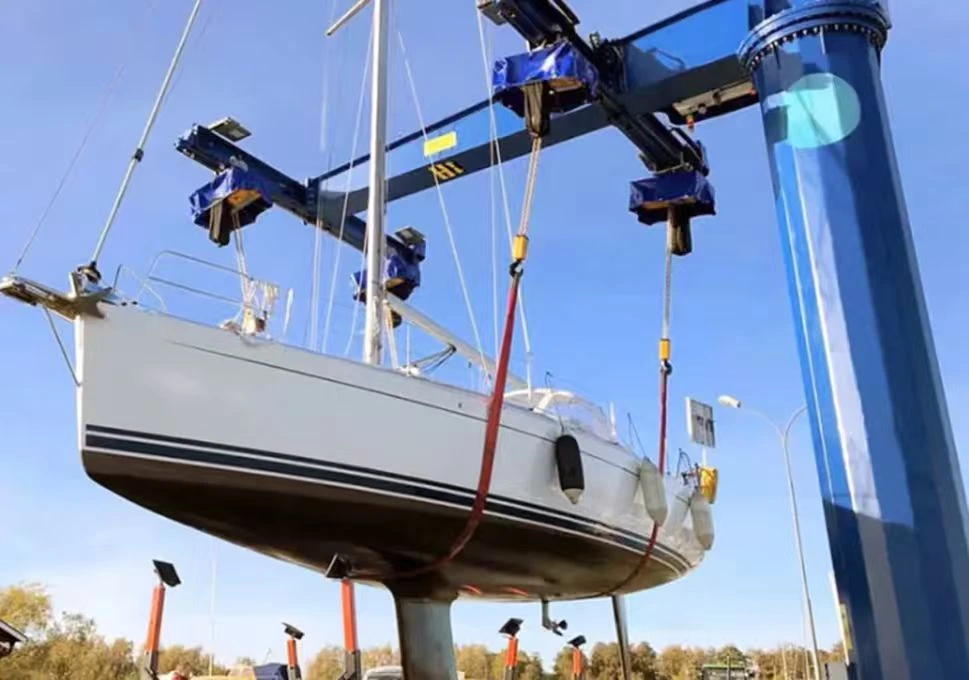
The Boat Jib Crane is the most widely used boat crane lift type for permanent marina and boatyard quayside installations. Its structure is straightforward: a vertical steel column, typically fabricated from structural hollow section or rolled I-beam, is anchor-bolted to a reinforced concrete foundation pad. A horizontal or inclined boom projects from the upper section of the column, carrying a trolley and hoist assembly that travels along the boom’s length.
Structural variants and configurations: The boom can be a plain I-beam profile (lower cost, suited for manual hoist applications) or a box-section fabrication (stiffer, preferred for longer reaches and electric hoist installations). Rotation mechanisms are either slew-ring bearing assemblies for full 360° rotation, or top-and-bottom pivot arrangements for 180°–270° arcs. Electric slewing drives are available for heavy or frequently rotated loads; manual rotation with a push handle is standard for lighter applications.
Capacity and reach combinations: Standard catalogue units run from 500 kg with a 3-metre boom through to 5T with a 10-metre boom. Custom configurations extend to 10T and beyond for commercial port applications. A critical point buyers frequently overlook: the rated capacity is specified at the maximum boom reach. A crane rated 2T at 6 metres may be rated 2.5T at 5 metres and 3T at 4 metres — the load-reach relationship is non-linear. Always request the load diagram, not just the headline capacity.
Aplicaciones típicas: Engine and gearbox removal, mast stepping and unstepping, outboard motor servicing and storage, chandlery pallet handling at the quayside, and general component positioning during vessel repair. The Boat Jib Crane covers the majority of daily lifting tasks at a marina or small boatyard at a cost that is an order of magnitude lower than a gantry or travel lift.
Hoist options: Manual chain hoists (lower capital cost, no power supply required, suited to infrequent low-cycle use) and electric chain hoists (faster cycle times, lower operator fatigue, required for daily multi-lift operations). Electric hoists add $400–$1,200 to the base crane cost for standard 1T–3T units.
Marine Gantry Crane: Structured Capacity for Multi-Task Yards
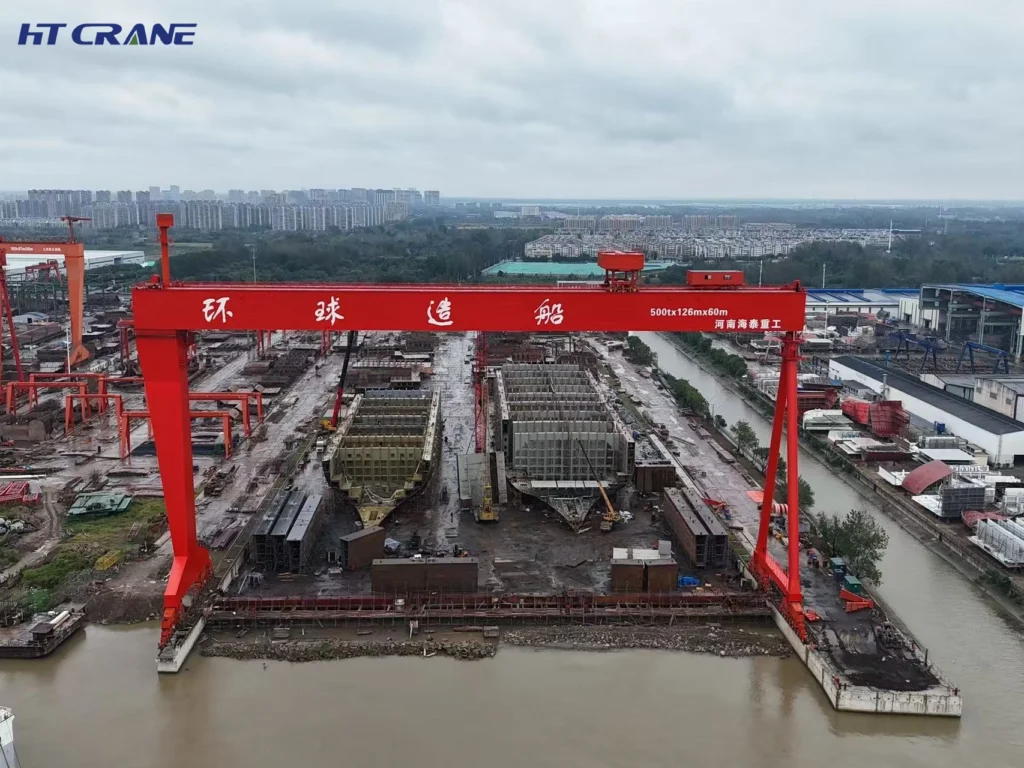
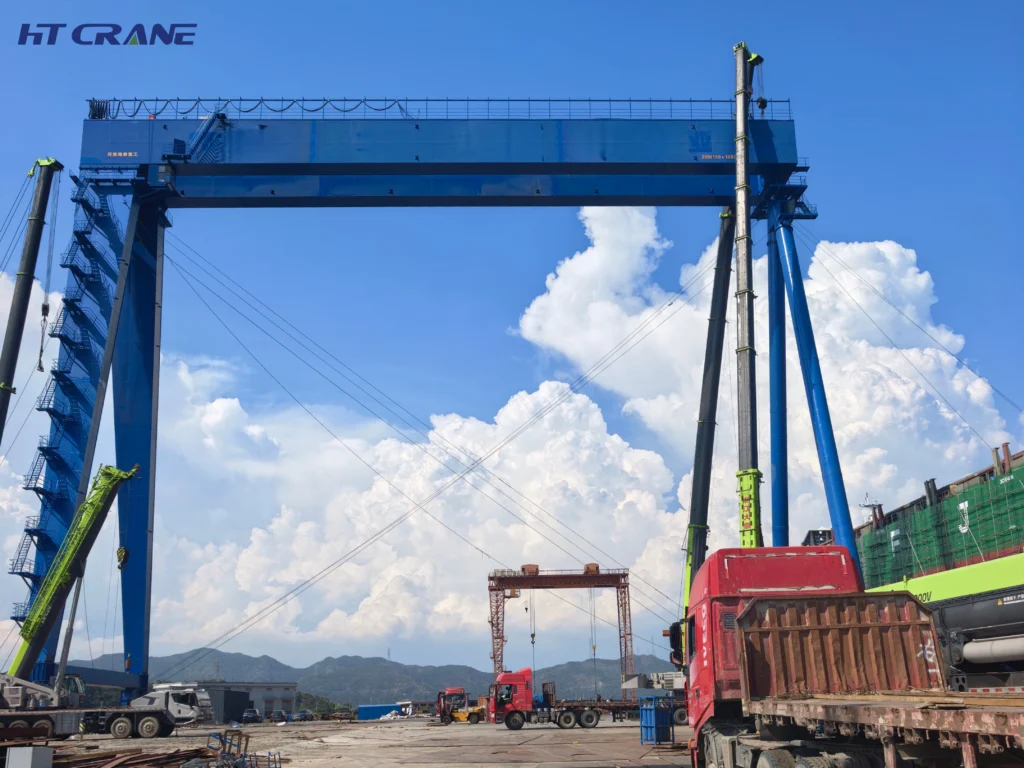
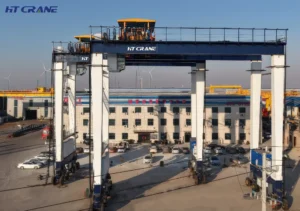
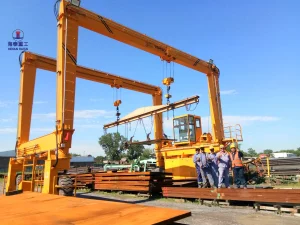
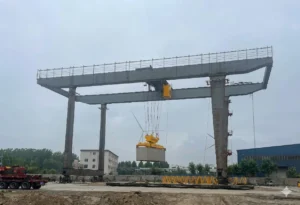
A marine gantry crane consists of a bridge beam spanning between two vertical legs, each running on a rail or runway track laid at ground level. The hoist trolley travels across the bridge span; the entire crane travels along the rails, giving access to any point within a defined rectangular lifting zone. This travel-plus-traverse capability makes the gantry fundamentally more flexible than a jib crane for yards that need to move loads horizontally over significant distances.
Structure and drive configurations: Single-girder gantries (one bridge beam) cover capacities from 2T to approximately 20T and are the most common configuration for small-to-medium boatyards. Double-girder gantries (two parallel bridge beams with a crab trolley between them) handle heavier capacities from 10T upward where headroom and load weight require a more rigid structure. Travel drives can be manual (push-along) for light, infrequent use, or electric (with pendant or radio remote control) for production boatyards with multiple lifts per day.
Rail and foundation requirements: This is where gantry cranes differ most significantly from jib cranes in terms of site preparation cost. Rails must be set in concrete beams sized to the crane’s wheel loads across the full travel length of the installation. For a 10T gantry with 20-metre travel, this is a substantial civil works package — typically $15,000–$40,000 in foundation and rail work on top of the crane purchase price. Budget for this from the outset; it is the most common cause of gantry crane project cost overruns.
Aplicaciones típicas: Lifting fibreglass or aluminium hull sections during boatbuilding, positioning keel assemblies and engine beds, handling large outboard or stern-drive units, lifting complete small craft (RIBs, day boats, small trailer-sailers) for cradle storage or hull inspection. For vessels up to approximately 5–8 tonnes displacement in good sling access conditions, a marine gantry crane is a practical and significantly cheaper alternative to a travel lift.
Marine Travel Lift: The Standard for Full Vessel Haul-Out
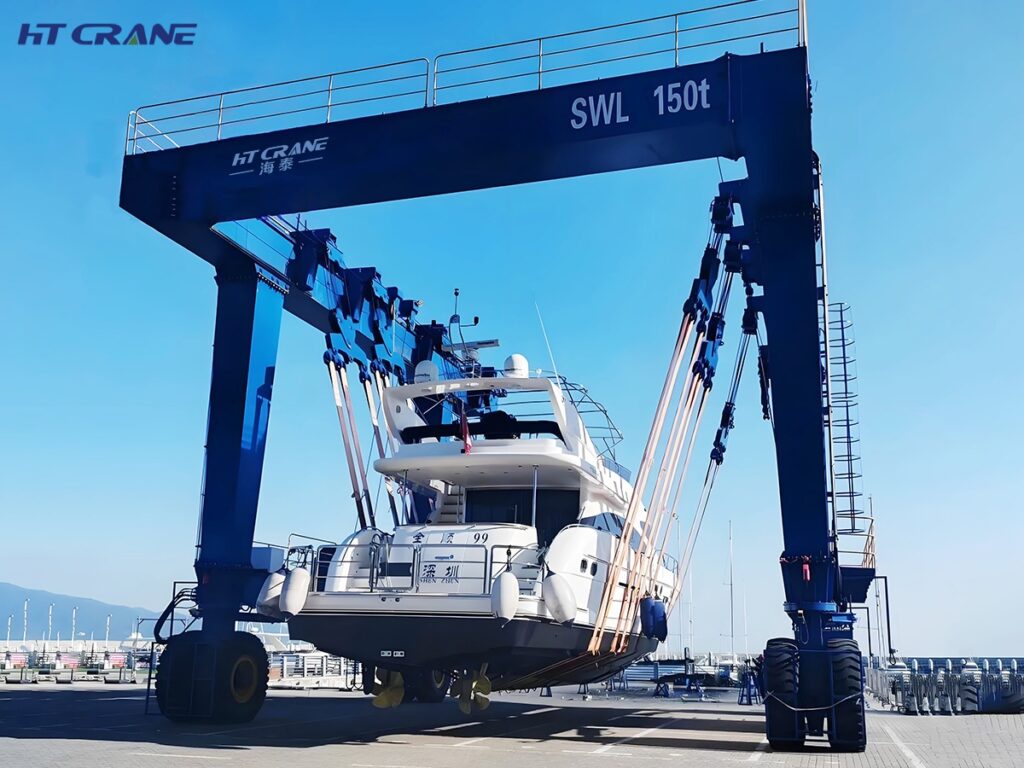
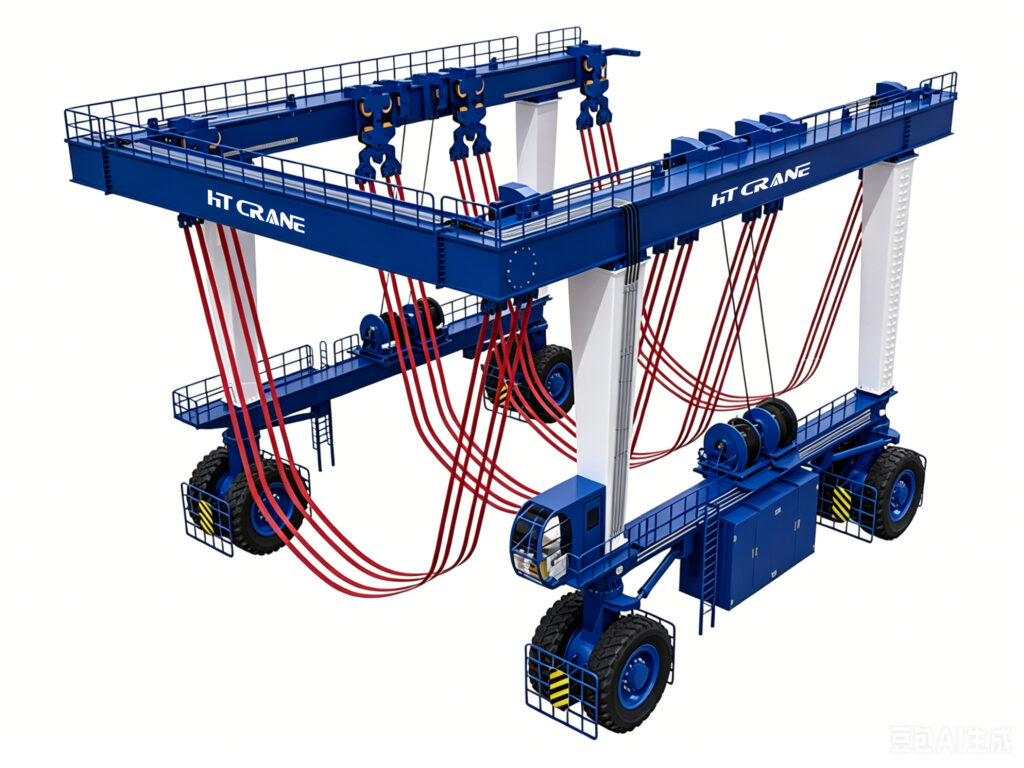
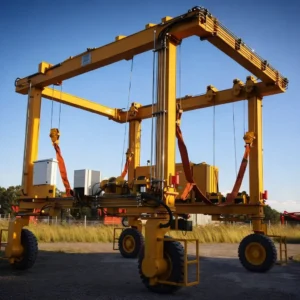
El marine travel lift — also called a boat hoist, mobile boat hoist, or syncrolift in some configurations — is the industry-standard equipment for lifting complete vessels out of the water and transporting them to a storage or work position ashore. It does not fit the same product category as the crane types above; it is a self-propelled wheeled machine that straddles the vessel in a specially constructed haul-out slip, passes lifting slings under the hull, and raises the vessel clear of the water on its own hydraulic or mechanical lifting system.
Capacity range and scale: Units start at 15T SWL for small yacht marinas and scale to 1,000T+ for commercial shipyard applications. The 35T–75T range covers the majority of recreational marina applications — this handles monohull sailing yachts up to approximately 60 feet LOA and powerboats of equivalent displacement. Above 100T, units are typically custom-engineered for specific vessel types.
Civil infrastructure: A travel lift installation requires a reinforced haul-out ramp of defined width, depth, and slope (typically 1:10 to 1:15 gradient), hardstanding areas for vessel storage with load-rated surface, and a turning circle or straight travel lane wide enough for the machine with vessel suspended. Site civil costs for a new travel lift installation routinely exceed the machine purchase price for smaller yards. This is not a crane to specify without a full site civil assessment.
When a travel lift is the right answer: Any operation where full hull haul-out, bottom painting, antifouling, keel inspection, or propeller shaft work is a routine service offering. For marinas with 50+ berths regularly servicing vessels over 10 metres LOA, a travel lift is operationally necessary — no jib crane or gantry arrangement is a substitute for routine full vessel haul-out.
Davit Crane: Vessel-Mounted Light Lifting
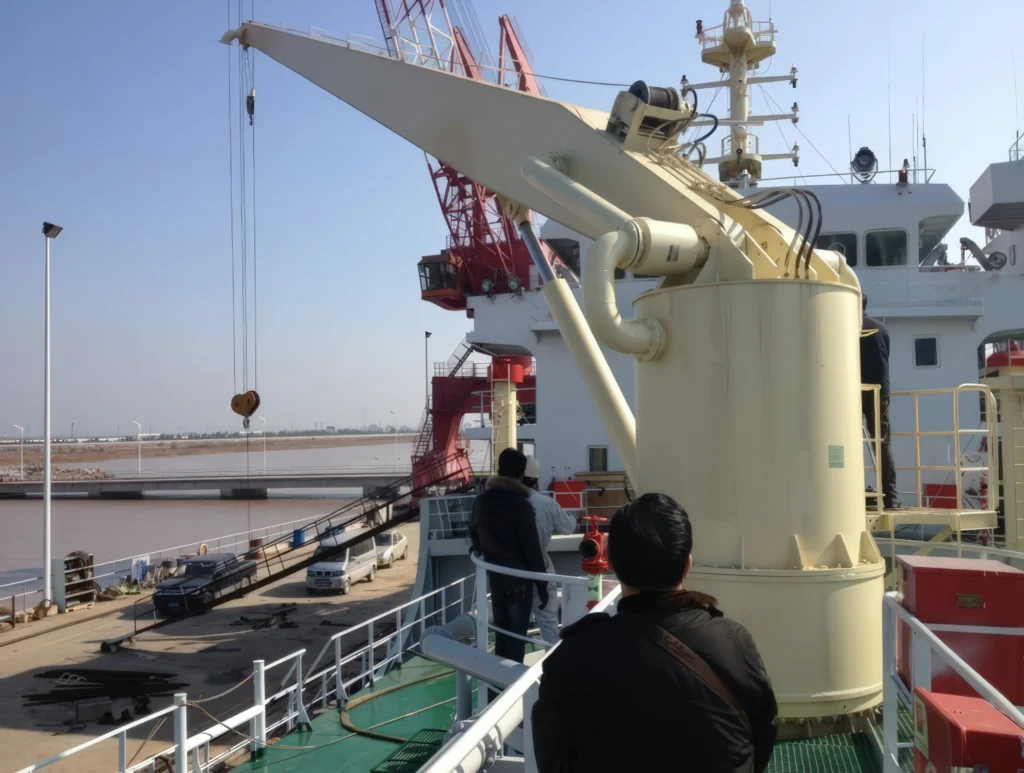

Davit cranes are compact, fixed-arm or articulating-arm lifting devices designed for vessel-mounted installation or light shore-side use at capacities below 500 kg. They are purpose-built for specific tasks: launching and recovering rigid inflatable tenders, retrieving life rafts from stowage positions, handling dive equipment, or lifting small loads over a vessel’s gunwale.
Why they appear in boat crane lift searches: Buyers new to the category sometimes search broadly and land on davit specifications when they actually need a fixed quayside crane. The distinction is straightforward — if the lifting task is quayside component handling, the equipment is a fixed jib crane. If the task is vessel-mounted or involves loads under 300 kg at very low frequency from a floating platform, a davit is the correct and significantly cheaper solution. Conflating the two categories leads to either dangerous under-rating (using a davit for a 400 kg engine) or unnecessary cost (purchasing a 1T jib crane for a 80 kg tender recovery application).
How to Select the Right Boat Crane Lift: A Step-by-Step Framework
Step 1 — Define the Lift Task in Precise Terms
Before any capacity or product discussion, write down the answers to four questions: What is being lifted? What is its weight including all rigging hardware (slings, shackles, spreader bars)? Where does the load start and where does it need to go? How many times per day, week, or month will this lift be performed? These four answers determine capacity class, hoist type, duty classification, and — in many cases — which of the five crane types above is the only viable option for the application.
A 480 kg marine diesel engine lifted weekly from a pontoon to a workshop bench is a 1T jib crane application. A 6-metre fibreglass hull lifted monthly from the water to a storage cradle ashore is a gantry or travel lift application. No amount of budget pressure changes this; the physics of the task determine the equipment category.
Step 2 — Calculate Gross Hook Load, Not Bare Component Weight
Rated crane capacity refers to the hook load — the total weight suspended from the hoist hook at any moment. This includes the component itself, plus all lifting tackle: slings, chains, shackles, spreader beams, and any purpose-built lifting frames. A 900 kg engine block lifted with a 40 kg spreader beam, two 8 kg chain slings, and four 2 kg shackles presents a 964 kg hook load. A 1T crane is still compliant in this case; a 500 kg crane is not, regardless of what the bare engine weighs.
As a practical working rule: add 10–15% to your heaviest bare component weight as a minimum rigging allowance when selecting the capacity class. For complex multi-point lifts with custom lifting frames, request a detailed rigging weight schedule before confirming the crane specification.
Step 3 — Confirm Boom Reach Against Your Site Geometry
This step is where specification errors most commonly occur on jib crane selections. The boom reach must place the hoist hook directly over the load pick point at the required operating radius — not approximately over it, and not at a reduced radius that forces the operator to swing the load manually into position.
Measure the horizontal distance from your intended crane pillar centre (or wall bracket position) to the farthest point where the hook needs to operate. Add 300–500 mm of clearance margin. That is your minimum required boom reach. Then check the manufacturer’s load diagram to confirm the crane’s rated capacity at that reach — it will be lower than the headline capacity at maximum reach, and you need to verify it still exceeds your gross hook load.
Step 4 — Assign the Correct Duty Class
Crane duty classification under FEM (Fédération Européenne de la Manutention) or ISO 4301 standards defines the structural and mechanical design requirements based on annual lift cycles and load spectrum. For marine and boatyard applications:
| Clase de servicio | Annual Lift Cycles | Aplicación típica |
|---|---|---|
| FEM 1Am (ISO M3) | Up to 3,200 | Seasonal marina, weekly maintenance lifts |
| FEM 2m (ISO M4) | Up to 12,500 | Active boatyard, daily single-shift use |
| FEM 3m (ISO M5) | Up to 50,000 | Multi-shift commercial yard, daily production use |
Specifying FEM 1Am for a crane used ten times daily in a commercial haulout operation is a structural design error. The crane will reach its calculated fatigue life in a fraction of the expected service period. Confirm duty class in writing with the manufacturer, and ensure it is documented in the structural calculation report supplied with the crane.
Step 5 — Verify Site Civil Capacity Before Ordering
Every crane type imposes specific loads on the structure it is mounted to or founded on. A Boat Jib Crane transmits a vertical load (crane self-weight plus hook load) and a horizontal bending moment (the overturning effect of the load at distance from the pillar centreline) to its foundation. The bending moment is frequently larger than the vertical load and governs foundation design. Request the base reaction force data sheet from the manufacturer — a reputable supplier will provide this as standard with any quotation.
For wall-mounted cranes, the wall or structure must be assessed by a qualified structural engineer using the manufacturer’s bracket reaction forces before the order is placed. For gantry cranes, the rail foundation must be designed to the manufacturer’s wheel load data across the full travel length. Skipping the civil capacity verification is the single most common cause of installation delays and post-installation structural failures.
Step 6 — Confirm Certification and Documentation Requirements Early
For any commercial or port authority-controlled installation, define the required certification package before requesting quotations — not after. The standard package for a fixed jib crane or gantry in a European or internationally traded port context includes: CE Declaration of Conformity (EN 13001 structural design, EN 15011 design rules for bridge and jib cranes), third-party load test certificate at 125% SWL, operator and maintenance manual, and foundation load data sheet. For floating structures or vessels, classification society approval (DNV, Lloyd’s, Bureau Veritas) may be mandatory — confirm with your port authority and marine insurer at project inception. Retrofitting certification to a non-certified crane after delivery is expensive, time-consuming, and sometimes impossible.
Conclusión
Boat crane lift is not a single product — it is a category spanning five distinct equipment types with price points from under $1,000 to well over $500,000. The right selection starts with defining the lift task precisely, then working through gross hook load, boom reach, duty class, and civil constraints before budget becomes the deciding variable.
Three actions to complete before contacting a supplier:
- Write down the lift task in full: load identity, gross weight including rigging, pick point, set-down point, and lift frequency
- Measure your site geometry — crane pillar position to farthest hook operating point — and check your quay deck or wall load rating against the manufacturer’s base reaction data
- Confirm the required certification package with your port authority or marine insurer before requesting quotations

Preguntas frecuentes
Q1: What is the difference between a boat crane lift and a marine travel lift?
A boat crane lift is a general term covering fixed quayside lifting equipment — jib cranes, gantries, and davits — that hoist components, gear, or small loads at the waterfront. A marine travel lift is a self-propelled wheeled machine that straddles a complete vessel on slings and hauls it entirely out of the water for storage or maintenance ashore. Travel lifts start at approximately $40,000 for 15T units and are the standard equipment for commercial marina haul-out operations. If your requirement is quayside component handling rather than full vessel extraction, a fixed jib crane is the correct — and far less expensive — solution. The two categories serve fundamentally different operational needs and are not interchangeable.
Q2: What capacity boat crane lift do I need for a typical marina?
For most marina and small boatyard quayside applications, a 1T to 2T Boat Jib Crane with a 5–8 metre boom reach handles the widest range of practical tasks: engine and gearbox removal, mast stepping, outboard motor servicing, and chandlery goods handling at the berth. Marinas regularly servicing vessels over 10 metres LOA with heavy diesel inboards or large mast assemblies should treat 3T as the minimum specification. Always calculate gross hook load — bare component weight plus all slings, shackles, and lifting frames — before confirming the capacity class. Undersizing by even 15% creates a compliance problem that surfaces at the first port authority inspection.
Q3: How much does a boat crane lift cost, fully installed?
Purchase price is only part of the total installed cost. A 1T Boat Jib Crane with electric hoist runs $2,000–$4,500 FOB factory; add $800–$2,500 for foundation civil works, $500–$1,500 for shipping and port charges, and $600–$1,200 for installation and commissioning, bringing the total installed cost to approximately $3,900–$9,700 for a standard unit. Marine gantry cranes in the 5T–20T range cost $15,000–$60,000 for the equipment, with rail foundation civil works adding $15,000–$40,000 on top. Marine travel lifts start at $40,000 for the machine and require site civil works that frequently exceed the machine cost for new installations. Always build a fully-loaded project budget — equipment, shipping, civil works, installation, and commissioning — before presenting a procurement case.
Q4: Do boat crane lifts need to be inspected after installation?
Yes. Under LOLER (UK), EU Lifting Equipment Directive 2006/42/EC, and equivalent international regulations, a thorough examination by a competent person is required at minimum every 12 months for most fixed crane installations, or every 6 months for cranes used in high-duty or safety-critical applications. Pre-use visual inspection by a trained operator is required before every operating shift in commercial settings. Inspection records must be maintained on site and are routinely requested by port authorities, insurance underwriters, and classification societies. Anchor bolt torque checks, structural weld inspection, hoist brake and limit switch testing, and slew bearing condition assessment are the primary focus areas for annual examination.
Q5: Can a boat crane lift be installed on a floating pontoon or floating dock?
Yes, with additional engineering coordination. Installing a fixed jib crane on a floating structure subjects the pontoon to dynamic overturning moments that differ significantly from the static quay deck loading case. The crane manufacturer must provide dynamic base reaction forces — including uplift loads under eccentric loading at maximum reach — and the pontoon designer must independently verify flotation reserve and structural capacity with those loads applied at the correct application points. Rotation is typically limited to 180° on floating structures to manage load asymmetry. This is a proven and widely used configuration at commercial marinas, but it requires coordinated input from the crane supplier and the pontoon designer or naval architect from the start of the project, not as an afterthought once the crane has been ordered.