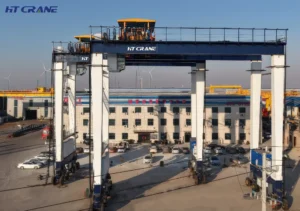
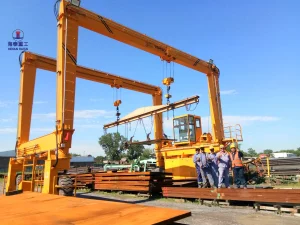
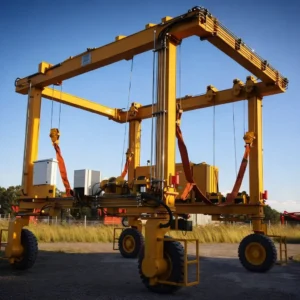
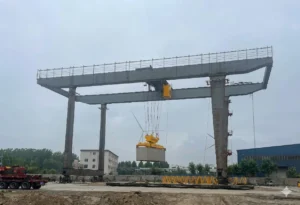
If your facility handles fewer than 50 haul-outs a year, a boat jib crane will likely cover your needs. Above 100 cycles, a travel lift crane isn’t a luxury — it’s the only way to run the yard efficiently. A travel lift crane priced at $150,000 can generate $2 million worth of capacity headroom per season. A boat jib crane at $30,000 installed can bottleneck your entire service bay if you chose the wrong one. The equipment that looks cheaper on the purchase order often costs more in constrained throughput over three years.
The real pain point is that both machines lift boats — which makes the comparison feel interchangeable until you’re six months into operation and realizing the wrong choice is costing you berthing cycles. Travel lift cranes dominate full-service boatyards with high vessel turnover. Boat jib cranes earn their place in fixed-position service bays, single-berth operations, or as supplementary lifting in facilities that already have a travel lift for primary haul-outs.
This guide breaks down the comparison across the parameters that actually affect the purchase decision: capacity range, site footprint, operational flexibility, total cost of ownership, and compliance requirements. By the end, you’ll have a decision framework your team can use this week.
Quick Reference — Equipment At a Glance
| Parámetro | Travel Lift Crane | Grúa de pluma para barcos |
|---|---|---|
| Rango de capacidad típico | 15 – 1,200+ tons | 1 – 30 tons |
| Indicative price (FOB factory) | $80,000 – $2,000,000+ | $8,000 – $85,000 |
| Site mobility | Full yard mobility | Fixed radius only |
| Minimum site width | 8 – 30 m (portal-dependent) | 1 – 3 m column footprint |
| Primary use case | Full haul-out / launch cycles | Service bay lifts, engine pulls |
| Crew required | 2 – 3 operators | 1 operator |
| Common certifications | CE, FEM 1.001, ISO 4301 | CE, ISO 9927-3 |
| Typical ROI horizon | 4 – 8 years | 1 – 3 years |
Prices are indicative market references (FOB factory, 2026). Actual pricing depends on capacity, configuration, and certifications. Contact us for a formal quotation.
What Each Machine Is Actually Designed to Do
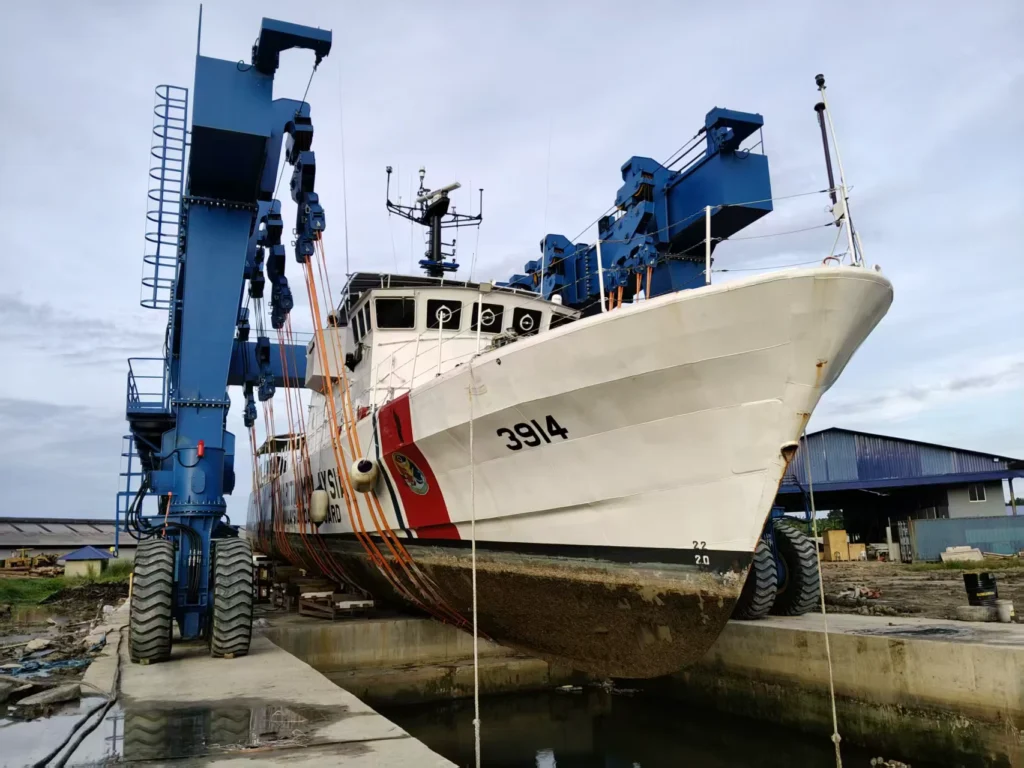
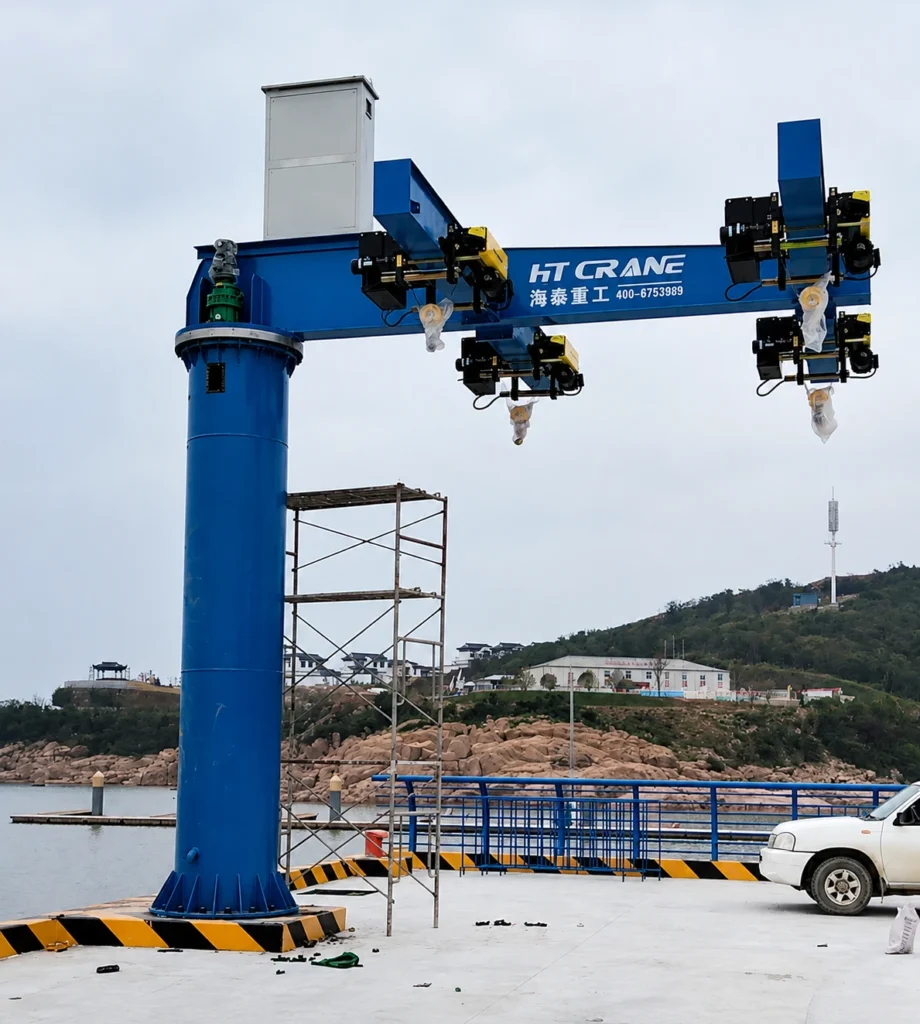
Comparing a travel lift crane to a boat jib crane without first establishing their design purpose is like comparing a forklift to a pallet jack — both move loads, but their operational envelopes are fundamentally different.
Travel Lift Crane: Purpose-Built for Full Haul-Out Operations
A travel lift crane is a self-propelled, portal-frame hoisting machine that straddles a vessel at the waterline, lifts it clear of the water, and transports it to a storage or service area under its own power. The machine walks the boat to exactly where it needs to go — no secondary transport, no crane repositioning.
This matters for facilities handling 200+ haul-out cycles per season. Each cycle with a travel lift is a single machine movement. The same cycle with a fixed crane requires a second piece of equipment (a trailer or boat dolly) to move the vessel once it leaves the water. At scale, that secondary handling step adds labor hours, potential damage risk, and scheduling complexity that most yard managers underestimate when comparing unit prices.
Boat Jib Crane: Purpose-Built for Fixed-Point Marine Service
A marine jib crane — whether wall-mounted, pillar-mounted, or floor-standing — swings through a defined arc (typically 180° to 270°) at a fixed location. It lifts within that radius and nowhere else. For service bays where work happens in one consistent position — engine pulls, mast steps, component exchanges — this is exactly the right tool. For anything requiring the load to travel across a yard, it is the wrong tool entirely.
Marine jib cranes rated from 1 to 30 tons cover the majority of recreational and commercial vessel service tasks. CE-compliant units built to ISO 9927-3 inspection standards provide a documented safety record that satisfies most port authority requirements without the complexity of a full FEM-rated travel lift certification program.
Where the Two Can Coexist
Larger boatyards frequently run both. The travel lift handles the water-to-yard cycle. Jib cranes — typically 2–5 ton units — are stationed at individual service bays for engine pulls, rigging work, and component handling. This combination eliminates the need to reposition the travel lift for small service lifts, freeing it for haul-out production during peak season.
Five Parameters That Drive the Selection Decision
Procurement teams that skip this analysis tend to either overbuy (travel lift for a low-volume marina) or underbuy (jib crane for a full-service boatyard). Run through these five parameters before any vendor conversation.
1. Annual Haul-Out Volume and Vessel Mix
This is the primary driver. If your facility handles fewer than 50 haul-outs per year and the vessels are consistent in type and size, a quality marine jib crane with a suitable service radius will cover most of your lifting requirement at a fraction of the capital cost. At 100+ haul-outs annually — particularly with a mixed fleet of power and sail from 30 to 80 feet — a travel lift crane becomes operationally necessary, not just convenient.
The break-even analysis is straightforward: calculate total annual labor hours attributed to secondary boat transport in a non-travel-lift workflow. At a loaded labor rate of $65–$90/hour (typical for skilled marina staff), those hours often amortize a travel lift within 5–6 seasons at medium volumes.
2. Site Geometry and Haul-Out Infrastructure
Travel lift cranes require a dedicated travel lane with reinforced surface and specific lane widths — typically 6–12 meters clear for smaller units, up to 30 meters for large ocean-going vessel lifts. The haul-out ramp must be engineered to handle the rated load of the machine plus vessel. Many older marinas cannot accommodate a travel lift without significant civil works investment that adds $50,000–$300,000 to the project cost.
A marine jib crane, by contrast, requires only a reinforced anchor point: a concrete column base or structural wall attachment. For marinas where civil modification is cost-prohibitive, a high-capacity jib crane is frequently the realistic option regardless of haul-out volume aspirations.
3. Maximum Vessel Beam and Weight
Travel lift portal widths are specified at build time and are not easily modified. If your target market includes wide-beam catamarans or commercial fishing vessels with beams exceeding 7–8 meters, confirm portal width during the specification phase, not post-delivery. The same applies to maximum sling capacity — FEM 1.001 classification governs the rated working load limit and must match your heaviest anticipated vessel with a minimum safety factor of 5:1 under CE/FEM standards.
For jib cranes, the critical dimension is outreach radius versus the crane’s rated load at maximum reach. Many operators discover that a 5-ton jib crane cannot lift 5 tons at full outreach — the capacity curve drops significantly at extended radius. Confirm the load-radius diagram, not the headline capacity figure, during procurement.
4. Operator Availability and Training Requirements
Travel lift operation requires trained personnel — typically two operators for safe haul-out (one driving, one managing slings and vessel contact). In regions with maritime equipment operator certification requirements, this adds a compliance layer to staffing planning. Marine jib cranes can typically be operated by a single qualified person with basic overhead crane operation certification, which is considerably easier to staff and schedule.
5. Budget and Total Cost of Ownership (TCO)
The purchase price gap is real but often overstated in procurement conversations. A 50-ton travel lift at $400,000 capital cost, amortized over 15 years with annual maintenance of approximately $12,000–$18,000, represents a TCO that can be recovered at $350–$600 per haul-out cycle at reasonable annual volumes. A marine jib crane at $30,000 has a dramatically lower TCO floor but a hard ceiling on the revenue it can generate.
Nota: Price ranges above are indicative market references (FOB factory, 2026). Actual pricing varies by rated capacity, portal configuration, drive system, certifications required, and destination port. Request a formal quotation for project-specific budgeting.

Side-by-Side Comparison: Travel Lift Crane vs Boat Jib Crane
The table below consolidates the evaluation criteria for a typical mid-size boatyard purchasing decision. Use it as the starting framework for your internal specification review.
| Evaluation Criteria | Travel Lift Crane | Grúa de pluma para barcos |
|---|---|---|
| Capacity sweet spot | 30 – 300 tons (standard commercial range) | 2 – 15 tons (recreational & light commercial) |
| Vessel haul-out | Full haul-out capable | Not designed for haul-out |
| Yard transport | Moves boat across the yard | Fixed radius only |
| Service bay lifts | Possible but inefficient | Optimized for this |
| Capital expenditure | High ($80K–$2M+) | Low ($8K–$85K) |
| Civil works required | Significant (lane, ramp, surface) | Minimal (column base) |
| Annual maintenance | $12,000 – $25,000 | $800 – $3,500 |
| Staffing requirement | 2–3 operators per cycle | 1 operator |
| Revenue ceiling | High (scales with volume) | Moderate (fixed-position constraint) |
| Lo mejor para | Full-service boatyard, high-volume haul-out | Service bay, marina with limited turnover, supplement to travel lift |
Certification and Compliance: What Your Port Authority Will Ask For
Both equipment types operate in a regulated environment — but the compliance framework differs enough that it should be part of your supplier evaluation, not an afterthought after delivery.
Travel Lift Crane Compliance Requirements
Travel lift cranes operating in European and export markets are typically required to carry CE marking under the EU Machinery Directive 2006/42/EC. The structural and load-calculation basis is usually FEM 1.001 (European Federation of Materials Handling standards) or ISO 4301 for crane classification. For US-market facilities, ASME B30.22 governs self-propelled jib and gantry cranes, though travel lifts often require specific state or port authority review. Verify which standard your port authority or insurance underwriter references before finalizing the specification.
Boat Jib Crane Compliance Requirements
Marine jib cranes in CE-marked markets must comply with the Machinery Directive and typically reference ISO 9927-3 for periodic inspection of slewing jib cranes. The rated working load limit must be permanently marked on the crane structure and verified through proof load testing prior to commissioning — typically 125% of rated capacity per CE protocols. Maintain inspection records from day one: port authority audits increasingly request documented inspection history rather than simply confirming current certification status.
Documentation Your Procurement Team Should Request
- CE Declaration of Conformity (DoC) with specific Machinery Directive article reference
- Structural calculation report stamped by a qualified engineer
- Factory acceptance test (FAT) report including proof load results
- Maintenance manual with mandatory inspection intervals
- FEM or ISO classification certificate (travel lifts)
- Load-radius chart for all boom/outreach configurations (jib cranes)
- Third-party inspection certificate (DNV, Bureau Veritas, or equivalent — if required by insurer)
Conclusión
The travel lift crane vs boat jib crane decision comes down to one operational question: does your facility need the boat to move after it leaves the water, or does it stay in one place for service? If the answer is “move it,” you need a travel lift. If the answer is “service in position,” a marine jib crane — possibly paired with a travel lift for haul-out — is the right tool.
Three actionable steps to take this week:
- Map your haul-out volume — count actual cycles from last season and project next season’s growth. The break-even between equipment types becomes clear at roughly 75–100 annual haul-outs for most mid-size facilities.
- Get a site survey — before issuing any RFQ, confirm whether your existing ramp and surface can support a travel lift without major civil works. This single data point changes the economics of many projects.
- Request certified quotations from both equipment categories — even if you’re leaning toward one option, the specification comparison reveals assumptions in your brief that a single-vendor quote won’t expose.
Preguntas frecuentes
Q1: What is the typical price difference between a travel lift crane and a marine jib crane?
Entry-level marine jib cranes in the 2–5 ton range start at approximately $8,000–$18,000 (FOB factory), while a production-grade travel lift crane for vessels up to 50 tons typically ranges from $150,000 to $400,000. At the upper end, large-capacity travel lifts for commercial shipyards exceed $1.5–2 million. The gap is wide, but so is the revenue potential: a travel lift generating 200 haul-outs per season at $800 per cycle produces $160,000 in annual gross revenue — a payback period of 2–4 years at that volume, excluding ancillary service revenue.
Q2: Can a boat jib crane be used for full haul-out operations?
Not in standard configuration. Marine jib cranes are designed for vertical lifts within a defined swing radius from a fixed mounting point. Full haul-out requires straddling the vessel at the waterline, lifting it clear, and transporting it laterally across the yard — a movement profile that only a self-propelled travel lift crane provides. Some small marinas use fixed gantry cranes with boat dollies underneath as a partial alternative, but this introduces handling steps, additional equipment, and coordination complexity that a travel lift eliminates. For facilities where haul-out is the primary revenue service, a jib crane cannot substitute for a purpose-built travel lift.
Q3: What certifications should I require from a marine crane supplier?
At minimum, require CE marking with a full Declaration of Conformity referencing the EU Machinery Directive 2006/42/EC, a factory acceptance test (FAT) report with documented proof load results, and a structural calculation report signed by a qualified engineer. For travel lift cranes, also require FEM 1.001 classification documentation and confirmation of which ISO 4301 group the machine is rated to. If your facility operates under IACS member classification society oversight, verify whether the supplier’s design is pre-approved or whether third-party surveyor attendance at factory testing is required. Accepting delivery without these documents creates significant liability exposure if an incident occurs during operation.
Q4: How much civil works does installing a travel lift crane actually require?
More than most buyers budget for. The travel lane must be engineered to support the combined weight of the machine plus rated vessel capacity — for a 70-ton travel lift fully loaded, the point loads on the travel lane surface can exceed 30–40 tonnes per axle. Existing asphalt or standard concrete surfaces rarely meet this requirement without reinforcement or full reconstruction. The haul-out ramp slope, surface grip, and drain configuration also need engineering review. For greenfield installations, budget $80,000–$300,000 for civil works depending on site conditions, as a preliminary estimate subject to geotechnical survey. Request a site survey from the crane supplier before finalizing the civil works tender — most reputable manufacturers offer this as part of the project planning process.
Q5: Is a marine jib crane the right choice for a small marina with 30–40 haul-outs per year?
At 30–40 haul-outs annually, the operational case for a travel lift is marginal for most facility sizes. If your vessel range is relatively uniform (say, 25–45 foot power boats with predictable weight), a well-specified marine jib crane paired with a boat trailer system can handle haul-outs cost-effectively at this volume. The calculation changes if your vessel mix includes multihulls, deep-keel sailboats with awkward sling points, or if you’re targeting growth to 100+ haul-outs within 3–5 years — in that case, specifying a travel lift now avoids a disruptive and expensive equipment change mid-growth. A useful reference point: explore our article on marine haul-out equipment selection for a deeper breakdown of the volume-to-equipment sizing methodology.