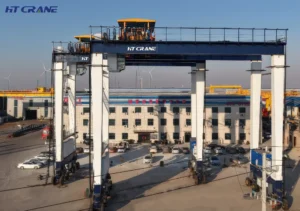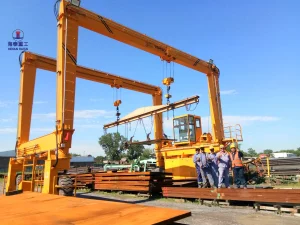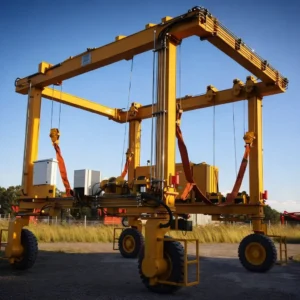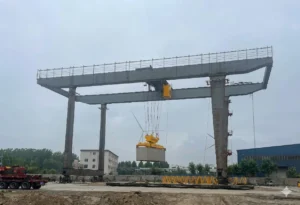
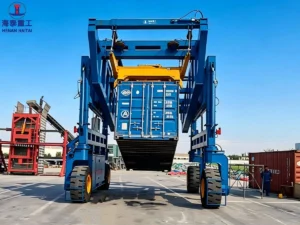
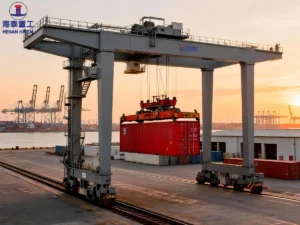
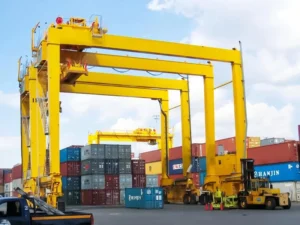
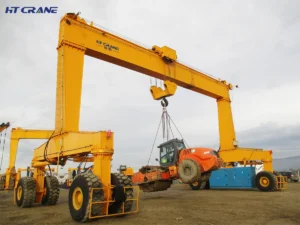
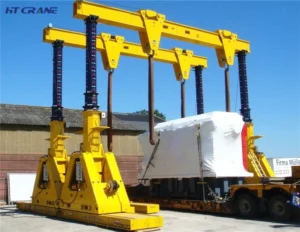
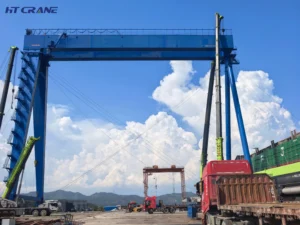
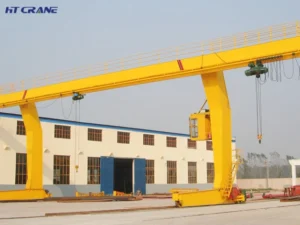
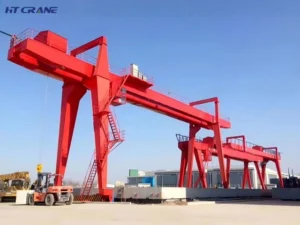
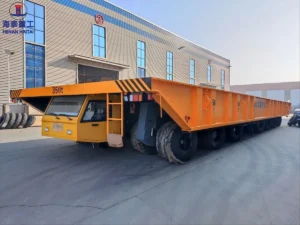
A hydraulic straddle carrier is a self-propelled heavy lift vehicle. This article explains what a straddle carrier actually is, how a hydraulic straddle carrier works, the specifications that matter when writing a technical requirement, and how the straddle carrier crane has performed on three real export cases at different tonnage classes — a 40-ton unit in Mongolia, a 50-ton unit in Romania, and a 60-ton unit in Brazil — to show how the equipment performs in the field.
What Is Hydraulic Straddle Carrier?
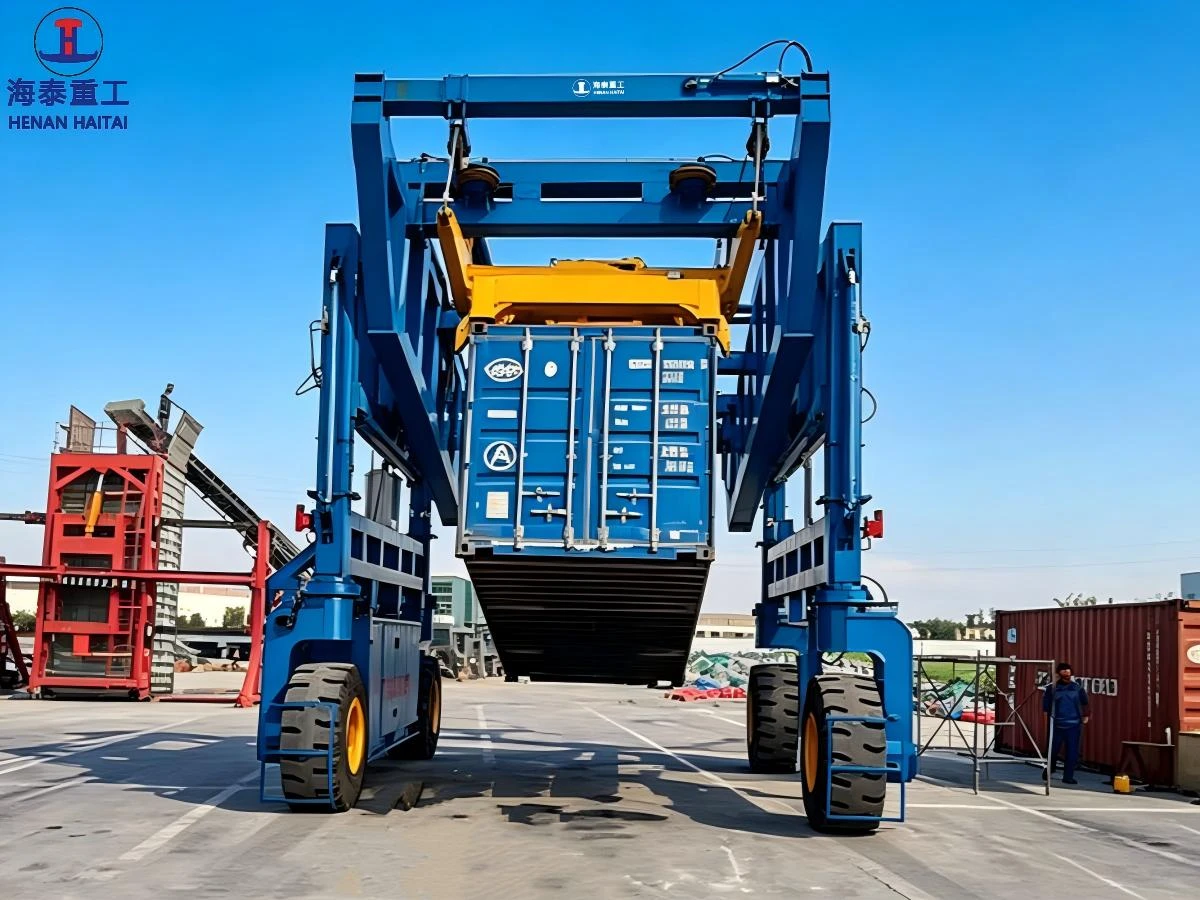
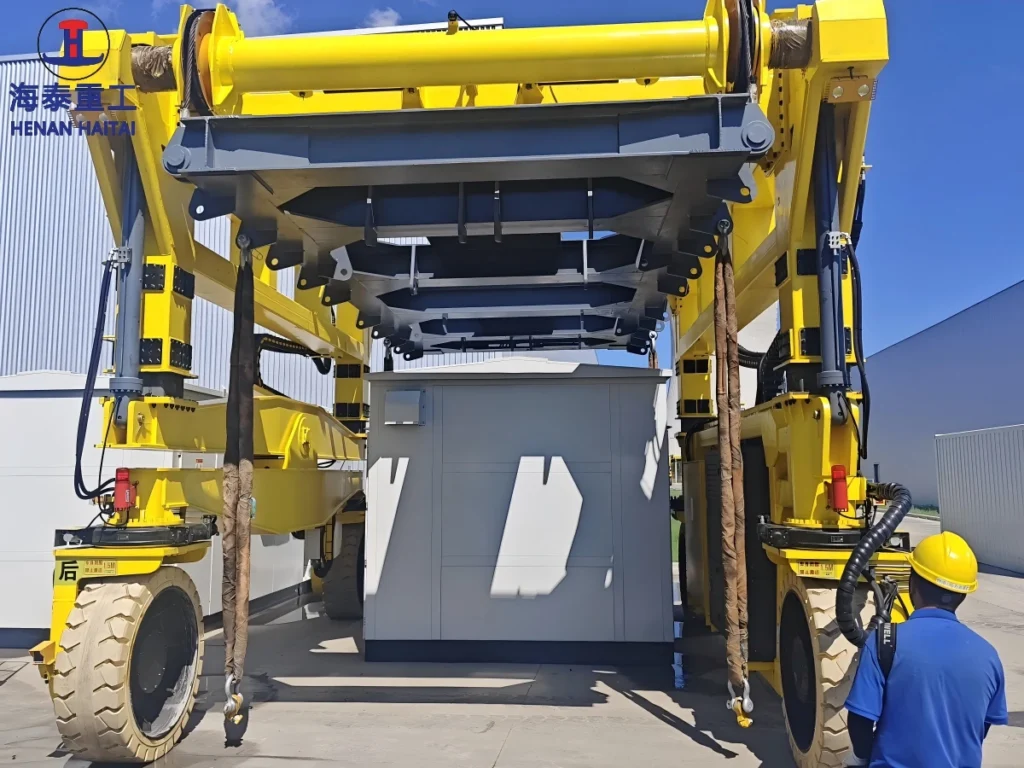
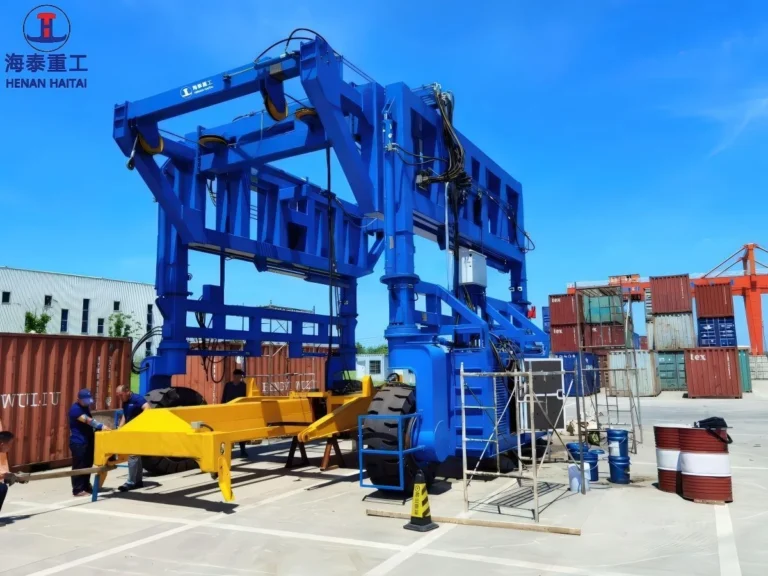
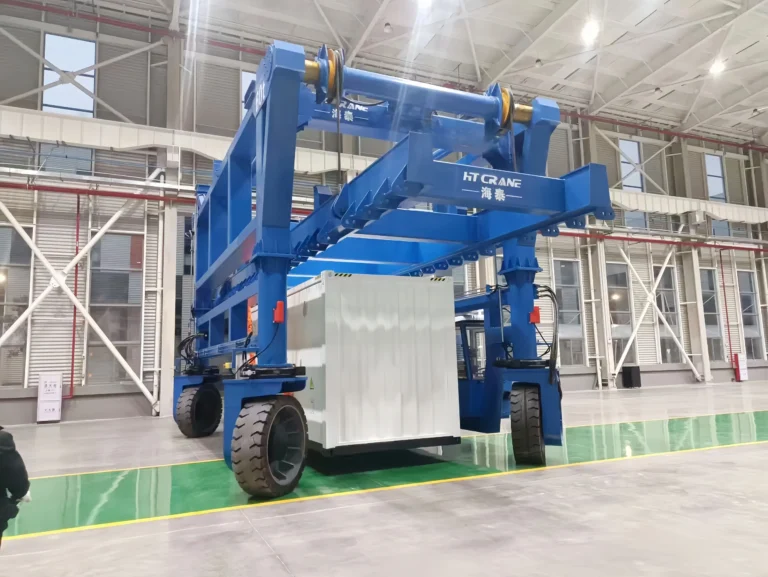
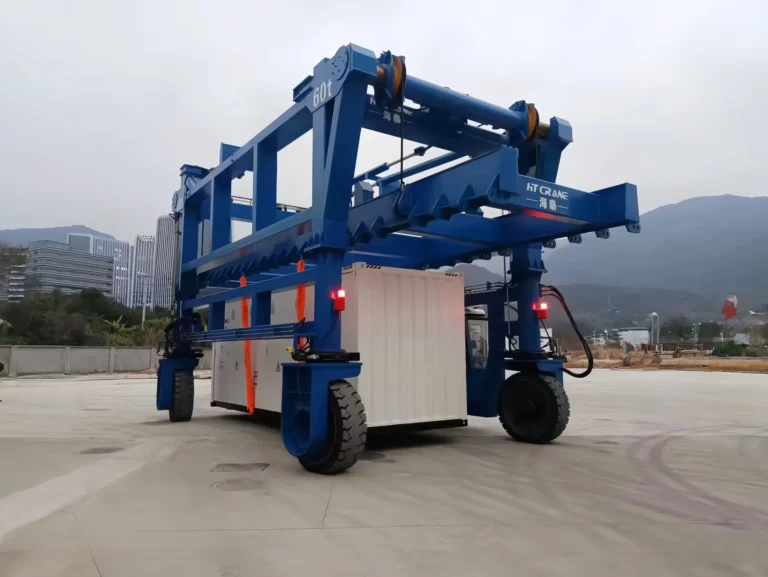
A hydraulic straddle carrier is a self-propelled, rubber-tyred lift vehicle that straddles a load and moves it without rails, overhead structures, or fixed power supply. It straddles a load, lifting from below using a hydraulic spreader or lifting beam, and moves freely across the yard on rubber tyres. The entire lift-and-travel cycle is powered by an onboard diesel-hydraulic system.
Unlike electric or cable-reel powered container cranes, a hydraulic straddle carrier carries its own power source. That makes it fully independent of yard infrastructure — it can be deployed anywhere the surface can support the wheel loads, with no fixed installation required.
If a site handles heavy containers, steel structures, or oversized industrial cargo and lacks fixed power infrastructure, a hydraulic carrier is usually the most practical equipment. It lifts, travels, and places loads without needing overhead structures, rails, or a high-voltage power supply — one machine, full mobility, minimal civil works.
How the Hydraulic System Works?
The engine drives hydraulic pumps that supply pressurized fluid to the lift cylinders, drive motors, and steering actuators. All motion — lifting, lowering, travelling, and steering — is controlled through proportional hydraulic valves, giving the operator smooth, stepless control at any speed. This matters when positioning loads onto trailers, rail flatcars, or storage saddles where millimetre-level precision counts, and operators familiar with hydraulic excavators or heavy transport equipment typically adapt quickly to the control system.
The primary difference from an electric straddle carrier is the power and drive system: electric models use AC drive motors powered by an onboard generator or an external cable reel, while hydraulic models use hydraulic motors driven by an onboard pump set. For facilities with no fixed electrical infrastructure, the diesel-hydraulic model removes a significant dependency; for high-throughput terminals with power already in place, electric models can offer lower running costs per cycle. The right choice depends on the site, not on which technology is newer.
Technical Specifications of a Hydraulic Straddle Carrier?
A typical hydraulic straddle carrier specification covers the following parameter ranges:
| Parâmetro | Faixa de especificações |
|---|---|
| Capacidade de elevação | 30T / 45T / 50T / 80T / 100T (custom available) |
| Altura de elevação | 4,500 mm – 7,500 mm (model dependent) |
| Span (Inside Leg) | 3,500 mm – 6,000 mm (configurable) |
| Sistema de acionamento | Diesel-Hydraulic (Cummins / Perkins / Deutz engine) |
| Travel Speed (Laden) | 0 – 8 km/h |
| Travel Speed (Unladen) | 0 – 15 km/h |
| Modos de direção | 4-wheel, crab steer, pivot steer |
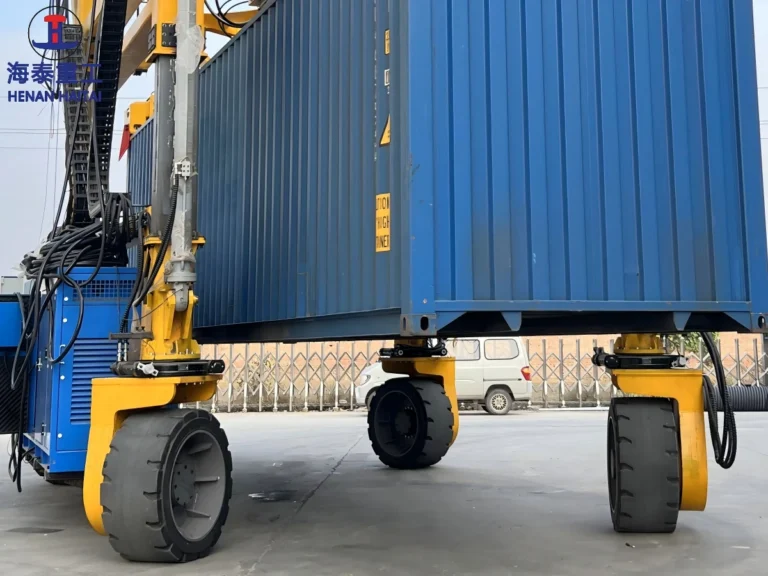
| Tyre Type | Solid rubber industrial or pneumatic |
| Cabin Standard | ROPS/FOPS certified, climate-controlled, 270° visibility |
| Temperatura de operação | -25°C to +50°C (cold weather spec available) |
| Certificações | CE (Diretiva de Máquinas da UE 2006/42/CE), ISO 9001 |
These break down into capacity classes depending on the operating environment:
| Classe de capacidade | Load Range | Aplicação típica |
|---|---|---|
| 30T – 45T | Light-duty | Inland container depots, light industrial yards |
| 50T | Mid-duty | Port-adjacent logistics, intermodal facilities |
| 60T – 80T | Heavy-duty | Heavy industrial yards, steel plant logistics |
| 100T+ | Project-duty | Heavy lift projects, module yards, offshore logistics |
Lifting Attachments of Haitai Container Straddle Carrier
Standard delivery includes one lifting attachment, with common configurations covering most cargo types:
- Telescopic ISO spreader — 20ft / 40ft, for standard container handling.
- Fixed lifting beam with adjustable hook points — for steel structures, pipes, and irregular cargo.
- Rotating spreader — for precise angular positioning in confined spaces.
- Custom saddle frame — for cylindrical or asymmetric industrial loads.
Multiple attachments can be supplied with a single machine and changed in the field.
Application Scenarios of Haitai Straddle Carrier for Sale
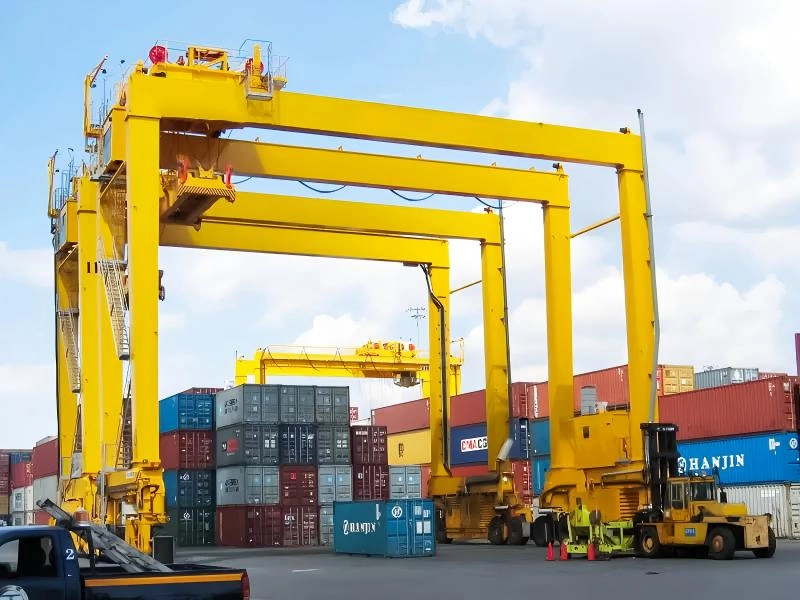
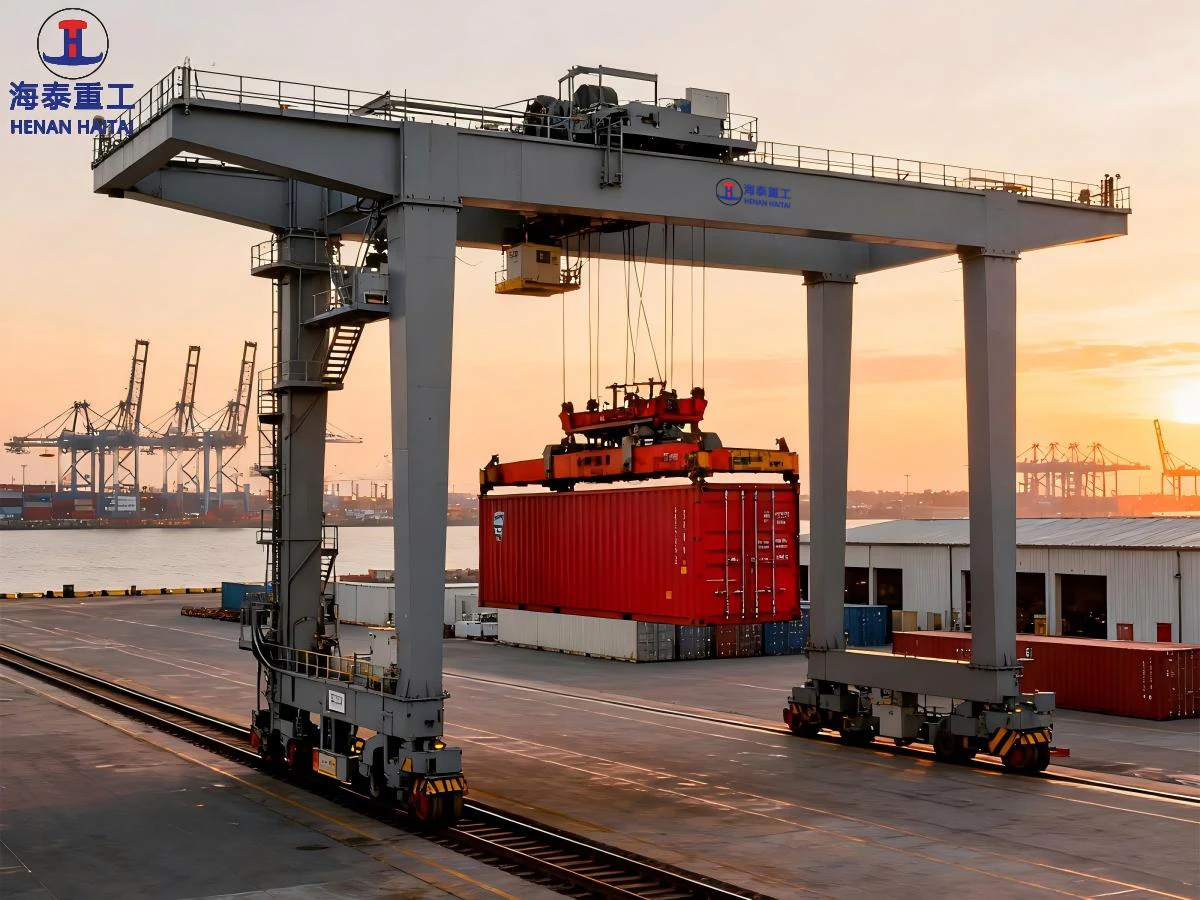
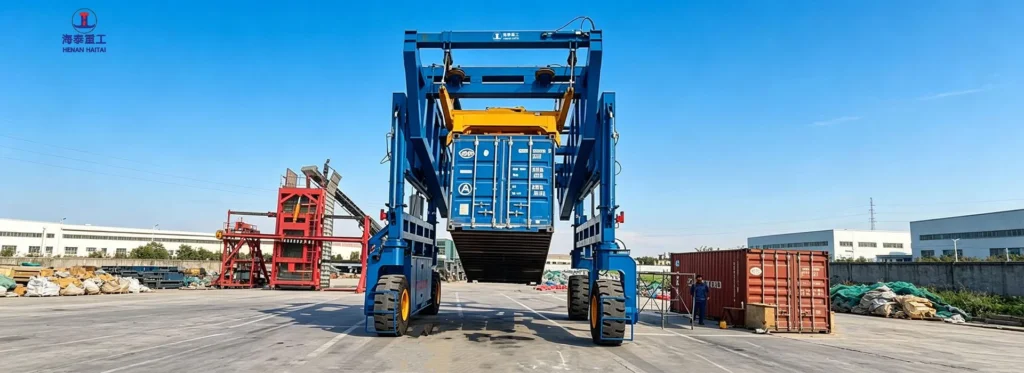
In port-adjacent facilities and smaller container depots, hydraulic straddle carriers handle ISO container loading and unloading without the civil infrastructure an RTG crane system requires — a practical first-equipment choice for growing depots that need immediate operational capacity. A single 50T unit can handle the full cycle, receiving a container from a truck, moving it to storage, and retrieving it for outbound loading, without a secondary horizontal transport vehicle.
Steel service centers, fabrication yards, and module assembly facilities frequently use hydraulic straddle carriers to move loads standard port equipment cannot handle. Lifting beams and custom saddle frames let the machine handle coils, structural sections, pressure vessels, and prefabricated modules that would otherwise need a crane plus rigging team — and the diesel-hydraulic system suits environments where power supply is limited and the load mix changes frequently.
For module yards, offshore supply bases, and project cargo terminals, the flexibility and high-capacity lifting of a hydraulic straddle carrier is often the defining operational advantage, with extended leg clearance and enhanced stability systems available for specialized applications.
Key Features That Matter to Buyers
- Full mobility, no fixed infrastructure — no rails, no overhead structures, no power supply installation; the machine arrives, is commissioned, and is operational within days.
- Cold weather and harsh environment readiness — standard models handle -20°C, with cold weather packages (hydraulic fluid rated to -40°C, engine block heaters, insulated cabins) available for Northern and Eastern Europe, Central Asia, and similar climates.
- Multi-mode steering for tight spaces — straight travel, 4-wheel coordinated steer, crab steer, and pivot steer allow manoeuvring in yards not originally designed for a straddle carrier.
- Long service life with in-house maintainability — a 15–20 year design life under FEM 1.001 classification, with hydraulic systems maintainable by any qualified hydraulic technician rather than requiring specialist proprietary support.
What to Verify Before Buying?
Regardless of which supplier is approached, three things are worth verifying before signing a contract:
- CE Declaration of Conformity issued by the manufacturer itself.
- Full load test certificate from factory acceptance testing.
- Spare parts availability confirmed in writing for a minimum of 5 years.
A supplier who cannot provide all three is a risk, regardless of price.
Real Export Cases Across Three Tonnage Classes — 40T 50T 60 T
Specification ranges only tell part of the story. The three projects below show how a hydraulic straddle carrier gets specified, exported, and put into service at three different capacity classes and three very different operating environments — a mid-duty 40-ton unit for a cold, unpaved inland yard in Mongolia, a 50-ton unit replacing aging equipment at a Black Sea port in Romania, and a 60-ton unit driving a measurable efficiency gain at a Brazilian export terminal.
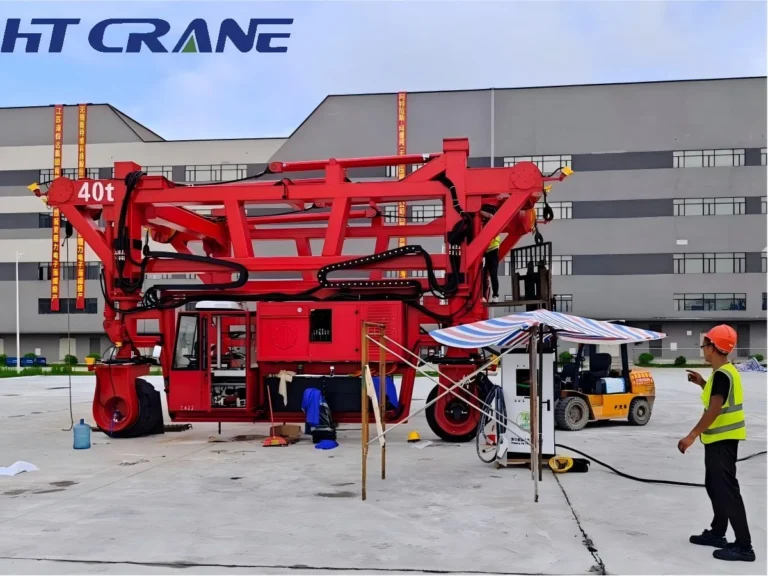
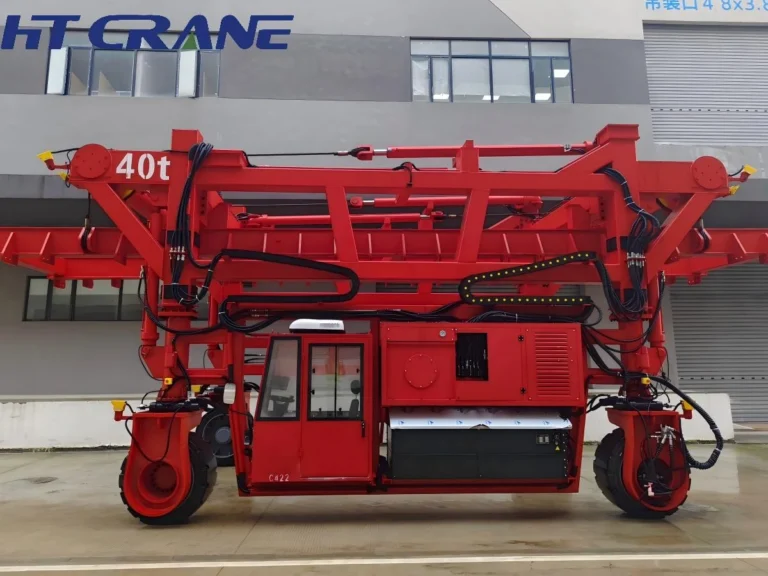
40-Ton Hydraulic Straddle Carrier — Mongolia
A Mongolia-based port logistics operator was handling steel coils, oversized containers, and prefabricated modules daily, often exceeding 30 tons per lift cycle, with aging equipment underspecced for the load. The site had no reliable three-phase power supply in the open yard, seasonal temperatures ranging from -35°C to +38°C, and unpaved sections across the working area — conditions that ruled out a battery-electric unit outright, since lithium battery performance degrades sharply below -20°C and the site’s maintenance team had diesel-hydraulic experience but no EV powertrain background.
| Parâmetro | Especificação |
| Capacidade nominal | 40 toneladas |
| Sistema de acionamento | Full hydraulic (diesel-hydraulic) |
| Largura do vão | 8.500 mm |
| Altura de elevação | 4.500 mm |
| Velocidade de deslocamento (carregado) | ≤ 10 km/h |
| Temperatura de operação | -35°C a +45°C |
| Modo de direção | Direção hidráulica independente nas 4 rodas |
| Configuração dos pneus | 8 tyres, solid rubber, off-road grade |
| Motor | Cummins / DEUTZ opcional |
| Destination | Mongolia |
Delivery followed a road-rail route from the factory in China to the Erlian (Erenhot) border crossing, then rail into Ulaanbaatar and road transport to site — 22 days factory-gate to site, with components shipped partially disassembled to meet road dimension limits at the border. Six months after commissioning, average yard throughput was up 34% against the client’s previous mixed-equipment setup, unplanned downtime stayed under 1.5% of operating hours, and the Cummins engine ran through a -28°C winter without cold-start issues — the only maintenance intervention in that period was a routine hydraulic fluid change at the 500-hour mark.
50-Ton Hydraulic Straddle Carrier — Romania
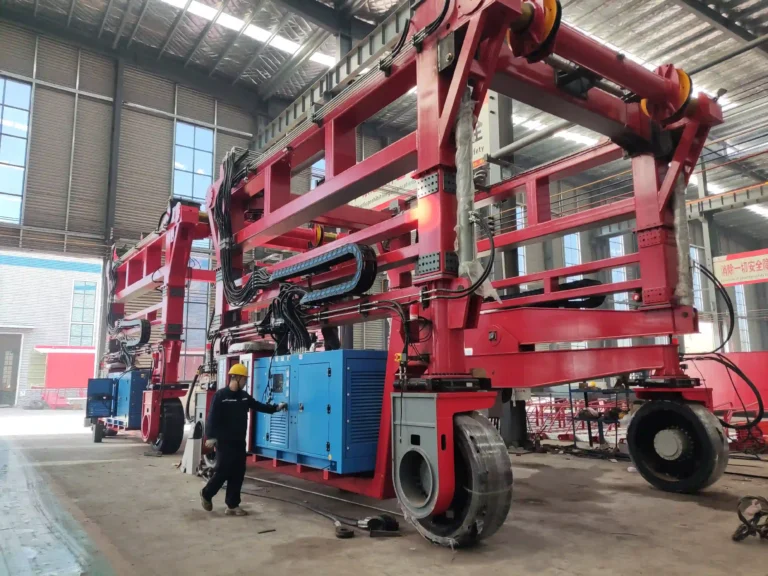
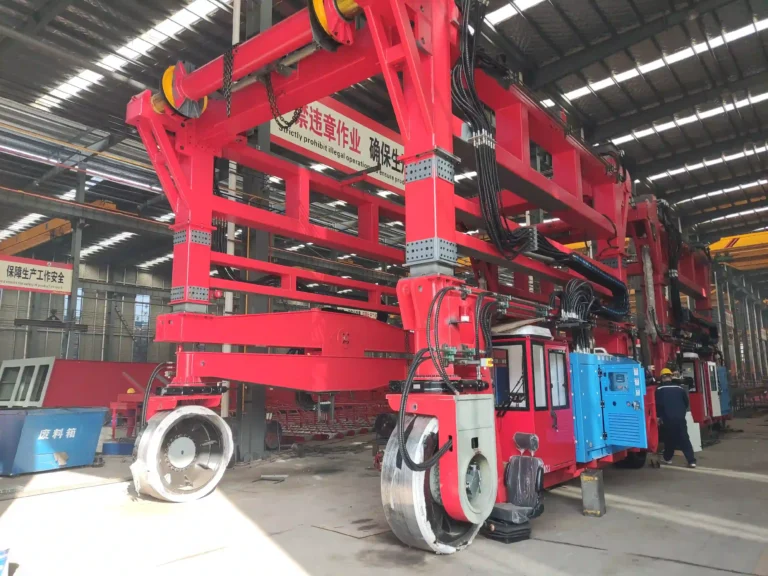
A privately owned heavy logistics company in Constanța, Romania — a major Black Sea port city — needed to replace an aging European-built diesel straddle carrier whose spare parts had become increasingly difficult and expensive to source. The replacement had to handle loads up to 50 tonnes, fit the existing yard layout, and arrive within a realistic project timeline. The hydraulic configuration was chosen for three specific reasons: the maintenance team already had hydraulic expertise from other yard equipment, the facility had no fixed high-voltage supply, and hydraulic systems offer smoother low-speed control for the irregular industrial cargo the site handles.
| Parâmetro | Especificação |
| Capacidade de elevação | 50T (under spreader / lifting beam) |
| Altura de elevação | 5,500 mm (top of container) |
| Span (Inside Leg) | 4.500 mm |
| Sistema de acionamento | Diesel-Hydraulic (Cummins QSB6.7 engine) |
| Travel Speed (Laden / Unladen) | 0–8 km/h / 0–15 km/h |
| Steering | Direção hidráulica independente nas 4 rodas |
| Structural Standard | FEM 1.001, ISO 4301 |
| Certificação | CE Marking – EU Machinery Directive 2006/42/EC |
| Destination | Constanța, Romania |
The project included cold-weather hydraulic fluid rated to -25°C, extended leg clearance for flatbed trailer loading, and a bilingual CE documentation package for Romanian equipment registration. The unit shipped from Qingdao to Constanța (18–22 days transit) as flat-rack and open-top cargo totalling roughly 68 tonnes, cleared customs without delay because documentation was prepared in advance, and was reassembled and commissioned on-site in seven days — total project duration from order confirmation to handover was approximately 119 days. At the time of writing the unit had been in service over 14 months with no major technical issues reported.
60-Ton Hydraulic Straddle Carrier — Brazil
A leading logistics and port operation group in Brazil, moving soybeans, coffee, and minerals through some of South America’s busiest export corridors, was running a container yard where gantry cranes handled the heavy lifts but every transfer still required a separate towing vehicle and a second operator. As export volumes climbed, that two-machine, two-operator cycle became the bottleneck. The client needed one machine that could lift, carry, and stack independently.
| Parâmetro | Especificação |
|---|---|
| Capacidade nominal | 60 Tons |
| Altura de elevação | 8.5 m |
| Span | 12 m (customizable) |
| Sistema de energia | Hydraulic drive |
| Operation Mode | Wireless remote control |
| Drive Configuration | Four-wheel drive (4WD) |
| Applicable Standards | CE certified, ISO compliant |
| Destination | Brazil |
The unit was built with targeted anti-corrosion and rust-resistant surface treatment for Brazil’s year-round heat, humidity, and rainfall — structural welds, hydraulic fittings, and external panels were all treated for tropical exposure rather than relying on a generic weatherproofing claim. Wireless remote control let operators work from ground level or the optimal viewing position instead of a fixed cab, improving both safety and precision in a dense yard. After commissioning, the operations director reported a 40% efficiency improvement, and single-operator deployment reduced the personnel required per container move — a saving that compounds over a full operating year.
What These Three Projects Have in Common
Different tonnage, different continents, different climates — but the same underlying pattern. In each case, the powertrain decision (hydraulic vs. electric) was driven by site infrastructure and climate, not by which technology was newer. In each case, the attachment and steering configuration were matched to the specific cargo mix and yard layout before production started, not adjusted afterward. And in each case, complete CE and compliance documentation prepared ahead of shipment kept customs and commissioning on schedule. Buyers evaluating a straddle carrier for a comparable environment should treat those three decisions — powertrain, configuration, and documentation — as the starting point of any technical review, not an afterthought.
About Haitai Crane
Fundada em 2015, Henan Haitai Heavy Industry Co., Ltd. (Guindaste HT) is a nationally certified Class-A manufacturer of special lifting equipment with 30+ patents and classification approvals from ABS, CCS, BV, DNV, and RMRS, alongside CE and ISO 9001 certification. HT Crane’s product range spans hydraulic straddle carriers, RTG cranes, portal cranes, marine cranes, bridge cranes, and electric hoists, exported to customers across Southeast Asia, the Middle East, Africa, Europe, and Latin America — with the Mongolia, Romania, and Brazil projects above representative of that track record across more than 50 countries and 5,000+ customers.
For buyers evaluating a hydraulic straddle carrier manufacturer, that combination of in-house engineering, factory acceptance testing, and export documentation experience across multiple trade corridors is intended to reduce both technical and delivery risk on equipment that will run daily for 15–20 years.

Conclusão
A hydraulic straddle carrier earns its place on a site the moment fixed infrastructure isn’t available or isn’t worth building — an inland yard with no grid power, a port replacing aging equipment on a tight timeline, or a terminal trying to cut a two-machine cycle down to one. The three cases above span 40 to 60 tons and three very different climates, but the specification discipline behind each is the same: match the powertrain to the site, define the attachment and configuration before production starts, and plan compliance documentation from day one rather than as an afterthought.
FAQs about Haitai Crane’s Hydraulic Straddle Carrier for Sale
1. What is the difference between a hydraulic straddle carrier and a reach stacker?
Both machines handle ISO containers, but they operate differently. A reach stacker uses a telescopic boom to lift and stack containers, faster in cycle time but more limited in lift height flexibility and load positioning precision. A hydraulic straddle carrier straddles the load and lifts vertically, offering better stability at high capacity and more precise placement. For loads above 45T or for non-container cargo like steel structures, the straddle carrier is typically the more capable and versatile choice.
2. Can a hydraulic straddle carrier work on unpaved surfaces?
It depends on the surface condition and the machine’s ground pressure specification. Hydraulic straddle carriers are designed for compacted, level yard surfaces — typically hardstanding or reinforced gravel. Soft ground, slopes above the machine’s rated gradient, or uneven surfaces can compromise stability and tyre life, so sharing the yard surface specification with the supplier’s engineering team for a ground pressure calculation is a standard pre-sales check.
3. How many operators does a hydraulic straddle carrier require?
One trained operator per machine, with no additional ground crew required for standard lift-and-travel operations. Complex lifts involving heavy or asymmetric loads may call for a banksman or lift supervisor under local safe working procedure, but the machine itself is built for single-operator use. Operator training typically takes 3–5 days for experienced equipment operators.
4. What maintenance does a hydraulic straddle carrier require, and how often?
Routine maintenance follows an engine-hours schedule: daily pre-shift checks (fluid levels, tyre condition, visual inspection), a 250-hour service (oil and filter change, hydraulic fluid sample), a 500-hour service (full drive system inspection), and an annual structural inspection per FEM 1.001 guidelines. Most tasks can be performed by a qualified in-house technician with standard hydraulic and diesel service tools.
5. Is CE certification sufficient for importing a hydraulic straddle carrier into Eastern Europe or the Middle East?
CE certification satisfies import requirements for all EU member states and is widely recognized in associated markets including Turkey, the Western Balkans, and GCC countries. Some markets require additional local registration or inspection — Romania requires ISCIR registration, for example, and Saudi Arabia has SASO product conformity requirements — so confirming specific import and registration requirements with a local technical advisor before finalizing procurement is worth the extra step.