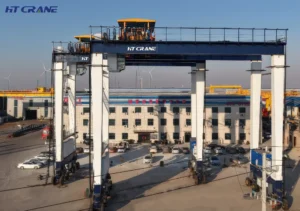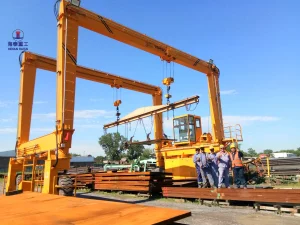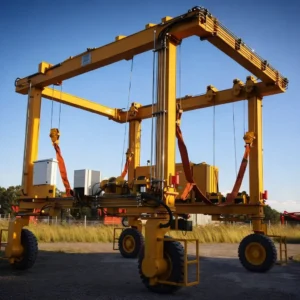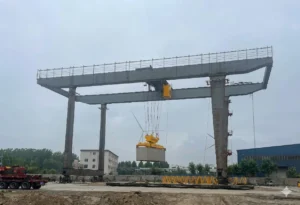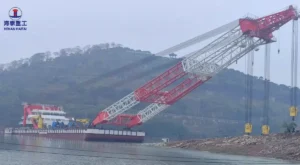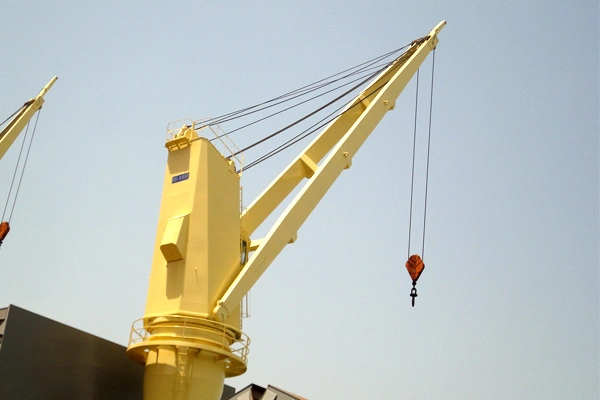
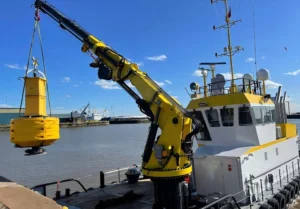
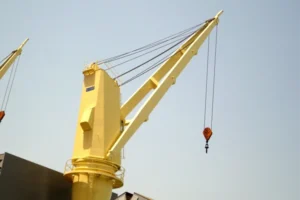
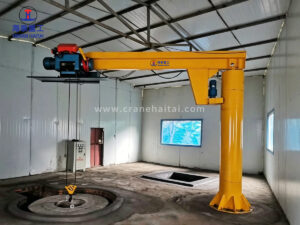
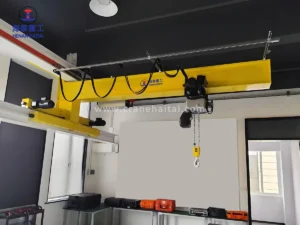
A hydraulic stiff boom marine crane is a straight-boom deck crane designed for controlled cargo handling on vessels, offshore platforms, workboats, and marine facilities. This guide explains its structure, hydraulic system, operating functions, applications, specifications, maintenance requirements, and key points for selecting a suitable crane.
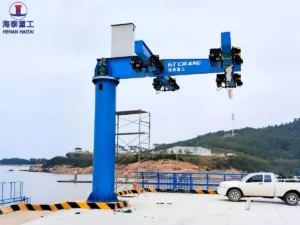
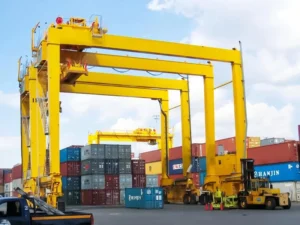
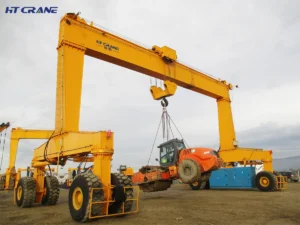
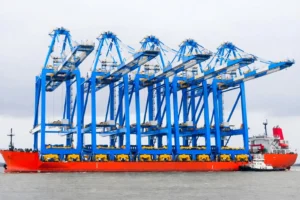
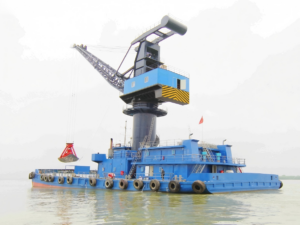
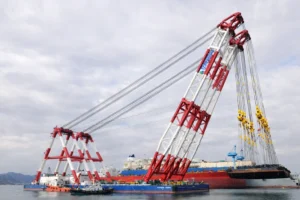
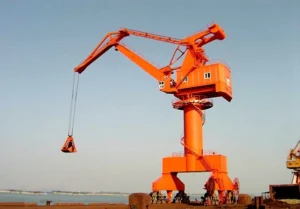
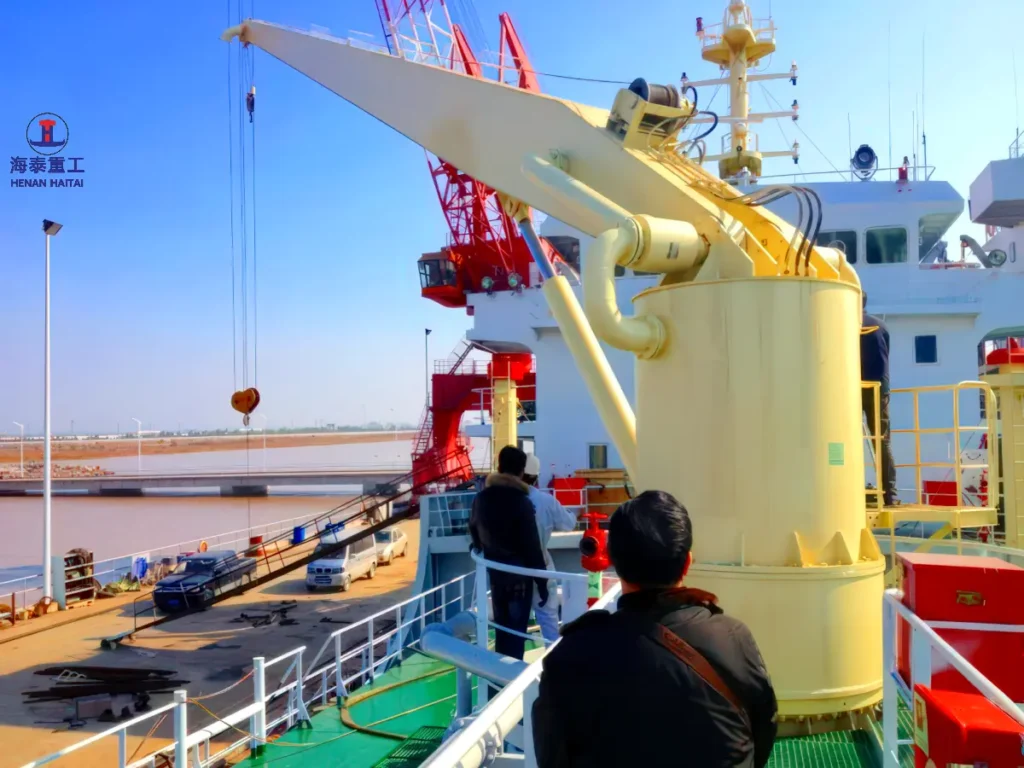
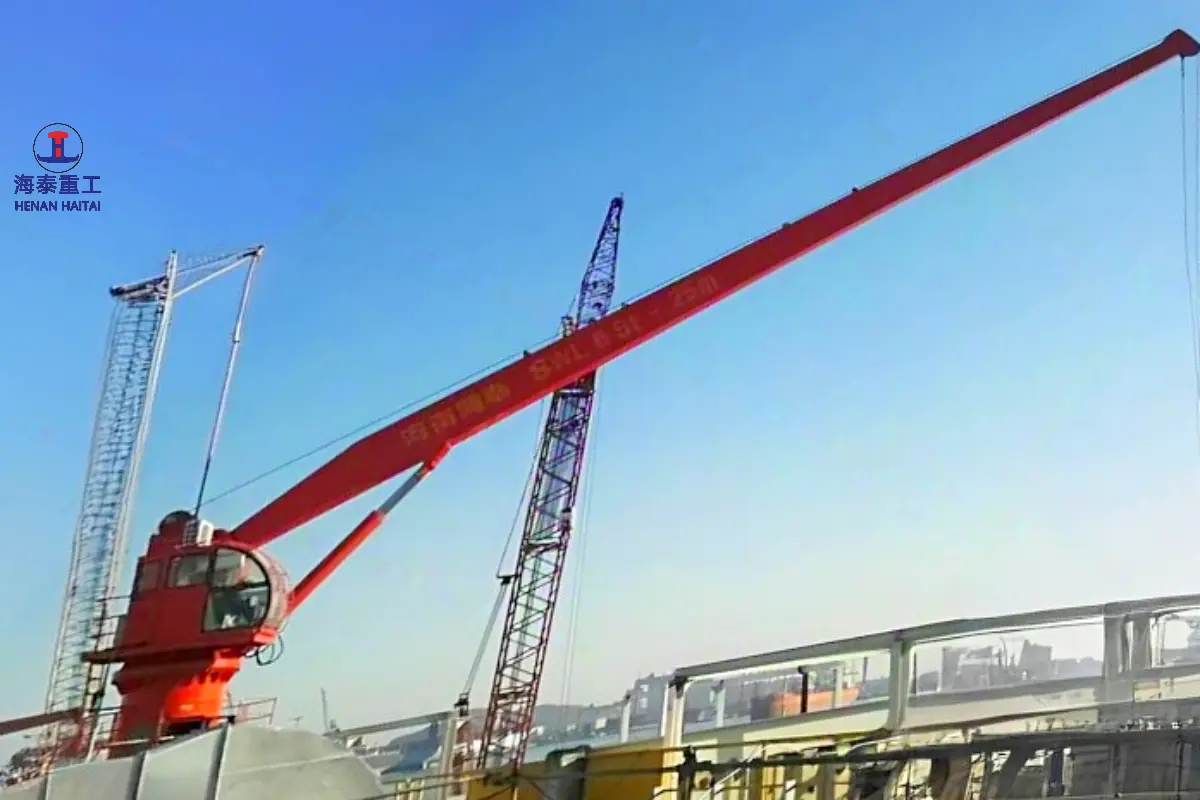
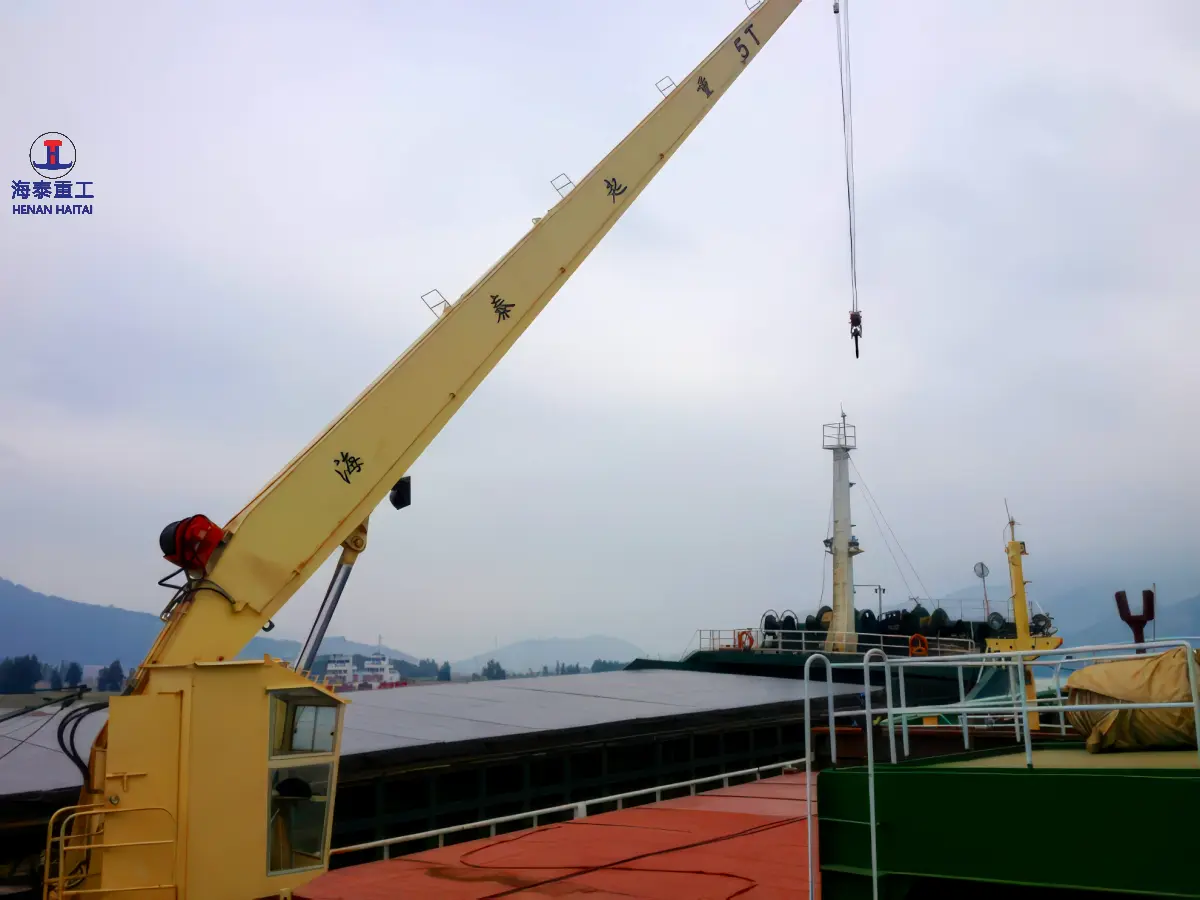
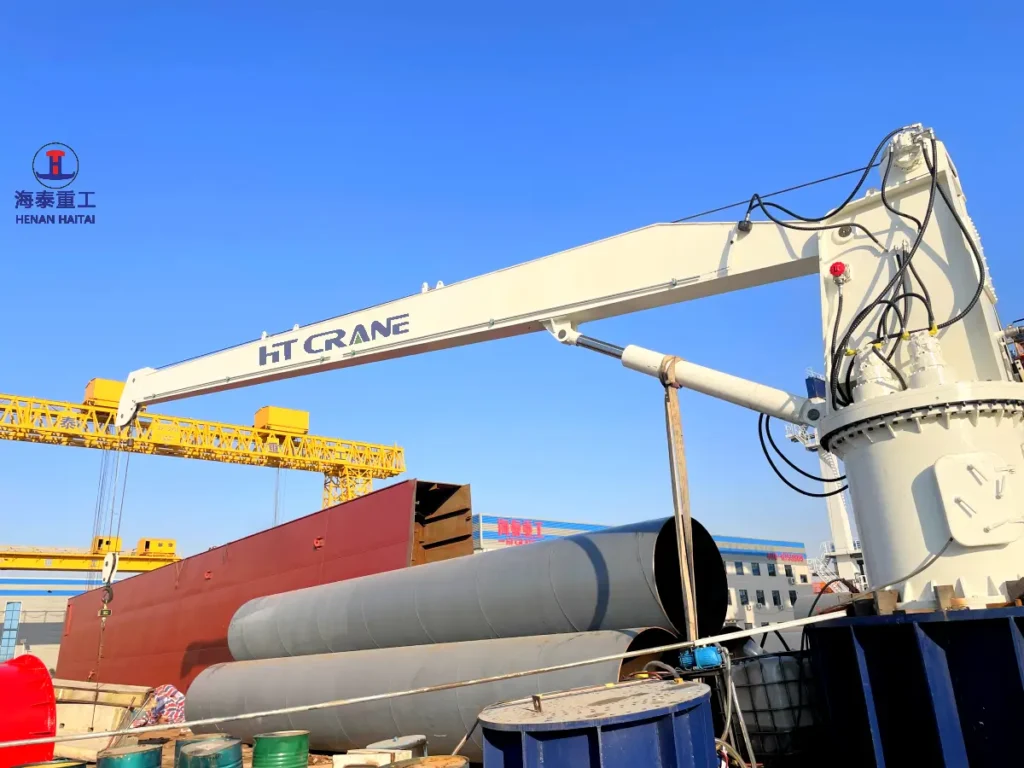
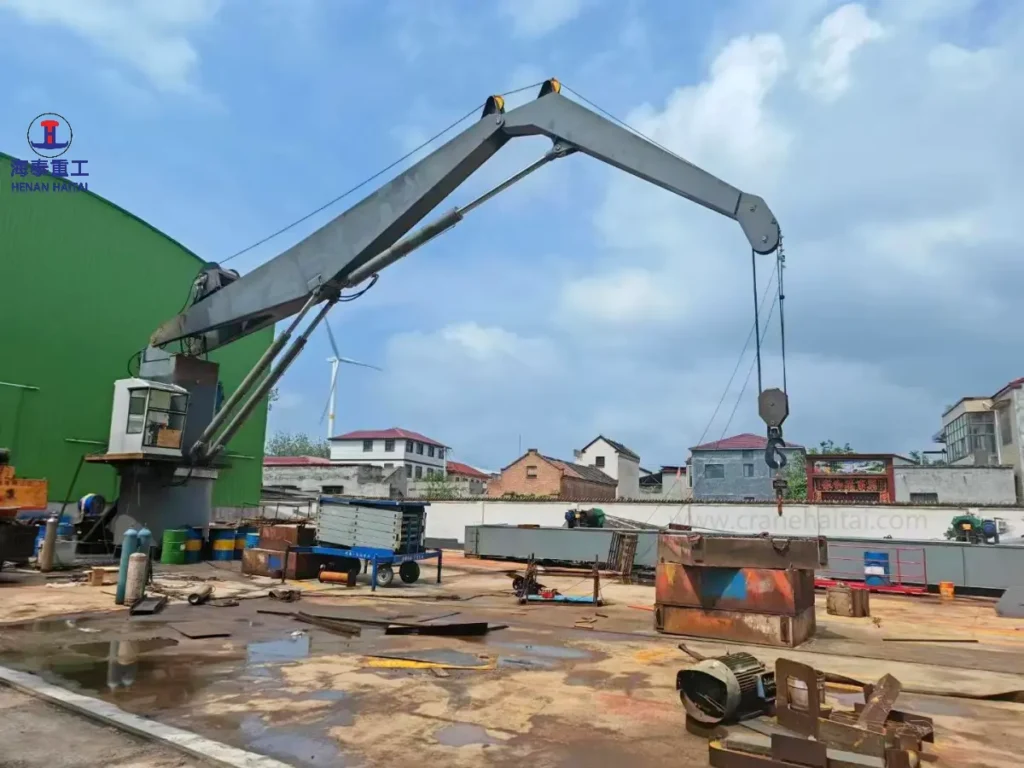
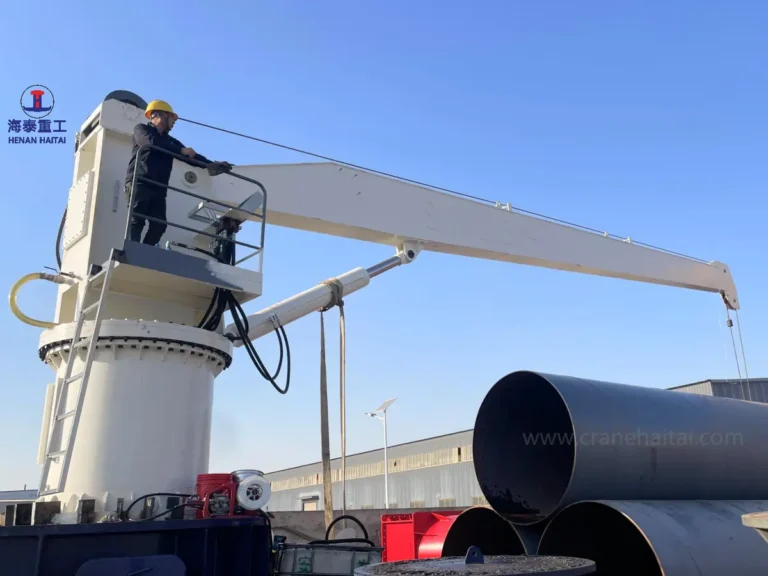
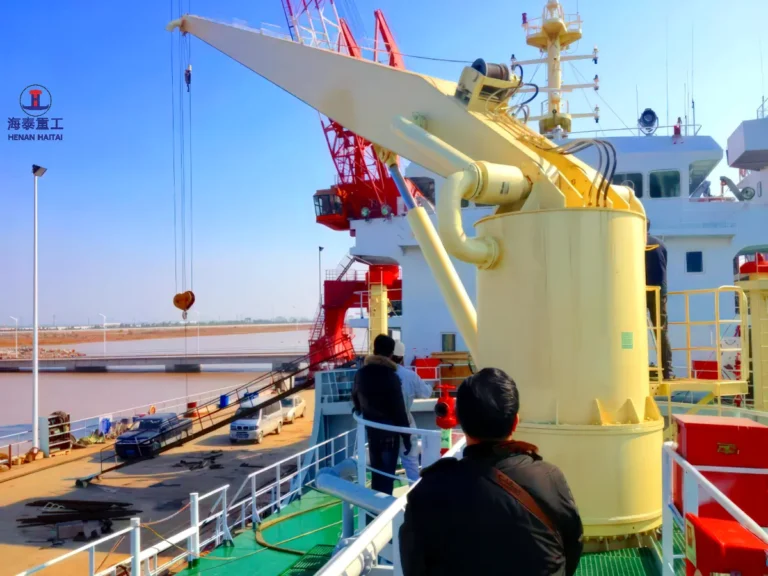
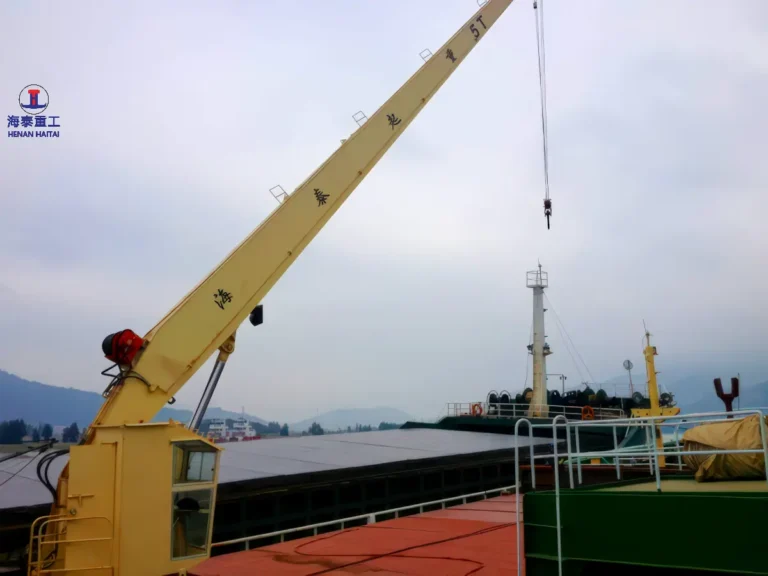
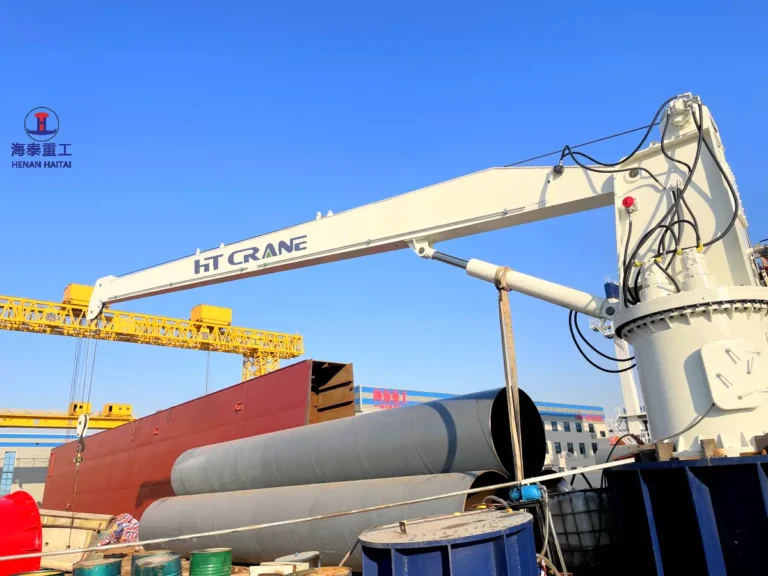
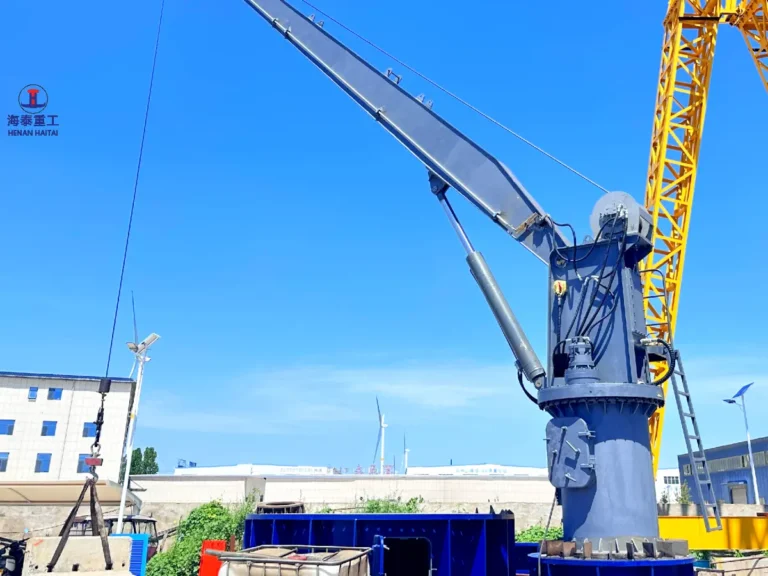
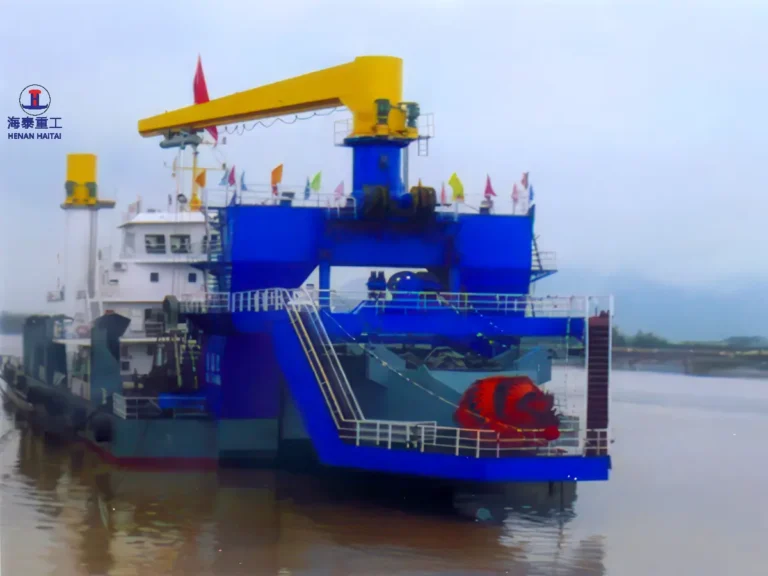
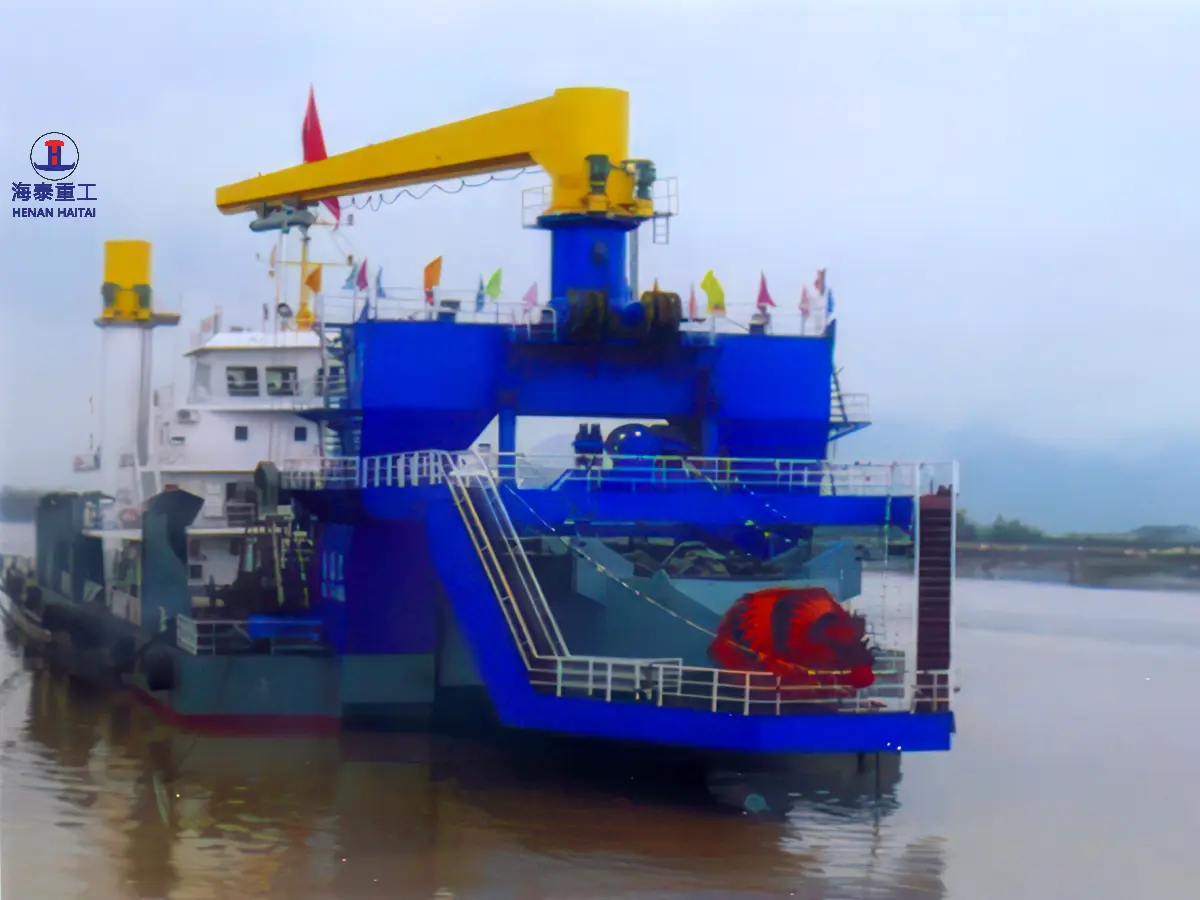
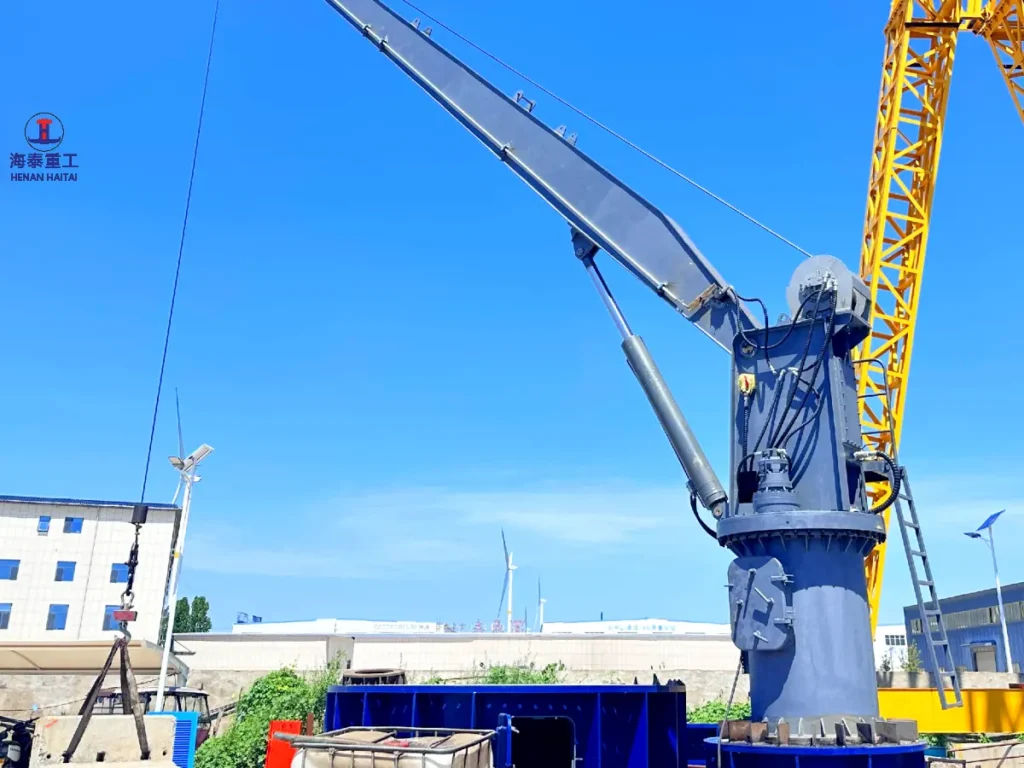
Stiff boom cranes are often selected when a project calls for a straightforward lifting structure, a defined working radius, and robust hydraulic operation — the photographs throughout this guide show the same basic configuration deployed across different vessel types, hull colors, and working environments, from barge-mounted units to cranes installed dockside for cargo transfer.
What Is a Stiff Boom Marine Crane?
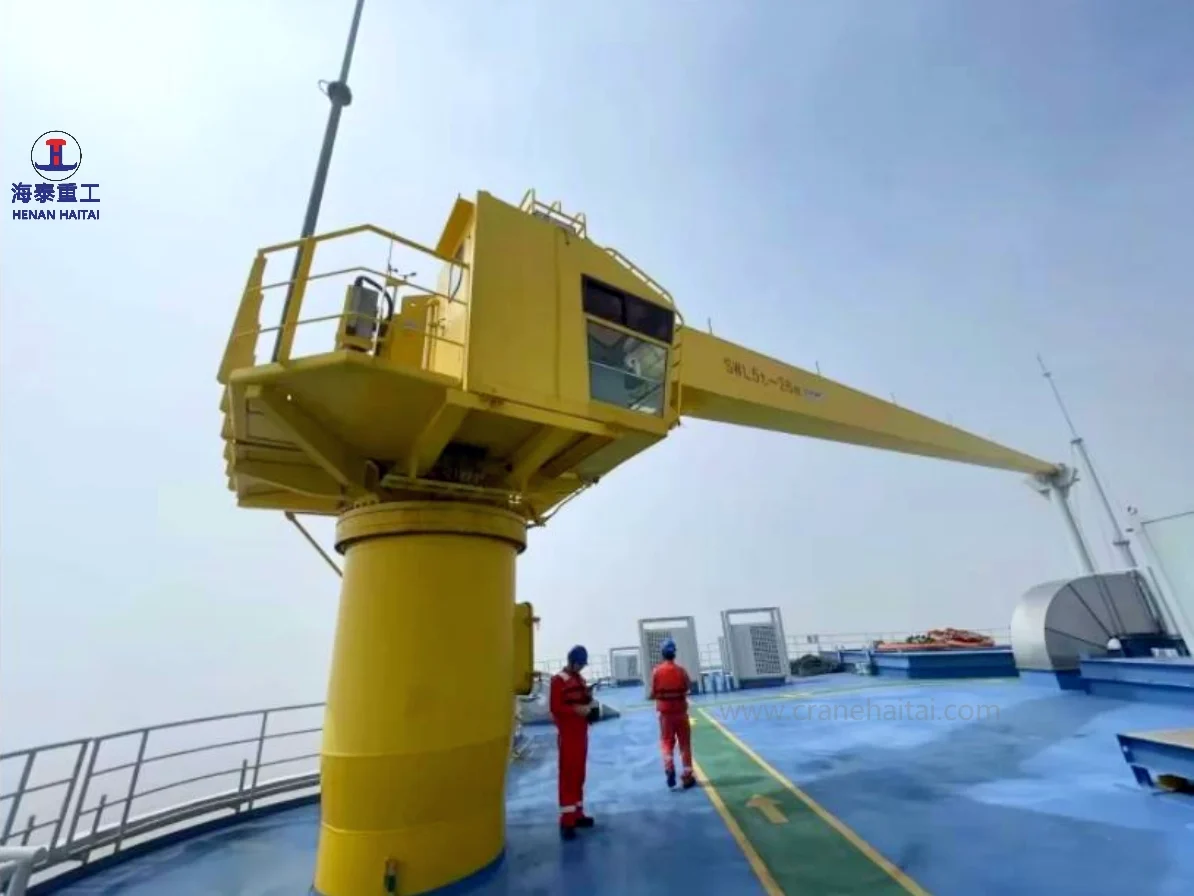
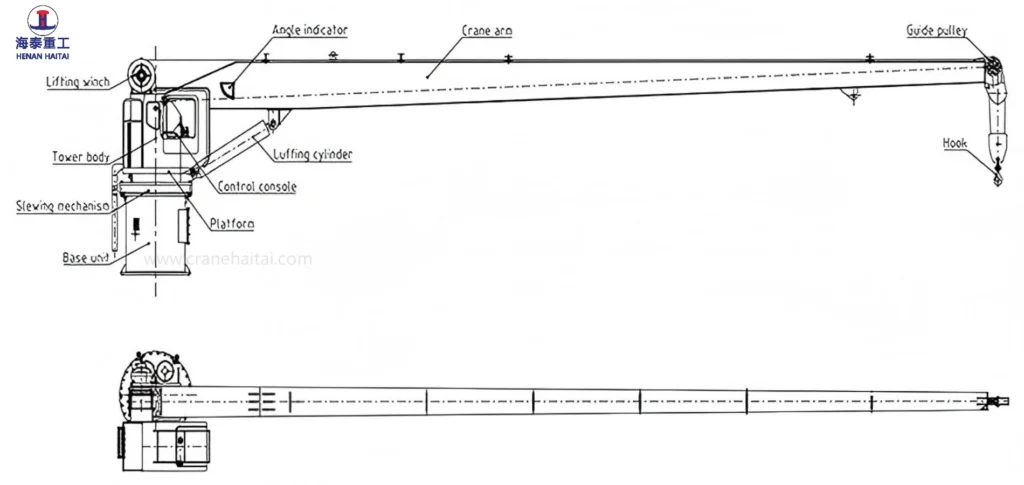
A stiff boom marine crane is a type of marine deck crane that uses a rigid, generally box-section boom rather than a folding or articulated boom. The crane is normally mounted on a pedestal welded or bolted to the vessel structure. Its main mechanisms are hoisting, slewing, and luffing. The hoisting mechanism raises and lowers the load through a hydraulic winch, wire rope, sheaves, and hook block. The slewing mechanism rotates the crane around its pedestal, while the luffing system changes the boom angle to adjust the outreach.
Many commercial designs use a hydraulic power system to operate these functions. Manufacturers also offer electro-hydraulic configurations in which the hydraulic power unit is driven by an electric motor. The term “stiff boom” is commonly used in the marine crane industry for this straight-boom configuration — PALFINGER, for example, describes its stiff boom cranes as pedestal-slewing cranes using hydraulic cylinder luffing, while other marine crane manufacturers use “straight boom marine crane” for the same basic arrangement.
How Does a Hydraulic Stiff Boom Marine Crane Work?
The operating principle is relatively straightforward: hydraulic power is converted into controlled mechanical movement through hydraulic cylinders and motors.
Hydraulic Luffing
A hydraulic cylinder is connected between the pedestal or crane housing and the boom. Extending or retracting the cylinder raises or lowers the boom. When the boom angle changes, the hook moves closer to or farther from the crane pedestal, letting the operator select the required working radius for the lifting task.
Hydraulic Slewing
The slewing system rotates the crane around its vertical axis. Depending on the design, a stiff boom marine crane can provide continuous or defined-angle slewing. A full-slewing configuration is useful when cargo must be transferred between the quay, deck, hatch area, and overboard working zone — commercial marine stiff boom designs are available with 360-degree slewing.
Hydraulic Hoisting
A hydraulic motor drives the winch to wind or unwind the wire rope, raising or lowering the hook block according to the lifting requirement. For a marine crane, hoisting control needs to be smooth because sudden acceleration or braking can cause the suspended load to swing, particularly when the vessel is moving.
Sistema de controle
The operator controls lifting, luffing, and slewing through a local control station or remote control, depending on the crane configuration. For more demanding applications, additional sensors and load monitoring functions can be integrated into the control system. The actual configuration should be selected according to vessel type, operating conditions, classification requirements, and the intended lifting operation.
Main Components of a Hydraulic Straight Boom Marine Crane
Understanding the crane structure helps buyers compare different manufacturers’ quotations.
Pedestal
The pedestal transfers the crane loads into the vessel’s deck structure. Its diameter, height, flange arrangement, and foundation design depend on the crane’s lifting moment and vessel structure. The pedestal shouldn’t be treated as a standard accessory — when a crane is being installed on an existing vessel, the deck foundation and supporting structure need to be checked before finalizing the crane design.
Stiff Boom
The boom is normally a welded steel box structure. Its length determines the available outreach, while its cross-section and material relate to the required lifting moment and structural loads. A longer boom doesn’t automatically mean greater lifting capability — as outreach increases, the load moment also increases, so the rated capacity may decrease at larger working radii.
Hydraulic Cylinder
The luffing cylinder changes the boom angle. Load-holding and related hydraulic safety arrangements can be incorporated according to the crane design and applicable requirements.
Hoisting Winch
The hydraulic winch controls the wire rope. Its capacity, rope diameter, drum configuration, braking arrangement, and hook-block design are selected according to the required safe working load and lifting height.
Slewing System
The slewing bearing and hydraulic drive allow the crane to rotate around the pedestal. The slewing arrangement must be designed for the crane’s maximum operating moment and environmental loads.
Hydraulic Stiff Boom Marine Crane vs. Knuckle Boom Crane
The two designs are often compared because both are used on vessels, but their mechanical arrangements are different. A stiff boom crane has a straight rigid boom with a comparatively simple structure, and the boom angle is normally controlled by a hydraulic cylinder. A knuckle boom crane has an articulated boom with a hinged joint, which allows the boom to fold and provides more flexibility when working around obstacles or storing the crane in a compact position.
A stiff boom configuration is often suitable when the vessel has sufficient deck clearance, the lifting area is relatively open, a straightforward boom structure is preferred, the project requires a defined outreach, or high structural rigidity is important. A knuckle boom may be more appropriate when compact stowage or positioning around deck equipment is a priority. Neither design is universally suitable — the vessel layout and actual lifting task should determine the configuration.
Where Is a Hydraulic Stiff Boom Marine Crane Used?
This type of crane is used across several marine and offshore applications.
✅️ Workboats and Service Vessels
Workboats frequently need to move pumps, tools, spare parts, pipes, maintenance equipment, and other deck cargo. A deck-mounted straight boom crane provides an onboard lifting point without requiring a shore crane for every small operation.
✅️ Cargo Handling
A shipboard crane can load or unload equipment between a vessel and a quay, or move cargo between different deck areas. For vessels operating on inland waterways or coastal routes, the crane can be positioned over the side to handle equipment directly between the vessel and the shore.
✅️ Offshore Support Operations
Offshore vessels may use hydraulic deck cranes to transfer supplies and maintenance equipment. In these applications, the crane specification needs to account for vessel motion, wind, sea conditions, and the required operating radius. The operating limits should always come from the crane’s approved technical documentation rather than from a generic tonnage rating.
✅️ Ship Maintenance
During maintenance, a crane may be used to lift pumps, motors, valves, pipes, hydraulic components, or other machinery. The ability to position the hook at a defined outreach can be particularly useful in areas where overhead lifting equipment is unavailable.
✅️ Port and Harbor Applications
Stiff boom cranes can also be installed on barges, floating platforms, and fixed marine structures for loading, unloading, maintenance, and equipment handling.
What Specifications Should Buyers Check?
When purchasing a hydraulic stiff boom marine crane, the rated lifting capacity is only one part of the specification.
✅️ Safe Working Load and Outreach
The buyer should check the SWL at the actual required outreach. A crane described as “10 ton” may not lift 10 tons at its maximum radius — the manufacturer’s load chart should show the relationship between rated load and working radius. This is one of the most important points when comparing marine crane quotations.
✅️ Maximum Outreach
Maximum outreach determines how far the hook can reach from the crane pedestal. Buyers should provide the required minimum and maximum working radius rather than simply asking for a certain boom length.
✅️ Lifting Height
Specify the required hook height or hook travel — particularly important when cargo must be lifted from a quay, hatch, lower deck, or water surface.
✅️ Slewing Range
Confirm whether the application requires limited-angle slewing or continuous 360-degree rotation.
✅️ Hydraulic Power
The hydraulic power unit should match the required lifting, luffing, and slewing performance. Buyers should also confirm the available vessel power supply if an electric motor drives the hydraulic system.
✅️ Environmental Conditions
The manufacturer should know whether the crane will operate in coastal waters, offshore, on an inland vessel, on a barge, in a tropical climate, in cold regions, or in a corrosive industrial environment. Saltwater exposure, ambient temperature, wind, vessel heel, trim, and sea state can all influence the design requirements.
Marine Crane Certification and 2026 Requirements
Certification should be discussed before the crane is manufactured, not after delivery — and this is particularly important in 2026. The IMO adopted SOLAS Regulation II-1/3-13 through Resolution MSC.532(107) in June 2023, introducing mandatory requirements for applicable onboard lifting appliances and anchor handling winches, covering design, construction, installation, examination, load testing, maintenance, inspection, and operation. Supported by IMO Guidelines MSC.1/Circ.1662 (design and construction) and MSC.1/Circ.1663 (testing and examination), the regulation entered into force on January 1, 2026, and applies to vessels holding a safety construction certificate (CCC, CSSC, or PSSC).
The requirements differ depending on when the lifting appliance was installed. New lifting appliances installed on or after January 1, 2026 must be designed, constructed, and installed according to a recognized classification society’s requirements, then load tested and thoroughly examined before first use. Lifting appliances installed before that date must be tested and thoroughly examined per the IMO guidelines no later than the first renewal survey on or after January 1, 2026, permanently marked with their Safe Working Load, and supported by documentary evidence of that SWL — existing valid certificates issued under another instrument, such as ILO Convention No. 152, remain acceptable for compliance.
An overseas buyer should tell the crane manufacturer at the quotation stage the vessel flag, classification society, vessel type, whether the project is a newbuilding or retrofit, required SWL, maximum outreach, intended lifting application, and required certification. This information can prevent a situation where the crane has already been manufactured but doesn’t match the vessel’s certification requirements.
Installation and Maintenance Considerations
The crane pedestal is one of the most important parts of the installation. For a new vessel, the crane foundation can be incorporated into the ship’s structural design; for a retrofit project, the existing deck needs to be assessed for the loads transferred by the crane.
Maintenance should focus on the hydraulic system, wire rope, hook, sheaves, brakes, slewing system, structural welds, bolts, and corrosion protection. Hydraulic hoses and fittings should be checked for leakage and physical damage, and hydraulic oil condition should be monitored according to the manufacturer’s maintenance instructions.
The boom and pedestal should be inspected for corrosion, deformation, cracks, and abnormal wear, and loose lifting accessories such as shackles and slings need their own inspection and certification regime. Under the new SOLAS lifting-appliance requirements, regular maintenance, inspection, and operational testing are part of the owner’s responsibility, with records maintained onboard.
How to Choose the Right Hydraulic Stiff Boom Marine Crane?
Start with the lifting operation rather than the crane model. Before requesting a quotation, prepare these details:
- Maximum load weight
- Required SWL
- Minimum working radius
- Maximum working radius
- Required hook height
- Lifting points and load dimensions
- Alcance de giro
- Vessel type and dimensions
- Deck installation position
- Vessel power supply
- Operating sea conditions
- Classification and certification requirements
A load drawing and vessel deck layout are especially useful — they let the manufacturer check whether the proposed pedestal position, boom length, and operating envelope are practical. For example, a 5-ton load located 12 meters from the pedestal may require a substantially different crane configuration from a 5-ton load handled at 5 meters. The capacity alone doesn’t define the crane.
Por que escolher Guindaste Haitai for a Marine Stiff Boom Crane?
Haitai Crane develops marine lifting equipment according to the vessel’s actual working conditions rather than treating every crane as a standard configuration. For a hydraulic stiff boom marine crane, the engineering process can cover the boom structure, pedestal, hydraulic system, winch, slewing mechanism, control system, corrosion protection, and installation requirements.
For an export project, buyers can provide the vessel drawings, lifting requirements, classification information, and operating conditions. These details let the engineering team establish the technical configuration before production, so the final crane can be manufactured, tested, and prepared for shipment according to the agreed technical specification and project requirements.
Conclusão
A hydraulic stiff boom marine crane is a straight-boom deck crane designed for controlled lifting and cargo handling on vessels, barges, offshore platforms, and other marine structures. Its main mechanisms are hoisting, luffing, and slewing, with hydraulic power commonly used to drive these movements. The main advantage of the stiff boom configuration is its straightforward structure and predictable working geometry, making it a practical choice for vessels with adequate operating clearance and regular cargo or equipment handling requirements.
When selecting a marine crane, don’t compare suppliers only by lifting capacity or price. Check SWL at the required outreach, hook height, hydraulic configuration, foundation requirements, operating environment, maintenance provisions, and applicable certification. For projects planned or installed in 2026 and beyond, certification and SOLAS requirements should also be discussed with the vessel’s classification society and crane manufacturer at the beginning of the project.

FAQs – Hydraulic Stiff Boom Marine Crane Manufacturer in China
What is a hydraulic stiff boom marine crane?
A hydraulic stiff boom marine crane is a shipboard lifting crane with a rigid straight boom. Hydraulic cylinders and motors control boom luffing, hoisting, and slewing. It’s commonly used for cargo handling, equipment transfer, ship maintenance, and offshore operations. It’s commonly referred to as a straight boom marine crane, straight arm marine crane, marine deck crane, or hydraulic marine crane, depending on the manufacturer and application.
What is the difference between a stiff boom and knuckle boom marine crane?
A stiff boom crane uses a rigid straight boom that changes angle around a pivot. A knuckle boom crane has an articulated boom with a hinged joint. The knuckle design generally provides greater folding and positioning flexibility, while the stiff boom has a simpler straight-boom structure.
What does SWL mean on a marine crane?
SWL means Safe Working Load. It indicates the maximum permitted working load under the specified operating conditions. Buyers should always check the SWL against the corresponding outreach and operating condition rather than relying only on the crane’s nominal maximum capacity.
Can a stiff boom marine crane rotate 360 degrees?
Yes, many designs provide full 360-degree slewing. However, the actual slewing range should be confirmed from the manufacturer’s technical specification because it varies by crane design.
Can a stiff boom marine crane be installed on an existing vessel?
Yes, but the vessel deck and foundation must be assessed before installation. The pedestal transfers significant loads into the ship structure, so retrofit projects may require structural reinforcement and class approval.
What information should I provide when ordering a marine stiff boom crane?
Provide the vessel type, required SWL, minimum and maximum outreach, hook height, lifting frequency, load dimensions, deck installation position, power supply, operating environment, classification society, and required certification.
Does a marine stiff boom crane require certification?
Applicable certification depends on the vessel, flag, installation date, classification society, and intended use. For applicable SOLAS vessels, new onboard lifting appliances installed from January 1, 2026 are subject to the requirements of SOLAS Regulation II-1/3-13 and its associated IMO guidelines.
Can Haitai customize a hydraulic stiff boom marine crane?
Yes. The crane can be developed around the required lifting capacity, outreach, hook height, pedestal dimensions, hydraulic system, control method, installation conditions, corrosion protection, and certification requirements.